Five Noblewomen Fled His Burned Mansion in Terror. Then a Penniless Woman With Four Shillings Stepped Out of the Storm, and What She Heard in the Dark That Night Revealed a Secret Someone Had Killed to Protect
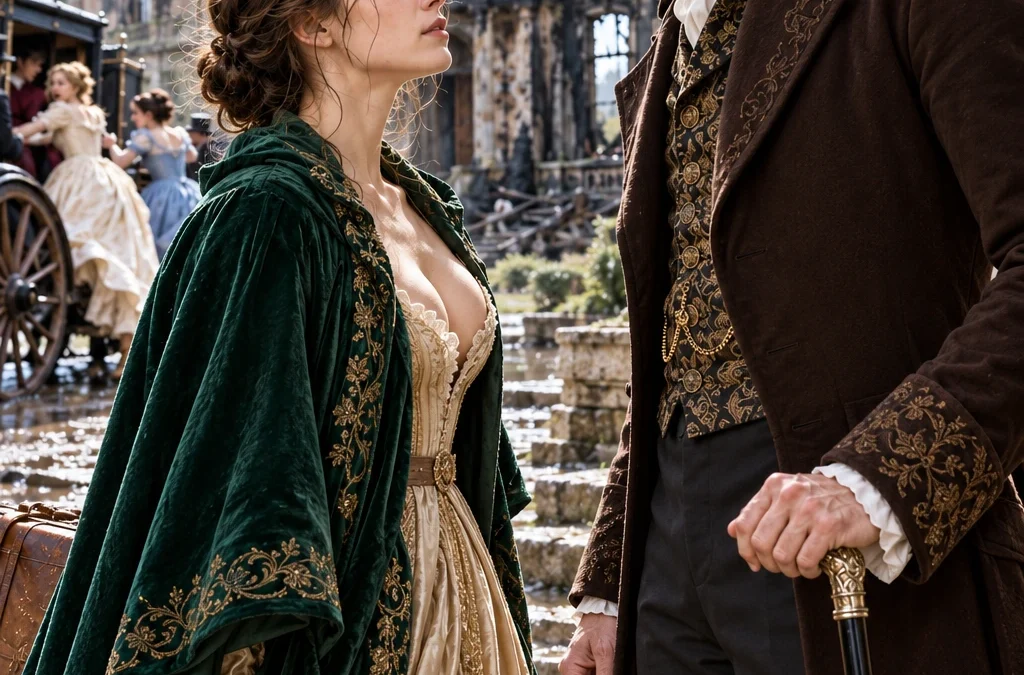
Five Noblewomen Fled His Burned Mansion in Terror. Then a Penniless Woman With Four Shillings Stepped Out of the Storm, and What She Heard in the Dark That Night Revealed a Secret Someone Had Killed to Protect 😱🔥
Part 1
The letters were written in a hand that did not shake, though the Duke’s left side trembled on damp nights.
Six letters, on thick parchment, sealed in black wax stamped with a leaping stag. They went to six of the grandest families in London, addressed to daughters whose dowries were matched only by their hunger for a title.
Arthur Pendleton, ninth Duke of Rothmere, had made his offer without a trace of romance.
“I require a wife of substantial means to restore my lineage and my lands. In return, I offer the title of Duchess of Rothmere. Be warned: I am not the man I was before the winter fire, and Ashbourne Hall is not the palace you remember. I offer a blackened crown and a home that mirrors my own ruin.” 🖤
The mothers of Mayfair thought it poetic. They remembered the Arthur of three years ago, a towering golden-haired lord who commanded every ballroom he entered. They remembered Ashbourne Hall as the jewel of the north, all pale stone and endless glass.
They assumed the letter was the melancholy flourish of a grieving widower playing the tragic hero.
They were wrong.
The first carriage rolled up to the wrought iron gates carrying the delicate Lady Clementine of the Arisdale fortune. She took one look at the shattered east wing, at the soot-black chimneys stabbing the gray sky, at the garden choked with dead vines and freezing mud.
Then she saw the man waiting on the cracked marble steps.
He leaned on a silver-tipped cane. The left side of his jaw and neck was ruined by silvered burn scars. His eyes, once a vivid, dancing blue, were as flat and cold as a frozen lake.
Lady Clementine never stepped out of the carriage. She shrieked, struck the roof with her parasol, and ordered the driver back to London. 😨
The second woman, Miss Arabella Trenton, made it into the foyer. She took two steps across the ash-stained boards, looked up at a great chandelier lying shattered in a heap of crystal and rusted iron, and fainted dead away. Her footman carried her out before Arthur could even offer tea.
By the time the fifth carriage fled down the drive, its passenger sobbing at the howling drafts that sounded like tortured spirits, Arthur had stopped hoping.
He retreated to his study, the only room the fire had spared, and poured a heavy measure of brandy.
The dukedom would die with him. The estate would fall to the Crown. And the crushing, secretive debts left by his late father would finally swallow what remained.
A monster in a collapsing castle, he thought. The world has rightly rejected me.
The door groaned open. Thomas, his elderly butler, whose loyalty bordered on madness, stepped inside.
“Your Grace. There is another carriage.”
Arthur’s scarred jaw tightened. “I sent six letters, Thomas. Six women have come and gone.”
“With respect, Your Grace, I believe there is a discrepancy in your count.” A pause. “Or perhaps in the passenger.”
Arthur seized his cane and hauled himself upright. He would send this latecomer away himself and spare them both another theatrical exit. His uneven footsteps echoed down the bare stone hall like a dark storm looking for somewhere to break.
The carriage in the downpour was no gilded barouche. It was a hired mail coach, wheels caked in yellow mud, horses foaming and spent.
And standing in the rain, completely unprotected, was a woman. 🌧️
She wore a plain gray wool cloak, soaked through and clinging to her slight frame. No maids. No footmen. No velvet trunks. A single battered leather portmanteau sat in the mud at her feet.
She was looking up at the jagged, blackened silhouette of Ashbourne Hall. And unlike the others, there was no horror on her face. Only quiet, intense calculation.
Arthur shoved open the doors. Wind whipped his dark hair across his scars.
“Who are you?” His voice boomed over the storm. “You are none of the women I wrote to. Turn that wretched carriage around before it sinks.”
She turned. Dark chestnut hair was plastered to her cheeks. Her eyes were a piercing hazel, and they did not drop to his cane. They did not flinch at his face. They met his stare head-on.
“I am Clara Linfield,” she said, her voice low, steady, and perfectly clear over the rain. “And I cannot turn the carriage around, Your Grace. I only paid the driver enough to bring me here. I have exactly four shillings left to my name.”
Arthur froze. “Linfield. The Linfields are destitute. I wrote to your cousin, Lady Genevieve.”
“Genevieve threw your letter into the fire the moment she read it. She said you were a madman offering a tomb.” Clara stepped into the shelter of the ruined portico without asking permission. “I pulled it out. The edges are scorched, but the offer remained legible.”
He stepped closer, using his size the way he always had. It had terrified grown men. “You have no dowry. You are a trespasser. Thomas, have this woman removed.”
Clara did not retreat. She lifted her mud-soaked bag and dropped it onto the dry stone of his foyer.
“The women with dowries ran from you, Your Grace. They will always run. They want a dukedom that sparkles. You need something entirely different.”
“And what do I need, Miss Linfield?” he sneered.
“A partner who is not afraid of the dark.” Her chin lifted. “I have spent ten years keeping my uncle’s failing estate from creditors while he drank away the family fortune. And I am running from a marriage to a man three times my age who looks at me like meat. You need a wife to secure your line and manage this ruin. I need a fortress.”
Her eyes swept the walls.
“And Ashbourne looks very hard to breach.”
Something shifted inside him as he watched her shoulders, shaking with cold, held rigid by sheer will.
“Thomas,” he said at last. “Prepare a room in the west wing. Light a fire. Miss Linfield is staying.”
Five days later, long past midnight, Clara crept down toward the library with a single candle. As she passed the corridor to the forbidden east wing, she heard it: the scrape of a heavy boot on stone. Deliberate. Stealthy.
She blew out her flame and pressed herself against the wall.
A faint amber glow moved through the ruins. A man in a heavy coat knelt at the base of a massive pillar, chiseling at the mortar, weakening the stone that held up the entire upper gallery.
Before she could scream, a hand clamped over her mouth and an arm dragged her into the shadows.
“Stop fighting,” a voice hissed. It was Arthur. His eyes blazed in the moonlight.
“He is trying to bring the wing down,” she breathed.
“Yes. And that is the third time this month.”
Clara stared up at him as the pieces snapped together. “The fire three years ago,” she whispered. “It was never an accident, was it?”
Arthur looked down at her, and for the first time he did not look like a broken man. He looked like a wolf cornered in its den.
“No, Clara,” he said softly. “It was murder. And whoever did it is still trying to finish the job.” 😱
Part 2
“No, Clara,” he said softly. “It was murder. And whoever did it is still trying to finish the job.”
The saboteur slipped out through the broken scullery door and vanished into the freezing Yorkshire night. Only then did Arthur release her. He sagged against the frozen stone, his cane scraping the floorboards.
“Three years ago, the fire took my father, my elder brother, and my face,” he said, his voice a jagged rasp in the dark. “The magistrates in York called it a tragic accident. A fallen candle in the library. But my father never read by candlelight. And my brother was supposed to be in London.” His jaw clenched. “Or so I believed, until they found his bones in the ashes.”
Clara’s heart ached with a sharp, sudden pain that surprised her. She offered no gasps and no empty comfort. She offered the only thing she truly owned. 🧠
“If someone is still destroying what remains, then the fire was not revenge. It was an eviction. They do not want the house, Your Grace. They want the land. And they need you to abandon it.”
Arthur gave a bitter laugh. “The estate is buried under fifty thousand pounds of debt. The creditors threaten me weekly. There is nothing here to covet but ghosts and rubble.”
“Let me see the ledgers.”
It was not a request.
For three days and three nights, the library of Ashbourne became Clara’s battlefield. She sat among mountains of curling parchment, leather account books, and furious letters of credit, her fingers stained permanently black with ink. Arthur watched from his wingback chair, his brandy untouched, mesmerized by the terrifying focus of the woman he had nearly turned away.
She did not weep over his ruin. She dissected it. 🔍
On the fourth morning, as gray dawn broke over the shattered chimneys, Clara slammed a ledger shut. The sound cracked through the room like a gunshot.
“I have it.”
Her eyes burned with triumph. She pushed a stack of promissory notes across the mahogany desk.
“Your father never owed fifty thousand pounds, Arthur. These notes are a web. They have been traded and repackaged through a dozen phantom holding companies in London. But trace the wax seals and the holding accounts, and every thread leads back to a single man.”
Arthur pushed himself out of his chair. “Who?”
Clara unrolled a dust-covered geological survey of the Yorkshire Moors, dated 1810. She tapped one fingernail on the coordinates directly beneath Ashbourne Hall.
“My uncle was ruined by bad investments in northern mines, so I learned to read these charts. Look. Beneath your gardens, beneath the very rubble of the east wing, runs one of the thickest and purest seams of black coal in all of England.” 😳
Arthur stared at the map until the scars on his neck pulled taut.
“The name, Clara.”
She said it as if it left a foul taste in her mouth.
“Lord Frederick Banning.”
The silence in the library turned to ice. And somewhere in the frozen halls behind them, a carriage was already on its way. 🚨
Part 3
The name hung in the air between them.
“Banning,” Arthur repeated, and his voice was barely human. “He owns the ironworks in Sheffield. He dined at my father’s table.”
“He needs coal to feed his furnaces,” Clara said, her voice dropping to a furious whisper. “But he could not buy the land. It is strictly entailed to the dukedom. So he forged debts to bankrupt your father. When your father refused to break the entail and sell, Banning burned the house to break his spirit. And now he is paying someone to collapse the rest, so you will flee and the bank, which he undoubtedly controls, can seize the land outright.”
Arthur’s blue eyes darkened into a tempest of rage and grief.
“The man in the east wing,” he growled. “I saw his face when he fled past the window. It was Higgins. My own estate manager.”
“Then we have a witness,” said Clara. She did not sound afraid. She sounded like a woman who had been waiting her whole life for a fight worth winning. “And I know how to break a forged note. I corresponded with Sir Samuel Romilly, the Chancery reformer, through my uncle’s worst legal battles. He taught me the architecture of fraud. But Banning must be brought here. We must draw him into the light.”
“And how do we do that?”
A small, dangerous smile touched her lips. “We let him believe he has already won.”
They did not have to wait long. Within days, word spread that the Duke of Rothmere was a broken man, locked in his study, ready to surrender. Two days later a gilded carriage bearing Lord Frederick Banning’s crest rolled up the muddy drive of Ashbourne Hall.
He did not come alone. He brought two senior magistrates from York and a grim-faced solicitor, fully expecting a terrified duke ready to sign away his birthright to avoid debtors’ prison. 😈
Banning stepped into the foyer, a sneer twisting his aristocratic features as he surveyed the cracked marble and damp walls.
“A profound tragedy, Your Grace,” he called, his voice echoing through the hollow space. “To see a great house fall to such squalor. I have come to offer you a mercy. Sign the foreclosure today, and I will see you granted a modest stipend to live out your days quietly in Bath.”
At the top of the grand staircase stood Arthur.
He did not wear the threadbare coat of a ruined man. He wore the immaculate midnight-blue velvet of the Duke of Rothmere. He held his cane not as a crutch but as a scepter.
“I will not be signing anything, Banning.”
Banning laughed, cold and sharp. “You have no choice. The debts are called in. You are entirely destitute.”
“He is not destitute,” said a clear voice. “And he is not alone.”
Clara stepped from the shadows of the upper gallery and descended the stairs to stand at Arthur’s side. She wore a simple dress of dark green wool, but she carried herself like an empress. In her arms was a thick sheaf of documents. 👑
Banning’s eyes narrowed. “And who is this? A scullery maid playing lady of the manor?”
“I am Clara Linfield, soon to be the Duchess of Rothmere.” Her voice rang like a struck bell. “And I hold in my hands the late Duke’s personal diaries and ledgers, cross-referenced with the dates of your promissory notes. Your notes, Lord Banning, are dated the fourteenth of October, 1811. Signed, supposedly, by the late Duke in a London banking house.”
She hurled the first leather-bound ledger down the stairs. It landed heavily at the magistrate’s boots.
“The late Duke was not in London on the fourteenth of October. He was in the House of Lords, delivering a recorded speech, after which he traveled directly to Scotland to survey an estate. The parliamentary record, which I had couriered from London yesterday, proves it. The signature on your notes is a clumsy, arrogant forgery.”
The color began to drain from Banning’s face. He glanced wildly at his solicitor. “This is absurd! An accounting error!”
“An error?” Clara’s voice cracked like a whip. “It is fraud. And it is not the worst of your crimes.”
Arthur struck his cane against the marble. From the dining room, two massive, fiercely loyal footmen dragged forward a bruised, weeping, trembling man.
“Mr. Higgins,” Arthur said softly. Dangerously. “Tell the magistrates who paid you to chisel away the pillars of my home. Tell them who paid the men to lock the library doors and light the fires three years ago.”
Higgins collapsed to his knees, sobbing onto the marble.
“It was Lord Banning! He threatened to put my sons in debtors’ prison if I refused! He gave me the gold! I swear it before God!” 😱
The silence in the foyer was absolute, broken only by the howling wind. The magistrates stared at Banning in horror. To forge a debt was a severe crime. To orchestrate the murder of a duke and his heir was high treason.
Arthur descended the last steps until he stood mere inches from the trembling baron. The scarred side of his face caught the gray daylight, and he looked like a god of vengeance.
“You have a choice, Banning. You will surrender every fraudulent note to the magistrates right now. You will sign a full confession to the forgery, which I will keep in my private safe. And you will never again set foot north of the Thames. Refuse, and Higgins testifies, my fiancée presents the financial records to the Crown Court, and you will hang at Tyburn.”
Banning looked at the magistrates, who were already stepping away from him in disgust. He looked at the towering, terrible Duke. And finally he looked at Clara: the penniless, overlooked woman in a plain wool dress who had just dismantled his empire with a stack of ledgers.
With shaking hands, he drew the leather folio of forged debts from his coat and let it fall to the floor. 💥
That evening, the relentless storm finally broke. The setting sun pierced the heavy clouds and spilled golden light across the ruined gardens.
Arthur stood in his study, staring out the window. The crushing weight of three years had vanished, replaced by a strange, terrifying lightness. He heard the rustle of wool and turned.
Clara stood in the doorway, exhausted, with dark shadows beneath her hazel eyes.
“The magistrates have left with Banning’s solicitor to freeze his assets,” she said quietly. “The estate is secure. The coal seam is yours to mine as you see fit. You will be wealthier than your father ever was.”
The ladies of London would have demanded a crown of diamonds on the spot. Clara only looked deeply satisfied that the ledgers were finally balanced.
He walked slowly toward her, his cane forgotten against the windowsill. He stopped in front of her, painfully aware of his scarred face, his half-ruined home, and the darkness that still lived in his memories.
“You said you came here seeking a fortress,” he said, and his voice trembled, stripped of all pride. “But you never needed a protector, Clara. You are the fiercest, most brilliant creature I have ever met. You do not need me.”
Clara looked up into his eyes. Then she lifted her bare hand and gently touched the silvered skin of his left cheek.
Arthur inhaled sharply. His eyes fluttered shut, bracing for revulsion.
It never came.
Her touch was infinitely gentle, tracing the line of his jaw with unapologetic reverence. 🕯️
“A fortress is not built of stone, Arthur,” she whispered, stepping closer until her warmth pressed against his chest. “It is built of trust. I fought for my uncle, and he drank away my efforts. I fought for you, and you stood beside me, unyielding. I do not want a dukedom that sparkles.” Her voice caught. “I want the man who survived the fire.”
The last wall around his bruised heart crumbled to dust. He pulled her into his arms and buried his face in her dark hair, breathing her in as though she were the very air keeping him alive.
“You are my life,” he murmured against her temple. “And I swear to you, I will rebuild this home stone by stone until it is worthy of you.” 💛
They were married three weeks later in the ruins of the east wing, beneath the open, brilliant Yorkshire sky.
They did not invite the lords and ladies of London who had mocked them. They were surrounded only by the loyal servants who had stayed through the darkest nights, old Thomas weeping openly in the front row, and the villagers who would soon find vast prosperity in the Duke’s new, ethically run mines. 🌅
In time, the east wing rose again, stone by stone. The gardens bloomed. The chandelier that had shattered on the foyer floor was never replaced. Clara had it mounted in the library, a tangle of crystal and rust, as a reminder of what the house had survived.
And the woman who had arrived at Ashbourne Hall with four shillings and a battered portmanteau became the most formidable and beloved Duchess the North had ever seen. She ruled a resurrected estate beside a man who finally learned that the greatest love stories do not begin with perfection.
They are built, enduring and unbreakable, in the ashes of the ruin. 🔥💛
This story is entirely fictional and created for entertainment purposes only. It does not represent any organization or individual, nor does it encourage inappropriate behavior. The content was generated with AI assistance.








