For Eight Years, My Parents Made Me Disappear Every Time My Brother’s Fiancée Visited. The Reason Nobody Could See Me Was Far Worse Than Being Thrown Out.
For Eight Years, My Parents Made Me Disappear Every Time My Brother’s Fiancée Visited. The Reason Nobody Could See Me Was Far Worse Than Being Thrown Out.
Part 1
For eight years, my parents made me vanish from my own home whenever my brother’s fiancée came to visit.
And the most monstrous part wasn’t being thrown out. It was the reason nobody was allowed to see me.
My name is Clara. I was nineteen when my mother, Elena, started hiding my photos from the hallway, my medication from the bathroom cabinet, even the car I parked outside our family house in Rocafort, Valencia.
“Inés comes from a very well-known family in Godella,” she’d say. “There’s no need to stir up unpleasant things.”
My father, Javier, was drier about it.
“Go away for the weekend. Come back Monday.”
I obeyed. At first because I had just come out of a psychiatric admission after a serious crisis, and I depended on my father’s private insurance, my prescriptions, my therapy appointments. Later, because I had been taught to feel that taking up space was a form of selfishness.
My brother Mateo was the only one who sometimes looked ashamed.
“I’m sorry, Clari.”
He never explained why.
While Inés arrived with pastries and flowers and my parents dressed up for Sunday lunch, I drove to a small peach farm in Carcaixent, owned by Carmen, the grandmother of my best friend Lucía. Carmen never asked what had happened in the hospital. She just put a pair of pruning shears in my hand.
“Work first. Questions can wait.”
That’s where I learned to graft, to prune, to tell whether a branch was still alive by scraping the bark with a thumbnail. Green meant life. Brown didn’t.
At home, meanwhile, my existence kept shrinking. One day my bedroom appeared with a lock on the outside. My mother kept the key. During visits, my toothbrush went into the trunk of the car. My mail disappeared. New family photos never included me. Elena told Inés that I “lived in Barcelona and was always working.”
I believed that lie for years.
I even agreed to pay 400 euros a month for a room I sometimes couldn’t enter.
Then my grandmother Amparo died. Inés was going to attend the funeral, so Elena forbade me from entering the church. I could only go to the cemetery after everyone else had left.
There, I read the obituary notice.
Amparo was listed as the mother of one daughter and the grandmother of one grandchild: Mateo.
I didn’t exist.
And beside the cemetery gate, a woman of about sixty was staring at my mother, whispering a name no one in my family had ever spoken.
“Leni?”
My mother went white.
I had no idea who that woman was.
But for the first time, I understood that my family didn’t only hide the living.
They turned them into the dead.
What happened next still gives me chills. Part 2 is in the comments—or leave any word below and I’ll send it to you privately.
Part 2
What happened next still gives me chills. Part 2 is in the comments—or leave any word below and I’ll send it to you privately.
The years that followed made the lie bigger.
I worked at a nursery in Paterna and became the employee professional gardeners called when they needed a difficult tree or a clean graft. At home, nobody knew. My father still asked whether I was “at that plant shop.”
Carmen, though, saw what I had in my hands. She introduced me by phone to Nuria Soler, who owned a fruit farm near Lleida and needed people who could bring old trees back to life through grafting.
“When you want to stop hiding,” Nuria told me, “there’s work here.”
I saved the offer.
In April 2022, another message arrived from my mother:
“Inés’s family at the house Saturday. Vigil Sunday. Out before 10:00.”
In my yellow notebook, I made another mark. Number 211.
That night, at Carmen’s house, I realized I’d forgotten a dose of my medication. The bottles were locked in my bedroom in Rocafort.
I drove back around ten p.m.
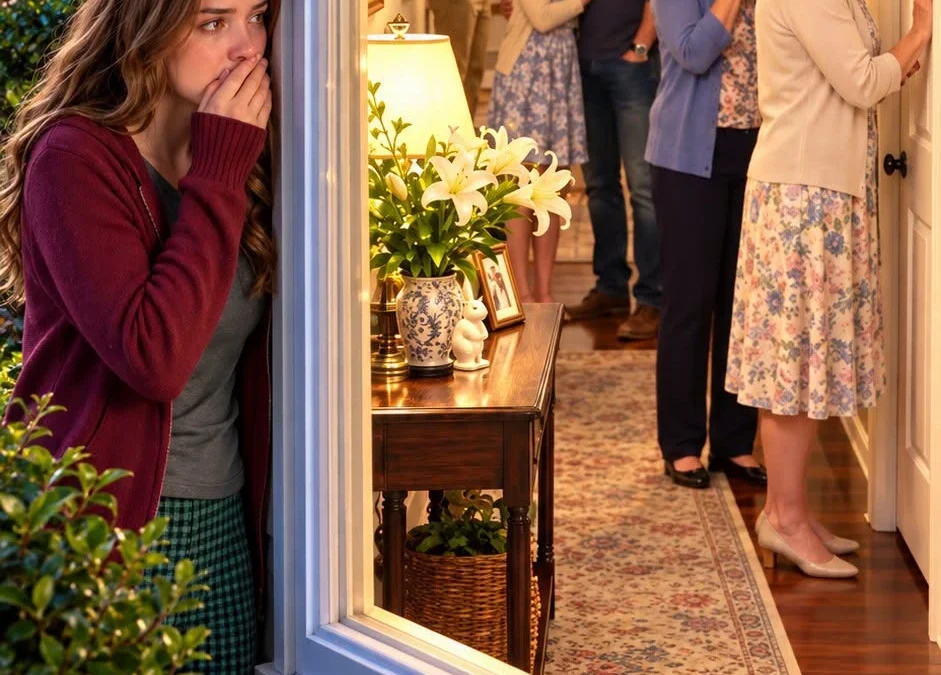
Inés’s parents’ car was still outside. I parked two streets away and approached through the side garden. A hallway window was ajar.
What I saw froze me.
Pilar, Inés’s mother, was standing in front of my closed bedroom door. My mother was crying beside her. Mateo held Inés. My father stared at the floor.
Pilar rested a hand on the wood.
“May I?”
Elena nodded, eyes wet. “I still can’t bring myself to open her room.”
Pilar bowed her head as though she stood before a shrine.
Crouched outside that window, I felt the air leave my lungs.
I waited until everyone left. Then I went in after midnight with the back key. On the dining room table sat a photograph of a white flowering dogwood, and in front of it, a small stone plaque prepared for the parish garden.
“In memory of Clara Ferrer. 1995–2014.”
A nursery tag hung beside it.
I recognized my own handwriting.
I had sold that tree to Inés myself, months earlier. She’d told me it was to remember “someone Mateo’s family lost far too soon.”
I had picked the healthiest one. I had checked the graft. And I had written on the tag:
“It will root well. It will bloom.”
Then every piece fell into place. The candles beside my old photo. The funeral I’d been erased from. The hidden medication, the locked room, the weekends away, Mateo’s silences.
My mother had never told Inés I lived in Barcelona.
She had let that whole family believe I was dead.
I opened my bedroom door, filled a single suitcase, and left it wide open with the light on. Then I sent one message:
“I’m alive. Don’t look for me.”
And I drove toward Lleida.
But the worst truth wasn’t that Elena had invented my death.
It was that four years later, when they finally found me, Mateo confessed that the first person who ever said I had died… was him.
If you want to know why my brother said it, LIKE this post and comment “VERDE.” When enough people comment, I’ll post Part 3.
Part 3
In 2022, I arrived at Nuria Soler’s farm near Lleida with one suitcase, 211 marks in a notebook, and the habit of asking permission even to breathe.
Nuria didn’t ask why I’d crossed half of Spain. She looked at my hands, gave me a grafting knife, and pointed at a row of apple trees.
“Show me what you know.”
I opened a bank account in my name alone, changed my number, and started therapy in Lleida. For the first time, my paycheck wasn’t tied to obeying anyone.
The following spring, Nuria trusted me with a plot of old trees.
“The roots are good. What’s no longer good is what’s on top.”
We cut them back and grafted a new variety. I led a team of twelve. Ninety-four percent of the grafts took.
That night I wrote “94%” on the first page of the yellow notebook. It was the first number I’d ever recorded to remember something I had created, not something I had endured.
Months later, a late frost hit. At dawn I walked the plantation, scraping the young grafts one by one. Thirty-eight were brown.
For a few seconds I felt the absurd urge to call my mother, as if a loss still needed her approval.
Instead, I called Carmen.
“How many are still green?” she asked.
I looked around. “Many.”
“Then work with those. The others, you graft again.”
That spring I redid all thirty-eight. I understood that failing didn’t mean I was defective. Sometimes a branch died from cold, from wind, or simply because it hadn’t taken. Nobody had to be ashamed of the tree.
On the farm I also met Álex, an agricultural mechanic who once repaired the lift platform where I’d gotten stuck.
“You check everything twice,” he observed.
“Once for the tree and once for me.”
He smiled.
He never tried to rescue me from my past. Some nights we had dinner after my therapy sessions. Other nights we walked between the rows without speaking. With him I discovered that silence could also mean calm.
Not always punishment.
In 2025 they named me assistant production manager and my photo went up on the cooperative’s website. I’d been there almost a year before my family found me.
It was an accident.
In February 2026, Pilar wanted to create an agricultural training scholarship in memory of “Clara Ferrer, gone too young.” My old horticulture professor saw the name and called my father.
“I wrote a recommendation for your daughter in 2023. How can she have died in 2014?”
That night, Mateo searched for me online.
It took him twenty minutes.
Four years of not really looking. Twenty minutes to find me.
The next morning, my mother called the farm. She didn’t ask how I was.
“I need you to talk to Pilar.”
Her new version was simple: I had left in 2014 after my crisis, the family had lost contact, and Pilar had misunderstood. They just needed me to confirm it.
“Afterward we can spend Christmas together.”
I looked at the 211 dates in my notebook. “I’ll think about it.”
She sighed. “You’ve always been good at disappearing. Do it one more time.”
Two days later, Mateo asked to speak without our mother.
“It was me, Clari. I said it first.”
In 2014, he’d been with Inés only a few weeks. She had told him how her own brother died in an accident, and how much she hated it when people minimized her grief. Mateo wanted to show he understood.
“We lost my sister in February too.”
He meant my crisis, the sense that I had changed. Inés understood that I had died. She cried and hugged him.
Mateo didn’t correct her.
When Elena found out, she chose to protect the lie.
“People understand grief. Mental illness only brings questions.”
That’s how it all started. The photos taken down. The hidden medication. The locked door. The weekends away.
Mateo cried on the phone. “Now I could lose Inés. And I work for her father.”
I felt a cold sadness. After eight years, my brother was still more afraid for his own life than for the one that had been stolen from me. I gave him until the Saturday of Holy Week to tell Inés the truth.
Then my father called. He had a confession of his own.
My mother had a sister four years older, named Rosario. At twenty, she developed schizophrenia and spent time in a psychiatric center. My grandparents, obsessed with appearances, moved away and told their new parish that Rosario “had gone to be with God.”
They erased her while she was alive.
I remembered the woman at the cemetery who’d called my mother “Leni.” That was Rosario. My father had been visiting her in secret since Amparo’s funeral.
“Your mother learned this at home,” he said. “In her family, death got flowers. Illness got silence.”
I finally understood where Elena came from. Understanding didn’t mean forgiving. It only meant seeing the chain. My grandparents erased Rosario. Elena erased me. Mateo learned that lying was acceptable if it protected appearances.
My father added that when I left, he’d seen a card payment in Zaragoza. As a bank director, he could have followed the trail.
He didn’t.
“I thought you wanted to be far away.”
“You thought it was easier not to look.”
He didn’t deny it.
I asked for eleven days off and went back to Valencia.
On Good Friday I visited Rosario. She had my mother’s cheekbones and a folder holding an old parish bulletin in which her parents thanked God for “the life of Rosario, who is already with the Lord.”
Rosario had been alive when that paper was printed.
“Your mother was sixteen,” she said. “She learned that if someone caused problems, it was more comfortable to turn them into a memory.”
I told her about the tree, the plaque, the 211 weekends. She listened, and then asked one question.
“Is Elena coming?”
I didn’t know how to answer.
That afternoon I went to the parish garden in Godella. The dogwood I had sold Inés was covered in white blossom. Beneath it sat the stone:
“Clara Ferrer. 1995–2014.”
Pilar was preparing the Easter celebration. When she saw me, it took her several seconds to understand who stood in front of her.
I put the yellow notebook on a table and told her everything. She turned the pages one by one.
“This was my birthday.”
Another date.
“Here we all had dinner at your house.”
She reached number 211. April 16, 2022.
“That night I put my hand on your door.”
“I know. I was outside, behind the window.”
Pilar covered her mouth.
My phone buzzed. Elena:
“Don’t do this to your brother.”
I turned it face down.
“What do you want me to do?” Pilar asked.
I looked at the tree. If I stayed silent, Mateo might keep his marriage. Elena could keep her version. They might even invite me for Christmas.
But a family that only accepted me while I pretended to be dead wasn’t a family worth returning to.
“Tomorrow, when you read the names, don’t read mine.”
That night Mateo wrote: “I told her.”
Thirty minutes later, a message came from Inés.
“In 2021 I saw a medication bottle with your name and a recent date. Mateo said it was old. I chose to believe him. Come tomorrow.”
Finally I understood why Elena hid the medicine. She wasn’t afraid of the treatment.
She was afraid of the dates.
On Easter morning, around eighty people filled the garden chairs before dawn. Carmen, Lucía, and my old professor sat in the back. I stood beside the dogwood.
My father saw me first.
My mother took two more steps before she recognized me. Her face didn’t show joy. It showed calculation. Who was here. Who knew. What lie might still save her.
“What are you doing here?” she whispered.
“Standing where you can see me.”
Pilar read the names of the dead slowly. When she finished, she folded the paper.
“This tree was planted by a young woman we believed lost. That young woman is here.”
She called me forward and handed me a card with the name of Inés’s late brother, whose real loss had been used to hold up an invented death.
I read my own name aloud, and went back to the tree.
No speech was needed. People looked at the plaque. Then at me. Then at Elena.
When it ended, my mother went straight to Pilar.
“I never said Clara had died.”
Pilar looked at her without raising her voice. “No. You just let me mourn her for eight years.”
Elena turned to me, waiting for a sentence that could save her.
I said nothing. I crouched by the dogwood, scraped a thin branch with my thumbnail, and showed the color underneath.
Green.
Inés came closer, looked at the nursery tag, then at my hands. “You sold me this tree.”
“I checked the graft.”
A man from the parish asked my father who this young woman was.
Javier looked at his wife, then at me. It took him eight years of silence and four of absence to say it.
“She’s my daughter.”
My mother picked up her bag and left through a side door.
For eight years she had decided when I could be visible. That morning, she was the one who disappeared first.
Two weeks later, they removed the plaque. Pilar asked what to do with it.
“Send it to my mother.”
The tree stayed.
“It’s not to blame,” I said. “It’s a good tree.”
Mateo and Inés began couples therapy. Mateo called every Sunday. I answered about one in three. In one of those calls he said, “I don’t know how to be your brother yet. But I want to learn.”
My mother never apologized. But a month later, my father took her to see Rosario. That night I received a message:
“Rosario told me you went to see her. Thank you.”
It was the first time my mother had ever thanked me for something that wasn’t leaving.
The scholarship didn’t disappear either. Pilar dedicated it to young people who work with their hands: farming, carpentry, mechanics, gardening. Carmen got several cuttings from the dogwood and set them to root. Weeks later she sent a photo.
“All still green.”
I returned to Lleida exactly on day eleven. The apple trees were beginning to blossom. Álex was waiting beside the plot I had grafted. He didn’t ask how it had ended. He just walked beside me until I stopped in front of one of the trees that had suffered the frost.
One of the thirty-eight I’d had to redo. The new graft had taken.
I scraped a small twig.
Green.
That night I opened the yellow notebook. Two hundred eleven marks. Two hundred eleven dates. I drew a line beneath the last one.
I didn’t add another.
On the next page, I wrote a single word:
“Green.”
I spent eight years learning to leave rooms without making a sound, convinced that disappearing was the only thing I did well.
I was wrong.
I had only grown up in soil where silence was mistaken for peace and shame for love.
Now, when a tree looks dead after winter, I don’t pull it out without checking. I scrape the bark first and look for the true color.
Because some things only look dead from the outside.
And because after eight years of letting others decide when I should disappear, I finally learned to decide where I want to grow.
Disclaimer: This story is entirely fictional and created for entertainment purposes only. It does not represent any organization or individual, nor does it encourage inappropriate behavior. The content was generated with AI assistance.








