“GET OFF MY LAND!” HE ROARED AT THE APACHE WOMAN WHO RODE THREE DAYS FOR HIS 91-DAY-OLD JOB… SHE POINTED AT A CRACK IN HIS FLUME AND WHISPERED, “YOU’RE ABOUT TO LOSE EVERYTHING.” SHE WAS RIGHT, AND SOMEONE HAD PLANNED IT
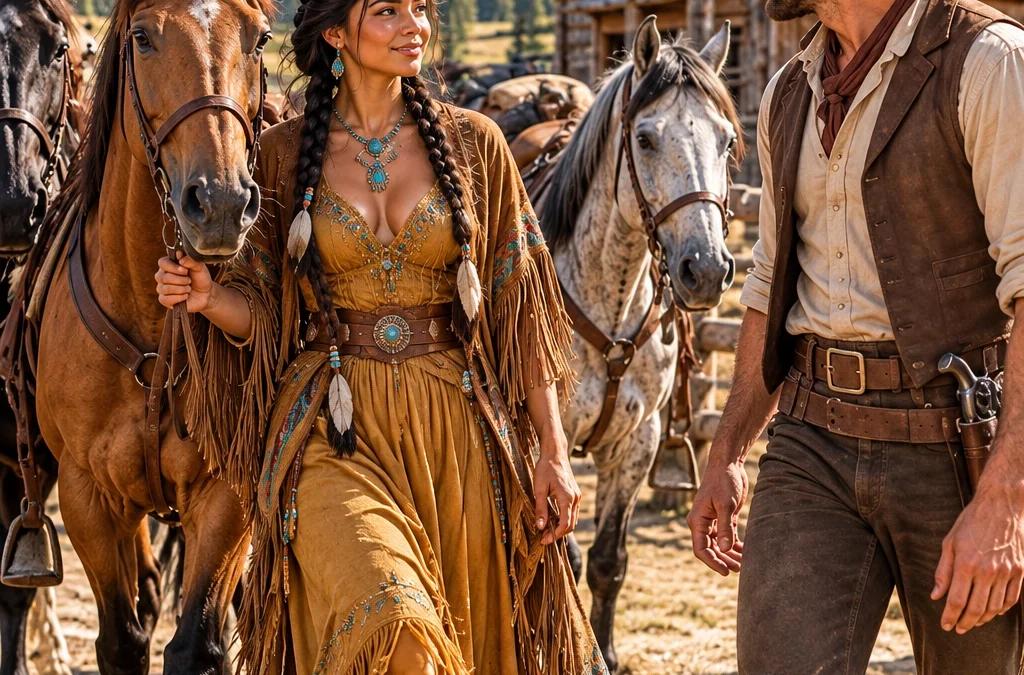
“GET OFF MY LAND!” HE ROARED AT THE APACHE WOMAN WHO RODE THREE DAYS FOR HIS 91-DAY-OLD JOB… SHE POINTED AT A CRACK IN HIS FLUME AND WHISPERED, “YOU’RE ABOUT TO LOSE EVERYTHING.” SHE WAS RIGHT, AND SOMEONE HAD PLANNED IT 😱💧
Part 1
She had ridden three days through desert heat to answer a help wanted sign nailed to a fence post. 🌵
When she stepped off her horse and reached for the irrigation gate, the rancher came out of nowhere, boots heavy on the dry earth, voice like thunder across an empty sky.
“Get your hands off that gate and get off my land!”
She didn’t run. She didn’t flinch.
She pointed at the crack running up the wooden flume behind him and said, very quietly:
“You’re about to lose everything.”
The summer of 1883 came down on southern Arizona like a punishment from God.
By July, the Dragoon Mountains shimmered behind a wall of heat so thick a man could almost see it breathing. The creek beds had dropped two feet since May. Cottonwoods stood pale and brittle. Cattle pressed together at shrinking water holes, ribs showing through dull coats.
Ransom Whitlock had watched three summers come and go on Blackthorne Ranch. Not one had worried him like this one.
It wasn’t the heat. A man from this country learned to live with heat.
It was the ditch.
The irrigation channel ran from a diversion on Creel’s Fork, down through his land, and out to four neighboring homesteads. For seventeen years it had been the backbone of the valley. Silas Fenwick’s alfalfa. Martha Rook’s grain plot. Two young homesteaders downstream who had staked everything on the promise that the water would keep coming.
And for three months, Ransom had watched that backbone begin to crack.
On the 23rd of April he nailed a notice to a cedar post at the edge of the road.
Ranch help wanted. Irrigation experience required. Inquire at Blackthorne Ranch.
In ninety-one days, four men had stopped. The first took one look at the flume and quit before lunch. The second lasted two days. The third wanted more money than Ransom had. The fourth lied about knowing anything about water, and Ransom caught it inside an hour.
Ninety-one days. Running out of time, cash, and patience.
The morning she arrived, he was checking his gray gelding’s shoe when he heard hooves.
Three horses came up the track at an easy walk. The rider in front sat straight and loose in the saddle, one hand resting on a worn saddlebag. A packhorse followed on a lead rope, then a spare.
She was Apache, mid-twenties, with dark eyes already reading everything around her before she said a word. Two long braids. A faded indigo blouse. Sturdy boots. A weathered belt hung with small tools he couldn’t immediately identify.
“Morning,” she said.
“Morning.”
“I saw the posting on the road. Help wanted. Irrigation experience.”
He studied her a beat too long. “That’s been up since April.”
“Yes, sir. I noticed.” She held his gaze. “Three months is a long time for a sign to stay on a post.”
His jaw tightened. “This isn’t light work.”
“I didn’t ride three days across desert in July heat for light work, Mr. Whitlock.” Her voice never rose. “If you’re still not sure I’m serious, I don’t know what else to say.”
Before he could answer, a voice came from behind him.
“Ransom.”
Orson Vale was crossing the yard, polished boots, good vest, the kind of man who managed to look unrumpled at ninety-five degrees. He had ridden in that morning about an overdue debt on two steers Ransom had sold him on credit.
His eyes went straight to her. The braids. The worn clothes. The three horses.
Something moved across his face that he made no effort to hide.
“You’re not seriously considering this.”
“I’m talking to her about it.”
“This is a shared system. Four families depend on it. You start letting strangers work on community water…”
“Every man I’ve hired has been a stranger.”
“That’s different.”
“How is it different?”
Vale looked at her once more. “You know how.”
She said nothing. She sat her horse and watched them with the expression of someone who had been present at this exact conversation many times and no longer felt the need to interrupt it.
When Vale finally turned toward the house, he threw one last line over his shoulder. “It’s your ranch. And your problem when it goes wrong.”
The silence after he left held only wind and horses.
“Does that happen often?” she asked.
“More than it should.”
“And you still want to interview me?”
“I want to find someone who knows water,” said Ransom. “If that’s you, I’m listening.”
She studied him the way a careful woman measures a man whose word she’s deciding whether to trust.
“Show me the problem.”
He walked her to the upper intake. The creek was lower than he’d ever seen it in July. A crack ran through the lower corner of the old frame, wedged with a wooden pin and packed with clay. The repair was already showing stress.
She walked the channel slowly, eyes moving along the banks, the slope, the soil. She stopped twice. Once at a slumped bank. Once at cracked clay lining.
At the lower section, where the old flume carried water across a twelve-foot drop, she stopped and was quiet a long time.
“Mr. Whitlock. When did you last check the base of that left post?”
He looked. He’d checked the boards. The seams. But the base was partly buried, and he’d assumed.
“A few weeks ago.”
She crouched and pressed two fingers into the soil. “This is saturated. It rained last week, but this soil has been wet far longer than that. Water is seeping up from somewhere under the base.” She stood. “Push on the post.”
He pressed his hand against it. It gave. Not much. Under an inch.
But solid timber doesn’t move.
“That post is compromised. If you open that headgate wider to make up for the low creek, you push more pressure into a structure that’s already moving.”
Ransom stared at the post. “So what do we do?”
“Nothing yet. First I measure the grade.” She looked at him. “Give me until midday.”
He hadn’t offered her the job. She hadn’t asked again. She was just going to work.
Later, when she brought him her figures, she laid out two options. Reroute through the sandy wash to the south, or cut through the northeast corner of his meadow.
“The meadow,” he said slowly. “That’s my best hay ground.”
“I know. I wouldn’t recommend it if the first option had better odds.” She met his eyes. “It’s your call. I’ll tell you what I think. I won’t tell you what it costs you.”
He should have bristled. Instead he stuck out his hand.
“What are your terms?”
She told him. Fair wage. Full authority over structural safety decisions. Paid in full at the end, not held against future promises.
“That’s a lot of conditions for a woman applying for a job.”
“It’s a lot of trust for a man asking someone to save his neighbors’ water.”
He almost argued. He caught the words before they came out.
“You’ve got a deal.”
Her name, she told him, was Nalin Deste.
They tried the sandy wash first, but only after a fight. He wanted to dig. She insisted on measuring.
“I have seen two projects fail because a man was too confident in his eyes and not careful enough with his numbers. I will not be the reason a third one fails.”
He opened his mouth, then closed it. “Fine. We measure.”
By the end of the second day, something had changed between them. They moved around each other with less collision, more coordination.
But on the afternoon of the fifth day, working alone near the old flume, Nalin dug six inches into the soil at the base of the left support and found something.
A diversion board. One of the old adjustable planks from the original intake framework.
Shifted.
The mortise marks were clean and recent. Made with a metal tool, not the old wooden mallets. Someone had moved it deliberately, and the new position had been routing a slow seep of water straight into the base of the post.
The flume hadn’t failed on its own.
Someone had helped it fail. 😨
She covered the board with loose earth, marked it with a small stone, and stood up.
And as she turned toward the ranch house, she saw Orson Vale on his horse at the edge of the fence line.
Watching her.
He had been there the whole time. 😰
Part 2
Vale touched two fingers to his hat brim and rode away, unhurried.
Nalin stood very still.
She had a choice. Tell Ransom tonight, or wait.
She chose to wait.
She told herself it was strategy. Accusing a man like Orson Vale without proof was the fastest way to get herself dismissed and let the guilty walk away clean.
But lying in her bedroll that night, she made herself be honest. She wasn’t sure yet how much she trusted Ransom Whitlock with something this dangerous. A man who had nearly thrown her off his land. A man who owed Vale money.
I’ll trust him when he gives me a reason. Not before.
Two days later, with a root system from a long-dead mesquite blocking the new trench, he gave her one.
They were cutting side by side with hatchets, elbows nearly touching, when he said without looking up, “You’ve been watching the flume.”
Her hands slowed.
“You went back to it twice yesterday. That’s not why you keep going back.”
She set the axe down.
“I found something. In the intake framework. A newer piece of timber with a bracket that isn’t part of the original construction. Placed deliberately, in a position that would make the seep worse over time.” She watched his face. “Someone who knew this system did it on purpose, and made it look like age and neglect.”
Ransom stood slowly. When he reached his full height, something very still and very cold settled in his expression.
“Orson.”
“I don’t know that. Knowing it and proving it are different things.”
“Who else could have touched that frame?”
He knew the answer before she said it. “Tobias Greer.”
They found Tobias at the feed store in Coyote Wells the next morning. A lean man in his late thirties with work-roughened hands and a habit of looking slightly left of whoever he was talking to.
Ransom had known him eight years.
“Last fall, when you worked the lower channel,” Ransom said. “The diversion frame. Did you do any work on it?”
Tobias’s eyes flicked to Nalin. A reflex he couldn’t control.
“I might’ve checked a board or two.”
“One of those boards is in a position that’s been putting water into the flume support for months. The base that just gave way.”
The color drained from Tobias’s face, in stages, like daylight leaving the sky.
“Tobias.” Ransom stepped closer. “I’ve known you eight years.”
Something broke. Not loudly. The way things break after long pressure.
“He said it was maintenance. He said the board was in the wrong position from the original installation.”
“Who said?”
Tobias looked at the floor.
“Vale.”
The name landed in the quiet like a stone into still water.
“How much did he pay you?”
“Twenty dollars. I thought it really was just maintenance.” His voice cracked. “I didn’t know.”
“I need it in writing. Signed. And I need you to tell the county water commissioner exactly what you told me.”
Tobias looked at the floor for a long moment.
Then he nodded.
The commissioner, Adelaide Mercer, rode in that evening. Steel-gray hair beneath a practical hat. Eyes that had seen most of what people tried to get past her.
She walked the channel without a word. She asked Nalin three technical questions about soil permeability and bypass grade tolerances. Nalin answered all three.
Then Adelaide took a folded paper from her saddlebag and handed it to Ransom.
“You have twelve days from tomorrow to present a functioning alternative and pass a full distribution test. All four outlets must meet their recorded allotments. If they don’t, I refer the matter for further proceedings, and four families make other arrangements for the rest of the season.”
“And if they lose their water?”
“Then Martha Rook loses her grain. Silas Fenwick loses his alfalfa. And two young men downstream lose everything they’ve built.” She paused. “I don’t tell you that to threaten you, Mr. Whitlock. I tell you because you should know what’s at stake.”
Twelve days.
They tried the wash. The first test failed at the third outlet, two inches short. The clay needed three more days of work, and the gradient through the fourth section was too shallow.
“The wash route won’t pass,” Nalin told him at the headgate. “The fourth outlet is geometry. I can’t change the land.”
Ransom stood very still. He looked out across the hay grass. Two acres of it. Brown and valuable.
“The meadow.”
“The meadow.”
He didn’t speak for a long while.
“I’ll have to sell the steers early. Buy replacement feed. That cuts deep.”
“I know.”
“Will it work?”
“I believe so. I won’t promise what I haven’t tested.”
He bent down and picked up the surveying stakes. He held them out.
“Show me where to drive them.”
She took them, looking at this proud, difficult man who had shouted at her to leave his land eight days ago, now asking her to cost him two acres of winter feed without flinching.
“I’ve owned this land fifteen years,” he said. “I thought it belonged to me the whole time.” He looked toward Silas’s field. Martha’s plot. The distant downstream parcels. “Maybe it never did. Not entirely.”
She drove the first stake into the northeast corner of his meadow.
And that was when the riders appeared on the ridge.
Three men on horses. At the front, a barrel-chested man named Puit, hat in hand. Behind him, a younger man with an angry face.
They had come, they said, about the woman.
And Orson Vale was riding in behind them. 😱
Part 3
Ransom stepped into the yard before the three men could dismount.
“Her name is Nalin Deste, and she works for me.”
“We’ve heard that,” said Puit. “We’ve also heard some things that concern us.”
“From who?”
Puit’s eyes shifted, fractionally. Not proof. Enough to be an answer.
“There’s talk the damage to the flume wasn’t natural,” the younger man said, less careful with his words. “And that the person who found the evidence is the same one who altered it herself, to get ahead of the accusation.”
Ransom turned to look at him. It lasted exactly long enough.
“What’s your name?”
“Doyle.”
“Doyle. You’re on my property accusing an employee of mine based on what someone told you. You want to make that accusation, you make it to Adelaide Mercer in writing and sign your name to it.”
Doyle’s jaw tightened. He didn’t answer.
Ransom looked back at Puit. “I have a signed statement from Tobias Greer in the commissioner’s hands, explaining exactly who paid him and what he was told to do. It doesn’t mention Nalin. It mentions someone else.” He let that sit. “Come to the final inspection in two days. Look at what the water does. You don’t have to trust her. Trust the measurement.”
The three men exchanged a look.
“Two days,” said Puit.
Doyle looked back once as they left. Not at Ransom. At Nalin.
She held his gaze. He looked away first.
Three days later, Orson Vale came to the general store while Nalin was inside buying lamp oil.
He stood at the counter with a glass of lemonade and the patient manner of a man who had been rehearsing.
“Three separate times at that old flume,” he was telling Silas Fenwick and Martha Rook. “Someone’s been handling those boards. And the only person I’ve seen there, other than Ransom, is her.”
Nalin stood in the doorway. Every head turned.
She walked in and set her list on the counter.
“Mr. Vale. You said I’ve been near the old flume. That’s true. I’ve been near it because something was done to it. I found the evidence. I reported it to Mr. Whitlock, and he’s bringing it to the water commissioner.”
“Doesn’t it seem convenient,” Vale said pleasantly, “that she finds wrongdoing in a structure that’s stood seventeen years?”
“It would be convenient if I’d made it up. I didn’t touch those boards except to document their position.” She looked at Silas directly. “Mr. Fenwick, your alfalfa is at stake. Don’t you want to know the truth?”
Silas shifted. He looked at Vale. Then at her.
“I want to know who to believe.”
“Then come to the inspection. All of you. Bring your questions. We’ll measure everything in front of Adelaide Mercer, and you can see for yourselves.” She picked up her list. “And Mr. Vale. When Commissioner Mercer has Tobias Greer’s signed statement and a look at that second timber, you’ll have a great deal more to answer for than I will.”
The room went completely silent.
“Bold words,” said Vale quietly, “from a woman who still hasn’t proven she can deliver water.”
“Six days,” she said without turning around. “Then we’ll see who proved what.”
The meadow channel went in in four days.
Ransom dug the center line. Nalin shaped the walls. They worked without stopping until the light was gone, and by the end of the first day they had eighty feet of clean excavation with walls that held their shape when she pressed a palm to them.
That evening Silas Fenwick came to the fence. He didn’t come onto the ranch. He stood there watching until Ransom walked over.
“That’s your winter hay ground.”
“Yes.”
“You’re cutting through it.”
“The other route won’t work. Four homesteads need water.”
Silas was quiet a long time. A man who had spent sixty years in this country didn’t process betrayal quickly.
He looked at Nalin. “Miss Deste. I told Adelaide Mercer I didn’t think you should handle the channel work alone.” He paused. “I want you to know I said it.”
“I know you said it. I’m saying it now, so you know I know.”
He held her gaze. “What time do you start tomorrow?”
“First light.”
“I’ll bring my shovel.”
At dawn, Silas was at the fence with his work gloves. An hour later, Martha Rook arrived with two hired men. She didn’t make a speech. She tied her horse, looked at the excavation, looked at Nalin, and said, “Tell me where you need me.”
The two young homesteaders, Cal and Henry, worked the center line beside Ransom. They didn’t talk. They dug harder than anyone.
By noon they had doubled the previous day’s progress.
The final test came on the twelfth day, and half the valley came with it.
Adelaide arrived at dawn with her notebook and measuring rod. Puit and his two men came. Silas had been there since before sunrise, standing near the first outlet with his arms at his sides instead of crossed. Martha Rook stood with her hired hands. Cal and Henry waited at the fourth outlet, the farthest point, the one that would tell the whole story.
Orson Vale came last, unhurried, keeping a slight remove from the neighbors. He didn’t look at Nalin. She noticed.
Adelaide walked the full length of the new channel and made her notes. She came back to the headgate.
“Are you ready?”
Ransom looked at Nalin.
She had checked every inch of it the evening before. She had checked it again at first light.
“Open it,” she said.
He pulled the lever.
Water entered the new channel and moved. Fast enough to carry, slow enough to hold. The upper bank didn’t shift. The first bend held.
Nobody spoke. The sound of moving water in the dry summer heat was the only voice the morning had.
The first outlet filled. “First outlet meets requirement.”
The second. “Second outlet meets requirement.”
The third, the one that had failed in the wash. The level in the measuring box rose steadily, no false plateau.
“Third outlet meets requirement.”
A sound went through the gathered neighbors. Not a cheer. Quieter. The collective release of people who had braced for disaster so long that relief came out like something they didn’t yet trust.
Then the fourth outlet.
The water entered the box. It rose one inch, two. Then it slowed.
Nalin was at the box before the thought finished forming. She crouched, reading the surface. Still rising. Slow. Very slow.
The mark was a quarter-inch above the water. Half a minute. An eighth of an inch. Another half minute. Another eighth.
She felt Ransom behind her without turning. She felt the held breath of eight or nine people watching an inch of water decide a season.
The water touched the mark.
It held. Not surging. Not dropping. Just holding.
Adelaide checked her watch. She waited a full two minutes. Then she rechecked all four outlets.
She wrote in her notebook for what felt like a very long time. Then she closed it.
“All four outlets meet their required readings. The banks show no signs of structural failure. The inspection is complete. The irrigation agreement is restored.”
The silence lasted exactly three seconds.
Then Henry, the younger of the downstream men, who looked like he hadn’t slept in four days, sat down on the ground. Not dramatically. His legs simply decided they were done. Cal put a hand on his shoulder. Martha Rook murmured something that sounded like a prayer. 🙏
Silas walked toward Nalin the way old men walk when they’ve made a decision and won’t let themselves back out.
“I was wrong about you.”
“You were wrong before you knew me.”
“Yes, ma’am.”
She nodded once. No softening. No dragging it past what needed saying.
“Mr. Vale.”
Adelaide’s voice carried level and official across the morning. “I’ll need you to remain available. County authorities will be contacting you regarding the investigation into unauthorized diversion alteration. The signed statement and physical evidence have been formally recorded.”
Vale sat very still on his horse. “I don’t know what statement you mean.”
“Tobias Greer’s. Signed three days ago. It describes the work he was paid to perform and the person who paid him.”
Vale looked across the gathered faces. Puit was looking at the ground. Martha Rook was looking at him with the steady, merciless gaze of a woman who has been lied to before and recognizes the smell.
He looked at Ransom. Ransom looked back without expression.
Orson Vale turned his horse and rode away from Blackthorne Ranch at a deliberate, unhurried pace that was doing a great deal of work on his behalf.
It couldn’t do enough. Everyone in that yard had watched him go. 🌄
Later, after the neighbors had left and the channel had been running three hours without a sign of failure, Nalin sat down on the new bank and let herself be tired for the first time in twelve days.
Ransom sat beside her. Not across. Not at a respectful working distance.
Beside her.
“He’ll fight it,” she said.
“He’ll lose. Adelaide’s meticulous.”
They listened to the water.
“I need to say something,” Ransom said. “I ordered you off this land the first morning. Before you’d done a single thing wrong. I’m saying it again because I mean it more now than I did then. A man who decides what a person is before he knows them has a long way to go before he’s worth much. I don’t know if I’ve come far enough.”
“You drove the stakes,” she said.
“You keep saying that.”
“Because it keeps being true. You lost two acres of winter hay and didn’t make it my fault. You stood in front of Puit’s men and called them wrong. You let me tell you no at the headgate when every instinct you had was telling you to push it.” She looked at him. “That’s not a man who hasn’t come far enough. That’s a man who came far enough when it counted.”
He looked at her a long time.
“You’re the most honest person I’ve ever met.”
“It causes problems.”
“Not here.”
The water ran on, and neither of them moved.
Over the next weeks, the consequences arrived the way water erodes a bank. Gradually. With a patience that made the result more complete than any sudden collapse.
Tobias Greer came to the ranch one Thursday with a packed bag and the expression of a man who had decided to do the most uncomfortable thing available.
“There’s something I didn’t tell Adelaide,” he said. “When Orson explained what he wanted me to do with the board, he showed me a draft. A purchase offer for the two downstream parcels. Already written out. Dated two months in the future.” His voice flattened. “He told me it was already arranged. That the homesteaders were going to lose their water and sell anyway, and I was only making the inevitable quicker.”
“It wasn’t decided,” said Ransom.
“No. And I know now that what I did helped him get close to making it so.”
“Add it to the statement.”
It took two hours to record. When it was done, Tobias looked across the room at Nalin.
“I should have come forward sooner.”
“Yes. You should have.”
“I was afraid of what Orson would do.”
“I know.” She held his gaze. “But the people who paid for your fear weren’t you. It was four families who spent twelve days not knowing if they’d have water. And a man who cut two acres of his best hay ground because someone moved a board for twenty dollars.” She paused. “I’m not telling you to punish you. I’m telling you because the consequences need to live somewhere accurate.”
He nodded. He didn’t argue.
Then came Vale’s last move.
Martha Rook rode in one Wednesday with a paper from the land office. Vale had filed a contested claim, arguing the original water allotments were improperly established seventeen years ago. If it held, the fourth outlet’s share would shrink, Cal and Henry’s parcel would lose value, and they’d have to sell.
“He doesn’t have to win,” Nalin said. “He only has to drag it out until two men in their second season can’t afford the uncertainty.”
Ransom went through the box of property records left by the man he’d bought the ranch from. He found a survey from 1866, signed by the county surveyor, setting the allotments in clear ink.
And folded between two transfer papers, a letter dated 1871 from the county water commissioner of the time. It described an inspection, confirmed the fourth outlet met its recorded share, and noted that all four homesteads had been taking their established portions without dispute.
Adelaide read the letter twice. “This effectively dismantles the factual foundation of his claim.”
Ten days later, Orson Vale withdrew it. No announcement. A single document filed with the land office.
“It doesn’t feel like enough,” Ransom said.
“It isn’t justice. It’s consequence.” Nalin looked at the paper. “His influence here is finished.”
Adelaide Mercer rode out alone one afternoon without her notebook.
“I owe you something, Miss Deste. When I came to this property, I asked you technical questions because I wanted to see whether you’d answer them right. But I was also testing something else.”
“I know.”
“I’m sorry for it. A commissioner’s job is to evaluate the work, not the worker’s background.” She held Nalin’s gaze. “If there is ever another irrigation project in this county that needs a qualified hand, I will be putting your name forward. With my full professional endorsement.”
Nalin took that in. Not with gratitude. With the quiet acknowledgment of someone who had been denied something for a long time and was finally receiving it.
“Thank you.”
That evening, over coffee, she told Ransom.
“It bothers me that it felt like so much,” she said. “Something that should be ordinary. A commissioner saying she’ll put my name forward. It felt enormous because it doesn’t usually happen.”
“No. It doesn’t.” He set down his cup. “And I’m sorry for my part in that. Not because you turned out to be useful. Because you were who you were before I knew you were useful. I owe you that apology for who you were then.”
She looked at him for a long, quiet moment.
“That’s the most precise apology anyone has ever given me.”
“I’ve had time to think about how to get it right.”
“Does it help?” he asked.
She thought about it honestly.
“Yes. It does.”
On a Sunday evening, he found her at the stable, checking her sorrel mare’s foreleg.
“Nalin. Would you have supper with me?” He kept his hands in his pockets, and for once he didn’t know what to do with them. “Not as my employee. If you’d rather keep things as they are, I’ll understand. It doesn’t change anything between us professionally.”
“Are you asking because you feel you owe me?”
“No.”
“Because the valley watched me save your ranch?”
“No.” He looked at her steadily. “Because I’ve spent twelve days watching you work and think and refuse to compromise and be exactly who you are in front of people who didn’t deserve it. And I’d like to spend an evening knowing that person without the irrigation project between us.”
She was quiet.
“I choose the location.”
Something in his chest released. “Fair enough.”
She turned back to the mare. But her shoulders had softened.
“I’m asking because I want to, Ransom. Not because you asked.”
“I know.”
“Good. Just making sure.”
The supper happened on a Tuesday, on a flat granite outcropping east of the ranch, above the creek, where late sun came off the mountains and the whole valley lay below. She brought the food. He brought two chairs from the ranch house, slung across his saddle.
“Chairs,” she said.
“You chose the location. I chose the chairs.”
She almost laughed. It happened in her eyes first, then reached her face as a small smile she didn’t bother to suppress.
They ate and talked about everything except the channel. Her mother, who had understood water better than anyone she’d ever met. Her father, gone since she was fourteen. The loneliness of being good at something that took you far from home. He listened without trying to fix any of it, and sometimes asked a question that showed he’d understood exactly what she had said.
“I almost left, you know,” she told him as the valley went gold. “The second day. When you snapped about losing daylight.”
“What made you stay?”
“The sign on the post. Ninety-one days.” She looked at him. “A man who keeps a help wanted sign up that long isn’t a man who’s given up on finding the right help. He’s a man who refused to settle for the wrong kind. I decided to see if that extended to people, not just skill sets.”
She reached across and set her hand on top of his where it rested on the arm of the chair.
He turned his hand over slowly and closed his fingers around hers.
August came down on Coyote Wells like a second summer. The channel held through all of it. Nalin walked it every morning and checked it every evening. Twice she organized maintenance days, and all four homesteads sent someone. Silas worked beside her three hours without being asked twice.
“You run a tight operation, Miss Deste.”
“The operation runs itself if you build it right.”
He laughed a real laugh and said she sounded like his father.
Then, on a Tuesday in the last week of August, the final test arrived in the form of a thunderstorm.
It came up fast from the southwest. By the time it broke over the Dragoon foothills, the creek was rising. Brush and dead wood washed down from the hillside and began to pile against the first distribution box, building back pressure on the upper bank.
Ransom was at the headgate. Nalin was already fifty yards down the channel.
Silas Fenwick came around his fence line on horseback.
“I saw the runoff from my field! What do you need?”
Ransom opened his mouth, then turned toward the channel.
“Ask Nalin. She knows this channel better than I do.”
Silas looked at him a moment. Then he turned.
“Miss Deste! What do we need?”
“Get to the third distribution box! Reduce outflow by a quarter until we clear this. Don’t touch it more than that.” She looked at Ransom. “Two people on the debris pole from the downstream side. Push it into the channel. Don’t drag it against the bank.”
Cal came through the gate without asking. Henry was two minutes behind him. Martha Rook’s hired man appeared from the south.
Within fifteen minutes, six people were working the blockage under her direction. She didn’t shout. She didn’t repeat herself. She said what needed doing, clearly, and every person did it.
The debris cleared in forty minutes. The bank held. The channel returned to a steady flow.
When it was over, everyone stood muddy and soaked, looking at the water running clean.
Silas pulled off his hat. “Good call on the third box.”
“You executed it fast.”
“We had a good instructor,” he said plainly, the way a man says something true after he’s stopped fighting it.
That evening, Ransom and Nalin walked the full length of the channel together. Not an inspection. Side by side, slow, letting the dusk come down around them.
The two acres of brown scar ran through his best hay ground, marked by iron stakes he would never pull. Even when the grass grew back, he would leave them. A record of what the decision had cost and why it was worth it.
“Do you remember what you said the first morning?” he asked. “When I told you to get off my land. You said water belongs to more people than me.”
“I said a great many things.”
“It was the most important thing anyone has said to me in fifteen years on this ranch.” He looked at the channel. “I built this place like the line of my fence was the line of my responsibility. It isn’t. Martha, Cal, Henry. Their water was mine to steward. Not to own. I didn’t understand the difference until you said it.”
“Most people don’t.”
“Nalin.” He said her name with the ease that had grown into it over four weeks of work and one Tuesday on a granite outcropping. “Stay.”
She looked at him.
“Not just for the channel. Not just the maintenance schedule and the inspection intervals. Stay because this is a place where your judgment matters. Where your word has weight. Where when a man asks who knows this channel best, the answer is you. And I’m the one saying it.”
“I already signed the work agreement.”
“I’m not talking about the work agreement.”
“Then say what you’re talking about.” Not evasive. Precise.
“I wake up in the morning and the first thing I think about is what you’ll find when you go check the channel. The second is whether I’ll get to talk to you before midday. The third is whether I’ve earned one more day of you thinking I’m the man you saw something in when you read that sign.” His voice caught. “I want to keep earning it for as long as you’ll let me try.”
She looked at him for a long time. The last light touched the western mountains and held there before letting go.
“Do you know what I thought when I read that sign?”
“A man who hasn’t given up.”
“That was part of it. The other part was simpler.” She looked at the channel. “I thought, whoever put that up is someone who needs help and knows it. Most people can’t admit that. Most would let the whole valley go dry before they’d stand at the road and say they couldn’t do it alone.” She looked back at him. “That sign said something brave, in a quiet, stubborn, difficult way. I wanted to meet the man who was brave enough to put it up. Even if he turned out to be everything I expected. Stubborn. Proud. Wrong about several things.”
She paused.
“And worth the trouble.”
“Stay,” he said again, softer.
She reached for his hand, the way she had on the granite outcropping. Directly. No ceremony.
“I’m already here.”
He closed his fingers around hers. They stood beside the channel in the last of the August light, and the water kept moving through two acres of sacrificed meadow, and four homesteads that had nearly gone dry, and a whole quiet, complicated valley that had spent twelve days not knowing whether to trust her, and then discovered, when it mattered most, that it couldn’t have made it without her. 🤍
Orson Vale’s investigation would grind through its slow official course. Blackthorne Ranch would face hard seasons. It would take Ransom two years, maybe three, to recover the ground the meadow had cost him.
He knew all of that. And he knew that, standing beside this channel with her hand in his, he was looking at the best decision he’d made in fifteen years on this land.
Not the decision to let her stay.
The decision, twenty-six days ago, on a hot July morning, to stop shouting long enough to listen.
It had taken him five minutes too long. But he had done it. And she had been patient enough, or curious enough, or stubborn enough, to wait those five minutes out.
“Thank you for not leaving,” he said.
She was quiet in the way she was quiet when she was saying something true.
“Thank you for finally asking me to stay.”
The water kept moving. The valley breathed.
And the man who had once roared “Get off my land!” at the only person who could save it stood in the last light of August and finally understood what the land had been trying to teach him since the day he bought it.
It wasn’t his.
It was his responsibility. 🌄
This story is entirely fictional and created for entertainment purposes only. It does not represent any organization or individual, nor does it encourage inappropriate behavior. The content was generated with AI assistance.








