“Give Her to Anyone,” Her Uncle Screamed in Front of Three Creditors, Then a Silent Duke Rose From the Shadows and Spoke Only Her Name
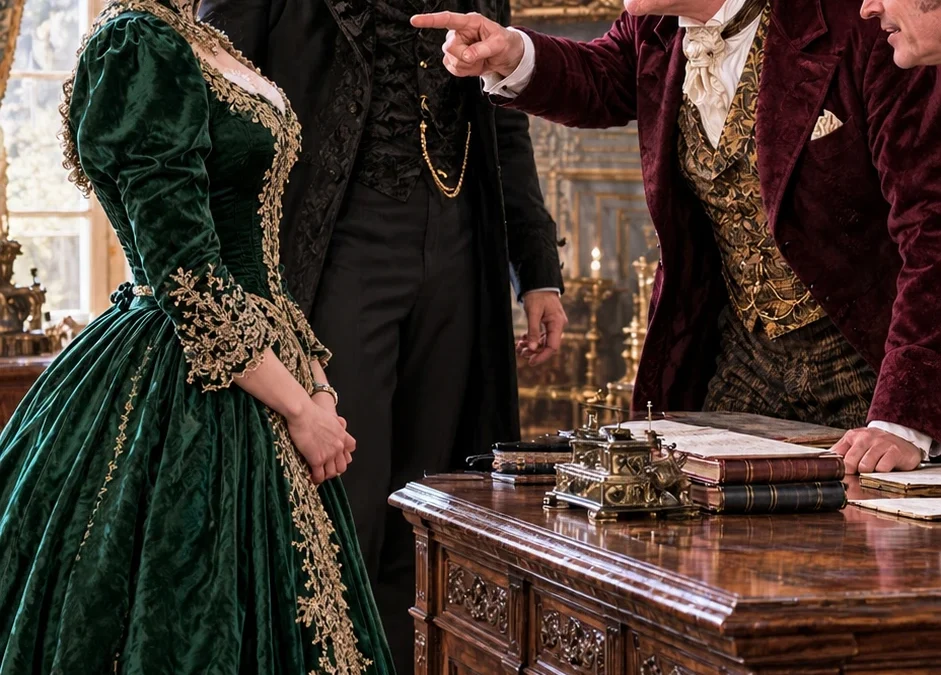
“Give Her to Anyone,” Her Uncle Screamed in Front of Three Creditors, Then a Silent Duke Rose From the Shadows and Spoke Only Her Name 😱
Part 1
The air in the study tasted of stale brandy and desperation.
Beatrice did not flinch when her uncle hurled his leather ledger at the fireplace. She did not cry when the creditors stepped closer.
“I don’t care!” Lord Croft spat, his face mottled with rage and ruin. “Take her! Give her to anyone who clears the debt!”
The room fell dead silent. 😨
Then, from the darkest corner of the library, a shadow detached itself from the wall.
A man stood.
Three hours earlier, the rain had been falling on London for three days, turning the cobblestones slick and washing soot into the gutters. But it could not wash away the stench of ruin inside Lord Croft’s townhouse.
Beatrice stood by the window, her spine rigid. Her faded blue wool dress had been mended twice at the elbows. It was practical. She was practical.
At twenty-four, she was long past blushing debuts and romantic delusions. She had spent five years managing her uncle’s dwindling household. Watering down the soup. Dismissing servants one by one. Pretending not to notice the bruised knuckles and bloodshot eyes he brought home from the gaming hells of St. James’s. 💔
Today, the pretenses were stripped away.
The fire in the hearth had burned down to sullen embers that offered no heat. Four men crowded the room with her, though she kept her gaze fixed on the dreary street outside.
“You owe me three thousand pounds, Croft,” said Mr. Higgins, a man whose tailored coat could not hide his thick, brutal neck. “I don’t deal in promises. I deal in hard currency or property.”
“I have property,” Lord Croft said, his voice high and cracked. The wine of a cornered dog.
“The Sussex estate is mortgaged to the hilt,” Lord Farnsworth interrupted, an older man who smelled of camphor and gin, tapping a gold-tipped cane against the floorboards. “The bank owns the bricks. We own the paper. You have nothing.”
Beatrice pressed her forehead against the cold glass. She knew exactly what was happening. Her uncle had finally reached the bottom of the barrel.
She calculated what lay hidden in the loose floorboard beneath her bed. Fourteen pounds and six shillings. Enough for a coach to Yorkshire and a month’s rent in a boarding house while she looked for work as a governess.
I will pack tonight.
“Just give me another week!” Croft begged, pacing, his boots scuffing the faded Persian rug. “My luck is turning, Higgins. Last night at White’s I was up two hundred before the tide turned.”
“Your luck is dead, Reginald.”
The voice had not come from Higgins. Nor from Farnsworth.
It came from the shadowed corner near the towering bookshelves.
Beatrice’s eyes flicked to the reflection in the windowpane. There was a fifth man in the room. He had been so still, so silent since arriving an hour ago, that she had almost forgotten him. He sat deep in the shadows, long legs stretched out, a glass of untouched amber liquid balanced on the arm of his chair. 🥃
Nathaniel, Duke of Ashborne.
She had met him exactly once, three years ago, before his older brother died and he inherited the title. A sharp-eyed second son then, wholly uninterested in the society that shunned him. Now he was a duke, and society still whispered. He did not host balls. He did not court debutantes.
He bought debt.
He owned shipping lanes, ironworks, and apparently a significant portion of her uncle’s misery.
Croft flinched. “Your Grace. If you would only extend the line of credit…”
“No.”
The single word dropped into the room like a lead weight. Quiet. Conversational. Completely immovable.
Higgins sneered. “You hear that, Croft? The Duke is done playing nursemaid. By tomorrow morning, you’ll be in Fleet Prison, rotting in debtor’s hell.”
Croft’s eyes darted wildly around the room. The empty safe. The bare walls where paintings used to hang.
And then they landed on his niece.
Beatrice felt a cold prickle of dread crawl up her neck. She turned from the window. She met her uncle’s eyes.
She saw the exact moment decency snapped, replaced entirely by animal desperation.
“I have her,” Croft said.
The silence that followed was absolute. The grandfather clock in the hall suddenly sounded like a hammer on an anvil.
“I beg your pardon?” Farnsworth rasped.
“My sister’s daughter.” Croft’s breathing was shallow and quick. He pointed a trembling finger at Beatrice. “Good breeding. Excellent pedigree. Unblemished reputation. She keeps a ledger perfectly. She’s twenty-four, no dowry, and entirely dependent on me.”
Beatrice did not move. She forced her face into a mask of stone. Inside, her stomach heaved.
She was not a weeping maiden. She was a woman realizing, with absolute clarity, the exact price of her life. 🩸
“What in God’s name are you suggesting, Croft?” Higgins asked, though his eyes slid over Beatrice, slow and appraising, making her skin crawl.
“Take her!” Croft shouted. He seized the heavy ledger from his desk and hurled it blindly. It struck the stone mantle and clattered into the grate in a cloud of ash. “I wash my hands of it all! Marry her! Make her a mistress! Sell her to a brothel in Paris! I don’t give a damn! Give her to anyone!”
He collapsed into his chair, burying his face in his hands, shoulders heaving with pathetic, ragged sobs.
Higgins whistled low. Farnsworth chuckled, a dry, rattling sound.
“Well, now,” Farnsworth murmured. “That is an interesting proposition. I am a widower, after all. And she does have a rather fine neck.”
Beatrice dug her fingernails into her palms until the skin broke. She would not cry. She would fight. She would run. She would carve out Farnsworth’s eyes if he touched her.
But she would not cry here.
Then the shadow in the corner moved.
The scrape of chair legs against the floorboards was shockingly loud.
Nathaniel stood. Tall, broad-shouldered, lean, dressed in stark black that made him look like an undertaker. He stepped out of the shadows, and the gray light from the window caught the sharp lines of his face. His expression was utterly blank. No anger. No disgust. No pity.
He did not look at Croft. He did not look at Higgins or Farnsworth.
He looked directly at the woman by the window.
He did not shout it. He did not frame it as a question. He simply said her name, anchoring it into the chaotic room like a spike driven through wood.
“Beatrice.”
Her heart beat so violently she could feel it in her teeth. His eyes were dark, unreadable, locking onto hers with a sudden, suffocating intensity.
And then he reached into his coat, and everything in that room changed. 😱
👇 Want Part 2? Find it in the comments, or leave any word and I’ll send it to you privately!
Part 2
Nathaniel reached into his coat and produced a thick stack of folded parchment. He tossed it onto the center table. It landed with a heavy, definitive thud.
“The promissory notes,” he said, his voice a low baritone, rough around the edges as though he did not use it often. “All of them. I bought out Higgins and Farnsworth this morning, before I came here.”
Higgins bristled and took a step forward. “Here now, Your Grace. I didn’t know you meant to use them to…”
“You have been paid, Mr. Higgins.” Nathaniel did not raise his voice. He did not even turn his head. “The door is behind you. Use it.”
There was a dangerous, coiled tension in the Duke’s posture. Higgins hesitated, knuckles white. Then the sheer glacial authority radiating from the man broke him. He muttered a curse and stormed out. Farnsworth followed, his cane clicking hurriedly across the floorboards.
The door clicked shut, leaving only three. 😳
Croft stared at the pile of notes, his mouth opening and closing like a landed fish.
“You hold all the debt?”
“Thirty-two thousand pounds.” Nathaniel finally tore his gaze from Beatrice and looked down at him. The contempt in his eyes was absolute. “Your gambling. Your failed investments. The arrears on the Sussex property. I own it all, Croft. I own the chair you are sitting in. I own the shirt on your back.”
“I cannot pay it.”
“I know. But you said…”
Croft looked from the notes to his niece, and a sickening gleam of hope dawned in his bloodshot eyes. “You want the girl to clear it.”
Beatrice felt the blood drain from her face. The room tilted on its axis.
She waited for the aristocratic sneer. The casual dismissal. He was a duke. He could have any willing, titled beauty in London. He would not take a ruined gambler’s niece as payment.
Nathaniel did not blink.
“Yes.”
Croft let out a breathless, hysterical laugh. “Done! Good God, done! She is yours, Your Grace! Burn the paper and take her!”
Beatrice finally found her voice. It was cracked and thin, but she forced it out.
“I am not a horse, Lord Croft. I am not a piece of furniture.”
Both men looked at her. Croft with irritation. Nathaniel with that same unreadable intensity.
“You will do as you are told!” Croft snapped, regaining a fraction of his bluster now that salvation was at hand. “You have eaten my food and lived under my roof for five years. This is how you repay me?”
She did not look at her uncle. She looked at Nathaniel.
“And what exactly are you purchasing, Your Grace?” Her tone dripped with a cynicism she had not known she possessed. “A scullery maid? A bedwarmer? A punching bag?”
He held her gaze. He did not flinch at her bluntness.
“A wife.”
The word hung in the air, heavy and absurd. 💍
“A wife,” Beatrice repeated flatly.
“I require a duchess.” He turned to the table, picked up the stack of notes, walked to the fireplace, and dropped them onto the glowing embers. The dry parchment caught instantly, a flare of yellow light illuminating his harsh profile. “I have no patience for the Season. I have no desire to court a child who giggles behind a fan. I need a woman who understands duty. Who can manage an estate. Who knows exactly how ugly the world is.”
He watched the papers burn until they were black ash curling in the updraft.
“Pack your things, Beatrice. We leave for Ashborne House. We will be married by special license on Thursday.”
“I have not agreed to this,” she said, her voice shaking with sudden fury.
He closed the distance between them, silent for so large a man, and stopped two feet away. Up close, she could see the exhaustion etched around his eyes, and a faint silver scar cutting through his left eyebrow. He smelled of rain, cedar, and something entirely solitary.
“You can stay,” he said, his voice dropping to a murmur meant only for her. “I have burned the debt. Your uncle is free. You owe him nothing now. You may walk out the front door and take your chances on the street.”
He looked at her faded dress, her trembling hands.
“Or you can come with me. You will never go hungry. You will never be struck. You will have your own rooms, your own allowance, and the protection of my name. I will demand your loyalty. In exchange, I will give you a life.”
It was not a romance. It was not a rescue. It was the coldest, most sterile proposal in the history of England.
Beatrice looked at his outstretched hand. Large. Uncalloused. Strong.
She looked at her uncle, weeping with relief by the fireplace. She looked at the bleak, rain-lashed street.
She placed her hand in the Duke’s.
His fingers closed around hers, warm and remarkably gentle.
“I have one trunk,” she said. 🌧️
The carriage ride to Ashborne House was a study in silence.
Beatrice sat stiffly on the forward bench, her small leather trunk strapped to the roof. The carriage was monstrously luxurious, upholstered in charcoal velvet, smelling of fresh leather and polish. A stark contrast to the threadbare squalor she had left twenty minutes ago.
Nathaniel sat opposite, an impenetrable wall of broad shoulders and dark wool. He watched the rain slide down the glass, jaw clenched, lost in whatever dark thoughts occupy a man who has just bought a bride on a Tuesday afternoon.
She kept her hands folded to hide their trembling. The adrenaline that had held her upright in the study was receding, leaving a hollow, icy panic. She had traded one cage for another. Society called him the Iron Duke. Not for military glory, but for his cold, unyielding nature.
The carriage hit a deep rut. Beatrice braced herself, but a sharp gasp escaped her.
His eyes snapped to her instantly. “Are you injured?”
“No. Just a jolt.”
He studied her for a long moment. His gaze dropped from her pale face to the thin, worn shawl around her shoulders. The damp London chill seeped through the floorboards. She suppressed a shiver.
Without a word, Nathaniel shrugged out of his heavy black greatcoat, leaned forward, and draped it over her.
It swallowed her in warmth. It held his scent: cedar, rain, clean soap.
“Keep it on,” he said softly, settling back into his corner.
“I am fine, Your Grace.”
“You are shivering. And it is pointless to let you freeze to death before Thursday.”
His tone was perfectly flat, but she caught a fleeting dark humor in his eyes. Gone as quickly as it appeared. It jarred her.
“Why did you do it?” The question slipped out before her pragmatic mind could stop it. “You spent thirty-two thousand pounds on a spinster with a ruined uncle.”
“Exactly.”
She frowned.
“Connections and powerful fathers are precisely what I do not want,” he said in a low, measured cadence. “I deal in trade, Beatrice. I own ships that sail to India and foundries in the north. The peerage despises me. Yet they flock to me when their gambling debts grow too high. A standard aristocratic marriage is a web of obligations. I marry a duke’s daughter, I marry his politics, his debts, his family squabbles.”
“So you bought a woman with no family left to protect her,” she said, her voice hardening. “Someone entirely dependent. Someone who cannot argue.”
“I bought a woman who survived Reginald Croft for five years without losing her mind.” He did not look away. “I watched you in that room. You did not cry. You did not faint. You were calculating the fastest way to the door. You are a survivor, Beatrice. I respect that.”
No one had ever called her a survivor. They called her a pity. A burden. The poor Croft girl. 🥺
She lifted her chin. “If you expect me to sit quietly in a corner and embroider cushions while you run your empire, you have made a terrible investment.”
The corner of his mouth twitched. Not quite a smile.
“If I wanted a mouse, I would have bought one. They are significantly cheaper than thirty-two thousand pounds.”
And then he told her the terms. Full control of the household at Ashborne. The staff, the budgets, the renovations. The house had been neglected since his brother died.
“Can you do it?”
“Yes,” she said immediately. It was what she was good at. Order out of chaos.
“Good.” He closed his eyes and rested his head against the velvet. “Then we understand each other. It is a partnership of convenience. Nothing more, nothing less. We will not pretend otherwise.”
Beatrice looked at the man she was to marry. Exhausted. Cynical. Entirely upfront about his coldness.
And yet, beneath the terror, a tiny, unfamiliar spark flickered in her chest.
Honesty.
For the first time in five years, she was not waiting for the other shoe to drop.
She pulled his coat tighter. The silence between them no longer felt heavy with dread. It felt like a truce.
Ashborne House did not welcome visitors. It loomed in the damp London evening like a limestone fortress, its narrow windows dark. The estate was massive.
It was also undeniably dying.
Nathaniel stepped down first, ignoring the footman scrambling with an umbrella, and offered Beatrice his hand. Servants lined the foyer with deep, unmistakable anxiety on their faces, looking less like a welcoming committee than a firing squad awaiting orders.
“Mr. Finch,” Nathaniel said to a thin, balding butler. “This is Beatrice. She will be the Duchess of Ashborne on Thursday. She now holds complete authority over this household.”
A ripple of shock ran through the staff.
He did not wait for a reply. He did not look at her again. He simply turned on his heel and strode down a long dark corridor, disappearing behind a heavy oak door that clicked shut with brutal finality.
Beatrice stood alone in the cavernous foyer, thirty-two thousand pounds of purchased bride.
She squared her shoulders. She was not a victim here. She was the manager.
“Mr. Finch, before I retire, I will need the household ledgers, the inventory books, and a list of all current staff. On my desk by morning.”
The butler blinked. “The ledgers, madam?”
“All of them.”
That night, alone in the vast, faded east suite, she locked the door. Only then did her knees buckle. She sat hard on the edge of the bed, pressing the heels of her hands against her eyes, breath coming in short, jagged gasps.
She let out one single, shuddering sob.
Then she clamped her hand over her mouth and choked it back down.
Crying solved nothing. Crying had not stopped the creditors. It had not stopped her uncle’s fists.
Action was the only armor she had.
Tomorrow, she would go to war with the dust of Ashborne House.
But she did not yet know that the real war would begin the night a crane snapped on the East India docks. 🩸
👇 LIKE or COMMENT “REVEAL” to see Part 3, which will be posted after enough comments!
Part 3
Thursday arrived wrapped in a dense, suffocating fog.
The wedding was the most depressing affair Beatrice had ever witnessed. It took place in the small chapel at the rear of the estate, its stone walls freezing, the air smelling of old incense and damp earth. There were no flowers. There was no music.
She wore a dark gray traveling gown, the nicest thing she owned, though the cuffs were frayed. Nathaniel wore stark black. He looked less like a groom than a man attending a board meeting.
The vicar, nervous and clearly afraid of the Duke, rushed through the vows. Nathaniel repeated his in a low voice, devoid of inflection. He took her left hand and slid a ring onto her finger. A heavy band of dark gold set with a square-cut sapphire flanked by two dull diamonds. Old. Intricate. Far too loose.
“I now pronounce you man and wife,” the vicar squeaked.
Nathaniel dropped her hand. He did not lean in to kiss her. He simply nodded, turned, and walked down the short aisle. Beatrice followed two paces behind, the heavy ring clinking against her other fingers.
In the hallway he stopped. “I have business in the city. I will not return until late. The accounts should be on your desk.”
“They are,” she replied, equally flat. “Mr. Finch is surprisingly efficient when terrified.”
His eyes narrowed, a spark of amusement breaking through his exhaustion. “Do not break the staff on your first day. They are difficult to replace.”
“I merely intend to weed out the thieves, Your Grace. The rest may stay.”
He stared at her a long moment. Then he gave a short, sharp nod and walked out into the fog.
Beatrice spent her wedding day buried in paper. The estate was bleeding money. Not from the Duke’s businesses, which were wildly successful, but from the house itself. Tradesmen overcharged. The butcher delivered half the meat they paid for. The coal consumption was mathematically impossible for a house with only a fraction of its rooms in use.
A familiar cold calm settled over her. Numbers did not lie. Numbers did not get drunk and throw ledgers at the fireplace.
By six o’clock she had summoned the cook and the housekeeper. She did not shout. She simply laid the ledgers open and ran her finger down the columns, asking polite, devastating questions about the price of flour. Within an hour, the housekeeper was weeping, the cook was pale, and Beatrice had recovered three hundred pounds in bloated invoices.
Her finger brushed the heavy sapphire. It slipped sideways. She frowned, pulled a spool of thick black thread from her sewing kit, and wrapped it around the base of the band until it fit snugly.
She was a duchess now. She had better get used to the weight.
When Nathaniel returned at eight, smelling of rain and city smoke, he found her at the vast mahogany dining table, a place long enough to seat forty. But she had set two places side by side at the center.
“An intimate arrangement,” he noted dryly, taking the chair beside her.
“I have no desire to employ a megaphone to pass the salt.”
A footman poured dark Bordeaux. Nathaniel took a long swallow, the tension in his shoulders easing fractionally.
“I am told you made the housekeeper cry this afternoon.”
“She was purchasing phantom coal and pocketing the difference. I only made her cry rather than calling the magistrate.” Beatrice finally looked at him. “Sixty tons in six months. Unless you are secretly running a steam engine in the West Wing, you are being robbed blind, Your Grace. The butcher is doing the same with the mutton, and the head groom is selling your oats to a neighboring stable.”
Nathaniel slowly lowered his fork.
Beatrice braced herself. Aristocratic men did not like being told they were fools, least of all by women they had purchased to be quiet.
A low rumbling began in his chest. It took her a moment to realize it was a laugh. A dark, rusty sound, from muscles long unused. 😲
“Sixty tons,” he murmured, shaking his head. “I knew the house was bleeding. I lacked the patience to track the wound.”
“It is never easier to ignore a rot. It spreads.”
His eyes fell to her left hand on the white linen. He reached out and closed his large, warm hand over hers, pulling it into the candlelight to examine the thick knot of black thread.
“It was too large,” she said defensively.
His thumb brushed over the coarse thread, surprisingly gentle. “This ring belonged to my mother. She was a small woman, but her knuckles were swollen with gout by the end.” He did not let go. “I can have it sized for you.”
“No.” The word came quickly, surprising her. “The thread is practical. It holds. That is all I require.”
He studied her face. The defensive set of her jaw. The way she built armor out of practicality and thread.
Slowly, he released her hand. “As you wish.”
The silence that settled over the table had changed its texture. It was the quiet of two solitary survivors realizing they might not have to fight the war alone.
“Pass the salt,” he said.
She handed him the cellar. Their fingers brushed. Neither pulled away immediately. 💛
Two months passed. Autumn stripped the trees bare around Ashborne House, leaving the estate a charcoal sketch against a slate sky. But inside, the house was no longer dying. It ran on the precise, unyielding fuel of Beatrice’s ledgers. The phantom coal vanished. The servants stopped walking on eggshells and settled into a crisp efficiency that grew into genuine respect.
Nathaniel remained a ghost in his own home, leaving before dawn, returning long after dark. They shared dinner every night at the center of the table. Their conversations were strictly logistical. Roof repairs. Shipping yields. The price of iron.
A bloodless marriage built entirely on structural integrity.
And yet Beatrice found herself looking forward to eight o’clock every evening. Memorizing the harsh angles of his face in the candlelight. The way his jaw tightened when he was tired. The rare dry humor that flickered in his eyes when she dismantled a tradesman’s excuse.
In late November, he announced a dinner.
“Lord Harrington and three of his sycophants. Investors in the railway line I am funding through the Midlands. They are bringing their wives.” He looked weary. “They need my capital, but they despise my methods. And the wives will try to belittle you. You are a sudden duchess with no dowry, no family, and a ruined uncle. They will smell blood. You do not have to attend.”
Beatrice looked at the man across from her. He was offering her an escape.
“I am the Duchess of Ashborne. If I hide in my rooms, they will assume I am weak. And if I am weak, they will assume you are weak for marrying me.”
Slow respect burned in his dark eyes.
“Wear armor, Beatrice.”
Friday arrived with a bitter frost. The dining room blazed with two hundred candles. Beatrice stood in deep emerald velvet purchased with the house funds, modest and severe, fitting her perfectly. The sapphire sat on her hand, still wrapped in black thread.
When the guests arrived, the temperature seemed to drop ten degrees. Lord Harrington was bloated and red-faced, smelling of port and unearned confidence. His wife, Lady Josephine, was a creature of sharp bones and sharper smiles.
The dinner was flawless. But the food was secondary to the warfare.
“Such a sudden marriage, Your Grace,” Lady Josephine remarked loudly over the soup. “We had no idea the Duke was even courting. I suppose, given your uncle’s… public difficulties, a swift arrangement was beneficial.”
The table went quiet. The other wives exchanged delighted, venomous glances. Nathaniel’s grip tightened on his knife, knuckles flashing white. He opened his mouth to end the evening right there.
Beatrice beat him to it.
She dabbed her lips with her napkin and met Lady Josephine’s gaze. She did not flush. She did not look away.
“My uncle’s difficulties were largely due to poor investments, Lady Josephine. He had a terrible habit of throwing good money after bad. He refused to look at his ledgers.” She turned her dark eyes to Lord Harrington. “Speaking of ledgers, I was reviewing the Duke’s shipping manifests this morning. Your estate in Kent is heavily leveraged against the success of this Midlands railway. A bold strategy. Tell me, if the steel shipments from Sheffield are delayed by winter snows, as they historically are, how do you plan to cover the quarterly interest on the six thousand pounds you owe the Crown Bank?”
The color drained from Harrington’s face so fast it looked like a physical blow. 😳
Society wives did not discuss trade. They certainly did not memorize debt structures and weaponize them over the soup course.
“I hardly think this is the time…” Harrington sputtered, glancing wildly at Nathaniel.
Nathaniel had leaned back, arms crossed, looking like a man watching a masterpiece being painted. The cold, dangerous aura he usually wore had entirely relaxed.
“The Duchess asked a question, Harrington,” he purred. “I am curious to hear the answer myself.”
“We have contingencies,” Harrington stammered, sweating into his cravat.
“I highly recommend utilizing them,” Beatrice said pleasantly. She motioned to Mr. Finch, who was struggling to hide a massive grin. “Finch, please pour Lord Harrington more wine. He looks a bit parched.”
The guests bolted for their carriages the moment the final course was cleared, abandoning any attempt to negotiate better rates.
When the front doors closed, the silence in the foyer was deafening. Beatrice stood by the staircase, adrenaline crashing, her hands shaking in the folds of her velvet skirt. She had gambled. She had memorized Harrington’s file from Nathaniel’s desk simply to understand her husband’s business, and loaded it like a pistol.
Nathaniel walked toward her and stopped a foot away. His dark eyes blazed with something entirely foreign. Not transactional. Not clinical.
Hunger. 🔥
“You read my private manifests.”
“They were on the desk.” She kept her chin up. “I like to know who is coming into my house.”
He reached out. He did not grab her hand this time. He cupped her jaw, his fingers rough, warm, and astonishingly gentle.
“My beautiful, ruthless wife,” he murmured, his thumb brushing her cheekbone.
For a fraction of a second, she thought he would kiss her. The space between them felt heavy, gravitational.
Then he dropped his hand and stepped back, the iron mask sliding into place. “Good night, Beatrice.”
“Good night, Nathaniel,” she whispered to his retreating back.
It was the first time she had ever used his given name.
He paused in the doorway for just a moment before disappearing into the dark.
January brought a freeze so deep the Thames began to slush with ice.
It was a Tuesday. Beatrice was in the morning room checking the linen inventory when the front doors banged open with the force of a cannon shot. Shouts echoed through the foyer. She dropped her pen and ran.
Three dock workers stood on the Persian rug, soaked to the bone, faces smeared with soot and panic. Between them, held up by two men, was Nathaniel.
He was a ruin. His coat was torn down the back. His face was gray, his jaw clenched in agony. A horrifying amount of blood soaked the left leg of his trousers, dripping onto the marble. 😱
“What happened?” Her voice did not shake. Panic locked down, replaced by the cold tactical efficiency she had honed over years of crisis.
“Crane snapped at the East India dock, madam,” one gasped. “Iron girders came down. He pushed a lad out of the way, but a cable whipped back and caught his leg.”
“Finch! Send a rider for Dr. Evans. Now. You three, carry him to the east suite. Do not drop him.”
“I can walk,” Nathaniel ground out. He tried to put weight on the leg and nearly collapsed.
“Shut up, Nathaniel,” Beatrice said sharply. “Carry him.”
She ran ahead, throwing open the doors, stripping the heavy coverlet from the bed. When the men laid him down, she sent them to the kitchens for whiskey and hot food. Then she grabbed the heavy shears from her sewing basket and began cutting away the blood-soaked wool of his trousers.
When she peeled the fabric back, her stomach rebelled. A ragged six-inch tear in his thigh, dangerously close to the great artery.
“Beatrice,” he whispered, eyes half closed.
“Don’t speak.”
She soaked linen towels in cold water, rushed back, and pressed a heavy pad directly into the wound. Nathaniel arched off the bed, a guttural sound tearing from his throat. She climbed up beside him, using her whole body weight to hold the pressure.
“I know it hurts. Hold still. You have to hold still.”
He shook uncontrollably. The iron facade was entirely shattered. He was just a man bleeding on a bed, fighting shock.
For twenty minutes, until the surgeon arrived, she did not move. Hands slick with his blood, she spoke to him in a steady, low stream of nonsense. The weather. The grain inventory. The terrible wallpaper in the guest wing. She anchored him to the sound of her voice, refusing to let him drift into the gray.
When Dr. Evans burst in, he took one look at her blood-soaked dress and the clamped wound. “You did well, Your Grace. If you hadn’t applied pressure, he would have bled out on this mattress. I need you to hold his shoulders. I must stitch it.”
“Do it,” Nathaniel bit out.
She leaned over him, pressing her hands against his broad shoulders. He opened his eyes. The pain in his gaze was blinding, but beneath it was absolute trust.
“Look at me,” she whispered. “Just look at me.”
As the needle began, he groaned, a terrible sound of pure torment. His hand reached blindly. She caught it. He crushed her fingers and buried his face in the crook of her neck, shaking with every pull of the thread.
She held him. She ran her hand through his damp, soot-stained hair, murmuring in his ear. She did not flinch from his pain.
She absorbed it. 💔
Beatrice did not leave that room for three days.
The fever hit on the second night. Nathaniel thrashed in delirium, shouting not about business but about his brother, about his father’s fists, about the suffocating weight of a title he had never wanted. She bathed his chest with cool water and forced thin broth past his lips. She slept in a chair pulled close to the bed, her hand on his chest to feel the steady beat of his heart.
On the morning of the fourth day, the fever broke.
She woke to the feeling of a heavy hand stroking her hair.
Nathaniel was awake. Haggard, stubble dark on his jaw, but his eyes were clear.
“You look terrible,” he rasped.
Beatrice let out a ragged, breathless laugh. She was in the same wrinkled dress she had worn for two days, hair falling from its pins, dried blood on her cuffs.
“You ruined my good rug with your river mud.”
He did not smile. He kept his hand in her hair, his thumb brushing her temple.
“Why did you stay? Finch could have hired a nurse. You are a duchess. You did not have to clean my blood.”
The cold, cynical armor she had worn since the day her uncle sold her was gone.
“Because you are my husband,” she said simply.
Nathaniel swallowed hard. He caught her left hand and looked at the heavy sapphire, still wrapped in its ugly, practical thread.
“When I stood in that room and bought your uncle’s debt, I told myself it was mathematics. I needed a manager. Someone who would not demand a romantic farce.” His thumb traced the thread. “I was lying to myself, and to you. I did not buy you because you were practical, Beatrice. I bought you because you were the only person in that room who was not afraid of me. You looked at me with absolute defiance, and I knew in that exact second I would burn the rest of London to the ground before I let another man take you.”
Beatrice stopped breathing. A warm, painful ache bloomed in her chest until it felt like her ribs might crack.
“Nathaniel.”
He pulled her hand to his mouth and kissed her knuckles, right over the rough black thread.
“I am terrified of you,” he confessed against her skin. “I am terrified that one day you will look at the ledgers, realize you have paid your debt, and leave.”
She slid from the chair and knelt beside the bed, level with him. She framed his rough face in her hands.
“The debt is burned,” she told him fiercely. “I am exactly where I choose to be.”
She kissed him.
It was not a polite, aristocratic press of lips. It was a collision. Desperate, bruised, tasting of salt and survival. Nathaniel groaned, his hand tangling in her hair, pulling her closer and ignoring the pain in his leg entirely. He kissed her like a man starving his whole life who had finally been handed bread. 🥹
When they broke apart, foreheads resting together, the quiet in the room was no longer transactional.
It was absolute, unbreakable peace.
Spring arrived in London with bright, hard sunlight. Ashborne House was unrecognizable. The windows gleamed. The gardens were pruned and beginning to bud. The staff moved with purpose, deeply loyal to a duchess who knew their names and a duke who paid them fairly.
Beatrice was reviewing the April accounts when Mr. Finch entered, his calm demeanor slightly fractured.
“Madam, there is a gentleman at the front door demanding to see you. He says he is your uncle.”
Her pen stopped scratching. A cold, familiar dread trickled down her spine.
Reginald Croft.
She had not heard from him in six months. She had assumed he had taken the clean slate Nathaniel gave him and fled to the Continent.
“Where is the Duke?”
“In his study, madam. Shall I fetch him?”
“No.” She closed the ledger and stood. “I will handle this. Show him into the drawing room and leave the door open.”
She did not feel the paralyzing terror of six months ago. She felt a cold, deep anger.
Croft was pacing the drawing room. He looked worse than she remembered. His clothes were fine but unbrushed, smelling of stale gin and desperation. His eyes darted around the room, assessing the value of the silver candlesticks and the velvet drapes.
He forced a wide, terrible smile. “Beatrice, my dear girl! Every inch the Duchess!” He stepped forward, arms open.
She did not move. “State your business, Reginald.”
His smile faltered into a petulant scowl. “Is that how you speak to the man who raised you?”
“You did not raise me. You tolerated me while spending my mother’s inheritance. Why are you here?”
He sighed and adopted a look of wounded pride. “I have had some temporary setbacks. A small debt of honor. Five hundred pounds. Barely a drop in the bucket for your husband. You have done well for yourself, thanks to me. I expect a little gratitude.”
“You sold me to clear your own neck. You hurled me at a room of creditors like a piece of meat.”
“I secured your future!” His voice rose, the old violent temper flaring. “Now go to your husband, open the vault, and give me the money, or I will go to the papers and tell them exactly how the Iron Duke acquired his bride. Tell them…”
“Tell them what?”
The voice came from the doorway.
Nathaniel stood there, leaning slightly on a silver-headed cane, a lingering consequence of his injured leg. But he filled the doorway completely, his face a mask of pure lethal ice.
Croft took a step back, blood draining from his face. “Your Grace, I was merely…”
Nathaniel did not look at him. He looked at Beatrice.
“Do you require my assistance, my dear?”
It was the ultimate show of respect. He was not swooping in to rescue a helpless maiden. He was standing at her back, giving her the sword. ⚔️
She looked at her uncle and saw a pathetic, broken man who had terrorized her youth. And she realized, with absolute clarity, that he had no power over her.
“No, Nathaniel,” she said softly. She turned her full attention to Croft. “You will not get a single shilling from this house, Reginald. You have no leverage. If you go to the papers, my husband will ruin what is left of your reputation before noon. If you come here again, I will have the footmen throw you into the street.”
“You ungrateful little…” Croft snarled, stepping forward and raising his hand.
Nathaniel moved so fast he was a blur of black wool. Before Croft’s hand could fall, the Duke had crossed the room and slammed his cane across the older man’s shins. As Croft buckled with a shriek, Nathaniel seized him by the throat and slammed him against the silk wallpaper. A priceless vase rattled on its pedestal.
“She told you no,” Nathaniel whispered, his face an inch from Croft’s terrified, purple one. “If you ever raise a hand to my wife again, if you ever speak her name, I will take you to the East India docks and throw you in the river with an anvil chained to your chest. Do you understand me?”
Croft choked, nodding frantically.
Nathaniel released him in disgust. “Finch! Remove this trash from my house.”
The butler hauled the weeping, ruined man away. The heavy front doors slammed like a gunshot.
The drawing room fell silent. Nathaniel stood near the wall, breathing heavily, hands clenched. He looked at Beatrice, searching her face for any sign of fear. Any sign that his violence had shattered the fragile peace they had built.
She walked toward him without hesitation, reached up, and smoothed the lapel of his jacket.
“He was going to hit you,” Nathaniel said, voice ragged.
“He would have tried,” she corrected gently. “And I would have broken his nose with the fire poker.”
The tension drained out of him in a shuddering breath. He dropped his cane. It clattered, forgotten. He wrapped his arms around her, pulling her flush against his chest, burying his face in her hair.
“The past is closed,” Beatrice murmured against his collarbone. “The ledger is balanced.”
He pulled back just enough to look at her. He reached into his waistcoat and drew out a small velvet box. Then he took her left hand and carefully unwound the thick black thread that had held his mother’s ring in place for six months. The thread fell away. He slid the sapphire off her finger.
He opened the box.
Inside was a new ring. Not an old family heirloom. Modern, clean, and terrifyingly expensive. A flawless rectangular emerald, the exact color of the dress she had worn the night she defended him against Lord Harrington, set in a band of bright, unblemished gold. 💚
“I did not buy you, Beatrice,” Nathaniel said, his voice completely steady, laying his soul bare in the middle of the drawing room. “I love you. I love your sharp tongue. I love your ledgers. I love the way you look at me as if I am actually worth something.” He held the emerald up. “This is not a transaction. This is not a debt. It is a choice. Will you choose me?”
She looked at the Iron Duke. The man who had bought her out of hell and given her the keys to a kingdom.
The tears she had refused to shed in her uncle’s study finally spilled over, hot and unashamed.
“I choose you,” she whispered.
He slid the ring onto her finger. It fit perfectly. It required no thread, no adjustments, no compromises. It was exactly where it belonged.
Nathaniel pulled her into his arms and kissed her deeply, sealing the promise in the quiet, sunlit room.
Outside, the ice had fully melted. The house was alive. And the Duke of Ashborne was finally, completely home. 🕊️
What began as a desperate transaction in a dusty library became a bond forged in fire, ink, and absolute loyalty.
Beatrice did not merely survive the Iron Duke.
She conquered him.
And in return, he gave her the world. 💍
If this story kept you reading until the very last line, share it with someone who believes love can begin in the most unexpected places.
This story is entirely fictional and created for entertainment purposes only. It does not represent any organization or individual, nor does it encourage inappropriate behavior. The content was generated with AI assistance.








