“GIVE YOUR SEAT TO MY MISTRESS,” THE DUKE ANNOUNCED IN FRONT OF ALL OF LONDON. THEN THE QUEEN OF ENGLAND STOOD UP, AND THE PENDANT AT HIS WIFE’S THROAT REVEALED A SECRET HE NEVER SAW COMING.
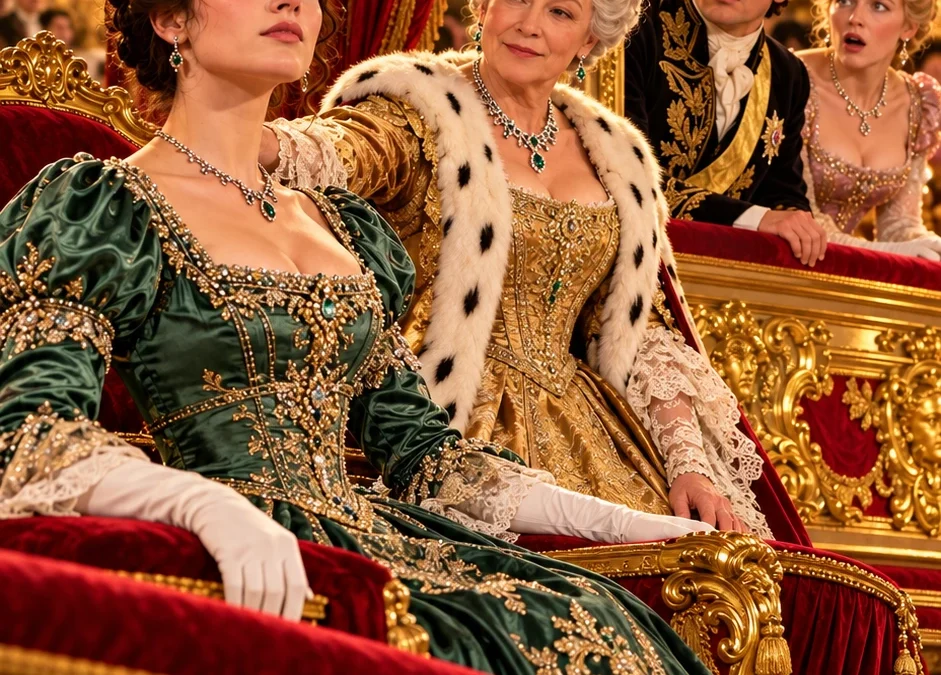
“GIVE YOUR SEAT TO MY MISTRESS,” THE DUKE ANNOUNCED IN FRONT OF ALL OF LONDON. THEN THE QUEEN OF ENGLAND STOOD UP, AND THE PENDANT AT HIS WIFE’S THROAT REVEALED A SECRET HE NEVER SAW COMING.
Part 1
Every seat in the King’s Theatre was full that April night. 🕯️
Five tiers of crimson velvet. Thousands of candles. Dukes, ambassadors, generals home from Spain. And in the royal box sat Queen Charlotte herself, in purple velvet, with amethysts in her silver hair.
Beside her, separated by a single gilded pillar, sat Julian Ashkam, Duke of Thornbury, thirty-two, dark-haired and devastatingly handsome. Next to him sat his wife Amelia, twenty-five, in lavender silk with a small diamond tiara.
At the end of the first act, the door opened. In swept a golden-haired woman in silver lace. Everyone in the theatre knew her name: Mrs. Arabella Fox. And everyone knew what she was to the Duke.
He did not stand. He did not look at his wife. He waved one hand at the seat where Amelia sat.
“Give your seat to my mistress.”
He did not say it quietly. He wanted the next boxes to hear.
A thousand opera glasses turned toward them. Amelia sat still for one moment. Then she rose, took up her fan, and turned toward the door without a word.
And in the next box, the Queen of England stood up. 😳
A queen does not stand for anyone. But to understand why she stood for a duchess she had not spoken to in three years, we must go back to a cold little chapel in Chelsea, and forty orphans singing a hymn.
Amelia Hart was the daughter of the chaplain at the Royal Military Asylum, a school for the orphaned children of soldiers. Her father taught the children to sing. By fifteen, Amelia was writing hymns for their small voices. She could play any tune she heard once, and she played her Welsh mother’s gilded harp so beautifully that the neighbors stopped on the riverpath to listen.
But there was no place for a woman composer. So the children sang her hymns, and no one outside the chapel knew her name.
When she was nineteen, her father died of a fever in three days. She stayed on as music teacher for half his wages.
That spring, Queen Charlotte visited. The children sang a hymn called The Soldier’s Child, which Amelia had written for her father. Halfway through, the Queen took out her handkerchief.
“Who wrote that?”
They brought forward a pale girl in a gray dress, her fingers still black with ink.
“You are a composer,” the Queen told her. “Do not let anyone tell you otherwise.”
Then she unpinned a small amethyst pendant from her own gown and pressed it into the girl’s hand. “So you remember that a queen heard it.”
Amelia wore it every day after, hidden against her skin. 💜
A year later, the Duke of Thornbury came to the asylum with his mother. He heard Amelia play. He brought her flowers and sheet music from Vienna. He called her good, quiet, and kind.
“I want a wife I can trust.”
She believed him. She was twenty, alone, and he had listened.
She did not know that for three years he had been the lover of Arabella Fox. She did not know his mother had threatened to cut off his fortune unless he married a respectable woman. She did not know he had chosen Amelia because she was the safest woman in England.
She was not a wife. She was a curtain hung in front of the truth. 🎭
The cruelty began quietly. On her first morning as duchess, he closed the piano lid gently over her hands. “Duchesses do not practice scales like governesses.” Her harp went to the attic. He forbade her to visit the asylum. When he found her writing music, he read the pages and fed them to the fire.
“I married a quiet wife. Not a scribbler.”
Every Tuesday, Thursday, and Saturday, he went out. Six months later, her Welsh maid Bethan finally told her the name. Mrs. Arabella Fox. Everyone below stairs knows.
Amelia did not cry in front of her. Later, alone, she cried for an hour. Then she remembered her father’s words: when you cannot change a thing, you can still choose how you carry it.
So she carried it quietly. And every night she held the amethyst in her palm, and wrote music in secret. Bethan smuggled the pages to the asylum in her sewing basket.
When the Dowager died, the Duke stopped pretending. Three nights out became six. He drove Arabella through the park in an open carriage. And Arabella, tired of being unreceived, began to want more.
“Take me to the opera. In your box. In her seat.”
The Duke hesitated. Then, because part of him enjoyed the idea, he agreed. He did not warn his wife.
Now, in the royal box, the Queen had watched it all. The mistress sweeping in. The cruel words. The laughter in the next box. And Arabella whispering softly, “Go on, little church mouse. Run home.”
Then, as Amelia turned, the great chandelier caught the pendant at her throat.
The Queen knew that pendant. It had been a gift from her own mother. She had worn it for thirty years. She had given it away only once. 😱
👇 Want to read Part 2? Find it in the comments, or leave any word below and I’ll send it to you privately!
Part 2
She had given it away only once.
The Queen leaned toward the pillar. She looked at the young woman’s face, older now and thinner and so tired. But she knew it. A pale girl in a gray dress with ink on her fingers.
So the Queen of England stood.
“My dear. Come here. You will sit with me.”
Amelia’s legs did not feel like her own. She stepped through the gap beside the pillar, and the Queen guided her down into the royal chair. When a lady-in-waiting tried to bring another seat, the Queen waved it away.
“I am quite comfortable.”
She bent her head and murmured, “The chapel in Chelsea. The Soldier’s Child.”
Amelia could only nod.
“You still wear it.”
“Every day, Your Majesty.”
“Good.” 🥹
Then, for the first time, the Queen looked into the next box, at the Duke of Thornbury, half out of his seat, red-faced, mouth open. She did not say one word to him.
She turned her back.
By noon the next day, all of London knew. Mrs. Fox sat in the seat she had craved, and not one person in the theatre looked at her.
The Queen’s own carriage took Amelia home, black and gold, four gray horses, scarlet footmen. Half of Grosvenor Square came to their windows.
The Duke was waiting in the hall, flushed with brandy. “Do you know what you have done? You humiliated me in front of all of London!”
Amelia took off her gloves one finger at a time.
“No, Julian. You did that yourself. I only stood up.”
For one moment she thought he might strike her. Then he turned and slammed his study door. Upstairs, Amelia sat on the edge of her bed in her lavender gown and, for the first time in two years, began to laugh. 😂
The cartoon appeared in a Strand print shop within the week: The Best Seat in the House. Arabella bought every copy. The shop printed more.
Five days after the opera, a letter arrived sealed in red wax with the royal arms, addressed not to the Duke, but to the Duchess of Thornbury.
Her Majesty requests your company at Frogmore House, Windsor, on Thursday. Please bring your music.
“You will write and say you are ill,” the Duke snapped.
“I will not lie to the Queen, Julian.”
“If you leave this house on Thursday, do not expect to come back to it.”
She drank her tea. “Then I suppose I will have to find out.”
On Thursday at eleven, a royal carriage rolled up outside, an officer of the household cavalry riding beside it. The Queen had simply sent it. The Duke could do nothing but watch from his window as his wife walked out in her plain blue dress, Bethan behind her.
And behind Bethan came two footmen, carrying a tall shape wrapped in a sheet.
Her mother’s harp. Brought down from the attic at five that morning.
At Frogmore, Amelia played for an hour and a half. The hymn from Chelsea. A harp sonata. A lullaby she had written for a child she did not have. The Queen never spoke. When it ended, she asked quietly:
“How much of this has been heard?”
“Only by the orphans, Your Majesty.”
“And your husband?”
“My husband burned the first pages I wrote.”
The Queen stroked her little dog for a long time. Then she leaned forward.
“I have a proposal for you.”
And what the Queen offered, and the trap her husband was already setting in the shadows, would decide whether Amelia would ever be free… 😨
👇 Do you want to know what the Queen offered, and what the Duke did next? LIKE this post or COMMENT “REVEAL” to unlock Part 3, which will be posted once we reach enough comments!
Part 3
“I need a new Woman of the Bedchamber,” said the Queen. “Three hundred pounds a year, rooms at Windsor. And one more duty: for my birthday in May, I want new music from an English composer. I want it to be you.”
“Your Majesty, I am married.”
“Your husband may refuse to let you take the post. He would be within his rights. And all of England would know the Duke of Thornbury had refused the Queen.” She sat back. “I do not think he will refuse. Do you?”
Amelia took it.
She laid the letter of appointment on her husband’s desk and watched him understand that there was nothing he could do. 👑
He did not refuse. He was angry, but not a fool. Three days later he laid a lawyer’s letter beside her plate.
“A wife’s earnings belong to her husband. Every penny. That is the law. So you will go to Windsor and sing for your supper, my dear, and I will have the supper.”
Amelia read it, folded it, and handed it back.
“Thank you, Julian. That is useful to know.”
He thought he had won.
On her second day at Frogmore, she went to see Mr. Craig, the Queen’s elderly treasurer, in his fireless room full of ledgers.
“When my salary is paid each quarter, I would like it paid somewhere else. To the Royal Military Asylum, as a gift for the music. I would like it called the Heart Fund, after my father, to buy instruments, hire a second music master, and give the best singers a little money when they leave. If it is never paid to me, it can never be my husband’s.”
Mr. Craig took off his spectacles and polished them.
“Your Grace, I have been treasurer for nineteen years, and that is the cleverest thing anyone has said in this room.”
The Queen laughed so hard she had to set down her teacup. The first quarter’s £75 bought twelve violins and an organ for the girls’ school. The governors printed their thanks in The Times. The Duke read it at his club and did not finish his breakfast. 😏
At Windsor, Amelia was given a room in the Round Tower with a piano that had once belonged to Handel. Every morning from six, she wrote the birthday ode. And she asked for one thing.
“I would like the orphans to sing it. Not the Chapel Royal choir. The children in red coats.”
“There will be talk.”
“There is already talk, Your Majesty.”
“Then let them talk about something worth hearing.”
Twice a week she rehearsed forty children in Chelsea with old Mr. Price, the white-haired, sixty-three-year-old music master with a bad leg and a wife of forty years.
And there, Arabella Fox saw her chance.
London had turned on her. Shops wanted payment. Ladies looked away. And from a maid, she learned that the Duchess rode to Chelsea twice weekly and spent hours behind closed doors with a music master. She did not ask his age.
She wrote an unsigned letter to the Morning Post hinting at a certain duchess’s secret appointments. The paper printed it Monday. By afternoon, the Duke had it in hand and a smile on his face.
On Tuesday he went to Windsor, grave and sorrowful. “I cannot let Her Majesty be deceived. I must ask that my wife be returned to my care.”
The Queen read the complaint. Then she sent for Amelia and held up the newspaper.
“Is it true?”
Amelia thought of everything she could say. She could cry. She could remind the Queen who had been faithless. Instead she said calmly:
“I rehearse the children on Tuesdays and Fridays from two until five. Mr. Price is always there. So are forty orphans. The doors are closed because the chapel is cold in April. We rehearse again Friday, if Your Majesty wishes to see.”
“I would.”
On Friday, a plain black carriage stopped at the chapel. A small old woman in a gray cloak slipped into the back pew. For twenty minutes, no one noticed her. Up front, the Duchess conducted forty children with a rolled sheet of music, smiling at a small boy who kept singing a beat too early.
When the ode ended, a little girl turned and screamed, “It’s the Queen!”
Forty children dropped into curtsies so fast three fell over. Mr. Price nearly collapsed on his bad leg. The Queen walked up the aisle, asked every child’s name and where their fathers had fallen, and gave the boy who sang too early a silver sixpence.
Then she turned to Amelia.
“So this is your secret lover.”
Amelia looked at Mr. Price, sixty-three, weeping into his sleeve, and could not help it. She laughed. So did the Queen. 😂
The Morning Post printed its longest apology ever the following Monday. And because the editor wished to stay in the Queen’s good graces, he handed over the original letter. It was written in Arabella Fox’s own hand, on her own pale pink paper, with her Keppel Street address at the top.
The Duke had carried his mistress’s lie to the Queen, and now everyone knew it.
He went to Keppel Street in daylight for the first time. Arabella went pale under her rouge, then lifted her chin. “I did it for us. Everyone laughed at me!”
“I know the feeling now,” said the Duke. And for the first time, he wondered what he had been paying for at all.
Within a month, Arabella fled to France, a mistress who had been caught lying to the Queen. She left a three-line note and a fortune in unpaid bills and gambling debts in his name. Most of his mother’s £40,000 was gone. The Prince Regent no longer received him.
And the Duke had one last hope: the Garter, the highest honour in England, which his father and grandfather had worn. Lord Melbury had died, the stall was empty, and the Prince Regent had asked his mother’s advice.
So the Duke went to Windsor with white roses.
“I was a fool. Come home. And when we are settled, you might say a word to Her Majesty about me.”
Amelia looked at him for a long time.
“The Garter,” she said softly.
His smile flickered.
“You did not come because you were sorry, Julian. You came because you need me to sit in a chair for you. You told me once to give my seat to your mistress. I did, and I found a better one. I am not giving it up for you.”
She laid the roses on the windowsill.
“Will you come to the concert? All the peers are invited. It is the first music of mine you will ever hear all the way through, without putting it in the fire.” 🔥
The Queen’s birthday concert was held in St. George’s Hall at Windsor, the shields of every Garter knight hanging along the walls.
The Duke came. A footman led him all the way down the long room to a seat in the very front row, two places from the Queen’s own chair.
She has forgiven me, he thought, sitting up straighter. Amelia must have said a word.
Backstage, Amelia’s hands shook. “For years I wrote music that nobody heard. It was safe that way. Tonight, all of England will hear it with my name on it.”
The little boy tugged her sleeve. “Your Grace, my papa was at Talavera. Do you think he will hear us?”
She knelt in her lavender silk on the dusty floor. “If anyone can sing loud enough, Tom, it is you. Just wait for Mr. Price’s hand this time.”
Her hands stopped shaking.
The trumpets sounded. The Queen entered on the Prince Regent’s arm. She stopped directly in front of the Duke of Thornbury.
“Your Grace, I believe you are in the Duchess’s seat.”
He did not understand.
“The Duchess composed tonight’s music. She will sit beside me. And so I am afraid I must ask you to give your seat to your wife.”
Two hundred people drew breath at once. 😱
The Duke stood, scarlet-faced and shaking, and walked the length of St. George’s Hall past every face that had envied him a moment before, to a single empty chair at the very back beside the door.
Amelia came down the aisle in lavender silk with the amethyst at her throat. The Queen took her hand and seated her in the chair her husband had just been forced to leave.
Then forty orphans in red coats sang the ode. They sang of soldiers who never came home, and children left behind, and a queen who crossed the sea at seventeen and made a strange country her own. In the last part, they sang The Soldier’s Child.
When it ended, nobody clapped. You could hear the candles hiss.
Then the Prince Regent, a large and emotional man, stood, blew his nose loudly, and began to applaud. In moments, the whole hall was on its feet. It was the first time in her life that anyone had applauded music with her name on it. 👏
The program said it plainly: Music by Her Grace, the Duchess of Thornbury. At the back, the Duke read those words again and again.
At supper, the Prince Regent announced the vacant Garter would go to the Earl of Ashford, a soldier who had lost his arm at Salamanca and had donated £1,000 to the asylum after reading the thanks to the Duchess in The Times.
Everyone applauded. No one looked at the Duke of Thornbury.
He went home to a house with forty rooms and no one in them. He sold Richmond to pay Arabella’s debts. He gave up his box at the theatre. In the autumn, he wrote asking Amelia to come home.
She answered the same day.
Julian, I am in the Queen’s service and will remain as long as she wants me. I will not divorce you. You may keep your name, your house, your lands. I want none of them. In public, I will be Duchess of Thornbury for the Queen’s sake and yours. In private, I will be what I was before I married you: a composer. If you ever wish to hear my music, you know where I am. But you will have to sit at the back.
He kept that letter for the rest of his life.
A year after that fateful night, the King’s Theatre opened its spring season with a new work. It was not an opera, since a woman could not yet write one for that stage. But between the acts, the orchestra played a harp suite, and on playbills all over London, a woman’s name appeared beside Mozart’s for the first time. 🎻
Every box was full. In the royal box sat Queen Charlotte in purple, and beside her, in a gilded chair of crimson velvet, sat the Duchess.
When the last note faded, the theatre rose in thunder.
“You should stand, my dear,” said the Queen. “They are applauding you.”
Amelia stood. Then she did something no one in that theatre had ever seen. She turned and held out her hand.
“Your Majesty, you stood for me once. Let me stand for you now. Will you take my chair?”
The Queen of England looked at her for a long moment. Then she laughed, took the Duchess’s hand, and sat down in the chair she had once given away.
In the next box, separated by a single gilded pillar, the Duke of Thornbury sat alone. He had bought back his old box for one night only and told no one. No Garter star shone on his black coat. The seat beside him was empty.
He did not look at the stage. He looked at his wife.
She never looked back. 💜
What do you think? Was Amelia right not to go home, even when the Duke said he was sorry? Or should she have given him a second chance? 💬 Tell us in the comments, and please LIKE and SHARE this story with someone who loves a good comeback.
This story is entirely fictional and created for entertainment purposes only. It does not represent any organization or individual, nor does it encourage inappropriate behavior. The content was generated with AI assistance.








