“Give Your Seat To My Mistress,” The Duke Ordered His Wife In Front Of All London… Then The Queen Of England Stood Up, And Everyone Gasped When They Saw What Was Around The Duchess’s Neck
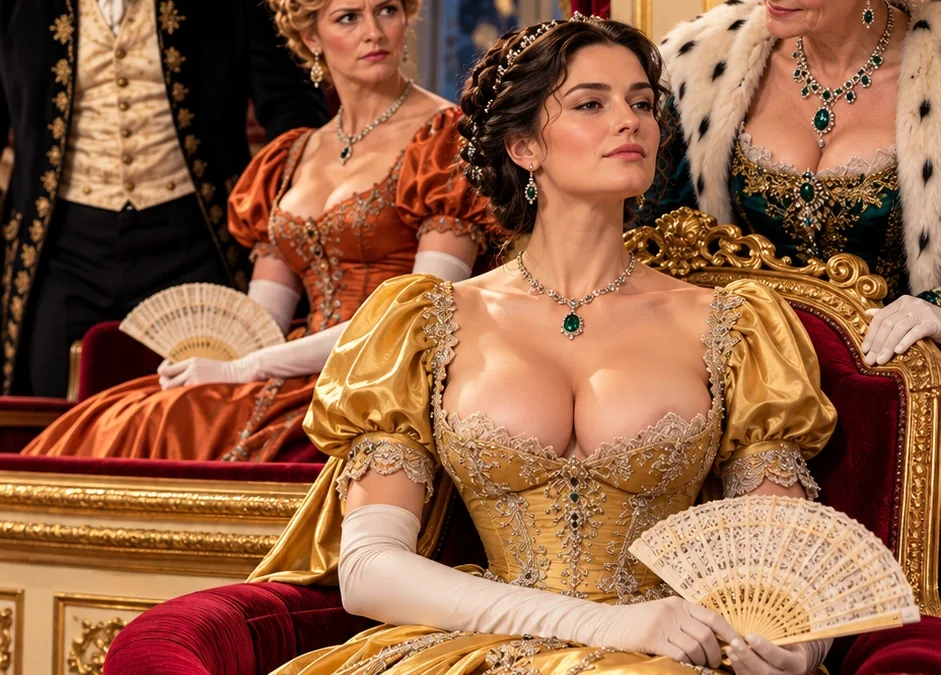
“Give Your Seat To My Mistress,” The Duke Ordered His Wife In Front Of All London… Then The Queen Of England Stood Up, And Everyone Gasped When They Saw What Was Around The Duchess’s Neck 😱
Part 1
“Give your seat to my mistress.”
The Duke’s voice cut through the Royal Lyric Theater while snow battered the tall windows outside.
His wife, Duchess Eleanor, sat frozen in lavender silk. Beside him stood his beautiful mistress, already smiling at the humiliation to come.
Hundreds of nobles turned to watch. 😳
Eleanor rose slowly, her gloved hands trembling. She had endured two years of betrayal, but never this.
Then a chair scraped against the floor in the box next door.
The Queen of England stood, and every conversation in the house died. She ignored the Duke completely and extended her hand toward Eleanor.
“Come, my dear. You shall have my seat.”
But why her?
On the coldest night of that Regency winter, snow fell over London as if the sky meant to bury the city whole.
One carriage after another drew up before the great doors. Inside, the cold was forgotten. Thousands of candles burned in crystal chandeliers, pouring light over row upon row of red velvet seats. Tiers of private boxes rose toward the painted ceiling, each trimmed in gold leaf, each a small stage where the powerful of London came to be seen as much as to see.
Tonight the house buzzed with a particular excitement. Queen Charlotte herself was in attendance.
Directly beside her box lay the private box of the Duke of Ravenshire. Lord Sebastian Blackthorne sat in its front row in a black coat stitched with gold thread, handsome in the hard, careless way of a man who had never once been told no.
Beside him sat his wife, Eleanor, Duchess of Ravenshire, in a gown of pale lavender silk. At her throat hung a small amethyst pendant on a thin gold chain, a modest jewel among the diamonds glittering all around her.
Eleanor had loved music more than anything in the world for as long as she could remember. As the orchestra swelled through the first act, something in her face softened. In two long years of marriage, there had been very few evenings when she felt happy.
This, for one fragile hour, was one of them. 🎶
When the curtain fell on the first act, the door at the back of the box swung open.
Mrs. Vivien Harcourt swept in on a breath of cold air, golden hair pinned high, her gown of silver silk catching every candle in the house. There was not a soul in that theater who did not know who she was. She entered as if the box belonged to her, as if the woman in lavender were merely a piece of furniture left in the wrong place.
Sebastian did not rise. He did not even look surprised. He turned toward his wife, lifted one gloved finger, and pointed at the chair she was sitting in.
“Give your seat to my mistress.”
He did not lower his voice. Somewhere to the left, a lady laughed behind her fan. Across the great horseshoe of the theater, opera glasses rose like a flock of startled birds, every lens turning toward the Duchess.
Vivien smiled and gathered her silver skirts, ready to sit.
Eleanor felt her fingers begin to shake beneath her white gloves. She tightened them around the ivory sticks of her little fan until the edges bit into her palm. She did not argue. She did not weep. She had learned long ago that tears only gave her husband another reason to call her weak.
She rose, smoothed the lavender silk, and turned toward the door.
As she passed, Vivien leaned close, perfume heavy as a hothouse, and whispered so only Eleanor could hear.
“Run along, little church mouse.” 💔
Eleanor had taken one step when a sound came from the box next door. The sharp scrape of a chair pushed back across a wooden floor.
Queen Charlotte had risen to her feet.
At once the entire theater fell silent. The queen looked straight past the Duke as though he were made of glass. Her gaze settled on the pale young woman by the door.
“Come here, my dear,” she said, in a voice that carried to the farthest gallery. “You shall sit with me.”
Eleanor could not move.
“Take my chair. I have been sitting long enough.”
Before hundreds of watching eyes, an attendant opened the little door between the boxes, and the Duchess of Ravenshire was led into the royal box and seated upon the Queen of England’s own chair. 😮
Sebastian sat rigid, color draining from his face. Vivien had finally won the seat she wanted, only to discover that not one person in the entire theater was looking at her anymore.
And as Eleanor turned in the candlelight, the amethyst at her throat caught the glow, and the queen’s eyes fell upon it.
She knew that stone.
She had worn it herself for more than twenty years, before she pressed it into the hand of an ink-stained girl in a freezing chapel. 😨
💬 Part 2 is waiting in the comments! Can’t find it? Leave any word below and I’ll send it to you privately.
Part 2
The queen knew that stone.
To understand why, the story must travel back to a small chapel on a winter morning, many years before.
Eleanor Witham was born in a narrow brick house on the edge of Kensington. Her father, the Reverend Frederick Witham, was chaplain and music master of the Royal Soldiers Academy, a school for the orphaned children of soldiers who had died in the King’s wars. Her mother had died when she was small, leaving behind a worn harp and a box of songbooks.
By fifteen, Eleanor was writing melodies of her own, little anthems and carols the children sang without ever knowing who had composed them. But she was a woman in Regency England, and the world had no place for a woman who composed. So she wrote quietly, filling notebooks no one asked to see.
Then came a winter so bitter the pump in the academy yard froze for a month. Her father caught a fever sitting up with a sick child, and within three days he was gone.
Eleanor was nineteen, with no fortune and no prospects. Out of her grief came a hymn for her father. She called it The Soldier’s Child. 🕯️
A few months later, Queen Charlotte visited the academy. Forty pupils in red uniforms sang Eleanor’s hymn in the freezing chapel, their voices plain and pure and aching. When the last note faded, the queen asked who had composed it.
Eleanor was brought forward in a plain gray gown, her fingers stained with copying ink.
“You are not merely a music teacher,” said the queen. “You are a composer.”
Then, to everyone’s astonishment, the queen unclasped the amethyst pendant from her own throat and pressed it into Eleanor’s palm. She wanted the girl to remember, on whatever dark days lay ahead, that her talent had once been recognized by a queen.
A year later, the Duke of Ravenshire’s carriage rolled through the academy gates. Sebastian, bored and thirty, heard the organ from the chapel door, saw a young woman in gray at the keyboard, and told her she had the hands of an angel.
He brought her hothouse flowers in winter, sheet music from Vienna, a fine silver pen. And Eleanor, against every instinct, believed she had found love.
He told her he wanted a wife who was gentle and trustworthy, unlike the vain creatures of the ballrooms.
What she did not know was that he had been lying from the first moment. For years he had been entangled with the widow Vivien Harcourt. His mother had refused to let him marry her, and had made her terms clear: marry a woman of spotless character, or lose the £40,000 she controlled.
In Eleanor, he found the perfect disguise. Poor, pious, and alone. 💔
After the wedding, the restrictions came one by one. He closed the lid of her pianoforte. He had her mother’s harp carried to the attic. He forbade her to visit the academy, and shut the door on her old friends.
One night, he lifted pages from beneath her hand, read a few lines with a curl of his lip, and dropped them into the fire.
“I married a quiet wife. Not a composer.”
Six months into the marriage, her maid Margaret told her the truth. The Duke had never stopped seeing Vivien. Everyone below stairs knew. Eleanor thanked her for her honesty and asked her to bank the fire. Only when the door closed did she weep until there was nothing left.
But she remembered her father’s words: a reed bends in the storm and still stands when the wind has passed.
So she began to compose in secret. At night, when Sebastian’s carriage rolled toward Belgrave Lane, she lit a single candle and wrote. Margaret hid the pages in her sewing basket and carried them to Mr. Walter Bennett, the old soldier who now led the academy’s music. Every Sunday, the children sang her new hymns, and she could never hear them.
Then Sebastian’s mother died, and he no longer needed to pretend. He appeared with Vivien openly. London condemned not him, but his wife. And Vivien wanted more. She wanted the Duchess’s own chair, before all of society.
That was the night of the snowfall.
Now, in the royal box, Queen Charlotte bent down and asked softly whether the children at the academy still sang in that cold little chapel.
Eleanor could only nod, her eyes filling.
Then the queen turned and looked into the neighboring box. She regarded the Duke for a long silent moment.
And she turned her back on him.
She said nothing at all. She did not need to. 😱
By noon the next day, all London knew. And five days later, a letter arrived bearing the royal seal.
But Sebastian was already plotting the one weapon that could destroy his wife, and it came from the pen of his mistress.
💬 Want to know what Vivien’s poisoned letter did, and what the queen said at the royal concert? LIKE or COMMENT “REVEAL” to unlock Part 3! It will be posted as soon as we have enough comments. 🔥
Part 3
The letter requested the Duchess of Ravenshire’s company at Wintermere House, the queen’s private residence near Windsor, and asked her to bring her newest compositions.
Sebastian forbade her to go. If she left without his permission, he said, she need not bother coming back.
“I cannot refuse the queen,” Eleanor said simply.
The next morning, a royal carriage with mounted guards drew up before the house. Behind Eleanor came Margaret with a small trunk, and two footmen carrying her mother’s old harp, rescued at last from the attic. For the first time in two years, she left her husband’s house without asking his permission. 🕊️
At Wintermere, the queen received her in a small sitting room with a roaring fire, wearing only a dove-gray gown and a lace cap. She looked less like a monarch than someone’s clever grandmother.
She asked Eleanor to play.
Her fingers were stiff at first, afraid. But the music remembered what her hands had forgotten. She played The Soldier’s Child. Then a harp sonata composed by candlelight while her husband was on Belgrave Lane. For an hour and a half, the queen sat perfectly still.
“Does your husband know what you have written?”
“He burned it.”
The queen said nothing for a very long time. Then she told Eleanor of a seventeen-year-old princess who had crossed the sea to marry a king she had never met, who had been told a queen existed only to produce heirs and keep her opinions to herself, and who had quietly refused to vanish.
“You cannot spend your whole life asking permission to be yourself. There is not enough time.”
Then she made an offer: a place as lady of the bedchamber, £300 a year, rooms at Windsor, and a commission for the royal birthday concert.
“Sebastian will never allow it.”
The queen smiled faintly. “He is welcome to try, and to explain to all London why he refused the crown.”
Eleanor accepted.
Three days later, Sebastian slid a solicitor’s letter across his desk, smiling. Under the law, a married woman had no property of her own. Every penny of her £300 would be his.
Eleanor read it, folded it neatly, and handed it back. She thanked him for letting her know.
At Windsor, she asked to see the royal treasurer, Mr. Malcolm Fraser. Her salary, she said, should never be paid to her at all. Every quarter, it should go directly to the Royal Soldiers Academy, to establish a fund in her father’s name. The Witham Music Fund. Instruments for the children. Fair wages for their teachers. Help for the poorest pupils.
Mr. Fraser peered at her over his spectacles, and slowly began to smile. If the money never passed through her hands, her husband could never seize it.
When the queen heard, she laughed so heartily her ladies came running.
The first payment arrived at the academy in a snowstorm. The governors bought violins, mended the organ, and bought warm cloaks for the choir. Their letter of thanks was printed in the newspapers.
Sebastian read it over breakfast at his club, while gentlemen around him praised the duchess’s generosity. He had not received a single shilling, and he knew he never would. 😏
Across London, Vivien’s world was coming apart. Shopkeepers sent bills. Friends were engaged elsewhere. But she was not a woman who accepted defeat. She learned the Duchess often rehearsed at the academy with Mr. Bennett.
One snowy morning, the Morning Post printed an anonymous letter hinting that a certain duchess, lately favored at court, was meeting secretly with another man.
Sebastian felt something close to joy. If his wife were disgraced, she would have nowhere to go but back to him. He drove to Windsor and asked the Lord Chamberlain to release her from her post, to shield her from scandal.
That evening, the queen laid the newspaper before Eleanor and asked quietly if there was any truth in it.
Eleanor did not shake. She explained: rehearsals from two until five, the chapel doors shut against the cold, forty children and Mr. Bennett always present.
“Your Majesty need not take my word. Come to the next rehearsal and see for yourself.”
Two days later, a plain black carriage drew up outside the chapel. A small elderly woman in a dark cloak slipped into the last pew. Forty children in red coats sang in the pale light, and the queen found her eyes had grown wet.
When it ended, she walked up the aisle. The children fell into a tangle of bows. Mr. Bennett struggled to his feet, leaning on his cane. The queen looked him over from head to toe.
“So this,” she said, with a perfectly straight face, “is your secret lover.” 😂
Eleanor burst out laughing. The queen laughed with her, and old Mr. Bennett, once the joke was explained, laughed hardest of all.
Three days later, the Morning Post printed a full apology. The original letter, surrendered under pressure, was written on pink scented paper in the looping hand of Mrs. Vivien Harcourt, with an address on Belgrave Lane.
The truth swept London faster than the lie had.
Sebastian stormed to Belgrave Lane. Vivien did not flinch. “It was you, not I, who ordered your wife out of her chair before all London. You made your choice that night.”
He walked out and never returned. Within a month, Vivien was shunned everywhere. She sold her jewels and slipped away to France. Her debts, run up in his name, consumed most of the £40,000.
Yet money was never what Sebastian wanted most. A place in the Order of the Garter had fallen vacant, his father had worn the blue ribbon, and he had imagined the star on his own breast since boyhood.
A week before the royal birthday concert, he drove to Windsor with an armful of white roses, the flowers Eleanor had loved since girlhood.
He stopped inside the door of her tower music room. Her mother’s harp stood by the window, restored and polished until it glowed. A pianoforte stood open beneath a window full of falling snow. It was exactly the life he had once forbidden her, built without him in a matter of weeks.
“I was wrong,” he said. “The affair was a mistake, the worst of my life. Come home. You could play, compose, visit the academy whenever you like.” Then, almost carelessly: “Perhaps you might say a kind word about me to the queen. It would heal the breach between our family and the crown.”
Eleanor looked at him for a long moment. And suddenly she understood everything.
“The Garter, Sebastian?”
He went very still. He had not come for love, or even guilt. He had come because he wanted a ribbon, and she was the only road left that led to it.
She did not raise her voice.
“For two years I tried with all my heart to become the wife you wanted. I gave up my music, my friends, and very nearly my self-respect, and none of it was ever enough. Now, for the first time in my life, I do not need your permission to live. You told me to give my seat to your mistress. I did. And I found a better one.”
He stood among the white roses and could not find a single word.
But she did not send him away empty-handed. She asked whether he would attend the queen’s birthday concert.
“It will be the first time a major work of mine is performed in public with my name upon it. It will also be the first time you have heard a piece of mine all the way to the end without throwing it into the fire.” 🔥
St. Edmund’s Hall at Windsor had been dressed for a royal birthday. Snow drifted over the courtyards. Hundreds of candles burned in tall silver stands, gleaming on the painted shields of knights long dead.
Sebastian sat in the front row, close beside the queen’s throne. He took it as a sign he had been forgiven.
When the trumpet sounded and the queen entered, the hall rose. She walked slowly down the aisle. And instead of proceeding to her throne, she stopped before the Duke of Ravenshire.
“Your Grace, I believe you are sitting in the Duchess’s seat.”
Sebastian stared up at her.
“The work to be performed tonight was composed by the Duchess of Ravenshire, and she shall sit beside me, as is only fitting. I am afraid I must ask you to give your seat to your wife.”
For an instant he did not move. Then, because there was nothing else he could possibly do, he rose. He walked the entire length of the hall beneath hundreds of watching eyes, all the way to the very last row, where a single empty chair waited beside the door. 😮
At the far end of the aisle, Eleanor appeared in her lavender gown, the amethyst glowing at her throat, and the queen herself took her hand and led her to the chair beside the throne.
Forty children in red coats filed onto the stage. Mr. Bennett limped to the conductor’s stand and lifted his baton.
The music told of soldiers who marched away and never came home. Of wives and children waiting at frosted windows, of grief settling over a household like snow. And of a woman who had answered that grief with kindness.
In the final movement, softly at first and then swelling until it filled the hall, came a melody the queen recognized at once. The Soldier’s Child, the hymn she had heard in a freezing chapel all those years ago, woven now into something far greater.
When the last note faded, the hall was utterly silent.
Then the Prince Regent rose and began to applaud, and the entire hall rose with him. 😭
For the first time in her life, Eleanor Witham stood before the world and was applauded by name as a composer.
In the last row, Sebastian sat holding a printed program with his wife’s name upon it, and understood at last the gift he had once held in his hands and thrown into the fire.
After the concert, the Prince Regent announced that the vacant place in the Order of the Garter would go to an elderly earl who had served with distinction in the army and given generously for many years to the Royal Soldiers Academy. Sebastian’s name was never mentioned. He left Windsor that night without speaking to anyone, the honor he had chased all his life gone forever.
Some months later, he wrote asking her to come home. She answered with a short, courteous letter. She would continue in the queen’s service. She would continue to compose. She asked nothing of him, not his lands, his money, or his jewels. She simply would not return to the marriage she had left.
In public, she would remain the Duchess of Ravenshire. In private, she would be what she had always been: a composer.
And if he ever wished to hear her music, she added, he was welcome to buy a ticket. But he would have to sit at the back.
A year later, winter returned to London, and snow fell once more on the steps of the Royal Lyric Theater. Between the acts of the opera, the orchestra performed a piece for harp and strings by Eleanor, Duchess of Ravenshire. Her name was printed on the official program.
Queen Charlotte sat in the royal box, and Eleanor sat beside her. When the music ended, the audience rose to its feet, and the queen smiled and told her she must stand and receive her applause.
Eleanor stood. Then she turned and offered the queen her hand.
“Your Majesty, you stood for me once. Let me stand for you now.”
She guided the queen into her own chair, and the two women smiled at one another while the theater thundered around them. ❤️
In the box next door, Sebastian sat alone. He had paid a small fortune to reclaim his old box for that single night. The chair beside him was empty.
He looked across at his wife, waiting, hoping she would turn her head.
She never did.
He had once ordered her to surrender a chair.
💬 If this story touched your heart, tell us in the comments: what would you have said to Sebastian in that last moment? Like and share this with someone who needs to know they never need permission to be themselves. 🙏
This story is entirely fictional and created for entertainment purposes only. It does not represent any organization or individual, nor does it encourage inappropriate behavior. The content was generated with AI assistance.








