He Cut the Barbed Wire Off a Dying Apache Mother, Never Knowing the Whole Town Already Wanted Him Dead… and What She Whispered Next Changed Everything
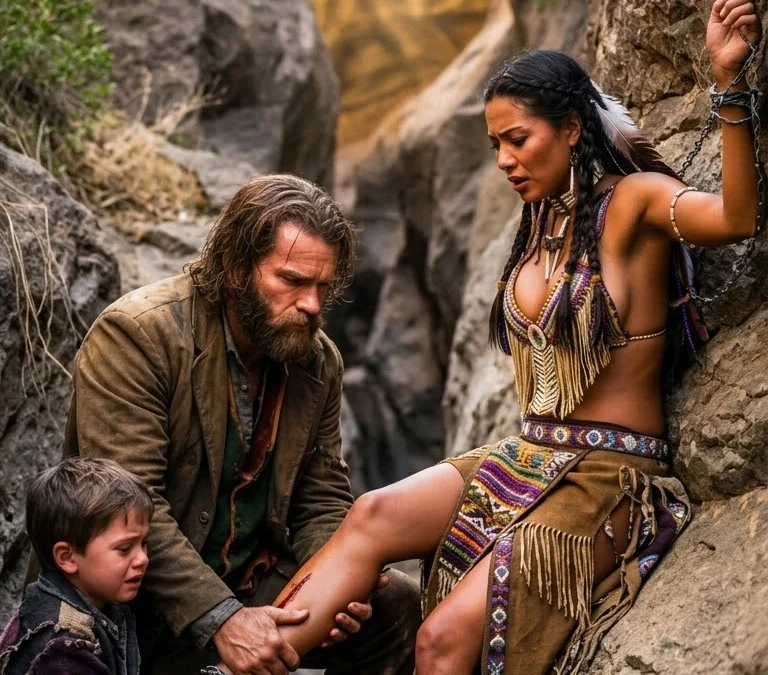
😱 He Cut the Barbed Wire Off a Dying Apache Mother, Never Knowing the Whole Town Already Wanted Him Dead… and What She Whispered Next Changed Everything
Part 1
The wind that morning cut like iron filings.
It hissed through the fence wire and flung grit against Cole Walker’s face. The air smelled of copper and dust, as if the world had been melted down and poured back wrong.
Outside San Judas Crossing, Arizona Territory, on the third of July, 1874, Cole was doing the only work that had ever quieted his mind. He checked fence line on a strip of land nobody truly owned.
Staple. Stretch. Tie. Step. Repeat until the day forgot his name.
It was penance, steady and silent, and Cole had earned every mile of it.
He had once been a soldier. He didn’t talk about that. He had lost everyone in different years, in the same war. He had come west to be alone with the ghosts, and for a long time it had almost worked.
Then the land made a sound it didn’t know.
It wasn’t cattle or wagon wheels. It was a boy’s cry, thin and breaking, as if the wind had snapped his voice in half.
Cole’s mare twitched her ears. A small figure burst out of the brush, barefoot and stumbling, both hands raised.
The boy nearly dropped to his knees. His chest heaved like it might split.
“Please,” he gasped. “My mother… she’s tied to a rock.”
Cole’s eyes swept the ridgelines the way they once had in the army, looking for glints and shadows. The desert had many tricks that began with the word please. Bandits sometimes used a child to bait a bullet.
But the boy’s eyes held the kind of truth pain always carries. It was raw and wide, with no room for acting.
Cole swung down. “Where?”
The boy pointed with his whole arm, because his hand shook too hard. “By the black stone. They left her there.”
Cole hesitated just long enough to hate himself for it.
“Lead,” he said.
They cut south, running the mare between sage and basalt. The boy’s feet bled in the dust, but he never slowed. The heat pressed in until the air felt solid.
Then Cole saw the rock.
It wasn’t the pale limestone of the flats. It was black, a slab of ancient volcanic stone, tall as a man and shaped like a broken blade driven into the earth.
And she was fastened to it.
Barbed wire, rusted red, spiraled around her wrists and ankles. It bit so deep it had turned her skin to torn lace. Dried blood hung in black ribbons that flaked when she moved. The wire pinned her spine to the stone and forced her face toward the sun.
Cole’s stomach turned. 😨
At the rock’s base, inches from her feet, a fissure split the earth. It was narrow as a hand and dropped straight into darkness.
She was straining to lean away from it. When she strained, the wire hummed, a cruel metallic laughter that men mistake for justice.
One wrong sway and she would fall into the crack. She might tear free, or she might vanish whole.
For a heartbeat, Cole stood frozen. The war crawled back through his bones, along with the memory of men left in traps built by other men who smiled while building them.
Then he moved, knife out.
The first scrape of steel on wire made a sound he would hear in his sleep for years. The barbs tore his gloves. He kept cutting.
She didn’t cry out. She turned her head slightly, eyes shut, mouth open but voiceless, like someone praying who never expected an answer.
The last twist snapped. Her body pitched sideways toward the fissure.
Cole caught her before gravity could finish what cruelty had started.
She weighed almost nothing. If you’ve ever lifted someone half-starved and heat-struck, you know that terrible hollowness. It feels like holding absence.
He carried her to a twisted, half-dead mesquite, the only shade for miles, and tipped his canteen to her lips. The first water ran down her chin. The second found its mark.
Her eyelids fluttered open. Her eyes were dark and fever-bright, and they locked onto his. Pride still lived behind the pain, the kind of strength you can’t beat out of a person.
“Slow,” she rasped. “Enough water.”
“Slow’s the only way,” Cole said.
The boy knelt beside her, whispering soft, quick words in Apache. Cole couldn’t catch a single one, but the tone said love.
Cole looked back at the black stone and felt cold settle in his chest. Bandits take what they want and ride. This was slower, almost ceremonial. Town work. Punishment dressed up as decency.
He tore a strip from his sleeve and wrapped her wrists. When he pulled the barbs from her ankles, the skin peeled with them. She hissed air through her teeth but didn’t beg.
That wasn’t pain in her voice. It was defiance. 🔥
He fed the boy and the woman first and ate last. The boy noticed the order. Children always do.
Overhead, two buzzards drew lazy rings in the heat, waiting on the outcome.
“We can’t stay,” Cole said at last. “There’s a canyon north. Water, shade. You walk until you can’t. Then I’ll carry you.”
He led them away from the basalt. Behind them the black rock stood shining, as though it were proud of the damage it had done.
By dusk they reached a hidden canyon, a clear stream, and a small fire the size of Cole’s fist. The woman finally spoke without a gasp.
“You, soldier?”
“Was,” he said.
She studied him and nodded once, understanding more than he’d said.
Late that night, the fire died to red eyes. Cole sat awake with his back to the stone and promised himself he would see them safe until morning and be gone by sunrise.
He lied. He just didn’t know it yet.
At dawn he found tracks in the mud above the canyon. Five horses, moving careful, one heavier than the rest. The hoof iron was stamped by the Prescott smithy.
That meant law.
They hadn’t been left to die by outlaws. Someone with a badge had tied that wire.
Cole buried the fire in sand and turned to her. Before he could speak, a lazy voice floated down from the rim of the canyon, calm as Sunday church.
“Cole Walker… you in there, boy? Hand her over, and I’ll forget the rest.”
Cole’s blood went cold. Nobody in this country was supposed to know his name. 😶
Part 2
Cole’s blood went cold. Nobody in this country was supposed to know his name.
He didn’t answer. He didn’t breathe.
“Ain’t no sense dying for another man’s property,” the voice called, lazy and sure.
Property.
That one word burned worse than the wire had.
Cole looked at the woman. She had gone still as carved stone, one hand gripping the boy’s shoulder, her chin lifted. She wasn’t afraid. She was counting.
“Nalin,” she said softly, when he looked at her. “My name is Nalin.”
“Cole,” he said. “Though it seems the whole territory knows that already.”
“Marshal Hargreaves,” she whispered. “He is the one who ordered the wire.” 😳
Cole’s jaw tightened. He thought of the badge, the writs, the lawful sale, and the fear in a town that called its cruelty law because it needed a word that let it sleep.
He pushed her and the boy deep into a cave above the ridge, dry and hidden, one narrow mouth facing north. He had used it years ago, running dispatch for the cavalry. Nobody found him then. He didn’t plan on being found now.
He crawled to a ledge and sighted his rifle.
Below, the first rider dismounted to check the wash. Cole took a breath and fired.
The shot cracked through the canyon. The man dropped. The others wheeled, shouting, and bullets sparked off the rock near Cole’s head.
Then came the worst kind of silence.
A pale hat edged into view. A brass badge flashed in the sun.
Cole fired once more. The bullet didn’t take the man’s heart. It took the badge, tearing it off his chest like a judgment. ⚖️
“Next one ain’t for decoration, Marshal,” Cole called.
Hargreaves swore and ducked back. “You’re already dead, Walker. You just ain’t laid down yet.”
They waited, still as stone, until the riders pulled back or pretended to.
That night they didn’t dare light a fire. Starlight crawled through the cracks, and the boy slept heavy, spent by the day.
Nalin came to sit beside Cole, a blanket around her shoulders.
“They’ll come back.”
“I know.”
“You’ll fight again.”
“I always do.”
She looked at him for a long time. Then she reached into her bundle and drew out a small deerskin pouch worn smooth by years of hands. Inside lay eagle feathers, a carved stone, and something that glittered like sand in moonlight.
“My husband carried this for luck,” she said. “It did not save him. They hanged him two winters ago for horses he never stole.”
She tied the pouch around her wrist, just above the wire scars.
“Tomorrow, you should ride away. They want me, not you.”
Cole laughed, quiet and mean. “You still don’t know me at all.”
“You will die for people who are not yours.”
“Maybe. But you’re mine now, like it or not.” 💔
She turned back to the dark. “That is not how my people speak of belonging.”
“I ain’t your people,” he said. “Maybe that’s the point.”
At dawn the boy’s lip trembled, though he swore he wasn’t afraid. Cole knelt and told him what he needed: quiet, fast, and brave. The boy nodded, far too solemn for his age.
They moved to a narrow saddle between two cliffs, one way up and one way through. Cole showed the boy how to stack stones and keep his mouth open when the guns started. Nalin gathered pitchwood. Cole set deadfalls where a footstep would betray weight.
“You could still leave,” she said softly.
“So could you.”
“No. My ghosts are here.”
“Then we stay together.”
It wasn’t gallantry. It was arithmetic.
Mid-morning, the wind turned. It carried the smell of horses, sweat, and burnt coffee.
“They’re coming,” Cole whispered.
Riders spilled into view, more than before. Marshal Hargreaves rode at the center with his pale hat and burnished badge, a man who expected the world to tilt toward him.
“Walker!” he called. “I got writs say that woman is property of San Judas for lawful sale. You turn her over, we’ll talk mercy.”
“You try to take her,” Cole answered, “we’ll talk God.”
Hargreaves sighed theatrically. “Last chance. Don’t make that child watch you die.”
Cole looked at the boy. The boy looked back, steady as a creek in shade.
“He’s seen worse mornings.”
Hargreaves lifted his hand. Cole saw the signal. He saw a deputy’s jaw tighten. He saw a rider touch heel to flank.
His finger curled around the trigger, and somewhere behind him Nalin whispered a word in Apache that sounded like a prayer, or a goodbye… 😰
Part 3
Cole fired first.
The world didn’t explode so much as unfold. A horse reared and its rider tumbled. A young deputy named Webb dropped low. Hargreaves jerked his reins and screamed orders no one heard over the guns.
Bullets chewed bark and threw splinters like bees with steel stingers. Nalin moved like a shadow with edges, her knife flashing. The boy lay flat against the stones and did not scream, which was the bravest thing Cole saw all day.
Two riders tried to force through the gap at once and discovered that physics had opinions. They jammed, cursed, and shoved. Cole put a round between them. A third man dove for the wrong cover and never rose again.
A chip of rock bit Cole’s cheekbone. Blood ran into his mouth, tasting of old pennies and new decisions.
“Down!” he barked, though the boy was already low.
Nalin hurled a flaming wad of pitchwood into a brush pile soaked with lamp oil. Fire leaped hot and sudden, and the wind chose a side. Smoke rolled into the riders’ faces. 🔥
Webb coughed, swore, and wiped his eyes. Cole saw the moment they cleared. They showed a man now, not a uniform.
Webb hesitated. In that small pause, a different life flickered and went out.
“Webb!” Hargreaves shouted. “Left! Take the left!”
Webb didn’t move left. He didn’t move at all. Slowly, he lowered his gun.
Hargreaves noticed too late. He wheeled to bark an order, and Cole put a bullet through the pale brim of the hat he loved like a mirror. The marshal fired low and grazed Cole’s thigh. Cole answered with a shot that took Hargreaves in the shoulder and spun him in the saddle like a man asking his past why it hadn’t written sooner.
Then silence, like a bell struck hard.
When the smoke thinned, three men were down. One crawled. Hargreaves lay on his back, staring at the sky between the pine needles as if it were too pretty for him. Webb sat with his gun in his lap and his head in his hands.
“Enough,” Nalin said, and even the wind seemed to adjust.
Cole stood slowly, his leg arguing. He walked to the marshal and let his shadow fall across him.
“Arrest me,” Hargreaves said through bloody teeth. “Make it official.”
“You ain’t the kind that looks good in irons. You’re the kind that looks good in a story told to men who like their lies loud.”
“Then kill me.”
Cole thought about mercy. He thought about the wire, the boy’s cry, and that word, property.
“No,” he said. “You’re going to ride back down and tell the truth. Five men went up that ridge and came down fewer. There was no woman to sell. There was a family to leave alone.”
“And if I don’t?”
“Then I’ll be water where the land is cruel, and stone where the water lies. Either way, you’ll meet me again.”
Hargreaves stared, unsure whether he’d been threatened or baptized.
Cole took his pistol and his badge. Webb helped the marshal into the saddle without being asked. They rode out ragged, less brave and more human, like a door closing halfway.
Nobody cheered. People who’ve lived long enough know better than to applaud a day that could still change its mind.
The boy looked up. “Is it finished?”
“Nothing’s ever finished,” Cole said. “But this part is quieter.”
They buried the dead, because leaving men to the birds only makes the birds mean. Nalin sang, not a lament and not a blessing but something in between that the pines seemed to understand.
At sunset they washed in a hidden spring. The water ran red, then remembered itself. Nalin brought three tiny juniper seedlings from damp earth where they’d hidden beneath moss, unlikely and stubborn. She set one beside the stone cairn, one at the lip of the pool, and pressed one into Cole’s hands.
“Plant it. Here, where you spoke your oath.”
Cole knelt and dug with his bare fingers. The earth was cold and clean. He pressed soil around the roots and set a small stone beside it so the wind couldn’t talk it into leaving.
Earlier at this same spring, she had taught him a vow that wasn’t words but a way to stand.
“I will be water where the land is cruel,” he had said. “I will be stone where the water lies. I will stand between this child and the men who hunt him.”
“And if the cost is your peace?” she had asked.
“Peace and I haven’t been introduced proper. Maybe this is my chance.” 🌲
Now she touched the carved stone from her husband’s pouch, untied it, and laid it on the cairn.
“Luck did not help the man who wore it. But perhaps gratitude will help those who come after.”
That night, Cole almost let himself believe the worst was over.
It wasn’t.
At dawn, a rider’s dust bloomed below, then more dust, then more. Hargreaves hadn’t come back alone. He had returned with the town itself. Six, maybe seven men, shopkeepers and ranch hands, carrying rifles and cheap conviction.
“They won’t stop,” Nalin said, wind tearing through her hair.
“No,” Cole answered. “But they can bleed.”
He led them along the ridge to a bowl-shaped hollow with one way in and no clean way out. It was a bad place to live and a good place to fight. A ravine angled north behind it.
“If they breach the rocks,” he told her, “take the boy up the ravine. Don’t stop.”
“And you?”
“I’ll keep them busy.”
Her eyes flashed. “Then you do not understand mothers.”
When the shooting began, it filled the hollow with smoke and thunder. Cole worked the rifle lever until it felt like breathing. A bullet grazed his shoulder and burned like iron. He bit back the curse and kept firing.
Then a man slipped past the lines and reached the hollow where they hid.
He grabbed Nalin’s arm and jerked her to her feet. His muzzle dipped toward the boy, as a coward’s promise does.
Something in Cole broke open.
He dropped the rifle and ran. The revolver bucked once. The man fell backward, eyes blank, and the world stuttered and remembered to keep moving.
Nalin staggered free, breathing ragged but alive. The boy clung to her. 💔
After that the fight thinned to scattered cracks and long silence. Then there was only wind through the pines and a jay starting up again, rude and relieved.
Cole leaned on the stone, trembling from the recoil and the rush. Blood soaked his shirt, some of it his and some not.
Nalin pressed her hand to his side. “You are hurt.”
“Not enough. They’re done.”
The valley below lay still.
They buried what they could. The boy carried stones, his small hands steady despite their shaking. In the pocket of one dead man they found a woman’s ribbon and a child’s marble. Nalin left both on the cairn.
“They were bad men,” the boy said at last.
“They were men,” Cole answered. “That’s bad enough.”
That night the fire burned low, and the boy slept hard. Nalin sat sewing a pouch of deerskin, her face softened by the glow.
“Why do you always eat last?”
“Habit. Soldiers learn to feed the living first.”
“Then you are still a soldier.”
“Not anymore. Just a man who forgot how to quit.”
She set down her work and crossed to him. Her fingers brushed the bandage on his arm.
“You saved my life twice.”
“Three times, counting the rock.”
“Then maybe I save yours now.”
She leaned in and pressed her forehead to his, for the briefest second.
It wasn’t a kiss. It was a truce between two survivors who had run out of places to hide from each other. ❤️
Morning came with mist curling through the pines. The boy stood by the stream, washing his hands, the water trying on his reflection to see how it fit.
“Can we stay here?” he asked.
Cole glanced at Nalin. She was waiting for the answer he hadn’t known he carried.
“Maybe,” he said, “if the land will have us.”
“It will,” she said.
They walked the bowl where they had fought and found that daylight had turned it into a museum, every bullet scar a label Cole didn’t want to read. They named the place together.
“Juniper Hollow,” Cole said at last.
“Hollow remembers,” Nalin said. “Juniper endures. It fits.”
They cut two saplings for corner posts. The boy held each upright while Cole tamped the dirt. Cole carved the rules into bark with the boy watching: No stealing water. No drawing guns inside the square. No lying where supper is served. No man eats twice before a woman eats once.
“And a woman?” Nalin asked, her mouth twitching.
“She eats when she wants. That’s the first law.”
The boy laughed, bright and unafraid of hearing himself. The sound climbed the pines and didn’t come back in pieces.
Weeks passed. They found an abandoned scout cabin in a green valley with a sagging roof and a stubborn chimney. They mended it with their own hands, and it took shape the way healing does, slow and uneven and full of small victories.
Cole patched the roof with cedar shingles. Nalin cleared the hearth and coaxed flame from bark and patience. The boy kept a ledger of simple truths in charcoal on a plank: Corn grew two. Fox stole one. Ma laughed. 🌽
On the second Sunday, they walked to the spring and said the oath again. Not because they feared forgetting, but because remembering is a muscle too.
“I will be water where the land is cruel,” Cole said.
“I will carry the names of what we bury to the spring each winter,” Nalin said.
“I will be mostly brave,” the boy added.
Nalin smiled and didn’t correct him. Bravery that knows it’s only mostly is the useful kind.
One cold dawn, a stranger named Luther Pike came down the north ridge, empty hand raised to show he knew how to be a guest. A trapper, he said. He brought news: San Judas was quieter since a marshaling went bad, and Hargreaves had ridden out with more pride than blood and come back with neither.
“There’s talk of a company buying water on paper,” Pike warned. “Paper’s a crueler rope than steel.”
Cole only nodded. Whatever came, they would meet it standing.
Before leaving, Pike looked over the cabin, the garden, and the boy on the stoop. “You got good bones here. Make them into a house that remembers.”
After he rode away, the boy carved a sign from a slab of fir and set it where the trail enters the hollow:
“Leave more than you take. Ask names before business. No guns inside the door.”
He paused, tongue between his teeth, and added a fourth rule in careful letters:
“Anyone tied to a rock gets cut free.”
Cole read it, and the man who had once walked fences as penance finally understood what his penance had been for.
He had never been waiting to be forgiven.
He had been waiting for someone to ask for help, and to be the kind of man who answered. 🌄
This story is entirely fictional and created for entertainment purposes only. It does not represent any organization or individual, nor does it encourage inappropriate behavior. The content was generated with AI assistance.








