He Fed Three Wounded Apache Strangers on a Freezing Night and Told No One. Three Days Later, Six Armed Riders Set His Ranch on Fire, and Then a Gunshot Echoed Across the Desert…
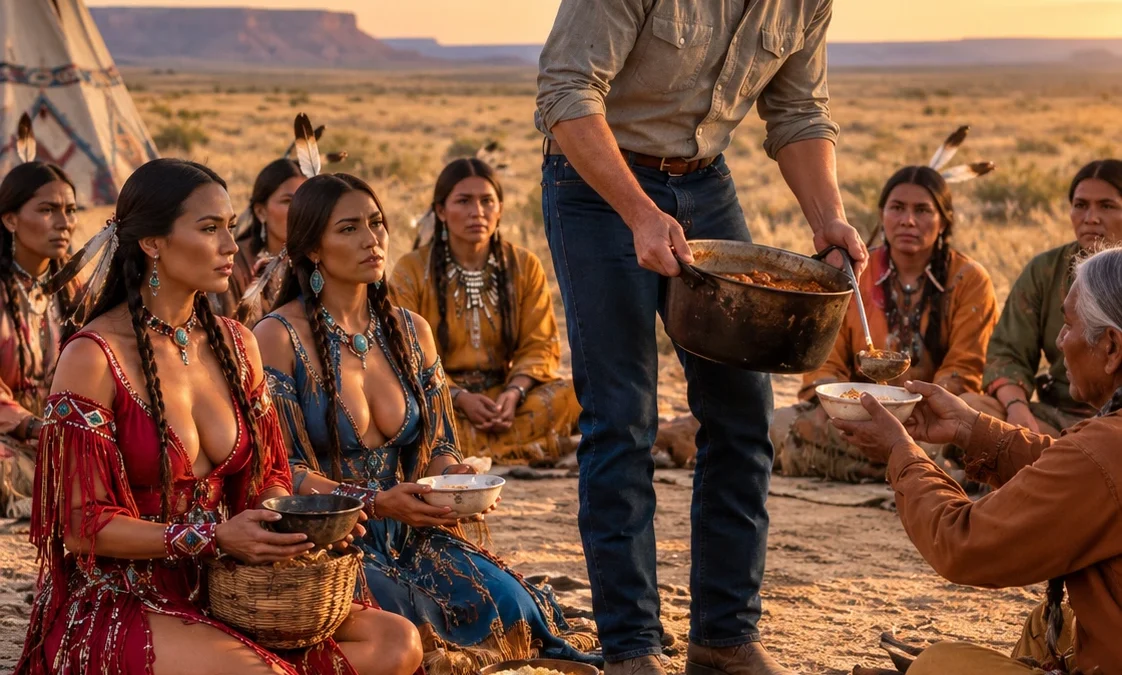
He Fed Three Wounded Apache Strangers on a Freezing Night and Told No One. Three Days Later, Six Armed Riders Set His Ranch on Fire, and Then a Gunshot Echoed Across the Desert… 😱
Part 1
The winter of 1883 came down hard on the Arizona desert. 🌵
The nights were bitterly cold, the kind that crept through floorboards and settled in the bones. Wind moaned across the empty land outside Tucson, and the stars looked sharp enough to cut.
Caleb Mercer lived alone on a lonely spread at the edge of all of it.
He had learned over the years to trust his rifle more than strangers.
Stories traveled across the frontier like dust. Tales of raids. Tales of revenge. Tales of families who had gone to bed one night and never woken up. Caleb had heard them all, and over time they had hardened inside him into something quiet and wary.
So when he went out one evening to check his horses, he carried more than a lantern.
The barn was dim and warm with the smell of hay. The animals shifted restlessly in their stalls.
Then he heard it.
A faint sound behind the barn. Soft. Scraping. The sound of something trying very hard not to be heard.
Caleb’s hand tightened on his rifle. He raised the lantern slowly and stepped around the corner.
The light fell across three figures pressed into the shadows against the wall.
Apache. 😨
One was a man, doubled over, blood darkening the cloth wrapped around his side. Beside him crouched a woman with hollow cheeks and frightened eyes. And between them, shivering so hard his teeth chattered, was a boy no older than eight.
Caleb froze.
Every story he had ever heard rushed through his mind at once. Raids. Revenge. Fire in the night. He knew what sheltering them could mean. If the wrong people found out, his ranch, his life, everything he had built could be forfeit.
His finger found the trigger.
No one moved. The lantern flame trembled. The boy stared at the rifle with enormous eyes, too exhausted even to cry.
Then the wounded man tried to rise.
He managed only a single step before his legs gave out. He collapsed into the dust, and the woman cried out softly, reaching for him.
Something inside Caleb broke open. 💔
He lowered the rifle.
“Come on,” he said roughly, though they could not have understood. “Get him inside.”
He lifted the wounded man himself, surprised by how little he weighed. The woman followed, clutching the boy’s hand. Caleb carried them all through the cold into the warmth of his small cabin, and laid the man down beside the stove.
He cleaned the wound with hot water and torn linen. His hands shook, not from fear now, but from the strange knowledge that he was doing something he could not take back.
He wrapped blankets around all three of them.
Then he went to the kitchen and made what little he had. Beans. Bread. Strong black coffee.
When he set the plates in front of them, the boy did not wait. He ate with both hands, quickly, as if afraid the food might vanish. The woman ate more slowly, but tears ran silently down her face.
It was the first warm meal they had seen in days. 🍞
Caleb sat in the corner, rifle across his knees, watching them eat.
The wounded man, once he could sit, pressed a hand to his chest and spoke in halting English.
“Nantan.”
“Caleb,” he answered.
Nantan inclined his head. He knew very few of Caleb’s words, but his gratitude needed no translation. It was in his eyes. It was in the way he looked at the boy.
That night, the cabin was quiet. No one slept deeply. But no one was harmed.
Before sunrise, the three travelers prepared to leave.
Nantan, pale but steady, stopped at the table. From inside his shirt he drew a small wooden horse, carved with care. He set it down in front of Caleb.
“A debt,” he said slowly, “is remembered.”
Caleb did not understand what he meant. Not yet.
He stood at the door and watched them disappear into the gray hills, a small figure leaning on a woman’s shoulder, a boy walking between them.
Then the land was empty again.
Caleb let out a long breath.
He told himself the danger had passed. He told himself it was over. He picked up the little wooden horse and turned it over in his hands, and he almost smiled.
He was wrong.
Three days later, hoofbeats thundered across the frozen ground. 😰
Six armed riders stormed into his yard, rifles across their saddles, faces hard and cold. Their leader, a broad man with a scar, reined in so close that Caleb’s horse stamped nervously.
“You seen any Apache come through here?” the man demanded.
Caleb said nothing.
“We’re asking you a question, Mercer.”
Silence stretched between them.
The leader smiled slowly.
Then a gunshot cracked across the distant hills, and something began to burn behind the barn.
Caleb turned and saw thick black smoke rising into the winter sky. The riders had set his haystack on fire. And their leader leaned down from his saddle and whispered, “Next time, it’s the house.” 🔥
Part 2
Caleb ran for the porch, rifle in hand.
Flames climbed the haystack, hungry and orange against the gray sky. Sparks leapt toward the barn roof. The horses screamed inside their stalls.
He swung the rifle up.
“Don’t,” the scarred leader said calmly. Five barrels were already trained on his chest. “We know you helped them, Mercer. We know exactly what you did.”
“I don’t know what you’re talking about.”
“Don’t lie to me.” The man’s smile was thin as a blade. “Tell us where they went, and the fire stops here. Keep quiet, and your house burns next.”
The smoke rolled across the yard. Caleb coughed, eyes stinging.
He thought of the boy eating with both hands. He thought of the woman’s silent tears. He thought of a man who had tried to stand with a wound in his side and fallen anyway.
“I’m not telling you anything,” Caleb said.
The leader’s expression hardened.
“Burn it.”
A rider lifted a torch toward the cabin roof.
And then, a strange silence fell across the valley.
It was not the silence of peace. It was the silence of something enormous holding its breath.
From the ridge came the low sound of horses. Not galloping. Walking. Slow and deliberate. 😨
The riders turned their heads.
Along the crest of the ridge, silhouetted against the pale sky, Apache riders were emerging one after another. Five. Ten. More. They spread out along the high ground, silent, watching.
At their front rode a figure Caleb knew.
Nantan.
He was no longer bent or pale. He sat tall on his horse, his face as calm as stone, a rifle resting across his saddle.
The scarred leader’s smile vanished.
“Easy,” he muttered to his men. “Nobody fire.”
Caleb’s heart hammered. He expected a battle. He expected blood on the frozen ground, his barn consumed, his life ending in smoke and gunfire.
Nantan raised one hand.
The Apache riders came down the slope in a slow, unbroken line and spread around the ranch until the six armed men were surrounded. Not a single shot was fired.
The silence lasted a long, long moment.
Then the scarred man cursed under his breath, wrenched his horse around, and spurred into the desert. The others followed, dust rising behind them, their torch dropped and sputtering in the dirt.
Caleb stood on the porch, barely breathing, as Nantan rode straight toward him. And what the Apache leader said next explained everything… 🔥
Part 3
Nantan dismounted in front of the porch and stood for a moment looking at the smoke still curling up behind the barn.
Then he turned to Caleb.
“You are not hurt?”
His English was still halting, but clearer now.
“No,” Caleb said hoarsely. “You came back.”
“I said a debt is remembered.”
Behind him, two of his men were already running toward the burning haystack with buckets and blankets. Others hurried to the barn to calm the terrified horses. Caleb watched in stunned silence as men he had once feared worked beside each other to save his property. 🕊️
By the time the fire died down, only the haystack was lost. The barn stood. The cabin stood. The horses were safe.
Nantan and Caleb sat on the porch steps as the sun dropped low.
“Those men,” Nantan said. “They did not hunt stolen horses. That was a lie.”
“Then what did they want?”
“Your land.” Nantan gestured toward the valley, the long open stretch beyond the fence. “A trail is planned. Wagons, many wagons, through this valley. Your ranch sits in the way. They wanted you gone. When they saw us come to your barn, they found a reason.”
Caleb stared at the ground.
He had spent so many years wary of the very people who had just saved his home. He had held a rifle on a wounded man.
“I almost shot you,” he admitted. “That first night.”
Nantan was quiet for a moment.
“I know,” he said. “I saw it in your eyes. And then I saw you put it down.” He looked at Caleb steadily. “That is why I came back.”
The words settled over Caleb like a blanket.
“The boy,” he asked. “And the woman?”
“Safe. My sister and her son. Because of you.” Nantan’s voice softened. “The boy asks about the man with the beans.”
Caleb laughed, and the sound surprised him. It was the first time he had laughed in a very long time. 💛
Over the following weeks, the ranch slowly healed.
Caleb rebuilt the haystack. He mended the fences. Nantan’s riders returned often, sometimes with fresh meat, sometimes simply to sit by the fire and talk in broken words and gestures. The little boy, whose name Caleb learned was Tomas, followed him everywhere, learning to feed the horses and brush down the mare.
But the danger had not gone.
The men who wanted the valley did not stop because six riders had been frightened off. Word came through town that surveyors had been seen along the creek. Papers were being drawn up. A deputy rode out one afternoon with questions that sounded polite and meant something else.
Caleb knew he could not fight it alone.
So he did something that would have been unthinkable a month earlier.
He rode to the nearest settlement and spoke to the ranchers. Quietly, one at a time. He told them what had happened. He told them about the fire and the lie about stolen horses. He told them the trail would cut through every one of their properties eventually, and that the men planning it cared nothing for fences or families.
Some refused to listen. Some muttered that he had lost his mind, siding with Apache over his own kind.
But a few did listen.
And one cold evening in early spring, the settlers and Nantan’s people sat down together on opposite sides of a fire in Caleb’s yard.
Fear sat heavily between them. Old grievances and older wounds hung in the air.
Nantan spoke first.
“We do not want your land,” he said. “We want to live. We want our children to live. You want the same. The men who burn your hay do not care about either of us.”
An old rancher named Hollis leaned forward, his weathered face troubled.
“Why should we trust you?”
Nantan looked at Caleb.
“Ask him,” he said simply.
Caleb stood. His hands were not steady, but his voice was.
“Because when I was holding a rifle on a bleeding man,” he said, “he didn’t reach for a weapon. He just waited. And because when my barn was burning, he didn’t wait at all.”
No one spoke.
The fire popped softly. Somewhere in the darkness, a horse stamped.
Then Hollis let out a long breath and leaned back.
“I never thought I’d see the day,” he muttered. But he nodded.
It was not friendship. Not yet. But the two sides agreed to stand together against the men who wanted the valley, and to share what they knew about the surveyors and the land deeds. 💛
Together, they sent letters to the territorial capital. Together, they gathered witnesses. When the men behind the trail plan came back with their papers and their false claims, they found a valley that no longer stood divided.
They did not get their trail.
The scarred leader was never seen in that part of the territory again.
Years passed.
The valley changed. Settlers and Apache families learned slowly to share water and trade goods. They never became close friends, not all of them. But they learned to respect one another, and in a land as hard as that one, respect was worth more than gold.
Caleb Mercer grew old on his ranch outside Tucson.
Tomas grew tall and strong, and one spring he rode into the yard on a horse of his own, with a wooden horse in his saddlebag that he had carved himself. He set it on the porch rail beside the old one.
“Two,” Caleb said, smiling.
“For the debt,” said Tomas. “And for what came after.”
Above Caleb’s fireplace, the little wooden horse sat where it had sat for decades. Visitors would sometimes ask about it, and Caleb would reach up and turn it gently in his weathered hands.
“A man gave it to me,” he would say. “On the coldest night of my life.”
And when they asked why he had kept it so long, he would smile and answer with the words he had learned from the longest winter he ever lived through.
“Sometimes the person you fear is the one who saves you.” 🌅
This story is entirely fictional and created for entertainment purposes only. It does not represent any organization or individual, nor does it encourage inappropriate behavior. The content was generated with AI assistance.








