He Fired the Governess for “Disrespect” at Dawn… Then Walked Past His Daughter’s Room at Midnight and Heard Something Being Packed
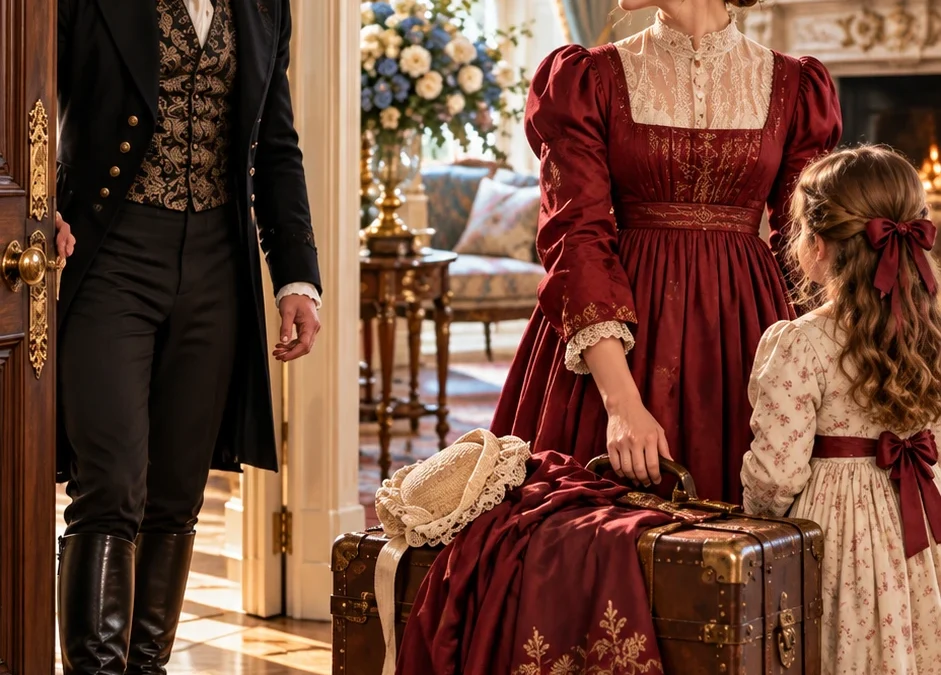
😱 He Fired the Governess for “Disrespect” at Dawn… Then Walked Past His Daughter’s Room at Midnight and Heard Something Being Packed
Part 1
The morning Duke Edward Ashborne dismissed Clara Bennett for disrespect, he believed he was defending his authority as a father.
By midnight, he would discover that his daughter had understood the moment very differently. 😨
For nearly five years, Clara had served as governess to Lady Sophie Ashborne, Edward’s only child. She had arrived when Sophie was eleven, awkward and grieving a mother she barely knew how to mourn. Over time, she had become one of the few people in Ashborne Hall with whom the girl spoke without measuring every word first.
Clara taught history, French literature, and mathematics.
But the lessons Sophie remembered most had nothing to do with books. Clara taught her to finish a thought even when someone older interrupted. To admit ignorance without shame. To tell good manners apart from silent obedience.
Edward had always considered Clara competent.
Until the day competence began to sound like contradiction.
The trouble started with a letter. 💌
Sophie was sixteen now, old enough to attend certain family gatherings, but still young enough, in Edward’s view, to need careful protection from poor judgment. Lord Henry Vale, the eighteen-year-old son of a neighboring family, had become one of her closest companions that summer. He was cheerful, curious, and far less impressed by rank than Edward thought appropriate.
When Edward discovered that Sophie had exchanged several letters with Henry, and meant to attend a picnic where he would be present, he ended the matter at once.
“You will not go.”
Sophie stood in his study, hands clenched behind her back. “Why?”
“Because I have said no.”
“That is not a reason.”
Edward looked up sharply.
Across the room, Clara felt the atmosphere change. Sophie felt it too. But instead of retreating as she once would have, she went on.
“I am asking what I have done wrong.”
His expression hardened. “You wrote privately to a young man without my knowledge.”
“I wrote about books. About writing. That is irrelevant to…”
She glanced toward Clara. Almost instinctively.
It was a single glance. It was enough.
So this is where it comes from.
“Your Grace…” Clara began.
“I am not speaking to you, Miss Bennett.” Edward turned back to his daughter. “This conviction that every decision must be debated.”
Sophie stepped forward. “Papa, Miss Bennett did not…”
“I am speaking to her.”
Sophie went silent.
Clara remained composed. “I have never encouraged Lady Sophie to disobey you.”
“No. But she has become remarkably willing to challenge me.”
“She has become older.”
Edward stood. “You mistake boldness for maturity.”
“And perhaps,” Clara said carefully, “you sometimes mistake disagreement for disrespect.”
The silence that followed was immediate. 😶
Sophie stared at Clara. In the doorway, the Dowager Lady Margaret Ashborne, who had entered unnoticed during the argument, drew in a quiet breath.
“You forget your position, Miss Bennett,” Edward said slowly.
Clara felt fear then. But not enough to make her lie.
“No, Your Grace. I remember it very well. That is why I know how easily someone without authority can be mistaken for someone without a voice.”
Margaret stepped forward. “That is quite enough.”
But Edward scarcely heard her. For years his household had run on clear lines. He did not consider himself cruel. He listened to advice, paid his staff fairly, and protected his tenants. He had given Sophie everything she needed.
Yet in that moment, Clara’s words sounded less like counsel and more like accusation.
“You are dismissed.”
Sophie gasped.
Clara did not move.
“You will receive three months’ wages and a reference for your academic abilities,” Edward continued, before he could reconsider. “You may leave tomorrow morning.”
“Papa. Sophie, no…”
Edward turned toward his daughter. The word shocked him more than Clara’s defiance had. Sophie’s eyes were bright with tears.
“She did nothing! She challenged me in my own study!”
“She defended…”
“Lady Sophie, please,” said Clara.
The girl looked at her. Clara’s voice softened.
“This is not your responsibility.”
Sophie shook her head. “It is because of me.”
Clara knew better than to argue while anger filled the room. She curtsied with a dignity that made the dismissal feel uglier than any plea would have.
“I will be ready in the morning, Your Grace.”
Then she left. 🚪
Edward told himself the matter was settled.
For the rest of the evening, Sophie stayed in her room. Margaret assured him the girl was being dramatic and would calm once Clara was gone. Edward tried to believe her.
Shortly before midnight, he walked past Sophie’s bedroom and heard the scrape of wood across the floor.
He opened the door.
A traveling trunk stood beside the bed. Sophie was folding dresses into it. 😳
Edward stopped. “What are you doing?”
She did not look up. “Packing.”
“For what?”
“For leaving.”
The answer was so quiet that for a moment he thought he had misunderstood.
“If Miss Bennett leaves because she defended me,” Sophie said, “then I am leaving too.”
“You will do no such thing.”
She finally looked at him. There was fear in her face. But something else, too.
Resolve.
“Will you lock the door?”
The question cut through him with more force than shouting could have. Edward had never struck his daughter. Never imprisoned her. Never imagined she could believe him capable of such a thing.
And yet Sophie stood before him, waiting for the answer.
For the first time that day, Edward wondered whether Clara’s disrespect had ever been the real problem.
Perhaps the real problem was that she had said aloud what his daughter had been too afraid to say… 💔
👇 Want to know what Edward said, and what Sophie was really afraid of? Find Part 2 in the comments, or leave any word and I’ll send it to you privately! 👇
Part 2
Edward did not sleep.
By morning, the anger that had made Clara’s dismissal seem necessary had been replaced by something far more uncomfortable.
Uncertainty.
Sophie’s trunk remained packed. She had not tried to escape in the night, nor had she written to Henry. She simply sat at breakfast in silence, pale from lack of sleep, while the servants moved around them with the strained caution of people who knew a household argument had crossed into dangerous territory.
Clara was due to leave at ten.
At eight, Edward asked Sophie to meet him in the morning room. She came reluctantly. He closed the door.
“I want to understand what you meant last night.”
Sophie stood by the window rather than sit. “I meant what I said.”
“You intended to leave with Miss Bennett.”
“To Aunt Catherine’s.”
Edward frowned. His widowed sister lived two counties away. “Did you arrange this? Did Clara?”
“No.”
“Then what exactly did you intend?”
“I would have asked her to take me to the station. Or I would have written to Aunt Catherine.”
“You are sixteen. You cannot simply leave whenever you dislike a decision.”
Her expression changed. “That is not why.”
Edward almost answered too quickly. He stopped himself.
“Then tell me why.”
Sophie looked genuinely surprised. Perhaps because he had asked, instead of correcting her.
For several moments she said nothing. Then the truth came slowly.
She had never planned to run away with Henry. She had not even imagined marrying him. She liked him because he treated her opinions as interesting rather than troublesome. The letters held nothing scandalous. A novel. A horse Henry was training. A lecture Sophie wished she had been allowed to attend.
“I hid the letters because I knew you would decide before I could explain.”
Edward leaned back. “You could have come to me.”
“I tried. Three weeks ago.”
He remembered it differently now. Sophie had mentioned the picnic while he was reviewing estate accounts. He had told her Henry’s influence was unsuitable and considered the matter resolved.
“I did not know you were trying to explain.”
“That is because you were already answering.”
The words echoed Clara’s. Edward felt irritation rise, then recognized it for what it was.
Defense.
“Miss Bennett told me I should stop hiding things from you,” Sophie went on. “She said secrets become dangerous because people use them to imagine worse things.”
That did not sound like rebellion. 🤔
Sophie twisted her hands together. “She never taught me to disobey you. She taught me to stop being afraid of telling you what I think.”
Edward felt the room grow smaller. “Afraid?”
Sophie lowered her gaze. “Not afraid that you would hurt me.” She looked up again. “Afraid you would stop being pleased with me.”
That hurt more.
Edward had always believed Sophie knew she was loved without condition. Apparently he had made his approval feel conditional.
When Margaret heard that Clara had not yet left, she protested. “You are allowing a servant to divide father and daughter.”
Edward looked at his mother. “Was Sophie divided from me yesterday?”
Margaret hesitated. “That girl has become too independent.”
Something in the phrase unsettled him. Too independent. He had heard it before. Years earlier, his own father had used those words about Edward’s late wife, whenever she challenged a household decision. Becoming difficult. Encourages too many opinions. Forgets what peace requires.
Edward had always believed he was unlike his father.
The resemblance now felt closer than he wanted.
Still, he did not stop Clara from leaving. That would have been too easy, and too much like another command.
At ten, her carriage departed. Sophie watched from an upstairs window. Edward watched Sophie.
The distance between them felt larger than the driveway. 🌧️
Later that afternoon, he entered the schoolroom. Clara’s desk had been cleared. The room seemed strangely impersonal without her shawl over the chair, or the stack of essays she always kept beside the window.
He opened a drawer, looking for nothing in particular, and found a slim notebook. Not a diary. A teaching ledger.
Most pages held lesson plans and reading lists. But several notes stopped him.
Encourage her to answer before correcting her. She apologizes too quickly when adults disagree. Ask what she thinks before telling her what is proper.
She knows the expected answer before she knows her own.
Edward sat down.
The notes were not accusations. That made them worse. They were observations, written over years by someone who had paid attention.
Near the end, one line had been underlined once.
She is brave when defending others, and timid when defending herself.
Edward closed the book.
For five years, he had believed Clara’s job was to educate his daughter. Only now did he understand she had also been listening to her. And he began to wonder how often he had mistaken obedience for trust, simply because obedience was easier to see.
He waited four days before going after Clara.
Not because he needed time to forgive her. Because he needed enough honesty to know why he was going.
She had taken a temporary post at a girls’ school near Bath, helping an old friend until she decided what to do next. Edward could have written. He could have sent a carriage.
He did neither. He went himself.
Clara received him in a small parlor overlooking a wet winter garden. There was no Ashborne crest, no servants in livery, no architecture reminding her who he was. For perhaps the first time, Edward had to speak without the help of his position.
“I did not come to order you back.”
Her expression barely changed. “That is reassuring.”
He almost smiled. Then he grew serious.
“I came to ask you something. What did you think I was doing wrong?”
The question clearly surprised her.
Clara sat opposite him. “You may not like the answer.”
“I am beginning to suspect that is the point.”
She looked toward the garden for a moment. Then she told him.
He loved Sophie. That had never been in doubt. His mistakes came not from indifference, but from certainty. He had spent so long believing responsibility meant protection that he rarely noticed when protection became control.
“When she agrees with you, you call her sensible,” Clara said. “When she disagrees, you begin looking for the person who put the idea in her head.”
Edward thought of Henry. Then of Clara. He said nothing.
“She has learned that honesty is safe only when it confirms what you already want.”
“That is severe.”
“Yes. But you believe it.”
“Yes.”
Edward looked down. And then Clara said the sentence that made his chest tighten.
“She does not lie because she is rebellious. She lies because she believes honesty will cost her your affection.” 💔
His late wife returned to him in memory with painful clarity. Anne had once stood beside Sophie’s cradle and said, “Do not make her earn tenderness by being easy.”
He had laughed, kissed her, and promised.
Somewhere in the years after her death, grief and fear had hardened that promise into something else.
“I failed her,” he said.
“You frightened her into being careful with you.”
“That sounds worse.”
“It is also fixable.”
He looked at her. “Come back.”
Clara shook her head. The refusal was immediate, but not cruel.
And what she said next changed everything… 😶
👇 LIKE or COMMENT “REVEAL” to see Part 3! It will be posted as soon as we have enough comments. 👇
Part 3
“Sophie needs you,” Edward said. “She misses you.”
“That is not the point.”
He frowned.
“If I return now because you need me to repair what happened between you and your daughter,” Clara said, “then nothing has changed. I become the person who translates her to you. Again.”
Edward understood slowly, painfully. “You think I have to do it myself.”
“Yes.”
He looked almost amused, despite everything. “You make that sound obvious.”
“It usually is, once someone else says it.”
Edward returned to Ashborne Hall alone.
That evening, he asked Sophie to join him in the library. She entered cautiously. He did not tell her to sit. He waited until she chose a chair.
Then he said the sentence he had rehearsed the whole journey home.
“I have spent years asking whether you were obedient. I should have asked whether you trusted me.”
Sophie’s face changed immediately.
Edward continued before she could rescue him from his discomfort. “I was wrong to dismiss Miss Bennett for speaking in your defense. I was also wrong to assume that disagreement meant someone had taught you to defy me.”
Sophie began to cry quietly. Edward wanted to cross the room and comfort her.
He waited. That, too, was new. 🕯️
When she finally spoke, the words came in fragments at first, then more steadily. She told him about conversations she had abandoned because his expression changed. About questions she had stopped asking. About how much she loved him, and how exhausting it was to love someone while constantly wondering whether honesty would disappoint him.
Edward listened. He did not explain himself. He did not remind her of his intentions.
He simply listened until she finished.
Then he said, “Thank you for telling me.”
Sophie stared at him as though those five words were more astonishing than any apology.
Nothing was mended in a single night. But something had opened. And for the first time, Edward understood that trust was not something a father could demand simply because he loved his child.
It had to be built in the moments when she told him something he did not want to hear.
Clara did not return to Ashborne Hall for three months.
During that time, Edward changed in ways small enough that no guest would have noticed. Sophie did.
He stopped opening her correspondence unless she asked him to read something. When she requested permission to attend a lecture in town, he asked who would be there before deciding. When they disagreed about visiting Henry’s family, he listened to her argument without treating it as evidence against her character.
Sometimes he still said no. But now he explained why. Sometimes Sophie still got angry. But she no longer fell silent afterward.
The difference was not that Edward had given up his authority. It was that authority no longer demanded Sophie give up herself. 💛
Margaret found the changes unsettling. “She argues more now.”
Edward smiled faintly. “Yes. You say that as though it is a bad thing. I say it means she expects me to listen.”
By spring, he wrote to Clara.
The letter took him nearly an hour, because every version sounded like an instruction disguised as politeness. In the end he wrote:
If you would consider visiting Ashborne Hall, Sophie and I would both be glad to see you. I will not presume upon your answer. The choice is entirely yours.
Clara came two weeks later. Not as a governess. As a guest.
Sophie ran down the front steps before the carriage had fully stopped, then caught herself halfway and approached with slightly more dignity.
Clara hugged her anyway. 🥹
Edward watched from the doorway.
Later, he and Clara walked through the schoolroom together. It looked different now. Sophie had chosen several new books. Her drawings had been moved from a drawer to the wall.
Edward paused beside the old desk.
“I fired you because I thought respect meant agreement.”
Clara looked at him.
“Now I think respect is what remains after disagreement.”
She smiled. “That is considerably better.”
He laughed softly.
He did not ask her to resume her old position. Instead, he offered something else: the supervision of a small school he was setting up for girls from estate families. A role separate from the private household.
Clara asked for time to think. Edward granted it. And that, perhaps, was answer enough.
Several weeks later, she agreed.
The final proof that Ashborne Hall had changed came not through any grand gesture, but at an ordinary breakfast. Sophie and Edward were arguing about whether she could travel with her aunt that summer. Clara entered halfway through.
Sophie finished a long explanation, clearly expecting to be interrupted.
The interruption never came.
When she stopped, Edward asked, “Is that all?”
Sophie blinked. “Yes.”
Edward nodded. “Good. Now let me tell you why I disagree.”
Sophie rolled her eyes.
Edward smiled.
And Clara, standing near the doorway, felt something inside her settle. Months ago she had been dismissed for suggesting that Sophie’s voice mattered even when it contradicted her father. Now father and daughter could disagree without either treating love as something at risk. ☕
Edward saw Clara watching. Their eyes met.
There was something there now, quieter than romance, and perhaps more promising because neither of them needed to name it yet. 💫
Ashborne Hall had not become a house without authority, arguments, mistakes, or fear.
It had simply become a house where disagreement no longer meant exile.
And that was enough to make returning feel like a choice. 🏡
THE END
If this story touched your heart, please LIKE and SHARE it with someone who loves family drama and quiet redemption! ❤️
This story is entirely fictional and created for entertainment purposes only. It does not represent any organization or individual, nor does it encourage inappropriate behavior. The content was generated with AI assistance.








