He Followed a Single Boot Print Into Apache Country to Find His Stolen Horse… What He Discovered About the “Raiders” Made Him Question Everything His Dead Father Ever Taught Him
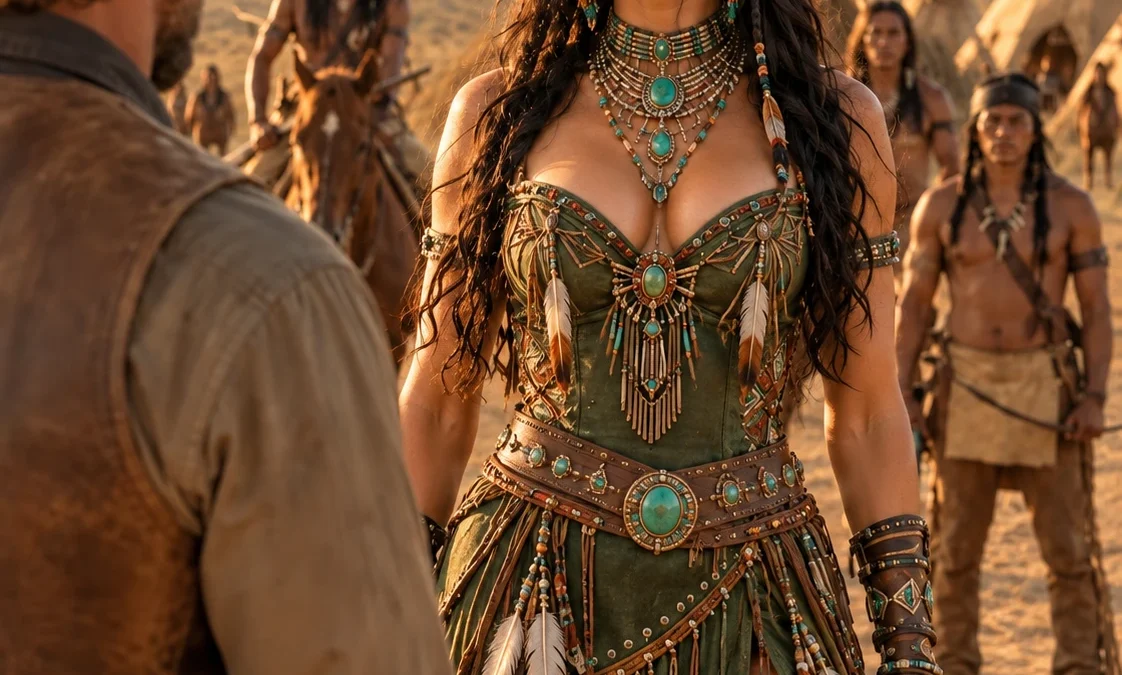
He Followed a Single Boot Print Into Apache Country to Find His Stolen Horse… What He Discovered About the “Raiders” Made Him Question Everything His Dead Father Ever Taught Him 😱🐎
PART 1
Red land. Silence. And an open corral gate swinging slowly on its hinge. 🌄
At 3:00 in the morning, the empty space where a black horse had stood hours before still held a ghost of steam.
Thad Colton stood in the yard with a cold rifle in his hands and a chest tight with something colder than fear. Tracks led west, steady and unhurried. And among them, one boot print, heel deep, stamped with a maker’s mark no man out here forged by hand.
A shop-made boot. On land everyone swore belonged to raiders. 😨
The wind died. The crickets stopped. A coyote on the far ridge cut off mid-howl, as if the dark itself had decided to listen.
He did not go back inside. He followed the prints into the black.
Two days earlier.
Dawn came slow over the Colton place: gray, then gold, then that particular orange that made a man believe the sky was on fire and didn’t care who knew it.
Thad was already up. He was always already up. Sleep hadn’t come easy since the funeral, since the ground had swallowed his father whole and left him standing there with a hat in his hands and no idea what a man did with his hands when there was nothing left to hold.
Except there was something. There was Onyx. 🖤
The black horse stood in the corral, steam rising off his back in the cold air. He already had his ears turned before Thad cleared the porch steps.
“Morning,” Thad said. Some men talked to their horses like children. Thad talked to Onyx like the last witness to a life he used to have.
His father used to say, A good horse remembers everything. Every kindness, every unkindness, every road you took him down, and every one you didn’t. His father had ridden Onyx through three winters before his hands got too stiff for the reins. Then he’d pressed the lead rope into his son’s palm, closed Thad’s fingers around it like he was sealing something shut, and said only: Take care of him.
Two months later, he was gone.
Thad didn’t go to church anymore. He hadn’t visited the grave since spring. He couldn’t stand the quiet out there. But the quiet in the corral had a heartbeat in it. That was the day the corral became the only place grief was allowed to be loud. 💔
Garrett Higgins rode up around noon on his old mule, squinting at the sun as if it had personally wronged him.
“You look terrible.”
“Good morning to you, too.”
“I rode two miles because Ruth heard talk in town. Raiders, down near the Ironwood country. Horses gone from three ranches. Taken clean in the night. No fight, no noise.” Garrett spat. “Folks are saying Apache.”
“Folks are always saying Apache.”
“Doesn’t mean they’re right.” Garrett’s eyes went distant. “I chased a stray heifer into the red rock once. Didn’t see a soul, but I felt watched the whole ride.” He tipped his hat back. “You’ve got that look. The one your father got right before he did something a smarter man wouldn’t. Keep that horse close.”
“He’s in the corral every night.”
“A corral’s not a wall, Thad.”
Thad didn’t know, standing there in the noon heat with a fence post half buried, that it would be the last quiet conversation he’d have for a long while.
That night, he checked the corral. Onyx watched him, ears up, like he was waiting for something to be said.
“Nothing’s coming,” Thad told him. He ate supper alone at a table built for four, from the same chipped plate, leaving his mother’s china untouched in the cupboard.
He did not sleep well. Something sat underneath the not-sleeping, a kind of static behind his eyes. Somewhere past midnight, a coyote called from the far ridge, and his chest tightened without knowing why.
Around three, he heard it. Not a crash. Not a shout. Just a change in the quality of the silence, the kind that happens when everything that normally makes noise stops at once.
Thad was up before he decided to be. Boots on, rifle in hand, out into a night gone completely still. Onyx should have been stamping. Should have been snorting at something in the dark.
The corral gate stood open.
“Onyx!”
Nothing. No whicker. No black shape rising out of the dark. Only the gate swinging soft on its hinge, and ground churned up with tracks that hadn’t been there at sundown. 😰
The latch hadn’t been broken. It had been worked loose. Which meant hands. Which meant a person had stood right here and undone the very knot Thad tied every evening of his life.
He knelt in the dirt and traced the tracks with two fingers, the way his father had taught him. Look at the depth, son. Look at the stride. And among the horse prints, half formed at the edge of the churned earth, he found the boot print. A heel. A sole with a maker’s stamp. Machine stitching. Not moccasin. Not bare feet.
He thought of every warning ever traded over fence posts and church steps, brick by brick, building a wall between his ranch and the red rock country beyond. He had never questioned that wall. Now a boot print was asking him to tear out the first brick with his own hands.
He didn’t take his father’s coat from its peg by the door. Some things a man isn’t ready to wear yet.
He borrowed a gray mule from a widower named Hollis, who asked no questions. (“Ranchers look out for ranchers.”) In town, a rancher named Puit stopped him outside the granary. “Third one this month. Half the county’s ready to ride out and settle it. The other half’s too scared to say Apache out loud in case they’re wrong.”
At the general store, Amos Whitfield was sorting nails into tin cups when Thad said, “Lost my horse last night.”
The nails stopped moving. Just for a second. Thad caught it, the way a man catches the smallest shift in weather before the storm arrives.
“Hear anything? Strangers passing through?”
“No. Nothing like that.” Too fast. Too smooth. Amos’s eyes went to the window and away.
“Which way would a man go with stolen horses?”
Amos’s throat worked. His eyes flicked toward the back room. “West. Toward the Ironwood Hills.” He stopped himself. “Thad, that’s Apache land. You go out there, you won’t come back with your horse or your hide.”
“Somebody’s already gone out there with my horse,” Thad said. “So I reckon I’m going after him.”
He left with a stone-under-still-water feeling in his gut, unable to name it, only to carry it.
The land changed as he rode. Green thinned to gold, gold to red, red hardened to rock, great shelves of it rising like the bones of something that never quite finished dying. The tracks didn’t behave like raiders’ tracks. They moved steady, deliberate, the pace of someone who wasn’t afraid of being followed.
He remembered a Shoshone trader, ten years back, whom half the ranchers had refused to deal with. His father had walked straight out to meet him, hand extended. A man’s money spends the same regardless of his face. Only fools price a man by what he looks like instead of how he deals. 🪶
Maybe that was the only compass he had left.
By late afternoon, he saw it: a thin curl of smoke between two red hills. A camp. A living place. He should turn back. He knew it the way he knew his own name.
You keep that horse close. Too late for that now. And underneath, older, steadier: Take care of him.
He kept riding.
Eyes were on him now. Not one pair, several. A pressure at the back of his neck, a stillness that had nothing to do with weather. Then he crested a low rise, and the camp opened below him.
Lodges arranged in a wide circle. Cook fires tended with the same care any rancher gave his own hearth. Nothing about it looked like the lawless danger he’d been raised to expect. And men, standing between him and everything else, watching him with an attention so total it felt like being read.
Thad swung down off the mule, hands visible, empty.
“I mean no harm. I’m looking for my horse. I believe he’s here. I’d like to speak with whoever leads this camp.”
Silence answered. A dog trotted out, sniffed once, and sat down to watch him.
Then the ring of warriors parted. An older man stepped through, his face carved deep by years and weather.
“You are far from your own land. And you have come alone. That is either very brave, or very foolish.”
“Might be both.”
Something shifted in the old man’s face. Not quite a smile.
“I am Natani. Tell me your name, and tell me about this horse of yours.”
Thad opened his mouth and found, for the first time since his father died, that someone was asking him to tell the truth of what he’d lost.
“Thaddius Colton. Folks call me Thad. My father built a ranch two days east of here. He passed two months back. This horse…” His voice caught. “This horse is the last thing he gave me.”
Natani studied him the way a man studies weather before deciding whether to trust it.
“Come. Walk with me.”
Past the watching faces. Past fires burning low and orange against the dark. And then Thad saw him: black, steam rising off his back the same way it did every cold morning in the Colton corral, ears swiveling toward the sound of boots before Thad even got close.
“Onyx.”
The horse’s head came up. One word, one voice. And Thad was running, actually running, and pressed his forehead against that warm black neck, and didn’t care who was watching.
“You’re all right. You’re all right.”
Natani let him have the moment. When Thad finally straightened, wiping his face, the old man said quietly:
“He is well cared for. We do not harm horses. We do not need to steal what already crosses our land freely.”
Thad went still.
“Then who did?”
Natani’s voice stayed level, but something underneath it had gone hard as rock beneath thin soil.
“We have lost eleven horses since the spring thaw. Eleven. Taken the same way. No noise. No struggle.”
The whole territory’s belief folded in on itself inside Thad’s chest. 😶
“You’ve been blamed.”
“We have been blamed for a hundred years. This is only the newest reason.”
And then Natani’s son, Kaywin, broad-shouldered, twenty-two, with a gaze sharper than the others, spoke for the first time. “White men. We have tracked them twice. Lost them both times in the rock country. They are led by a man. Tall. Gray through the beard. He rides a bay gelding with a white foreleg.”
Thad’s stomach dropped through the earth.
Because it did mean something. God help him, it did.
“That sounds like Corwin Dayne.”
His mind was already running backward twenty years to a stock auction. Dayne, his father’s ranch manager, caught skimming cattle sales. His father had fired him publicly, in front of half the county, so no one else would hire him. Dayne’s face going white, then red. His father’s voice carrying flat and final across the crowd, never raised, never needing to be.
Dayne swore he’d make my father regret it. I was fourteen. I thought it was just talk.
“It was not just talk,” Natani said quietly.
Thad stared into the fire. The man who’d stolen his horse, who had been raiding his neighbors and this entire camp for months, wasn’t some stranger. He was a ghost out of Thad’s own childhood, come back with a grudge that had had twenty years to rot.
“I want to help you stop him.”
Natani studied him a long moment. “Kaywin knows the rock country better than any man living. He will go with you.”
“You trust me that fast?”
“I do not trust you. I trust that a man who weeps for his horse in front of strangers has nothing left to hide. That is not the same as trust. But it is close enough to begin with.”
Thad almost laughed. “Close enough. I’ll take it.”
PART 2
They left before sunrise.
Two horses, two riders, and a silence between them that wasn’t unfriendly, only unfamiliar. Thad tried to fill it, because silence for him had never meant peace.
“How old are you?”
“Old enough.”
“That’s not an answer.”
Kaywin glanced sideways, almost amused. “Twenty-two.”
“I had you younger.”
“I had you older.”
Thad barked out a laugh before he could stop himself, the first in so long he couldn’t place it. 😄
“You always this hard to get a straight answer out of?”
“Only with strangers. Ask me again in a week.”
They rode on. Red rock gave way to redder rock. The trail narrowed until it was barely a trail at all.
“Your father,” Kaywin said, not looking at him. “He died recent.”
“Two months.”
Kaywin didn’t offer sympathy. Thad found it was exactly what he needed.
“My mother died when I was young. Before I could remember her voice. My father does not speak of her except sometimes at night, when he thinks no one hears.” He kept his eyes on the trail. “Do not be sorry. Sorry does not reach that far back.”
Thad turned that over a long while. Grief only worked forward, always forward, dragging whoever carried it into days they hadn’t asked for. Maybe that was what they had in common, two saddles apart in country neither fully belonged to.
Later, Kaywin reined in beside a patch of disturbed earth. “Tell me what you see.”
Thad felt like a boy again under his father’s patient silence. “Horse tracks. Three. This one’s smaller.” He looked harder. “This one’s favoring a leg. Shorter stride on the left.”
“You have a tracker’s eyes, Colton. Somebody taught you.”
“My father. Long time back.”
“Then he taught you well.”
By mid-afternoon they found a cold campfire, scattered ash, a spent brass cartridge. “Good rifles,” Kaywin murmured. “Not the kind a man buys on a rancher’s wages. Somebody is funding this.”
They followed the trail into a narrow wash between two rising walls of red stone, the sky above narrowing to a pale strip. Onyx’s ears pinned flat. Thad’s gut went tight and wrong.
“This is a bad place.”
“Yes. It is.”
“We could turn back.”
Kaywin studied the walls a long moment. “Rain is coming from the west. The trail will be cold by tomorrow. We may not get a cleaner chance.”
Neither of them turned back. It was, Thad would think later, the worst decision either of them made in the whole ordeal.
The first shot came from above.
“Down!”
Thad threw himself sideways, rock biting his palms. His horse screamed and bolted. More shots echoed wrong off the stone walls, impossible to count. Then Kaywin cried out, one sound, short, cut off almost as soon as it began, which was somehow worse than a longer scream.
Thad scrambled across the rocks and found him pressed against the canyon wall, a hand clamped over his upper arm, blood dark and spreading between his fingers. 😱
“I’m all right.”
“You’re bleeding.”
“I said I’m all right.”
“That’s not the same thing.”
He dragged Kaywin into a shallow crevice, the only cover the canyon offered. They pressed together so close Thad felt the other man’s heart hammering as hard as his own.
Then, from above, a voice, distant and rough, carrying down the walls. “Not worth the powder, boys. Let him bleed out or walk out. Don’t much matter to me.” Laughter. Then the sound of horses moving away, unhurried, confident.
Thad tore a strip from his own shirt and wound it tight around the wound. “Stay still.”
“I don’t need—”
“Stay still, Kaywin.” His voice came out harder than he meant it to, because his fear had nowhere else to go. “Please.”
Kaywin went still.
“Talk to me. Keeps you awake.”
“You are worse than my father when I was small.”
“Good. Somebody should be.”
When the echoes finally faded, Thad asked, “That voice. Was that Dayne?”
“No.” Kaywin’s jaw was tight, something older and darker moving behind his eyes. “That was one of his men. I know the voice. Three years ago, Dayne’s men raided a smaller camp two days north of here. My mother’s cousin’s family. They took the horses. They took the winter stores. They burned what they could not carry.” His voice had gone flat, carefully flat, the flatness of a man holding something down by force. “Two people did not survive that winter because of what was taken. I was nineteen. I rode two days to help bury them. I have not forgotten the smell of that place.”
Thad felt his own two months of grief go small beside it, a candle set next to a wildfire.
“So when you feel this anger, this need to make it right. Understand. I have carried that same anger three years longer than you have carried yours.”
There was nothing to say that wouldn’t sound small. “Then we finish this. Both our reasons, together.”
Kaywin held his gaze. “Together.”
They made it to the edge of the rock country by nightfall and sheltered under an overhang without a fire. Thad kept first watch, rifle across his knees, stars burning hard and close overhead. His father used to point out constellations. He’d forgotten all their names.
But he couldn’t stop circling back to Amos Whitfield’s hands going still over a tin cup of nails.
“No, nothing like that.” Too fast. Too smooth. Like a line already rehearsed before Thad ever walked through the door. Which meant someone had warned Amos he might come asking. Which meant someone in that town had a line straight to Dayne’s men. Which meant the ambush wasn’t chance. It was information.
And Amos handled every letter, every wire, every piece of news moving through the territory. There was no better post to buy than behind that counter.
Thad sat up so fast Kaywin stirred, wincing.
“I think somebody in town’s been telling Dayne where to look. Maybe even that we were riding out here at all.”
Two days later he rode back to town alone to resupply, leaving Kaywin resting under Natani’s watch. Natani offered a rider. Thad declined. Whatever was happening in that store would only happen if Amos believed himself unwatched.
He didn’t go to the store first. He crouched behind a stack of crates in the alley across from the back door, the afternoon sun hot against his neck, waiting to see if his suspicion was worth anything or just a grieving man’s need to blame somebody.
He didn’t wait long. A stranger in a dusty coat rode in from the west, tied his horse well clear of the main street, and slipped around to the back door like a man who’d done it before. Amos let him in without a word. The bell over the front door stayed silent.
Thad crept low beneath the cracked-open back window.
“Can’t keep doing this,” Amos was saying, voice strained. “That Colton boy asking questions. Sharp ones.”
“Then answer him sharp. Or don’t answer him at all. Dayne doesn’t pay you to get clever, Whitfield. He pays you to keep quiet and keep us informed.”
“I didn’t sign on for men getting shot.”
“Nobody signed on for that. Nobody asked your opinion either.” 😡
Thad’s hands curled into fists. The man who had sold his father nails and rope and kind words for fifteen years. The man who had stood at the funeral with his hat over his heart. Selling information to the men who’d taken everything.
He didn’t confront Amos. Not yet. He filed it away carefully, not forgotten, just waiting.
On the long ride back, he thought of Dayne, and twenty years of grudge rotting into raids and gunfire and a nineteen-year-old burying his family in the snow. He thought of how easily his own anger could calcify the same way, given enough years to feed on itself.
He didn’t want that. Whatever else came of this, he didn’t want to become a man whose grief turned into somebody else’s ruin.
That night, Natani listened in silence as Thad laid out everything: Dayne, the ambush, Whitfield’s betrayal. When he finished, the old chief’s eyes had gone hard and distant.
“My scouts found something while you were gone. A canyon three days ride north. Smoke most evenings. Horses, more than a small band would need. I believe we have found where they keep what they have stolen. Perhaps fifteen men.”
“Then that’s where we go.”
“Yes. But not alone. This time we go as one camp, settlers and Apache both, because I think by now we have all lost enough to the same man.”
Word went out before dawn. Runners rode to Natani’s allied families. Thad sent word to the ranchers along the Ironwood line, men who had lost horses of their own and stayed quiet too long. By the second morning, riders were arriving from both directions, settlers on tired horses, Apache scouts moving quiet and fast through the rock, all converging on the same fire.
On the last night before the ride, someone built a fire big enough for the whole gathered camp. Plates and bowls passed hand to hand. Garrett sat beside an older Apache man he’d never met, trading stories through gestures and broken words and a surprising amount of laughter.
“It is strange,” Kaywin said, settling beside Thad, his arm still bound. “All my life I was told your people would never sit at a fire like this. Mine told me the same about yours.” He looked at the mingled voices. “Perhaps we were both told wrong.”
Twenty riders left at dawn: twelve of Natani’s warriors, six ranchers, Thad, and Kaywin, who had refused to be left behind. Some debts, Thad thought, a man had to collect in person.
They reached the hideout canyon at first light on the third day. Horses, dozens of them, stood penned in a wide box canyon behind a crude fence of lashed timber. Guards walked the rim above, careless, confident. One yawned, rifle slung loose across his back. Another dozed against the rock.
“Now,” Natani said.
And the canyon exploded.
Thad would remember it only in pieces. Rifle fire cracking off red stone. Kaywin, one-armed and somehow still faster on a horse than most men with two. A young guard dropping his rifle and running rather than dying for a boss who had never ridden into danger himself. The fence coming down under axe and rope, horses pouring free in a black and brown flood, dust so thick he couldn’t see his own hand.
A rider broke from the chaos and came straight at him, rifle swinging up. One of Dayne’s men, young, desperate, close enough that Thad could see the fear plain on his face. Their barrels met across the length of a heartbeat.
“Don’t,” Thad said. Just that. Low, almost gentle.
The younger man’s rifle wavered, then dropped. He wheeled his horse and fled.
And through all of it, Thad searched every face for one man. Tall. Gray through the beard. A bay gelding with a white foreleg.
He didn’t find him. Not at first. Because Dayne wasn’t fighting. Dayne was running, a flash of gray beard, a bay horse breaking hard for the canyon’s back exit, low over the saddle, gone before Thad could lift his rifle.
“Dayne!” The name tore out of him, swallowed by gunfire.
“Let him run,” Kaywin said, appearing through the settling dust. “We have the horses. We have his men. That is enough for today.”
“It’s not enough.”
“No. But it is what today gave us.”
And then Onyx. Black coat gleaming, ears up, cantering free through the broken fence line straight toward him. Thad slid off his borrowed horse and pressed his forehead to that familiar neck and let himself, for one full minute, believe the worst was behind him. 🖤
It wasn’t.
PART 3
The peace lasted three days.
Three days of ordinary ranch work. Fences mended. Cattle counted. The particular relief of hands busy with tasks that didn’t involve rifles or grief. Thad rode out to Natani’s camp twice, ate with Kaywin, and let himself believe, against every instinct, that the worst had passed.
It ended on the fourth night with the sound he’d learned to fear more than any other.
Gunfire.
He was out on the porch with his rifle before he’d fully woken, just in time to see fire climbing the far fence line, orange and furious against the dark. Six men, maybe seven, riding hard through his own yard like they owned every inch of it. Smoke stung his eyes. Cattle bawled and scattered. Somewhere, a window shattered.
Garrett was already firing from behind the water trough, his old mule long gone into the dark. “Told you!” he shouted, voice cracking with adrenaline. “Told you a corral’s not a wall!”
“Where’s Dayne?”
“Right here, Colton.”
The voice came from behind them. Familiar. Rough. The same voice that had laughed down a canyon wall days before.
Thad turned. Corwin Dayne sat his bay gelding at the edge of the yard, rifle resting easy across his saddle, gray beard catching the firelight like something carved from old stone. He didn’t look rushed. He didn’t look afraid. He looked satisfied, like a man who’d waited twenty years for exactly this moment and meant to enjoy every second of it. 😨
“You lost your canyon,” Thad said.
“I lost some horses. Lost some men too dumb to run when I told them to. Figured I’d come collect something more personal.”
“This is between you and me. Leave the ranch out of it.”
“Your ranch is the only leverage I’ve got left, boy.” Dayne’s grip tightened. “Your father made it personal twenty years back. Standing me up in front of half the county like I was nothing. Like everything I built didn’t matter a damn to him.”
“My father’s dead. You want to punish somebody for what he did, he’s not here anymore.”
“No,” Dayne agreed. “But you are.”
He raised the rifle.
Time slowed the way it does in the worst moments of a man’s life. Every detail unbearably clear: firelight along the barrel, Dayne’s finger finding the trigger, the whole yard holding its breath.
And in that precise, impossible moment, hoofbeats thundered in from the eastern ridge. Dozens of them. And Kaywin’s voice cut through the firelit chaos:
“Dayne!”
Dayne’s head snapped sideways. In that half second, Thad threw himself off the porch as the shot cracked through the space where his chest had been. 💥
Natani’s riders poured into the yard. And behind them, more: Garrett’s neighboring ranchers, roused by the smoke, riding in with whatever weapons they’d grabbed on the way out the door. Settlers and Apache, side by side in the Colton yard, under a sky lit orange by a fire that had started as an act of hate and was ending as something entirely different.
Thad would remember this image longest: proof, plain and undeniable, that everything the territory had spent a generation insisting was impossible had simply never been tried.
Dayne’s men broke first, scattering into the dark, the fight draining out of a raid that had counted on surprise and found an army waiting. Garrett brought one down near the barn, an old rancher’s steady aim proving more than a match for a younger man’s panic. Two Apache riders flanked a pair of fleeing raiders and drove them straight into the rifles of settlers who a week earlier might have hesitated to fight beside them at all.
Dayne himself tried to run. His bay reared, spooked by the gunfire, and that half second of struggle was all Kaywin needed. His horse cut Dayne off at the fence line, two warriors flanked him before he’d gone twenty yards, and twenty years of grievance ended not with a final stand but with an old man dragged off his horse into the dirt of the ranch he’d sworn revenge against.
Thad walked toward him slowly, rifle in hand, chest heaving. The whole ride, the whole week, he’d imagined this moment a dozen ways. Satisfaction. Vengeance. Some final release. None of it matched what he felt now.
Mostly he just felt tired.
Dayne looked up from the ground, blood on his lip, hatred still burning. “Your father was a self-righteous…”
“He was right about you,” Thad said quietly. “That’s all that ever mattered.”
He turned away before Dayne could answer. He didn’t need an apology or an explanation or even the small ugly satisfaction of the last word. Only the sight of his own ranch, still standing, still his, with people from two different worlds working side by side to beat back the flames. Apache hands and settler hands, passing water buckets down a line from the well to the burning fence. 🔥
By the time the last flames died to smoking char, dawn had begun to gray the eastern sky.
Garrett found him at the edge of the ruined fence line. “Fence is cheap. Everything else that could’ve been lost tonight wasn’t.”
“You almost died tonight, Garrett.”
“So did everybody standing here.” He clapped a rough, warm hand on Thad’s shoulder. “Reckon that’s a fair trade for what we got instead.”
They rode into town three days later with Dayne and his surviving men bound, and delivered them to the territorial marshal, a weathered man named Coyle, who looked over the prisoners with a low whistle.
“Corwin Dayne. Been trying to pin something on him for six years.” He glanced at Thad, then at the Apache riders flanking him. “This is an unusual posse, Colton.”
“Unusual times.”
“Rustling, arson, attempted murder. You’ll need to testify.”
“We will testify,” Natani said before Thad could answer. “Truth does not become less true for who speaks it.”
Coyle held his gaze a moment, something shifting behind his eyes, then nodded.
Thad went to the general store alone. Amos Whitfield looked up when the bell rang, and his face went gray.
“Thad. I heard you caught Dayne. That’s fine news.”
“I know about you, Amos.”
The store went very quiet. Amos’s hands found the counter and gripped it.
“I heard you behind the store talking to one of Dayne’s men. You told him I was asking sharp questions. You knew about the canyon before Kaywin and I ever rode into it.”
Amos’s face crumpled. Not with defiance. With something worse: the collapse of a man who’d carried a weight so long he’d half convinced himself it wasn’t there.
“I owed Dayne money. Years back. A bad debt. He never let me forget it. Said he’d ruin me in this town if I didn’t.” He swallowed. “That’s no excuse. I know that’s no excuse.”
“Kaywin almost died in that canyon.”
“I know. I’ve known every hour since.” His eyes were wet, his hands trembling. “There’s nothing I can say that undoes it.”
Thad studied him a long moment: fifteen years of nails and rope and small kindnesses, and underneath, a debt that had curdled into betrayal because Amos hadn’t had the courage to ask for help. He thought of his father on that auction platform, choosing to humiliate a thief in public rather than let the wrong continue. There was a version of Thad who wanted to do the same now.
He thought of Dayne. He didn’t want to become that.
“You’ll go to the marshal. Tell him everything. What you did, why, every detail. Then you’ll make it right, however long it takes, whatever it costs.” His voice softened slightly. “But you’ll do it walking, Amos. Not running. That’s the only mercy I’ve got left to give today. And I’m giving it because my father would have wanted me to, not because you’ve earned it yet.”
Amos nodded, tears spilling over. “I’ll do it. I swear.”
Thad believed him. Not because Amos deserved easy belief, but because a man who wept that openly over his own failure was perhaps still a man capable of climbing back out of it.
He walked out into the sunlight and found that some of the weight in his chest had eased.
Before riding home, he found himself walking, without quite deciding to, toward the small fenced plot on the hill behind the church. It was his first time standing there since spring.
His father’s headstone sat plain and unadorned, exactly as the old man would have wanted. Thad crouched, pulled a few stray weeds from the base, and ran his thumb along the carved letters of his father’s name.
“You’d have liked him,” he said finally, to the stone, to the silence. “Natani. Stubborn as you were. Fair in the same way, too.” His throat tightened. “I found Dayne. Finished what you started at that auction, I suppose, whether you meant for me to or not.”
The wind moved through the grass.
“I’m not angry anymore,” he said, surprising himself with the truth of it. “Wasn’t sure I’d ever get here. But I’m not.” 🕊️
He stayed until the sun began sliding west. Then he rose, dusted off his knees, and walked back down toward Onyx, waiting patient at the hitching post. He pressed his palm flat against the horse’s neck.
“Home,” he said quietly.
They rode west to the Ironwood Hills, back toward the camp where it had all truly begun. Natani met him at the edge, Kaywin beside him, arm finally free of its sling.
“Full strength returning,” Kaywin said, rolling his shoulder. “Another month, maybe two, and you will have no excuse left to go easy on me when we race.”
“I never went easy on you.”
“You did badly. It was not subtle.” Kaywin’s mouth curved. “I forgave it.”
“It is finished,” Natani said.
“It’s finished.” Thad swung down off Onyx, exhaustion settling into his bones.
Natani studied him, something in his weathered face softened since the night they met. “You came here a stranger. Alone, grieving, certain the world had already decided what kind of man you would find at the end of your search.”
“I was wrong.”
“You were afraid,” Natani corrected gently. “There is a difference. A man who is only wrong learns a fact. A man who is afraid and still comes anyway, that man learns something worth keeping.”
They stood together in silence, watching the last light fade over the rock country.
“My father used to say a good horse remembers everything,” Thad said. “I think maybe that’s true of people, too. And of whole territories, given enough time.”
“Your father sounds like a man I would have respected.”
“He’d have respected you more than most men he ever met.”
Thad felt grief still there underneath everything, his father’s absence a permanent shape carved into his chest. But something else, too, that hadn’t been there when he first rode into this camp.
“I’d like to propose something. Not just gratitude. Something lasting.” Natani waited. “An agreement between my ranch and your people. We share word of trouble. Rustlers, raiders, anyone meaning harm to either side. We trade fair. We treat the land between us as something held in common, not something to fight over. My father spent his whole life building something out here. I don’t want what’s left of it built on the same fear that almost got Kaywin killed.”
Natani was quiet a long moment. Then he extended his hand, not the formal grip Thad expected, something looser and warmer, equal to equal, forged in a canyon full of gunsmoke and a burning ranch yard where settlers and Apache had fought side by side without a single person questioning why.
“Agreed.”
He said something further in his own language, low and formal, and an elder woman brought forward a woven blanket and laid it across Thad’s shoulders with a solemnity that told him this was no small gesture. He didn’t know the custom. He didn’t need to. 🤝
Kaywin offered his uninjured arm, and Thad shook it.
“Try not to almost die next time.”
“Try not to weep on your horse quite so loudly next time. The whole camp heard you.”
“That’s twice now you’ve brought that up.”
“I intend to bring it up considerably more than twice, Colton. Perhaps for the rest of both our lives.”
Thad laughed. Real laughter, unguarded, the first in longer than he could remember.
Months passed. Autumn came down slow and gold, turning the grass amber and the evenings sharp with the first true cold. The Colton ranch rebuilt its burned fence line with help from Garrett and a dozen riders from Natani’s camp, men who’d once been strangers now sharing coffee at Thad’s own table like they’d always belonged there. Kaywin showed up the second morning with three others, sleeves already rolled, no ceremony about it, just the plain fact of neighbors helping neighbors. Garrett brought Ruth’s cooking out most days, and by the third week the fence mending had become something closer to a standing gathering, old suspicions quietly dissolving under the shared labor of setting posts and stringing wire.
When the harvest came in that October, Thad hosted a gathering he never would have imagined a year before: half the county’s ranchers and a good portion of Natani’s camp, sharing a meal across tables dragged out into the yard, low sun catching gold on every face. Natani sat at the head of one table like he’d always belonged there, trading stories with Garrett that grew taller with each retelling. Nobody questioned why an Apache chief was breaking bread at a settler’s table. By then it had simply become the way things were.
Garrett stood, raised a cup of cider that had clearly seen a splash of something stronger, and cleared his throat until the yard quieted.
“Known this family thirty years. Watched Thad’s father build this place out of nothing but stubbornness. Didn’t think I’d live to see the day his boy built something even his father never got around to.” He raised the cup higher. “To fences that come down instead of staying up. And to the fool who was brave enough to knock the first one over.”
Laughter rippled through the yard. Thad felt his face go warm, raised his cup in return, and caught Kaywin’s eye across the table. The younger man was grinning, as if something in him had finally been given room to unclench.
Later, as the fires burned low, Kaywin found Thad standing apart at the edge of the yard, looking out over land that had nearly burned to nothing a season before.
“You are thinking again. It is becoming a habit.”
“Just taking stock. Hard to believe how much changed in one year. Harder to believe how little needed to change once somebody was willing to try.”
“My father says the land remembers who treats it well. Perhaps it remembers who treats each other well, too.”
“Your father says a lot of things worth writing down.”
“He would agree with you completely.” Kaywin’s grin returned, easy and familiar. “Do not tell him I said so.”
Amos Whitfield still ran the general store. Thinner now, quieter. He had confessed everything to the marshal and paid back what he owed through months of labor and restitution. The town hadn’t fully forgiven him. Some wounds take longer than a season to close. But Thad had noticed him more than once going out of his way to help families in trouble, as if trying one small kindness at a time to outweigh what he’d done. One afternoon in late October, Thad found him past the edge of town, helping a widow named Sorenson repair a wagon she couldn’t afford to have fixed properly, working without asking for coin or thanks.
“Don’t stop on my account.”
“Wasn’t stopping.” Amos wiped his hands on his trousers. “Figured I owe this town considerably more than nails and rope for a while yet.”
“Figure you might be right about that.”
It wasn’t forgiveness, not entirely. But it was something moving in that direction, and Thad found he could let that be enough for now.
He rode out to the Apache camp most weeks, sat by Natani’s fire, argued good-naturedly with Kaywin about everything and nothing: whose horse was faster, whose land held better grazing, whether Thad’s tracking had improved enough to be trusted alone in the rock country. Twice that autumn, word came through the new arrangement of trouble brewing. Once, a pair of rustlers scouting the Ironwood line. Once, a grazing dispute that might have turned ugly without a rider from Natani’s camp arriving first with word of it. Both times, the trouble was handled before it could grow teeth.
And in the evenings, when the ranch had gone quiet, he still walked out to the corral to find Onyx waiting.
He thought some nights about his father’s last days, the fever that took him slow instead of fast, weeks of watching a strong man grow smaller in the bed he’d built with his own hands. His father hadn’t spoken much toward the end. Hadn’t needed to. The two of them had simply sat together in the quiet, the way they’d always communicated best, until one morning the quiet became something else entirely.
Thad hadn’t known, in that raw first grief, what a man was supposed to do with a life suddenly missing its center. He hadn’t known that the answer would eventually arrive riding in on the back of a stolen horse, and a chief’s steady patience, and a young warrior’s stubborn courage. He hadn’t known that grief, given enough time and the right company, could soften into something closer to gratitude. Not because the loss stopped mattering, but because it had, in its own strange way, led him somewhere worth being.
“We made it,” he told the horse one such evening, palm against that familiar black neck, the sky above bruising slow into violet. “Both of us. Somehow.”
Onyx pushed his nose into Thad’s chest, warm and solid and alive.
His father used to say, A good horse remembers everything. Every kindness, every unkindness, every road you took him down. Standing there in the gathering dark, with the sound of distant laughter drifting over from a shared fire between two peoples who had once believed they had nothing in common, Thad thought his father might have been talking about more than horses all along.
About what it cost to hold a grudge for twenty years until it burned a man’s whole life down around him. About what it cost instead to ride toward the very fear you’d been taught your whole life to run from, and find waiting on the other side of it not an enemy at all, just another man grieving something of his own, willing, if given the chance, to build something better out of the wreckage than either of them could have built alone.
He thought of the boot print in the dirt that started it all. How certain he’d been that first terrible night that he was chasing a stranger’s cruelty into unfamiliar country. How wrong that certainty had turned out to be, and how much he’d gained by staying wrong long enough to find the truth underneath it.
The fire crackled somewhere behind him. Onyx shifted his weight, patient, unhurried, exactly the way he always had.
And for the first time since his father’s grave went quiet, Thad Colton stood in the dark and felt, instead of loss, peace. 🕊️
THE END
💬 What do you think Thad’s father would say if he could see the yard that harvest night? Tell me in the comments, and share this with someone who still believes a fence can’t come down. 👇
Disclaimer: This story is entirely fictional and created for entertainment purposes only. It does not represent any organization or individual, nor does it encourage inappropriate behavior. The content was generated with AI assistance.








