HE FOUND A BRUISED APACHE WOMAN SHAKING IN HIS CREEK. HE LAID DOWN A CLOTH AND WALKED AWAY WITHOUT A WORD… BUT AT NIGHTFALL SHE WAS COLLAPSED AT HIS BARN, AND THE TRACKS IN THE MUD PROVED SOMEONE HAD FOLLOWED HER
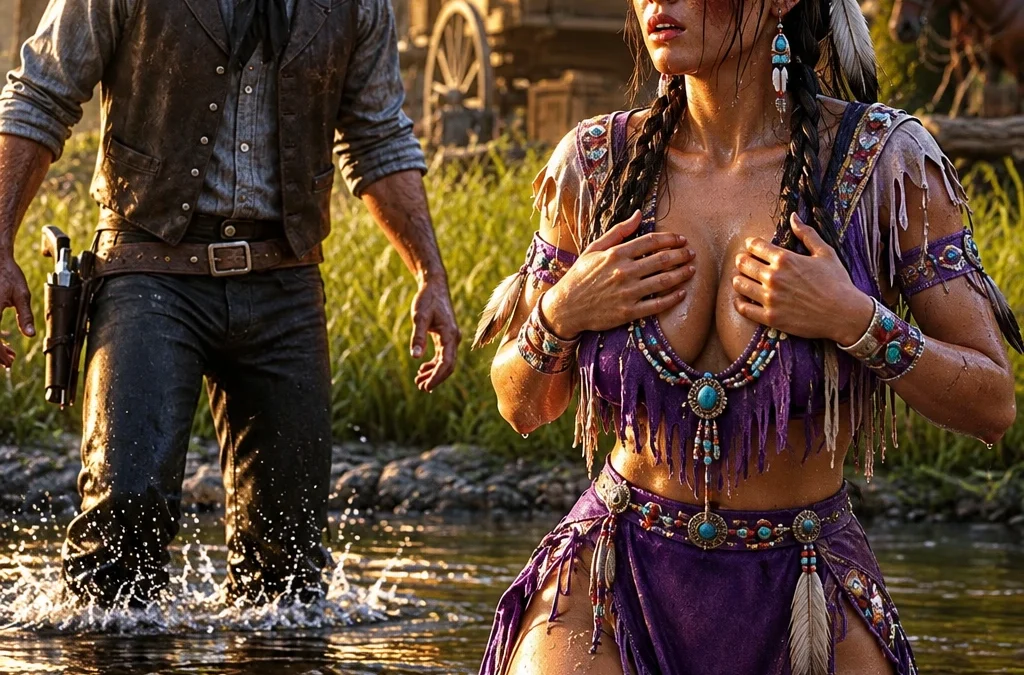
HE FOUND A BRUISED APACHE WOMAN SHAKING IN HIS CREEK. HE LAID DOWN A CLOTH AND WALKED AWAY WITHOUT A WORD… BUT AT NIGHTFALL SHE WAS COLLAPSED AT HIS BARN, AND THE TRACKS IN THE MUD PROVED SOMEONE HAD FOLLOWED HER 😱🐎
Part 1
Elias Ward spent most days alone on his ranch, miles from the nearest town and far from any trail strangers might use. 🌄
He had chosen that isolation years ago.
After his younger brother died in a range accident, Elias blamed himself. Distance from people became a kind of armor. Work filled the hours, and silence filled everything else.
His life was simple. Fix fences. Tend horses. Keep the land in order. A routine that never asked him to explain himself or say more than a few words a day.
That afternoon he was working the northern fence line. Two posts had shifted after the last rain, and the ground there always softened first.
Then he heard the creek.
Not the usual murmur, but water moving faster and louder than he remembered. It pushed through the quiet and made him look up.
Elias wasn’t a man who chased every sound. But he knew this land, and when something changed, he noticed.
He wiped sweat from his forehead and walked toward the noise through a stand of scrub oak.
As he drew closer, a second sound slipped in beneath the rush of water. A faint splash. Too controlled to be an animal tumbling in.
He stopped. Every instinct tightened in his chest.
Human.
He nearly turned around. He didn’t want trouble.
But he moved closer anyway, slow and careful, and when he reached the edge of the brush, he froze. 😨
A young Apache woman stood knee-deep in the creek with her back to him, rinsing mud from her arms. She moved stiffly, as though every motion cost her something. What remained of her clothes was torn and clinging to her skin, and her shoulders shook from the cold.
When she shifted, he saw bruises along her side and dirt packed into cuts that had never been treated.
Elias felt his throat tighten.
She isn’t here by choice.
He stepped back at once, letting his boots scrape the gravel on purpose so he wouldn’t startle her.
She spun toward him anyway.
Her eyes were sharp and terrified, ready to bolt or fight depending on what he did next.
Elias lifted both hands slowly, palms open.
“All right,” he said in a low, steady voice. “Just passing through.”
She didn’t understand all his words, but she understood tone. Her jaw clenched. Her whole body stayed coiled, waiting for the move that would force her to defend herself.
He knew what people said about ranchers who sheltered the wrong stranger. He knew he wasn’t supposed to get involved.
But leaving her like this, cold and hurt and alone, felt wrong deep in his ribs.
He forced himself to look away so she wouldn’t feel cornered. Nearby, a flat rock sat half in shade. He took a clean cloth from his saddlebag, walked to the rock without hurrying, and set it down.
“You can use that,” he said quietly. “I’ll go.”
He didn’t wait for an answer. He turned and walked back through the brush, his heart beating faster than he cared to admit.
The image of her trembling in that water stayed with him. Someone who had survived something terrible and was barely hanging on.
Elias knew the Apache bands in this region. He knew the raiders who drifted between territories, preying on anyone they could overpower.
Whoever she was, she hadn’t wandered here by accident.
He didn’t go straight home. He lingered at the corral and checked the barn door that didn’t need checking. He wondered if she could walk. If she had food. If leaving her alone had been the safest choice or the most foolish thing he’d done in years.
By sundown the temperature dropped sharply. Elias lit his lantern, planning to mend tack before turning in.
But a quiet, persistent worry tugged at him.
He stepped outside and scanned the shadows near the barn.
And stopped. 😰
A small figure lay collapsed against the outer wall, barely moving.
He set the lantern down and crouched.
It was the same woman from the creek. Her breathing was shallow, her skin ice-cold, her eyes unfocused. She had tried to stay away, but her strength had failed before she ever reached the open fields.
Elias hesitated for exactly one second.
Then he lifted her into his arms. She was lighter than he expected. Too light.
“Easy,” he murmured. “You’re all right.”
He carried her into the cabin, laid her by the fire, and wrapped a blanket around her shoulders. She opened her eyes once, confused, unsure whether he meant harm.
He knelt a few steps away and kept his distance.
“You’re safe. Warm up. No one’s going to touch you.”
Slowly, the fear in her face gave way to cautious awareness. She didn’t speak, but her gaze followed his every move.
For the first time in years, Elias felt the weight of responsibility settle on him again. Not as a burden. As a choice.
He wasn’t going to let her die on his land.
Later, with a tin cup of warm water in her hands, she finally whispered her name.
“Aayoka.”
“Elias.”
Her shoulders loosened, just barely. Names meant something. Names meant a person wasn’t hiding an intention.
He asked softly who she was running from.
Her eyes flicked to the window. Her hand drifted to her hip, where a knife must once have hung.
“Raiders,” she whispered. “Men bad. Take horses. Take people.” Her voice cracked. “My band… gone.”
Elias’s jaw tightened. “Did they follow you?”
She shook her head slowly. Then, so quietly he almost missed it, she lifted her eyes to his.
“I killed one of them.”
Elias went completely still. 🔥
“And they never leave a man like that unburied.”
Part 2
“I killed one of them.”
The cabin fell silent except for the crackle of the stove.
Elias didn’t flinch. He didn’t pull back. He only watched her, the bruises on her ribs, the grief behind her steady eyes, and waited.
“He hurt my sister,” Aayoka said. “She fall. She no breathe. I not leave her until midnight.” Her voice shook, then steadied. “Then I take his knife. I fight. I run.”
Elias lowered his gaze. He knew grief when he saw it, the kind someone carried by raw will alone.
“You didn’t abandon her,” he said quietly. “You did everything you could.”
She wiped her cheek with the back of her hand. “Raiders know. They hunt.”
“Then they’ll find out what it costs,” Elias said, “to come near this ranch.”
She stared at him, surprised that he hadn’t asked her to leave.
Over the next days, the cabin settled into a fragile calm. He tended her wounds, though only after she nodded permission, and he never pressed on any bruise. She ate slowly, always watching his hands. When the first storm rolled in, he sat by the door all night, rifle across his knees.
“You keep watch,” she murmured in the dark. “Like family.”
The word struck him harder than he expected. He said nothing, but he didn’t forget it. 🤍
The morning after the storm, she insisted on walking the land with him. She wore his heavy coat, its sleeves hanging past her hands. Her side still ached, but she moved with purpose.
At the edge of the treeline, she stopped.
“Here.”
Elias crouched beside her.
Hoofprints. Three, maybe four horses. Deep, carrying weight, heading toward the north ridge, the path raiders used to skirt ranch land unseen.
“Fresh?”
She touched the mud with two fingers. “Before rain. Not long before.”
Elias felt his stomach tighten.
“They come again,” she whispered. “Raiders no give up.” Her voice cracked. “I leave. If I go, they follow me. Not you.”
“You’re not going anywhere.”
“I make trouble.”
“You didn’t bring this.” He stepped closer, stopping before the invisible line she kept between them. “Men like that don’t need a reason to ride near a ranch. And if you walk out there alone, hurt, you won’t last an hour.”
For a long moment she fought it. Then her shoulders dropped.
“I stay. For now.”
“That’s enough.”
That afternoon, she found a faint footprint behind the barn, too large to be hers, too fresh to ignore.
“Someone came close.”
“They’ve been looking,” Elias said.
“Running no help,” she said. “Running make me die. Here better.”
He nodded slowly. “Then we don’t run. We make them leave.”
He spread stones and a coil of wire across the table.
“They don’t know how this place works. If they come from the north, they hit the fence we fixed. From the west, the creek cuts off their path. From the east, they get stuck in the ravine. Easiest way is the barn. That’s where we make it look like three or four men are watching.”
She stared at him, understanding dawning. “You trick them.”
“No one gets hurt. They just decide we’re not worth the trouble.”
They worked until the last light faded. Elias hung a second lantern outside the barn. Aayoka tied one of his old coats to a post in the corral so it swayed like a sentry. Two rifles were propped in the window at angles that suggested someone aiming out. A rope line ran through the brush, tied to tin pans that would clatter if anyone crept too close.
When night fell, the ranch looked guarded by men who weren’t there. 🌙
They sat in the dark cabin. Hours passed.
Then, just after midnight, Elias heard it.
Hoofbeats. Slow. Searching.
From the north ridge.
Aayoka lowered herself against the wall, breathing shallow. Elias moved beside her, rifle across his knees, not aimed. The hoofbeats circled. Slowed. Stopped.
And somewhere out in the dark, a man’s voice called out a single word.
Her name. 😱
Part 3
Aayoka’s hand locked around Elias’s sleeve.
The voice called again, low and carrying across the yard. “Aayoka.”
Not a shout. Almost gentle. The way a man calls a dog he intends to catch.
She had gone rigid. Elias had never seen anyone so afraid and so determined in the same breath.
“They know my name,” she breathed. “Someone told them.”
“Someone who saw you run,” Elias whispered. “That’s all.”
He eased toward the window, careful not to disturb the false rifles.
Out past the barn, at the edge of the lantern light, sat four riders. Their horses stamped and shifted. The lead man, thick-shouldered, a scar through one eyebrow, sat his saddle with the slouch of someone who expected the world to part for him.
“We know you’re in there, girl,” he called. “You took something from us.”
Elias felt her shake against his shoulder.
“He is the brother,” she whispered. “Of the one I killed.”
The man spoke again, and every word dripped with lazy menace. “Come out now and I’ll make it quick. Hide behind that rancher and I burn the roof over both of you.”
Elias set his jaw.
He had spent years in silence. Years letting fear tell him that distance was safety. He had lost his brother and promised himself he would never be responsible for another life.
And yet the woman beside him was breathing, shaking, alive.
He rose to his full height behind the door and called out, clear and level.
“You’re on my land.”
The riders went still.
“There are four men on this ranch with rifles on you,” Elias said. “I’d think hard about that before you ride closer.”
The scarred man laughed. “I see one lantern and a coat on a post.”
Aayoka’s eyes widened. He had seen through it.
Elias didn’t move.
And that was when the rope line snapped.
Somewhere in the brush, a horse had stumbled into the cord, and a dozen tin pans clattered like a shower of rifle shots. The lead man’s mount reared. A second rider swore and went for his gun. A third wheeled around, certain they were surrounded.
“It’s a trap!”
“Hold!” the scarred man roared.
But in that heartbeat of chaos, Elias stepped out onto the porch with the rifle raised, finger off the trigger, fully lit by the lantern.
“I won’t fire first,” he said, his voice steady and ice-cold. “But if you come one step closer, I will not miss. Turn around. Ride out. Tell whoever sent you that this land isn’t worth the fight.”
For a long moment, no one breathed.
The scarred man stared at him. Elias saw the calculation, the weighing of what he knew against what he feared, the sense that there might be more rifles in the dark than he could count.
“This isn’t finished,” the man snarled.
“It is,” said Elias.
The man spat. Then he reined his horse around and spurred hard toward the ridge. The others scrambled after him, their hoofbeats hammering away into the night.
Elias held his position until the sound faded to nothing.
Only then did he lower the rifle.
Behind him, in the doorway, Aayoka stood with her hand pressed to her mouth, shaking all over.
“They go,” she whispered.
“They go.”
She crossed the porch and gripped his sleeve, and this time she did not let go. 🌅
Dawn came pale and quiet.
They didn’t sleep. They sat on the porch step wrapped in blankets, watching the light creep over a ridge that had been so full of dread the night before.
“You didn’t have to stand in front,” Aayoka said at last. “They could have shot you.”
“They could have.”
“Why?”
Elias didn’t answer right away. He stared at his hands, scarred from years of fence wire and rope.
“I had a brother,” he said. “Younger. His name was Daniel.”
She turned to him.
“We were moving cattle across a gully, and I told him to take the lead. It was a bad crossing. The ground gave way.” His voice thinned. “I was thirty feet behind. I watched it happen. I’ve spent every day since telling myself I should’ve gone first.”
Aayoka was quiet for a long time.
“You not leave him,” she said. “He fall. You not push.”
“I know that now.” His laugh was small and bitter. “It took eight years and a stranger in a creek.”
She reached for his hand. Her fingers were small and scarred, and she held on without hesitating.
“My sister the same,” she said. “I tell myself I should have seen the knife. I should have stand in front.” Her voice broke. “But she not want me to carry it. She want me to live.”
“Daniel would’ve said the same.”
They sat together while the sun climbed, two people who had carried the same weight in different languages.
The next days were strange in their gentleness.
Aayoka helped him mend the barn roof and patch the walls. She taught him to read tracks the way her people did, and he realized how little he had ever truly seen on his own land. In the evenings, she told him about her band, the horses her father raised, the songs her mother sang while she ground corn, the way her sister laughed with her whole body.
Elias, who hadn’t said more than a few words a day in years, found himself telling her about the first fence he had built with his father, about the way his brother used to hum off-key while he worked.
One morning Aayoka went alone to the creek.
Elias stayed on the porch. He wasn’t afraid she would run. He knew she’d come back.
The knot in his chest was something else, something he had been trying hard not to name.
When she returned, her face looked different. Lighter.
“I thank the water,” she said. “Where you find me. Where everything change.”
“You all right?”
“I think first time I breathe since running.”
He smiled. A small, real smile.
“Why you help me?” she asked, stepping closer. “Many men shoot first. Many men no help Apache woman.”
Elias took a long breath and chose honesty over comfort.
“Because I’ve seen enough hurt in this world. I wasn’t going to add to it.” He rubbed the back of his neck. “And because you remind me what it feels like to have someone to protect. I haven’t felt that in a long time.”
Her eyes shone.
“I stay,” she said softly. “If you want.”
“I want.”
“Not because I owe. Because I choose.”
“I know.”
She stepped into the space between them and rested her forehead against his chest. His arms came around her, careful and warm, offering a shelter she could walk out of whenever she wished.
She didn’t.
By week’s end, the ranch no longer felt like a place meant for hiding.
Aayoka brushed the horses each morning, whispering to them in her own language. Elias patched the last of the fence line. She planted herbs beside the porch, and he built a second chair.
No more raiders came.
Word spread through the territory about the rancher who had turned away armed men with nothing but lanterns and nerve, and no one wanted to be the next fool to test it.
One evening, with the sun burning orange across the horizon, Aayoka sat beside him on the porch and watched the land go gold.
“You think future good here?” she asked.
Elias looked at the pastures he had tended alone for so long. At the horses grazing in the last light. At the woman beside him, whose laugh he had first heard over a dropped nail on the barn roof and now wanted to hear every day for the rest of his life.
“I think,” he said, “it’s the best future I’ve ever had.”
She smiled, small and certain.
“I stay,” she said again. This time it was not a question, and not a hope. It was a promise.
He turned his hand over and let her fingers fall into his.
“Then we build something here,” he said. “Together.”
Down in the pasture, the horses lifted their heads. The wind moved gently through the grass. And on a porch at the edge of the territory, two people who had survived more than any life should ask stopped running at last.
There was no more fear. No more silence.
Just a quiet loyalty, a home they had chosen, and a future that belonged to them both. 🌄
This story is entirely fictional and created for entertainment purposes only. It does not represent any organization or individual, nor does it encourage inappropriate behavior. The content was generated with AI assistance.








