SHE KNOCKED ON HE GAVE HIS LAST WATER TO THREE DYING APACHE STRANGERS, BUT BY SUNRISE THERE WAS A BLOODY ARROW IN HIS DOOR AND A DEAD LAWMAN AT HIS FENCEDOOR OF THE LONELIEST MAN IN RED MESA ON CHRISTMAS EVE, BUT WHAT HAPPENED INSIDE HER CABIN WHEN THE BLIZZARD LOCKED THEM IN LEFT THE WHOLE TOWN WHISPERING
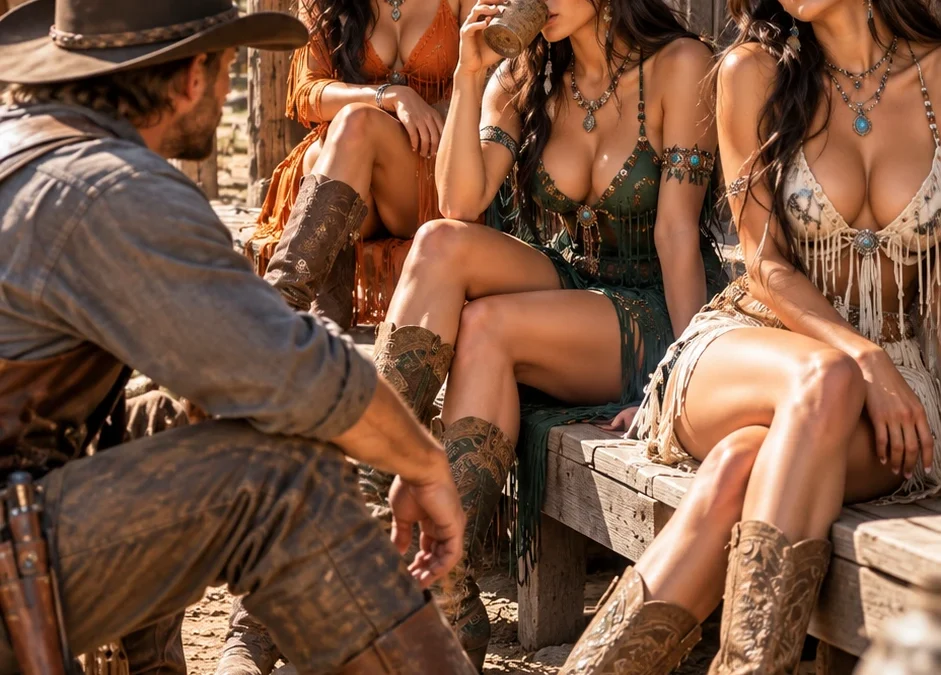
HE GAVE HIS LAST WATER TO THREE DYING APACHE STRANGERS, BUT BY SUNRISE THERE WAS A BLOODY ARROW IN HIS DOOR AND A DEAD LAWMAN AT HIS FENCE 🩸😨
Part 1
The arrow hit Wade Harlland’s front door sometime before dawn.
When he kicked the door open and stepped onto the porch with his rifle raised, it was still quivering in the wood. Something dark and wet ran down the shaft, and it was not paint.
Three Apache strangers stood frozen in his yard. An old man. A young woman. A boy.
They were the same three he had pulled out of the dirt the day before.
“They know you helped us,” the old man said quietly, without turning around.
Wade stared at the arrow. Then he sighed. “Well,” he muttered. “That’s new.”
Nobody laughed. And Wade understood that the worst day of his life had not started this morning.
It had started yesterday, with a canteen. 💧
The summer of 1884 was cruel. Wade was thirty-eight, rode an old gray gelding named Deacon, and had a cabin, a rifle, a well, and a reputation. Mostly the reputation.
Rancher Garrett Voss had offered to buy his land three times. Three times Wade had refused. The last time, Voss had smiled and said, “Everybody sells eventually, Harlland.”
Since then the feed store always ran out of feed when Wade walked in. The preacher suddenly found the ceiling fascinating.
So Wade rode alone, and he followed three rules his father had given him at fourteen. Keep the cabin. Leave the old well be. Never tell a stranger what lies under the land.
He had never asked why. He had only asked one question that mattered. What happened to Pop?
The answer was always the same. Fever. In a man who had never been sick a day in his life.
That afternoon, Wade stopped Deacon above Cedar Wash and frowned. The creek that had run every summer of his life was bone dry. Cracked mud. Bleached stones.
Then he saw the shapes beneath a dead cottonwood. One of them moved.
An old man with gray braids. A young woman with a cracked lip and a stare that could cut wire. A boy curled around a small leather pouch like it was the last warm thing in the world.
Apache. All three, dying of thirst.
Wade did the math. A man alone. A half-full canteen. Four hours from home.
“Idiot,” he told himself. “Complete idiot.”
He handed it over anyway.
The old man drank and passed it on. The young woman drank like she hated needing it. The boy drained the last drop and whispered, “Sorry.”
“Don’t be,” Wade said. “I noticed there’s none left.”
Their names were Teaya, Guian, and Nalin. Then Guian said something that chilled him.
“We know who you are.”
“Is that so? How?”
She did not answer. Teaya laid a hand on her arm, the way a man stops a storm before it gets a name.
Wade filed it away. He was good at filing other people’s secrets. He had plenty of his own.
“The spring stopped four days ago,” Teaya told him. “Sixty-one of us are dying at our camp.”
Wade looked at the creek bed. A neat line of stacked stone ran across the upper channel. Nature does not stack stone.
“Somebody dammed it.”
Teaya’s eyes slid toward the long green valley where every fence post bore one name. Voss.
They had gone two miles when a rifle cracked.
Deacon screamed and went down. Wade hit the dirt, then crawled to his oldest friend. The horse tried to rise and failed. Wade did the last kindness left, with his hand shaking so hard he nearly missed.
Nobody spoke. He picked up his saddlebags. “Walk.”
At dusk, the four of them reached the cabin. Wade hauled water from his father’s old stone well, the one he had been told all his life to leave be. They drank like it was church.
Then the boy did something strange. Beneath the lamplight, Nalin pulled a cloth bundle from his pouch. Inside was half a bronze disc, scratched and dull, with a symbol cut into it. A circle. A line through it. Three short marks beneath.
Wade felt the floor tilt.
He had seen that symbol every day of his life, carved into the stock of his father’s rifle above the fireplace. The rifle that had never been fired, never cleaned, never questioned.
He said nothing. But the boy saw him look and hid the disc away, fast and guilty.
Before Wade could press him, outside in the darkness, a horse stepped softly.
“Lights out,” he whispered. “Everybody down.”
Then came torches. Then shots. Wade slipped out the back window and knocked one rider cold with his rifle butt. The others fled into the night.
The man Wade tied up in his cellar wore a Voss brand on his saddle blanket. Wade checked the fence line afterward and found deep boot tracks along the north fence. They sank so deep they looked like wells, the kind men leave when they are hauling dead weight.
He told himself it was a calf. A sack of grain.
At dawn, he stepped onto the porch and found the arrow.
But the old man was already pointing at the north fence. Wade followed the boot prints at a run, straight to the corner post, and tore the weeds aside.
A man lay on his back with an arrow through his chest and a tin star on his vest.
Wade knew that face. Days earlier, in front of half the town, he had sworn he would see this man dead. 😱
👉 Want to know what Wade had said, and who wanted him to hang for it? Part 2 is waiting in the comments. Leave any word and I’ll send it to you privately!
Part 2
Wade knew that face. Days earlier, in front of half the town, he had sworn he would see this man dead.
Deputy Corbin Hail.
They had argued on Saturday outside the feed store, loud and public. Hail carried Voss’s offers around the county in a leather folder. Wade had snapped, “I’ll see you dead before I sign.”
Half a dozen witnesses had nodded along like a choir.
Wade knelt and touched the ground. Dry. Not a drop of blood in the dirt. A man shot through the heart should have bled out.
“Dead before he got here,” Teaya said softly. “Carried by men with heavy boots.”
Wade turned to the arrow in his door. The feathers were too bright, the binding too neat. Guian studied it with disgust. “Whoever wrapped this learned from a drawing. It was never Apache.”
“Someone wants you to believe it was,” said Teaya.
The picture closed around Wade’s throat like a hand. A dead deputy. A public quarrel. An arrow in his door. And three Apache standing beside him, looking like the guests he had invited in.
“They were never hunting you,” he said. “They were hunting me.”
“They will hang you,” said Teaya. “And then they will go to Cedar Wash.”
Wade’s one hope was Sheriff Amos Rudd, the gray-mustached man who had pulled him out of a river at nineteen and bought his father’s coffin. Wade loaded Hail’s body onto a horse, threw the tied rider over his saddle, and rode to Red Bluff by the old wash road no one ever used.
Rudd looked up from his desk. “Wade. Figured you’d come in the back way.”
Wade froze for half a second.
Nobody knew that road existed. Only Wade, his father, and whoever his father had shown.
Rudd ordered the bound rider taken to the back room. “Give him some coffee.”
Coffee. The man who had tried to burn Wade out. As the rider walked out rubbing his wrists, he glanced back with the faintest ghost of a smile.
Then Rudd held out his hand. “Give me the rifle, son.”
The cell door closed behind Wade like a coffin lid.
Hours later, footsteps. A key. Rudd appeared holding a tin cup of water.
“Drink up,” he said sadly. “It’s the last you’ll get from anybody.”
“Why, Amos?”
“Everybody sells eventually, Wade.”
Wade took the cup gently, polite as a Sunday guest. Then he threw the water in the old man’s face and yanked his collar through the bars. The sheriff’s forehead hit the iron with a sound like a dropped frying pan.
Wade took the revolver and the keys, locked Rudd in the cell, and tossed the keys into the stove. Then he rode out into the night, faster than he had ever ridden in his life.
Because three people were waiting in a cabin he had told them was safe.
He saw the glow while he was still two miles away. Orange. Pulsing. Climbing into the stars.
The cabin was gone. Burned to the stones. Only the chimney stood, like a gravestone.
“Wade.”
Guian crouched behind the well, face smeared with soot, a burn across her forearm, his father’s rifle in her hands. Teaya rose out of the shadows, bleeding from the shoulder, his eyes worse than the wound.
“They took Nalin.”
The world went very still.
Wade had barely absorbed it when something white fluttered on the well post. A note, nailed there, still smelling of fire.
Bring your father’s rifle to Dry Fork before Sunday. Come alone, or the boy goes in the ground. Regards, Callaway.
And behind him, in the firelight, Teaya spoke in a voice Wade had heard once before, long ago, in the dark.
“We did not stumble across you by chance.” 😳
👉 Like or comment “REVEAL” to unlock Part 3! It will be posted as soon as there are enough comments. ❤️
Part 3
“We did not stumble across you by chance.”
A prickle crawled across Wade’s skin. That voice. Where had he heard that voice?
“We were coming to your cabin,” Teaya said. “Because of your father.”
A memory stirred. A boy of fourteen crouched in the dark with his hands over his ears, and somewhere beneath him, a voice. Low chanting, in a language he did not know.
“You were there,” Wade whispered.
“When the boy is safe, I will tell you everything. I swear it on the lives of my people.”
Wade looked at him for a long time. Then he pointed at the carving on the rifle stock. Teaya pressed his thumb along the lower mark.
Click.
A hidden panel slid open. Inside, wrapped in faded blue cloth, lay the other half of the bronze disc. Guian laid Nalin’s half beside it. They met perfectly. In the center was a tiny keyhole.
At dawn, Wade found a stone in the well that sat a quarter inch proud of the others. Behind it was a cedar box holding a map drawn on oilcloth. A well. A river crossing called Sorrow Bend. A town named Fenwick. And a fourth mark, deep in the mountains.
“Fenwick,” Wade said. “My godfather lives there. Elias Puit.”
Teaya went quiet for just a flicker. Wade saw it. He filed it.
They crossed the country on foot, shadowed by a man in black on a tall black horse. Callaway never lost anyone. At the Sorrow Bend ridge, bullets sent them diving behind the rocks. Teaya stood up on the lip of the shelf and shouted, “Look at the old man!”
Four rifles swung toward him. A bullet tore through his shoulder, and while the gunmen stared, Guian rose and drove them off.
“You are insane,” Wade said.
“They looked at me,” Teaya answered, smiling through the gray of his face. “That is how I knew.”
The river below was a brown, roaring beast. They tied themselves to one rope and went in. A drifting log struck Guian and she vanished. Wade caught her by the wrist, but she would not let go of the rifle, and the map case tore loose in the current.
One free hand. Two things to save. A woman who did not like him, and the road to a boy.
He let the map go. Half of it spun away downstream.
“You gave up the destination for me,” she said when they lay coughing on the gravel.
“For the record, I’d do it again.”
She did not answer. But she did not leave.
An old widow named Mrs. Ridley gave them three horses at dawn. She had known Jonas Harlland. “He dug my husband’s well and wouldn’t take a cent. Go and be his boy.”
In Fenwick, Elias Puit wept and hugged Wade like a son. Over stew and rhubarb pie, he told them about a land commissioner arriving Wednesday, and a sealed deed hidden in his vault. “Eat. I’ll open it.”
Then Wade saw the light.
A lamp in the attic. Three flashes, a pause, three more. A signal game from his childhood called Lighthouse, taught to him by this very man.
He found Puit at the window, tears running down his face. “They held my daughter’s debt, Wade. I only said you were coming.”
Wade drew the revolver. His hand did not shake. His finger did not tighten. A boy at a kitchen table learned to write his name.
He lowered it.
“Open the vault, Elias.”
Inside was a deed sealed in bronze. It transferred Cedar Wash to Voss, signed in his father’s hand. Wade’s knees nearly gave. His father, a forger and a liar.
Boots hammered the stairs. Callaway had arrived. Puit stepped between them with a lantern and said in a voice Wade had never heard from him, “Not in my office.”
A gunshot cracked. Wade rode.
On Saturday, Guian proposed something audacious. “I am twenty-two. Nalin is fourteen. I will forge a better copy.”
They hammered two fake discs from a tin pan. Teaya tucked the real halves into a handkerchief, along with a bronze pin and a flake of black glass. “For a door I hope you never need to open.”
At Dry Fork, Garrett Voss sat in a white linen suit with a china cup, surrounded by eight riders. Nalin lay bound by a wagon wheel, bruised, one eye swollen shut, grinning.
The forgery nearly worked. Voss pressed it between his fingers and it bent like a bottle cap. A pie tin.
Then the silver revolver rose.
Wade pulled out the leather case and held it high so the whole yard could see it. Then he threw it into the fire.
Voss plunged both hands into the flames. A shot cracked from the ridge, Guian’s shot, and the barrels of lamp oil beside the wagon exploded. Wade drove his elbow into Callaway’s ribs, snatched Nalin onto his saddle, and rode. When Voss tore the case open, he found a feed store receipt. Paid in full. The only piece of paper in Wade’s life that had ever made him proud.
They hid in an abandoned mine. Nalin had overheard that a wagon carrying Voss’s ledgers would cross Hollis Bridge at sunrise. “It is bait,” said Teaya.
“It’s also real,” said Wade. “A thing can be both.”
They stopped the wagon on the bridge. The ledgers were blank. Then a shot rang from the gorge’s far rim and a soldier, Corporal Davies, dropped dead with a canteen in his hand. A voice shouted, “Apache attack on an army wagon!”
Wade found a sealed order in the wagon bed. Captain Pike would clear the Apache camp by force at dawn Monday. It was dated Saturday, the day before the attack ever happened.
“It was never about the ledgers,” Teaya said. “It was about us standing here, looking guilty.”
Wade sent a terrified young private named Weller racing to Fort Kesler.
That evening, above the dam at Cedar Wash, the old man finally told the truth. “Your father did not die of fever. Garrett Voss shot him at the well in September of 1860. I was hidden in the passage beneath. I heard everything and did nothing. I sang so you would not hear.”
Wade grabbed his collar. “Who else?”
“Amos Rudd. He held the lantern.”
Before Wade could answer, torches ringed the ridge. Callaway’s men dragged Nalin and Guian into the firelight.
Wade looked at the deed. A name is just ink, he thought. People are not ink.
“Let them go,” he said, and handed it over.
Voss freed them. In that half second, Guian lunged at Callaway. The rifle came up, and an old man stepped between her and the bullet.
Teaya folded gently, like a tree deciding to rest. He pressed the handkerchief into Wade’s palm. “The well is not the way up. It is the way down. Tell the boy the voice was real.”
Then his hand went slack.
Guian made a sound like a rope breaking. Wade sent her away with Nalin to move the camp downriver before dawn. Then Callaway’s rifle butt came down, and the world went white.
He woke bound beside the burned cabin. Voss lowered him in a bucket into the old well. The fuse hissed above him as six sticks of dynamite turned on a rope.
Down, not up.
His boot found a stone shelf beneath the water. He worked the knot loose, found the bronze pin and the black glass, and sawed through his ropes. He dove, and under his fingertips found the circle carved in the wall. He slid in the pin, pressed the joined disc to the carving, and turned.
The wall swung open. The water drained, and Wade went down with it. Above, the blast shook the world.
In a small stone room lay a sleeping mat, a water jar, and Teaya’s twenty-four Septembers. And there, in a box, were seven torn pages from Jonas’s notebook.
Wade, if you are reading this, I am dead. Voss made me sign both deeds at gunpoint. But a man who signs under a gun has not truly signed. In the silk of the ribbon, I pricked the truth with a pin. Let Voss record it. Let him wave it before the highest man in the territory. Then let the truth read itself.
Wade wept. “You sly old goat. You magnificent goat.”
His father had not been a forger. He had walked into the worst night of his life with a sewing pin and built a trap. And he had trusted a fourteen-year-old boy to spring it.
Wade ran toward the dawn. In a dry wash, sixty-one people were walking away from their home. Guian reached him in four strides and hit him so hard he nearly fell.
“You are dead.”
“Mostly.”
Behind her, a line of blue topped the ridge. Captain Pike rode at the front. Wade walked out alone to meet him, hatless, soaked, holding the false order. “Dated Saturday, before the attack.”
A second bugle sounded from the north. Colonel Hargrove charged in with Commissioner Thorne and a freckled private named Weller. Beside them rode Elias Puit, arm in a sling. He had crawled thirty miles with a bullet in him to put it right.
Then a white buggy rolled in. Voss stepped down, claiming to carry the original deed.
Commissioner Thorne frowned. “This is dated 1859. Mr. Harlland says his father signed it in 1860.”
Puit took the ribbon in shaking fingers. His lips moved. “Three and three. It spells it out. Signed under threat. Backdated by G. Voss.”
Wade drew the seven pages and the true agreement from his shirt. Thorne read, and his face went to cold fury.
Sheriff Rudd climbed slowly from the buggy. “I held the lantern, Wade. I have held it every night since.”
“Were the river and the coffin lies?”
“No. Those were the only true things I ever did.”
Callaway raised his rifle at Puit. Wade shoved him aside, took the shot meant for him, and then took the man down with a rock, a headbutt, and a twisted wrist. Guian stood over him, rifle at his back.
“He took him from both of us.”
“Don’t hand it back to him,” Wade said softly. “He spent twenty-four years keeping that anger out of you.”
Her barrel dipped. “Take him, Colonel.”
Voss ran east into the badlands on a gray mare. Wade filled a canteen at the dam and followed.
He found him at noon, sprawled in the cracked red mud, white suit the color of a dishrag. “I killed your father,” Voss whispered.
“I know.”
“Why?”
Wade did not answer. He only held out the water. Voss drank, then began to weep.
They buried Teaya beneath a cottonwood above the creek. Nalin hummed a low tune, and Wade found himself humming too. Puit set a crust of rhubarb pie on the grave. Everyone laughed until they cried, and cried until they laughed.
At the hearing, Rudd served five years in territorial prison, which he said was too few. Pike was stripped of his commission. Callaway hanged the following spring. Garrett Voss spent the rest of his life behind a different kind of fence.
They tore down the dam. Cedar Wash ran again, brown and loud and glorious, and children shrieked as they ran out into it. Every acre went back to the families.
Wade tried to refuse his place beside the well. Guian told him it was not his to refuse. “You are terrible at duties.”
“I’m improving.”
She smiled for the first time in six days.
In spring, Wade built a new cabin and dug a new well beside the old stones. Over it, he nailed a handlettered board. The well is open. Drink first. Tell me your name after, if you want to.
Years later, a woman rode up with a rifle across her saddle and a tall, laughing man beside her with an old man’s patient hum. She laid half a bronze disc on the porch rail. “The other half is with Nalin. For when one of us is lonely.”
“I’m not lonely.”
“I know.”
She mounted and looked down at him, older now, softer, lined with laughter and grief.
“Thank you for the water.”
“It was only a canteen.”
“No, Wade. It was never only a canteen.”
She rode into the long gold evening. Wade watched until the dust settled. Then he lowered the bucket, drew it up cold and full, and left the dipper hanging for whoever came next. 💧❤️
This story is entirely fictional and created for entertainment purposes only. It does not represent any organization or individual, nor does it encourage inappropriate behavior. The content was generated with AI assistance.








