HE GAVE HIS ONLY HORSE TO A DYING APACHE MOTHER IN A BLIZZARD… THREE DAYS LATER, HE WAS CHAINED TO A POST IN A SHED FULL OF GUNPOWDER, THE FUSE BURNING, WHEN A SCREAM TORE THROUGH THE DOOR: “I KNEW THAT SCREAM.”
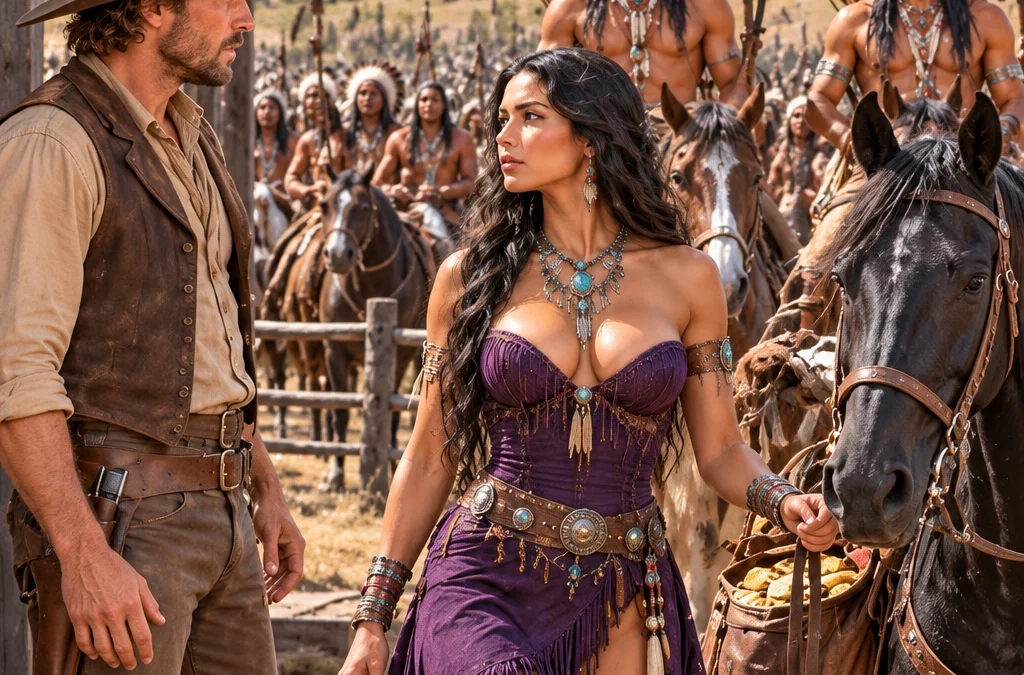
HE GAVE HIS ONLY HORSE TO A DYING APACHE MOTHER IN A BLIZZARD… THREE DAYS LATER, HE WAS CHAINED TO A POST IN A SHED FULL OF GUNPOWDER, THE FUSE BURNING, WHEN A SCREAM TORE THROUGH THE DOOR: “I KNEW THAT SCREAM.” 😱
Part 1
The fuse was already burning when the door slammed shut.
Hosea Marlo yanked against the chain. Iron bit into his wrists. The post behind him didn’t budge. 🔥
Ten feet of black powder crawled across the stone floor toward a wall of old army kegs. An inch a second. He did the math.
Two minutes. Maybe less.
He braced both boots against the post and heaved. Wood groaned. Blood ran warm down his forearms. Nothing gave.
Outside, hooves. Voices fading down the lane. The men who had chained him weren’t staying to watch.
The spark slid past the first barrel. He threw his weight sideways, stretched one leg toward the fuse, and kicked. His heel scraped stone a foot short.
Then the whole shed shook.
Something huge slammed into the door. Once. Twice. A scream ripped through the wood, high and furious.
Not a man’s scream. A horse’s.
Hosea went still.
He knew that scream. He had heard it every morning for four years.
Teeth clamped onto the wooden bar outside, biting, tearing.
Three days ago, in a blizzard, he had given that horse away to a stranger. 😳
Frost had a grudge against Hosea Marlo that morning.
It was on the fence rails. It was on the water trough. It was inside his boots, which he had left by the stove all night, which proved nothing, because the New Mexico high country in December of 1874 did not care where you left your boots. It cared only that you were stupid enough to be standing in them.
He was thirty-four years old. He lived alone. He had a cabin with a leaning chimney, forty head of scrawny cattle, a coffee pot older than his temper, and one horse.
One. Cinder.
The bay gelding stood in the lean-to with his ears pinned flat, looking at Hosea the way a banker looks at a man asking for a loan.
“Don’t start.”
Cinder blew a long wet breath right into Hosea’s face.
“That’s how it is, then.”
He saddled the horse in the dark. Cinder swelled his belly against the cinch, as he did every single morning. Hosea waited. Cinder held his breath. Hosea waited longer, until the horse, outmatched by a man with nothing to lose but patience, let the air out with a groan of pure injury.
“Thank you.”
Cinder bit the hat off his head. It landed in the frozen mud.
Hosea looked at it. Then at the horse. Then up at the sky, which was the color of old dishwater and promised nothing kind.
“Fine,” he said. “We’ll both be miserable.”
He rode north because two calves were missing, and two calves was the difference between a lean winter and a starving one. That was the whole of his ambition. Find two calves. Come home. Eat something hot.
He had no idea.
The ride took most of the morning. Snow had come overnight, a thin skin hiding the rocks in the creek ice, and Cinder picked his way across it like a man crossing a room full of sleeping dogs.
His father’s voice came to him often out here, in the long quiet. Rough and patient, always a half step ahead of him.
A man’s worth is how he treats folks when nobody’s looking, son.
Elias Marlo had said it every winter evening beside the fireplace, over a pipe he could not afford. Hosea had heard it so many times it wore smooth, like a coin passed through too many hands. Then his father died. Lung fever. Quick. Eleven years ago now.
And the coin turned out to be the only thing Hosea owned that was worth anything.
His father’s tin box still sat on the mantle. Black, dented at one corner, locked. The key had gone missing the week of the funeral, and Hosea had never pried it open. Because opening it meant admitting the old man was really gone.
“Don’t think about the box,” he told Cinder.
Cinder flicked an ear. He had no opinion on boxes.
The calves were under the cottonwoods, exactly where a calf with any sense would be, which was the cruel part. He had ridden four hours to find them where he’d looked first.
“Smart little things. Wasted my whole morning.”
One of them sneezed.
He roped the bigger one, got a hand under the smaller, and turned them south. That was when Cinder lifted his head and stood rigid.
Hosea followed the horse’s gaze west, over the ridgeline.
The clouds had changed. They weren’t dishwater anymore. They were iron, piled and boiling and coming fast, with a hard blue edge along the bottom that Hosea had seen exactly twice in his life.
Both times, someone had died.
“Oh no,” he said quietly. “Not today.”
The first flakes hit his cheek, sharp as thrown gravel.
“Home, Cinder. Now, please.”
In the space of one hour, the world turned white, then whiter, then a blank roaring. Trail, sky and horizon dissolved into the same gray howl. Hosea pulled his hat low, buried his chin in his collar, and stopped steering altogether. He put both hands on the saddle horn, because Cinder had carried him through four winters, and Hosea had finally accepted the humbling truth that a horse could be right.
The cold climbed inside his coat. It went through the wool, through the shirt, through his skin, and began laying its fingers on his ribs. His eyelashes froze together. He pried them apart with a gloved thumb.
The calves had stopped bawling. That frightened him more than the wind.
They walked for a long time. Then Cinder stopped.
A hard stop. A planted stop. The horse’s whole body went tight beneath him, ears shot forward, nostrils flaring against the snow.
“What is it?” Hosea shouted. “Nothing out there!”
White wind. Then a shape. Low, dark, moving. Something that rose and fell and rose again.
Something trying to walk.
He slid from the saddle, legs nearly buckling, caught Cinder’s bridle, and dragged himself forward through knee-deep drifts. The shape resolved into a woman. 😨
She was wrapped in a buffalo robe worn so thin the hide had gone to cloth. Her black hair was frozen white at the edges. Her face was gray with cold and with something worse.
Because she was carrying a child against her chest, wrapped in what was left of a blanket. And she was holding him the way a person holds the last thing she owns.
She saw Hosea. She did not run. She couldn’t. She swayed, and her legs folded slowly until she knelt in the snow with the boy still pressed against her.
Hosea dropped to his knees. “Ma’am. Ma’am, I’m not going to hurt you.”
She said something fast and low in a language he did not know, rising and breaking in her throat. Her eyes were wide, swollen, desperate. She said it again and again.
He didn’t understand one word.
He understood all of it.
She pulled back the blanket. The boy was perhaps four. His face was pale as candle wax. His lashes lay still against his cheeks. His lips were a terrible dusty blue.
Hosea laid two fingers against his neck. A pulse. Faint, fluttering, a moth caught in a lamp. And fever. He could feel it through his glove, hot as a stove lid.
He had felt that heat before.
He had been twelve. His little sister Ada, in the bed by the window, burning like a coal while the doctor was forty miles away and the snow was up to the porch rail. He had stood at that window all night, begging the sky to clear.
It had cleared at sunrise.
Ada had died at dawn.
“How long?” he said stupidly, to a woman who couldn’t answer. “How long has he been like this?”
She pointed back through the snow, toward the ridge. A hundred yards off, half buried in drifts, lay a dark mound that Hosea took for a rock until he saw the curve of a rib cage.
A dead horse.
She turned her face back to him. She laid her hand against the boy’s forehead. Then she looked into Hosea’s eyes, and what she said, in the breaking voice of a woman with nothing left, needed no translation at all.
Please.
Hosea stood. He looked at Cinder.
Cinder looked back. Snow clung to his mane. His breath came out in white clouds. He stood in the wind as if carved there, patient and steady and absurdly dignified for a horse who bit hats.
Twelve miles. That was what lay between this spot and Hosea’s stove. Twelve miles on foot in a blizzard, with no horse waiting at the end. No horse to haul hay. No horse to drag firewood. Forty cattle he could not feed without one.
He understood the arithmetic perfectly. He had always been good at arithmetic.
The woman said it once more. Barely a breath.
And Hosea, who had stood at a window for one night when he was twelve and had hated himself for it ever since, did the only thing he had ever known how to do.
“All right,” he said. “All right. Come here.”
He lifted her. She weighed almost nothing. He got her into the saddle with the boy clasped to her chest, and Cinder stood like a rock. Not a flinch. Not a stamp. As if the horse understood.
Maybe he did.
Hosea stripped off his coat, a heavy gray wool. His mother had stitched his name inside the collar when he was seventeen, Hosea Marlo in tight red thread, so he’d never lose it at a barn dance. He wrapped it around the boy and tucked it tight under the woman’s chin. He laid his blanket roll across her shoulders. The wind hit his bare arms like a knife.
“Listen.” He pointed south. “Trapper’s cabin by the river. Roof. Stove. People use it in winter. Cinder knows the way.”
She watched his hand. She watched his face.
He tapped the bay’s neck. Then he looked into the animal’s dark eye, and something pulled tight in his chest.
“You take care of them,” he whispered. “You hear me? You carry them, and you do not bite anybody.”
Cinder blew out a breath that fogged the air between them.
The woman’s hand shook as she reached into a pouch at her belt. She drew out a pendant on a thin leather cord. Turquoise, carved into a soaring eagle, its wings spread wide, the stone as blue as a summer lake. She pressed it into Hosea’s palm and closed his fingers over it.
Then she touched her own heart twice and said one word, slowly, carefully.
“Marlo.”
Hosea went still.
He stared at her. She was looking at the coat. At the collar, where the red stitching showed above the boy’s head.
“Yes,” he said slowly. “That’s my name. How did you…”
The boy coughed. A small, wet, dreadful sound. The woman’s eyes snapped down. There was no more time.
Hosea slapped Cinder’s rump. “Go.”
The bay moved slowly at first, then steadily into the white. Hosea watched the shape of the horse and the woman and the child grow smaller, dimmer, until the storm swallowed them.
Then there was only wind.
He stood alone in the snow in his shirtsleeves, a turquoise eagle clutched in his fist.
“Well,” he said aloud, to no one. “That was dumb.”
He hung the pendant around his neck and buttoned his shirt over it. Then he turned toward home, and stopped.
Because he was a careful man. A curious man. A man who had been told all his life that he looked too hard at things.
The dead horse lay a hundred yards back. The woman had pointed at it. And horses did not die of cold in a day. Not unless they’d been run into the ground.
Go home, he told himself.
He walked toward the horse instead.
A paint mare. Small, well kept. Her hooves were trimmed. Her coat had been curried recently. Not a broken-down animal. A loved one.
He knelt beside her head, brushed the snow from her neck, and there, just behind the ear, small and neat and black with frozen blood, was a hole.
Hosea stared at it.
Not a fall. Not exhaustion. Not winter.
A bullet. Close range. Clean. Done by someone who knew exactly where to place it. 💔
His mouth went dry. He looked up, and in the swirling white, he saw them. Tracks. Dozens of them. Shod horses circling the body, and then branching off in three directions across the snow.
After the woman. After the boy. After Cinder.
“Oh God,” Hosea whispered.
They had been running from something much, much worse than the storm.
And he had just pointed the way.
Then he heard hooves.
Three riders, maybe four, coming from the east, heads down against the wind. Dark shapes in the snow, rifles across their saddles.
Hosea’s hand dropped to his chest. The eagle lay beneath his shirt, cold against his skin. He pulled the collar high.
He did not run. Running was for men with something to hide.
“Evening,” called the first rider.
Hosea knew him. Rafe Quillin, foreman for Anselm Dre’s ranch, the biggest spread in the valley. A lean man with a sunburned neck and eyes the color of dirty water.
“Marlo. Thought that was you. Where’s your coat?”
“Lost it in a blizzard. Seemed like the weather for it.”
Quillin’s mouth twitched. “You see a woman out here? Indian woman. Might have had a kid with her.”
Hosea made himself shrug. Slow. Tired. Disinterested. “I’ve seen two calves and a lot of snow. That’s about it.”
Quillin studied him. His eyes dropped to Hosea’s bare red hands. To the dead mare behind him. Back again.
Another rider nudged forward. A broad man in a sheepskin coat. Hosea knew the way he looked at the dead horse, then at the bullet hole, then very casually away.
“Mr. Marlo,” said the broad man, his voice warm, friendly, almost kind. “You’re half frozen. Let me give you a lift.”
Sheriff Merritt Cobb. A heavy, genial man in his fifties, with a gray mustache and a laugh that rolled out of him like warm gravy. Hosea had shared a bench with him at a church supper once, and Cobb had slipped him an extra slice of pie.
“I’m fine.”
“You’re blue.” Cobb laughed. Then he leaned down from the saddle, and his voice dropped, soft and fatherly. “Son, that woman out there. She’s dangerous. We’ve got reports. Stole some things. Might have hurt somebody. If you’ve seen her, you tell me. You’d be doing the whole valley a kindness.”
Hosea looked up at him. He thought of the woman’s cracked, shaking hands. The boy’s blue lips. The hole behind the mare’s ear.
“Sheriff,” he said, “I haven’t seen a soul.”
It was the first lie he had told in eleven years. It came out smooth as butter.
Cobb studied him a long moment. The smile stayed. But something behind it shifted, like a curtain moving in a window.
“Well,” Cobb said at last. “Good man.” He unhooked a saddle blanket and tossed it down, thick and gray and warm from the horse’s body. “Take that. Mind how you go.”
The riders turned and rode east, and the snow swallowed them.
Hosea stood motionless until the last hoofbeat faded. Then he wrapped the blanket around his shoulders and began to walk.
Twelve miles.
He never remembered all of them.
He remembered the first mile, because it was merely awful. The third, because that was where his fingers stopped hurting, which was the worst sign of all. The fifth, because he sat down in the snow for a minute, just a minute, and thought how pleasant it would be to close his eyes.
And Ada’s voice in his head, clear as a bell.
Get up, Hosea.
He got up.
He remembered talking aloud, arguing with the wind, asking it how a grown man could be so spectacularly stupid as to give away the only horse he owned in the middle of a December blizzard. The wind did not answer, which he reflected was exactly what Cinder would have done.
“I miss you already,” he told the empty white. “You big, biting, ungrateful lump.”
The cattle had probably died. He might die, too. But somewhere south, in a trapper’s cabin by a river, a little boy with a terrible fever might be lying by a stove tonight. Might be warm. Might be breathing.
Because of one stupid decision.
That thought kept his boots moving through the longest dark of his life.
The cabin came out of the storm near midnight. A low black shape, a leaning chimney, a crooked door. He hit it with his shoulder, fell through onto the floorboards, and lay there breathing like a bellows. Then he crawled to the stove. His hands shook so hard he snapped three matches. The fourth caught, and he cupped the little flame like a dying thing and fed it pine shavings until a real fire crackled up, orange and alive. 🔥
He sat before it with the blanket pulled over his head, teeth chattering, fingers on fire as the blood came back.
And through it all, one image. A hole behind a horse’s ear. Neat. Cold. Deliberate.
Someone had shot that mare and chased the woman. Someone was still chasing her. And that someone had asked Hosea to tell them where she’d gone.
He pulled out the pendant and held it up. The turquoise eagle turned slowly on its cord, firelight sliding across the blue.
Marlo. She had known his name. Not from the coat. She had said it before she looked at the collar. Hadn’t she?
His gaze drifted to the mantle. To the tin box. Black, dented, sitting there like it had been sitting there forever.
A shiver crawled up his spine.
“No,” he said aloud. “That’s ridiculous.”
He put the pendant back under his shirt and lay down in front of the stove. The last thing he heard before exhaustion pulled him under was the wind, dying at last.
He dreamed of a bay horse standing in a doorway of white light, looking at him with deep, patient eyes. It bit his hat off.
He woke to someone pounding on his door.
Part 2
Bang! Bang! Bang!
“Marlo! Open this door, you damn fool, before I freeze to it!”
Gray light in the window. His whole body one long ache. Hosea dragged himself up by the table leg, shuffled across the floor, each step a small private war, and lifted the latch.
Lionus Otley stood on the porch.
Sixty-seven years old, built like a fence post, with a white beard that reached his chest and a hat that had outlived two wives. A rifle in one hand, a burlap sack in the other. His eyebrows were frosted solid. His eyes were sharp as a hawk’s.
“Well,” said Lionus. “You’re alive. Barely. I’d have bet money against it.”
“Who’d you bet with?”
“Myself. I lost.”
He pushed past into the cabin and dropped the sack on the table. “Whole valley’s talking. Quillin’s boys came through at dawn saying you were out on the north trail with no coat and no horse.” He fixed Hosea with a long, flinty stare. “Where’s the horse, Hosea?”
Hosea sat down slowly. “Gave him away.”
Silence.
Lionus lowered himself onto the other chair. He set his rifle on the table. He took off his hat and laid it beside it very carefully, like a man preparing for a funeral.
“Gave him away. Your only horse.”
“Yes.”
“To who?”
“A woman and a little boy. Sick.”
“What kind of woman?”
Hosea looked at the stove. “Apache.”
Lionus said nothing for a very long time. Then he put his face in both hands, and his shoulders began to shake. Hosea, alarmed, half rose, until he realized the old man was laughing. Helplessly. Wheezing. Tears running into his beard.
“Oh, son. Oh, Lord. Oh, you magnificent idiot.”
“It wasn’t funny.”
“It truly is.” He wiped his eyes. “Your paw did this, you know. Gave away his best saddle once to a man who’d lost his in a river. Never saw it again. Your ma didn’t speak to him for a week.”
“I know the story.”
“I was there.” The old man’s voice gentled. “Elias would be so damn proud of you. He’d burst.” That landed somewhere soft. “He’d also tell you you’re a fool. Because it’s both, Hosea. It’s always both. That’s the whole trouble with being decent.”
He took a pull from a flask, offered it, shrugged when Hosea shook his head. Then his face sobered.
“Now listen. The valley’s in a bad way. Folks are saying you’ve been dealing with Apache. Dre’s been stirring it up for weeks. Raiding parties in the hills, he says.”
“Are there?”
“Not a one. I’ve hunted those hills forty years.” Lionus leaned forward. “But a scared man will believe anything. And Anselm Dre wants this valley scared.”
“Why?”
“Because scared people sell cheap.” He tapped the table. “And it’s working. Dre wrote the army about Apache troubles. Colonel Straoud rides in with a full column. Sunrise, day after tomorrow.”
The stove popped.
“Lionus,” Hosea said slowly. “That mare they were chasing. The one the woman was riding. I looked at it afterward. It was shot behind the ear.”
Lionus did not move.
“Quillin’s men were out there. And the sheriff. Cobb gave me his blanket.” Hosea held up the gray wool. “He said the woman was dangerous. Said she’d stolen things.”
“Merritt Cobb,” Lionus said quietly, “sheriff of this county, also owes Dre eleven hundred dollars. Everyone knows it. Dre holds the note on his house.”
Hosea’s stomach sank.
“Which means when Cobb asks you something, he’s not asking for the law. He’s asking for Dre.” A long breath. “What was she carrying, Hosea?”
Hosea hesitated. His hand drifted, without thought, to the front of his shirt.
Lionus noticed. The old man’s eyes dropped, then rose slowly. “Whatever you’ve got under there, don’t take it out. Don’t show me. Don’t show anyone.”
“Why?”
“Because if I don’t know, I can’t be made to tell.”
Hosea swallowed. “Is it that bad?”
“I don’t know.” Lionus pulled on his hat and picked up the rifle. “But a man doesn’t get chased through a blizzard over nothing. And a man doesn’t get shot behind the ear over nothing either.” He opened the door. Cold air poured in. “Bread in that sack. Bacon. A little coffee. Eat. Sleep. I’ll look in tonight.”
“Lionus. The calves. Did they make it?”
The old man’s mouth twitched. “Both walked into my barn at dawn, hungry and indignant. One bit my dog.”
Hosea laughed. Suddenly, helplessly, a cracked, aching, grateful laugh that came out of his chest like a bird escaping a cage.
“They’re yours till you want them back,” said Lionus. “Eat something, boy.”
He ate. He slept in the chair with the stove ticking. When he woke it was afternoon, thin yellow light across the floor. He did chores slowly, painfully. Thirty-eight cattle where there had been forty. He hauled hay on his shoulders, chopped wood until his arms burned, carried water from the creek in two buckets, because the sled was too hard to pull without a horse.
Every few minutes he caught himself looking north at the empty white, waiting for a bay horse to come trotting down the ridge with its ears flat and its dignity intact.
Nothing came.
By dusk he sat in his father’s chair with the pendant in his hand, turning it, watching firelight slide across the turquoise.
The eagle had tiny marks on the back he hadn’t noticed before. Thin lines cut into the silver. Not decoration. Something deliberate.
His heart began to pound.
He stood, walked to the mantle, and picked up the black tin box. It was heavier than he remembered. Something shifted inside with a soft metal slide. He studied the lock, a small brass thing tarnished green. He held the pendant against it.
The eagle didn’t fit the lock. But the shape of the lock plate did something strange. That odd little notch on the left side. He had always thought it a flaw in the casting.
He lowered the pendant slowly.
The eagle’s tail feathers slid into the notch perfectly.
Hosea stopped breathing.
Outside, very faintly, a horse snorted.
His head snapped up. He set the box down, crossed to the window, and parted the curtain a half inch. The yard was black. A thin moon slid behind clouds.
Then a shape moved against the barn. Another. Another. Six, eight, ten riders spread in a slow arc, silent on the snow. Dark coats, dark hats, and every one of them wore a mask of feathers and paint and leather.
Apache war masks. 😨
But they were wrong. He saw it at once. The way the nearest man sat his horse, a rancher’s slouch, not a warrior’s stillness. The way another fumbled with his mask. The way a third reined in too hard. Men playing at something they’d only read about.
They were not Apache. They were Dre’s men.
A match flared. A torch caught. Then another. Then ten. The yard lit up like a nightmare, and the riders wheeled toward the barn, toward the hay.
Hosea ran.
He grabbed the box. He grabbed the pendant. He grabbed nothing else, because there was nothing else, and he hit the cellar door in the floor at a dead sprint, hauled it up, dropped into black, earthy dark, and pulled it shut over his head.
Above him, boots hit the porch.
“Check inside,” said a voice.
Hosea froze. He knew that voice. Warm. Easy. Almost kind. A voice that had offered him a blanket not two days ago.
Merritt Cobb.
“The box,” Cobb said. “He’s got a tin box. Find it.”
Boots pounded across the floor above. Furniture crashed. A chair splintered. Dust sifted through the boards into Hosea’s hair.
“It’s not here, Sheriff.”
“Look again.”
“There’s nobody here either.”
“He’s close. His fire’s still warm.” A long, weighted pause. “Burn it. The whole cabin. If he’s inside, he’ll come out.”
Hosea pressed himself against the earthen wall. His heart hammered so hard he thought it might crack his ribs. The pendant burned against his chest. The tin box in both arms felt like the heaviest thing he had ever carried.
Smoke came first. A thin curling thread through the floorboards. Then thicker. Then the roar of fire eating a house he had lived in his whole life. His father’s chair. His mother’s quilts. The window where he’d stood at twelve.
All of it going.
Hosea closed his eyes. He did not cry. He could not afford to. He counted breaths instead, the way his father had taught him. In for four. Hold for four. Out for four.
The cellar had a second exit: a narrow tunnel dug by his grandfather, ending beneath the creek bank. Hosea had crawled through it once as a boy on a dare and gotten stuck. He was bigger now.
He crawled anyway. Dirt in his eyes. Smoke curling through the dark behind him. The box scraping the tunnel walls.
He emerged half choked at the edge of the frozen creek, barefoot. His boots were in the burning cabin.
He lay on the ice, coughing, lungs on fire. Behind him, the sky had turned orange. His house. His barn. His hay.
He rolled onto his stomach and looked back across the field. Cobb’s men sat their horses in a ring around the flames, torches high, feathers fluttering, painted faces lit like devils. One of them was laughing.
Then a rider dropped something on the ground. An arrow. Then another. Then a third. Carefully laid across the porch steps where the whole valley would find them at dawn.
Hosea understood.
By morning everyone in the valley would know that Hosea Marlo, who had given aid to the Apache, had been burned out by Apache. That the war everyone feared had finally begun. And Anselm Dre would stand on the ruins and ask the army to protect the valley.
He lay on the ice, and the cold crept into his bare feet, his bones, the hollow place where something called hope used to live.
A sound beside him. A small wet snuffle.
He turned his head. A calf. The smaller one, black with a white blaze. It stood on the ice not three feet away, shivering, steam rising from its flanks. It must have followed him all the way from Lionus’s barn.
“You,” Hosea whispered. “You came all this way.”
The calf sneezed.
And Hosea, flat on a frozen creek bed, barefoot, homeless, hunted, began to laugh. Quietly. Helplessly. Tears cutting hot trails through the soot on his face.
“Fine,” he said. “You and me.”
He pushed himself up, the tin box under one arm, the pendant against his heart, the calf at his heels. Behind him the cabin collapsed with a roar, and sparks climbed the black sky.
He turned his back on the fire.
Barefoot was a mistake.
Hosea had made a great many mistakes since the storm, and he had been keeping count. Giving away the horse was the first. Lying to the sheriff was the second. Letting a calf follow him across a frozen creek was somewhere around the fourth.
But barefoot was the one his body wanted to discuss. His feet had stopped hurting two miles back. That was the problem. Feet that stopped hurting in the snow were not feet getting better. They were feet leaving.
“Keep walking,” he told the calf.
The calf did not argue. It plodded beside him with the air of an animal who had decided that this particular fool was now its fool.
Ahead of him, a lantern burned in a window. Lionus Otley’s place.
He did not remember the last half mile. He only remembered the porch boards under his bare feet, and the front door opening before he could knock, and a rifle barrel stopping an inch from his nose.
“Marlo? Lord God Almighty.”
The rifle dropped. Two hard hands hauled him inside. Lionus half carried him to the stove as if he weighed no more than a sack of oats.
“I saw the sky light up. I was saddling Biscuit. I was coming, I swear to you.”
“I know.”
“Boy, your feet are white.”
“I’m aware.”
Lionus knelt with a basin, a kettle, and a rag, and did something that made Hosea say words his mother would not have liked. Then did it again. Somewhere in the middle of the second time, Hosea started to laugh, because the pain meant they were still attached.
“Hurts?” Lionus asked, wonderfully pleased. “Good hurting’s a fine sign.” He sat back on his heels. “Dre’s men dressed as Apache.”
“Of course they were. Cobb was with them. I heard him tell them to burn it.”
Lionus said nothing. His jaw worked beneath the white beard. He crossed to a chest in the corner, rummaged, and came back with a pair of boots. Enormous. Cracked leather, sturdy soles.
“My late wife’s brother’s. Dead man’s boots. Plenty of room.”
Hosea pulled them on. They fit like two small boats. He stood, wobbled, sat back down. “Thank you.”
“Don’t thank me yet.” Lionus’s eyes dropped to the box. “What’s that?”
Hosea set it on the table. The pendant came out from under his shirt. He held the eagle to the lock plate, found the odd little notch, and slid the tail feathers into it.
It fit like a key. Because it was one.
A soft metallic click. Eleven years of silence broke open in his hands.
Neither man breathed. Hosea lifted the lid.
Inside lay a folded square of black oilcloth. Beneath it, a small leather pouch. And on top of everything, a single sheet of brittle brown paper, covered in his father’s cramped handwriting.
His hands were not steady.
Hosea, if you are reading this, then Tall Cedar’s people have found their way to you, and I am no longer here to meet them. I am sorry for that. I made a promise, and I did not live long enough to keep it.
The map is half of what you need. The other half is theirs. Do not trust any man who asks you for either. Do not trust any man who smiles too easily. Your mother used to say you could read people. I hope she was right.
Be a better man than your father was a keeper of secrets.
Elias
Hosea read it twice. Then he set it down very carefully and looked at the wall for a while.
“Son,” Lionus said gently, “he knew.”
“Knew what?”
“That he was dying. He wrote this before he knew.”
“Eleven years.” His voice came out strange, flat, far away. “I walked past this box every day. I thought it was full of nothing.”
Lionus put one rough hand on his shoulder and said nothing, which was the kindest thing anyone had done for Hosea in a very long time.
After a minute, Hosea unfolded the oilcloth. A map. Half of one. The torn edge ran down the right side, jagged as a broken tooth. Ridge lines. A river. The valley he knew like his own hands. And in the middle, circled in faded ink, a small spring marked with a tiny eagle.
Beneath it, two signatures. Elias Marlo, witness. And next to it, a single curved stroke like a wing.
“Eagle Spring,” Lionus whispered. “Fifteen miles up. It feeds the whole river. Hosea, every ranch in this valley drinks from that spring. Mine. Yours. And Dre’s most of all. He’s got four thousand head and not a drop of his own.”
The stove ticked. A log shifted.
“So this paper says the spring belongs to someone else.”
“This paper says your father shook hands on something, and somebody wrote it down.” Lionus rubbed his jaw. “I always wondered what Elias carried to the grave. Never thought it’d be water.”
Hosea looked at the jagged edge. “The other half. Tall Cedar’s people have it.”
“Old chief up in the canyons. I’ve traded with his band thirty years.” Lionus’s face tightened. “Hosea, if Dre gets both halves and burns them, there’s no proof. And if the Apache can’t prove the spring is theirs, there’s an army in this valley looking for a reason.”
“Then it’s not a treaty.”
“It’s a land sale with a body count.”
Hosea slipped the map into the pouch and the pouch inside his shirt, beside the eagle, over his heart.
“I need to find them.”
“You need sleep.”
“I need to warn them.” He stood. The borrowed boots slid on his feet. “She was looking for my father, Lionus. She crossed a blizzard with a sick child because she thought a man was still alive who could help her. And instead she found me.”
“You’d have been enough.”
“I gave her a horse. That’s all I did.”
Lionus fixed him with a look. “That’s the whole thing, boy. That’s all anybody ever does.”
They left before dawn. Hosea rode a mule named Deacon, thirteen years old, with opinions about everything, particularly water, shadows, and the concept of hurrying. He balked at every puddle. He balked at a fence post that looked at him strangely. At a patch of ice the size of a dinner plate he stopped dead and refused to continue until Hosea apologized.
“I’m sorry.”
Deacon walked on.
“I hate you,” Hosea told him.
Deacon flicked one weary, wise ear.
Lionus rode beside him on an old gray mare named Biscuit, rifle across his saddle, whistling through his teeth. The calf stayed behind in his barn, bawling its indignation. Hosea had promised it a name when he got back.
“Where first?”
“The trapper’s cabin.”
“She won’t be there.”
“I know.”
“Then why?”
Because he had stood in a blizzard and pointed south and sent a mother and child toward a roof he had never actually looked at. And a man who sent people toward a place ought to know what he’d sent them to.
The cabin stood in a stand of bare willows beside the river. Gray logs. A sagging roof. No smoke. Hosea slid off the mule and crossed the yard in his borrowed boots, pushed open the door, and stopped on the threshold.
It was empty. Cold. But it had not been empty a day ago. A bed of pine boughs lay beside the hearth. A tin cup sat on the floor, still half full. A small wooden bowl held the dregs of something that smelled of herbs.
And across the table, folded neat and square, lay a gray wool coat.
His coat.
He walked toward it. He did not trust his voice. Someone had brushed the snow from it. Someone had folded the sleeves. On top of the collar, where the red stitching read Hosea Marlo, lay a tiny braided bracelet, black horsehair knotted tight, small enough to fit a child’s wrist.
Beside it, scratched into the table with the tip of a knife, three crude marks. A circle. A line. A tiny bird.
“What does that mean?” Lionus asked from the doorway.
“Thank you,” Hosea said. His throat was tight. “I think.”
He turned the bracelet over. A single strand of coarse black hair was caught in the knot. A horsehair.
Then he noticed the door frame. Deep in the oak, at about the height of a horse’s mouth, was a perfect set of tooth marks.
“Lionus.”
“Hm.”
“Cinder was here.”
Lionus leaned in and studied the splintered wood. Then the shelf above the stove, which had a distinct bite taken out of one corner. Then a leather strap hanging from a peg, chewed clean through.
“Well,” he said gravely. “That’s definitely your horse.”
Hosea laughed, a cracked, helpless sound. And in the middle of it, he found his eyes were wet, and he turned his face to the wall.
“He’s alive. They all are. The boy’s fever must have broken.”
Then outside, Deacon began to scream.
Not a bray. High and furious.
Lionus was already at the window. His face changed.
“Riders.”
Hosea shoved the coat on. It was stiff and cold and smelled of wood smoke, and it was the best thing he had ever put on his body. He stuffed the bracelet in his pocket, grabbed the door frame, looked out.
Six men, coming along the riverbank at a canter. Quillin out in front, sunburned neck, dirty eyes, a rifle already rising.
“Back door!”
“There isn’t one!”
“Then make one!”
Hosea kicked out a rotten chunk of the back wall. It splintered like old bread. They fell through into snow, scrambled for the animals, and a bullet hit the cabin behind them with a sound like a slammed door.
“Ride!”
Biscuit bolted. Deacon, shockingly, bolted too. For the first time in thirteen years, the old mule discovered that he could in fact run, and he ran like a creature who had been lied to all his life. 🐴
The river lay to the west, frozen, a gray road of ice curving between the willows. Behind them, hoofbeats thundered. A second shot cracked.
Lionus grunted.
Hosea twisted in the saddle. The old man was still riding, but his left hand had come off the reins. A dark stain spread across the shoulder of his coat.
“Lionus!”
“I noticed.”
Another bullet clipped the ice beside them. Hosea turned Deacon hard, and in the swerve, he saw it. A dark seam across the ice, fifty yards upstream. A long ragged stripe where the surface looked slightly different, slightly wet, slightly dull.
He knew that place. He had known it since he was seven. His grandfather had told him a hundred times, in that gravelly voice: Warm seep spring runs under the ice there. Never thickens. Never. You stay left of the willow stump, or you swim.
“Left!” he shouted. “Stay left of the stump!”
“What stump?”
“Follow me!”
He wrenched Deacon left. Lionus, grim and pale, dragged Biscuit after him. They swept along the river’s edge in a wide arc, hugging the bank, while the riders swung straight across the middle to cut them off.
Straight across. Over the seam.
Quillin was first. His big roan hit the dull gray ice at full gallop.
There was a sound Hosea would remember for a long time. A deep, soft groan, like a house settling. Then a crack that ran thirty feet in a single instant, and the ice opened.
The roan went in head first. Quillin went over its neck. The two men behind him hauled back on their reins, and their horses reared, screaming, skidding on the lip of black water. A third man fell sideways onto the ice.
Everybody was shouting. Nobody was chasing anymore.
Hosea did not look back. He crouched low over Deacon’s neck and rode until the willows closed behind them.
When he finally slowed the mule to a walk, his hands were shaking so hard he could barely hold the reins.
“Well,” Lionus wheezed, his face gray. “That was clever.”
“You didn’t sit up. Let me look at that.”
“It’s a scratch.”
“It’s a hole.”
“It’s a very small hole.”
Hosea made him dismount and peeled back the coat. The bullet had gone through the meat of the shoulder, low and clean, and out the back. It bled freely but not badly. He tore a sleeve off his own shirt, packed the wound tight, and bound it with his belt.
“You need a doctor.”
“I need a drink.”
“You need both.”
“There’s only one man within thirty miles who wouldn’t sell me out.” Lionus winced as the belt pulled tight. “Edmund Vance. Runs the trading post at the crossing. Speaks Apache better than the Apache do. Only man in this valley who can walk into that canyon and not get an arrow for it.”
Hosea hesitated. “Do you trust him with my life?”
Lionus managed a ghost of a grin. “With my whiskey, never.”
The trading post sat where the river road forked. A long, low building of weathered planks, a sagging porch, a chimney that seemed to lean in sympathy. Edmund Vance met them at the door.
A slim man in his fifties, with round spectacles and ink on his cuffs and a cardigan mended by someone who loved him. His hands were soft and clean. He looked more like a schoolteacher than a traitor. When he saw Lionus bleeding, he dropped the ledger he was holding and ran.
“Good heavens. Sit. Hosea, take his other arm.”
In ten minutes, Lionus was stitched and swearing.
“There,” said Vance. “You’ll live out of spite, mostly.”
“That’s how I do everything.”
“I know. It’s your best quality.” Vance wiped his hands, and his eyes, magnified behind the round lenses, settled on Hosea with gentle concern. “And you. Your feet. Your face. You look like you were buried and thought better of it. Long couple of days, I’ve heard.”
“The whole valley has.”
Vance poured three cups of coffee. His hands were perfectly steady. “They say you gave your horse to a woman and her child.”
“I did.”
“And that your house burned.”
“It did.”
“I’m so sorry, Hosea. Truly.” He handed over a cup. “What can I do?”
Hosea looked at the spectacles, at the kind, tired face. He thought of his father’s note. Do not trust any man who smiles too easily. But Vance wasn’t smiling. Vance looked genuinely sad. And Hosea, who had spent a day and a night being hunted, found he wanted very badly to believe in one honest face.
“I need to reach Tall Cedar’s camp. Today, before dark. I need someone who speaks the language.”
“Why?”
“To warn them. Dre is coming for them.”
Vance’s face did not change at all. He simply set down his cup, adjusted his spectacles, and said, “Then we’d better go. I’ll guide you, of course.” A small, sad smile. “Somebody has to.”
He asked the question almost as an afterthought, as Hosea turned toward the door. “What was she carrying? The woman. Did she have anything with her?”
“Why?”
“Only curious. Rumors in the valley. That she had something Dre wanted.”
Hosea’s hand dropped. Not toward his chest. Toward his pocket, where the horsehair bracelet lay.
“A sick boy,” he said. “That’s all she had.”
Vance nodded slowly. “Of course.”
It was not until they were back on the road, three riders heading into the hills, that Hosea realized what had bothered him.
Vance’s boots.
Every other man in the valley had mud to his knees after the storm. Lionus had it. Hosea had it. The mule had it.
Edmund Vance’s boots were perfectly clean. 😨
The canyon opened like a door.
They had ridden three hours, climbing, the path narrowing between walls of red stone dusted with snow. Pines clung to the ledges. A hawk wheeled overhead. The air had gone sharp and thin and so quiet Hosea could hear his own heartbeat.
Then a low whistle. A single clear note.
Vance raised one hand. “Stop. Let them see us.”
From the rocks above, figures appeared. Four, five men with rifles and long black hair and eyes that gave nothing away. Vance called out in a language like running water. One of the men answered, short.
“They know who you are,” Vance translated. “They’ve been watching you since the river.”
“What else did they say?”
“They said you ride a very ugly mule.”
Deacon snorted.
The camp lay deeper in, a hollow sheltered from the wind, ringed by cottonwoods and rock. A dozen low dwellings. Thin smoke rising from cook fires. Dogs barked. Children stopped playing and stared. An old woman at a fire looked up and said something sharp, and two men rushed to help Lionus from his saddle.
And in the center of the clearing, perfectly still, stood a small figure in a blue blanket.
Hosea stopped breathing.
The boy was about four. His cheeks were round and brown and healthy. His eyes were dark and solemn. He looked at Hosea for a long, steady moment, as if checking something against a memory.
Then he ran.
He crossed the clearing at a dead sprint and hit Hosea’s legs like a small, furious cannonball. Wrapped both arms around his knees and held on.
“Hey,” Hosea said, his voice cracking. “Hey there. Hey.”
The boy looked up and grinned, a gap in his front teeth. In a tiny, precise, triumphant voice, he said one word.
“Cinder.”
Hosea stared. “You learned his name.” He tapped his own chest. “Hosea. Hosea.”
The boy squinted with great seriousness. “Hos,” he said. Wrong, but proud. Then he pointed. “Cinder.”
Hosea looked.
At the far edge of the camp, tethered to a cottonwood, stood a bay gelding, ears pinned flat, breath steaming. He had been groomed. Someone had braided feathers into his mane, which he plainly regarded as a personal insult.
He saw Hosea. His ears came up.
Then he did something Hosea had not seen him do in four years. He whinnied. A high, shaking, undignified sound. He strained at the rope, hooves stamping, while the whole camp watched a horse try to climb out of his own skin with joy. 🐴
“Cinder,” Hosea said. “Cinder, you big ugly…”
He was across the clearing in six strides. He put both arms around the horse’s neck and pressed his face into the warm bay shoulder. The smell of horse and smoke and home hit him like a wave. And Cinder, with infinite gentleness, took Hosea’s hat off his head and dropped it in the snow.
“I missed you too,” Hosea said, laughing and crying at once. “You terrible animal.”
Someone cleared her throat behind him.
He turned. She stood a few paces away in a woven blanket. The woman from the storm. She looked healthier, rested. Her face was still gaunt, but her eyes were clear, and they rested on Hosea with an expression that made him feel seen all the way to the bottom.
She spoke softly.
“Her name is Juniper,” Vance translated. “The boy is Ren. They are the daughter and grandson of Tall Cedar.”
“Tell her I’m glad she’s safe.”
Vance spoke. Juniper answered, a long soft exchange.
“She says she is glad you came back. She says you are the first man in her life who gave something away and did not ask for it back.”
Hosea’s throat closed. “Ask her why she was looking for me.”
Juniper’s answer was long. Hosea watched her face while she spoke. Watched her eyes drop. Watched her hand move to her heart.
“She was not looking for you,” Vance said slowly. “She was looking for Elias Marlo.”
Hosea nodded. He had expected that.
“Her father and Elias were friends many years ago. Elias gave his word and his name on a paper that protects the spring.” Vance paused. “Her husband was a guide. His name was Stonewalker. Three weeks ago, he was hired by Dre’s surveyors. He saw them redrawing the line. Moving the spring onto Dre’s land.”
“What happened to him?”
Vance’s voice thinned. “They shot him. And then they came for her. For the boy. To make certain no one was left to say what he saw.”
Juniper stared at the ground.
“They shot her horse from under her. She walked on, carrying the boy.”
The words fell into the clearing heavy as stones.
Hosea walked over to her. He took the horsehair bracelet from his pocket and held it in his open palm. Juniper looked at it. At him.
“My father’s dead,” Hosea said, though she couldn’t understand. “Eleven years. I’m sorry. He would have helped you. And I will.”
Vance translated.
Juniper closed her eyes. When she opened them, she did something he did not expect. She reached out, folded his fingers over the bracelet, pressed her hand against his, and said three words, soft as breath.
“The son carries it,” Vance whispered. His voice was odd. “She says the son carries the promise.”
An old man stepped from the largest dwelling. Small and bent, with a face like folded leather and white braids to his waist. He carried a tall staff topped with a carved eagle’s head, turquoise stones glinting along its length. He walked slowly, as if every step were a negotiation. When he reached Hosea, he looked at him for a long time.
Then he spoke, not to Vance, but directly, in slow, careful English.
“You. Marlo?”
“Yes, sir.”
“Your father. Good man.”
“Yes, sir. I’m learning that.”
The old chief’s mouth twitched, something that might have been a smile. “You have the paper?”
“Half of it.”
“Show.”
Hosea hesitated. He glanced at Vance, who stood a polite distance away, hands folded. Then he drew out the pouch, unwrapped the oilcloth, and held up the torn edge.
Tall Cedar studied the map. He touched the eagle mark with one finger. Then he looked up at his own staff, at the carved head, at a dark seam running down the shaft so faint Hosea had not noticed it. He said something quietly in his own tongue.
“He says,” Vance began, and cleared his throat, “he says the other half sleeps where the eagle watches.”
Tall Cedar was looking at Vance now. A flat, measuring look. The look a man gives a stranger who has asked one question too many.
Vance smiled. A thin, pleasant smile.
“A beautiful staff, Mr. Vance,” Hosea said. “Could you ask him how many men he has, if Dre comes?”
Tall Cedar answered. Vance relayed it. “Thirty. Perhaps forty with the boys.”
“Against?”
“Dre?” said Vance. “A hundred. Maybe more, with the army.”
Hosea nodded slowly. He looked up at the sky. The light had begun to change. The canyon walls glowed copper and gold, shadows pooling at their feet. A raven called from the high rocks.
And somewhere up on the ridge, faint, he almost missed it. Something flashed. Once. A tiny bright wink of light, like sun on glass.
Hosea’s blood went cold.
He turned slowly. Beside him, Vance’s right hand had slipped into his pocket. It came out cupped. Light flashed between his fingers. A small round mirror, angled toward the canyon rim.
And on the rim, a flash answered, as if someone had been waiting all day for it.
Hosea looked at the hand. Then at the face. And he saw the exact moment the kind, tired face stopped being kind.
“Edmund,” he said. “What did you do?”
“I’m sorry,” said Vance.
Something whistled overhead. An arrow, Hosea thought wildly. Then he understood.
Not an arrow.
A rifle shot. A long flat crack. And a warrior on the nearest ledge folded backward and fell.
The camp exploded. Men shouting, women snatching children, dogs howling. Riders poured down the canyon wall in a wave, forty, fifty, dark against the sunset, rifles up, torches blazing.
And these ones did not wear masks. They did not need to. They had badges.
Cobb’s deputies. And behind them, Dre’s hands in sheepskin coats, riding like a flood.
“Down!” Hosea roared. He grabbed Juniper and shoved her toward a rock. “Get the boy! Get him down!”
She was already moving. Ren was already in her arms. She dove behind the stone as bullets chewed the snow.
Hosea whirled on Vance. “You led them here.”
“They hold the note on the post.” Vance’s face was wet. His spectacles had slipped crooked. His voice cracked, small and broken. “My daughter’s school. Everything I own. They said it would only be the staff. Only the map. Nobody was supposed to be hurt.”
“You watched a man get shot.”
“I know.”
“You knew they’d come with guns.”
“I knew!” Vance screamed. “I knew, and I came anyway. God help me. I knew!”
He ran, dropped his glasses, plunged into the smoke, and was gone.
Hosea had no time to chase him, because the world was a roaring wall of gunfire, and a bullet tore the hat off his head. For the first time in his life, he was grateful to be hatless.
“Hosea! Here!”
Lionus had propped himself behind a wagon, rifle braced on the tailgate, cursing steadily and firing with one good arm. “Go! Go get your idiot horse!”
Hosea ran through smoke and screaming. Past Tall Cedar, who stood in the open with his staff raised and his white braids lifting in the wind, and did not flinch. Past a warrior firing from one knee. Past a cook fire kicked into the air. He reached the cottonwood.
Cinder was rearing, eyes rolling white, rope strained taut.
“Easy. Easy. I’ve got you.”
A loop of rope dropped over the horse’s head.
Hosea froze.
Rafe Quillin sat his saddle ten feet away, soaked to the waist, hair plastered flat, face blue with cold and fury. He had dragged himself out of that river. He had ridden here wrapped in a stolen blanket. And he was smiling.
“Evening, Marlo.”
“Let go of my horse.”
“This horse?” Quillin jerked the rope. Cinder screamed. “This is stolen property, reported missing by one Hosea Marlo, rancher, taken in an Apache raid. You’ll want to tell the colonel that when he asks.”
“He’s not stolen. I gave him.”
“That’s not what the paperwork says.”
“Rafe.”
“Hm?”
“He bites.”
Quillin frowned. “What?”
Cinder lunged.
It happened so fast Hosea almost missed it. The bay gelding whipped his head around and clamped his teeth onto Quillin’s forearm, right through the coat, and held on. Quillin howled. The rope went slack. Cinder let go, wheeled, and kicked out with both hind legs. Quillin flew from the saddle and landed in the snow with a sound like a dropped sack. 🐴
For one glorious second, Hosea thought they had won.
Then a gun hammer clicked behind him.
“That’s enough,” said a soft, pleasant voice. “Mr. Marlo. Please don’t move.”
Hosea turned.
A man sat a white horse at the edge of the firelight. Not what Hosea had expected. Not a brute. Not a bully. Silver-haired and slender in a black coat of excellent cut, with a face like a kind professor and a pistol held lightly in one gloved hand. He did not look angry. He looked mildly amused, like a man watching a child struggle with a puzzle.
Anselm Dre.
Behind him, two deputies held Lionus at gunpoint. Others had rounded up the camp, warriors on their knees, women clutching children, smoke drifting through it all like a curtain.
And on Dre’s left arm, wrapped in a blue blanket, wide-eyed and silent, sat Ren.
Hosea’s heart stopped.
“Put him down,” he said.
“In a moment.” Dre’s voice was gentle, cultured, almost sad. “You know, I stood at your father’s grave eleven years ago. I hoped very sincerely that stubbornness wasn’t hereditary.”
“You knew my father.”
“Everybody knew your father. He was a very difficult man.” Dre smiled. “And now he’s a very difficult box. Where is it?”
“Where’s Juniper?”
“Safe. For now. As is her father.” Dre shifted the boy higher on his arm. Ren stared at Hosea, small and silent and brave. “I have no wish to hurt anyone, Mr. Marlo. I wish only to buy a little piece of land. That requires two small things. The eagle and the box.”
“Go to hell.”
“Possibly. But not before dawn.” He glanced at the sky, at the last red streak sinking over the canyon wall. “Colonel Straoud’s column arrives at sunrise. By then I’d like this matter closed. If you bring me what I want, the boy goes back to his mother unharmed. If I don’t, the colonel will find a camp full of Apache raiders, and a very frightened child, tragically caught in the crossfire.”
Hosea took one step. Three rifles came up.
“Don’t,” Dre said softly. “Please. He’s very young.”
Ren made a small sound. Hosea stopped.
“Come alone. Mr. Vance will tell you where.”
Dre turned his white horse and rode out of the firelight with the boy in his arms. His men fell in behind him. Quillin, bleeding and furious, dragged himself into the saddle, snatched Cinder’s rope, and hauled the screaming bay along into the dark.
The last thing Hosea heard was Ren’s voice. Small, high, bewildered.
“Cinder?”
Then nothing.
The camp lay in ruins around him. Fires scattered. Wounded groaning. Juniper stood alone in the open, arms hanging empty at her sides, staring at the place where her son had been.
Lionus limped over, blood soaking his sleeve. He looked a hundred years old. “Hosea.”
“I know. One night. I know.”
Hosea took the pouch from his shirt. The map. The eagle. The whole terrible weight of his father’s promise. He held it in his hand and looked down at it.
Half a map. Half a promise. One night to find the other half before the sun came up, and the army rode in, and a boy who had just learned his horse’s name was carried into the dark by a man who smiled like a priest.
He closed his fist around the turquoise.
“Then we’d better start,” said Hosea Marlo.
Part 3
The camp smelled of gunpowder and spilled coffee.
Hosea stood in the wreckage with half a map in his shirt and a hole where his courage used to be. Fires lay kicked across the snow. A dog whined beside a body he could not look at. Somewhere an old woman was singing, low and steady, the way you sing when there is nothing left to do but keep the sound going.
Tall Cedar was gone. Dre’s men had taken him in the confusion, bound and silent, white braids lifting in the wind. They had taken four warriors, too.
They had left the dead. And in the trampled mud beside the largest dwelling, they had left a tall staff topped with a carved eagle’s head.
Hosea picked it up. It was heavier than it looked. Turquoise stones ran down its length like a river of small blue eyes. He turned the carved head in his hands and found the thin dark line he had noticed once and forgotten.
“Juniper.”
She stood three paces off, staring at nothing.
“He’s alive,” Hosea said, though she had no English for it. “Dre needs him alive. A dead boy buys him nothing.”
Lionus limped over and tried it with his hands and three words of Apache and plain stubbornness. Something reached her. Her eyes came up, dry and terrible.
Hosea held out the staff.
She studied it a long moment. Then she drew a bone-handled knife from her belt and did what her father had never let anyone do. She slid the blade into the seam and twisted.
The eagle’s head split like a walnut.
Inside lay a tight roll of hide, no thicker than a thumb. She unrolled it across her knee. Hosea took his father’s half from his shirt and laid the torn edges together. They matched ridge to ridge, river to river. The jagged tear closed like a healed wound, and the whole valley lay spread across the two pieces. Every creek. Every canyon. And at the center, the circled spring with its little eagle.
Below it were the signatures. Two he knew. Elias Marlo, witness. The curved wing of Tall Cedar’s mark.
And a third, wedged in the corner where the tear had cut through it. A neat, looping hand. Very young. Very proud.
A. Dre.
And beside it, in careful numbers, a date. 1851.
“Lionus.”
“I see it, boy.” Lionus’s face had gone hard. “I’ve looked at that handwriting on the note against my barn for nine years. It just had fewer lines around the eyes back then.”
Hosea did the arithmetic. This was the winter of 1874. Twenty-three years.
Anselm Dre had not stumbled across a valley and grown greedy. He had stood at a table at twenty-seven years old and put his name on a promise. Then he had spent twenty-three winters trying to burn it.
“He’s bound by it,” Hosea whispered. “If the colonel reads this, the water isn’t his. He’s a signer. He swore to share it. Which is why he needs it gone.”
“Gone,” said Lionus. “And everyone who ever touched it.”
The sun was a red coin sinking behind the canyon wall. Long blue shadows lay across the snow. Somewhere inside the coming dark, a boy was sleeping in a stranger’s grip.
“I need a plan.”
“You’ve never had one in your life.”
“I gave away a horse in a blizzard. That was a plan.”
“It just had a terrible second act.”
“So far,” said Hosea.
A boy found the summons pinned beneath a rock at the canyon mouth. A scrap of paper. A careful, shaking hand. The ink was blurred by something that might have been rain.
Hargreave Mill. Five in the morning. Come alone with the box. The eagle and your half.
“Your half,” Lionus read. “Not both. He doesn’t know. Tall Cedar’s half was in the staff. He thinks the old man still has it. And the old man’s in his hands.”
“So Dre figures to take mine, squeeze the old man for the other, and be done by breakfast.”
“Then we let him think it’s working.”
The plan took nine minutes. It was terrible. Lionus said so. Hosea agreed. They did it anyway.
Lionus had scouted for the army forty years ago, and a scout draws maps the way other men whistle. He cut a scrap of tanned hide from the camp. He mixed soot, spit, and a drop of pine pitch with a stub of charcoal, and drew with a hand that stayed steady despite the bandage on his shoulder. Ridge for ridge. River for river. The little eagle at the spring.
“It won’t fool him up close,” Lionus muttered. “It only has to fool him long enough.”
“Long enough for what?”
“For Juniper.”
She had listened to the halting translation with her arms folded and her eyes narrowed. Her warriors, eight of them still able to ride, would circle the mill in the dark while Dre was busy with Hosea at the front door. They would go in through the back. A trade. A distraction. And a boy who simply vanished.
“That’s the whole thing,” said Lionus.
“There’s a lot of and then it works in it.”
“There usually is.”
Juniper said something short.
“She says,” Lionus translated, “that if you fail, she will feed you to your own mule.”
“Tell her that’s fair.”
“She also says she is not afraid of a man who laughs at his own funeral.”
Hosea blinked. “I haven’t laughed once.”
“Twice. She counted.”
Juniper held out her hand. He took it. Her palm was warm and rough, hard as a saddle. She held on one second longer than she needed to. Then she went to find her horse.
Lionus settled his hat on his head. “And me? You want me sitting in the rocks with a rifle?”
“I want you alive.”
“That’s not a job. That’s a hobby.” Lionus squinted east toward the lights of the town, eight miles off. “Dre keeps two sets of books. Everyone knows it. Nobody’s seen the second set. A man like that can’t stand to throw paper away. He wrote to Vance. He wrote to Cobb. He wrote it all down because he loves being clever.”
“Where? The assay office on Front Street?”
“He owns the building and rents it to himself under a different name.” The old man smiled. It was not a kind smile. “I scouted for the army, Hosea. Locks are just a conversation.”
“You’re shot.”
“I’m shot in the shoulder. I’ll be picking the lock with my hands.”
“Lionus. Don’t.”
He climbed onto Biscuit with a grunt. “I’ll be waiting there at midnight. If you’re alive at sunrise, come find me. If you’re not, I’ll be very rude to the colonel on your behalf.”
He rode out into the dusk, whistling through his teeth.
Then came the longest waiting of Hosea’s life. Nine hours of dark. He spent them among Juniper’s riders, slipping away one by one into the rocks, counting stars between the canyon walls until the count ran out.
The Hargreave Mill had been dead twenty years.
It hunched on the northern edge of the valley, a gray skeleton of beams and broken wheel. The great paddles hung rotted and still. Ice crept along the sill. And beside the main building squatted a low stone outbuilding with a heavy door and a single slit of a window.
The old powder shed. The mill had once ground gunpowder for the army, and the shed still held kegs no one had ever claimed.
Hosea rode Deacon up to the front door at five minutes to five. The mule balked at the gate. He balked at the porch. He balked at the lantern swinging from the beam and throwing yellow shadows across the snow.
“I know,” Hosea whispered. “I don’t like it either.”
The door opened. Anselm Dre stood on the threshold in his black coat, no hat, silver hair neat. A lamp burned on the table behind him. He stepped aside with a courtesy that made Hosea’s skin crawl.
“Mr. Marlo. You’re punctual. How rare.”
“Where’s the boy?”
“Sleeping. Come in.”
The great room was a cave of dark beams and ghostly machinery. A table. A cast-iron stove glowing red in the corner. And in the far corner, wrapped in a blue blanket, curled like a small brown bean on a pile of sacks, lay Ren. His chest rose and fell. A tiny whistle came from his nose.
Hosea’s knees nearly went.
Quillin stood by the wall, forearm bandaged, face the color of old meat. Cobb leaned in a doorway, hat tilted, wearing his warm-gravy smile. And at a small writing desk in the back, lit by a single candle, sat Edmund Vance, spectacles mended with wire, pen in hand. He would not look up.
“The box,” said Dre.
Hosea set it on the table.
“The eagle.”
He lifted the pendant over his head and laid it down. Dre’s eyes dropped to it. Something old and hungry flickered across his face.
“You know, I stood in your father’s house the night of the funeral. I drank your mother’s coffee. I looked at that dented tin box on the mantle, and I never gave it a second glance.” He smiled thinly. “I will think about that for the rest of my life. Eleven years searching every drawer in the county, and it sat in plain sight, waiting for a key nobody could find.”
“It found me.”
“It did. A woman and a dead horse found you.” His gaze moved. “And the half.”
Hosea took out his father’s half and set it beside the box. Then he drew out the second roll, tied with a thong. Lionus’s forgery.
Dre did not touch it. He folded his hands behind his back and walked once around the table, studying the two rolls as a man studies a bottle of wine.
“Barefoot, I understand. Admirable. It was cold, I imagine.” He stopped. With one gloved finger, he lifted a corner of the forgery and tilted it toward the lamp. He looked at it for a long time.
Hosea’s stomach turned to ice.
“Very fine work,” Dre murmured. “Lionus always did cross his sevens.”
The room went still.
“A little hook on the stem. He learned it from a sergeant in the Tenth Cavalry. A man can change his handwriting, Mr. Marlo. He cannot change his sevens.” He tapped the hide. “There are no sevens on that map. Elevation marker. Southwest Ridge. Seven thousand four hundred.” He tapped it again. “He crossed it.”
Hosea closed his eyes. “Of course he did.”
“Rafe.”
The rifle butt hit Hosea in the stomach. He folded. Went down on the boards, wheezing, stars bursting behind his eyes. A boot caught his ribs. Another.
“Easy now,” Cobb’s soft voice said. “Easy.” As if gentling a colt.
Dre crouched. “Do you know what I was waiting for? Not your forgery. A man who finds half a map does not hand over the other half. He hides it with someone he trusts. I was never after the copy, Mr. Marlo. I was after the person who didn’t come.”
A gunshot cracked outside. Then another. A roar of shouting, the thunder of hooves, and a long, high war cry that broke off in the middle.
“No,” Hosea whispered.
The back door banged open. Two deputies dragged her in, wrists bound in rope, fists wound in her hair. Her blanket was gone. Her lip was split. But her eyes were blazing, and she was biting one of them on the hand as they hauled her through. 😨
“She’s a handful,” Cobb said mildly.
“Eight riders in the willows,” the deputy said, shaking his bitten hand. “Four ran. Four didn’t.”
Ren woke. He sat up, rubbed his eyes, saw his mother struggling, and a thin sound came out of him. Then he saw Hosea on the floor, and his whole face changed.
“Hosea!”
Hosea’s heart dropped through the boards. Not Cinder. Not horse. The name. A boy had squinted at him in a canyon clearing and said it back wrong, and he had kept it ever since, the way a child keeps a coin.
Dre turned his head very slowly. “That’s touching. Let them go. I will. In a moment.”
He rose and crossed to the table. He took up the two real halves, laid them edge to edge, and for a heartbeat he only stood there. The whole valley spread beneath his hands. His own signature, young and proud, in the corner.
He opened the stove.
“Don’t,” Hosea said.
Dre fed the hide to the flames.
And Hosea saw what no one else did. At the desk, Vance’s pen had been moving since the moment Elias’s half touched the table. Not on the false map. On a second sheet, angled away from the lamp. The spring. The wing. The signatures. A young man’s looping name. And a date. When the second piece came out of the pouch, he added its lines in a dozen quick strokes.
And then the first corner of hide curled in the fire and blackened.
Hosea watched his father’s cramped handwriting go up in a bright orange breath. Elias Marlo, witness. Then a wing. Then nothing. Ash drifted up the flue.
Dre slid the turquoise eagle into his waistcoat like a man pocketing a coin.
“Mr. Vance,” he said without turning. “My copy.”
Vance rose from the desk. His hand shook as he held out a sheet of fresh hide, the ink still wet. Dre studied it. The spring had moved. A small neat line had slid it across the ridge onto land that said Dre in the corner.
“Perfect. The colonel will find this in a dead man’s pocket.”
“Whose pocket?”
“Yours, Mr. Marlo. They’ll know who. Lionus Otley is sixty-seven with a hole in his shoulder. I have riders at his barn now. Everyone else has seen the arrows on your porch. You gave away a horse and burned a house. The valley drew its conclusions. I only helped them along.” He tucked the false map in his coat. “In a few hours the colonel arrives to a valley where wild Apache have burned a rancher’s home. He will find the rancher in the old powder shed. A tragic accident, with the Indians’ stolen map in his pocket. And a frightened orphan in the road. A mission school in Santa Fe. They are so good with children.”
“Orphan?”
“His mother dead in the crossfire. I’m afraid.”
Juniper screamed. It tore out of her without words. She wrenched against the men holding her, and one of them struck her. Ren shrieked. Hosea heard himself roaring something he would not remember.
“Dre.”
His own voice was quiet. It stopped the room.
“What do you want for them?”
Dre studied him. “A sensible question.” He sounded almost pleased. “A signed confession. Your hand. Your name. Conspiring with Tall Cedar’s band. Stolen property. Aiding raiders. A man who has already lost his house will not be missed. In return, the boy and his mother ride out now. Anywhere but this valley. My word.”
Hosea looked at Juniper. She had stopped fighting. She hung from the hands that held her, hair across her face, looking at him. Not begging. Just looking.
And in her eyes was something he had seen once before, at a window. A burning girl in a bed. Please.
He thought of Ada. He thought of his father, writing a note for a son he would never see grown.
It’s both. It’s always both.
“Get me a pen.”
Nobody moved.
“I said, get me a pen.” He looked up. “And Cinder. Outside. He goes with them.”
A long, strange silence. Then Dre laughed, a soft and genuinely delighted laugh. “You are about to burn to death, Mr. Marlo. And your last request is for a horse.”
“He bites.”
“I’m sure he does. Done.”
Hosea signed. Cobb dictated in his warm, rolling voice. Hosea wrote in his careful hand. I, Hosea Marlo, do… Every word was a nail. When he signed his name at the bottom, the ink shook.
Dre read it twice and tucked it into his coat. “Thank you.”
And while he said it, Hosea saw it. A small thing. A gloved hand rising to the brim of a hat that was not there. Two fingers touching the air beside his temple.
Across the room, Quillin nodded once and slipped out the front door.
Dre had never meant to let them go.
Hosea said nothing. He kept his face still. He had spent three days learning to read men, and he had just read the worst page in the book.
“Mr. Vance,” said Dre. “Take them out the back and see them to the road.”
Vance crossed the room. His face was gray. He took Ren by the hand as gently as if walking him to school. At the desk he paused as if to collect his coat, and the blue blanket slid across the surface for one second. When it came off, it was a little heavier, a little stiff along one edge. He did not look at Hosea.
Ren looked back over his shoulder. “Hosea.”
“It’s all right,” Hosea said, his voice almost holding. “Go with your mother. Be good. Rub Cinder’s nose. He’ll let you ride.”
Ren studied him. Then he slid the horsehair bracelet from his own small wrist, the twin of the one in Hosea’s pocket, and held it out. Vance carried it across the room and pressed it into Hosea’s palm.
Hosea closed his fingers.
“Friend,” said Ren.
The room was very quiet.
At the door, Juniper twisted free enough to turn. Her eyes found his across the dark. She said one word in her own language.
He did not understand it.
He understood it.
The powder shed was a stone box the size of a horse stall. It smelled of sulfur and mice and old rain. Barrels lined three walls, dark and fat, their government stamps faded to ghosts. A single narrow slit let in a stripe of light, and it was no longer the black of midnight. It was gray, creeping.
They chained him to the center post. A deputy did it badly.
Cobb laid a gentle hand on his shoulder. “No hard feelings, son.”
“Several,” Hosea said.
Cobb laughed.
Dre came last. He stood in the doorway with the dawn behind him. “You might have been wonderful, if you were more like your father.”
“I’m exactly like my father.”
“Yes.” Dre sighed. “That’s the tragedy.” He tossed something bright onto the floor. It skittered across the stone and stopped against Hosea’s boot. A match. Unstruck. “For courtesy’s sake. In case you wish to pray.”
The door closed. The bar dropped. The lock clicked.
At the back of the mill, Vance fumbled at a latch he had left unfastened on purpose.
Juniper had counted the knots all night. Rope, she had learned long ago, is only a promise someone makes with their hands. She had been loosening hers since the willows, with her teeth, an inch at a time, while the men argued about maps. When Vance led them down the back passage toward the horses, bent to the latch, and kept his back to her longer than any honest man needs to, she let it fall.
He did not stop her. He did not say a word. He did not turn around. He only stared at the latch, lips moving as if praying.
She took the knife from the nearest deputy’s belt before he could blink. Her elbow found his throat. The second man turned. Ren, who had learned more in three days than most children learn in years, bit his ankle.
Then they were through the back door and into the gray.
She did not run for the road. Dre would have riders on the road. She ran for the wheelhouse, the low shed beneath the mill’s rotten paddles, where she had seen two guards smoking. One glance told her all she needed. Her father sat bound against a post, bruised and upright, white braids unbroken. His eyes met hers.
The guards never heard her. She cut her father loose. He rose without a sound and took a dead man’s rifle.
At the next post, Cinder stood tied. Ren reached for him. “Cinder!”
The bay’s head came up. His ears flicked toward the stone shed. He knew that smell. Smoke. Sulfur. His man.
Juniper hauled Ren onto the mule. The bay snapped his rope like thread, wheeled the other way, and was gone around the corner of the mill at a dead gallop.
“Cinder!” Ren screamed. “No!”
“Chah,” said Tall Cedar. He took the reins. “The horse knows his own business.”
They rode over the ridge. A rider burst out of the willows with a rifle, heading straight for them. Rafe Quillin, sent out the front door to make certain no one left the valley. But the willows were alive. A dozen painted ponies rose from the snow like a field coming awake, and the warriors Juniper had never let Dre’s men find rose with them. A rifle cracked. Quillin’s horse screamed. He hit the ground and did not get up quickly.
Juniper did not look back. Her son was alive. Her father was free. And behind her, a man who laughed at his own funeral was chained in a room full of gunpowder.
She turned her horse toward the east and the army, and rode in.
In the shed, Hosea heard it all from the wrong side of the stone. Hooves. A shout. A single shot. The distant, stretching sound of a war cry that did not break off in the middle this time.
He let out a breath he had been holding since the mill.
“They got out,” he whispered. “Oh, thank God. They got out.”
Then he heard a different sound. Small and close. A hiss.
He looked down. Along the base of the far wall, behind the nearest barrel, a single bright spark was crawling. A thin line of black powder, laid neat as a seam. A fuse at the end of it, burning slow and sure and patient as a clock. The spark had come from the slit in the wall. Someone had lit it from outside.
Perhaps ten feet long. About an inch a second.
He did the arithmetic. He had always been good at arithmetic.
Two minutes. Perhaps less.
“No,” Hosea said. “No, no, no.”
He pulled on the chain. The iron held. He braced his feet against the post and heaved and felt his wrist tear, heard something in the wood groan. But it did not give. It did not give at all.
The fuse hissed.
In the town, eight miles off, a lock turned beneath an old scout’s patient fingers, and Lionus Otley stepped into the dark of an assay office and began, very quietly, to read.
In the shed, Hosea closed his eyes. And then he heard it.
A scream. Furious. Shrill. The sound of an animal who has been led away from something he was never willing to leave.
The shed wall shuddered. A thud, dull and heavy, as if something large had thrown its whole body against the stone. Again.
Hosea opened his eyes. The spark crept closer.
Another thud. Another scream. And from the other side of the door, over the roaring of his own blood, a sound that made his heart stop, start, and stop again.
Teeth. Closing on a wooden bar. Biting.
Hosea stared at the door, the fuse, the small dancing star of fire. And for the second time in three days, he laughed.
“Come on, you big, ugly, ungrateful lump,” he whispered. “Bite faster.”
The bar broke.
It did not break gracefully. It broke with a crack like a rifle shot, a splintering groan of old oak giving up its argument, and the door swung inward on a rush of cold gray light.
In that light stood Cinder. Lips curled back, ears pinned flat, a long splinter of wood hanging from his teeth like a cigar. His chest heaved. His eyes rolled white. He looked like a horse who had finally found a reason to be difficult.
“Cinder,” Hosea breathed. “Oh, you beautiful, terrible animal.”
The fuse hissed. It had crept past the second barrel. Seven feet from the kegs. Six.
“The chain. Cinder, the chain!”
The horse did not know the word chain. He knew only that his man was on the floor, and the floor was wrong, and something small and bright was burning in the corner. So he walked in, head lowered, nostrils flared against the stink of sulfur. Every instinct in that big bay body screamed turn around, because a horse knows fire. A horse knows it in the bones.
“Please,” Hosea whispered.
Cinder crossed the stone floor. He set his shoulder against the center post and leaned.
The old timber groaned. Dust sifted from the ceiling. Hosea braced his boots against the base and pulled with everything he had, and the chain bit his wrists, and blood ran warm down both forearms. A hairline crack ran up the post from the floor.
Again. Cinder leaned again.
Four feet from the kegs. Three.
Hosea screamed something wordless and heaved. A shard of wood the length of his arm tore free. The chain slid loose in a rattling rush.
He hit the floor on his knees and lunged. His fingers closed on the burning end of the fuse, and it seared his palm, and he did not feel it. He ripped the powder trail from the stone, stamped it, ground it out, until nothing remained but a black smear and a thin curl of smoke.
Silence.
He knelt there, panting, a horse’s breath hot against the back of his neck.
“Well,” he said. “That was close.”
Cinder reached for his hat. Found no hat. It had been shot off in the canyon. So the horse, deprived of his favorite occupation, took a mouthful of Hosea’s hair instead.
“Ow! Ow! You!” He laughed. He couldn’t help it. He wrapped both arms around the bay’s neck and held on. For ten seconds the world was nothing but horse and dawn and the astonishing fact of being alive. 🥹
Then he heard the hooves.
Not one horse. A hundred. A deep rolling thunder from the east, the sound of a column of cavalry coming down a ridge.
Hosea ran to the door.
The sun had not yet cleared the mountains. The sky was the color of a peach. Below the mill, in the broad white meadow, stood the whole valley. Fifty ranchers, their wives, their sons, men with rifles and women in shawls, gathered at Dre’s invitation to welcome the army and bear witness to a tragedy.
On the eastern ridge, a long blue line was cresting the rise. A flag snapped in the wind. Colonel Straoud’s column, a hundred riders strong.
And in front of the column, alone on the crest, sat a small group on painted ponies. Thirty riders, blankets over their shoulders, rifles held low and still. At their head, tall and straight on a paint mare, rode Tall Cedar. Free. Bruised. White braids lifting in the wind. Beside him rode Juniper, one arm holding a boy against her chest, the other holding a strip of white cloth high over her head like a flag.
Hosea understood. She had not run from the mill. She had ridden straight at the army. Because a mother who has already lost a husband does not hide from the men with the guns. She stops them. She makes them look.
The column had halted. A dozen carbines were leveled at the ridge. Nobody had fired. Not yet.
And at the center of the meadow, on a white horse in his fine black coat, sat Anselm Dre, calm, smiling, one gloved hand resting on the pistol at his hip. He had expected a flash and a thunderclap from the old powder shed by now. He had expected to be standing in the smoke, wringing his hands. Instead he kept glancing at the shed. A small, tight glance. A man waiting for a sound that had not come.
Hosea looked at Cinder. “I don’t have a plan.”
Cinder snorted.
“I know. That’s never stopped me.”
He grabbed the mane and swung up bareback. His ribs screamed. His wrists were raw meat. And the bay gelding, with visible reluctance, accepted the weight of the man who had once given him away.
“Go,” Hosea said. “Please. Just this once.”
They burst out of the shed at a dead run, across the millyard, past the rotted wheel, onto the open snow. A woman screamed. A rifle came up, then another.
“Hold your fire!”
He drew rein in the exact center of the meadow, between the army and the riders, between the ranchers and the ridge. He slid off and stood alone in the open, hands raised, empty, shaking.
“Everybody stop. Please. Just for a minute.”
“Marlo.” Dre’s voice carried across the field, easy, pleasant. “Colonel, this is the traitor I spoke of.”
The column began to move again, slowly, down the slope. Colonel Peyton Straoud rode at its head, a stiff gray man with a face like a closed door. He drew rein at the meadow’s edge. He looked at Hosea. At the Apache on the ridge. At the pistol in Dre’s hand. He said nothing.
“He has confessed in writing,” Dre went on. “In his own hand. Conspiring with these raiders to seize the spring and drive honest families from the valley.”
“I did sign that,” Hosea said.
A murmur ran through the crowd.
“I signed it because Mr. Dre was holding a woman and her child at gunpoint. Every word is a lie, and I’d like to prove it.”
“Convenient,” said Dre.
“True. Colonel, please. Lionus!” Hosea shouted.
Nothing. A boy giggled somewhere.
Dre’s smile widened. “Lionus Otley is dead, Mr. Marlo. I’m so sorry. He died of his wounds in the night.”
Hosea’s heart stopped.
“That’s a lie, is it?”
And from the back of the crowd, in a voice like a rusted gate, came: “Oh, for the love of God. I was taking a nap.”
The ranchers parted.
Lionus limped through the snow, one arm in a sling, a canvas sack clutched in the other. His hat sat low. He looked ready to fall over. He looked like the most beautiful thing Hosea had ever seen.
“Sorry I’m late,” Lionus said. “I had to wake some people.”
“What people?”
“The sort who needed waking.”
He stopped beside Hosea and dropped the sack. And behind him, one by one, stepping out of the crowd with hats in their hands and eyes on the ground, came the neighbors. A big man with a red beard. A thin woman in a gray shawl. An old rancher named Puett, who had once laughed at Hosea over a church supper table. Three brothers with matching jaws. A widow with a baby on her hip.
They formed a line, silent, awkward. Ashamed.
“Mr. Marlo,” said the red-bearded man, his voice cracking. “Tobias Hale. You gave me a sack of seed corn last spring when my wife was sick. You never said a word.”
“It was nothing.”
“It was a harvest,” said the widow, shifting her baby. “Last winter, someone left firewood on my porch for three weeks. I thought it was an angel.”
“It was Cinder,” Hosea said. “He carried it. I just walked beside.”
A ripple of startled laughter ran through the crowd.
“Sentiment is not evidence, Colonel,” Dre said, and for the first time his voice had an edge. “These men have been misled.”
“Have we?” said Lionus. He bent and opened the sack. “Dre keeps his real books at the assay office on Front Street. I’ve been reading them since midnight. I’m no great scholar, but I know a man who writes everything down because he loves being clever.”
He drew out a thick bundle tied with string and held up a single page. A copy of a letter from Anselm Dre to Edmund Vance, dated three weeks ago.
“Obtain the Marlo map by whatever method serves. I need not remind you of the school note. Burn the rest.”
A gasp.
“Burn the rest,” Lionus repeated. “Meaning, I expect, everyone.”
“Forgery,” said Dre.
“Is it?” said a thin voice.
Edmund Vance walked into the meadow. He had no hat. His coat was torn. His spectacles were gone entirely, and he squinted against the dawn like a man crawling out of a cellar. He walked slowly, palms open, until he stood before the colonel.
“I received that letter, Colonel. I have the original in my pocket. And the two before it.”
“Edmund,” Dre said softly. “Think carefully. I have your daughter.”
“My daughter,” said Vance, “would rather have a father in prison than a father who is a coward.”
He reached into his coat and drew out a roll of pale hide, scratched fresh.
“This morning in the mill, Dre ordered me to draw a map. The spring moved onto his land. I drew it. But I drew a second one while he watched the stove. The spring where it belongs. Both marks copied. Elias Marlo’s. Tall Cedar’s. And Dre’s own signature, with the year, his hand shaking. I pinned it inside a child’s blanket, because nobody ever searches a child.”
On the ridge across the snow, Ren held up one small hand. Between two fingers, a corner of pale hide. He grinned, a gap in his front teeth.
Dre made a sound Hosea would never forget. It was not rage. It was something older and smaller. The sound a man makes when he realizes, very late, that a four-year-old has outplayed him.
“A copy,” Dre said. “A scrap of hide drawn by a bankrupt shopkeeper. Colonel, this proves nothing.”
“It proves a witness,” said Straoud. “The originals burned in that stove this morning, which Mr. Dre’s own pocket will confirm.”
Dre sneered. “He sold his own honor.”
“Which is why I believe him.” The colonel dismounted. “Because nobody sells that for nothing.”
“Colonel,” Vance said, and swallowed. “There is one more thing. When Tall Cedar told us the other half sleeps where the eagle watches, he said it in Apache. I understood every word. I told Dre only that the old man kept it close. I never told him about the staff. It is the only thing I kept back.” He looked at Hosea. “It was not enough. But it was something.”
Hosea said nothing. He only nodded once.
“Shoot them,” said Dre.
Nobody moved.
“Shoot them!”
Rafe Quillin stood at the edge of the line, arm bound in a dirty sling, limping badly on a leg that had not forgiven the frozen river. His good hand dragged a rifle up. Four deputies swung their barrels toward the neighbors, toward Lionus, toward the boy on the ridge.
“Sir,” said Colonel Straoud. His voice was flat and cold and carried like a bell. “If one of those weapons discharges, I will hang every man who fired it before sundown.”
Silence.
Then a soft sound. A heavy pistol hitting the snow.
Sheriff Merritt Cobb stood with his empty hand hanging at his side. His gray mustache twitched. For once, his warm-gravy smile was nowhere to be found.
“Eleven hundred dollars,” he said, to no one in particular. “That’s what I owed him. Cheap, ain’t it? For what he made me do.” He looked at Hosea. His eyes were wet. “I’m the one who laid the arrows, son. On your porch. He gave the order. I carried it out. I’ll say so in front of God and the colonel.”
“Merritt,” Dre hissed.
“No, sir,” said Cobb. “I’m tired.”
One by one, the deputies lowered their rifles. Quillin stood alone a moment, swaying, white-faced, a man who had just discovered that the walls had gone. Then the rifle slid from his fingers, and two troopers took his arms.
Colonel Straoud walked forward through the snow. “Mr. Dre. You have been deceived. Perhaps by yourself. Lieutenant. His coat.”
The lieutenant stepped to the white horse. Dre stiffened. Two troopers pulled him down. The lieutenant thrust a hand into the black coat, searched the lining, and began drawing things out one by one, like a magician with a very long, very bad trick.
A folded sheet of hide, its spring moved onto land marked Dre. A sheet of paper. I, Hosea Marlo, do hereby confess. The ink had shaken at the bottom of it. And a small bright thing on a leather cord, wings spread wide.
The turquoise eagle.
Strapped behind the white horse’s saddle, a trooper found a battered black tin box. The dent in its corner had not changed. The lieutenant carried it across the snow and set it in Hosea’s arms.
“You took that eagle from a man at gunpoint,” said the colonel, “under the threat of killing a child, and carried it next to your heart like a man collecting souvenirs.”
“It was a negotiation.”
“It was a crime.” Straoud unrolled Vance’s map against his saddle and laid it beside the false one. The spring moved. The spring where it belonged. He looked at both a very long time. “Tell me about 1851.”
Dre said nothing.
“I was twenty-two,” said the colonel. “A lieutenant at Santa Fe, carrying the minutes of a council between this valley’s settlers and a band of Apache. A man named Marlo interpreted. He spoke their tongue better than any officer in my regiment. He witnessed a paper. A young man signed beside him, nervous, eager to be generous, because he had just learned how much the water was worth.” He lifted his eyes. “The minutes of that council are in the archive at Fort Marcy. I put them there myself.”
Dre’s face emptied.
“Anselm Dre,” said the colonel. “Twenty-three years ago. I remember the ink. You pressed too hard.”
“I was young.”
“You were consistent.” Straoud turned. “Lieutenant. Take Mr. Dre into custody.”
For one frozen second, Dre did nothing.
Then he moved, a white blur. A derringer appeared from his boot like a card from a sleeve. He did not aim at the colonel. Not at the crowd. He aimed at the one man in the meadow who had just ruined him.
At Hosea.
“It was always going to be you,” Dre said.
Hosea did not run. He looked down the black barrel and thought, absurdly, of his father’s voice by the fireplace. A man’s worth is how he treats folks when nobody’s looking, son.
Well. Everybody was looking now.
Something bit the hand holding the gun.
Cinder had come up behind him in complete silence through the confusion, and with deliberate and terrible relish had clamped his big yellow teeth on Dre’s gloved wrist.
Dre screamed. The derringer fired. The bullet went high, tore a hole through the peach-colored sky, and fell somewhere near Tennessee.
Dre hit the snow. A circle of bayonets closed over him.
Cinder spat out a mouthful of black leather.
“Did you plan that?” Hosea asked.
Cinder blew a long wet breath right into his face.
“That’s what I thought.”
The meadow was very quiet. Then from the ridge came a thin sound. Hooves in the snow. Slow. Careful.
Tall Cedar rode down alone, past a hundred silent men who parted to let him through. He stopped before Hosea and looked at him for a long time. Then he held out the staff, which Juniper had carried out of the camp. Its eagle head had been fitted back together, and the turquoise stones burned blue in the first light.
“Marlo. You gave away your horse for a woman you did not know. For a child who was not yours. Why?”
Hosea thought about it. He thought about a window. A girl in a bed. A winter morning when the sky cleared too late. He thought about a man who had once said that worth is what you do when no one is watching.
“Because somebody needed him more than I did,” he said. “That’s all. It wasn’t anything grand.”
Tall Cedar nodded slowly. “That,” he said, “is the grandest thing.”
He pressed the staff into Hosea’s hands. Then he turned and spoke in a clear, ringing voice, a long sentence in his own tongue. Vance, standing between two troopers with his head bowed, translated quietly.
“He says every family in these mountains will know the name Hosea Marlo. That his land will never be harmed by their people. That any traveler carrying his mark will find water and food and safe passage from now until the river runs dry.”
Hosea’s throat closed.
Juniper had ridden down behind her father. She drew rein beside him. Ren sat in front of her, small and solemn and extremely proud. She said something quietly, and the lieutenant, who had no idea what she was saying, understood perfectly. He handed her the turquoise eagle.
She did not take it for herself. She leaned down from the saddle and laid it in Hosea’s palm, folded his fingers over it, and held them there.
“She says,” Vance called softly, “that you came to the mill alone. And that she was not going to let you stay alone.”
Hosea looked up at her. “I thought you ran.”
She answered.
Vance cleared his throat. “She says she did not run. She rode to the army so the colonel would have to look.”
Hosea laughed. A cracked, aching sound. And somewhere in the middle of it, he found his eyes were wet. 🥹
They took Dre away in a wagon before noon. Irons on his wrists, silver hair tangled, still murmuring about misunderstandings and lawyers. At the tailgate, he turned his head and met Hosea’s eyes. He opened his mouth.
Cinder flattened his ears.
Dre shut it.
Cobb and Quillin followed in a second wagon, silent. Vance went in a third. He climbed in on his own with his head high and looked back once at the valley in the sky. His face was the face of a man who had finally set something heavy down.
By evening the army had gone, and Hosea stood alone in the ashes of his house.
It was a poor sight. Black beams. A stone chimney standing by itself. Twisted nails, charred boards, the iron frame of a bed. He kicked through the cinders, looking for anything that had survived. His father’s chair was gone. His mother’s quilts were ash.
But the hearth stood. And on the mantle, unscorched, sat a small, flat tin picture.
He rubbed the soot away with his thumb. Ada. Seven years old, squinting at the sun.
“She’d have liked the horse,” he said quietly.
Behind him, hooves crunched on snow.
Lionus sat Biscuit at the edge of the yard, one arm in a sling. Behind him came a wagon. Then another. Then a third, stacked and tied beneath canvas. Fresh-cut pine. Kegs of nails. Coils of rope. And men. Tobias Hale. The widow’s three brothers. Old Puett, who had laughed. The thin woman in the gray shawl, who had somehow acquired a hammer. Twenty of them, climbing down with sleeves already rolled.
“We figured you’d be needing a roof,” said Tobias.
Hosea opened his mouth.
“Don’t say anything,” Lionus advised. “You’ll only cry, and then I’ll cry, and it’s undignified.”
“I wasn’t going to.”
“You were.”
“I was,” Hosea admitted.
They built until dark. By lantern light they raised a frame. By midnight they had walls. Women brought stew and iron pots. Children carried nails. Someone found a fiddle and played it badly, and nobody minded. At the edge of the yard, an old mule named Deacon stood in sullen silence and refused to be anyone’s friend.
Near midnight, Hosea walked out to the animals. The stars were thick and cold. Cinder stood beside the mule, ears forward, calm. Footsteps crunched in the snow.
Juniper stood in the lantern light with Ren asleep on her shoulder. She said nothing. She only laid her free hand on Cinder’s neck, and the horse leaned into her palm like a dog.
Ren lifted his head, blinked, and looked at Hosea with sleepy dark eyes. “Friend,” he mumbled.
“Yes,” said Hosea. “That’s exactly right.”
Cinder stretched out his neck. With infinite gentleness, he lifted the small wool cap from Ren’s head and dropped it in the snow.
Everyone looked at the cap. Everyone looked at the horse.
“Some things,” said Hosea, “never change.” 😂
In the weeks that followed, the house rose again. A porch. A real chimney. A window facing east, where the sun came up over the canyon. The tin box sat on the new mantle, open, with Elias’s note inside it. And a second note beside it, in Hosea’s own hand.
Do not trust any man who smiles too easily. Do not trust any man who doesn’t. Ask what he does when no one is looking.
On the first evening the porch was finished, Hosea sat on its boards with Lionus in a rocker beside him and a lanky black calf with a white blaze asleep at their feet. The sun slid behind the canyon. Smoke rose from the chimney. Somewhere in the hills, an eagle circled above a spring that fed the whole valley, clear and cold and free.
Hosea took off his hat and held it out.
Cinder looked at it. Looked at Hosea. And with theatrical, long-suffering patience, he lowered his head and took the hat gently between his teeth. He set it on the porch rail.
He did not drop it.
“Well, I’ll be,” said Lionus.
“You’re welcome,” Hosea told the horse.
Cinder bit the hat anyway.
Hosea Marlo leaned back and watched the light go. He had lost a horse once. He had given it away for nothing.
And the whole world had come back. ❤️
This story is entirely fictional and created for entertainment purposes only. It does not represent any organization or individual, nor does it encourage inappropriate behavior. The content was generated with AI assistance.








