HE GAVE HIS ONLY HORSE TO A WOUNDED APACHE WOMAN — THE NEXT MORNING, 70 WARRIORS CAME FOR HIM
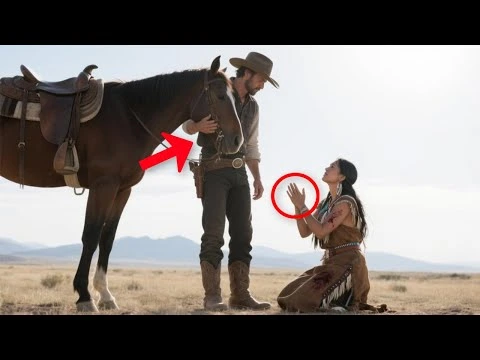
HE GAVE HIS ONLY HORSE TO A WOUNDED APACHE WOMAN — THE NEXT MORNING, 70 WARRIORS CAME FOR HIM
PART 1 — THE SEVENTY WARRIORS
At sunrise, Sterling Maddox stood alone on a rocky ridge, staring at something that made his blood run cold.
Seventy Apache warriors sat motionless across the valley, mounted on their horses in a formation so precise that they looked carved into the earth. None advanced. None retreated. They simply watched him.
Sterling instinctively reached toward the empty holster at his side, then remembered that he had no weapon left, just as he had no horse, almost no water, and no idea why seventy armed riders had appeared after spending the night surrounding his position.
Only yesterday, Sterling had been riding through a remote canyon when he heard a faint moan near a dried creek bed. He followed the sound and found a wounded Apache woman lying against the rocks, her leg badly injured and her skin burning with fever.
Her name was Ayana.
Every instinct told Sterling to leave her where she was. He was deep inside territory where a white stranger could easily be mistaken for an enemy, and helping an Apache woman could bring consequences he might never escape.
But when Ayana opened her eyes, there was no fear in them, only exhaustion and a quiet determination to survive.
Sterling lifted her onto his horse.
For six hours, he walked beside the animal while Ayana drifted in and out of consciousness. When they finally reached the edge of her territory, marked by three red stones, he helped her down and watched her stumble toward the distant settlement.
Then he did something even he could not explain.
He slapped his horse gently on the flank and sent it after her.
His only horse.
His only reliable means of survival.
Sterling had expected nothing in return.
But now, less than a day later, seventy warriors stood across the valley holding identical white feathers.
An older warrior finally descended toward him.
He stopped only a few feet away, stared into Sterling’s eyes, and spoke a single word in Apache.
Sterling raised both hands.
“I don’t want trouble. I helped your woman because she was hurt. That’s all.”
The warrior smiled strangely, then reached into a leather pouch and pulled out Sterling’s missing bridle.
But it had been changed.
New symbols had been painted across the leather.
The warrior pointed at the markings, then at Sterling’s chest.
Before Sterling could understand, a haunting song began rising from somewhere beyond the ridge.
And then Sterling turned around.
Coming through the canyon was a procession of Apache women, children, elders—and at the center of them all was Ayana, walking slowly on her injured leg.
She looked directly at Sterling.
Her eyes were filled with gratitude.
But there was something else in them.
Something that looked almost like sorrow.
Why had seventy warriors come to honor a man who had expected nothing in return, and what did the strange white feather mean? Most importantly, why did Ayana look at Sterling as if she already knew that his greatest trial had not yet begun? Tell me what you think Sterling should do next, and share your thoughts about Ayana’s mysterious reaction.
#WesternStory #OldWest #ApacheStory #CowboyStory #FrontierTales #EmotionalStory #WildWest #StoryTime #AmericanFrontier #HistoricalFiction #UnexpectedEnding #CowboyTales
PART 2 — THE LAW OF THE HORSE GIFT
Ayana finally reached Sterling and spoke in careful English.
“My grandfather wishes to thank the man who gave his horse to save his granddaughter.”
Sterling shook his head.
“I only helped someone who was hurt. Anyone would have done the same.”
Ayana translated his words, but her grandfather’s expression immediately changed.
When she turned back, her voice was serious.
“He says that is not true. Most men would have ridden away. You gave up the only thing that could have carried you safely out of this country.”
The old man stepped forward and placed a hand on Sterling’s shoulder.
Ayana translated his words slowly.
“You have honored the old law of the horse gift. When a man gives his horse to save a life, he does more than give an animal. He binds himself to the life he saved.”
Sterling looked at the seventy warriors surrounding him.
“So what does that mean?”
Ayana hesitated.
“It means you are connected to us now.”
Before Sterling could respond, every warrior raised his white feather into the air.
The elder spoke again.
Ayana’s face became pale.
“He says the gift must be tested.”
“Tested how?”
She looked toward the setting sun.
“There is a choosing ceremony. Before sunset, you must prove that your gift was genuine. If your heart was true, you will be welcomed as family. If it was false, you will leave marked as a man whose generosity cannot be trusted.”
Sterling stared at the village below.
He had expected gratitude.
He had expected his horse to be returned.
He had never expected a ceremony that could determine whether he lived as an honored guest or walked away as an enemy.
Inside the elder’s dwelling, Sterling saw his horse’s bridle lying beside a ceremonial knife, painted symbols, and bundles of sage.
The old man explained that the ceremony had three parts: truth, sacrifice, and choice.
Sterling’s throat tightened.
“What kind of sacrifice?”
Ayana looked at him with tears beginning to form in her eyes.
“The kind that will show whether you are willing to let another person suffer for your sake.”
Outside, the sun continued sinking toward the horizon.
Seventy warriors waited.
The entire village waited.
And Sterling suddenly understood that the real question was not whether he had been brave enough to give away his horse.
The real question was whether he would still choose courage when the cost was much higher.
If you were Sterling, would you risk everything to prove that your act of kindness was genuine, or would you walk away before the ceremony began? And what do you think the Apache elders are truly trying to discover about him?
PART 3 — THE TEST THAT CHANGED EVERYTHING
By the time the sun touched the western horizon, the Apache settlement had changed completely.
What had been a quiet village that afternoon was now filled with movement, preparation, and an atmosphere Sterling could feel in every breath. Stones had been arranged into a wide circle near the center of the settlement, torches had been placed around its perimeter, and the seventy warriors who had watched him from the ridge now stood around the village like silent guardians.
Their white feathers had been tied to the bridles of their horses.
Sterling could not stop thinking about what those feathers represented.
He had arrived as a stranger.
He had given away his only horse.
And somehow, that simple decision had carried him into a world governed by rules he had never known existed.
Ayana stood beside him as several elders approached.
“My grandfather says the ceremony is ready,” she explained.
Sterling nodded.
“What happens first?”
“You must answer questions.”
“That sounds easy enough.”
Ayana gave him a troubled look.
“It will not be easy.”
She was right.
Sterling was led into the center of the stone circle and seated on a woven mat. His hands were bound behind his back, not tightly enough to injure him, but firmly enough to remind him that he could not rely on strength or movement once the questioning began.
Five elders sat opposite him.
Ayana stood nearby to translate.
The oldest man, Ayana’s grandfather, raised his hand, and the first question came.
Why had Sterling entered Apache territory?
Sterling explained that a drought had devastated his small ranch, leaving him searching for better grazing land.
Where was his family?
His parents had died years earlier from fever. His sister had died during childbirth, leaving Sterling alone.
Had he helped Ayana because he expected something from the Apache people?
“No.”
Had he hoped they would reward him?
“No.”
Did he consider himself a good man because he had saved her?
Sterling hesitated.
That question was harder.
“I don’t know if I’m a good man,” he finally said. “I only know that leaving someone to die when I could help felt wrong.”
The elders exchanged glances.
Then a woman among them asked another question.
Why had he not taken Ayana to a white settlement where a doctor might treat her?
Sterling looked toward Ayana.
“Because she belonged with her people. Taking her somewhere unfamiliar just so I could call myself her rescuer would not have been right.”
The elders listened carefully.
Then an older man asked the question that struck Sterling harder than any other.
“You gave away your only horse. Was that kindness, or were you punishing yourself?”
Sterling froze.
For years, he had buried memories of his sister’s final days, when he had been unable to get her medical help in time. He had blamed himself for choices he could no longer change.
Perhaps, without realizing it, he had been carrying that guilt ever since.
“Maybe it was both,” Sterling admitted.
Ayana’s eyes filled with tears as she translated.
The elders remained silent for several moments.
Then Ayana’s grandfather stood.
He spoke slowly to the gathered village.
When he finished, Ayana approached Sterling.
“You passed the first test.”
Sterling exhaled.
Then he noticed that she did not look relieved.
“What is wrong?”
“The second test is more dangerous.”
Two young warriors carried a wooden box into the circle and placed it before the elder.
The box was opened.
Inside were five arrows, each marked with a different color and symbol.
Sterling stared at them.
“What are those?”
Ayana swallowed.
“Five trials.”
She pointed to the red arrow.
“Crossing the rapids at Devil’s Canyon at night.”
Then the black.
“Entering a mountain cave where a large predator has its den.”
The white.
“Climbing a cliff no one has successfully climbed in many years.”
The yellow.
“Entering the territory of a rival group and returning with proof of peaceful contact.”
Then she touched the blue arrow.
Her voice became quieter.
“And the last one involves surviving a rattlesnake bite with traditional medicine.”
Sterling stared at the five arrows.
“What does this have to do with me?”
Ayana looked toward the five volunteers standing around the circle.
“You are supposed to choose one.”
Sterling’s expression hardened.
“Choose one person to face one of those trials?”
“Yes.”
“So someone else risks their life because I want to become accepted?”
Ayana said nothing.
Sterling looked around.
There was a young man barely old enough to be considered an adult, an older warrior covered in scars, a middle-aged woman, a teenage girl who reminded him painfully of his sister, and a man with a wife and children standing behind him.
He understood immediately.
The test was not simply about courage.
It was about what a person was willing to ask of someone else for his own benefit.
The elder spoke.
Ayana translated.
“There is another choice.”
Sterling looked at her.
“You may refuse to select anyone.”
“What happens then?”
“You may offer to face all five trials yourself.”
Sterling stared at her.
“All five?”
Ayana nodded.
“No one has ever done it.”
“Why?”
“Because no one could reasonably expect to survive.”
Silence spread through the village.
The seventy warriors watched.
The five volunteers waited.
Sterling looked at the arrows again.
He thought about his sister.
He remembered her final words, spoken when she was too weak to sit upright.
She had told him that courage was not the absence of fear.
It was choosing what was right while fear was still there.
Sterling slowly lifted his head.
“I won’t choose an arrow.”
Ayana’s eyes widened.
“If someone has to face these trials because of me, then I’ll face them myself.”
She stared at him.
“All five?”
“All five.”
A murmur swept through the crowd.
The five volunteers lowered their eyes.
The seventy warriors suddenly removed the white feathers from their horses’ bridles and raised them above their heads.
Sterling looked around in confusion.
The elder stood.
His voice echoed across the settlement.
When he finished speaking, the seventy warriors answered with a deep, rhythmic chant.
Ayana was crying.
Sterling turned toward her.
“What did he say?”
She struggled to speak.
“He says no one has ever offered what you just offered.”
Sterling looked toward the elder.
Ayana continued.
“He says a man who is willing to face certain death rather than allow another person to suffer for his benefit has already revealed the truth of his heart.”
Sterling waited.
Then Ayana smiled through her tears.
“The trials are over.”
Sterling stared at her.
“What?”
“You passed.”
“But I haven’t done anything.”
“That is exactly why you passed.”
The elder approached him.
For the first time, the old man’s face held a clear smile.
Through Ayana, he explained that the trials had never been created simply to kill people. Their purpose was to reveal character.
A person could claim to be generous.
A person could claim to be brave.
A person could even give away his most valuable possession and still have selfish motives.
But when Sterling was given the opportunity to save himself by placing another person’s life in danger, he had refused.
That choice had answered everything.
The elder reached down and untied Sterling’s hands.
Then something extraordinary happened.
The seventy warriors began walking toward the stone circle.
One by one, they knelt.
One by one, they placed their white feathers at Sterling’s feet.
Then they began placing gifts beside them.
A beautifully carved knife.
A handwoven blanket.
A piece of silver jewelry.
A finely crafted belt.
Small objects made by individual families.
Sterling could barely comprehend what he was seeing.
Then the lead warrior approached.
He was the same gray-haired man who had first descended from the ridge that morning.
But now he spoke English.
“White brother.”
Sterling looked at him.
“We came expecting to witness judgment.”
The warrior pointed toward the feathers.
“Instead, we witnessed your choice.”
Sterling looked at the growing collection of gifts.
“What are these?”
“Gifts from seventy families.”
The warrior explained that each feather represented a pledge of protection and friendship from one warrior’s household.
Sterling shook his head.
“I don’t understand.”
“You gave your horse to save one life.”
The warrior glanced toward Ayana.
“Our people saw what you did and asked whether your action was only kindness toward one person, or whether it revealed something deeper about your character.”
He looked back at Sterling.
“You chose to protect five strangers rather than protect yourself.”
The warrior smiled.
“That answered the question.”
Ayana’s grandfather approached next.
He placed both hands on Sterling’s shoulders.
Ayana translated his words.
“You arrived here as a stranger who gave a gift.”
The old man looked toward the returned horse.
“You leave as a brother who has received many gifts in return.”
Then the horse was brought forward.
Sterling’s horse.
The animal looked exactly as he remembered, except that the bridle had been decorated with new markings.
Sterling ran his fingers over the leather.
“You changed it.”
Ayana smiled.
“They marked it so others will know you are under the protection of our people.”
Sterling looked at the seventy white feathers lying at his feet.
He finally understood what had happened.
He had thought he was giving away his last possession.
Instead, he had unknowingly opened the door to a relationship that would change the rest of his life.
As he prepared to leave, Ayana walked beside him.
“Where will you go now?”
Sterling looked toward the northern mountains.
“I think I’ll find new grazing land.”
He paused, then smiled.
“And apparently I have seventy new neighbors.”
Ayana laughed.
“You do.”
Sterling mounted his horse.
Behind him, the seventy warriors mounted as well.
They formed an escort as he rode away from the village, their white feathers catching the last light of the setting sun.
Sterling had entered Apache territory with no weapon, no protection, and only one horse.
He left carrying something far more valuable than anything he could have purchased in Red Creek.
He carried trust.
He carried friendship.
And he carried the knowledge that a single act of kindness, when given without expectation of reward, can travel farther than the person who performs it ever imagined.
The horse he had given away had been returned.
But the lesson remained.
Sometimes, the greatest gift is not what a person gives away.
It is the willingness to give without knowing what will come back.
Sterling had saved Ayana because he believed a wounded human being deserved help.
He had never expected seventy warriors to watch him from a ridge.
He had never expected to stand before elders and have his heart questioned.
And he certainly had never expected to leave with seventy families calling him brother.
But perhaps that was the meaning hidden behind the white feathers all along.
They were not symbols of power.
They were symbols of a promise.
A promise that one man’s decision to help another could create a bond neither side had expected.
As Sterling rode toward the mountains beneath the darkening sky, he looked once over his shoulder.
Seventy warriors remained behind him for a moment before slowly turning back toward their home.
Sterling touched the decorated bridle.
For the first time in years, he no longer felt as though he was riding alone.
And somewhere behind him, in a quiet village between the red cliffs, Ayana was watching the trail disappear into the distance, knowing that the wounded woman Sterling had found beside a dry creek bed had changed his life just as completely as he had changed hers.
He had given her his only horse.
She had given him something he had not realized he was missing.
A place where his courage had meaning.
A people who remembered his choice.
And seventy feathers that would forever remind him that sometimes, one small act of humanity can become the beginning of an extraordinary story.








