HE GAVE UP LOOKING FOR HIS LOST CATTLE—THEN A WIDOW RODE OUT OF THE STORM WITH ALL OF THEM
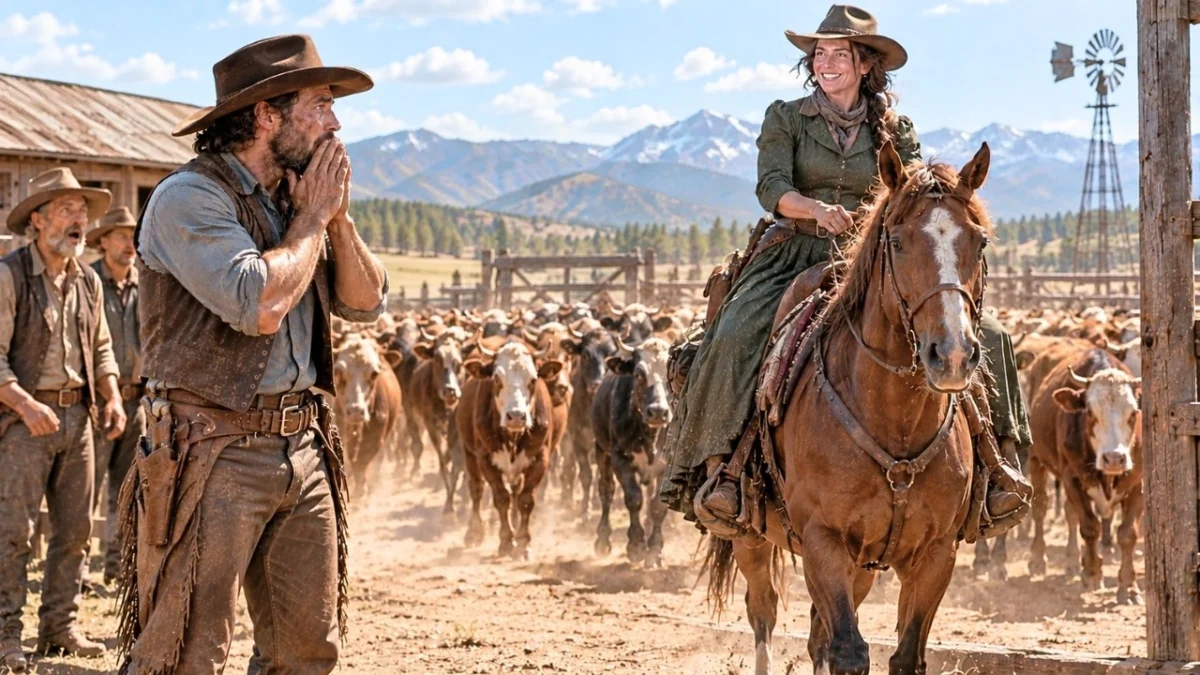
THE WIDOW SAVED HIS CATTLE—THEN SOMEONE ARRIVED WITH A BILL OF SALE
PART 2 — THE PAPER THAT COULD TAKE EVERYTHING AWAY
Eight days after Dela Tate brought Elias Crane’s cattle home, a buggy came rattling up the wagon road.
Elias was standing beside the corral when the stranger climbed down.
His name was Royce Puit, a cattle buyer from town.
He wore a clean black coat, polished boots, and the kind of smile Elias had learned never to trust.
Puit glanced over the fence at the ninety-two cattle.
“I’m glad to find them here,” he said. “Saves me a ride.”
“Find what here?”
“My cattle.”
Elias felt his stomach tighten.
Puit reached into his coat and produced a folded document.
“A bill of sale,” he said.
Elias opened it.
Ninety-two head.
Six hundred and forty dollars.
And at the bottom was a signature.
Amos Tate.
Elias read it twice.
Then a third time.
“That man has been dead for nearly two months.”
Puit shrugged.
“He sold these cattle before he died.”
“He never owned them.”
“He held them, fed them, and apparently sold them.”
Puit folded the document.
“I intend to load them Thursday morning.”
Elias stared at him.
He understood immediately.
Puit did not need to prove the cattle were his.
He only needed to make the fight too expensive for Elias to survive.
But Elias remembered Dela’s ledger.
He remembered her cracked hands.
He remembered the woman who had spent her last hay keeping his cattle alive.
So he rode south.
Eleven miles.
He found Dela outside her house.
When Elias told her about the bill of sale, her face went still.
“He came here in March,” she said.
“Puit?”
She nodded.
“He wanted me to sign something. I refused. Those cattle were not mine.”
“What did he show you?”
“A bill of sale.”
Elias felt the pieces falling into place.
Dela disappeared into the house and returned carrying a small tin box.
Inside were three things.
Amos Tate’s old tally book.
A letter from the preacher.
And an official county record.
The tally book showed that Amos had counted his own cattle months before his death.
Sixty-one head.
Every one carrying his brand.
Not a single Crane animal among them.
The preacher’s letter recorded Amos Tate’s death on February ninth.
The county record confirmed the burial.
The bill of sale Puit carried was dated April second.
More than seven weeks after Amos Tate was buried.
Thursday morning, Puit returned.
Two hired men rode behind him.
Elias was waiting beside the corral.
Dela stood beside him, holding the tin box.
Elias looked at Puit and said calmly:
“Your paper is dated April second.”
Puit said nothing.
“Amos Tate was buried February eleventh.”
Still nothing.
Dela opened the tin box.
Elias continued.
“She has the preacher’s letter. She has the county record. And she has her husband’s tally book proving these cattle were never his.”
Puit’s face hardened.
Then Elias delivered the words that ended the entire matter.
“If this goes before a judge, the question won’t be whose cattle these are.”
He paused.
“The question will be who signed a dead man’s name.”
For the first time, Puit looked afraid.
He climbed back into his buggy.
“Somebody in town sold me a bad paper,” he muttered.
“Then take it up with him,” Elias replied. “Not with me.”
Puit drove away.
The cattle stayed.
But the story did not end there.
That summer, Elias kept his promise.
He brought his wagon south and helped Dela cut hay.
She had no husband.
He had no wife.
Both had spent years carrying grief and anger as if those things were debts that had to be paid forever.
Then one evening in September, Dela finally asked him the question neither of them had wanted to answer.
“Four years,” she said. “You wouldn’t ride past this place.”
Elias looked at her.
“Now you can’t seem to ride past it.”
He lowered his eyes.
“The fight I had was with Amos,” he said. “He’s gone. I’m still here, holding a grudge against nobody.”
He looked toward the sunset.
“That’s a poor way to spend a life.”
The following spring, Elias Crane and Dela Tate were married in the little church at Sweetwater.
And the same blue roan that had once belonged to Elias, then carried Amos Tate’s widow through the storm, carried Dela to the church door.
Sometimes a man thinks he has lost everything.
Sometimes the thing that looks like loss is simply the road leading him somewhere he never expected to go.
Elias thought he was searching for ninety-two missing cattle.
What he found was a second chance.
And Dela?
She never set out to find a husband.
She only heard cattle crying in the darkness—and refused to leave them there.
💬 If this story touched you, comment “YES” and tell me: Would you have sacrificed your last hay to save someone else’s cattle, even if that person had been your enemy?
#WesternStories #CowboyStories #WildWest #OldWestStories #RanchLife #HeartwarmingStory #UnexpectedKindness #LoveAfterLoss #EmotionalStory #Storytime #FrontierLife #AmericanWest #InspiringStories #MustRead #Part2 #TrueSpirit #NeverGiveUp








