HE HADN’T SMILED IN YEARS. THEN HIS COUSIN “DROWNED” IN KNEE-DEEP WATER, AND HIS BRIDE’S SECRET FACE MADE THE WHOLE GARDEN GO SILENT… BUT SOMEONE IN THAT FAMILY WAS PLAYING A FAR DARKER GAME
HE HADN’T SMILED IN YEARS. THEN HIS COUSIN “DROWNED” IN KNEE-DEEP WATER, AND HIS BRIDE’S SECRET FACE MADE THE WHOLE GARDEN GO SILENT… BUT SOMEONE IN THAT FAMILY WAS PLAYING A FAR DARKER GAME 😱🦆
Part 1
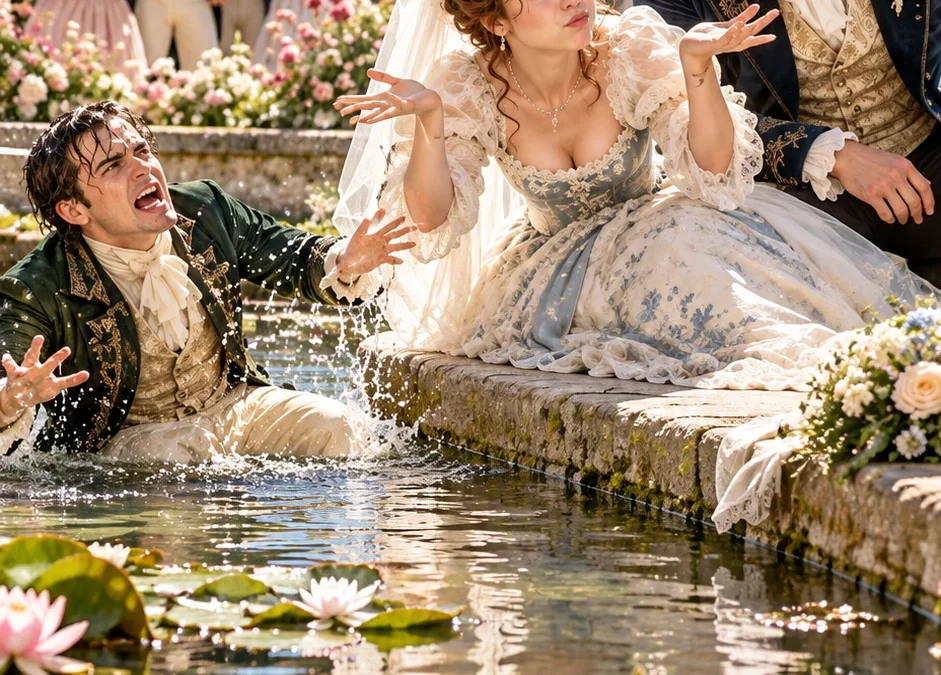
Lord Perival Rook was thrashing in the ornamental lake.
The water was shallow enough for ducks to stand in. 🦆
The whole garden party heard him cry, “Save me!”
Only Tessa, the new Duchess of Renmore, saw him pause between flails to check whether the Duke was watching.
So Tessa crossed her eyes, puffed her cheeks, and mimed a dying trout behind her fan.
And the Duke of Renmore smiled.
It was real. The garden went silent. Someone dropped a sandwich. Lord Perival, still sitting in the lake, forgot to drown. 😱
Tessa lowered her fan at once. Too late.
Her husband had seen the face. His guests had seen the smile. His cousin had seen both, and looked more offended than endangered.
“Perival,” the Duke said, perfectly calm. “Stand up.”
“I cannot. The current.”
The ornamental lake had no current. It had lilies, three bored ducks, a stone cherub, and one damp cousin in white trousers.
Every eye moved from the water to Alistair Rook, Duke of Renmore. He stood at the lawn’s edge, black coat buttoned, gloved hand still, face restored to marble. Tall, lean, severe, like a man who had learned that softness becomes a weapon in other people’s hands.
Until one minute ago, Tessa had believed his face might crack if forced into amusement.
Now she knew it could smile. That knowledge felt dangerous.
Tessa had been Duchess of Renmore for eleven days.
In that time she had learned the house rules, the names of twelve footmen, the location of the linen cupboard, and the fact that her husband did not smile. No one had mentioned that the fastest way to make him do so was to silently insult his cousin’s theatrical drowning.
The marriage had begun as an arrangement, which was a polite word for a bargain made by families while the people involved stood nearby like furniture being valued. Tessa Marley had brought a modest dowry, a scandal-free name, and a talent for staying cheerful in rooms where cheer was treated as a decorative mistake. Alistair had brought a title, land, wealth, and a reputation for coldness so established that village children dared one another to build snowmen in his likeness.
She had expected decency, distance, and perhaps a library with ladders.
She received all three: decency in measured sentences, distance at breakfast, and a library with two ladders and an elderly cat named Admiral.
She had also received Lord Perival Rook. Cousin to the Duke. Self-declared family favorite. A man who used charm as a glove over sticky fingers.
On the wedding day he had smiled at her and said, “My dear cousin, if Renmore frightens you, I am always available to explain him.”
Tessa had replied, “How generous. If you frighten me, I shall explain you to the housekeeper.”
His smile had thinned.
Now he sat in the lake, glaring, while two gardeners helped him upright. The water reached his thighs. His “seized” leg worked perfectly whenever he forgot which side was supposed to limp.
Tessa saw Alistair notice. She also saw pain flicker behind his eyes. Not for Perival’s wet trousers, but for whatever old weariness the performance had reopened.
Perival staggered onto the grass and collapsed with a groan. “I nearly died.”
One duck quacked.
“The duck disputes that,” Tessa whispered.
Alistair heard. His gaze moved to her. For one second the marble vanished, and something alive looked through.
Then Lady Augusta Rook, the Duke’s aunt, arrived with smelling salts and authority. “Alistair, send for a physician. Perival might be in shock.”
“He is certainly damp.”
Perival clutched his chest. “Cousin, your lack of concern wounds me. I suppose no one thought to risk themselves for me.”
That was when Tessa understood.
The fake drowning had not been random foolishness. Perival had expected Alistair to leap into the lake, ruin his dignity, and prove some family story about coldness wrong in the most humiliating way possible. When Alistair did not move, Perival had hoped the guests would judge him for it.
Instead, the new duchess had turned his tragedy into a silent comedy.
Perival’s eyes found hers. His smile returned, wet and unpleasant.
“Your grace,” he said sweetly. “Your bride seems amused by near death.”
“By near theater,” Tessa answered.
The guests went silent.
“You accuse me?”
“No. I observed you. Accusation requires more paperwork.”
The vicar coughed. Lady Augusta pressed the smelling salts to her own nose.
Alistair stepped beside Tessa. Not in front of her. Beside her. 💫
“Perival. Go inside.”
“As you command, Renmore.” The title sounded like an insult.
Alistair did not react. That, Tessa suspected, was how Perival usually won. He threw small knives into silence and called the silence proof.
After Perival was taken away, Tessa remained by the lake, the fan ridiculous in her hand.
“You made a face,” Alistair said.
“I made several.”
“At my cousin.”
“Direction matters in law.”
“You crossed your eyes.”
“That was artistic emphasis.”
He looked at the water. The smile did not return, but his voice changed. “He has been falling into trouble since childhood.”
“Does he always choose shallow water?”
His gaze came back to her. “You noticed real drowning is quiet.”
“I know brothers. Similar noise level. Less danger than they claim.”
For a moment he seemed caught between amusement and disbelief.
“I apologize if I embarrassed you,” she said.
“You did.”
Her stomach sank.
“But not as much as Perival intended.”
She looked up. He was watching her with an expression she could not name. Not warmth exactly. The first door of a cold house opening a little.
“Thank you,” he said.
Those two words were quieter than applause, and far more unsettling.
That evening, Tessa went to the library, because libraries had always been kinder than drawing rooms. Admiral the cat occupied the best chair and judged her insufficiently alarming. She climbed halfway up a rolling ladder and sat there, because a ladder was an excellent place to avoid being a duchess for ten minutes.
Alistair found her.
“Are you hiding?”
“I am reading at altitude.”
“The book is closed.”
“I am considering it from above.”
He came into the room. In the lamplight, the Duke seemed less like stone and more like a man holding himself still out of habit.
“Augusta thinks I should rebuke you. For the face.”
“Did it encourage disrespect?”
“Yes.” Tessa winced. “It was also remarkably effective.”
She blinked. That sounded almost like praise.
“Would you like me to come down for the rebuke?”
“No. I have never rebuked a duchess on a ladder. I would need guidance.”
It was not a smile. But it was near. Tessa felt an absurd urge to earn the rest.
Then the air shifted.
“Perival will retaliate,” he said quietly. “He has lived at Renmore on family tolerance for years. My father loved him. My mother pitied him. My aunt excuses him. I have paid his debts more than once, because public disgrace stains everyone nearby.”
“And he repays you by pretending to drown at garden parties.”
“That is one of his lighter efforts.”
Tessa climbed down. “Then what are the heavier ones?”
He did not answer at once.
“Alistair,” she said. It was the first time she had used his name without a title.
He turned. The silence between them changed shape.
“He wants me to look cruel,” he said. “It is easier to ask the family for sympathy if I am the villain.”
“And is there something he wants sympathy to conceal?”
“Probably. I have not looked closely enough.” The admission cost him. She heard it. “Because when I look closely, my aunt says I dishonor my father’s affection. Because Perival weeps. Because the family has mistaken my refusal to smile for an endless capacity to endure nonsense.”
Tessa thought of the shallow lake, the theatrical flailing.
“Then perhaps it is time nonsense learned to swim.”
He looked at her.
“That was not a proper ducal strategy,” she said.
“No,” Alistair said. “It was better.”
The next morning, Tessa went to deliver a book to Lady Augusta, and heard Perival’s voice floating from his open bedroom door.
“She laughed while I struggled. The new duchess has a coarse nature.”
“She is young,” Lady Augusta said. “She is dangerous. Renmore smiled at her.”
“Did you see it? He will listen to her now. If she turns him against me, I am ruined.”
“Why would you be ruined?”
“Because he is cold enough to cast family aside. Aunt, you know he resents me.”
Tessa backed away silently.
She found Alistair in the breakfast room with a plate of untouched toast.
“Your cousin thinks that if I turn you against him, he is ruined.”
His face changed. “You listened.”
“I am not noble enough to waste useful information.”
His eyes warmed. “Then what are we missing?”
“His accounts.”
And that was when she learned something that chilled her. When she asked the steward, Mr. Hobb, about the household ledgers, he lowered his voice.
“There was the West Terrace fall, your grace. Lord Perival said the step crumbled. The mason found nothing wrong.”
“What else?” Tessa asked.
“The carriage wheel.”
Alistair turned. “What carriage wheel?”
Hobb swallowed. “Lord Perival claimed the north carriage nearly overturned because a pin failed. The coachman insisted the pin had been removed and put back poorly. His lordship said the man was drunk.”
“Was he?”
“No, your grace.”
Alistair went very still.
“Why was I not told?”
“Lord Perival said it would upset Lady Augusta.”
There it was. The family shield, used as a curtain.
Alistair’s face had shut down, but his hand curled tight on the desk.
“Alistair,” Tessa said quietly. “Toast.”
He blinked. “What?”
“You are about to become too angry to be useful. Think of toast.”
Hobb stared. Alistair looked at his wife for one impossible second, and then laughed. Not loudly, not long. But enough to loosen the room.
“Continue,” he said.
But beneath the laugh, one question had already lodged in Tessa’s mind like a splinter:
If a man will fake drowning for attention, what would he do to someone who stood in his way?
👇 Want Part 2? Comment any word and I’ll send it to you privately, or look for it in the comments!
Part 2
The investigation grew legs. Then it grew teeth.
Perival had borrowed money using implied access to Renmore funds. He had staged small accidents to persuade relatives he was frail, unlucky, and dependent. He had made Alistair look cold whenever Alistair refused his requests. Every performance created sympathy. Every sympathy became a loan. Every loan became another secret.
Tessa saw the pattern because she understood comedy. A repeated joke grows funnier, or more suspicious, depending on timing. Perival’s tragedies had far too much timing.
On the third day after the lake, he appeared at luncheon in a shawl. The weather was warm.
“Since the incident, yes,” he said, coughing delicately when Lady Augusta fussed. “The lake took something from me.”
Tessa looked at the soup. “Perhaps it returned your appetite.”
Perival’s spoon paused. Under the table, Tessa nudged her husband’s boot. She widened her eyes, puffed one cheek, and drooped over her soup as if struck by tragic broth.
Alistair stared at his plate with tremendous intensity. 😂
Perival saw. “Your grace seems merry today.”
“I am admiring the soup’s courage. It entered a dangerous room and remains hot.”
The vicar smiled into his napkin.
“I had hoped my suffering might inspire kindness,” Perival said.
“Kindness does not require everyone to pretend.”
Lady Augusta inhaled. But Alistair spoke first.
“My wife is correct.” The words landed heavily. “We have all pretended too long.”
No one finished the soup.
That afternoon, Perival cornered Tessa in the conservatory, where she was trying to coax Admiral down from a citrus tree. He closed the door behind him.
“Do leave it open,” Tessa said. “Admiral dislikes impropriety.”
“And you?”
“I dislike closed doors with men who drown for applause.”
His smile dropped. He stepped closer. “You understand nothing. Alistair was not always stone. My uncle made him so. His father praised me because I had charm. Alistair had duty. Do you know what duty does to a boy? It dries him out. By twenty he was already a sermon in boots.”
Tessa’s hand tightened around the watering can. “Is that why you steal from him?”
His face went blank.
Admiral chose that moment to leap onto Perival’s shoulder. Perival shrieked. The shawl slid over his head. The citrus tree shook. Three oranges fell, and one struck his foot.
Alistair opened the door and took in the scene: his cousin blinded by a shawl, his wife holding a watering can, and Admiral perched on a plant stand with the offended dignity of a bishop.
“She set the creature on me!” Perival tore the shawl away.
Admiral licked a paw.
“Unlikely,” Alistair said. “Admiral dislikes instruction.”
Tessa bit her lip. Alistair saw. The smile came slowly, and this time it stayed.
“There again!” Perival pointed. “She makes you laugh at me!”
Alistair’s smile vanished. “No, Perival. You do that yourself.”
For the first time, Tessa saw Perival frightened. Fear made him uglier.
Later, when she repeated what Perival had said about Alistair’s father, Alistair set Admiral on a bench.
“My father loved easy rooms. Perival made rooms easy. I made them correct. Both are useful. Not to my father.”
Tessa felt the child inside that admission. The boy who had learned that duty earned reliance, but never delight.
“Your father was wrong about rooms,” she said carefully. “Easy rooms can hide rot. Correct rooms can be lonely. Better rooms have windows, chairs, and someone willing to make a fool of herself when a cousin starts fake drowning.”
Something broke in his face. Pain first. Then almost laughter.
He took her hand. Not dramatically. A simple contact, warm and astonished.
“You make rooms possible,” he said.
Admiral sneezed on an orange. They both laughed. ❤️
Perival’s next move came at Lady Augusta’s card evening. He arrived pale and tragic, with a bandage around one hand. He claimed Admiral had injured him. He displayed it to three dowagers before the first game.
Tessa could not prove his hand was uninjured. But she could change the room.
She took the chair opposite him at whist. Alistair stood behind her like a silent warning in black evening clothes.
Perival used the bandaged hand awkwardly whenever Lady Augusta looked. When she did not, the hand moved perfectly.
Tessa watched. Alistair watched Tessa watching.
Halfway through, she dropped a card. “Oh dear.” She bent to retrieve it and, under the table, made a face at Perival. Not the fish. A new one. An exaggerated tragic grimace, both hands clasped around her own wrist.
Perival’s mouth opened in outrage. “You are behaving like a child!”
Tessa rose with the card. “Found it. Where did you see that, my lord?”
“Under the table!”
“Then how did you see?”
Silence.
Alistair’s hand touched the back of Tessa’s chair. The room understood at once. Perival had noticed a face hidden under a table because he was not nearly as frail as he performed. The vicar said mildly, “A clear question.”
Perival’s bandaged hand curled into a fist. Perfectly.
He stormed out. Lady Augusta did not follow.
“Has he lied to me?” she asked.
“Yes,” Alistair said softly. “Often. I fear so.”
Lady Augusta sat very still. Then she laughed once, a small, shocked laugh.
“This house has become absurd.”
Alistair looked at Tessa. “Yes.” The way he said absurd sounded like rescue.
But accounts alone could not end Perival. Debts could be explained. Staged injuries could be dismissed as family embarrassment.
“He needs an audience,” Tessa said. “Give him one he cannot control.”
“I dislike this already.”
“Good. That means it may work.”
They chose the village regatta. Every summer, Renmore held boat races on Broadmill Pond. Perival had always presented prizes, soaking up applause without rowing an inch. This year, he volunteered to judge the gentleman’s exhibition boat.
Of course he did.
Tessa prepared carefully. She spoke with the boatman, checked the ropes, and asked the miller’s daughter, Nan, who swam like an otter, what real panic in water looked like. She learned where the pond shelved, and where a man could stand while pretending not to.
On regatta day, the sky was bright and the grass crowded. Perival arrived in cream linen and charm. “Let us hope no one nearly drowns today.”
“Let us hope no one nearly pretends to,” Tessa said.
Halfway across the pond, in a narrow boat with a red stripe, Perival stood with one hand to his heart. “The boat is unstable!”
The boat was not unstable. It was offended.
“Here he goes,” muttered the boatman.
Perival tipped sideways with magnificent commitment and fell into the pond.
People shouted. Lady Augusta rose. Alistair stepped forward, but Tessa caught his sleeve.
“Wait.”
Perival thrashed on the marked shallow shelf. “Help! I cannot swim!”
Nan stood ready with a rope. Tessa nodded once. The rope landed across Perival’s shoulder. He ignored it and kept thrashing.
Tessa lifted her parasol, shielded her face from the guests, and made the most elaborate drowning face of her life. Cheeks puffed. Eyes crossed. Tongue caught between her teeth. One hand flapping like a fish with social aspirations.
Alistair stared at her.
Then he laughed. Openly, helplessly, in public, under the bright regatta sky. 😂
The crowd turned. Perival stopped flailing.
“If you cannot swim, my lord,” Nan shouted, “hold the rope!”
Perival grabbed it too late. His feet touched bottom. Everyone saw him stand.
The silence was so complete that the ducks on the far bank sounded judgmental.
Then the village boys began to laugh. Children are merciless when adults deserve it.
Perival waded to shore, furious, holding up the rope. “You set this up!”
“I set up a rope,” Tessa said. “You declined assistance because performance required danger.”
The villagers heard. The guests heard. Lady Augusta heard.
Alistair stood beside her. “Perival. You will leave Renmore.”
“Because your wife makes faces!”
“Because she made me look. And once I looked, I saw what you were doing.”
“You always wanted me gone!”
“No,” Alistair said quietly. “For years, I wanted you better.”
That sentence hit harder than any anger.
Perival turned to Lady Augusta. Tears ran down her face, but her chin was firm.
“Aunt,” he pleaded.
“Take the rope next time,” she said.
That was the end of his audience.
But as Perival stalked away, dripping, he leaned close to Tessa and whispered, so softly that only she heard:
“This isn’t over, little duchess. I kept letters. Letters your husband would pay a great deal to keep out of London.”
👇 Want to know what was in those letters? LIKE or COMMENT “REVEAL” and Part 3 will be posted once we reach enough comments!
Part 3
Perival left Renmore within three days. Alistair did not ruin him publicly. He paid no more debts, placed the evidence in a solicitor’s hands, and required Perival to live on the modest income that was honestly his. Lady Augusta wept in private and apologized in public to no one, because she was too proud. But she invited Tessa to tea and observed that the sandwiches were less dry when the room was not full of lies.
Tessa accepted this as a declaration of affection.
The house changed after the regatta. Not dramatically. Houses rarely change with trumpets. They change when people stop pretending not to see cracks. Servants spoke more plainly. Mr. Hobb brought troubling accounts sooner. Alistair smiled more. Not constantly. He did not become a grinning fool, thank heaven. Tessa had not wanted a fool. She wanted the man who stood serious beside her, who laughed when truth became absurd, and who had carried duty like a locked chest and was learning that a window could be opened without the whole house collapsing.
Then, weeks later, trouble arrived by post, wearing a Bath postmark and smelling faintly of desperation.
The letter came to Lady Augusta first. She read it in the morning room, turned the color of old lace, and rang for Alistair with hands that trembled despite her pride.
Tessa found him on the stair with the page open. Perival wrote that he had been unjustly cast out. He claimed the Duke’s new wife had bewitched Renmore with vulgar comedy. And he claimed he possessed letters proving Alistair had always meant to strip him of family protection. If his allowance was not restored, those letters would reach London.
“Do these letters exist?” Tessa asked.
“Some may. I wrote to my solicitor after the carriage incident.”
“Did you threaten him?”
“I wrote that no man would continue receiving family funds while staging accidents.”
“That sounds reasonable.”
“Reasonable things sound cruel when quoted without weather.”
“Then we provide weather.”
He looked at her. “You have a plan.”
“Not yet. It often grows.”
Lady Augusta sat near the fire, very straight. “He was a sweet boy once.”
“Perhaps he was,” Tessa said gently.
“Do not be kind to my foolishness.”
“I am not. I am being kind to grief.”
Lady Augusta looked away. Her mouth worked once, then steadied. “I let him use my grief as a purse.”
Alistair knelt beside her chair. Tessa had never seen him kneel to anyone but children.
“Aunt.”
“No, I did. Your father loved him because Perival made him laugh. After your father died, I defended Perival because it kept some echo of my brother in the house.” She placed one hand on Alistair’s shoulder with awkward tenderness. “I made you carry the hard part. Then I scolded you for not smiling under it.”
Alistair’s face changed, but he only said, “We all mistook something.”
Tessa wanted to love him quietly for that. But quiet love did not solve blackmail. So she folded the letter.
“We need the earlier incidents in order.”
They spent the afternoon in the cedar room, which smelled of paper old enough to have opinions. Mr. Hobb brought accounts. The coachman brought maintenance records. The gardener brought notes from the terrace repair. And Lady Augusta brought memory, which proved the sharpest document once she stopped protecting Perival from it.
Tessa made no formal chart. She disliked charts that made human foolishness look like arithmetic. Instead she arranged objects on the table: a broken carriage pin, a bill for lantern oil, the mason’s note, a receipt for musicians never hired.
“This looks like a village fair run by evidence,” said Alistair.
“Excellent. Evidence behaves better when entertained.”
Lady Augusta lifted the carriage pin. “I remember this. Perival came in limping and said the coachman nearly killed him. I told you to dismiss the man.”
“I did not,” Alistair said. “His wife had fallen ill.”
Lady Augusta closed her eyes. “And I called you cold because you would not embrace Perival’s version.”
Tessa touched the old woman’s sleeve. “You are seeing it now. Late is better than never. Never is overcrowded.”
Lady Augusta gave a small laugh despite herself. “You are impertinent.”
“I am married in.”
Their answer to Perival’s threat was an invitation.
Alistair asked him to Renmore for a private family council. But the council included Lady Augusta, the solicitor, the vicar, Mr. Hobb, the coachman, and Tessa.
Perival arrived expecting fear. He found tea. This offended him first.
“How domestic.”
Tessa poured. “It is Lady Augusta’s strongest blend.”
“It wakes men who prefer fog,” said Lady Augusta.
Alistair sat beside Tessa, not at the head of the room. Perival noticed. “You brought an audience.”
“You always preferred one,” said Tessa, handing him a cup.
The solicitor read the threatening letter aloud. The coachman explained the carriage pin. Mr. Hobb explained the phantom musicians. The mason’s note proved the terrace had never crumbled. Each fact was small. Together they formed a net.
Perival tried charm, then injury, then outrage. When those failed, he turned on Alistair.
“You hated me because your father loved me.”
The room went still. Alistair’s face closed. Tessa felt him retreat behind the old wall.
She did not let him vanish. She leaned toward Perival and made a face. Not comic this time. A plain, exaggerated look of exhausted disbelief, the face one makes at a child who blames the missing cake on a ghost while still covered in crumbs.
“There!” Perival sputtered. “She mocks me!”
“Yes,” Tessa said, setting down her cup. “That statement deserved it.”
Lady Augusta’s eyes flashed.
“My brother loved you, Perival. He also loved Alistair. You profited from making those loves compete after the man was dead. That was not grief. That was theft from the living and the dead.”
Perival’s face drained. Alistair looked at his aunt as if she had opened a window in a room he had forgotten had walls.
“You would choose him over me now,” Perival whispered.
Lady Augusta’s voice shook but did not break. “I choose truth over the habit of pitying you.”
The solicitor arranged terms. No restored allowance. No criminal charges, provided the blackmail ceased and the debts were settled through the sale of Perival’s London lease. Perival called it cruelty. Tessa called it arithmetic. Lady Augusta called it mercy with teeth.
When he left, he did not bow to Tessa. She bowed anyway.
“Take care near water.”
Alistair made a sound behind her. Perival slammed the door. The house exhaled. 🌿
That evening, Tessa sat barefoot on the piano bench in the music room, toes aching from standing through the council. Alistair appeared in the doorway holding a plate of biscuits.
“Excellent husband,” she said.
He sat beside her. The piano gave a soft complaint under their combined weight.
“My father did love me,” he said.
Tessa stayed still.
“I knew it once. Then years of comparison made knowledge feel like vanity. Perival benefited from that. So did silence.” He looked at her. “You ended the silence by making the rudest fish face I have ever seen.”
“A historic achievement.”
“A beloved one.”
The word did not sound like a casual compliment. It sounded like a truth.
“I am not saying the rest of it yet,” he said, taking her hand, thumb brushing biscuit dust from her knuckle, “because I would like to do it without crumbs on my coat. But I am moving toward it at a terrified pace.”
That honesty undid her more than a declaration could have. She leaned her head on his shoulder.
“Take your time. I have many faces left.”
“That is what I fear.”
Renmore grew honest, which was louder than peaceful.
Alistair began walking the estate with Tessa each morning. At first tenants stared. Then they spoke. A widow mentioned a leaking roof. A boy asked why his grace never came to the sheep fair.
So he went. The sheep fair was chaos and wool. Alistair endured it with dignity until a lamb chewed the edge of his coat and refused to repent.
“It favors quality,” Tessa said.
“It favors theft. A family habit.”
She widened her eyes innocently. He laughed in front of a shepherd, a cheese seller, and three children sticky with gingerbread. The children laughed too, because laughter from a duke apparently gave permission to the whole field.
An old tenant woman, Mrs. Brack, said, “Good. About time.”
Alistair bowed to her. “I apologize for the delay.”
“See it does not happen again.”
When Tessa discovered that Perival had also taken small commissions from traders wanting preferential stalls at fairs, she argued not for cancellation but for transparency. Draw stall positions by lot. Publicly. With a hat.
“Must it be a hat?”
“People trust hats. They look too foolish to hide conspiracy.”
Lady Augusta supplied the hat, a monstrous feathered thing from 1812. Cook named it the Legal Peacock. The villagers cheered whenever Alistair drew a number, and he endured it with the expression of a man sacrificing himself to civic reform.
“Smile,” Tessa whispered. “As if you respected service.”
He did. The crowd applauded.
By autumn the house no longer held its breath around the Duke. People still respected him. Some still feared him. But fear had loosened around the edges, making room for jokes, requests, and the occasional impertinent observation from his wife.
Then came the invitation from Lady Morvin.
She wrote with honeyed praise for the village comedy that had funded the school roof, and suggested the duchess might bring her “rustic players” to the market town for a charitable evening. Lady Augusta distrusted it at once.
“One compliment is manners. Three are bait.”
“She wants us to look ridiculous,” said Tessa, “or decline, so she may say Renmore fears laughter.”
Alistair stood at the window, Admiral in his arms. “Do we fear laughter?”
“No.”
“Do we fear Lady Morvin?”
“No.”
“Do we fear the blacksmith forgetting his lines about turnips?”
“Reasonably.”
“We will go,” Alistair said.
At Morvin Hall, silk-clad ladies leaned toward one another and young men smirked. Lady Morvin kissed the air near Tessa’s cheek. “How brave of you to bring village performers into society.”
“How brave of society to survive them.”
The first sign of sabotage was the missing magistrate’s wig, found behind a screen with a pug attempting to claim it as prey. Alistair crouched and spoke to the pug with grave courtesy, and surrendered a biscuit from his pocket.
“Why do you have that?”
“The blacksmith’s daughter said actors work better when fed.”
“And you believed her?”
“She was holding a hammer.”
The second sign was worse. Three pages of the script had been replaced with a clumsy scene mocking a cold duke and a vulgar bride. The disguised handwriting was bad. The malice was clear.
Tessa read it in a servants’ corridor while the actors gathered around in horror. Alistair read over her shoulder. For a moment, the old coldness returned. Not as armor. As pain.
“If we withdraw, Lady Morvin wins,” Tessa said. “If we perform her pages, she wins. If we pretend nothing happened, she wins politely.”
“What do you propose?”
“We make the sabotage obvious by making it funnier than she intended.”
Lady Augusta’s eyes lit. “Improvisation. Legal improvisation. I have always wished to prosecute in real time.”
They rewrote the scene into a trial of bad comedy. When the false page was read aloud on stage, naming the Duke’s bride a “fish-faced rustic,” Lady Augusta rose in full costume and slammed her cane.
“Fish-faced? My dear sir, a fish has dignity in water. This sentence has drowned on land.”
The room erupted. Alistair laughed first, openly, clearly. That gave the audience permission to laugh at the line, not the target. Lady Morvin’s trap snapped shut on its maker. A child carried out a wooden bowl labeled SHALLOW WIT, and every false page was dropped into it and sprinkled with flour. 😂
Afterward, Lady Morvin approached. “How inventive.”
“My wife dislikes poor writing.”
“Do you accuse me?” she snapped.
“No,” Tessa said. “Accusation requires more paperwork.”
“In better ink,” murmured Lady Augusta, passing behind them.
The performance raised more money than expected, because scandal properly turned becomes ticket sales. Lady Morvin sent no further invitations. She did, however, send an unsigned donation to the school roof fund. Tessa recognized the handwriting. Lady Augusta said guilt had finally learned penmanship.
In the carriage home, with the magistrate’s wig sleeping between them, Alistair said, “You were magnificent.”
“I was angry.”
“Both can wear the same shoes.”
She leaned against him. “I am glad you do not need me to protect you from every sharp thing.”
He kissed her temple. “Only from the dull ones.”
Winter came with frost on the lake. The ornamental water froze at the edges but not at the center. Alistair ordered warning signs placed to keep children off the ice. Tessa added a drawing of a duck looking judgmental. Children obeyed the duck more than the words.
Then, in February, as the ice softened, little Peter Hobb, the steward’s nephew, chased a red wool ball down the bank onto a thin shelf of ice near the reeds.
Tessa saw him from the rose path. “Peter! Stop!”
The ice made a small sharp sound. Alistair, at the far end of the path, began running before he knew why. Lady Augusta rose so fast her cane fell.
Peter froze, and that saved him. Running would have broken the sheet.
Tessa dropped flat on her stomach, gown and dignity forgotten. “Peter. Do not move your heroic little boots.”
“My ball!”
“Your ball has made a poor life choice. We shall discuss consequences later.”
Alistair arrived, breath sharp. The gardener pulled a rope from the tool cart. Tessa tied it around her waist.
“I can reach him,” Alistair said. “You are heavier.”
“I am also longer. Do not make me argue physics while a child stands on foolish ice.”
He looked at the distance, then at her. His jaw eased, and the fear in his eyes found discipline. “Tell me what to do.”
“If I say pull, pull. If I say wait, wait. If Lady Augusta shouts, ignore everything except me.”
“I heard that!” Lady Augusta called from the terrace.
“Good! Then cooperate!”
Tessa slid forward. Mud soaked her elbows. The ice whispered. Peter whimpered.
“Look at me. Make the ugliest face you know.”
Peter blinked. “Now, Peter. I require art.”
His small mouth wobbled into a grimace.
“Terrible. I have seen cabbages with more expression.”
The boy stared, offended enough to stop crying. “Try again.”
He crossed his eyes and puffed one cheek.
“Better. Hold that face.”
Her fingers closed around his wrist. Alistair and the gardener pulled. Tessa slid back, dragging Peter with her just as the ice gave way beneath one boot. Water splashed. Peter screamed. Lady Augusta shouted something unprintable for a woman of rank.
Then Peter was on the bank, wet to one knee, alive, and furious about his ball.
Tessa rolled onto her back in the mud and laughed from pure relief. Alistair knelt beside her, hands on her shoulders.
“Are you hurt?”
“Only my gown.”
“I disliked every second of that.”
“So did I.”
“You ordered a child to make a face on breaking ice.”
“It worked.”
“Was my face good?” sniffed Peter, wrapped in the gardener’s coat.
Tessa lifted one muddy hand. “Promising. Needs discipline.”
That night, Alistair found her in her dressing room while her maid mourned the ruined gown.
“You were frightened,” she said, meeting his eyes in the mirror.
“Yes.”
“Good. I dislike being alone in terror.” She reached back and took his hand. “When Perival faked danger, I laughed because I saw the lie. Today I made Peter laugh because I saw the fear.”
He bent and kissed the top of her head. “That is why I trust your laughter.”
Two days later, the ice sign was repainted. The duck remained, now holding a red ball in its beak and looking personally disappointed. Beneath it, Alistair added words in his own hand:
REAL DANGER IS QUIET. OBEY THE DUCK. 🦆
Spring returned. So did the garden party. There would be no boating, no dramatic cousins, and no cucumber sandwiches cut too thin to taste. The ornamental lake stayed open, because guests enjoyed admiring water they had no intention of entering.
“Do you want to fill it with gravel?” Alistair asked on the eve of the party.
“Tempting. But no. A house should not hide every place something foolish happened. Otherwise the map becomes very dull.”
During the party, a young boy chasing a hoop tripped near the water. Alistair moved quickly, caught him by the collar, and lifted him away before he fell.
“Did his grace save me from drowning?” the boy squeaked.
Tessa looked at the dry grass, the lake three feet away, and the hopeful face. “Nearly. A very dry drowning.”
“May I tell my sister?”
“Only if you include the dry part.”
He ran off shouting, “I nearly dry drowned!” Alistair sighed. “You have created a phrase.”
Guests laughed when the story spread. Not cruelly. The laughter moved through the party like sunlight between leaves. And Alistair accepted it. That acceptance was the final change. He no longer braced against every laugh as if it might become a blade.
Near sunset, Lady Augusta joined Tessa by the roses.
“I once thought happiness made people careless. But unhappiness made us blind.” She watched Alistair, listening to the dry-drowning boy explain with extravagant gestures. “He sees more now. So do you. Do not become sentimental. I dislike it before dinner.”
“Of course.”
“Thank you for making that ridiculous face.”
“You are welcome.”
“Never do it at me.”
“No promises.”
Lady Augusta laughed.
That evening, Tessa and Alistair walked a last circuit of the lake. The water held the pink of the sky. Ducks settled in the reeds. The stone cherub looked less smug.
“Do you regret smiling that day?” she asked.
“No. Even though everyone saw. Especially because everyone saw. It saved time.”
“For what?”
He turned her toward him and touched her cheek. “For this.”
He kissed her beside the water where his cousin had performed false peril and his bride had performed truer comedy. The kiss had no audience except ducks, who had already proven discreet when not bribed with bread. ❤️
Tessa rested her hand against his chest, his heart steady under her palm.
“Alistair. If you ever fake drowning, I will not rescue you.”
“What will you do?”
“Judge your technique. Marriage requires standards.”
“Then I shall avoid water-based fraud.”
“Wise husband.”
They walked back toward the house, where lamps glowed in windows that no longer looked sealed from within.
In later years, guests would ask when the Duke first smiled at his duchess. Some expected a grand answer, a moonlit vow, a ballroom dance, a saved life.
Alistair always said, “At the lake.”
Tessa always added, “Because a man was lying badly.”
If the guests looked confused, Lady Augusta would lift her teacup and say, “You had to be there.”
That was the miracle. Not that the Duke smiled once. Not that a wicked cousin fell from favor. Not even that a new duchess had turned a fake drowning into family reform.
The miracle was that laughter became ordinary.
And in Renmore, where duty had once sat alone in every room, ordinary laughter was the grandest scandal of all.
This story is entirely fictional and created for entertainment purposes only. It does not represent any organization or individual, nor does it encourage inappropriate behavior. The content was generated with AI assistance.








