He Hadn’t Spoken to a Soul in 8 Years, Until He Cut Down a Hanged Apache Girl in a Storm and Learned Who Was Hunting Her
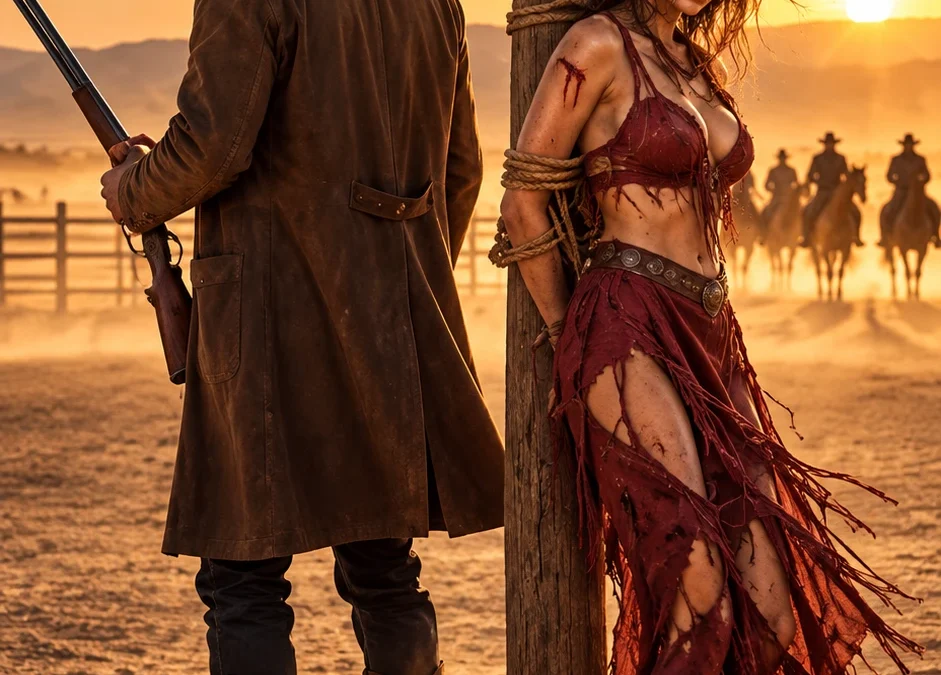
He Hadn’t Spoken to a Soul in 8 Years, Until He Cut Down a Hanged Apache Girl in a Storm and Learned Who Was Hunting Her 😱
Part 1
I had been alone for eight long years.
No laughter. No supper shared. Just the wind moaning through rotten fence posts and the sound of my horse breathing in the dark. 🌾
I told myself I’d grown used to the silence.
Then came the night of the storm.
The wind tore across the valley like the Lord’s own whip. Rain slapped the windows so hard the glass rattled like gunfire. I sat by the fire, mending a torn bridle strap, when I heard something that didn’t belong.
It wasn’t a wolf. It wasn’t a tree snapping.
It was wood, creaking. Slow. Rhythmic.
The sound a rope makes when it swings.
I grabbed my lantern and stepped onto the porch. Lightning split the sky, and my heart nearly stopped.
Hanging from my gate post, in the driving rain, was a young Apache woman. 😨
Her feet kicked weakly at empty air. Her hair was plastered across her face. Every gust of wind pulled the rope tighter around her neck, dragging out a dry, rasping groan I will never forget as long as I live.
She was still alive. She was still fighting.
I stood frozen, lantern shaking in my fist, heart pounding like war drums.
The old soldier in me whispered, Walk away. This ain’t your fight.
But the man who once had a wife and a little girl whispered something else.
If that was Sarah, would you turn your back?
I don’t remember crossing that yard. I only remember the sting of cold rain on my face and the numbness in my hands as I climbed that post with a knife that wouldn’t hold steady. Maybe from the cold. Maybe from my heart hammering too hard.
The rope snapped.
Her whole body collapsed into my arms, so light I could feel her ribs through the soaked fabric. Her throat was bruised purple. When I pressed my ear close, I caught a whisper. It wasn’t English, but it was enough.
She was breathing.
I carried her inside.
Eight years. Eight years since I had held another living soul. Eight years since I lost Sarah and little Molly. 💔
I’ve never told anyone how they died, except my horse and the wind.
A cavalry patrol burned an Apache village to “keep the border safe.” Sarah was there that day, bringing food to the starving children. Little Molly tagged along behind her mama like she always did.
They called it an accident.
Try digging through ashes for your little girl’s necklace. Then tell me it was an accident.
I buried them on the hill behind the house. After that, I shut the world out. I didn’t want to see anybody. I didn’t want to save anybody. I had nothing left to lose.
And yet, on this night, God or the devil had sent me this girl.
I laid her near the fire and wrapped her in a wool blanket. Her throat was swollen, her eyes shut tight, but her lashes trembled like she was still fighting death in her dreams. I dripped warm water onto her cracked lips.
That’s when I saw the cut on her arm.
It wasn’t from the rope. It was from a blade.
Not the work of outlaws, either. I’d seen that kind of cut before, on the arms of prisoners held by army men. The kind a man leaves when he wants a captive to feel fear before the end. 🩸
I sat back, cold sweat running down my spine.
Somebody had wanted this girl dead.
Somebody had wanted her to die slowly.
And they would not be pleased to find her gone.
She stirred just past midnight. The storm still screamed against the door, and the fire had burned low. I sat with an old tin cup of coffee, my eyes fixed on the hunting knife lying on the table. Out here, waking up beside a stranger usually means trouble is close behind.
Her eyes opened, black and gleaming in the firelight.
First came confusion. Then caution. Then despair.
“Don’t be afraid,” I said, my voice rough from years of disuse. “You’re safe. At least for tonight.”
She tried to sit up, but the pain in her neck dragged a groan out of her. I steadied her shoulders. Then, for the first time, I heard her speak. Her voice was a rasp, but her English was clear as day.
“My name is Naelli.”
The name hit me strange and beautiful, like wind whistling through a canyon.
But it was her next words that froze the blood in my veins.
“They’re coming. Soldiers. They’ll kill you, and they’ll kill me.”
I went still.
“Why would soldiers hunt a girl?” I asked.
Her trembling hand pulled a small leather pouch from her soaked belt. She untied it. Inside lay a stack of folded papers, army writing, red seals still unbroken.
“Proof,” she whispered. “Every village they burned. Every woman they took. And the names of the officers who gave the orders.”
My eyes dropped to those pages.
Names. Dates. A territory. A year.
My territory. My year.
Outside, over the howl of the wind, came a sound that made my stomach drop.
Hoofbeats. Not distant. Close. And a cold, arrogant voice rolled through the storm:
“Open the door, Redmont.”
My blood turned to ice.
They knew my name.
And the voice calling it belonged to the man who had burned my wife and daughter alive. 😱
👇 Want Part 2? Find it in the comments, or leave any word and I’ll send it to you privately!
Part 2
And the voice calling it belonged to the man who had burned my wife and daughter alive.
Morrison.
I had never seen his face that day eight years ago. I had only ever heard that name whispered by men who were ashamed to say it. But I knew his voice the way you know the sound of a rattlesnake in tall grass.
“Count of three, Redmont,” he called. “Hand over the girl, or we open this door ourselves.”
I looked at Naelli. She was already crouched beneath the window, clutching the pistol I’d handed her. There was no tremor in her grip. She was young, but her eyes burned like someone who had already buried too many people. 🔥
“You’ll hand me over?” she asked quietly.
I was silent a long moment. Then I told her the truth.
“Eight years ago, if you’d knocked on my door, maybe I would have. Not tonight.”
I pulled back the old rug and lifted the trapdoor beneath the floorboards. Everything I had buried was down there: a hunting rifle, a few beat-up Winchesters, iron stakes, snares, and a few sticks of railroad-grade dynamite. I had sworn I’d never touch them again.
That oath died the moment I cut the rope from her neck.
We worked fast. Chairs against the doors. Spikes scattered across the porch. Snares strung in the dark. Somewhere in the middle of it, I looked at her, rain-soaked, blood dried on her throat, and I saw Sarah. I saw Molly. I saw everything I had lost.
I rested a hand on her shoulder.
“Tonight, we might die.”
She didn’t turn. She only said, softly, “Then let’s die standing.”
“ONE!” Morrison roared.
The door shuddered under the first kick.
I fired. The bullet tore through the gap and dropped the soldier beside him. Gunfire answered instantly. Windows exploded inward, splinters flying like knives. Naelli and I hit the floor and crawled to our positions.
Outside, the spikes did their work. Horses screamed. Men cursed. Naelli squeezed off two shots at the side door. One man dropped. The other fled into the storm. ⚡
“BURN THEM OUT!” Morrison screamed. “BURN IT ALL!”
Flames licked the roof. Smoke poured through the cracks. We dove into the cellar, and I yanked the fuse. The dynamite buried along the wall went off with a deafening roar, hurling three soldiers into the mud.
Smoke. Fire. Screaming. Chaos.
And then, cutting through all of it, I heard something that made my blood stop.
A child’s cry.
Faint. Fragile. Barely there.
I froze.
Morrison’s laugh drifted through the burning rain. “Want to play hero, Redmont? My boy’s out here. Come on out and see if you’ve got the guts.”
I turned to Naelli.
She was trembling, but not from fear. From fury.
Because a man who would use a crying child as a shield would do anything. And I had just realized the worst part.
Morrison wasn’t bluffing. That cry was real. 😰
👇 LIKE or COMMENT “REVEAL” to see Part 3, which will be posted after enough comments!
Part 3
The child’s cry cut straight through the rain, weak but sharp enough to clamp my heart in a vise.
Morrison knew exactly where to strike. And he had found the mark.
I shouted through the shattered window. “That child’s got nothing to do with this!”
A cold laugh answered. “This was never about you, Redmont. The boy is my blood. You want to keep that Apache girl? Fine. But you’ll have to shoot through my son to do it.”
In that instant, the memories came flooding back. Molly, her hair matted with blood, cradled in Sarah’s arms. Morrison, laughing while I dug two graves on the hill. And now he was using a baby as a shield.
Naelli leaned close, her lips at my ear.
“He’s lying. That child isn’t his.”
I turned to her. “How do you know?”
Her voice cracked, but she held steady. “I know the mother. She was one of the women taken from the villages. They took her during the raids. She died giving birth. The child was the only thing she left behind.”
I understood then, and the understanding turned my stomach.
Morrison had taken women during those raids. This child was living proof of it. That was why the papers mattered. That was why he needed Naelli dead. And that was why the baby was here. A child like that, in the right hands, could be the one witness no court could call a liar. 🕯️
“Hand over the girl and those papers,” Morrison roared, “or I’ll burn you alive with that rat hole you call a home!”
I breathed in deep, tasting smoke and gunpowder on the rain.
I used to think I had run out of courage. But when you lose a wife, a daughter, your friends, even your will to live, you become something dangerous. You become a man with nothing left that fear can take.
I looked at Naelli. “When I go out, you stay down.”
“Redmont…”
“Stay down.”
She held my gaze. Then, slowly, she nodded.
“I’m coming out!” I shouted.
I stepped onto the porch, rifle on my shoulder, rain slashing my face.
Morrison stood twenty paces away, the baby clutched tight against his chest. He still had an officer’s good looks, right up until he opened his mouth.
“Drop the gun,” he said. “On your knees.”
I smirked. “Ain’t got knees to drop, Morrison. You took them eight years ago.”
His eyes narrowed. Recognition crawled across his face.
“Redmont. You?”
“Yeah,” I said. “The widower you left breathing.”
The wind carried whatever curse he spat next. His rifle came up, and so did mine. In that heartbeat, I couldn’t hear the storm anymore. Only my own pulse.
A shot rang out.
Then Morrison screamed.
I still don’t know who fired first. Only that Morrison staggered, eyes wide with shock. My bullet had torn through his shoulder, forcing him to release the child. The baby tumbled into the mud, wailing.
I charged forward, boots sinking into blood-soaked muck. Morrison crumpled to his knees, clutching his wound. He tried to raise his pistol, but all it gave was a dry click. Empty. 🔫
I stood over him with the Winchester in my hands, my heartbeat strangely calm. No storm. No voices. Just me and the man who had taken everything.
“Redmont,” he rasped, blood bubbling at his lips. “Kill me, and you’ll be just like me.”
I stared into those eyes, the same eyes that had laughed while my wife and child burned.
And I knew something he didn’t.
“No,” I whispered. “That’s where we’re different.”
I lowered the rifle. I turned my back on him. And I knelt in the mud and scooped the crying child into my arms.
The baby was ice cold and shaking, tiny fists clenching my soaked shirt. For the first time in eight years, I felt a heartbeat against my chest that wasn’t my own. 💔
Behind me, Morrison made a sound. A guttural roar, like a wounded beast.
Then silence.
I turned. Naelli stood over him, her knife still in her hand. It had been swift. Clean. No words.
I didn’t blame her. For some men, dying is a mercy. And for the people he’d hurt, it was a justice that no court had ever given them.
“Forgive me,” she said, her voice barely a breath. “I could not let him rise again.”
“There’s nothing to forgive,” I told her.
Then came the sound that made us both go still.
Hoofbeats.
Distant, but fast. Not a handful this time. A whole squad. Torches flickered through the rain, dozens of lights crawling down the ridge like hungry wolves. Morrison’s reinforcements. 🐺
“We have to go,” Naelli said, clutching the pouch of papers.
I held the baby tight, feeling its faint breath on my neck.
“North,” I muttered. “The old trail. The one they’ve forgotten.”
We left the ranch behind. The house that had been my fortress for eight years burned in the night, its roof collapsing, flames painting the mud in hell’s own colors. I didn’t look back. A part of me died in that fire. And maybe that’s the only reason I’m still alive.
We walked through the night.
The rain quit just before morning, leaving the land damp and heavy with the scent of smoke. The narrow trail cut through the canyon and opened onto wide prairie. In the east, the sun rose like a red blade, slicing through the fog.
I carried the child on my back. It slept soundly, breath faint but steady. Beside me, Naelli clutched the leather pouch, the evidence that could bury powerful men.
For a long while, neither of us spoke. After a night like that, there weren’t words big enough to fill the silence.
Finally, she said, “Why did you cut me down?”
I thought about it. The honest answer wasn’t a pretty one.
“Because eight years ago, I didn’t save anyone,” I said. “I dug graves. I swore I’d never get the chance to fail like that again. And then there you were, hanging from my gate.”
She was quiet. Then, softly, “My village was burned too. The summer before the soldiers took me. They said it was an accident.”
I stopped walking.
“They always say that,” I said.
She looked at me for a long time. In her eyes I saw something I hadn’t expected. Not pity. Understanding. The kind that only comes from two people who have buried the same kind of grief.
“Then we are not so different, you and I,” she said.
“No,” I agreed. “I suppose we’re not.”
At the valley’s edge, I stopped and looked back. All I could see was a column of black smoke rising into the pale sky. My ranch, my lonely fortress, was nothing but ashes.
I thought it would hurt.
Strangely, I just felt light. 🌅
“Where will you go?” Naelli asked.
I stared west, where the mountains gave way to endless grass.
“Somewhere that needs an old man who can mend fences and shoot straight.”
She nodded once. “And I’ll head north. To find the family I have left, and to take these papers somewhere justice still means something.”
The morning wind caught her hair, blowing away the soot clinging to her shoulders. The young woman who had hung helpless in a storm now stood tall, her eyes fixed farther than the horizon.
I looked down at the baby on my back. It stirred, opened its eyes, and smiled.
A weak little smile, but sharp enough to pierce an old man’s heart.
It had been a long time since I remembered what it felt like to have a reason to keep walking.
“You’re taking the child with you?” I asked.
“I have to,” she said. “This child is the last piece of proof. The world needs to know what the men behind us did, and that a life came out of it that deserves a future.”
I slipped the baby from my back and placed it gently in her arms. The little one curled against her chest as if it had always belonged there.
“Go,” I said. “Don’t look back.”
She gripped my hand once, tight, and for the last time. Then she stepped into the northern mist, the child in her arms and the pouch at her hip.
I turned toward the west.
Each step felt like shedding another layer of the past. I had no home. No family. But that night, in the mud, the blood, and a child’s cry, I had found something I thought I’d lost forever.
The feeling that I was still human. 🕊️
Years have passed since that stormy night.
The old ranch is nothing but a scar in my memory now, a patch of cracked earth where grass still refuses to grow. I still remember the baby’s cry. Strange, isn’t it? Out of all the gunfire, the screams, the pounding rain, it’s that tiny cry that haunts me. It reminded me that no matter how rotten this world gets, there is always something left worth saving.
Folks sometimes ask me, “Do you regret it?”
Regret? Yeah.
I regret the eight years I spent hiding, letting hatred gnaw at me day after day. But the night I opened my door to a half-dead Apache girl was the same night I opened a door for myself. A door out of the darkness.
I heard that Naelli and the baby made it. The papers she carried dragged plenty of powerful men down into the dirt where they belonged. I never saw her again. Sometimes it’s better to leave a good memory untouched.
And me? I just kept drifting. Fixing fences, mending wells, trading work for a warm meal.
I don’t chase peace anymore. I only hope that when my time comes, I die under a wide sky, so the wind can carry my wife’s and daughter’s names back to me. 🌬️
If you’re younger and you hear this story and think, “I’d have chosen differently,” remember this:
Out here in the West, there ain’t always a right or wrong choice. There’s only the choice you can live with when you look in the mirror.
That night, I chose to be human.
And maybe that’s enough to keep me going a few more years.
❤️ Thank you for staying with me until the end. If this story stirred even a flicker of your own younger days, share it with someone who needs a reminder that it’s never too late to open a door.
This story is entirely fictional and created for entertainment purposes only. It does not represent any organization or individual, nor does it encourage inappropriate behavior. The content was generated with AI assistance.








