He Handed Over His Last $10 for a Chained Stranger… Then Dozens of Riders Appeared on the Ridge, and the Man at Their Center Said Her Name
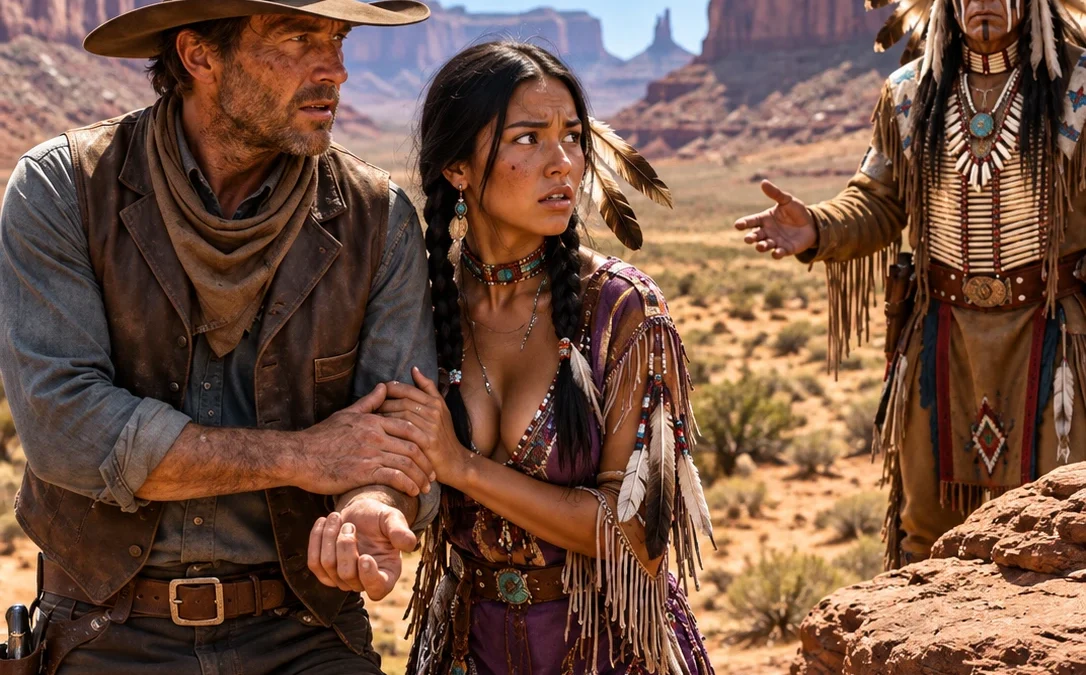
He Handed Over His Last $10 for a Chained Stranger… Then Dozens of Riders Appeared on the Ridge, and the Man at Their Center Said Her Name 😱🐎
PART 1
Dust. Heat. And the sound of chains behind a rough wooden fence. ⛓️
Caleb Mercer was thirty-six, broad-shouldered, quiet, and weathered by years of hard work on a ranch that had once belonged to his father. He rode into the dusty trading post that morning on his horse, Buck, counting the few coins left in his pocket. Two failed seasons had left him with barely enough for flour, coffee, and grain.
He had buried his mother, his father, and his younger brother within six years. He knew what it looked like when someone stopped expecting kindness from the world.
Then he heard the chains.
Behind the fence, beneath a narrow strip of shade, sat a young Apache woman, perhaps twenty-seven, her long black hair braided over one shoulder, her faded dress covered by a torn gray shawl. Dust coated her bare feet. A metal restraint circled one ankle.
Her face was exhausted. But her eyes were strangely calm. 😔
The trader lounging nearby noticed him looking. He explained casually that she’d been taken in a raid years earlier and was being transferred to another buyer.
Something tightened in Caleb’s chest. He knew the laws and customs of the territory were tangled, and that crossing men like this trader could bring trouble down on his head. But he also knew one simple thing: whatever people called it, keeping another human being in chains was wrong.
“How much to release her?”
The trader laughed, sure the worn-out rancher was joking.
Caleb set ten dollars on the table. Almost everything he had. 💵
The trader shrugged, pocketed the money, and unlocked the restraint. “She’s nothing but trouble.”
Caleb didn’t answer. He walked to the enclosure and held out his hand.
She stared at him for several long seconds. Then, slowly, she took it.
Her name was Naira.
She barely spoke on the ride to his ranch. Caleb didn’t question her. He gave her water, offered food, and kept his distance so she wouldn’t feel trapped again. When they reached the small ranch house, she stopped near the porch and looked out across the open plains.
For the first time in years, there was no fence between her and the horizon. 🌅
“You can leave whenever you want,” Caleb told her.
She looked at him as though she didn’t understand the words. Then she pointed toward the distant mountains.
Caleb followed her gaze. Something in her expression changed. Fear. Not ordinary fear, but the kind that comes from remembering something terrible.
Over the following days she slowly recovered. Caleb discovered she was intelligent, observant, and astonishingly skilled with horses. She could calm a frightened animal with a single touch, name plants he’d never heard of, and mend leather better than any hand he’d ever hired. She rarely spoke of herself. But every morning she stood on the hill behind the ranch and stared at those mountains.
And Caleb began noticing strange things.
Tracks near the ranch that vanished before reaching the house. A broken branch left beside the fence. Three small stones arranged in a perfect triangle beside his well. 👀
Someone was watching them.
One afternoon, while he was repairing a wagon wheel, Naira appeared at his side, her face gone pale, pointing toward the northern ridge. Three riders stood far away, too distant to identify. They remained for several minutes, then disappeared behind the rise.
That night Caleb kept his rifle beside his bed.
The next morning, Naira surprised him. She walked into the kitchen, set a small leather pouch on the table, and opened it. Inside lay an old silver medallion engraved with an unfamiliar symbol.
Caleb froze. He recognized it from a story his father had once told him, about an Apache war leader who vanished after his daughter was captured. A name spoken with fear and respect.
Chief Aaron Vera.
Naira touched the symbol. Then she pointed at herself.
Caleb finally understood. She wasn’t simply a woman taken from her people. She was the missing daughter of the chief.
Before he could say a word, hoofbeats thundered toward the ranch. A lone Apache rider stopped at the gate. He raised no weapon. Instead he slowly dismounted and laid a white cloth over his shoulder.
Naira stepped outside. The rider looked at her, and then he dropped to one knee.
Caleb’s blood ran cold. 😨
Behind the rider, dozens of figures appeared along the distant ridge. And at the center of them stood an older man in a dark leather coat, silver ornaments gleaming, a long braided necklace across his chest.
Naira covered her mouth.
She knew him.
PART 2
Chief Aaron Vera halted his horse several yards from the ranch house.
He was an imposing man in his early sixties, long gray-black hair, a weathered face, and eyes that carried the weight of decades. Behind him stood dozens of Apache warriors, but their posture held no threat. They were silent, watching Naira as though they could hardly believe what they were seeing.
For a moment, she couldn’t move.
Then she ran.
Aaron dismounted just before she reached him, and the powerful chief who had faced enemies, storms, hunger, and three years of searching suddenly looked like an old father who had been handed back a piece of his soul. He held his daughter tightly. 🥹
Caleb looked away. He understood grief. He knew what it meant to carry someone’s absence through every sunrise.
When they finally separated, the chief looked toward Caleb. His warriors stayed still. He asked what had happened.
Naira answered in her own language, speaking for several minutes. Caleb couldn’t follow the words, but he understood her expression. She pointed toward the house, the well, the horses, and finally at him. She touched the silver medallion at her neck and explained that Caleb had bought her freedom, but more importantly, that he had never treated her like property afterward. He’d never demanded payment. Never asked where she came from. He had simply given her food, shelter, and the freedom to choose her own path.
The chief studied Caleb for a long moment.
“Why?”
Caleb struggled for an answer. He could have said he wanted to be brave. He could have claimed he believed in justice. But the truth was simpler.
“I saw someone suffering. And I couldn’t walk away.”
Aaron lowered his eyes. For years he had imagined the man who might someday find his daughter. In his darkest hours he had feared she was dead. In his angriest, he had pictured revenge on everyone responsible. But standing before Caleb, he realized something unexpected: his daughter had survived because one stranger had chosen compassion. 💔
That afternoon Aaron remained at the ranch. Naira showed him the horses she had helped train, the little garden Caleb had planted behind the house, the room where she’d slept. Every small thing told the story of her life after captivity.
But Aaron noticed something else. The fences were broken in several places. The barn roof needed repair. Only a handful of cattle remained. The fields were dry, and the well was nearly empty.
Naira quietly told her father that Caleb had spent almost everything he had to free her.
Aaron’s expression hardened. Not against Caleb. Against the world that had made such a choice necessary.
He offered no gold and demanded no gratitude. Instead he asked Caleb to walk with him to the northern fields. There, between the rocks, he showed him a hidden natural spring. Naira had remembered the place while staying at the ranch. It could give enough water to bring the whole ranch back to life.
But there was a problem.
The land around it belonged, on paper, to a wealthy cattle owner named Silas Crow. Silas had been watching Caleb for months, waiting for him to fail so he could buy the ranch cheap. 😡
That evening he rode in with armed men.
“You’ve got no right to that spring, Mercer. Pack up and get off this property.”
Caleb stood in front of his house. He knew he was outnumbered. But this time, he wasn’t alone.
Aaron and his people stood behind him.
Silas looked at the Apache chief and immediately saw the situation had changed. Yet Aaron raised no weapon. He simply produced an old territorial document proving the spring had never belonged to Silas. The land had been shared by several communities long before Silas arrived. He had been using intimidation to claim it.
The evidence was enough. Silas turned his horse and retreated.
But Aaron did not celebrate. “Freedom is not simply the absence of chains,” he told Caleb. “It is having the courage, and the chance, to build something after surviving what broke you.”
Naira understood those words deeply.
Then the chief turned to look at her, and something in his face changed. Slowly, he reached into his coat and drew out a second silver medallion, identical to hers.
“I have carried this for three years,” he said quietly. “I never believed I would need two.” 😳
Naira stared at it.
Because the second medallion wasn’t a mirror of hers. It had one thing hers did not: a name carved into the back. A name that was not Naira.
PART 3
“Read it,” Aaron said softly.
Naira turned the medallion over in trembling fingers. The carving was old, worn smooth, but still legible.
Nyala.
She looked up. “That is the name my mother gave me.”
“It is the name I have called you in my heart every day for three years.” His voice cracked. “The traders who took you changed it. They changed everything. They called you whatever they wished, so you would forget who you were.”
“I did not forget.” A tear slid down her cheek. “I told myself the name every night. Naira was what they wrote on the paper. Nyala was who I was.” 💫
The chief pressed the medallion into her palm. Now she held two, one worn through years of captivity, one carried through years of searching. Together they finally made a pair.
Caleb stood a few steps back, feeling suddenly like an outsider at a sacred moment. But Nyala turned and held out her hand to him, the same gesture he had offered her at the trading post.
“Come,” she said. “You are part of this story.”
That night they ate together on the ranch porch, an Apache chief, his warriors, and one tired rancher, all sharing the little food Caleb had left, then more from the saddlebags the Apache riders had quietly brought. Nobody made a speech. Nobody needed to. The fire popped. The stars came out. And for the first time in longer than he could remember, Caleb’s table was full. 🌌
Over the following months, something remarkable happened.
The ranch came back to life. Apache riders helped repair the fences. Caleb taught them how to work certain cattle lines, and Nyala taught Caleb and his neighbors how to identify plants, preserve food, and use the mountain spring responsibly. Slowly, the ranch became a place where people who had once feared one another could sit at the same table.
Silas Crow did not give up quietly.
Three weeks after the confrontation, he returned in the night with six men and a torch. They rode in fast, hoping to burn the new barn roof before anyone woke. But the Apache riders had left two sentries at the ridge, and the alarm went up before the first flame caught. 🔥
It was Nyala who reached the water barrel first. She didn’t hesitate, didn’t flinch, just filled bucket after bucket and passed them hand over hand with the warriors and the neighbors who had come running. By the time the sun rose, the fire was dead and Silas’s men were bound in the yard.
Silas himself was dragged out from behind the wagon he’d hidden under, shaking with rage.
“You’ll regret this, Mercer. You think a few savages and a ranch can stand against the territory?”
Caleb walked up slowly. He didn’t raise his voice.
“I think a man who burns a barn in the dark has already lost. The marshal’s coming. You can explain the spring to him. And the burning.”
The marshal arrived two days later and took everything: the torch, the stolen documents Silas had forged, and the testimony of three of his own men who, once the Apache chief looked at them, decided it was better to talk. Silas Crow was taken away in chains. 😶
Nyala watched from the porch.
“Does it feel strange?” she asked Caleb afterward. “To see a man in chains and not feel victory?”
“It feels like a door closing,” he said. “Not a win. Just an ending.”
She nodded slowly. “My father says justice is not triumph. It is the quiet that comes when something that kept you awake finally leaves.”
“Your father is a wise man.”
“He is also stubborn. You will learn.”
Caleb laughed. Really laughed, the sound surprising him, as if it had been waiting years in a locked room.
Caleb never asked her to stay. That was what made her choose to.
One evening, in the soft light after the day’s work, Nyala found him mending a bridle by the corral.
“My father has offered me a place with my people,” she said. “A tent. A family. A name that carries weight.”
His hands stilled. “That’s a good life. You should take it.”
“I could.” She sat beside him. “I could also travel somewhere new. Or I could stay.”
He didn’t look up. “What do you want?”
“For the first time in my life, no one is asking me to pay for the answer.” Her voice was quiet, steady. “You gave me that. Not freedom. Freedom was mine already. You gave me the choice.”
“Nyala…”
“I choose to stay. Not because you saved me. Because you reminded me that my life belongs to me. And I want it to be here, with this land, with the horses, and with a man who never once asked me for anything.” 🥹
Caleb finally looked at her. And for the first time in years, the lonely rancher who had eaten every meal in silence felt something warm and unfamiliar settle in his chest.
“Then stay,” he said. “As long as you want. As long as you choose.”
“I choose,” she whispered.
Years passed.
The ranch grew. Not because Caleb became wealthy, but because he stopped believing survival meant living alone. Apache riders and neighboring settlers worked the land together, trading knowledge, sharing tools, sitting side by side at the long table under the cottonwood that Nyala had planted the first spring.
Chief Aaron returned to the mountains, but he visited every year. On one such visit, he stood beside Caleb at the edge of the ranch, watching Nyala teach a group of children how to calm a frightened horse. Her voice was low and patient, the same voice that had once calmed a spooked mare with nothing but a touch.
The chief smiled.
“A man can spend his whole life searching for justice,” he told Caleb, “and still fail to find peace. But sometimes peace begins with one small act of kindness that nobody expected.”
Caleb looked at Nyala. She glanced up from the children and smiled back, warm and bright beneath the clear afternoon sky.
In that quiet moment, he understood that the ten dollars he’d spent years earlier had never really been a payment.
It had been a choice. A choice to see a human being where others had seen something they could own. And that choice had changed not only Nyala’s life, but his own. 🌅
When travelers passed through the valley, they heard an unusual story about a cowboy who spent his last ten dollars on a stranger. Some called it foolish. Others called it bravery.
But Nyala always remembered it differently.
“He did not save me,” she would say. “He opened a door. I was the one who walked through it.”
And when people asked what she remembered most about the day she regained her freedom, she never mentioned the money. She remembered the open hand of a tired cowboy. She remembered being offered a choice. And she remembered the first time someone looked at her and saw not a prisoner, not an Apache, not a chief’s daughter, but simply another human being who deserved to be free.
That was the true legacy of Caleb Mercer.
He hadn’t become a hero because he defeated an enemy. He became one because when the world expected him to look away, he chose to see.
And sometimes the greatest act of courage is simply refusing to treat another person’s suffering as someone else’s problem. 🕊️
THE END
💬 Have you ever helped a stranger without expecting anything in return, or had someone’s kindness change your life? Tell me your story in the comments, and share this with someone who needs a reminder that one small choice can open a door. 👇
Disclaimer: This story is entirely fictional and created for entertainment purposes only. It does not represent any organization or individual, nor does it encourage inappropriate behavior. The content was generated with AI assistance.








