HE HATED HIS ARRANGED BRIDE FOR SIX WHOLE HOURS. THEN THREE ARMED MEN BLOCKED THEIR CARRIAGE, AND HIS “GENTLE” WIFE STEPPED OUT WITH A PARASOL… BUT WHO PAID THOSE MEN TO ATTACK HIM ON HIS WEDDING DAY?
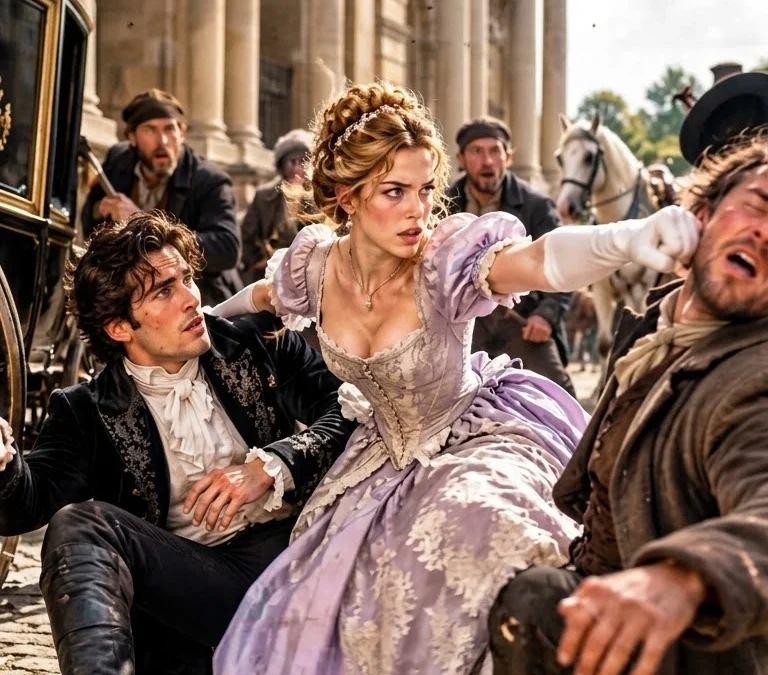
HE HATED HIS ARRANGED BRIDE FOR SIX WHOLE HOURS. THEN THREE ARMED MEN BLOCKED THEIR CARRIAGE, AND HIS “GENTLE” WIFE STEPPED OUT WITH A PARASOL… BUT WHO PAID THOSE MEN TO ATTACK HIM ON HIS WEDDING DAY? 😱☂️
Part 1
Duke Gareth Rookmir was six hours into his marriage before he began to seriously consider what he had done wrong.
He sat in the carriage beside his new wife. She was eating a sugared plum.
It was her third that day. 🍑
The first had been at the chapel. He had stood beside Lady Varity Crowley and answered every vow clearly, without stumbling once. The vicar had lost his place twice. Both times, a small dimple had appeared near Varity’s mouth. Gareth had not looked. He had thought himself rather impressive.
The second had been at the wedding breakfast. She had eaten one plum, thanked every footman, and remembered every servant’s name after hearing it once. She had sat there gentle and quiet, looking as harmless as a dove placed in a bank vault.
Now she was eating another.
Gareth distrusted harmless people. They were usually sent by dangerous ones.
Varity set the plum stone aside. “What are you thinking?”
“I am thinking about my father.”
“Oh, I am also thinking about your father.” She smoothed one glove. “I am wondering how he convinced mine to sign that settlement. My father usually demands three bloodline certificates before buying a horse.”
Gareth glanced at her. Clear hazel eyes. Not timid. Not pleading. Observant. She was studying him the way one studies a thing one has just purchased and not yet decided whether to return.
“You believe I married you for your title?” he said.
“Of course you do. But you married me for my father’s money, so we are even.”
The coachman coughed outside.
Gareth was silent a moment. His fingers tapped once against his knee. “You are honest.”
“Honesty saves time. Also, your aunt cried into the wedding schedule. My mother told me to smile as if I had not been sold with ribbons. The vicar called you George twice. And I am hungry again.”
“You just ate a plum.”
“A plum is not dinner.”
Gareth almost smiled. Almost. He looked out the window. “You are free to arrange your own household. Rookmir Hall is large enough for distance.”
“How romantic.”
“I did not offer romance.”
Her tone held no injury and no anger. Clearly, that annoyed him. He had prepared for tears, resentment, some delicate accusation. Instead she looked at him like a woman waiting for a kettle to boil.
“I will not interfere with your life,” he said.
“That may be difficult. We are married.”
“Legally.”
She raised one finger, serious as an auditor. “Socially, publicly, inconveniently, and with cake.”
“Cake does not create intimacy.”
“No. But it creates witnesses.”
Before he could answer, the carriage stopped.
Not slowed. Stopped.
Gareth’s hand went at once to the door strap. “Stay inside.”
Her brows lifted. “That sounded practiced.”
Outside, a man shouted. The coachman cursed. Horses stamped. Another voice laughed from the hedgerow.
Gareth opened the door before the footman could.
Three men stood in the rain-soaked lane. Not beggars. Not drunkards. Hired muscle. One carried a cudgel. One held the horses. One stood by the ditch with a pistol aimed badly but confidently.
“Your grace,” the pistol man called. “Out, if you please.”
Gareth stepped down. Rainwater soaked his wedding shoes. “You have chosen a poor afternoon for stupidity.”
“We was paid for the afternoon.”
Paid. Of course. He had enemies enough to fill another carriage. Tenants angry over evictions his father had ordered. Creditors disappointed that he refused to sell village land. Cousins who preferred him dead and the estate divided.
“Take the purse,” Gareth said. “Then leave.”
The pistol man grinned. “Not here for the purse.”
The footman lunged. The cudgel struck him across the shoulder.
Gareth moved. He was not ornamental. He had boxed at university, fought two duels he regretted, and once held up a stable roof beam during a fire until the men beneath it escaped. He caught the cudgel man’s wrist and drove him into the carriage wheel. The second man released the horses and came at him from the side.
The pistol lifted.
And the carriage door opened.
“I said stay inside!” Gareth snapped.
“Yes,” said Varity. “It was a poor suggestion.”
She stepped down holding her parasol. It was pale blue to match her gown, with a carved handle, a silk canopy, and no visible reason to terrify anyone.
The pistol man laughed. “Back in the coach, duchess.”
Varity smiled. A gentle smile.
Then she struck him across the wrist with the parasol handle.
The pistol fired into the ditch. Birds exploded from the hedge. Before the man could shout, she hooked the parasol behind his knee and pulled. He fell backward into the mud with the expression of a man betrayed by weather and marriage.
The second thug stared. That was his mistake. Varity stepped under his arm, drove her elbow into his stomach, and used his own weight to send him over the milestone. 😳
The cudgel man recovered and charged. Gareth reached for him. Varity was faster. She drew a hatpin from her bonnet and held it two inches from the man’s nose.
“Sir,” she said pleasantly, “I am newly married, underfed, and wearing satin shoes in mud. Do not test the mercy of a bride.”
The man stopped. Gareth stopped. The coachman stopped swearing halfway through a word.
“Drop it.”
He dropped it.
“Now apologize to his grace’s footman.”
“What?”
The hatpin did not move.
“…Sorry, mate.”
“With feeling.”
“Sorry, mate.”
The footman, clutching his shoulder, blinked. “Accepted.”
Gareth looked at his bride. A streak of mud marked her hand. One curl had escaped her bonnet. The parasol was bent. Her expression remained sweet enough to serve with tea.
“You,” he said, “can fight a little.”
Varity tilted her head. “A moderate amount.”
Gareth felt several firm opinions about his wife break apart and fall uselessly into the mud.
“Who sent you?” he demanded of the thugs.
No one answered.
Varity sighed. “Gentlemen, I have not yet had my dinner.”
The cudgel man pointed at the pistol man. “He knows.”
“Coward,” wheezed the pistol man.
“Hungry bride,” the cudgel man replied.
That was how Gareth Rookmir arrived at his ancestral home with one bruised footman, three thugs tied with carriage straps, and a wife everyone had described as gentle.
Mrs. Pennock, the housekeeper, came down the steps expecting a formal arrival. She found mud, rope, blood on Gareth’s cuff, and the new Duchess holding a pistol by two fingers like a dead mouse.
“Your grace?” Mrs. Pennock said faintly.
“Which one?” Varity asked.
Gareth covered his mouth with one hand.
“I mean,” said Varity innocently, “there are two now.”
Soon the thugs were locked in the old tack room. And while Gareth should have taken charge at once, he found himself watching his wife direct the hall with calm precision, binding the footman’s shoulder more neatly than the housekeeper, ordering hot water, vinegar, thread, and soup.
“Soup, your grace?”
“For the footman, and for me, and perhaps for the men in the tack room. Criminals answer questions better when not fainting from hunger.”
Gareth stared. “Do you often feed men after defeating them?”
“Only if I need them conscious.”
But what truly chilled him came later, in the tack room. One thug, soup in his belly, finally spoke.
“Didn’t get a name. Gentleman. Good boots. Paid half.” He hesitated. “Told us to frighten your grace. Rough him a bit. Take papers, if he carried any. And leave the lady alone.”
Gareth’s stomach hardened. Papers?
Whoever had hired them had known his route. Had known the wedding date. Had ordered the men to avoid the bride.
And on the walk back through the dark stable yard, Varity said quietly, “They attacked you six hours after a marriage someone apparently wanted completed. That is not robbery, Gareth.”
He stopped. It was the first time she had said his name.
“Someone needs me alive,” she said. “Or innocent. And the question is why.”
👇 Want Part 2? Comment any word and I’ll send it to you privately, or look for it in the comments!
Part 2
The next morning, the whole household knew three things.
The new duchess had defeated three highwaymen. The Duke had apologized to her in the stable yard. And Mrs. Pennock’s soup had aided interrogation. Only the third made the cook unbearable.
Rookmir Hall changed its opinion of Varity with indecent speed. The grooms became reverent. The footman she had bandaged tried to stand whenever she entered, winced, and was ordered to sit before he became decorative.
Gareth’s aunt, Lady Maud, took longer. “My dear, how exactly did your mother train you?”
“Patiently,” said Varity, buttering toast. “With household objects. My sister favored a chamber pot.”
Lady Maud’s teacup rattled.
“A clean one.”
“Thank heaven,” Lady Maud whispered.
Gareth failed to hide his laugh. Across the table, there was the dimple again. He disliked how quickly he had begun waiting for it.
Then the letter arrived. No seal. No signature. One line in an elegant hand:
Marriage gives you her dowry, not safety.
Varity read it beside his desk and frowned. “This person thinks my dowry matters most.”
“It does matter to the estate.”
“To the estate, yes. To the attack, perhaps not. If someone wanted to stop the marriage, they chose poorly. If they wanted to steal papers, they chose loudly. If they wanted to scare you, they told the men not to hurt me. Why?”
No woman had ever stood at his desk and taken danger apart like sorting thread. “You have a very irritating calm.”
“I worked hard for it.”
He unlocked a drawer and removed the marriage settlement. “May I?” she asked. He gave it to her. She read slowly. Her lips moved once over a phrase. Then her face changed.
“Did you read this clause? The one that transfers the Eastern Mill rights to Rookmir if I die childless within five years?”
Gareth’s hand stilled. “That clause was removed.”
“Not in this copy.”
Silence drew tight between them. He took the paper and read the neat legal script. A cold feeling spread through him. “I did not agree to this.”
“I believe you.”
The speed of it struck him. “Why?”
“Because if you wanted my land after my death, you would not look as if you had swallowed a nail.”
Then he saw the second page. The witness line. Lord Davin Croft. His cousin.
Davin was charming, idle, always in debt. And he expected to inherit if Gareth died without issue.
“Do you trust him?” Varity asked.
“Less than I did one minute ago.”
“Good progress.”
But Davin was not in the house. He had ridden out before dawn, supposedly to inspect the south covert. No one had seen him since.
When he finally returned at dusk, smiling, damp, and lying before he removed his gloves, Varity said, with perfect innocence, “Only the puddles near Howick Mill.”
Davin’s eyes flickered. Tiny. Gareth saw it only because he was watching Varity watch him.
When Gareth showed him the forged clause, Davin’s outrage arrived polished and loud. “I have never seen this!”
“Yes,” said Varity. “It is monstrous.”
Davin’s gaze slid to her. The dislike there was naked for one moment. Then it dressed itself again. “A bride should not spend her first day among papers and ruffians.”
“I agree. I had hoped for better cake.”
Gareth coughed. Lady Maud whispered, “The almond cake was dry.”
That night Davin vanished. The groom posted at his door lay slumped in a chair, not drunk but drugged. His cup smelled faintly of bitter almonds.
Gareth’s blood turned cold.
Varity knelt, touched the groom’s pulse, and looked up. “He will try to finish what he started. If I die before the altered paper is disproven, confusion helps him. If you are blamed for my death, it helps him more.”
Fear moved through Gareth with startling force. Not duty. Not guilt. Fear of Varity harmed. Varity silenced. Varity’s dimple gone forever because he had spent their first hours calling distance wisdom.
“No,” he said, quieter. “Then help me stay alive,” she said.
That steadied him. Not enough. But enough to move.
They searched Davin’s room and found a torn cuff stained with mill dust, a second copy of the altered settlement, and a note signed only M., demanding the Duchess’s removal before the next quarter day.
“M,” Varity said slowly. “Not Davin alone. Someone in my father’s household.”
Gareth saw the blow land. Lord Crowley had insisted on this marriage. If someone near him had helped alter the papers, then her own home had sold her into a trap.
“I am sorry,” Gareth said.
“Do not be sorry yet. We need facts first. Then we may be sorry efficiently.”
By dawn, the magistrate’s men had searched the grounds. But it was Varity who found Davin. She was supposed to remain in the central hall with Lady Maud, Mrs. Pennock, two footmen, and a magistrate’s clerk. Unfortunately, she noticed a muddy smear on the lower hall door and followed it. She claimed she intended only to inspect the corridor.
Gareth believed this as much as he believed porcelain birds made good company.
The smear led to the old orangery. Davin stood there, trying to reach the south gate, carrying a lease, a pistol, and Varity’s missing traveling cloak.
“Dear cousin,” he smiled.
“We are not cousins,” Varity said. “Only by marriage. Temporarily, if you continue.”
The pistol lifted. “You should have stayed gentle.”
“People keep misunderstanding that word.”
“Walk ahead of me. Quietly.”
“No.”
Davin blinked. “No is a small word. You may have missed it among your debts.”
“Do you think I will hesitate?”
“Yes. Because men who mean to shoot do not explain first. They shoot.”
Varity counted the distance, the footing, the breath. Her mother had drilled it into all three daughters: men with pistols trusted the pistol. That was why they forgot elbows, eyes, knees, and loose gravel.
The orangery roof leaked. Rainwater had gathered in broken tiles. Davin stood near a patch of moss, in boots too fashionable for survival.
She took one slow step back. He followed.
Then she threw her candle at his face.
He cursed and fired. The shot shattered glass behind her. Varity moved toward him, not away. She struck his wrist with both hands. The pistol fell. He grabbed her sleeve. She turned, drove her heel into his instep, and shoved.
Davin slipped on the moss and crashed into a dead orange tree, which collapsed on him with dry, undignified grandeur. 🍊
That was how Gareth found them. Smoke in the air. The pistol on the floor. Varity standing dusty under the branches.
“I am unshot,” she said.
“That is not a sufficient report.”
“It is the best one.”
He crossed the room and gripped her shoulders. Then he stopped, as if remembering she was not a thing to seize. “May I?” His voice was rough.
That undid her more than the pistol. She nodded. He pulled her into his arms. His heart hammered under her cheek. His arm shook. The Duke who had wanted distance held her as if distance had become the enemy.
Behind him, Davin groaned. “Help!”
Varity lifted her head. “The tree appears to be managing.”
Gareth made a sound that might have been laughter, if it had not been so close to panic.
But as the magistrate’s men dragged Davin out, something else tumbled from his coat. A letter from a man named Markham. A clerk in Lord Crowley’s own household.
Varity read it, and went very pale.
👇 Want to know the truth about Markham? LIKE or COMMENT “REVEAL” and Part 3 will be posted once we reach enough comments!
Part 3
Markham had altered the settlement after Lord Crowley signed it, expecting Davin to pay him once the mill rights became valuable. Davin, being Davin, had promised money he did not possess to men who disliked waiting. The plan had been foolish, greedy, and nearly fatal. Most wicked plans were less elegant than people feared.
Gareth listened to the magistrate’s first account with a face like stone. Then he walked to Varity.
“Your father may not have known.”
“No. Markham did.”
“We will send word at once.”
Varity nodded. She looked steady until Lady Maud reached her and touched her cheek. “My dear,” Lady Maud said softly.
Varity’s mouth trembled once. That was all.
Gareth saw it, and understood something important. Varity did not need him to save her from every danger. She needed a place where she did not have to be brave alone afterward.
He could become that, if she allowed it. If he earned it.
Davin was taken away before noon. Mr. Lawrence, the steward, confessed fully by supper; he had hidden debt payments as mill repairs and looked away when letters came from men he described only as “not domestic.” Markham was arrested three days later in Lord Crowley’s library, trying to climb out a pantry window.
Lord Crowley sent six letters of apology and one enormous crate of oranges, because he had heard about the orangery and misunderstood which part required replacement. Lady Maud arranged the oranges in bowls all over the house.
“Is this support or invasion?” Varity asked, finding one in the umbrella stand.
“Both,” said Gareth. “My aunt expresses relief through citrus.”
The danger receded. But marriage remained.
That proved harder. Danger had given them purpose. Without it, they had to learn what to do with breakfast, silence, shared corridors, and the fact that both reached for the same inkstand while pretending not to notice.
They were polite for four days. It was awful.
On the fifth, Varity entered his study with a ledger, a basket of mending, and a determined expression.
“We cannot continue like this. Like two nations avoiding war through napkin placement.”
“I thought we were improving.”
“You asked whether I preferred marmalade in a tone suitable for treaty borders.”
“Marmalade is serious.”
“Not that serious.” She set down the basket. “I do not want a marriage of gratitude.”
“Nor do I.”
“I also do not want a marriage where you treat me as a soldier in the morning and porcelain by supper.”
He exhaled. “I am trying not to.”
“And I do not know how to be married without preparing to leave if command arrives.”
There it was. The wound under the wit.
Gareth stood slowly. “I will not command your obedience. If I do so by habit, correct me.”
“You may regret that invitation.”
“I expect to.”
The dimple appeared. He crossed the room and stopped an arm’s length away. “May I say something foolish?”
“Is it about marmalade?”
“No. When you stepped into the lane with that parasol, I was terrified. And when you stood in the orangery, I was terrified again. Not because you were weak. Because you were brave where I could not reach you.”
“Gareth, I am not asking you to become reachable at all times.”
“I am telling you that loving someone brave is less comfortable than admiring them from a distance.”
Her lips parted. “Loving.”
He had not meant to say it yet. But there it was, sitting between them like a lit candle near dry paper.
“Yes,” he said.
She looked down at the mending basket. “That complicates honesty. I was about to say I have become very fond of your worst expressions.”
“My worst expressions?”
“The one where you are displeased by correct advice. The one where you want to smile but think a duke should not. The one where you are proud of me and angry about it.”
He smiled. He did not stop this time.
He held out his hand. She looked at it. He waited. When she placed her hand in his, he felt the trust in it more sharply than any kiss.
“Varity. May I court my wife?”
“That is a strange request.”
“Our beginning was strange. I would like to do some parts in better order.”
“Will there be cake?”
“Improved cake.”
“Then yes.”
They laughed together. It did not solve every wound. But the room changed. ❤️
The courtship of the Duchess of Rookmir by her own husband became the household’s favorite emergency. Gareth sent flowers; she rearranged them because the colors fought. He invited her to ride; she outran him on a mare everyone called unmanageable. He ordered almond cake from London; she praised the effort and admitted Mrs. Pennock’s seed cake was better. Mr. Finn kept a list of damaged objects now considered courtship casualties, including one parasol, two gloves, the dignity of three grooms, and a porcelain bird Varity broke while demonstrating how she had disarmed Pel.
Gareth hated the porcelain birds. He mourned it convincingly for nine seconds.
“You disliked that bird.”
“It had a judgmental beak.”
“I will break another on your birthday.”
“You are too generous.”
Not every night was easy. Some evenings Varity woke from dreams of the pistol shot in the orangery. She did not cry out. She simply sat upright, breath tight, one hand searching for a hatpin that was not there.
The first time, Gareth reached for her too quickly. She flinched. He stopped at once.
“It is me. Gareth.”
“I know. I hate that I flinched.”
“I hate that you needed to learn not to.”
She turned her head. “That was well said.”
“I am improving.”
“Do not become proud.”
“Too late.”
She leaned against him. He counted it among the greatest honors of his life.
Spring altered Rookmir. The forged settlement was voided. The true one was ratified. Lord Crowley dismissed Markham’s entire network and sent Varity a letter that began with apology and ended with concern over whether she was eating enough. Her mother sent three lines: Good wrist work. Your left turn remains weak. Visit soon and bring the Duke if he listens.
“Do I listen?” Gareth asked.
Lady Maud answered before Varity could. “Less than ideal.”
“Aunt.”
“Accuracy is my contribution.”
Gareth made changes, not grand gestures. Varity distrusted grand gestures unless accompanied by practical receipts. He hired a steward who did not think fraud was an unfortunate weather pattern. He opened the mill accounts to tenant review. He funded a school for village girls in writing, bookkeeping, and what Lady Crowley politely called household defense.
The vicar objected to the last. Varity invited him to observe a lesson. He left after a twelve-year-old named Bess disarmed him with a folded umbrella.
One afternoon, Gareth found Varity in the stable yard teaching three maids to use laundry poles. “A pole is only useful if you do not apologize to it,” she told Molly, the youngest.
Gareth leaned against the gate. “Are you supervising?”
“Admiring,” he said, and the maids giggled. Varity’s cheeks colored. He enjoyed that far too much.
Then he asked her to show him. The lesson was humiliating. He had boxed, fenced, ridden hard, and managed angry tenants. None of it prepared him for being corrected by his wife with a laundry pole while two stable boys pretended not to watch.
“Your shoulders are too proud.”
“They are not proud.”
“They are practically giving a speech.”
She stepped behind him to correct his grip. Her hands covered his. The yard, the boys, the horses, the entire estate seemed to fall away.
“I am no longer learning,” he said, his voice low.
“I noticed.”
That evening he kissed her in the west garden under a pear tree. It was not careful like the first. It was certain. She rose on her toes, caught his lapel, and kissed him back as if she had decided gentleness could have teeth. 💋
“I hated our arranged marriage,” he murmured against her forehead.
“I remember.”
“Do you forgive me?”
“Mostly. I reserve a little for future bargaining.”
Then, at the spring tenants’ assembly, held in a long barn because the hall roof was being repaired, trouble came as trouble liked to: during a public event with too many chairs.
Markham’s brother arrived with four men and a grievance. They accused Gareth of ruining an honest clerk, and Varity of entrapping Davin. One man carried a knife poorly hidden under his coat.
The tenants rose. Gareth moved toward Varity. Varity moved toward Markham’s brother.
“Madam,” the man shouted, “you should have stayed a soft little bride!”
The barn went silent. Varity looked at him with an expression so calm that Gareth almost pitied the man.
“Sir. I have been hearing that advice all year. It has not improved.”
He lunged. This time Gareth was closer. He caught the man’s wrist before Varity needed to. She looked not disappointed exactly, but nearly. He twisted, disarmed him, and sent the knife skidding under a hay rake.
Molly stepped from the side with a broom handle. “Feet apart!” Varity called. Molly struck the nearest attacker behind the knees. He dropped. Lady Crowley, visiting, closed her fan with a snap. Another man froze at the sound. Lady Maud threw an orange. It missed everyone, but morale improved.
Within two minutes, the intruders were held by tenants, grooms, and one elderly widow who pinned a man’s sleeve to a hay bale with a knitting needle.
The exhausted magistrate asked, “Your grace, does this sort of thing occur often?”
Gareth looked at Varity, at the broom handle, at the orange rolling under a bench, at his mother-in-law calmly retrieving her fan.
“Less than before.”
The barn erupted in laughter. It should have embarrassed him. It did not.
Afterward, he stood before the tenants, Varity beside him. He folded the speech he had prepared.
“My father left this estate tangled. I left too much of the untangling to men who enjoyed knots. That changes now.” He looked at Varity. “Her grace has reminded this house that gentleness is not weakness. Politeness is not surrender. And safety is work shared by everyone under a roof. The Eastern Mill will reopen under tenant partnership. And if any man here believes household defense improper for young women, he may discuss the matter with Lady Crowley’s fan.”
Lady Crowley lifted it. No one objected.
“I married for duty and money,” Gareth said. “I was wrong to think that made the marriage small. She has done what no settlement could. She has made this estate braver.”
Varity’s face changed. He did not make a spectacle of touching her. He only held out his hand. She took it.
The applause began with Molly.
That night, lanterns glowed in the courtyard. Mrs. Pennock’s soup was served in enormous bowls. Gareth found Varity beneath the old carriage arch, holding the repaired blue parasol, its silk bearing one visible patch.
“I thought you had thrown that away.”
“Never. It nearly broke.”
“So did we.”
“Do you regret it?” he asked. “The marriage?”
“I regret that we were not given a choice in the beginning.”
“So do I. But I like the choices we made after.”
“I love you,” he said.
“I know. You might say it back.”
“I might.” She smiled. “I am enjoying your expression. The one where you are proud, nervous, and slightly annoyed.”
“My shoulders are composing a speech.”
She lifted the bent parasol and rested it against his chest.
“I love you, Gareth Rookmir. Even when you command badly, apologize stiffly, and believe marmalade is diplomacy.”
His laughter stopped. He covered her hand on the handle. “May I kiss my formidable, gentle wife?”
“In public? Half the estate is watching.”
“Half the estate is looking away badly.”
“Very well. But if anyone applauds, I am blaming you.”
He kissed her. Someone applauded.
It was Lady Maud. “I am old. I have earned my pleasures.”
Later came the family. Lord and Lady Crowley and Varity’s two sisters arrived to inspect the Duke. Her mother inspected his manners. Her father inspected his remorse. Anora inspected his posture. Cecily inspected the exits.
“He stands well,” said Anora.
“Thank you,” Gareth said.
“I was speaking to Varity.”
Lady Crowley studied him a long moment. At last she nodded. “Acceptable.”
Gareth felt absurdly proud.
When Lord Crowley asked to speak alone, they walked in the west garden. “I failed her,” he said. Gareth did not soften it. “Yes.” Lord Crowley looked at him. “You agree quickly.”
“Your daughter prefers honesty. I am practicing.”
Lord Crowley looked toward the lit windows, where Varity sat between her sisters, laughing. “Is she happy?”
“Not every moment. Marriage does not erase harm. But she laughs here. She argues here. She walks into rooms without asking whether she may be useful.”
Inside, Anora cornered Varity. “Do you love him?”
“Yes.”
“Does he make you smaller?”
“No.”
“Does he kiss well?”
“Anora.”
“Essential information.”
Varity’s ears went red. Cecily gasped. “Oh, he does.” Their laughter was so loud that Gareth and Lord Crowley heard it from the garden.
That visit left behind three changes. Lady Crowley began a correspondence with Lady Maud about household defense and the political uses of fans. Anora persuaded Gareth to hire a riding instructor for the estate girls. And Cecily found a hidden panel behind the porcelain birds.
Behind it lay letters from Gareth’s mother.
He had believed she left when he was ten because she disliked country life. His father had told him so. The house had repeated it until it became furniture. The letters told another story. Duchess Alina had left after discovering the old Duke’s debts and unlawful evictions. She had written to her son for years. The letters never reached him.
He read them alone, then brought them to Varity, face stripped of every ducal defense.
“My father kept them.”
“Do you want me to read them?”
“I want you to sit here while I do.”
The fifth letter broke his voice. My dearest boy, if you were told I chose comfort over you, this is false. I would live in a field if I might keep you warm. I am not permitted near you now. I write because one day truth may find a crack in the wall.
Varity took the letter before it bent in his grip. “The hidden panel was the crack.”
“I hated her.”
“You hated the story.”
“Can I find her?”
“We can try.”
“We?”
“I fought armed men for a marriage I disliked. Surely I can help write letters for a man I love.”
Finding Alina took two months. She had remarried a quiet scholar in Bath. When Gareth’s letter reached her, she arrived at Rookmir with gray in her hair, nervous hands, and eyes exactly like his. Gareth met her in the hall beneath the bent parasol. Varity stood back. This was not her moment to manage.
“Gareth,” Alina said.
He bowed. It was too formal. Everyone saw it. Then he failed at formality completely. He crossed the hall and embraced his mother.
Varity turned away, because privacy could be given even in a room full of servants. Lady Maud wept openly. Mrs. Pennock distributed handkerchiefs as if preparing for weather. 💔
The reunion did not heal everything. Nothing true did. But Alina loved Varity at once, which embarrassed Gareth and pleased him beyond reason. “You look at her as if you were still surprised,” his mother said.
“I am. By being happy.”
“Then let it continue. Do not interrogate joy until it flees.”
On the first anniversary of their wedding, rain tapped the glass, the same thin rain that had silvered the road after the chapel.
“I was afraid too,” Varity said, in bed. “Of disappearing into your life. Of being called fortunate until I forgot I was trapped.”
“Were you trapped?”
“At first, nearly. Not by locks. By expectation, by debt, by everyone agreeing the arrangement was sensible.” Her hand rested on his. “And now I am here by choice.”
They marked the day by taking the same road in an open carriage, the repaired parasol across their knees. At the milestone where Nance had fallen, Gareth stopped the carriage and opened the parasol, though it was not raining.
“On this road, I saw you as a complication. I would like to stand here and state that I was wrong in the precise location.”
“Very legal of you.”
“You were never the trap. You were the witness, the warning, the ally, the scandal, the instructor, the defense, and the home I did not know I lacked.”
Her eyes shone. “That is a large revision.”
“I had a year and severe editors.”
He kissed her there under the patched parasol, while the coachman looked away with heroic effort. No thugs appeared. No pistol fired. No one fell into the ditch.
At home, the bent parasol hung in the front hall on a plain hook beside Gareth’s riding crop. Beneath it, a small card in Mr. Finn’s impeccable hand read: Her Grace’s traveling parasol. Not to be borrowed without permission. And beneath that, in a different hand: Her courage.
“Did you add the second line?” Gareth asked.
“No.”
“Do you know who did?”
“Yes.”
“Will you tell me?”
“No. Marriage requires trust. It also benefits from mystery.”
He touched the bent handle. “We should leave it here. Always. As a reminder that the day I thought my life had been burdened, it had actually been defended.”
“And that the day I thought I had been traded,” Varity said softly, “I had actually arrived somewhere I could change.”
From the upper landing, Lady Maud whispered far too loudly, “Are they being tender?”
“Yes,” whispered Lady Crowley.
“Leave them,” whispered Alina.
“I cannot see,” whispered Anora.
“Move left,” whispered Cecily.
Gareth closed his eyes. Varity laughed against his shoulder.
“Family,” he said. “Does it ever become quiet?”
“Not if healthy.”
“A troubling standard.”
“You will adapt.”
He opened his eyes and looked down at her, grateful for the noise. Then she lifted the parasol from its hook, opened it right there in the hall, and tugged him beneath the patched blue silk.
“Indoors,” she said. “Revised weather.”
She kissed him under the parasol in the hall of a house that had once expected obedience and had now learned the sound of women laughing upstairs. The parasol hid them from no one. That was all right. They were done mistaking secrecy for safety.
Lady Maud applauded from the landing.
Visitors who later asked about the bent handle got the truth from Gareth. “My wife saved my life with that.”
Varity usually corrected him. “I saved your pride first. Your life came next. Both were in peril. One more than the other.”
Rookmir became known for odd things after that. Transparent accounts. Strong soup. Girls who could read contracts and bruise shins. A duke who listened when corrected and never again called safety a matter for men alone.
And a duchess whom no one who met her would ever again mistake for the absence of strength, simply because she chose, so often, to be gentle.
He had once believed an arranged marriage could only diminish him.
Instead, it had brought him a woman who stepped out of a carriage with a pale blue parasol, and taught him the difference between being protected and being chosen.
This story is entirely fictional and created for entertainment purposes only. It does not represent any organization or individual, nor does it encourage inappropriate behavior. The content was generated with AI assistance.








