HE INVITED HIS “BARREN” EX-WIFE TO HIS WEDDING TO HUMILIATE HER. THEN THE CHURCH DOORS FLEW OPEN, AND THREE LITTLE BOYS WITH HIS EYES WALKED DOWN THE AISLE.
HE INVITED HIS “BARREN” EX-WIFE TO HIS WEDDING TO HUMILIATE HER. THEN THE CHURCH DOORS FLEW OPEN, AND THREE LITTLE BOYS WITH HIS EYES WALKED DOWN THE AISLE.
Part 1
The church doors of Eastbrook swung open in the middle of the wedding, and the whole church turned to look. 😳
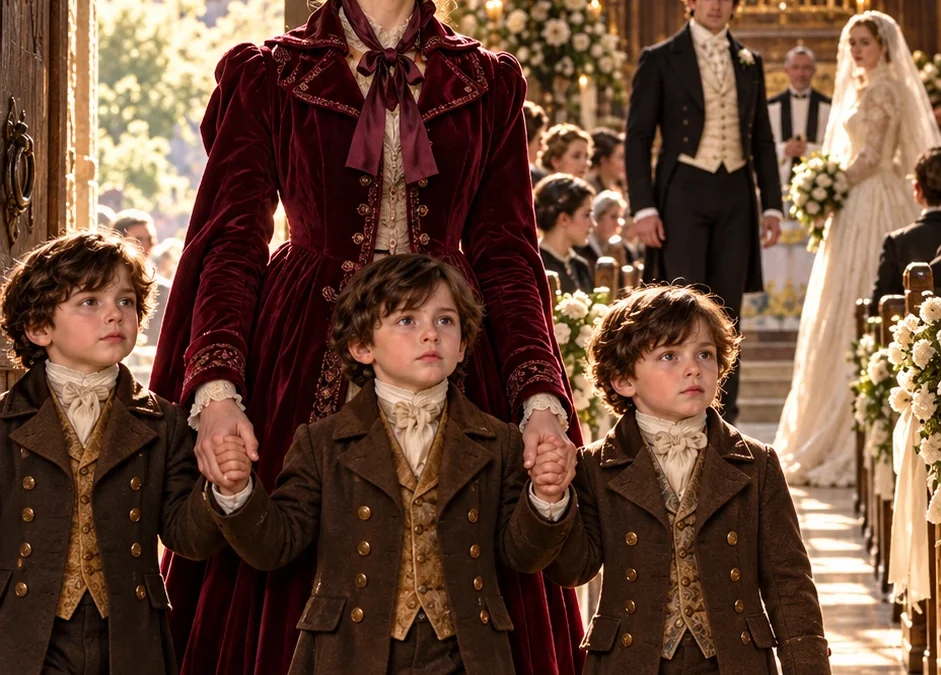
A woman stood in the light. A plain gray traveling dress. A face pale but calm. And in front of her, three small boys in matching blue coats, all the same height, all with the same dark hair.
And each with a pair of storm-gray eyes that half the people in that church recognized at once.
The Duke of Eastbrook, standing at the altar beside his bride, stopped in the middle of a word.
He had invited this woman to make her feel small. He had wanted her to see him happy. He had wanted her to see what she had thrown away: the childless wife who could never give a duke an heir.
He had never imagined she would arrive with three.
But to understand how she got there, you must go back one week.
It began with a card.
Georgiana Fell was standing in the yard of her little Cornish schoolhouse, a bucket of chalk in one hand, when the post boy handed it over. Behind her, a dozen village children recited their sums.
The card was thick and cream-colored, edged in gold. On the front was a crest she knew far too well: a gray hawk on a blue shield.
The Duke of Eastbrook requests the pleasure of the company of Miss Georgiana Fell at his marriage to Lady Cordelia Fenwick, Saturday the 14th, at ten o’clock, Church of St. Mary, Eastbrook.
And beneath the printed words, in a hard black hand, three more lines:
I trust you will attend. It seems only right that you should see how a man can be happy after a wife who could give him nothing.
Georgiana read it twice. Then she folded it very small and put it in her apron pocket. Her hands were shaking.
“Miss Fell! Tom took my slate pencil again!”
“I did not! Jonah lost it!”
Two identical little boys skidded to a stop in front of her, red-faced, fists raised. Six years old, with scabbed knees, untied boots, and the same stubborn chin.
Behind them, a third boy sat quietly on the doorstep with a book on his knees. Benny. The quiet one. Where his brothers charged into the world, Benny watched it first.
“You will both apologize,” said Georgiana. “Then you will fetch the water.”
“Yes, Mama,” they groaned.
Benny looked up and gave her a small, serious smile. And she saw, as she always did, Rafe’s gray eyes looking back. 💔
Seven years ago, she had been the young Duchess of Eastbrook, and she had been happy. Rafe was proud and stern, but he made her laugh. He rode with her at dawn. He read her poetry when he thought no one was listening.
Then, after four years of marriage, there was no child.
The old Dowager Duchess made sure everyone knew whose fault it was. She summoned a smooth, smiling doctor named Pedigrew, who examined Georgiana behind a closed door and told the Duke, in a low and sorry voice:
“I fear Her Grace can never bear a child.”
Georgiana heard it from the hall. Rafe’s face went white. Then hard. He looked at her as though she had lied to him for four years.
That night he did not come to her room. Nor the next. She waited a week for him to say it does not matter, we have each other.
On the eighth night she heard voices in the library.
“The name of Eastbrook is worth more than any woman. Send her away.”
And Rafe, low and tired: “Perhaps you are right.”
She packed one bag and left before dawn.
Two months later, in a cold Cornish cottage, she was sick every morning. She sat on the edge of her bed with her hand on her stomach, and a strange, wild, terrified joy washed over her.
Dr. Pedigrew had been wrong. Or he had lied.
She wrote to Rafe that very day. Then again. Then a third time, when the lawyers’ papers came ending the marriage. She begged him to answer.
He never did.
So she raised her sons alone, in a village that knew her only as Miss Fell, a widow with three boys.
That night, with the boys asleep, she sat at the kitchen table with the card and a guttering candle. She told herself to burn it.
But something nagged at her, and it was not pride.
Three days ago a tall, thin stranger in a good gray coat had come to the school. He asked the children their names. He gave Tom a penny. Then he took a room at the inn and did not leave.
This morning the post boy had whispered: there’s a man been asking in Truro, Miss Fell. Asking whose boys they are. Asking who their father is.
Who would want to know? And why now, with the Duke about to marry?
She read the card again. I trust you will attend.
She knew Rafe. He was hard, but he was never cruel like this. That was not the man who had read her poetry. This card had been written by someone who wanted her to come.
Across the road, a single light burned in an upstairs window of the inn.
If she stayed, she would be safe. No one would ever know.
But she thought of Benny’s gray eyes. Of a father who had never known he had sons. Of a doctor’s smooth voice and three letters that never got an answer.
Somebody had stolen seven years from them all.
“Very well,” she whispered. “I will come.”
She woke the boys before dawn and packed three small blue coats with brass buttons, all alike, sewn by her own hand.
“Where are we going, Mama?”
“To see your father.”
Three small faces stared at her. She had never once said his name.
“Is he rich?” asked Jonah.
She hesitated. “Yes.”
Benny said nothing. He only took her hand.
They reached a coaching inn by dusk, where Georgiana took a room at the back and put the boys to bed. She sat by the window and did not sleep.
Near midnight, she heard boots in the passage. They stopped outside her door. Two men murmured low.
“…three of them. You said all in the same blue coats. It will be easy. When the coach leaves at six, we take the children where the road runs through the wood. Nobody will see.”
Georgiana’s blood turned to ice. 😨
She seized the poker and stood between the door and the beds. The boots moved on. Down the stairs. Gone.
She was still shaking, poker in hand, when something struck the window with a sharp crack.
The glass had a star-shaped split in one corner. On the floor lay a small gray stone, a scrap of paper tied around it with twine.
Seven words, in a rough hand.
Turn back now or your sons will die.
And that was only the beginning of the nightmare, because somewhere in the dark, someone was watching their every move…
👇 Want to read Part 2? Find it in the comments, or leave any word below and I’ll send it to you privately!
Part 2
Turn back now or your sons will die.
Georgiana did not wait for morning.
She woke the boys one at a time, a hand over each small mouth. “We are playing a very important game. We must be quiet as mice.”
Jonah’s eyes were huge. Tom nodded. Benny whispered, “Are there bad men, Mama?”
She could not lie to him. “Yes. But I will not let them touch you.”
Benny thought about it. “All right,” he said, and pulled on his boots without another word. 🥺
They crept through the kitchen into the dark stable yard, where a bent old carter was checking the ropes on a cart of barrels.
“I will pay you double to take us now, before the light.”
He looked at the boys. He looked at her pale face. He asked no questions.
“Get in the back, missus. Under the sacks.”
She tucked the boys into a hollow between the barrels and lay down beside them, her heart drumming against the boards. The cart lurched forward.
An hour later, far behind them, came hoofbeats.
Two riders, galloping hard, a lantern swinging wildly. In its light, the pale gleam of a gray coat.
“Mr. Watt, there are men behind us!”
“I cannot go faster with this load. But there is a toll gate half a mile on. Old Mrs. Bragg keeps it fierce as a badger.”
Georgiana had nine shillings left. It was all she owned.
She sat up as the cart reached the gate and let the sacks fall, so the stout old woman in a nightcap could see three sleeping boys.
“Two men are chasing us. They mean to take my children. I have nine shillings. Please shut the gate.”
Mrs. Bragg looked at the children. Her fierce face softened for one moment.
“Put your money away, girl. Drive through quick.”
The cart rattled out. The old woman swung the gate shut with a crash, slammed the bolt, sat squarely in front of it, and folded her arms.
“Open!” shouted a rider. “We are on the Duke’s business!”
“Duke or devil, I’ll not open after dark. Double toll for rudeness.”
Georgiana laughed until tears ran down her wrists. 😭
By dusk they were in Eastbrook. She led the boys to a small stone rectory beside the church and knocked. Mrs. Tilling, the vicar’s wife, had been kind to her in her old life. The door opened. The plump woman stared, went white, then pink, then flung her arms around Georgiana and wept.
When the boys were fed and asleep in a feather bed, Georgiana sat at the kitchen table.
“They have his eyes,” said Mrs. Tilling softly. “Does he know?”
“I wrote three times. He never answered.”
Something strange crossed Mrs. Tilling’s face. Anger. Then sorrow.
“My dear. The Dowager’s maid takes in all the post at the great house. Every letter goes first to her. And my husband’s cousin, a footman there, told us that in the first year after you left, His Grace wrote to you three times. Long letters. All three came back unopened. Marked not known at this address.”
Georgiana went cold.
“I was in Cornwall. Any post boy would have known my name.”
“Not if the Dowager copied a false address on the outside.” Mrs. Tilling’s voice shook. “He thought you did not want him. And you thought the same of him.”
The teacup tilted. Tea spilled.
Seven years.
“Why would she do that?”
“Because if you had a child, she would lose her power. She has always wanted the dukedom for her younger son, Lord Barnaby. If the Duke has no heir, Barnaby gets everything.”
Georgiana remembered him. Soft-faced, red-lipped, empty-pocketed. He would never plan so much alone.
“No. But his mother would.”
“Mrs. Tilling. The card said Saturday.”
The vicar’s wife hesitated. “It is not Saturday, my dear. The wedding has been moved. Two days ago the Dowager sent word. Tomorrow morning at ten. A special license.”
Georgiana’s stomach lurched. The gray-coated stranger. The men in the passage. They had reported everything.
“She wants it over before I arrive.”
“And she has men at the church,” Mrs. Tilling whispered. “Six big fellows at every door. They are not guests. They will not let a stranger in.”
Georgiana crossed to the bedroom door and looked through the crack at three small heads on one pillow.
“I will get into that church.”
“How?”
“I do not know yet.”
And that was when they both heard it. A soft, slow scratching on the window glass, like fingernails.
They turned.
Outside the kitchen window, a long, thin, smiling face was looking in. Above it, the collar of a good gray coat. 😱
By the time the vicar came puffing back from chasing him, the man had vanished over the wall.
“He has seen our faces,” Georgiana said quietly.
They sat up all night, six men at the church doors, a wedding at ten, and a Dowager who had lied for seven years and would not stop now.
Then Mr. Tilling lifted his head.
“The bell tower.”
And what the old sexton did next would give Georgiana exactly two minutes, two minutes to walk her sons down the aisle before anyone could stop her… and she would need every second of them. ⏳
👇 Do you want to know what happened inside that church, and what the Dowager did when the doors flew open? LIKE this post or COMMENT “REVEAL” to unlock Part 3, which will be posted once we reach enough comments!
Part 3
“The old sexton, Josiah, has rung that bell for fifty years,” said the vicar, a slow smile spreading across his round face. “He is deaf as a post and stubborn as a mule, and he has hated the Dowager ever since she dismissed his son. If a bell rang out at five to ten, what would six big fellows do?”
“Run to see,” said Georgiana.
“And the doors would stand open. You would have perhaps two minutes.”
She looked at her sleeping sons. “That will do.”
At nine the next morning, St. Mary’s was full. The whole county sat in silk and velvet. Sunlight lay in red and blue puddles on the stone.
At the front stood the Duke of Eastbrook. Rafe was thirty-six now, tall and broad, dark hair graying at the sides, standing like a man carved from rock. Beside him, Lady Cordelia Fenwick, twenty-four, lovely in white satin, pale as milk, twisting her bouquet.
In the front pew sat the Dowager, upright as a sword in gray silk. Beside her sat Dr. Pedigrew, smiling his smooth smile, and Lord Barnaby, chewing his thumbnail.
Nobody looked at the door.
Behind a yew hedge in the churchyard, Georgiana knelt and straightened three small collars.
“Hold hands. Walk together. Do not let go.”
“Is he in there?” whispered Tom. “Will he like us?”
She could not answer. She kissed his forehead. Benny said nothing, but his small cold hand slipped into hers and held on. 🥹
At five to ten, a sound broke the morning like a hammer on glass.
The great bell of St. Mary’s began to clang, a wild alarm, not a wedding peal. A cracked, ancient voice roared from the tower: “FIRE! FIRE IN THE TOWER!”
The men at the doors jerked upright. Two ran. The third hesitated until Mrs. Tilling shrieked “FIRE!” from the path and sent him after them.
The doors stood empty.
Georgiana pushed them open with her shoulder, and the bell fell silent.
In the sudden hush, every head turned.
A woman stood in the light, chin high. In front of her, in a careful row, three little boys in blue coats with brass buttons.
They began to walk.
Not a sound in the church but small boots on stone. Past the staring lords and the ladies with their mouths open.
At the altar, Rafe turned his head. He saw the woman first, and seven years fell away from his face, until it was the face of a boy who had lost something precious.
Then he saw the children. The dark hair. The stubborn chin.
The eyes.
Gray as a winter sea. His father’s eyes. His own.
Lady Cordelia’s bouquet fell to the floor.
“Georgiana,” Rafe whispered.
She stopped ten paces from the altar. Her voice was quiet and clear, and carried to every corner.
“Rafe, I received your invitation. I have brought your sons.”
A woman gasped. A prayer book clattered on the stone.
“Their names are Jonah, Tom, and Benedict. They are six years old. They were born at Michaelmas in a cottage in Cornwall, seven months after I left your house.”
Rafe gripped the end of a pew to stay upright. “You did not tell me.”
“I wrote to you three times.”
“I never had a letter.”
“I know,” she said, tears sliding silently down her face. “I know that now.”
And then the Dowager rose.
She rose slowly, like a black cloud, and every person in the church felt the temperature fall.
“Liars,” she said, flat and cold. “Rafe, my son, do not listen. This woman was cast out of your house for being barren. Dr. Pedigrew will swear to it. She has taken three gypsy brats from some poorhouse and dressed them in blue coats to shame you on your wedding day!”
Pedigrew stood, sweating. “In my professional opinion, it is quite impossible.”
“Silence,” said Rafe.
He looked at Georgiana for a long time. She stood small and pale, hands trembling, and did not look away.
“If this is true, you have proof.”
She did. In the satchel at her shoulder, wrapped in oilcloth, were the boys’ baptism papers, signed and sealed.
“I have it here.”
But as she reached for the strap, a thin hand in a black glove shot out from the front pew. Grub, the Dowager’s maid, had slid along the bench like a snake. She snatched the satchel, tore out the papers, ripped them in half, and in half again, and flung the pieces into the air. They fell like snow on the stone.
“There is your proof!” screamed the Dowager. “Forged rubbish, and now it is dust!”
“Mama!” shouted Jonah, darting forward.
The side door banged open. Six big men in rough coats poured in. They had never been chasing a fire. Before Rafe could lift a hand, before a single lord could stand, they seized the boys.
“MAMA!”
Georgiana flew at the nearest man. He threw her aside like a curtain. She struck a pew and cried out.
“For their safety,” said the Dowager with a smile like a knife. “Take them to the coach.”
Three small blue coats vanished through the side door in a tangle of arms. Benny’s white face looked back over a man’s shoulder. He was not crying. He was looking straight at his father.
The door slammed. Iron wheels rattled on gravel. A whip cracked.
And in the silence, with torn paper scattered around her, Georgiana lifted her head and looked at the Duke.
“Now,” she said, shaking with fury. “Will you believe me?” 🔥
Rafe did not answer with words.
“Constable Pike! Take my mother to the great house. She is not to leave it or speak to any servant. Grub goes with her. Dr. Pedigrew stays here and does not move an inch.”
“Rafe, you cannot!”
“I can and I will.” He did not even look at her. “Cordelia, forgive me. There is no wedding today.”
Then he strode down the aisle, took Georgiana by the arm, and ran with her into the sunlight. His great black horse stood at the lychgate with a white wedding ribbon in its mane. He ripped it off, threw her into the saddle, and vaulted up behind her.
“Which way?”
“I do not know.” Her voice broke. “There are three roads. Rafe, they are only six, and Benny never cries, and he will not call for help.”
His arm tightened around her waist. “Breathe. We will find them.”
They reached a fork at the bottom of the hill. Left to the moor, right to the town, straight ahead to the sea. She closed her eyes and tried to think like a six-year-old.
Then she saw it. In the dust at the mouth of the middle road, something gleamed.
A small brass button. A thread of blue wool still clinging to the back.
“Benny,” she whispered, laughing and crying at once. “I sewed these myself. He is dropping them. He is leaving us a trail.”
Rafe stared. “He is six years old.”
“He watches everything. He always does.”
Something rough and tender crossed his face. “Then he is my son.”
They rode hard along the sea road, eyes on the dust. A button on a fence post. A button in a puddle. Three together where the coach had bounced on a rut.
“Tell me about them,” Rafe said.
So, as the horse thundered along the cliffs, she told him. How Jonah was born first and screamed for an hour. How Tom came second, silent and cross. How Benny, last, was tiny and blue and not breathing, until the midwife shook him and he gave one thin cry and looked up with those gray eyes wide open.
“I said your name in my head all night.”
His arm tightened around her.
“I heard you and your mother that night in the library,” she said at last. “Perhaps you are right.”
His whole body went rigid. “I said that because I was afraid. Pedigrew told me you could never have a child. My mother said you had known from the start. I thought you had lied to me for four years. I meant to come to your room in the morning and say I do not care. But you were gone.”
“I searched for weeks. My mother said you had a lover in Cornwall. I wrote three letters to the address she gave me and they came back.”
“She gave you a false one.”
“I have been a blind fool for seven years.”
“So was I,” said Georgiana.
The buttons led them down a narrow lane to a place where the ground dropped to a long tongue of gray water.
“Sable Creek,” said Rafe. “A tidal inlet. At high tide it fills to the brim. There is an old boathouse at the end, shut for thirty years. Barnaby has a key. Barnaby has a key to everything.”
Below them stood a long, low building of black wood on stilts, half over the water. A coach waited outside. A tall thin man in a gray coat was leading a horse away up the far bank.
They crept down the lane. In the mud, button after button led to the boathouse door. Rafe threw his shoulder against it. Locked. Bolted from outside with an iron bar.
“Jonah! Tom! Benny!”
Then, faint and brave from within: “Papa?”
Rafe’s whole body jerked as if struck.
“Yes. It is Papa. I am here.”
“The water is coming up,” Jonah’s voice cracked. “It is up to Tom’s knees!”
Georgiana tore at the bar until her fingers bled. Below them, the gray tide lapped the black stilts, rising fast.
And from the top of the lane came the slow, dry sound of one pair of hands, clapping. 😨
A slender young man in a green coat stood smiling, a pistol in his hand.
“Welcome, brother,” said Lord Barnaby. “You should have stayed at the church. Everything would have been so much neater. A rotten old boathouse, a high spring tide, a tragic accident. And the poor Duke, overcome with grief, will surely fall in himself trying to save them.”
Georgiana’s mind raced. Barnaby stood on a landing of green, rotten boards. And she remembered what the old boatman had shown her seven years ago.
“There is a door at the water end,” she said, as if thinking aloud. “Where the boats went in and out. I only wondered whether you had locked that one, too.”
His pale eyes flicked toward the creek side. He had forgotten.
She met Rafe’s gaze for one heartbeat, then let her eyes slide to the water. He understood.
“The lady has done nothing to you,” said Rafe, walking forward, hands raised.
“She did everything!” Barnaby burst out. “I waited seven years! And then she had to go and have them.”
“You and Mama lied to me.”
“We arranged things. Pedigrew was easy to buy. And Grub burned two of her letters and kept one for Mama’s desk.”
While he talked, Georgiana edged one step at a time. Then she ran, not away, but sideways down the muddy bank toward the black stilts.
The pistol cracked and the shot went wild. “Rafe!”
The Duke of Eastbrook was built like an oak. He hit his brother at full speed, and the pistol skidded across the boards.
“Georgiana, go!”
She waded into freezing gray water, skirts dragging, hauling herself hand over hand along the slippery stilts. At her waist, then her ribs. At the creek side she found a tall double door with an iron bar across it.
“Mama! We are here!”
“Stand back, darling!”
She braced her feet and pulled with everything she had. Her arms burned. Her hands slipped. The bar shifted a finger’s width. She pulled again, and with a shriek of rusty iron it slid free and splashed into the water.
The doors swung open. A flood of dark water surged out, and with it, wet and shivering, came three small boys clinging to a floating plank.
“MAMA!”
She caught them one by one and dragged them against her chest. Benny came last, gray with cold, a single brass button clutched in his fist.
“I dropped them all,” he said through chattering teeth. “Like in the story. I thought you would follow.”
Georgiana held him and could not speak. 💗
On the landing, the rotten planks gave way with a crack like a breaking bone. Both men plunged into the creek. Barnaby surfaced first, scrambled up the far bank, seized the gray horse, and was gone across the flats.
“Let him run,” gasped Rafe, staggering from the water, lip bleeding. “I will hunt him down.”
Then he saw the boys.
He stopped. Creek water streaming from his coat, he looked at three small wet faces looking back at him.
“Are you really our papa?” said Jonah.
Rafe dropped to his knees in the mud.
“Yes. I am.”
“Mama said you lived far away.”
“I did.” His eyes shone. “But I am here now.”
Tom, who trusted no one, stepped forward and looked hard into his father’s face. Then he threw both arms around Rafe’s neck. Jonah followed, bawling. And after a moment, small and shy, Benny came too.
Rafe held all three with the dark tide rising around his boots, and his shoulders shook.
Georgiana turned away. It was too much to bear. 😭
That night, Eastbrook House was quiet as it had never been. The boys lay in a huge four-poster in the old nursery, warm and full of hot soup, heaped together like puppies. A storm blew in from the sea.
Rafe sat on the edge of the bed with his hand on Benny’s hair. He had not left them for one minute.
Georgiana came and sat beside him. “They look like you.”
“Everyone has your mouth.”
The fire popped. “I am so sorry,” said Rafe. “I let them tell me you were barren. I never rode after you. I was a coward, and I lost six years of these three.”
“You were lied to. So was I.” She reached for his hand, and his rough, warm fingers closed around hers. “We were both very young and very proud and very stupid. But I do not think we are stupid now.”
“What are we now?”
“I do not know yet,” she said honestly. “But I would like to find out.”
He lifted her hand to his lips. She let her head rest against his shoulder, and for the first time in seven years, she felt safe.
It lasted until dawn.
At six, a pounding shook the great front door. A minute later, the butler appeared in the nursery, gray in the face.
“Your Grace, forgive me. There is a magistrate downstairs with six constables and a paper. An order for the arrest of Miss Georgiana Fell.”
“On what charge?” said Rafe.
The butler swallowed. “Stealing the Duke’s heirs.”
By nine, the great hall was packed. Lords and ladies who had come for a wedding stayed for a trial. At the long table sat Sir Marcus Blythe, a lean, dry magistrate with a loud voice, who liked rules and liked the Dowager.
Georgiana sat alone in a borrowed black dress, back straight. Rafe stood behind her.
The charge was read: that Georgiana Fell had taken three children of unknown birth from a Cornish poorhouse and falsely claimed them as the Duke’s sons to extort money from the estate.
“Not guilty,” said Georgiana.
The Dowager rose like a queen. “In four years she gave my son nothing. Dr. Pedigrew examined her and found she could never bear a child. And now she returns with three boys she has bought or borrowed or stolen.”
“I object,” said Rafe. “As her husband.”
The hall gasped.
“Your Grace, the marriage is ended.”
“Not in my heart,” said Rafe, his voice carrying to every corner. “Not for one single day.”
Pedigrew rose, gray and damp. “It is, I regret to say, as Her Grace states. There could be no possibility.”
“Doctor,” said a voice from the back. “Look at me.”
Everyone turned.
Lady Cordelia Fenwick stood in her creased, stained wedding gown. She had clearly not slept. But her eyes were steady, and in her arms she carried a flat wooden box.
“I was told to marry the Duke. My father owes the Dowager eleven thousand pounds. She said if I did not marry her son, we would lose our house.”
“Lies!” said the Dowager, but her voice was thin.
“Last night I could not sleep. I saw Grub go into the Dowager’s rooms and come out with her arms full of paper.” She set the box on the table. “I found this under a false board in the bottom of the Dowager’s writing desk.”
Sir Marcus lifted the lid.
Four letters. Three were thick and sealed in red wax, addressed in a strong black hand to Georgiana Fell at a house in Bodmin that did not exist. Across each, in a smaller, crueler hand: Return to sender. Unknown.
The fourth was addressed to the Duke of Eastbrook. The seal was unbroken.
“That is Georgiana’s writing,” Rafe said hoarsely.
“Read it,” someone called.
Rafe broke the seal. His face went pale. Then, in a voice that cracked and steadied and cracked again, he read aloud:
“My dear Rafe, I would not write if I did not have news I cannot keep to myself. I am going to have a child. I am nearly three months gone. I do not know what the doctor told you. I think it was a lie. I am well and happy and I love you. Come, or write, and I will come home. Yours, Georgiana.”
The silence was so deep that a cough at the back sounded like a shout.
“Three months,” said Rafe, looking up. “That was before the lawyers signed the papers.”
“Then the children were conceived in lawful wedlock,” said the Duke’s old lawyer, Mr. Corbin, pale with excitement. “The law is plain. Those boys are the lawful sons of the Duke of Eastbrook. All three.”
“Forged!” The Dowager swayed. “It is a wicked plot!”
“Then let the doctor speak,” said Rafe, very softly.
Pedigrew looked at the letter. At the faces.
And that was when the doors at the end of the hall opened, and three small boys walked in hand in hand, in clean blue coats, a maid running after them, whispering, “Come back, please, young masters!”
“Papa!” said Jonah loudly. “Why is everybody here?”
A ripple went through the hall like wind in a field. Every lord and lady looked at the boys, then at Rafe, then at each other. No one needed a word.
Something inside Dr. Pedigrew gave way.
“Oh God. God forgive me.” He fell to his knees. “I never examined her. Never, not once! The Dowager came to me with a paper already written. She said sign it. She gave me two hundred pounds and promised a hundred more each year. I had debts. I was afraid. She was healthy, Your Grace. She was perfectly healthy. I never said a true word.”
The hall erupted. The Dowager’s face went the color of tallow. Grub flung herself on the floor with a thin scream: “It was all her! I only did as I was told!”
“Constable, take Pedigrew and Grub into custody!” roared Sir Marcus, crimson, having just learned the rules had been used to make a fool of him.
But Rafe raised a hand. “Not yet.”
He walked across the floor until he stood before his mother.
“You took seven years from me. You took my wife. You took my children. A cell is too small a punishment. I will send you to Kinlock in Scotland. It is cold and empty and very far. You will have three servants and a small allowance. And you will never see my sons.”
For the first time, her face crumpled. She looked not like a queen, but like a very old woman.
“Barnaby,” she whispered.
“I will deal with Barnaby,” said Rafe.
He had spoken too soon.
From the gallery above came the slow, dry sound of one man clapping.
At the top of the stairs stood Lord Barnaby, his green coat stained with mud and salt, a small silver pistol in his hand.
“Well. Everyone has confessed. Now it is my turn.”
He came down fast. Before Rafe could move, he had caught Georgiana around the neck and pressed the cold barrel to her temple. 😱
“Nobody move, or the little schoolmistress dies!”
The boys screamed. Nobody in the hall moved.
“A horse at the door. Two hundred pounds in gold. And nobody follows me, or she gets a hole in her head.”
“You will have it,” said Rafe, white to the lips. “Only let her go.”
“Not until I am on the road.”
Georgiana forced herself to think. Barnaby was a coward. He had hired thin men to frighten women and locked children in a boathouse and gone away. He was only brave with someone weaker than himself.
But he was very frightened now, and frightened men do foolish things.
She looked across the floor. Jonah wept loudly into his fists. Tom was red and furious, held back by a footman’s grip on his collar.
And Benny stood perfectly still in the middle of the floor, head tilted, watching Barnaby the way he watched everything.
No, Benny, she thought. Stay back.
“Uncle Barnaby,” said a small, clear voice.
“Shut that brat up!”
“Uncle Barnaby.” The same polite, careful tone. “You dropped something.”
He held out his hand. In his palm lay something small and bright.
Barnaby blinked. He could not help it. “What is that?”
“A button. It is off my coat. You stepped on it at the creek. I thought you might want it back.”
And with a neat flick of his wrist, he rolled it across the floor.
A little brass button, glinting, turning over and over across the flagstones, straight toward Barnaby’s boots.
Every eye in the hall followed it. Barnaby’s too, for one moment, for the length of a single breath.
The pistol wavered.
Georgiana did not think. She had waited seven years for this moment, and she did not think at all. She drove her elbow into his stomach with all her strength. Stamped her heel on his instep. Seized the wrist that held the pistol and twisted it up and out, throwing her whole weight sideways.
“RAFE!”
The pistol went off. A chunk of plaster fell from the ceiling in a shower of white dust. Women shrieked. A lord dived under a bench. But the ball had gone into the roof.
Georgiana wrenched the pistol free and flung it across the floor. Rafe hit his brother with a fist that would have felled an ox.
Barnaby went down in a heap and did not get up.
Constable Pike and four others fell on him with irons. The hall broke into shouting and weeping and clapping, and over it all rose Tom’s furious voice: “I could have kicked him! I could have kicked him in the SHIN!” 😂
Then Rafe had her in his arms, holding her so hard it hurt, his whole body trembling.
“You could have been killed, and I stood there and did nothing.”
“You did exactly right. You waited.” She laughed shakily into his coat. “It was Benny. It was his button.”
Three small boys came running, and Rafe let go of her just in time to catch them. He knelt on the cold stone and pulled them all in. And before every lord and lady in the county, before the constables and the magistrate and the weeping Dowager, the Duke of Eastbrook pressed his face into his children’s hair and wept without any shame at all. 💔
The Dowager left Eastbrook that evening in a plain black coach with two footmen and a single trunk. She never returned. It was said she lived at Kinlock for twelve years, quarreled with every servant she was given, and never once received a visitor.
Barnaby was tried at the summer assizes and transported across the sea for fourteen years. Dr. Pedigrew lost his license and his fortune. Grub went to prison for two years and came out very small.
As for Lady Cordelia, she left that same evening, her father’s debt torn in half and burned in the library fire by the Duke’s own hand. Three weeks later, she wrote: “I am very well. I have decided I would rather marry for love, and wait. Thank you for setting me free.”
Rafe kept the letter in his desk. He said it was one of the kindest things anyone had ever written him.
But the greatest question was still unanswered.
It came on a warm spring evening, three months later.
Georgiana sat on the terrace with a cup of tea, watching the boys play cricket on the lawn with a worn wooden bat. Jonah bowled. Tom batted fiercely. Benny sat in the grass at the edge of the pitch, reading a book and shouting advice.
She had meant to go home to Cornwall once the trial was over. Then Jonah had begged, and Tom had sulked, and Benny had said nothing but put his hand in hers. She had stayed a week, then a month, then somehow three.
Rafe came out and sat beside her. The sun was low, the light gold on the grass.
“I have been trying to work out what to say to you for three months. I made a speech. I practiced it in the mirror. It was very long.” He almost smiled. “I have forgotten every word.”
She turned to look at him. He wore the open, nervous, hopeful face of the young man she had married before either of them had learned to be careful.
“You do not need a speech.”
“Then I will say the one thing.” He took her hand. “I never stopped. Not for one day of those seven years. I told myself I hated you. I told myself I was glad you were gone. But every night I looked at the door and waited for you to come through it.”
Her eyes filled.
“I was angry and proud and wrong. I would give everything I have to go back and do it differently. I cannot. But if you will let me, I will spend the rest of my life doing it right.”
He slid from the chair and knelt on the terrace stones in the golden light.
“Georgiana Fell. Will you marry me again?”
The cricket game had stopped. All three boys stood on the lawn, bat and ball forgotten, mouths open.
“Mama!” shouted Tom. “Say yes! I want cake!”
Georgiana laughed and cried at once and wiped her eyes. She looked at the man on his knees. At three small faces. At the house, the garden, and the blue line of the sea beyond the trees. She thought of the cold Cornish cottage and the nights she had sat by the window talking to the moon.
“Yes,” she said. “Yes, you foolish man. Yes.”
The boys’ cheer could be heard in the village. 💞
They married in the same church in June, on the anniversary of their first wedding. The bells rang. The church was packed to the doors. And this time, nobody was hiding.
Mrs. Tilling wept in the front pew. Old Josiah the sexton was given the honor of ringing the bell, and rang it so hard a pigeon fell off the roof.
Three small boys in blue coats walked down the aisle ahead of their mother. Jonah carried the flowers and read the cards aloud. Tom carried the cushion with fierce dignity and did not drop it once. And Benny held the ring on a ribbon in both hands and gave it to his father without a word.
Rafe slid the ring onto her finger. “I never stopped,” he said low, so only she could hear.
“I know,” said Georgiana. “Neither did I.”
And when the vicar said, “You may kiss the bride,” a small voice rang out from the front pew:
“Finally.”
If this story had you laughing and crying, please LIKE and SHARE it with someone who believes true love is worth waiting for. 💬 Tell us in the comments: who was your favorite, brave little Benny, fierce Tom, or loud Jonah?
This story is entirely fictional and created for entertainment purposes only. It does not represent any organization or individual, nor does it encourage inappropriate behavior. The content was generated with AI assistance.








