HE LAUGHED: “I’LL TOLERATE HER UNTIL SHE GIVES ME AN HEIR.” SHE SAID NOTHING FOR FIVE MONTHS… THEN, IN FRONT OF 200 GUESTS, SHE TOOK OFF HER SHAWL
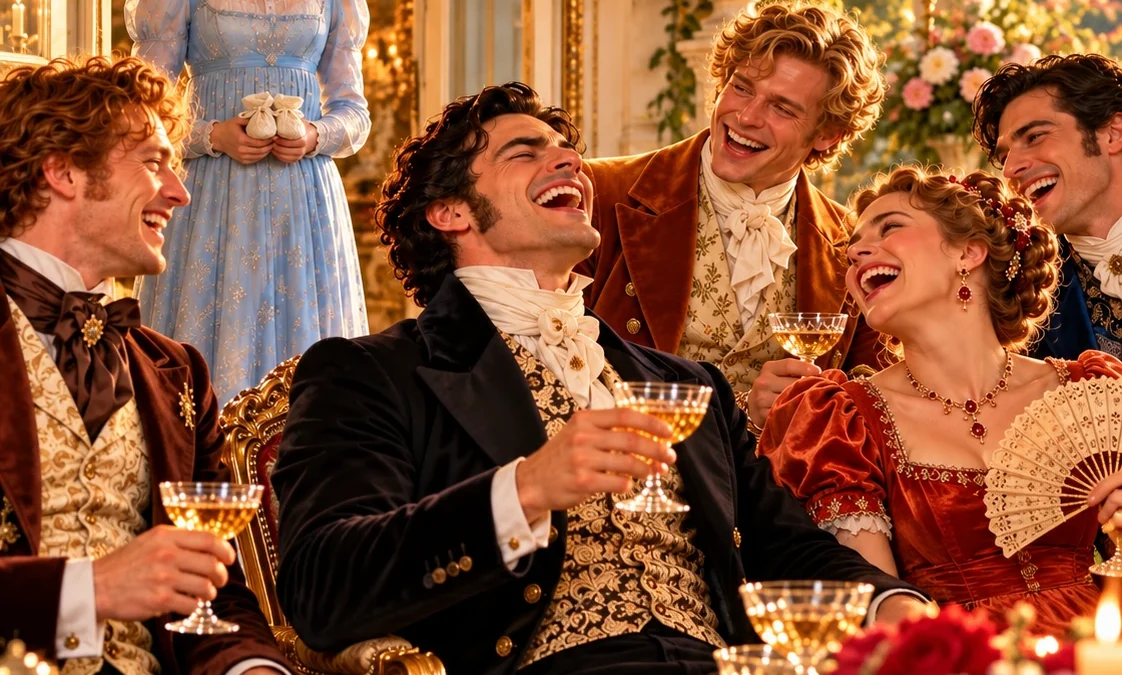
HE LAUGHED: “I’LL TOLERATE HER UNTIL SHE GIVES ME AN HEIR.” SHE SAID NOTHING FOR FIVE MONTHS… THEN, IN FRONT OF 200 GUESTS, SHE TOOK OFF HER SHAWL 😱👶
Part 1
The baby shoes were no bigger than a teacup. 👶
Isabelle Lennox, Duchess of Ashgrove, had knitted them herself two years earlier, out of the softest white lamb’s wool from her father’s mills in Yorkshire. She had made them in secret, late at night, and hidden them at the bottom of her sewing box beneath a tangle of silks.
Because a duchess who knits baby shoes before there is any baby is a duchess people laugh at.
And the people at Ashgrove Park laughed at her enough already.
Tonight, she took them out.
It was a cold October evening in 1818. She came down the great staircase with the little shoes held in both hands and her heart beating so hard she could feel it in her fingertips.
That afternoon, in a small paneled room in the town of Marlbury, old Dr. Loather had polished his spectacles, put them back on, and smiled at her.
“July, Your Grace. I should think the middle of July. Congratulations. His Grace will be delighted.”
Three years she had been married. Three years of whispers at dinner parties and pitying looks in church. Three years of her husband’s aunt asking every Christmas, in a carrying voice, whether the Yorkshire air was bad for breeding.
And now, at last, there would be a child.
She had told no one. Not her maid. Not the aunt. She wanted Rafe to be the first. She wanted to see his face. ✨
The library door stood half open. Firelight spilled across the hall in a long golden bar. Isabelle stopped just outside it, smoothing her pale blue gown, holding the shoes against her waist, searching for the right words.
Then she heard her husband laugh.
Rafe Lennox, sixth Duke of Ashgrove, sat in his favorite red leather chair beside the fire, long legs stretched out, brandy in his hand. He was thirty-two, tall and dark, with black curls and the careless handsomeness that had made him the most admired man in three counties.
Across from him on the sofa sat his two oldest friends: Lord Kit Danvers, fair-haired and red-faced, already halfway through the decanter, and Sir Harry Monreith, dark and quieter, in a crimson coat.
“Come on, Rafe,” Kit was saying. “Tell the truth. Three years with the mill girl. Don’t you ever regret it?”
“Regret it?” Rafe laughed and lifted his glass toward the ceiling. “My dear Kit, I married £100,000. Why would I regret it? The roofs are mended. The mortgages are quiet. My horses are the best in Wiltshire.”
“And the girl herself?”
Rafe shrugged.
“She’s pleasant enough. She keeps out of my way.” He took a long swallow of brandy. “I’ll tolerate her until she gives me an heir. After that, she can go back to Yorkshire and count her bobbins, and I’ll keep the money and the boy.”
Kit roared with laughter.
“And if it’s a girl?”
“Then,” said the Duke of Ashgrove, “I suppose I’ll have to tolerate her a little longer.”
All three men laughed together, the way men laugh when they have had a great deal of brandy and nobody has ever told them no. 🥃
In the doorway behind them, nobody noticed the Duchess.
She stood perfectly still in the shadow beyond the firelight, the little white shoes in her hands. Rafe had his back to the door. Kit was too drunk to see past the decanter.
Only Harry Monreith, glancing up for a moment, seemed to look toward that dark gap. His face did not change. He said nothing.
Isabelle made no sound. She did not cry out. She did not run into the room. She did not throw the shoes into the fire, though for one wild moment she wanted to.
She simply listened to her husband’s laughter until a part of her that had been warm for three years went perfectly, quietly cold. 🥶
Then she turned, walked back up the great staircase, and closed her bedroom door.
She did not tell him about the baby that night.
She did not tell him the next morning, or the next week, or the next month.
For five months, while the child grew and the winter came and went, the Duke of Ashgrove had no idea his wife was carrying his heir.
Before she went to sleep that night, she did one more thing.
When her maid had undressed her and gone, she sat at her dressing table, opened her jewel box, lifted out the top tray, and felt along the velvet lining until her fingers found a small, flat iron key. 🗝️
Her father had pressed it into her hand on the morning of her wedding, in the vestry of St. George’s, Hanover Square, while the organ played and the guests waited.
“There’s a box, Belle. Greaves has it in Leeds. You’ll never need it, I hope. But if that man ever makes you unhappy, you write to Greaves and ask for the box. And you open it.”
For three years the key had lain at the bottom of her jewel box. She had never once thought of using it.
That night, by the light of a single candle, she wrote a short letter to Mr. Abel Greaves, Attorney at Law, Park Square, Leeds.
“Please send me my father’s box.”
The box arrived nine days later. Plain black tin, the kind a Yorkshire clerk keeps his deeds in. It was heavy.
Isabelle carried it up to her room herself, locked the door, and turned the little iron key.
Inside lay a bundle of papers tied with red tape, and a letter in her father’s square, heavy hand.
She read the letter first. Then the papers. Then the letter again.
And for the first time since she had stood in that doorway, Isabelle Lennox smiled. 😏
Because those papers revealed that the Duke of Ashgrove, who had laughed so easily about “the mill girl’s money,” did not own the roof over his own head.
He never had.
And the woman he planned to send home to count her bobbins was about to count something else entirely.
Part 2
And the woman he planned to send home to count her bobbins was about to count something else entirely.
Josiah Pembury had been born in a cottage in the Calder Valley with a dirt floor and one window. By seven, he was carrying bales of raw fleece up the steep lanes of Huddersfield for a penny a day. By forty, he owned four mills, nine hundred looms, and a warehouse in Leeds the size of a cathedral.
His daughter grew up in the counting house. She learned to read from bills of lading and arithmetic from the wage books. The weavers called her Little Miss Ledger.
When the Duke of Ashgrove asked her to dance at a ball in Berkeley Square, Josiah had no illusions.
“He’s charming as a cat in a dairy, Belle. I’ve had a man look into him. Ashgrove is mortgaged to the chimney pots. He’s not courting you, lass. He’s courting my money.”
“He asked about the mills, Papa. And he listened.”
“A man in debt will listen to anybody.”
But Josiah did not forbid it. He only said: “If you marry him, you’ll do it on my terms.”
Those terms were written by Mr. Abel Greaves, a small, dry, gray man who had never once been seen to smile in public. 📜
In England in those days, everything a woman owned passed to her husband the moment the vows were spoken. Unless her father was clever.
Josiah was clever. Every penny of Isabelle’s fortune went into a trust, for her sole and separate use, as if she were unmarried.
The Duke’s lawyers objected for one afternoon. The Duke himself waved it through, yawning. “Let the old man have his trust. She’ll sign it over. They always do.”
And there was one more thing, written nowhere in the settlement.
Two weeks before the wedding, a quiet gentleman from Leeds walked into a bank in Lombard Street and bought every mortgage on Ashgrove Park. All £60,000 of them, paid in cash.
Nobody told the Duke. He still paid his interest every quarter to an address in Leeds. He never asked whose.
They married on the twentieth of June, 1815. For a fortnight in Brighton, Rafe was charming.
Then they came home, and he was simply gone.
He rode out after breakfast and returned after dark. Shooting, hunting, racing at Newmarket. When he was home, he was polite to his wife the way a man is polite to a guest he did not invite.
The house was run by his aunt, Lady Philippa Lennox, a tall, thin widow with a long nose and a longer memory, who sniffed as she passed Isabelle in the hall.
“Lanolin. Do you know, I can always tell.” 😤
So Isabelle was patient. Every quarter, she signed a paper from Leeds, and £1,250 went into her husband’s bank. It mended the roof. It paid for the hunters, the racehorses, the brandy.
Rafe never thanked her. He may not even have known where it came from.
When her father died in 1817, collapsing among his looms, three thousand people came to his funeral.
The Duke did not. A horse of his was running at Newmarket.
Isabelle buried her father alone in the rain and thought about the iron key. She did not use it. Because she still believed that if she was patient enough, and gave him a child, he would look at her one evening the way he had in that ballroom.
She believed it for eighteen more months.
Now the black tin box lay open on her bed.
The mortgages on Ashgrove Park. The four mills. The warehouse. Nine hundred looms. Everything held in trust for her.
And on top, her father’s letter:
“Do not cry. Do not run. Running is for people who have nothing. You have everything. You only gave it away because you are kind. Stop giving it away. You know how to count, Belle. Now go and count what you are worth.” 💰
Isabelle could have fled to Yorkshire that night.
But that, she realized, was exactly what he wanted.
So she wrote to Mr. Greaves.
“From the Christmas quarter, I shall not be signing the usual order. Pay the servants, the coal, the candles directly from my account. But not one penny more is to go to His Grace.”
On the morning after Twelfth Night, the Duke came down to breakfast frowning.
“My bank says the Christmas money hasn’t arrived.”
“I’ve decided to keep my own money this quarter.”
Rafe laughed. “Your pin money? Buy yourself some ribbons.”
He did not understand that his wife’s “pin money” had been paying for everything. His own estate brought in barely £4,000 a year, and £3,000 of that went straight back out in interest on mortgages he did not know she held.
He had a thousand a year to live on.
He had been living on six.
Meanwhile, at the foot of his own dinner table, the Duchess wore her shawls loose and low, and nobody noticed.
Except one person.
On the fourth of January, Lady Philippa found the Duchess pale and sick in the morning room. That afternoon she knocked on her sitting-room door, closed it, and leaned against it.
“How far along are you?”
Isabelle did not pretend. And when she had told her everything, the library, the brandy, the laughter, the old woman walked slowly to the window.
“My husband said something very like that to his brother once. I heard it through a door too. Forty years ago.”
She turned. Her eyes were wet.
“I’ll not tell him. Not a word.” 🤫
But back in the library, a very different danger was brewing, and it began, like all of the Duke’s troubles, over a decanter of brandy.
Kit Danvers had a horse. A long-legged chestnut mare called Sweet Fury. Rafe had a black colt called Corsair, whom he loved more than anything at Ashgrove, including, people said, his wife.
By the fifth glass, they had agreed to a match race at Newmarket. Stakes: £15,000.
“And if I lose,” Rafe laughed, “I have a wife with a hundred thousand pounds who does exactly as she’s told.”
Isabelle heard it through the half-open library door.
And as she walked on, she glanced back and saw Sir Harry Monreith watching her, his dark face troubled.
That was the second time he had seen her outside that door.
And Sir Harry had a secret about Kit Danvers’s mare that could save the Duke… or ruin him.
Part 3
In the middle of January, Isabelle announced at dinner that she was going to Yorkshire for a month.
Rafe did not even look up from his plate. “Go. Stay as long as you like.”
Kit Danvers sniggered into his claret. At the far end of the table, Lady Philippa laid down her fork and gave him a look that could have curdled milk.
Isabelle was four months gone by then, and even the gray merino was beginning to tell its own story. In Yorkshire, nobody would be watching her waist. 🌫️
The West Riding was black with frost and smoke when her carriage crested the hill above Huddersfield. Below, the four Pembury mills stood along the river, chimneys pouring gray into the white sky, the sound of nine hundred looms rising to meet her like a heartbeat.
Sam Booth was waiting at the gate. He had been her father’s foreman for twenty years, and he had once carried her on his shoulders through the weaving sheds.
“Little Miss Ledger,” he said, his face breaking into a smile. “By heck. Welcome home.”
She spent three weeks walking the sheds each morning, as her father had, and sitting in the counting house each afternoon. She caught a dyer watering the indigo. She caught a carter selling stolen wool out of the back of his wagon. She raised the wages of the women in the spinning room, who had been paid two shillings a week less than the men for the same work.
The women cried. Sam Booth pretended he had something in his eye. 🥹
On the first of February, she rode to Leeds.
Mr. Greaves was waiting in his dusty room with a fire burning and a single letter on his desk. It was from the Duke’s London attorney. The Duke of Ashgrove wished to raise £15,000 on the security of the home farm. Would the trustees of the Calder Settlement be so good as to advance it?
He had added a careless line in his own hand. “Kindly reply by return. The matter is urgent.”
“He doesn’t know,” Isabelle said slowly. “He doesn’t know who the trustees are. He has never asked.”
“As far as His Grace is concerned, the Calder Settlement could be a society of Quaker widows.”
“What does he want it for?”
“A horse race, madam.”
Isabelle looked into the fire for a long time. She thought of the library. The brandy. The laughter. The little white shoes in her sewing box.
“Tell him no. Tell him the trustees regret that, since the estate can barely meet the interest on sums already lent, they cannot in conscience advance a penny more.” She picked up her teacup. “Every word of that is true. I’ve done the sums.”
When she came home at the end of February, two of the hunters were gone. The trainer had sent his bill three times. The wine merchant and the tailor were writing less and less politely.
And at dinner, Rafe raised his glass to her down the long white cloth.
“My wife has been in Yorkshire, counting sheep. How many were there, my dear? Did you lose count and have to start again?”
The table laughed.
Isabelle smiled, inclined her head, and said nothing. Under the table, her hand rested on the small swell beneath her shawl.
The baby moved for the first time that night, a tiny flutter like a moth against a window. 🦋
Two days later, Sir Harry Monreith came to see her.
He stood on the carpet with his hat in his hands, miserable.
“Your Grace, I saw you that night in the library doorway. I knew you’d heard every word, and I said nothing. I sat there and drank Rafe’s brandy. I’ve been ashamed of it every day since.”
“Why tell me now?”
“Because I think you’re the bravest person in that house. And because there’s something Rafe won’t hear from me.” He lowered his voice. “Sweet Fury is not what he thinks. Before Kit bought her, she ran four times in Ireland under another name and won every race. Kit has known all along that Corsair can’t beat her. He’s been setting this up since October. He owes money all over London, and he needs Rafe’s fifteen thousand more than Rafe does.”
Isabelle sat very still.
The whole thing is a trap.
Her husband had laughed at her, mocked her at his own table, and planned to send her away the moment she gave him a son. Didn’t he deserve to lose?
She thought about it all afternoon.
That evening, she went to find him.
He was alone in the library, boots on the fender, a racing calendar in his lap. She almost never came into that room.
“Rafe, I need to tell you about Kit’s mare.”
She told him everything, calmly and clearly, the way her father had taught her to lay out figures for a buyer.
Rafe looked at her for a long moment.
Then he laughed.
“You’ve been in Yorkshire a month counting sheep, and you’ve come back an expert on Irish bloodstock?” He turned back to his calendar. “Go to bed, Isabelle. What does a mill girl know about horses?”
“Rather more than you’d think. My father taught me to look at a horse’s legs before its face, and to look at a man’s debts before I listened to anything he said.”
He did not look up.
Isabelle went upstairs, took the little white shoes from her sewing box, and held them for a long time.
She had warned him. And he had laughed at her for the second time.
That was the last time she would ever try to save him from himself. 💔
The match was run on the tenth of March, on the Rowley Mile, under a gray sky.
Isabelle did not go. She sat in her sitting room with a book she did not read, while Lady Philippa sat opposite with embroidery she did not sew. Neither mentioned horses.
At nine that night, Harry rode in, mud to the knees.
“Three lengths. Corsair never saw which way she went. Rafe’s at the Rutland Arms with Kit, drunk. Kit’s buying champagne for the whole room with money he hasn’t got yet.”
“When must Rafe pay?”
“Lady Day. The twenty-fifth. It’s a debt of honor, Your Grace. If he doesn’t pay, they’ll throw him out of White’s. No gentleman in England will sit at a table with him again.”
Lady Philippa set down her embroidery.
“Then he will have to sit down at a table with his wife.”
Three days later, the Duke of Ashgrove climbed the stairs to his wife’s sitting room for the first time in three years.
He had not shaved. His dark curls were wild. For the first time since she had known him, he did not look handsome at all.
He looked frightened.
“I need fifteen thousand pounds by the twenty-fifth. Sign it over to me.”
“No.”
He stared. “Isabelle, do you understand? If I don’t pay, I’m ruined.”
“I understand perfectly. I told you three weeks ago that Kit’s mare had won four races under another name. You told me to go to bed.”
His face went dark red. “You are my wife! By the law of England, everything you own is mine!”
“Read the settlement, Rafe. You signed it. You yawned through it, I’m told. But you signed it.” She folded her hands. “Not one penny of my fortune is yours. It never was. I gave you money for three years because I wanted to. I’ve stopped wanting to.”
For a long moment, he could not speak.
Then he drew himself up, cold and quiet.
“Very well. The ball is Thursday, and I won’t have it said I put my wife out before a ball. But the morning after, you’ll pack your trunks. You’ll go back to Yorkshire. I’ve tolerated you long enough.”
Isabelle looked at him with her hands folded over the shawl in her lap.
“Very well, Rafe.”
The Ashgrove spring ball had been held every March for ninety years. That year, every person in Wiltshire wanted to see whether the Duke would still be smiling.
Two hundred guests filled the ballroom beneath a thousand candles. Kit Danvers was there, flushed and loud. Harry Monreith stood silent by a pillar. Lady Philippa sat enthroned on a gilt sofa in purple satin, watching everything.
And at nine o’clock, a small, gray, dusty gentleman in an old-fashioned black coat slipped in through a side door with a leather case under his arm, and stood quite still against the wall. Nobody noticed him at all.
The Duchess came down last, in pale blue silk with long lace sleeves, her honey-colored hair braided in a crown. Over her shoulders lay a long white cashmere shawl, draped low and loose, the way she had worn her shawls all winter.
She was very calm.
At midnight, as supper was served, Kit made the first toast, to “the most sporting loser in England.” Then Rafe rose, flushed with too much champagne, glass in hand.
“My friends, I give you my wife.”
Every head turned.
“Whose father bought me three years ago for a hundred thousand pounds, and who has decided this spring to keep the change.” Laughter rippled down the table. “She prefers Yorkshire to Wiltshire, it seems. So I’m happy to tell you all that next week the Duchess will be returning home to her looms. Long may she count her bobbins!”
A short, shocked silence.
Then someone began to clap.
The Duchess rose.
She did not hurry. The clapping died away.
And she reached up with both hands, lifted the long white shawl from her shoulders, and laid it over the back of her chair. 😶
In the light of a thousand candles, the shape of her was plain for every person in that room to see.
She was five months gone with child.
A gasp went round the table like wind through a cornfield. A lady dropped her fork. Lady Philippa sat up straight and smiled a small, grim smile.
And the Duke of Ashgrove stood frozen at the head of his own table, glass still raised, every scrap of color draining from his face.
“Isabelle… what…?”
“In October,” said Isabelle, her voice clear enough to reach every corner, “I came down to the library to tell you I was carrying your child. I had a pair of baby shoes in my hands. I had knitted them myself two years before and hidden them, because I was afraid people would laugh at me.”
She looked at him.
“You were sitting by the fire with Lord Danvers and Sir Harry. Your back was to the door. I was standing right behind you, Rafe.”
The silence was absolute.
“I heard every word. I’ll tolerate her until she gives me an heir. After that, she can go back to Yorkshire and count her bobbins, and I’ll keep the money and the boy. And when Lord Danvers asked what if it was a girl, you said, Then I suppose I’ll have to tolerate her a little longer.” She paused. “And you all laughed.”
Two hundred people turned slowly to look at the Duke.
His lips moved. No sound came out.
“So I didn’t tell you. I stopped giving you my money instead. You thought it was pin money. It was everything you lived on. Every horse in your stable, every bottle in your cellar, every coat on your back.” She turned her head. “Mr. Greaves, would you come here, please?”
The small gray man came forward, opened his leather case, and laid a bundle of papers tied in red tape on the white tablecloth beside the Duke’s plate.
“The mortgages on Ashgrove Park, Your Grace,” said Mr. Greaves dryly. “Sixty thousand pounds. Purchased by the late Mr. Josiah Pembury two weeks before your wedding, and held ever since by the trustees of the Calder Settlement, for the sole and separate use of Her Grace the Duchess.”
Rafe looked down at the papers. Then at his wife.
“The Calder trustees,” he said hoarsely. “The letters from Leeds. It was you.”
“It was always me, Rafe. You simply never asked.” 🔥
She turned down the table.
“Lord Danvers, I believe Sir Harry has news for this company about your mare.”
Harry Monreith stepped away from his pillar. Quietly and clearly, in front of two hundred people, he told them about the Curragh, the four races, and the other name.
Kit Danvers stood so fast his chair fell over. Nobody helped him pick it up. Nobody looked at him at all. Within five minutes he was gone, and Sweet Fury’s silver cup went with him.
Isabelle turned back to her husband.
“You’ll have your heir in July. Boy or girl, I don’t know. I’m not going back to Yorkshire, and I’m not taking the child anywhere. This is my house. Every brick and slate of it.” She picked up her shawl. “I’ll tolerate you until the baby comes. After that, we’ll see whether you’ve earned anything more.”
She walked out past two hundred silent guests with her head high and the white shawl over her arm.
Nobody laughed this time.
The Duke did not dance. He stood at the head of the empty table with a bundle of mortgages beside his plate until the last carriage had rolled away down the drive.
Then he went into the library, sat in the red leather chair where he had sat that night in October, and stayed there until four in the morning, when the fire had burned to embers and the door opened behind him.
It was not his wife. It was his aunt.
“I knew,” said Lady Philippa, standing beside the fender. “Since January. She told me everything. I kept her secret.”
“Why?”
“Because your uncle said nearly the same thing about me once, through a half-open door. I never told him I’d heard. I spent thirty-one years being polite to a man I could not forgive, and I made myself hard and cold and proper so it wouldn’t show.” Her voice was steady. “That girl has more courage in her little finger than I had in my whole life. She didn’t hide it or swallow it. She stood up in front of the whole county and told the truth.”
Rafe put his face in his hands.
“I said every word. I don’t even remember saying it. That’s the worst of it, Aunt. It was nothing to me. Just something to make Kit laugh. And she was standing behind me with baby shoes in her hands.”
Lady Philippa said nothing for a while.
“You’ve been tolerated for three years, my boy, and never noticed. Now you’ll find out what it feels like. I’d make good use of it if I were you.” 🕯️
At seven, unshaven, in yesterday’s clothes, the Duke climbed the stairs and knocked on his wife’s door.
She was by the window in a plain morning gown, writing a letter. The little white shoes lay on the table beside her.
He stood in the doorway for a long moment, exactly where she had stood in October.
“May I come in?”
“It’s your house, Rafe.”
“It isn’t. It’s yours. Greaves made that plain.” He did not sit. “I’m not here to ask for anything. Not money. Not forgiveness. I only wanted to say that I’m sorry, and that I know it’s worth nothing, because I’ve never said anything to you that was worth something.”
Isabelle set down her pen.
“Sit down, Rafe. You look as if you’re going to fall over.”
He sat on the edge of the chair like a schoolboy called before the headmaster.
“I’ll tell you what will happen. I’ll run Ashgrove. The house, the farms, the tenants, the accounts. Mr. Greaves will hold the mortgages, and the interest will be paid out of the rents, not out of my pin money. You may live here. You won’t be sent away, and neither will I. The debt to Kit was won by fraud, so it isn’t a debt of honor. Sir Harry will see that every man at White’s knows how that mare was trained.”
She looked at him steadily.
“But your trainer at Newmarket is honest, and so is the wine merchant in Bristol, and so is your tailor. You’ll pay them every penny.”
“I haven’t got a pocket. You’ve seen to that.”
“You’ve got a stable full of racehorses.”
He was silent for a long moment. Then he nodded.
“And Corsair?”
“That’s for you to decide. He’s your horse.”
Isabelle picked up one of the little white shoes and turned it in her fingers.
“If you want to be a father to this child, you’ll have to earn it. I’ll never keep her from you. But I won’t hand her over the way I handed you my money for three years, without a word of thanks. You’ll learn her name. Her habits. You’ll be there when she’s ill, and frightened, and tiresome. And if you want to be a husband to me again, that will take a great deal longer.”
She set the shoe down.
“I’ll tolerate you until July. After that, it’s up to you.”
The Duke of Ashgrove looked at his wife across the little table, at the steady gray eyes and the set jaw and the hand resting on the curve of the child, and understood for the first time that he had married the strongest person he had ever met, and had spent three years too busy laughing to notice.
“Thank you,” he said.
He meant it.
He sold the racehorses in April, all eleven of them at Tattersalls in a single afternoon. The money paid the trainer and the wine merchant and the tailor. Corsair went last. Rafe stood at the rail in the rain and watched the big black colt led round, his face white. When the hammer fell, he walked away without looking back and did not speak for the rest of the day.
That evening, for the first time in five months, Isabelle asked her husband how his day had been.
And he told her. 🌧️
Through April, May, and June, a strange change came over Ashgrove Park. The Duke stopped going to Newmarket. Kit Danvers vanished to the Continent to escape his creditors, and nobody missed him. Harry still dined, but now for the conversation, not the brandy.
Every morning, the Duke rode out with his wife’s land agent to the tenant farms. He had owned those farms for eleven years and never set foot in most of them. He learned which fields flooded in March, and which tenants were struggling. In farmhouse kitchens he drank strong tea and listened, which he had never done in his life. The farmers looked at him with suspicion for a month. Then they began to talk.
In the evenings, he came to his wife’s sitting room and asked about the rents, the drainage, the mills in Yorkshire. Sometimes she laughed at him.
He did not mind. He found, to his surprise, that he liked it more than anything.
The baby came on the fourteenth of July, in the middle of a summer thunderstorm, after a long night that Rafe spent pacing the gallery while Lady Philippa sat outside the bedroom door with her embroidery and refused to let him in.
At six in the morning, just as the rain stopped, there came a thin, furious cry.
Dr. Loather emerged, wiping his spectacles. “A girl, Your Grace. A fine, healthy girl. You may go in.”
Rafe stood quite still. Then he went in.
Isabelle lay against the pillows, pale and exhausted. In the crook of her arm was a small, red, crumpled person with a shock of black hair exactly like her father’s. On her tiny feet, much too big for her, was a pair of white knitted shoes. 👶
Rafe knelt by the bed. The baby opened her eyes, gray like her mother’s, and looked at him with deep disapproval.
“A girl,” said Isabelle quietly, watching his face. “So I suppose you’ll have to tolerate me a little longer.”
The Duke of Ashgrove lowered his head onto the edge of the bed, beside his daughter’s small, furious fist, and wept.
“I’ll love her for the rest of my life,” he said when he could speak. “And I’ll spend the rest of it trying to deserve you both. I don’t expect to manage it. But I’ll try.”
Isabelle looked down at his dark, untidy head for a long moment.
Then she reached out her free hand and rested it on his hair.
They named the baby Josephine, after the grandfather she would never meet. Everyone called her Josie. She had her father’s black curls and her mother’s gray eyes, and by the age of two she could tell broadcloth from kersey by the feel of it, and ruled Ashgrove with an iron fist.
The Duke kept his word. He never went back to Newmarket. He never laughed with Kit Danvers again. In time he knew every farm and every family on the estate, and the tenants came to like him almost as much as they loved his wife.
It took two years before Isabelle trusted him. She told him so herself, one summer evening, walking in the park with Josie asleep on his shoulder.
“Two years. I counted.”
“Of course you did,” said Rafe.
And he smiled at her. Not the careless smile of the ballroom in Berkeley Square. A quieter, better one. Entirely hers. 💛
She never gave him the key to her father’s box. It stayed at the bottom of her jewel box for the rest of her life, beside a pair of small white shoes, a little worn now at the toes. Rafe never asked for it. He understood at last that some things were never his to take.
They could only be given.
And on Josie’s fourth birthday, he gave his wife a gift of his own: a small silver frame with a single line inside it, in his own hand, which hung on the wall of her sitting room for the next forty years.
“I was tolerated, and I did not deserve it. I am loved, and I am trying.” 💫
💬 Was Isabelle right to hide the baby from her husband for five months, or should she have told him that very night? And when he finally changed, did he truly deserve a second chance, or would you have gone home to Yorkshire and never looked back? Tell me in the comments, and share this with someone who needs to read it! 👇
This story is entirely fictional and created for entertainment purposes only. It does not represent any organization or individual, nor does it encourage inappropriate behavior. The content was generated with AI assistance.








