HE LEFT HIS 19-YEAR-OLD BRIDE TO FREEZE—THREE YEARS LATER, THE DUKE RETURNED AND FOUND A QUEEN
HE LEFT HIS 19-YEAR-OLD BRIDE TO FREEZE—THREE YEARS LATER, THE DUKE RETURNED AND FOUND A QUEEN 👑❄️
PART 1
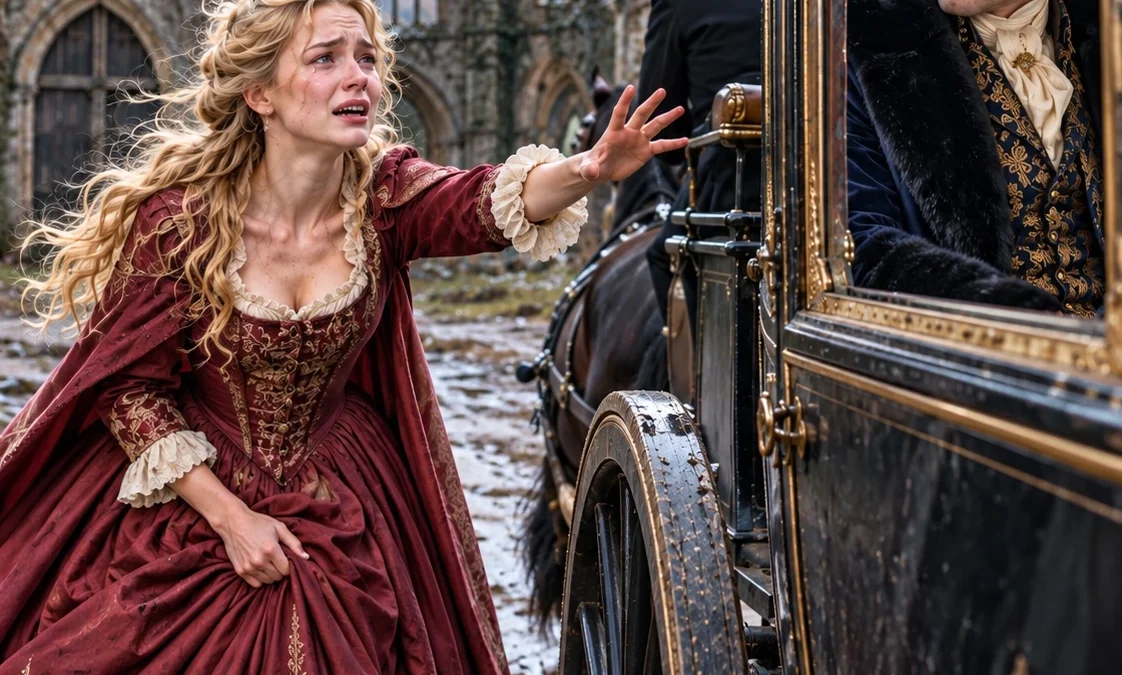
He did not even step out of the carriage.
They had been married at noon.
By dusk, the Duke of Caldwell had abandoned his nineteen-year-old bride at a ruined abbey on the edge of the Northern Moors.
Edmund Caldwell lowered the carriage window just enough to look at her.
Constance stood outside in a pale blue traveling gown, surrounded by freezing mud and crumbling stone.
Their marriage had never been about love.
Her father’s gambling debts had destroyed her family. Edmund needed a legal wife to satisfy an inheritance clause.
So a bargain had been made.
But Edmund had no intention of actually living with his bride.
He tossed a leather pouch from the carriage.
It landed in the mud at Constance’s feet.
“Fifty pounds,” he said. “The steward will see to your needs.”
Constance stared at him.
“Do not write to me. I will not answer.”
Then Edmund tapped his cane against the roof.
The carriage pulled away.
Its wheels sprayed freezing mud across her boots.
Constance watched until it vanished into the fog.
She was alone.
The wind screamed across the courtyard.
She bent down and picked up the pouch.
Then she turned toward her new home.
St. Jude’s Abbey looked like a corpse.
The roof sagged.
Windows were boarded over.
Black damp crawled across the stone walls.
One of the enormous doors creaked open.
A painfully thin man emerged carrying a lantern.
He stared at Constance.
“Where is the Duke?”
“Returning to London.”
The man looked past her.
“He left you?”
Constance’s teeth were chattering.
“I am the Duchess of Caldwell. Who are you?”
“Finch. Steward of St. Jude’s.”
His face tightened.
“Winter is nearly here, Your Grace. We barely have enough firewood for the kitchen.”
“Then we sleep near the kitchen.”
Inside, another servant waited.
Mrs. Gable, gray-haired and exhausted, looked at Constance’s ruined silk dress.
“He sent a child here to freeze.”
Constance heard her.
She also heard something else.
The certainty in the woman’s voice.
Everyone expected her to die.
Her father had sold her.
Her husband had discarded her.
Society would condemn her if she ran.
There was nowhere to go.
Constance lifted her chin.
“Mrs. Gable, hot water.”
Then she turned to Finch.
“And bring me the estate ledgers.”
“Tonight?”
“Tonight.”
By midnight, Constance understood exactly what Edmund had done.
St. Jude’s was bankrupt.
The sheep were dying.
The farms had failed.
The mill was broken.
Tenants were starving.
Edmund had sent no meaningful funds for years.
And the £50 he had thrown into the mud?
It would barely keep them alive for weeks.
Mrs. Gable urged her to flee south.
Constance closed the ledger.
“No.”
She looked at the dying fire.
“Pack my wedding clothes tomorrow.”
Mrs. Gable blinked.
“For what?”
“Sale.”
Finch nearly dropped his cup.
“You cannot sell a duchess’s trousseau!”
Constance looked at him.
“Shame does not buy firewood, Mr. Finch. And a duchess who freezes in silk is still a corpse.”
The next morning, Constance rode into Oak Haven.
She sold French lace.
Velvet.
Jewelry.
Silk gowns.
Everything.
Then she bought what mattered.
Wool.
Lumber.
Canvas.
Food.
Seed.
Animal feed.
Heavy boots.
That winter became a war.
Constance fought it personally.
She patched windows.
Carried wood.
Learned accounts.
Walked tenant farms through snow.
Her hands blistered.
Her face burned from the wind.
The farmers hated the Caldwell name.
One man named John spat near her boots when she entered his sheep pen.
“The Duke sends his pretty wife to collect what little we have left?”
“No.”
Constance looked at his starving animals.
“I brought feed.”
John froze.
She offered him a new agreement.
She would wipe away old arrears.
She would provide feed to save the breeding stock.
In return, St. Jude’s would receive a larger share of the spring wool.
“The Duke will have my head.”
“The Duke does not know you exist,” Constance replied.
Then she stepped closer.
“But I do.”
John accepted.
So did the others.
Winter ended.
Constance survived.
Then she did something far more dangerous.
She learned.
She studied prices, transportation, leases, mortgages and trade routes.
She rebuilt the mill.
She bypassed merchants who cheated the estate.
She established direct contracts with northern ports.
She bought livestock through private companies.
She reinvested every profit.
One year became two.
Two became three.
And St. Jude’s transformed.
The ruined abbey became a fortress of commerce.
The fields turned green.
Thousands of sheep grazed the hills.
The mill thundered beside the river.
Storehouses filled with grain.
Tenant cottages had warm roofs.
The starving steward gained weight.
The bitter Mrs. Gable began smiling again.
And Constance?
The frightened nineteen-year-old bride disappeared.
At twenty-two, she rode the estate in a dark wool habit, her blonde hair braided beneath a practical hat.
Her hands were calloused.
Her ledgers were ruthless.
Her word was trusted.
People stopped calling her “Your Grace.”
They called her something else.
Master.
Not because a priest had married her to a duke.
Because she had earned it.
One autumn afternoon, Constance returned from inspecting the harvest.
Finch entered her study carrying correspondence.
“Port authority.”
She approved it.
“Timber contract.”
She signed it.
Then she saw the third envelope.
Dark red wax.
A roaring lion holding a sword.
The Caldwell crest.
For three years, Edmund had been a ghost.
He had never asked whether she lived.
Never sent money.
Never returned.
Constance broke the seal.
She read.
Then read it again.
Edmund was in financial trouble.
He needed money.
So he had decided to sell St. Jude’s to industrial developers.
His solicitor would arrive within two weeks.
Constance was ordered to surrender the keys and leave the estate.
Finch watched her.
“What does he say?”
Constance walked to the fireplace.
She dropped Edmund’s letter onto the coals.
Flames consumed his signature.
“He thinks he can sell St. Jude’s.”
Finch went pale.
“Can he?”
A strange smile appeared on Constance’s face.
“Send for John.”
“Why?”
“Double the guards.”
Finch stared at her.
Constance turned toward the window.
Outside lay three years of sacrifice.
Every rebuilt roof.
Every saved farm.
Every warm cottage.
Every sheep purchased with money she had created.
Edmund thought he had abandoned a helpless girl on worthless land.
He had no idea she had spent three years preparing for the possibility that one day he might remember she existed.
Two weeks later, Edmund’s solicitor, Mr. Mercer, arrived expecting ruins.
Instead, he found guards.
A functioning mill.
Packed storehouses.
Prosperous farms.
And an abbey glowing with heat.
Finch escorted the stunned man into Constance’s study.
Mercer placed the eviction documents before her.
“By law, Your Grace, the land belongs to your husband.”
Constance picked up the documents.
And dropped them into the fireplace.
Mercer jumped to his feet.
“Those are legally binding!”
“Sit down, Mr. Mercer.”
Something in her voice made him obey.
Constance opened a massive ledger.
“The Duke owns the dirt.”
Mercer frowned.
“The mill?”
She smiled.
“I rebuilt it. A merchant company owns it.”
“The sheep?”
“Purchased by another company.”
“The grain?”
“Financed privately.”
“The silos?”
“Mortgaged through a northern bank.”
Mercer’s face slowly drained of color.
“A wife cannot independently—”
“Exactly.”
Constance leaned forward.
“So none of it is in my name.”
Mercer stared.
Over three years, she had created a maze of merchant partnerships, proxy investors and private companies.
Edmund legally owned the soil.
But nearly everything valuable standing on it belonged to commercial entities Constance controlled.
“If your Duke evicts me,” she said quietly, “he receives dirt.”
Mercer swallowed.
Constance’s eyes hardened.
“Tell Edmund that if he wants one coin from St. Jude’s, he will have to come north and ask me for it himself.”
And hundreds of miles away in London, when Mercer delivered her message, the Duke of Caldwell finally learned the truth:
The girl he had abandoned in the mud had become powerful enough to destroy him.
👉 Find Part 2 in the comments—or leave any word below and I’ll send it to you privately.
PART 2
The girl he had abandoned in the mud had become powerful enough to destroy him.
Edmund hurled his brandy glass into the fireplace.
“Impossible!”
Mercer sat rigidly across from him.
“The contracts are legitimate, Your Grace.”
“She is an uneducated girl!”
“She was nineteen when you left her. She is twenty-two now.”
Mercer hesitated.
“And she is not taking orders from anyone.”
Edmund’s rage hid a more terrifying truth.
He was nearly bankrupt.
Ships he had invested in were gone. Creditors were circling. Selling St. Jude’s had been his last escape.
Now Constance controlled everything that made the estate valuable.
Edmund summoned Captain Graves, a disgraced former officer who solved aristocratic problems with intimidation.
“Twenty men,” Edmund ordered. “We ride north.”
The journey was brutal.
When Edmund reached Oak Haven, he expected peasants to bow.
Instead, the local innkeeper refused him rooms.
“I own this land!” Edmund shouted.
The innkeeper barely looked up.
“You own the dirt.”
Edmund froze.
Constance’s words.
All around the tavern, farmers and workers silently placed hands near knives, hammers and iron staves.
Captain Graves leaned toward Edmund.
“Back to the carriage.”
Humiliated, Edmund obeyed.
They continued toward St. Jude’s through driving snow.
Then they reached the hill.
Edmund stared.
The ruin was gone.
Below him burned hundreds of lights.
The abbey had become a fortress.
And in its courtyard waited hundreds of people.
The gates opened.
Edmund ordered the carriage forward.
The instant his men entered, the gates slammed shut behind them.
Workers surrounded the carriage.
Shepherds.
Millers.
Blacksmiths.
Farmers.
At the top of the stone steps stood Constance.
Edmund barely recognized her.
Dark green riding coat.
Tall boots.
Blonde hair braided like a crown.
Finch stood on one side.
John stood on the other.
Constance looked down.
“You should have written before visiting, Edmund. I might have prepared the stables.”
Laughter moved through the crowd.
Edmund’s face turned crimson.
“I AM the Duke of Caldwell! I am your husband! I am master here!”
Constance descended one step.
“You are a signature on paper.”
“I own this estate!”
“You abandoned it.”
Edmund pointed toward her.
“Captain Graves! Remove this woman!”
Graves looked at the hundreds surrounding him.
Then at his twenty men.
“No.”
Edmund spun around.
“What?”
“I was hired to evict a tenant,” Graves said. “Not lose a war.”
He ordered his men to stand down.
Suddenly Edmund was alone.
Constance walked down the remaining steps.
Three years earlier, he had looked at a nineteen-year-old bride through carriage glass.
Now he had to look up at the woman she had become.
“You left me here to die,” she said.
“You stole my estate!”
“I saved it.”
“You ruined me!”
Constance became very still.
Then she asked:
“Who do you think bought your promissory notes from the Royal Bank?”
Edmund stopped breathing.
Constance stepped closer.
“The Northern Trade Syndicate owns your debt.”
His eyes widened.
“I control the Northern Trade Syndicate.”
Edmund stumbled backward.
“You orchestrated this.”
“I applied pressure to cracks you made yourself.”
“You cannot—”
“You owe my syndicate forty thousand pounds.”
His face collapsed.
“I’ll sell the land.”
Constance removed a sealed envelope from her coat and tossed it into the mud.
“The developers withdrew yesterday.”
Edmund stared at it.
His final escape was gone.
His knees struck the freezing mud.
“What do you want?”
Constance looked at the man who had once thrown £50 at her feet.
“The northern land transferred permanently beyond your control.”
“If I agree, I’ll have nothing.”
“You will have your freedom.”
“And if I refuse?”
Constance’s expression did not change.
“Your creditors take everything.”
Edmund’s shoulders shook.
Constance turned toward the abbey.
Then she stopped.
“One more thing.”
She looked back.
“When the documents are signed, you will leave St. Jude’s with exactly what you gave me.”
Edmund’s face went white.
He knew immediately what she meant.
£50.
The same amount.
The same leather pouch.
The same road.
Only this time, he would be the one walking into winter.
🔥 LIKE this post or COMMENT “WINTER” if you want Part 3. Once I receive enough comments, I’ll post the complete ending.
PART 3
Edmund remained on his knees long after Constance went inside.
Snow gathered on the shoulders of his expensive coat.
Nobody rushed to help him.
Nobody laughed either.
That somehow made it worse.
Around him stood the people he had ignored for years.
Farmers whose rents his family had raised.
Parents who had watched children shiver through brutal winters.
Workers who had rebuilt the estate while its duke spent money hundreds of miles away.
Edmund slowly rose.
His trousers were soaked with mud.
“Open the gates,” Captain Graves called.
The guards looked toward John.
John looked toward Finch.
Finch nodded.
The iron bar lifted.
Graves and his men departed without another word.
The Duke tried to follow.
Finch stepped into his path.
“Not yet.”
Edmund glared at him.
“You dare detain me?”
Finch’s expression remained calm.
“The transfer papers must be prepared.”
“I am still Duke of Caldwell.”
“Yes.”
Finch glanced toward the enormous abbey behind them.
“But that title has proved less useful here than you expected.”
Edmund was given a room below the main house.
It was cold.
Bare stone.
A wooden cot.
A single candle.
No velvet curtains.
No servants waiting for orders.
No brandy.
Twice each day, someone brought oats, bread and weak ale.
Nobody beat him.
Nobody starved him.
Nobody even insulted him.
For the first time in Edmund Caldwell’s life, the world simply refused to care about his discomfort.
On the third evening, the lock turned.
Finch entered with a young clerk carrying documents.
Edmund sat on the cot.
“Where is my wife?”
“The master is in Oak Haven negotiating timber contracts.”
Edmund flinched.
“The master?”
“Yes.”
“I demand to see her.”
“She is busy.”
The answer was so simple that Edmund almost laughed.
Three years ago, Constance had been a girl whose entire future could be rearranged by men who considered themselves busy.
Now Edmund could not even secure an appointment.
Finch placed the documents on a portable desk.
“These are the transfer articles.”
Edmund stared at them.
“And if I refuse?”
“Mr. Mercer returns to London and informs your creditors that the St. Jude’s sale has collapsed.”
Finch spoke without pleasure.
“Your townhouse will likely be seized. Your remaining possessions will follow.”
Edmund looked down.
His anger had nowhere left to go.
“She stole everything.”
Finch’s expression finally changed.
Not anger.
Disappointment.
“She arrived with fifty pounds.”
Edmund looked up.
Finch continued.
“She slept beside the kitchen because there was no wood for her chambers. She sold her wedding clothes to buy food for your tenants. She walked farms in snow while you ignored every letter this estate sent south.”
“She turned them against me.”
“No.”
Finch’s voice softened.
“You accomplished that without assistance.”
Silence filled the cellar.
The clerk placed a quill beside the documents.
Edmund stared at his name printed across the parchment.
Once, that name had opened every door.
Now it seemed strangely small.
He signed.
One page.
Then another.
And another.
Each scratch of the quill stripped another illusion from him.
When he reached the last page, his hand stopped.
“What will I have?”
Finch looked at him.
“Your title.”
Edmund laughed bitterly.
“A duke without an estate.”
Finch gathered the completed papers.
“A Duke of Caldwell nonetheless.”
“A king of nothing.”
Finch did not answer.
He did not need to.
The following morning, Edmund emerged into a bitter gray dawn.
His London clothes had been replaced by a coarse wool coat and sturdy boots.
His carriage was gone.
Graves was gone.
Mercer had already left.
Finch descended the steps.
Something hung from his hand.
A small leather pouch.
Edmund stared.
He remembered another winter evening.
A young bride standing in freezing mud.
His own hand tossing a pouch from the carriage window.
“Fifty pounds,” Finch said.
Edmund accepted it.
The coins felt impossibly heavy.
“The road to Oak Haven is open. A mail coach passes at noon. You can purchase passage south.”
Edmund looked toward the windows.
“Is she watching?”
Finch followed his gaze.
“No.”
That answer wounded him more deeply than triumph would have.
Inside her study, Constance was examining plans for a water-powered loom with John.
The signed transfer documents rested nearby.
She did not stand at the window.
She did not need to watch Edmund leave.
Her life no longer revolved around the man who had abandoned her.
Outside, the workers paused.
Edmund walked toward the gates.
Blacksmiths.
Stable boys.
Women from the carding sheds.
Farmers.
Millers.
They formed a silent corridor.
Edmund braced himself.
He expected insults.
Spitting.
Perhaps stones.
Nothing came.
Mrs. Gable stood holding a basket of eggs.
She barely looked at him.
John said nothing.
The workers simply watched.
Then Edmund understood.
Their silence was not fear.
It was not respect.
It was indifference.
Three years earlier, Edmund had treated Constance as though she were disposable.
Now an entire valley regarded him the same way.
He crossed the threshold.
Behind him, the enormous gates began closing.
He looked back one final time.
Before they had even shut, the workers were returning to their tasks.
Hammers rang.
Carts moved.
The mill turned.
Life continued.
Without him.
The gates slammed shut.
Edmund Caldwell pulled his rough coat tighter around his body and began walking south.
Winter descended over St. Jude’s.
Snow piled four feet against the outer walls.
But inside the abbey there was warmth.
Real warmth.
Not merely fireplaces.
Security.
Food.
Work.
On the night of the winter solstice, Constance sat at a massive oak table in the restored dining hall.
Three enormous hearths burned.
John was telling a ridiculous story about a draft horse.
Mrs. Gable poured spiced cider.
Young workers sang songs loudly and not particularly well.
Finch had finally closed his ledger.
Constance sat among them.
Not at the head of the table.
Among them.
She wore a simple dark-blue wool dress.
Her blonde hair fell loose over her shoulders.
For three years, every sound from the road had carried a warning.
A creditor?
An official?
A solicitor?
Edmund?
Tonight, she heard only laughter.
Finch noticed her silence.
“You are quiet, Master.”
Constance smiled.
“I’m listening.”
“To what?”
“The fire.”
Finch waited.
She looked around the hall.
“For the first time since I arrived, I am not listening for a carriage.”
Something in Finch’s face softened.
“The deed was registered yesterday.”
Constance looked at him.
“Everything?”
“Everything.”
“And the challenges?”
“The solicitor believes there is almost no viable path to reverse the transfer under the agreements that were executed.”
Constance exhaled slowly.
Three years.
For three years, she had lived as though the next morning might bring disaster.
Now there was nothing left to defend against Edmund.
He was no longer the shadow behind every door.
“The syndicate owns the valley,” Finch said.
Constance shook her head.
“We own it.”
Finch glanced around the table.
Constance followed his gaze.
She had not survived alone.
Mrs. Gable had stretched food through impossible winters.
Finch had found records others thought lost.
John had convinced suspicious farmers to try her contracts.
Workers had rebuilt walls in freezing rain.
Women had spun wool until their fingers cracked.
Children had carried kindling.
Merchants had taken chances.
Constance had led them.
But St. Jude’s had been resurrected by hundreds of hands.
That mattered.
Much later, after the feast ended, Constance walked alone through the restored halls.
A candle burned in her hand.
She entered her study.
The maps remained on the walls.
Trade routes.
Warehouses.
Farms.
The marks of a world she had built from nothing.
She approached the window.
Moonlight covered the valley in silver.
The mill was still beneath the winter ice.
The grain silos stood full.
Smoke curled from tenant cottages.
Somewhere in the distance, a dog barked.
Constance placed her palm against the cold glass.
She remembered being nineteen.
She remembered the pale blue dress.
She remembered kneeling in the mud to retrieve £50.
She remembered the carriage disappearing.
For years, she had imagined what she would say if Edmund returned.
She had imagined rage.
Revenge.
Perhaps even the satisfaction of watching him suffer.
Yet when the moment finally came, the greatest victory had not been seeing him kneel.
It had been discovering that she no longer needed him to.
Constance had already won before his carriage crossed the gates.
She had won the first winter when she chose wool over silk.
She had won when John accepted her first contract.
She had won when the mill wheel began turning again.
She had won when the first tenant family entered winter with enough grain.
She had won when the people of St. Jude’s stopped waiting for Caldwell to rescue them.
Most of all, she had won when she stopped thinking of herself as something discarded.
Her father had believed her value could settle a debt.
Edmund had believed her existence could satisfy an inheritance clause.
Both men had misunderstood her.
They believed power came from a surname.
A title.
A seal pressed into red wax.
A document locked in a London vault.
Constance had learned differently.
Power could be built.
One contract at a time.
One field.
One repaired roof.
One sack of grain.
One brutal winter survived.
There came a quiet knock.
“Enter.”
Mrs. Gable appeared.
“You ought to sleep.”
“So should you.”
“I’m old. I am entitled to hypocrisy.”
Constance laughed.
Mrs. Gable stepped farther into the room.
For a moment, neither spoke.
Then the older woman looked toward the window.
“I remember the night you arrived.”
“So do I.”
“You were blue.”
“My dress?”
“You.”
Constance smiled faintly.
“I thought you would be dead by morning.”
“I believe you mentioned something similar.”
“I was not subtle.”
“No.”
Mrs. Gable studied her.
“You frightened me that night.”
Constance raised an eyebrow.
“I was nineteen and freezing.”
“That wasn’t what frightened me.”
“What did?”
“You asked for the ledgers.”
Constance laughed again.
Mrs. Gable smiled.
“Everyone else who came here looked at the roof and asked how soon they could leave. You looked at the accounts.”
“I did consider leaving.”
“I know.”
Constance turned back toward the valley.
“Where would I have gone?”
Mrs. Gable’s expression softened.
“That was what I feared.”
Constance was quiet.
Then she said:
“Perhaps having nowhere to go forced me to discover where I wanted to stay.”
Mrs. Gable nodded.
“That sounds suspiciously sentimental.”
“Tell no one.”
“I will inform the entire kitchen before breakfast.”
Constance smiled.
Mrs. Gable left.
The door closed.
Constance remained at the window.
Somewhere far to the south, Edmund Caldwell still carried a ducal title.
Perhaps he would rebuild his life.
Perhaps he would not.
That was no longer Constance’s concern.
She did not need him ruined forever to prove she had survived him.
She needed only to wake tomorrow and continue building.
And tomorrow there would be plenty to do.
The new loom needed approval.
Spring contracts needed negotiating.
John would almost certainly argue about the timber allocation.
Finch would discover three problems before breakfast.
Mrs. Gable would complain about flour prices.
Someone would need her judgment.
Someone would disagree with it.
Life would continue.
Constance looked once more across the moonlit land.
Three years earlier, this had been where a nineteen-year-old girl was supposed to disappear.
Instead, she had planted her feet in frozen earth and refused.
The abbey survived.
The farms survived.
The people survived.
And the frightened bride in the blue silk dress?
She survived too.
Not unchanged.
Never unchanged.
But alive.
Strong.
Free.
Constance extinguished the candle.
Moonlight remained.
She walked toward the door, then stopped and glanced back at the desk.
On one corner rested a small leather pouch.
£50.
Finch had recovered it from the original household records after Edmund left.
Constance had considered throwing it away.
Instead, she had emptied the coins and placed them into the estate’s winter-relief fund.
The pouch itself remained.
Not as a trophy.
As evidence.
A reminder that the difference between destruction and beginning could sometimes be nothing more than what one person decided to do after everyone else had written her ending.
Constance touched the worn leather.
Then she left it behind.
Outside her study, the abbey was warm.
Somewhere downstairs, someone was still laughing.
Constance followed the sound.
The Duke had thought he was burying a helpless bride in a ruined abbey.
Instead, he had given her the one thing nobody before him had ever intended to give her:
A place where she could discover exactly what she was capable of becoming.
And by the time he returned to take it from her—
it was no longer his world to command.
It was hers.
Not because someone crowned her.
Not because a husband gave it to her.
But because when winter came, Constance stayed.
She worked.
She learned.
She built.
And when the gates finally closed behind the man who had abandoned her, the people of St. Jude’s did not cheer.
They simply returned to work.
Because the greatest revenge was never watching Edmund lose everything.
It was realizing that Constance had built something so strong that losing him changed nothing.
Disclaimer: This story is entirely fictional and created for entertainment purposes only. It does not represent any organization or individual, nor does it encourage inappropriate behavior. The content was generated with AI assistance.








