He Lent His Dead Wife’s Horse to a Stranger Running for Her Life… Four Days Later, a Line of Riders Appeared on His Ridge
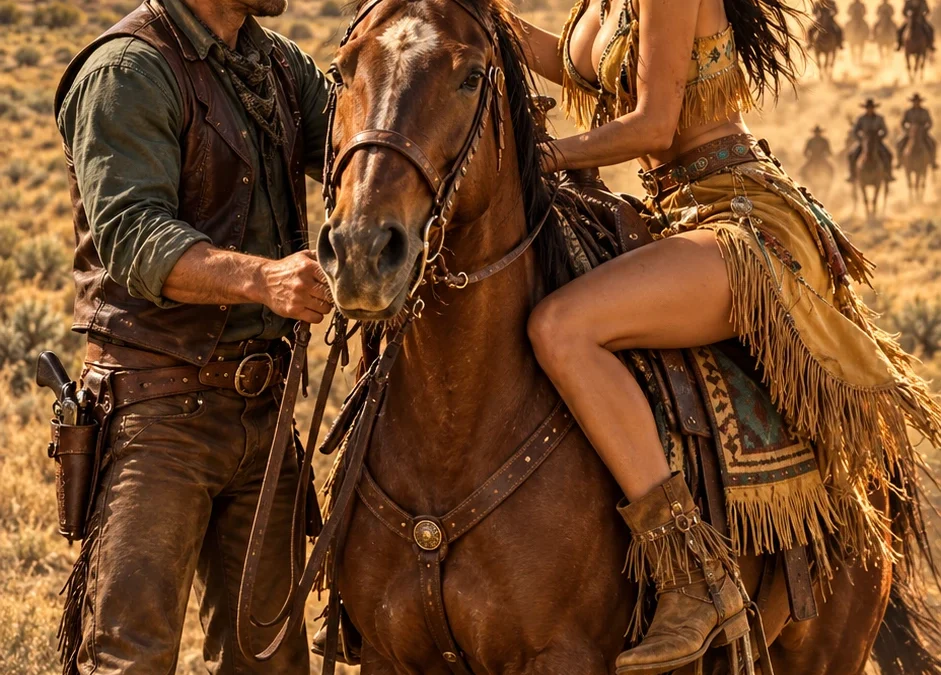
🔥 He Lent His Dead Wife’s Horse to a Stranger Running for Her Life… Four Days Later, a Line of Riders Appeared on His Ridge 🔥
PART 1
The Arizona sun scorched bare skin, and hooves thundered behind her like death closing in.
An Apache girl sprinted along the old Chiricahua trail, barefoot and ragged-breathed, a hide-wrapped bundle clutched against her chest. Then she skidded to a stop. In front of her stood a lone white man beside a broken fence line, pliers in hand, no gun, no horse, with the dead eyes of a man who had buried his heart years ago.
At the far end of the valley, three riders appeared, red dust boiling behind them. Coming fast. Faster.
Marcus Webb silently held out the reins of his mare.
Marcus was forty-three, lean and weathered, built by fifteen years of fixing fences alone. He knew every post on his ranch the way some men know their children’s faces, every rise, every hollow that held water after rain. He knew it all because knowing things was safer than feeling them. And Marcus hadn’t felt much of anything in a very long time.
The morning had started the way every morning did. Black coffee, no sugar, because he’d run out three weeks ago and hadn’t bothered riding into town. Sugar was for people who cared about small pleasures. He sat on the same porch, in the same chair, and watched the sun climb the eastern ridge the way it had every morning since the world began. A world that had kept spinning after his stopped.
Inside, on the table by the window, sat a photograph he walked past every morning without looking at it directly. Sarah, twenty-two, in the blue dress she’d made herself, standing in front of this very cabin before everything went wrong.
She had died on October 17th, 1871. The baby with her. Daniel, named for Marcus’s father. Sometimes it just happens, the midwife had said. Sometimes babies aren’t meant for this world. Marcus had nodded, because what else do you do when someone says something that stupid? He buried them on the hill behind the cabin under the cottonwood. Two names, one date, no scripture.
After that he stopped talking much. He stopped planning for any future beyond the next day’s work.
Owen had shown up six months after the funeral, a drifter, good with horses, good with cattle, good with silence. That last part was why Marcus hired him. Seventeen years now. Cole had arrived two seasons ago, younger, a talker, a smiler, which made Marcus trust him less. But the ranch needed hands. Marcus watched Cole the way you watch a horse you’re not sure is broken yet.
On this particular morning, August 14th, 1887, Marcus rode east on Copper, an eleven-year-old bay mare Sarah had named. At the eastern edge of his property the old Chiricahua Trail ran, used by Apache for generations. Marcus left it alone. Let people pass. The Apache did the same.
He was working on a downed fence when he saw her. At first just movement, a shape, fast along the trail. A young woman, maybe eighteen, running with the specific economy of someone who’d been running for hours. Behind her, half a mile back, dust. Three horses, moving hard.
She wasn’t going to make the tree line.
Marcus stood holding the wire cutters, thinking about a great many things very quickly. His ranch, four miles west, in no need of extra trouble. Three riders who could be anything. Sarah, which he tried not to do. Sarah would have helped without calculating. Marcus wasn’t Sarah. He’d spent sixteen years making sure he never cared enough to get hurt again.
And then, for the first time in sixteen years, Marcus Webb did something impulsive.
The girl stopped and looked at him. Her eyes were dark, level, unreadable. No fear in them, only assessment. He held out the reins and didn’t speak. She took them and ran a hand along Copper’s neck, checking. Then she spoke, in careful, precise English.
“Left front shoe is loose.”
Marcus blinked. She was running for her life, and she was telling him his horse needed work. Because even in crisis, some things mattered.
She swung up in one smooth motion, adjusted the bundle, and looked back at him once. Something passed between them. Recognition. Then she drove Copper east into the broken country between the cedar stands and was gone.
His hands were shaking, not from fear but from shock at himself.
The three riders pulled up short when they saw him standing in the middle of the trail with no horse. White men, roughly dressed, but the horses too good, the saddles too expensive. These were men paid well to do things other men didn’t want to do. The one in front wore a red bandanna.
“You see an Apache girl come through here?”
“Been standing here about five minutes,” Marcus said. “Haven’t seen much of anything.”
The lie came easy. The man’s eyes dropped to the fresh hoofprints leading east, then back to Marcus. His hand drifted near his belt. Marcus didn’t flinch. Men with nothing to lose are dangerous not because they’re reckless, but because they’re free. The rider saw it. The math didn’t work out.
“Keep moving,” he told the others, and they rode off at a different angle than the girl had gone.
Marcus walked four miles home under the August sun with no water. Owen met him at the gate, horrified. “Jesus, Marcus. Where’s Copper?”
“I lent her. To somebody who needed her more than I did this morning.”
Owen gave him a long look and said nothing. “All right. Get out of this heat.”
For three days Marcus worked the ranch the way he always had. But it felt different. He was noticing things. After sixteen years of sleepwalking he was waking up, and it was uncomfortable, like pins and needles, like pain, but also feeling. Life.
On the evening of the fourth day Owen came up from the barn walking faster than usual. “You got company. East ridge.”
A line of riders sat along the ridge at the edge of his land, still as the rock itself. Seven. Then more. Chiricahua, Owen said, by the horses.
Marcus did not reach for his rifle. Reaching for a gun when someone is watching you is a message. They waited. The light went gold, then orange, then red, then purple, then black. When the last of it was gone, so were the riders.
At first light Marcus walked out to feed the horses and stopped at the gate.
Copper stood there, patient, her coat brushed, her mane untangled, her hooves clean. All four shoes reset by a professional. Tied to the saddle horn was a bundle wrapped in cured hide. Inside were dried venison, a handful of piñon nuts, and a length of blue-and-white beadwork on a thin leather cord. Hundreds of tiny beads. Hours of work. Someone had made this for him.
Two days later, a young Apache rider came in at a walk, in daylight, from the east.
“You are the man from the trail. My name is Kai. I was sent to speak with you.” Over coffee in the cabin, Kai set down his cup and looked at Marcus directly. “The woman you helped is Aya. She is the daughter of our headman. The men who followed her,” Kai said, “were hired by a man named Silas Crane.”
PART 2
“The men who followed her were hired by a man named Silas Crane.”
Marcus already knew the name. Crane had appeared about three years ago with money from back east. In eighteen months he had acquired three ranches. The Henderson place: Henderson left in the middle of the night. The Clifton ranch: Clifton had been there twelve years, then something scared him off. The Morrison place: Morrison was found dead, a hunting accident, and the widow sold a week later. Nobody could prove anything. Everybody knew.
“Crane wants the corridor between your ranch and our summer grounds,” Kai said. “He needs both to control the water.”
Marcus understood. Out here, water was everything.
“Why tell me this?”
“Because our headman says a man who gives something freely, without expecting a return, is a man worth warning.” Kai paused. “Crane’s men have watched your ranch two nights this week. They are counting your men, your horses, your ammunition. Our headman believes they will move against your land within the week. And he offers help. What threatens you also threatens us. We have a common enemy.”
Marcus felt something he hadn’t felt in sixteen years: someone offering partnership.
“Tell your headman I want to speak with him.”
At the door Kai turned back. “Aya said to tell you the loose shoe was reset. She said you would understand.”
Marcus stood in the doorway long after the rider disappeared, thinking about a young woman who had noticed a loose horseshoe while running for her life. For the first time in years, Marcus Webb wanted something beyond survival. He wanted to meet her.
Three days later, at dawn, on the dry creek bed marking his eastern boundary, he met Natan, the headman, a man of sixty with silver threaded through his hair and eyes that held weight. Kai translated.
“He asks if you understood what it would cost you.”
“Not entirely. I knew it was a risk. I didn’t know how much of one.”
Natan nodded slowly. “He says a man who does the right thing knowing it is a risk is worth more than a man who waits until the risk is gone. Many men wait. The risk never goes.”
Marcus told them the truth. He had two hands, Owen and Cole, and he wasn’t sure he trusted Cole. He had ammunition for maybe three days of fighting, thirty head of cattle, and no friends in town. “I spent fifteen years making sure I had no debts. No obligations. I thought being invisible meant being safe. Tell him I was wrong.”
Natan’s eyes softened. “He says Crane does not leave anyone alone. Sometimes the only way to protect what is yours is to stand up and be seen.” He agreed to send four warriors. “But he says do not be grateful yet. When white men in town learn you work with Apache, they will turn on you. When our people learn we protect a white man’s ranch, some will question. This will cost both of us. But the cost of not allying is worse.”
“I accept the cost.”
Natan smiled, small and brief, and held out his hand. They shook. No words. None were needed.
The next day four riders came to the ranch: Kai, Tahoma the scout, stocky Nitus who knew horses, and young Kuruk. They walked the land together and found weaknesses Marcus hadn’t seen. Cole hung back, watching.
“You really trust them?” Cole asked quietly as the light faded.
“They didn’t have to help. But they are. That’s all I need to know.”
Two days later Aya came to the ranch.
Marcus’s heart skipped. She was striking, angular and strong, with dark eyes that really looked at you. She told him her father had sent her to see the land. They walked the dry creek bed, and she knelt and put her hand to the earth. “Water here, underground. If Crane’s men poison your well, dig here.” She had learned the plants from her grandmother, who raised her after her mother died in childbirth.
“Mine too,” Marcus said quietly. “My wife. Sixteen years ago. The baby died with her.”
“My grandmother told me, before she died, that pain does not disappear. It only changes shape. You do not move on. You learn to carry it, and make room for it without letting it take all the space.”
Marcus stood very still.
Over the next week she came twice more. She taught him plants and water and seasons. He found he could talk about Sarah without the crushing weight.
Then, on the seventh evening, voices rose outside the barn.
Marcus looked out. Cole stood by the fence talking to a rider on a horse Marcus recognized as Crane’s. Cole handed over a folded paper. The rider galloped off.
Cole turned and saw Marcus watching.
PART 3
For a long moment, neither man spoke.
Then Cole walked to the bunkhouse and came out with his saddlebag, already packed.
“I’m leaving.”
“I know,” Marcus said.
“You going to try to stop me?”
“No.”
Cole’s face twisted. Anger. Shame. Both. “Crane pays better. And you’re a fool, fighting a war you can’t win with people who’ll turn on you.”
“Maybe. But I can sleep at night.”
Cole flinched as if he’d been hit. “They’ll kill you. They know your positions, your numbers. They’ll come soon. And you’ll die.”
“Maybe. But I’ll die standing.”
Cole rode south, toward Crane’s camp. Owen came to stand beside Marcus. “He told them everything.”
“Yes. And he has to live with that. That’s punishment enough. We tell Kai tonight. And we prepare.”
The attack came on the third night, just as Natan had predicted. Marcus heard the desert go quiet, something big moving through it. Owen appeared at the barn with a rifle. “South fence. Eight riders. Maybe more.”
Tahoma materialized from the dark. “Four at the fence. Two to the barn. Two to the house.”
Owen took the root cellar, stone walls and good cover. Marcus climbed into the barn loft. Tahoma vanished back to the ridges where Nitus and Kuruk waited.
The riders came slowly, carrying cans, rope, torches not yet lit. They meant to burn him out. They did not know about the Apaches on the ridge, or that Marcus had spent days preparing. The arithmetic had changed.
Marcus stepped out of the barn into the open.
“I know who sent you. Silas Crane. I know what he’s done in this valley. Henderson. Clifton. Morrison.”
“Then you know this is done already,” one of the riders said. “Leave tonight, or we burn it all.”
“Here’s what you don’t know.” Marcus looked up at the South Ridge and the North Ridge. “Right now, on both ridges, there are people watching you. They know your positions. They’re waiting for my signal.”
“You’re bluffing.”
Marcus didn’t answer. A small fire bloomed on the South Ridge for three seconds, then dark. The North Ridge, same. Then from the east came a single clear note, long, carrying. The horses grew restless. The riders felt it through their mounts. One spoke low and urgent, and they turned, slow at first, then fast, and rode south into the night.
“They will come back,” Kai said, riding down from the ridge. “Next time to kill.”
“I know,” Marcus said. “But we survived. That means something.”
By dawn, Marcus had an idea. He rode east to the dry creek bed, where Natan waited.
“Crane operates through fear and violence,” Marcus said. “But he also operates legally. False deeds. Corrupt officials. I can’t beat him with violence alone, even with your help. But if I can prove his deeds are false, if I can expose his corruption, I take away his legal standing. Without that, he’s just another criminal.”
Natan nodded, and Kai translated. “He says you need evidence. And witnesses the territory will believe. Not Apache. They will not believe Apache. You need white witnesses.”
“Henderson. Clifton. The families Crane drove out. If they’ll testify.”
“He says wise. Violence only brings more violence. Exposing corruption, that is how you truly win. Truth wins battles weapons cannot. He will send riders to find Henderson and Clifton and tell them they are not alone. Fear grows in isolation. Courage grows in community.”
Over the next three weeks, Natan’s riders found Henderson working a small farm in Colorado, barely surviving. He was scared, but thinking. Clifton had gone as far as Montana Territory, but word was sent. Marcus hired an independent land surveyor from Santa Fe, Thomas Pike, who studied his deed and frowned. “The boundary here doesn’t match the original survey. Someone altered it.”
“What if we forced Crane to show his documents?”
“A territorial judge could order it. But you’d need evidence of fraud first.”
“I’m working on it.”
Through those weeks, Aya came four more times. One afternoon, under a cottonwood by the creek bed, she asked about Sarah. What she looked like. What her laugh sounded like.
“She would have liked you,” Marcus said. “Because you’re like her. Strong, kind. You notice things. You make me want to be better.”
Aya was quiet. “That is the kindest thing anyone has said to me.”
She took his hand and didn’t let go this time.
Four weeks after the first attack, Crane came himself. Fifty, well dressed, everything about him said money. He extended his hand. Marcus didn’t take it.
“I’m prepared to offer you triple what this land is worth. Cash. You could buy a bigger spread and start fresh.”
“No. This land isn’t for sale.”
Crane’s smile thinned. “I’ve looked into you. You lost a wife and son sixteen years ago. That’s a long time to be alone. I understand loss. I lost a son too. I decided after that never to be weak again. Money is power. Land is power.”
“Some things aren’t for sale.”
“Everything is for sale, if you offer enough.”
“Then you can’t afford this.”
Crane stepped closer, menacing. “You think your Apache friends scare me? You think you can expose me? I own this valley. The sheriff, the judge, the land office. I could have you killed tonight and no one would question it.”
Marcus met his eyes. “Then do it. Because I’m not leaving.”
Crane broke first and stepped back. “You’re a fool.”
“Maybe. But I’m a fool with honor. Which is more than you have.”
Crane rode off, furious. Marcus knew this was the point of no return.
That night he gathered everyone around a fire outside the cabin: Owen, Kai, Natan, Tahoma, Nitus, Kuruk, three other warriors, and Aya. “He’s coming back with overwhelming force. Not to scare me. To kill me.” He looked around the circle. “Why are you doing this for me?”
“You gave your horse to my daughter without question,” Natan said through Kai. “That made you family. And you stand for honor and integrity. Fighting with you is fighting for ourselves, for our children, for the right to exist without men like Crane taking everything.”
Marcus looked at Aya. “And you?”
She stood, walked around the fire, and sat beside him. “I am here because I choose to be. Because you are worth standing with. Because when I am with you, I feel seen.”
“I see you too,” he said quietly.
She took his hand in front of everyone, claiming it.
Three days later a territorial marshal rode in from Santa Fe with a court order. Thomas Pike had convinced the judge that there was enough evidence of fraud. Both men were ordered to present their deeds and surveys.
“Will you comply?” Marshal Clayton asked.
“Yes.”
“Good. This ends legally, one way or another.”
The courthouse in Santa Fe was small, adobe, cool inside despite the heat. Judge Morrison, seventy, white-bearded, presided. Crane sat with two lawyers in expensive suits. Marcus sat with Pike, and, to his astonishment, with Henderson, who had come after two months of hiding.
Henderson, hands shaking, told of the poisoned well, the threats, and the land he sold for a fraction of its worth out of fear for his family. Crane’s lawyer objected that Apache testimony was hearsay and unreliable.
“I’ll decide what’s reliable,” the judge said coldly. “Sit down.”
Pike presented his survey showing the boundary discrepancies and the altered documents. Crane’s lawyers produced their own deeds, all looking official. Pike examined them and found dates that didn’t match and signatures that looked wrong. “These are forgeries. Professional ones, but forgeries.”
A land office expert was called. The examination took five days, the testimony three more. The proceedings stretched two full weeks.
“Forgeries,” the expert confirmed. “Multiple documents dating back three years. Systematic fraud.”
Judge Morrison looked at Crane, his face stone. “You are hereby ordered to return all land acquired through fraudulent means to its rightful owners. You will pay restitution. You will pay court costs. And you are banned from purchasing land in this territory for twenty years.”
“I have witnesses!” Crane shouted.
“You have nothing except bills to pay and a reputation in ruins. Court dismissed.”
Crane looked at Marcus across the courtroom with pure, undiluted, impotent hatred. The law had spoken.
Marcus rode home with Henderson and Pike and a real victory. The land would be returned. The families could come home. He felt no elation, only the quiet satisfaction of justice done.
Six months later, Marcus stood on his porch with coffee in hand, watching the sunrise the way he had for sixteen years. But everything was different now. Owen was in the barn, still loyal, still steady. Henderson had reclaimed his land. Clifton was back from Montana, working his ranch again. The valley was healing.
Footsteps behind him, soft and familiar. Aya came to stand beside him, her shoulder touching his.
Three months ago, she had asked what he wanted now that Crane was gone and his land was safe. Marcus had answered honestly: her, not just as a friend, but as more. Aya had considered, talked to her father, consulted her own heart, and said yes. Not marriage, not yet. Both needed time to learn each other and to build something new from the ruins of what they’d lost. But yes to trying. Yes to seeing. Yes to being together.
“I love you,” he said. Simple and true.
She turned and smiled, that smile that transformed everything. “I know. I love you too.”
She leaned up and kissed him, soft and brief. And Marcus, forty-three years old, sixteen years alone, sixteen years certain he would never feel anything again, felt everything. Joy. Hope. Love. Gratitude.
“Thank you,” he whispered against her hair.
“For what?”
“For noticing.”
She laughed, a sound like water over stones. “Always. I will always notice.”
He knew she wasn’t only talking about horseshoes. She was talking about seeing him, all of him, the broken parts and the healing parts and the parts that would never fully heal, and loving him anyway.
They stood watching the valley wake. Behind them, in the cabin, Sarah’s photograph still sat in its place, still honored, still remembered. Beside him stood the second love he had never expected, the proof that a heart could break and still have room for more.
Marcus had spent sixteen years invisible, and in the end it hadn’t worked. Danger had found him anyway. But so had community, alliance, friendship, and love. And standing there with Aya beside him, with Owen in the barn, with Natan’s people trusted neighbors now and the valley finally free of Crane’s shadow, he understood what Sarah had tried to say on that last day, the words he couldn’t hear over his own grief.
Keep living.
And finally, after sixteen years, Marcus was.
💬 Have you ever been “invisible” after a loss, and what finally pulled you back into living? Tell me in the comments. I read every one. ❤️
This story is entirely fictional and created for entertainment purposes only. It does not represent any organization or individual, nor does it encourage inappropriate behavior. The content was generated with AI assistance.








