He Mocked Her As “The Mole Woman” And Laughed At Her Dugout… Then The Storm Came And He BEGGED At Her Door
Part 1
The hand pressed against the frozen window first — large, knuckles split and blackened, moving in a slow, ragged knock that had no urgency left in it.
It was the knock of a man who had already spent everything just to reach there.
Inside, Hazel Voss sat beneath the light of a single oil lamp, and she knew exactly who it was.
Six months earlier, that same man had stood on the other side of the fence, calling her a lunatic.
Tonight, he was dying on her doorstep, and she was the only reason he still had a chance.
It all began in April 1885, when 42‑year‑old Hazel arrived in Mil Haven, Montana Territory.
She carried two trunks, a crate of books, and hands hardened by 15 years guiding supply convoys through the harshest winters in the West.
She’d left that life not because she couldn’t do it anymore — but because she ached to build something truly hers: something she would never have to hand back at season’s end.
The cabin on Blackwood Road was falling apart.
Gaps wide enough to fit a fist ran through its foundation; damp cold seeped up through the floorboards; the roof leaked and the frames rotted.
But Hazel didn’t turn away.
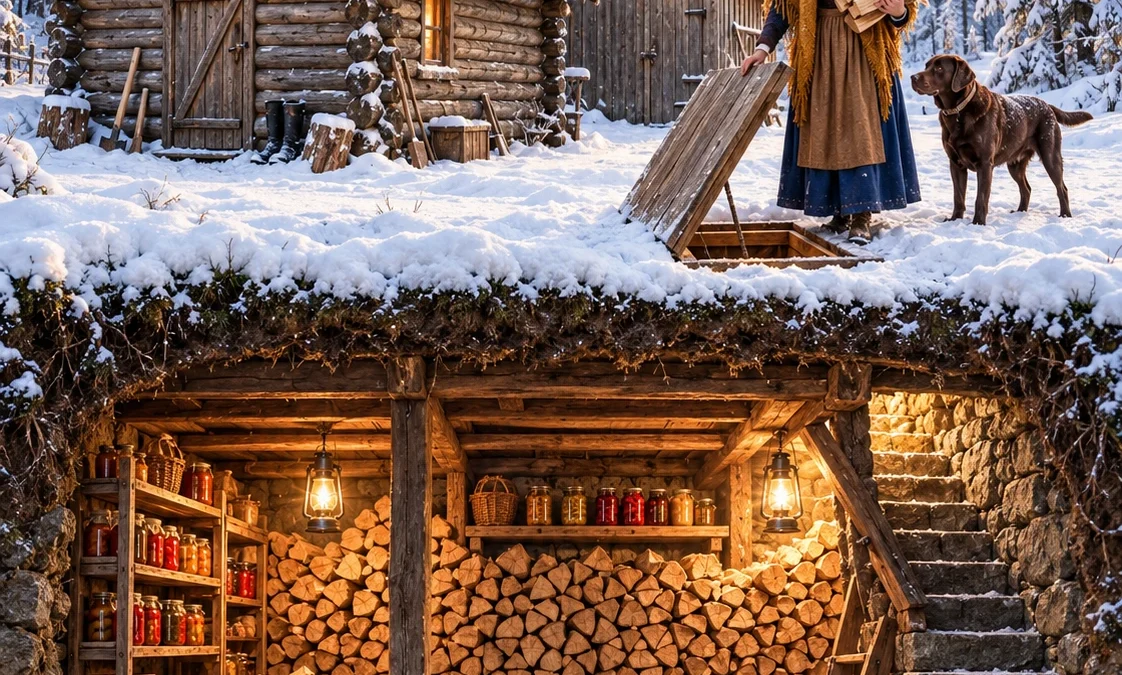
Instead, she spread out a plan scrawled in her own hand: Dig the dugout beneath the storage room — complete before October.
She worked alone, hauling earth in a wheelbarrow by day and studying old homesteader journals by night.
Six to eight feet down, she knew, the ground held a steady warmth — between 45 and 52 degrees — no matter how freezing the wind above.
She lined the walls with cedar posts and oiled canvas, packed the floor tight with clay, and installed a small cast‑iron stove designed to breathe safely in low spaces.
She stacked three cords of white oak and ash — split and drying since April — along the back wall, knowing slow‑burning wood was the difference between surviving and freezing.
But news travels fast in small towns.
By mid‑summer, the new neighbor moved in: Cornelius Algate, 48, wealthy and arrogant, fresh from St.
Louis with a grand house, a $500 furnace, and a wife named Doroththa who wrote for a ladies’ magazine back East.
He built a mansion of plate glass and plaster, convinced civilization meant buying your way out of hardship.
When he saw Hazel digging, he didn’t ask questions — he mocked.
“Where exactly are you planning to come out?” he jeered before his guests at a garden party.
“Seattle? Denver?” Neighbors laughed.
Ward Gilpin, the storekeeper, joined in: “She works hard… for a mole woman.
” The name stuck.
The Mole Woman of Mil Haven.
It wasn’t vicious — not exactly — but it closed doors and minds.
Hazel just kept digging.
Only young Toby Crane, Cornelius’s 19‑year‑old hired hand, watched quietly from the fence line and asked real questions.
“Why white oak?” “Because it burns slow and steady,” Hazel told him.
“Pine gives you two hours.
Oak gives you days.
In a storm, that matters.
”
Then in late July, deep in the earth, Hazel found something that changed everything: a rusted tin box buried beneath the floor, sealed with solder.
Inside lay a journal dated 1863, written by a settler named Ezra Witmore.
Its final entry, written in shaking ink in February 1868, stopped her cold:
“The Carver family — gone.
They had wood, but their chimney froze.
We survived because of the hole.
Dig deeper than you think you need.
Dig deeper than seems reasonable.
The hole is the only thing that never lies.
”
That night, Hazel picked up her pickaxe and dug 18 more inches deeper than she’d ever planned.
Cornelius was furious.
He filed a formal complaint — claiming her digging threatened property values and foundations — and sent the deputy marshal to her door.
Hazel read the law calmly and told him: “Tell him I know it was him.
And tell him I’ve read the statutes more carefully than he has.
” The inspector came, measured, and found nothing wrong.
But Cornelius wasn’t done.
He watched her finish the dugout in October, then hauled in 12 sacks of coal and stacked them in a shed facing north — straight into the teeth of the valley’s fiercest winds — secured only by a thin tarp and two stakes.
“Finished in one afternoon!” he called across the fence, triumphant.
“No digging required!” Hazel looked at the shed, the door, the flimsy ropes — and said nothing.
But her heart sank.
She knew what was coming.
By mid‑February, the sky turned the color of a bruise.
The barometer dropped faster than Hazel had ever seen.
Birds vanished.
Horses whinnied in terror.
She began moving supplies down: food, water, blankets, medicine, her longest rope.
Toby saw her from the stable, looked at the sky, and nodded — he knew, too.
On the afternoon of February 14th, freezing rain began.
It coated every surface in glass‑smooth ice.
Agnes Morfield, the elderly widow down the road, tried to walk to Hazel’s cabin and slipped on her own porch steps — trapped, unable to cross the frozen road.
Toby tied a rope around his waist, crawled on hands and knees across the ice, and guided her to safety at Hazel’s door.
By 4 p.
m.
, the rain stopped — and the temperature plunged.
The wind hit like a physical wall, roaring from the north, howling through the valley.
Hazel herded everyone down through the trapdoor into the dugout.
The storm above sounded distant, muffled by six feet of earth.
The stove glowed warm.
The walls held steady.
Up in the grand house next door, however, Cornelius Algate’s perfect world was collapsing.
His fancy furnace had stopped pushing heat — the external pipe had frozen solid.
The coal shed tarp had been torn away by the gale, the coal soaked and frozen solid.
There was nothing left to burn.
For three days the blizzard raged.
Cornelius burned chair legs, crates, baseboards — anything he could find — while the temperature dropped lower and lower inside his beautiful, fragile home.
Doroththa grew pale, her hands turning blue, her pulse slowing dangerously.
On the third night, she whispered: “Neil… if we stay here, we’re going to die.
”
Cornelius looked at the plate glass windows letting in the cold, at the dead fireplace, at the frozen coal he couldn’t light.
He thought of the woman he’d laughed at — the “mole woman” — six feet underground, warm and safe.
He put on his heaviest coat and stepped out into the white darkness.
He found the fence by falling into it.
He counted every step, terrified of getting lost — just as Hazel’s father had gotten lost, 70 steps from his own door, 24 years before.
He reached her cabin, pressed his freezing hand to the window, and knocked.
Once… pause… again… slower still…
He had no idea if she would open it.
He had called her a fool.
He had mocked her.
He had tried to stop her.
But now, shivering so hard his bones ached, he saw faint golden light glowing from beneath the floorboards — a light that meant life.
He knocked again, weaker this time.
And then — the window swung open.
Hazel stood there, lantern in hand, looking down at him with eyes that had seen too much loss to hold grudges.
Part 2
He collapsed onto the floor, his breath coming in ragged, frozen gasps.
Hazel caught him by the arms and hauled him inside, shutting the door instantly against the screaming wind.
The cold rushed in for a heartbeat and was gone — replaced by the quiet, deep chill of the cabin above, nothing like the warmth below.
“Toby!” she called down through the trapdoor.
“Come up — now!”
The young man appeared seconds later, lantern swinging, already moving before he fully understood.
He saw Cornelius on the floor — pale, lips cracked, coat stiff with ice — and he saw the look on Hazel’s face: calm, urgent, no time for anything but what mattered.
“His wife’s unconscious,” Hazel said, already looping her thickest rope around her waist.
“70 steps across the yard.
I’m going after her.
You hold this end — brace yourself against the table leg.
If I don’t pull twice within 30 minutes, pull the rope in hand overhand.
Whatever comes back… you bring it back.
”
Toby didn’t hesitate.
“I’m coming with you.
”
“You said a rope’s only as good as the person holding the other end,” he said steadily.
“Mr.
Algate can barely sit up.
Agnes can’t pull against that wind.
You need someone at this end who can hold on.
”
Hazel searched his face — really looked — and saw not a boy anymore, but someone who had listened, who had learned, who would not let go.
She tied the knot — strong, secure, one that wouldn’t slip — and handed him the other end.
“Hold fast.
Don’t let go.
And if I signal twice… you pull like your life depends on it, because mine might.
”
She opened the back door.
The wind hit her like a blow, blinding white, stinging cold that stole breath and thought alike.
She stepped out into it, counting each step, hand clamped to the rope, leaning into the gale.
At 22 steps, the rope went taut — Toby bracing, taking the weight, holding firm.
At 41 steps, she found the corner of the Algate house by touch alone.
She pushed through the front door and stopped.
The parlor was a graveyard of failed hope.
Burned furniture heaped around the dead hearth, blankets scattered, every possible thing consumed for warmth.
And there on the floor, Doroththa — still, cold, her skin unnaturally pale, fingers stiff — was barely breathing.
Hazel worked fast.
She stripped away the frozen outer layers, wrapped her in warm blankets from the sled, lashed her securely so she wouldn’t slide off, and then — she saw it.
On the writing table, half‑covered by a fallen shawl, sat a sheet of paper, ink stopped mid‑sentence by the cold:
Hazel stared at those words for two seconds, then pulled sharply — once, twice — on the rope.
The return journey was a nightmare.
The sled caught on a ridge of ice halfway across the yard.
Hazel pushed with everything she had, lungs burning, vision blurring, while Toby hauled from the cabin, his feet braced, hands raw and bleeding.
For a terrifying moment, they were stuck — the wind howling, the ice holding fast — and then the sled broke free.
She stumbled through the open door at last, falling to one knee, gasping, and Toby dragged them both inside.
“Downstairs — now,” she rasped.
“We have to get her downstairs.
”
They carried Doroththa between them, step by careful step down the steep wooden staircase into the dugout.
The warmth wrapped around them instantly — steady, golden, radiating from every wall.
Agnes stood waiting beside the stove, hands folded, ready.
They laid Doroththa close to the fire, and Hazel went to work — hot stones wrapped in cloth against her sides, rubbing life back into frozen limbs, watching the pulse at her neck.
Cornelius sat on the packed clay floor, staring at the stacked oak wood along the wall — three cords, perfectly cut, perfectly stacked — and at the stove glowing steadily, and at the walls that held the heat without even trying.
He had laughed at this place.
He had tried to destroy it.
And now it was the only thing keeping his wife alive.
Hours passed.
The storm howled above, unrelenting.
Slowly — so slowly they barely dared breathe — color returned to Doroththa’s cheeks.
Her breathing deepened.
She opened her eyes.
Cornelius leaned forward, reaching for her hand — and then stopped.
Hazel stood by the stairwell, listening.
The wind had shifted.
It was changing… weakening… but not before one last, violent gust shook the earth itself.
Part 3
Three days passed before the wind truly died.
It didn’t taper off — it simply stopped, between one breath and the next, leaving a silence so absolute it felt like something new.
All five woke at once, listening, disbelieving.
The roar that had filled every corner of their world was gone.
Hazel climbed the stairs first and pushed against the trapdoor.
It wouldn’t budge — drifted snow had buried it from above.
“East window,” she called back down.
“Faces away from the drifts.
”
It took nearly an hour to dig their way out.
When Hazel finally pulled herself through the opening and stood upright, she froze.
The valley was gone — vanished beneath a vast, blinding sea of white.
Fences, roads, roofs, trees — all buried.
The world was nothing but snow and sky and silence.
Toby emerged beside her, blinking.
“I… I don’t know where the road is.
”
“Neither do I,” Hazel said quietly.
“But it’s still there.
Underneath.
”
Cornelius appeared next, squinting toward where his house should be.
Only the roofline peeked above the drifts — a dark, broken line against the white.
He stood motionless for a long time, seeing it all for what it was: the beautiful, expensive, civilized life he had built… buried, just like everything else that couldn’t bend.
By afternoon, riders came — the rescue party from Helena, pushing through the deep snow.
Leading them was Ward Gilpin.
He reined in when he saw them — five people, standing upright on top of the buried cabin — and sat his horse in silence for a long moment before dismounting.
He walked toward Hazel slowly, hat in hand.
“I’ve told folks for 30 years,” he said, his voice rough with something like shame, “that a tarp and a stack of wood is all you need for a Montana winter.
I believed it.
I said it to you.
And I was wrong.
” He paused, then gestured toward the dugout.
“I’d like to see it — if you’ll show me.
”
Later, at the rescue station, the medic checked them one by one.
Doroththa was weak but recovering — her circulation had returned, no permanent damage done.
Agnes was declared “remarkably sound for 65.
” Toby’s hands had frostnip that would heal.
Cornelius had a deep cough that needed watching — and a look in his eyes that said he would never be the same.
When Hazel returned from showing Ward the dugout, Cornelius was waiting for her by the edge of the camp.
He set down his tin cup carefully in the snow, as if it were something precious.
“Mrs.
Voss,” he began, then stopped.
He looked at the ground, then back at her.
“I owe you my wife’s life.
I owe you mine.
” His voice shook.
“I was a fool.
Not just once — from the very first day.
I mocked what I didn’t understand.
I tried to stop you because every time I saw you working, I felt… I felt something I couldn’t name.
I know now what it was.
It was fear.
Fear that I had built everything on the wrong foundation.
”
He took a breath.
“I filed that complaint.
I knew there was no real danger.
I just wanted you to stop.
Because if you were right… then I was wrong about everything.
”
Hazel watched him — really watched — the man who had stood tall and loud and sure of himself, now humbled, stripped bare by the storm he hadn’t believed could touch him.
“You came to the window,” she said gently.
“That was the hardest part.
Everything after that was just work.
”
He nodded, tears freezing on his cheeks.
“I don’t have words big enough.
But I’ll spend the rest of my life trying to make them matter.
”
“Go be with your wife,” Hazel said, placing a hand briefly on his shoulder — not forgiveness, exactly, but something deeper: acknowledgement.
“You’re here.
That’s the beginning of what comes next.
”
Cornelius rebuilt — but not the same way.
The plate glass came out, replaced by smaller, sturdy windows.
The thin plaster gave way to insulated walls and log lining.
The coal shed moved to the south side, door facing east, reinforced roof, proper drainage.
And beneath the back porch, he dug his own dugout — not as large or as fine as Hazel’s, but his own work, done with his own hands.
Every Saturday morning, the sound of his axe rang across the fence — steady, patient, splitting oak and ash, stacking them to dry, preparing honestly for the winter ahead.
He never asked for advice.
He didn’t need to — he had seen the truth.
Doroththa never sent that original article to the magazine.
Instead, she filled a wooden box with pages of honest, quiet writing — about what civilization actually means, about strength that doesn’t shout, about people who survive not by rising above the earth but by sinking roots deep into it.
Her final line that spring said it all: Civilization is not what you build.
It is what remains when everything you built is gone.
Agnes planted purple mountain asters along her fence line — right where Toby had crawled on his hands and knees across the ice to reach her.
She didn’t explain it to anyone.
She didn’t need to.
The memory of the Harpers — the family who had knocked in the dark and been turned away — would always be with her.
But it no longer weighed her down.
It had become something she could look at, and live with, and grow flowers beside.
Toby stayed.
He told Cornelius he wouldn’t be coming back — and then asked Hazel if she needed help.
“The pay is poor,” she warned him.
“The work is hard.
” He grinned.
“I don’t have expensive habits.
” By summer, he was her right hand — expanding the dugout, helping other families in the valley build their own safe spaces, teaching what he had learned.
He had found his place.
And Hazel? She sat on her back step one warm May afternoon, coffee in hand, watching the valley wake up.
The aspens were budding green.
The sky was clear and blue.
Somewhere, a meadowlark sang.
Across the fence, Cornelius split wood — steady rhythm, blow after blow.
Inside, Doroththa wrote quietly.
Down the road, Agnes watered her flowers.
She thought of her father, lost 70 steps from his door in 1862.
She thought of Ezra Witmore, writing his warning in the dark.
She thought of all those who had come before — digging deeper, trying harder, leaving light for those who would follow.
She had gone deeper than anyone thought reasonable.
And those extra inches had held them all.
The barometer needle sat steady — fixed, calm, pointing to fair weather.
But Hazel knew.
Winter would come again.
It always did.
And that wasn’t a threat.
It was just the truth.
She lifted her coffee cup, took a slow sip, and smiled.
The work was waiting.
There was always more to do before winter.
And this time — everyone was getting ready together.
This story is entirely fictional and created for entertainment purposes only.
It does not represent any organization or individual, nor does it encourage inappropriate behavior.
The content was generated with AI assistance.








