HE ORDERED HIS WIFE TO EAT WITH THE SERVANTS IN FRONT OF 112 GUESTS… THEN THE QUEEN OF ENGLAND PICKED UP HER SKIRTS AND WALKED TOWARD HER TABLE 😱👑
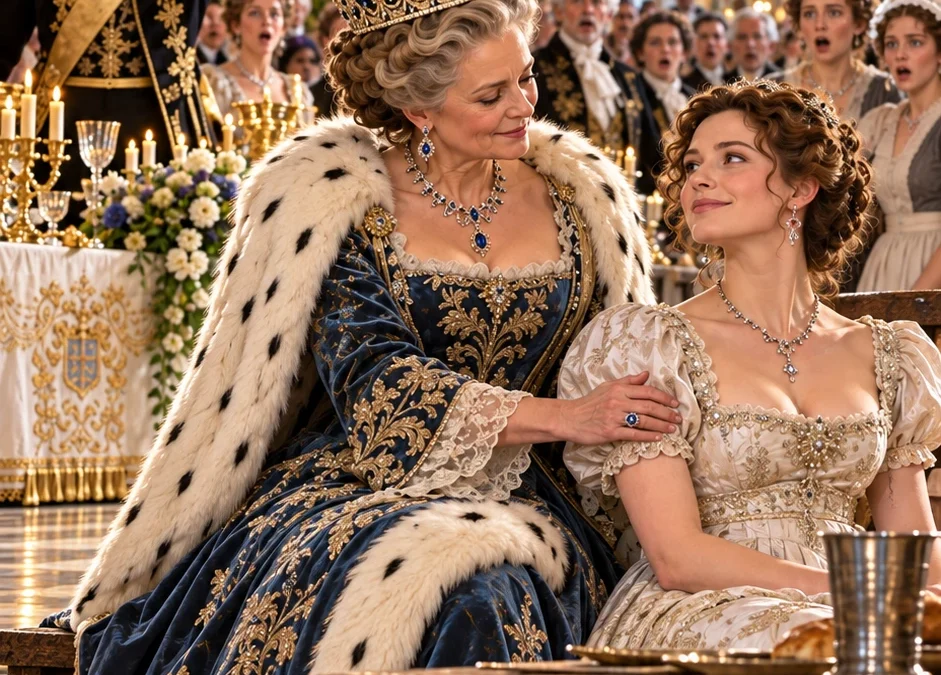
HE ORDERED HIS WIFE TO EAT WITH THE SERVANTS IN FRONT OF 112 GUESTS… THEN THE QUEEN OF ENGLAND PICKED UP HER SKIRTS AND WALKED TOWARD HER TABLE 😱👑
Part 1
There were 112 guests at the Duke of Wexley’s banquet, and every one of them heard it.
“Go and eat with the servants.”
He did not shout. The Duke of Wexley never shouted. He said it in the cold, clear voice he used on his coachmen, standing at the head of the great table with a glass of wine in his hand and the light of 400 candles on his face.
“You have embarrassed me enough for one evening, Helena. Go and eat with the servants. It is where you belong.”
The hall fell silent. 😶
It was the most magnificent room in Wiltshire. The ceiling was painted with gods and clouds. Six chandeliers blazed overhead. Earls, countesses, two bishops and the Lord Chamberlain sat in their finest silks. At the center of the high table, in a gilded chair of crimson velvet, sat Queen Charlotte of England.
She had arrived that afternoon to stay for three days. It was the greatest honor any house in England could receive. The Duke had spent eight months and eleven thousand pounds preparing for it.
At the place of honor beside him, where a wife should have sat, was a golden-haired woman in silver silk: Lady Cressida Bayne, his mistress. Everyone in the hall knew it.
At the far end of the table sat Helena, the Duchess. She was twenty-seven, with dark hair pinned plainly and a calm, forgettable face. Her pale lavender gown was the only good one she owned, and she had altered it twice.
She did not cry. She noticed, distantly, that she hadn’t.
She felt 112 pairs of eyes turn toward her. She saw Lady Cressida raise her glass to hide a smile. And she saw the Queen of England slowly turn her head and look at her.
Helena set down her fork. She folded her napkin exactly as she had been taught as a girl.
“Of course, Your Grace.”
Then she walked the entire length of the hall, past the staring faces, past the silent musicians, to the plain scrubbed table by the service door where the senior servants ate. A dozen of them froze mid-bite.
“Good evening, Mrs. Pell,” said Helena, taking a stool. “Would you be so kind as to pass the bread?”
The housekeeper’s hands shook as she did.
At the high table, the Duke smiled coldly, as if a small inconvenience had been dealt with. Lady Cressida laughed behind her fan.
But how did the Duchess of Wexley end up at that table? And why was the Queen of England watching her so closely? 👀
Two years earlier, Helena had been a poor clergyman’s daughter turned governess, eating from trays in other people’s schoolrooms. Then the Duke summoned her to a library.
“I need a wife,” he said, as coldly as if he were discussing a lease. “I do not want one. My grandmother’s will leaves me sixty thousand pounds, but only if I am married by my thirty-second birthday and live under the same roof as my wife for part of every year. You will live quietly. You will be invisible.”
Helena thought of the trays and the six years of belonging nowhere.
“May I ask one thing, Your Grace? The gardens of Wexley Court. May I tend them?”
He gave a short, surprised laugh. “Plant cabbages in the ballroom for all I care, so long as I never have to hear of it.”
They married in eleven minutes. In two years, he spent twenty-one days under her roof.
And Helena spent every dawn in those ruined gardens. She hacked through briars until her hands bled through her gloves. She freed forgotten roses from the thorns. She coaxed eleven orange trees from a single green shoot that everyone swore was dead.
The Duke never knew. Then a letter came from Windsor: the Queen herself, famous for her love of gardens, would visit to see the restored roses.
The Duke raged. He claimed the credit and ordered Helena silent.
That afternoon, the Queen stopped before a crimson rose with a golden heart. “Where did you find it, Duke?”
“It has always been here, Majesty.”
The Queen gave him a long, polite look. “I see.”
Now, at the banquet, oranges were served, grown from the very tree Helena had saved. When the Queen asked about them, the Duke lied again. Helena finally spoke the truth from the end of the table. And the Duke gave his order a second time, loud and cold, in front of everyone.
Helena had walked to the servants’ table with her head high.
And then the Queen of England stood up. 👑
💬 Want Part 2? Comment “PART 2” or leave any word below and I’ll send it to you privately. Don’t miss it!
Part 2
And then the Queen of England stood up. 👑
Everyone in the hall rose with her. That was the rule: no one may sit while the Queen stands. A hundred and twelve chairs scraped across the stone floor at once. The musicians scrambled to their feet. The servants froze where they were.
The Duke rose too, smiling faintly. He thought, perhaps, that she was leaving, offended by his wife’s impertinence. He bowed.
“Majesty, I apologize for my wife. She forgets herself.”
The Queen did not even look at him.
She stepped down from the high table, a small, elderly woman in deep purple, and began to walk. Slowly. Her skirts swept the stone. Her ladies hurried after her, pale as candle wax. She walked the whole length of the hall between the long tables, past 112 motionless guests, toward the plain wooden table by the service door.
Helena was still holding her bread.
The Queen stopped in front of her. “Sit, my dear.”
Helena stared. “Sit,” said the Queen again, gently. “Please.”
Helena sank back onto her stool. And Queen Charlotte gathered her purple skirts in both hands and sat down on the rough wooden bench beside her, between the butler, the housekeeper and the ladies-in-waiting, in full view of the entire great hall.
Nobody breathed. 😳
She turned to the butler, who stood frozen against the wall with a tray of rolls. “Would you be kind enough to bring my plate from the high table? And my glass. I find I prefer to dine here.” She paused. “And bring the oranges.”
The butler didn’t move for a full second. Then he bolted toward the high table as if the hall were on fire.
The Queen turned back to Helena, her sharp old face softening.
“Now tell me about the crimson rose by the south wall. I asked your husband where it came from. He said it had always been there.” Her eyes held Helena’s. “I did not believe him. I think you know where it came from.”
Helena’s voice trembled. “I found it two springs ago, Majesty, under eight feet of brambles. Even Mr. Reed didn’t know it was there. I didn’t know what it was. I only knew it was alive.”
“With your own hands?”
“Yes, Majesty. It took me three days.”
The Queen was silent for a moment. “That is the China Crimson,” she said quietly. “A sea captain brought one cutting to England the year I was crowned. It was given to the old Lady Wexley. I was told for forty years that it died with her.” She looked at Helena. “It is the only one in Europe, my dear. You saved it.”
Helena couldn’t speak. The butler returned, hands shaking, and set the Queen’s plate, glass and silver dish of oranges on the scrubbed table between the bread and the cold meat.
The Queen lifted an orange and turned it in her fingers. Then, for the first time since she had left the high table, she looked back down the long hall at the Duke of Wexley.
He was still standing. They all were. Beside him, Lady Cressida had turned the color of her silver silk.
“Duke,” said the Queen of England.
Her voice wasn’t loud. It didn’t need to be. Every word reached the painted ceiling.
“You told me this afternoon that these gardens were restored under your direction. You told me tonight that these trees came from Lisbon.”
She raised the orange.
“I have now met the person who truly restored them. And I find…”
💬 Want to know what the Queen said next, and what it cost the Duke? Like and comment “REVEAL” below. Part 3 will be posted once we reach enough comments! 🔥
Part 3
“…I find that I much prefer to dine with her than with you.”
The Queen set the orange down.
“Please,” she said to the whole hall, “sit, all of you, wherever you like.”
For a long moment, nobody moved. 112 people in silk and jewels looked from the empty high table to the plain wooden one by the service door and back again. Every one of them understood exactly what wherever you like meant. Every one of them understood what choosing would say.
The first to move was the Bishop of Salisbury, a stout, red-faced man of seventy. He had wandered into the rose garden the autumn before because an old gardener invited him, and he had written to the Queen about what he saw. He took up his plate and glass, crossed the hall, and sat on a bench across from Mrs. Pell.
“I wished to meet that gardener eight months ago, Your Grace,” he told Helena warmly. “Nobody would tell me who it was.”
The second was Lady Ramsey, the Duke’s own sister. She stood from her place three seats from her brother without so much as a glance at him. She was a tall, quiet woman in gray, and Helena had taught her daughters for two years. She carried her plate across the hall and sat on Helena’s other side.
“I am ashamed of him,” she murmured, so only Helena could hear. “I have been ashamed for two years. I should have said so long ago.”
After that, it was like a dam breaking. 🌊
They came in twos and threes, then in dozens. The Lord Chamberlain. Two countesses. The Queen’s own ladies. The two country baronets who had sat beside Helena at the end of the high table. Even the Duke’s deaf old uncle, who had not heard a word of any of it, saw everyone else going and followed.
When the benches ran out, the footman, grinning, hauled another plain table in from the servants’ hall, and then another. By the time the oranges were finished, forty people were crowded around the servants’ tables of Wexley Court. The Queen of England sat in the middle of them. The butler, the housekeeper and the ladies-in-waiting were squeezed between earls and countesses, too stunned to know whether to sit or stand.
And at the high table, beneath the painted ceiling and 400 candles, the Duke of Wexley stood beside an empty chair of crimson and gold.
Lady Cressida Bayne remained at his side. For a while.
She was a clever woman. She had always been clever. She looked at the empty high table. She looked at the packed servants’ tables, where all of fashionable England laughed and passed oranges to the Queen. Then she looked at the man beside her.
She picked up her fan. “I believe I have a headache, Hugo,” she said, low and cold.
She left through the side door without looking back.
The Duke stood alone for the rest of the banquet. He couldn’t sit, since sitting would look like accepting it. He couldn’t walk to the other tables, since there was no room, and since he would have had to beg for a place in front of his wife and the Queen. So he stood for an hour and fifteen minutes while the musicians played and forty people laughed and the Queen talked to his wife about roses.
Helena did not look at him once.
The Queen stayed three days, as planned. She spent nearly all of them in the gardens with Helena, leaning on her cane, old Amos Reed a respectful step behind. She asked real questions, the questions of a woman who had spent fifty years growing things. How had Helena kept the cuttings alive through winter? What had she fed the old roses to make them bloom again? Why had the orange grafts taken when the books said they never would?
Helena answered cautiously at first. By the second morning she answered without thinking, the way she once spoke to her father in the rectory garden. She realized the Queen was the first person since his death who wanted to know what she knew.
The Duke was never invited. Nobody said so. He simply found each morning that the Queen’s party had already gone out, and when he followed, the conversation stopped, politely, until he left.
On the third morning, in the orangery among the eleven young trees, the Queen sat on a bench and asked Helena to sit beside her.
“My dear, I have a garden at Frogmore. It is mine, not the King’s, not the nation’s. I go there when I want silence.” She paused. “My head gardener of twenty years retires at Michaelmas. He is a good man, but he would never have found the China Crimson under eight feet of briars. He would never have kept searching a dead tree for one green shoot.”
Helena sat very still.
“I would like you to take his place. Not as a servant, but as Keeper of my garden. A house comes with the post, with its own walled garden. A salary of four hundred pounds a year, paid from my own household, in your own name.” The old face was stern and plain. “I am told I cannot appoint a married woman without her husband’s consent. I have never paid much attention to what I am told I cannot do. But I thought I should ask you first.”
Helena thought of the schoolroom trays, and the six years of belonging nowhere. She thought of two years of being invisible, and a voice in a library saying plant cabbages in the ballroom. She thought of the Queen lifting her purple skirts to sit beside her on a servants’ bench.
“Yes, Majesty,” she whispered. “If he allows it.”
“Oh,” said Queen Charlotte, rising with the help of her cane, “I think you will find he does.”
He did not.
He told her so that very night in the library, after the Queen’s carriages had vanished down the drive. He did not raise his voice. He was pale, standing by the fire with an untouched brandy in his hand. He said a wife goes where her husband sends her. He said that if she thought he would let the Duchess of Wexley work for wages in anyone’s garden, even the Queen’s, she was a fool.
“You humiliated me before the Queen,” he said. “Before all of them. In my own house.”
“No, Hugo,” said Helena. “You did that yourself. I only told her where the oranges came from.”
His hand tightened on the glass. “You will stay here at Wexley, out of sight, or you will go to Northumberland. Those are your choices.”
Helena studied her husband for a long moment in the firelight. Then she said, “Hugo, have you read your grandmother’s will?”
He stared at her.
“I have,” she said. “Your sister showed it to me the night of the banquet.” She folded her hands. “The sixty thousand pounds, the London house, the best of the land. They come to you only if you live under the same roof as your wife at Wexley Court for part of every year. For the rest of your life. If you do not, it all goes to your sister’s daughters.”
The Duke went white.
“If you send me to Northumberland, you will not be living under my roof. Nor will you if I go to Frogmore without your consent and you refuse to reach terms with me.” She met his eyes. “So I think we had better reach terms.”
The agreement was drawn up by Lady Ramsey’s own solicitor from Salisbury, a dry, careful old man who read the dowager’s will three times and then looked at the Duchess over his spectacles with deep respect. It took two weeks. Helena wrote every line herself at the writing desk in the morning room, with Lady Ramsey on the sofa reading over her shoulder.
The terms were these. Helena would take the post of Keeper of the Queen’s Garden at Frogmore, with her husband’s written consent. She would live in the house that came with it. Her salary would be paid into an account in her own name, and the Duke would never touch a penny. Each year, for the first two weeks of June, when the roses were at their height, she would return to Wexley Court and live under his roof. That would satisfy the old duchess’s will, and he would keep his sixty thousand pounds.
And the gardens of Wexley Court would be hers. Hers to plant and hers to prune, in his presence or his absence. Old Amos Reed would have a house and a pension for life. Eight under-gardeners would be hired at the estate’s expense, and the Duke would have no say in any of it.
Helena read the last clause aloud on the morning he signed.
“In the gardens of Wexley Court, His Grace shall be a guest.”
The Duke stared at that line for a very long time. His face was gray. His valet said he hadn’t slept properly since the banquet. Then he picked up the pen and signed.
He didn’t look at her. But as she folded the paper and turned to go, he said, without lifting his head, “How long did it take? The rose garden?”
She paused at the door. “Two years,” she said. “Every morning.”
He said nothing. She went out and closed the door behind her.
London heard the story within a week. Forty people had sat at the servants’ tables, and seventy-two more had watched from the long tables. Every footman and maid in the great hall told every footman and maid they knew. By the end of June there wasn’t a drawing room in London that hadn’t heard how the Duke of Wexley ordered his wife to eat with the servants, and how the Queen of England sat down beside her.
By July, the cartoonists had it. The most famous drew a long banquet table, completely empty except for one tall, haughty figure in a gold sash at its head, cobwebs growing across the silver around him. On the other side of the picture, a plain wooden table overflowed with laughing people in crowns and coronets, squeezed in among footmen and maids, passing round a bowl of oranges.
The caption read: “The Duke Dines Alone.”
The name stuck. For the rest of his life, in the clubs and salons of London, they called him that behind his back. Never to his face. The Duke Who Dines Alone.
Lady Cressida Bayne never visited him again. She married a rich, elderly banker that autumn and moved to Bath. And the doors of the Queen’s houses at Windsor, Kew and St. James’s closed quietly to the Duke of Wexley. Nobody refused him anything. He simply found that invitations did not arrive, that the Queen was always busy when he came to court, and that there was always a reason he could not be presented that day.
He went back to London and lived alone in his house on Grosvenor Square. He had his sixty thousand pounds. It did not seem to make him happy.
Helena went to Frogmore at Michaelmas. It was a white house in a green park, a few miles from Windsor Castle, with a long still lake and a hundred acres of gardens the Queen had made herself over thirty years: lawns and groves, temples and ruins, flowerbeds, a great kitchen garden and a long glasshouse full of plants from every corner of the world.
The house that came with the post was a lovely red-brick cottage at the edge of the kitchen garden, with roses around the door and a small walled garden of its own. It was the first house she had ever been able to call hers.
That first evening she stood on the threshold with her trunk on the step and the autumn light gilding the lake, and for a long time she couldn’t make herself go in. She simply stood there, taking it in.
She worked at Frogmore for twenty-six years. She was in the garden at dawn every day in a plain brown dress and leather gloves, and didn’t go indoors until the light failed. She learned every bed in that great garden. She revived plants the old head gardener had let die. She grew things that had never grown in England.
And twice a week, when she was in residence, the Queen drove down from Windsor in her little pony carriage and walked the garden with her, slowly, leaning on her cane, asking questions. They became friends. Helena never knew another word for it. An old queen of seventy and a Somerset vicar’s daughter, walking together among the roses, arguing.
In her first spring, Helena took cuttings from the China Crimson at Wexley and grew them on at Frogmore. In her second, she sent three young plants to Kew, the first living specimens of that rose anywhere in Europe outside the south wall of Wexley Court. The botanists wished to name it for the Queen. The Queen refused.
“No,” she wrote in her own hand in the margin of their letter. “It shall be called the Duchess of Wexley. She found it under eight feet of brambles and freed it with her own hands. I merely sat beside her.”
And every June, Helena went home to Wexley Court.
She went because she had promised, and she always kept her promises. She went because June was when the roses were at their height, and the rose garden at Wexley was still the loveliest thing she had ever made.
The Duke came too. He had to. The will required it. For the first few years they hardly spoke. She lived in the east wing and he in the west. They dined together, because the servants would talk if they didn’t, in silence, at opposite ends of the long table. She spent her days in the gardens with old Amos, the new under-gardeners and the village boys who were men now. He spent his days riding, or in the library, or standing at the library window looking down at the terrace.
He never went into the gardens. The agreement said he was a guest there, and he behaved like one who had never asked to be invited.
Then, on the sixth of June of the sixth year, on a still, warm evening, with the sun sinking over the lime walk and the whole rose garden glowing crimson, gold and white in the last light, Helena looked up from the bed she was weeding and saw him standing at the gate.
He was forty now. He looked older. There was gray at his temples and something in his face that hadn’t been there before: something tired, quieter, less certain.
He did not come in. He stood at the gate in the wall with his hands at his sides, and for a long moment neither of them spoke.
“May I come in?” said the Duke of Wexley.
Helena straightened slowly, trowel in her gloved hand. In six years he had never asked her for anything. He had told her, ordered her, decided for her. He had never once asked.
“You may,” she said.
He walked slowly along the gravel path between the beds, looking at the roses as though he had never seen them before, which, she supposed, he hadn’t. Not really. At last he stopped in the corner by the south wall, before the tall, arching bush covered in small, flat, crimson blooms with a heart of gold.
“This is the one,” he said quietly. “The one she asked about. The Duchess of Wexley. I saw it in the Kew catalogue.” He didn’t look at her. He was looking at the rose. “I told her it had always been here.”
Helena said nothing.
“Where did you find it?” said the Duke. “Truly. I never asked.”
And Helena understood, standing there in the evening light by the old south wall, that it was the first real question he had ever put to her. Not an order, not a test: a question from a man who wanted to know the answer.
“There,” she said, pointing her trowel at the foot of the wall, “under eight feet of brambles. It took me three days to free it. I didn’t even know what it was. I only knew it was alive.”
He looked at the rose for a long time.
“May I pick one?” he said at last.
Helena looked at him: at the gray in his hair, at the quiet, tired face, at the empty hands. She looked at the man who had stood alone at the head of his own table for an hour and a quarter while all of England laughed at the servants’ tables.
“No,” she said, not unkindly. “You may look, Hugo. You may not pick.”
He was silent. Then, to her surprise, he nodded slowly, as if it were only fair.
“That seems right,” he said.
He stood beside her a little longer, watching the rose as the sun went down and the light turned from gold to red to gray. Then he bade her good night, walked back along the gravel path, out through the gate in the wall, and up the terrace steps to the house.
He did not ask again that year. But the following June, on the first evening, he was at the gate again. He asked again. She let him in again, and he walked beside her through the rose garden, asked about the old French roses, and listened to the answers. He never picked one. She never offered.
It was not forgiveness. Helena was careful, all her life, never to call it that. It was something smaller and simpler: a man learning, far too late, to ask before entering a garden that was not his.
Queen Charlotte died in the seventh year Helena was at Frogmore. In her will, she left Helena a single bequest, written in her own hand: a silver dish. It was the one that had held the oranges at Wexley Court on the night of the banquet, which she had quietly asked the Duke’s butler to send to Windsor afterwards.
Engraved on the bottom, in small, plain letters, were the words:
“To the keeper of my garden, who found what everyone said was dead, and kept looking.”
Helena kept it on the table in her cottage at Frogmore for the rest of her life. In summer she filled it with roses. In winter she filled it with oranges.
And on the south wall of the walled garden at Frogmore, where the Queen used to sit on a stone bench in the afternoons with her cane, there grew a tall, arching bush covered in small, flat, crimson flowers with a heart of gold. It came from a cutting, from a cutting, of a rose that once grew in the corner of a wall in Wiltshire. A vicar’s daughter found it under eight feet of brambles, in front of 112 guests she was ordered to eat with the servants, and she did.
That is the story of Helena, Duchess of Wexley: the woman who was sent to the servants’ table, and found the Queen of England sitting down beside her. 🌹👑
This story is entirely fictional and created for entertainment purposes only. It does not represent any organization or individual, nor does it encourage inappropriate behavior. The content was generated with AI assistance.








