HE POURED HIS LAST DROP OF WATER INTO A DYING APACHE MOTHER’S MOUTH AND RODE HOME THIRSTY… SIX DAYS LATER, 14 RIDERS SURROUNDED HIS RANCH AT DAWN, AND THE WOMAN HE SAVED STEPPED DOWN AND SAID ONE SENTENCE THAT CHANGED HIS LIFE
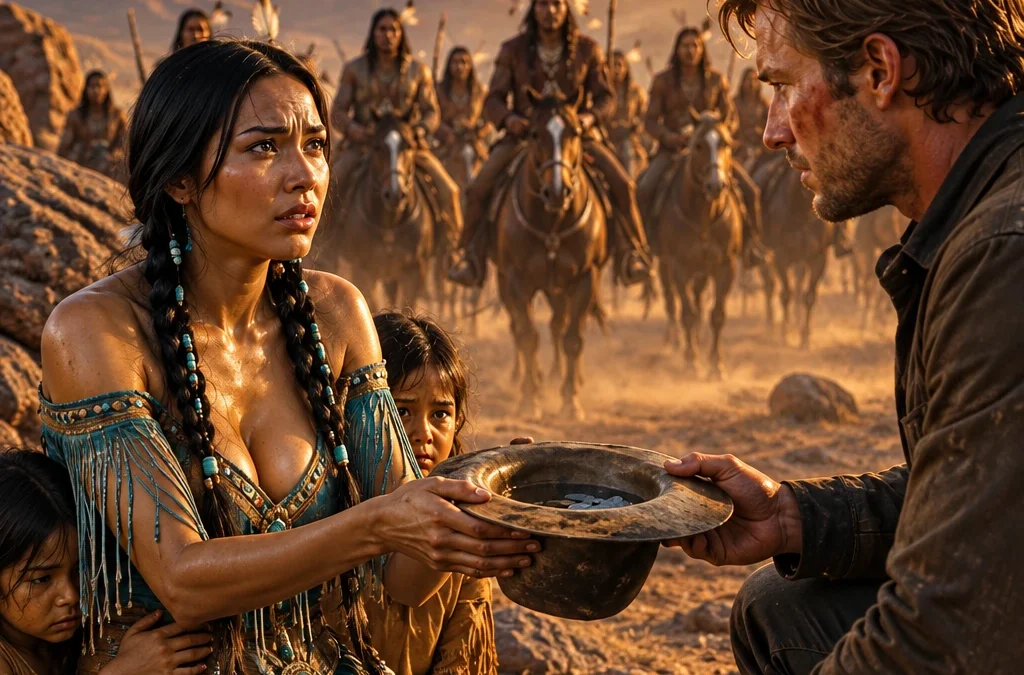
HE POURED HIS LAST DROP OF WATER INTO A DYING APACHE MOTHER’S MOUTH AND RODE HOME THIRSTY… SIX DAYS LATER, 14 RIDERS SURROUNDED HIS RANCH AT DAWN, AND THE WOMAN HE SAVED STEPPED DOWN AND SAID ONE SENTENCE THAT CHANGED HIS LIFE 😱🏜️
Part 1
One swallow of water. 🌵
That was all Levi Hardin had left in his canteen.
He was thirty-one that summer of 1881, a rancher known up and down the Sable Creek valley for two things: the honesty of his word, and the stubbornness of his refusal to sell.
His spread sat along Antelope Creek, fed by the one dependable spring for twenty miles in any direction. For nearly a year, a cattle buyer named Emmett Rourke had ridden out from town with offers that climbed higher every time and sounded colder every time Levi said no.
Three weeks before the cattle drive, Rourke had sat his horse at the yard gate with a smile that never reached his eyes.
“Last offer, Hardin. Triple what any honest man would pay for dry grass and one lucky spring.”
Levi leaned on the fence rail and shook his head, unhurried.
“That spring feeds six outfits besides mine. Sell it to you, and five other families go dry the first bad summer you decide water’s worth raising the price on. I’ll pass.”
Rourke’s smile thinned. It was the first crack Levi had ever seen in it. He rode off without another word, and Levi knew the offers were finished.
Something a good deal less patient was coming.
His father had dug and walled that spring thirty years ago, in a drought so hard that half the valley’s small outfits went under before the water was found and shared free among everyone still standing. Levi had grown up on that story. Some things a man is given aren’t his to hoard. Only his to keep safe for whoever needs them next.
He didn’t know yet that the same inheritance was about to lead him to a canyon where a dying stranger needed exactly that kind of man.
He had spent the week driving forty head of cattle to the rail depot at Prescott Junction and was riding home alone, three long days across open desert with a bedroll, a rifle, and a canteen that had gone from full to nearly empty by the second sunrise.
The heat that summer had a mean, dry weight, pressing on his shoulders until the far hills swam in the shimmer.
Then he heard it.
Thin. Ragged. Carried hollow on the hot wind out of a canyon mouth he’d passed a hundred times without a glance.
Crying.
Blackrock Canyon cut down through red stone on the west side of the trail, narrow and shadowed at its throat. A man rode past it without thinking, because there was never anything in it worth the detour.
Levi reined up anyway.
A hurried man would have mistaken it for wind through rock, or a coyote pup. But something in the pitch of it was high and human and frightened in a way no coyote ever sounded.
He turned his horse down into the shadowed cut before he had fully decided to.
Thirty yards in, tucked into a thin slice of shade beneath a red overhang, he found them.
A boy, no older than five, crouched over a woman sprawled motionless in the sand, tugging at her sleeve and crying in a language Levi didn’t know. He understood it anyway. It was the universal grammar of a frightened child. 😢
The woman was young. Apache. Dark hair fanned across the sand, lips cracked pale, skin flushed a deep, dangerous red under a layer of trail dust.
She wasn’t moving.
For one cold, dropping second Levi thought he’d come too late.
Then her chest rose. Shallow. Slow.
He was off his horse and on his knees beside her before the thought finished forming.
Her eyes opened at his touch, glassy, fighting a fever that had her burning even in the shade. She looked past him first, straight to the boy, and whatever strength she had left she spent entirely on him.
“Please,” she managed, in careful, broken English that must have cost her everything. Her hand closed weakly around the boy’s small wrist instead of her own throat. “My son. Save him. Please… save my son.”
She said nothing about herself. Not one word.
As though her own life had stopped mattering the moment she understood she couldn’t fetch water for the boy any longer.
It was that, more than the fever, more than the cracked lips, that Levi would carry the rest of his days.
He unhooked his canteen with hands gone fast and sure and shook it once against his ear.
One swallow. Maybe less.
Three days of careful rationing, boiled down to one mouthful of warm, canvas-tasting water standing between him and the last twelve miles of trail to his own well.
He didn’t think about the twelve miles.
He tipped the canteen, careful and unhurried despite his hammering heart, and let the last of his water fall drop by drop across her lips. He watched her throat work to swallow it, and felt something in his own chest loosen like a fist finally letting go. 💧
Color crept back slowly. Her eyes found his properly, with an intensity that had nothing left of delirium.
“The Great Spirit will never forget your kindness.”
It was more a vow than a thank-you.
Levi shook his head, uncomfortable the way plain men always are when thanked for the one thing any decent soul would have done.
“Don’t need remembering for it. Just need you and the boy someplace with shade and real water. Quick.”
He lifted her the way a man lifts something he’s afraid of breaking, and the boy followed close at his boot heel all the way to the horse.
He didn’t dare risk the long ride home. Instead he turned toward a small mission chapel two miles nearer, tucked at the foot of the ridge, where gray-robed Sisters kept a well that never ran dry and a cool stone room for exactly this kind of trouble.
The Sisters needed no explanation. They laid the woman on a cot by the window, worked cool cloths across her brow, and coaxed slow sips past lips that had been cracked bone-dry in the sand an hour before.
She slept through most of that first day and into the next, her body claiming back everything the desert had nearly taken, while her son kept a small, stubborn vigil at her bedside.
Levi never learned her name in that rush.
But before he rode on toward home that evening, the boy dug in a small pouch at his belt and pressed something pale and light into Levi’s palm.
A single eagle feather, its quill worn smooth from handling. Plainly a treasured thing, given up without a second thought.
“Mama says good men always find their way back.”
He said it solemn as a much older person.
Levi didn’t have the first notion what to say. He only closed his fist gently around the feather and promised he’d see them both again soon. He meant it more than he’d meant almost anything in a long while. 🪶
Six days passed quiet on the Hardin ranch.
Levi worked the fence line. Broke a young mare he’d been putting off for a month. And more than once, in the idle stretches between chores, he thought about the woman in the canyon and the boy’s small face, and the feather he’d taken to carrying in his shirt pocket without rightly meaning to.
He assumed he would never see them again.
He was wrong. And the valley found out how wrong on the sixth morning, when the low thunder of many hooves rolled up out of the east before the sun cleared the ridge.
His foreman Otis came pounding on the door before Levi had his boots laced, white around the eyes. “Riders! A great many of them, coming fast, coming armed!”
Levi stepped onto the porch with his rifle, heart going hard, half expecting Rourke’s men, half expecting worse.
He found instead fourteen Apache riders drawing up in a long, silent line at the edge of his yard, gold dust hanging in the morning light behind them. 😨
For one taut, terrible moment nobody dared breathe.
The rider at the center, an old man with silver in his braids and a bearing that needed no rifle, inclined his head toward Levi. Not a challenge. Something closer to a bow.
Behind him, a horse stepped forward out of the line, and the rider swung down with an ease that told Levi exactly who she was before he saw her face.
She wore traditional dress now, doeskin with fine beadwork at the shoulders. Her hair was braided and oiled. She stood straight and steady, bearing no resemblance to the fever-ravaged woman he had carried out of a canyon, except in the particular set of her eyes when they found his.
“My name is Elu.” Her English was steadier now. “I am the daughter of Chief Talako. You gave me the last drop of water you had in this world, and you did not ask my name before you gave it.”
She paused, something fierce and grateful moving across her face.
“That is a debt I do not forget. And neither do my people.”
The old chief spoke next, his voice carrying easily across the silent yard.
“A life saved creates a debt of honor. My daughter would have died in that canyon, and her son beside her, if a stranger had not chosen kindness over caution. We do not come to your door as strangers this morning, Levi Hardin. We come to repay what is owed.”
At his signal, the riders began unloading packhorses. Woven blankets. Sacks of dried meat and corn. Three sturdy horses. More than Levi would ever have thought to ask for one canteen’s worth of water.
But the chief hadn’t ridden two days across hard country only to deliver gifts.
The warmth left his voice.
“There is a man who leads outlaws through these hills. Emmett Rourke. And the twenty guns who ride for him. Our scouts have watched his men for three days, moving closer to this valley every night.” His eyes held Levi’s. “We hear he means to burn this ranch to the ground before the season turns. Because you will not sell him the water that feeds it.”
Levi’s jaw tightened. He was unsurprised in the worst possible way.
Then Elu stepped forward, something decided already fixed behind her eyes.
“My father and the others will return to our camp before nightfall. But I will not. I have not forgotten what almost happened to my son in that canyon, and I will not watch it happen to the man who stopped it, on his own land, without lifting a hand.”
Levi opened his mouth to argue. A fair instinct.
He found, looking at the steadiness in her face, that he didn’t have a single honest argument that would hold.
And that was when Elu said the thing that made his blood run cold.
“There is something else you do not know, Levi Hardin. Rourke did not find our camp by chance. Three weeks ago, his men came looking for me.”
She met his eyes.
“And the reason has everything to do with your spring.” 😰
Part 2
The yard went quiet.
Chief Talako dismounted slowly and gestured toward the porch. “We should speak inside.”
They sat around Levi’s kitchen table, Levi, Elu, her father, and two senior warriors, while Otis hovered by the door and little Kai sat cross-legged on the floor, solemnly sorting spoons.
Elu took a folded piece of cloth from inside her doeskin dress and spread it flat.
It was a hand-drawn map, worn thin at the creases.
“My mother drew this before she died. It shows the underground channels beneath this valley.” Her finger traced a dark line threading through the paper. “Your spring is not one spring, Levi. It is the mouth of a great hidden river, running far beneath the rock. Rourke’s surveyors have been hunting for the source for two years.”
Levi stared. “The source.”
“Whoever controls the source controls the water for every outfit downstream. Your spring is only where it rises.” Her voice dropped. “My people have known for generations. We never spoke of it to outsiders. But a man who once traded with us, a surveyor, learned of it and sold the secret to Rourke.”
Chief Talako spoke quietly. “Three weeks ago, Rourke’s men raided our camp looking for the map. They did not find it. But they learned my daughter carried my wife’s knowledge in her memory.”
“They took me,” Elu said, “and I escaped with Kai. That is why we were alone in the canyon.”
Levi’s hand tightened around the feather in his pocket.
So that was it.
Not a cattle buyer’s greed. Not simple land hunger.
Rourke meant to find the hidden river and dam it at the source, starving the whole valley until every family had to sell.
“He doesn’t want my ranch,” Levi said slowly. “He wants the valley.”
“Yes.”
Something hard settled in Levi’s chest. Six outfits. Dozens of families. Every child who drank from that creek.
“Then he doesn’t get it.”
They spent the next days preparing in the focused quiet of people who understand exactly what is riding toward them and refuse to waste an hour pretending otherwise. 🌄
Levi and Elu’s six warriors walked every foot of the perimeter, marking the ground that favored a defender. The rise behind the barn, with its clear line down the wash. The choke point where the trail narrowed before the yard. The long open stretch an attacker on horseback would have to cross with no cover at all.
Elu drilled the ranch hands on a rifle range behind the corral. More than one came away grudgingly admitting she had taught them more about patience and breath control than years of ranch work ever had.
In the evenings, they talked. Elu told him of her mother, gone to fever. Her younger brother, learning to hunt. The word her people had for the light on a canyon wall at dusk, which didn’t translate into English no matter how she turned it over.
Levi found himself talking too, more than he had to another living soul in years.
She taught him the word for water first, of all things, and laughed, low and surprised, when he mangled it twice. 🤍
One evening, Kai found him checking the rifle by the door and asked, in the plain unblinking way of a child who has decided truth is better than comfort, whether the bad men were coming to hurt his mother again.
Levi knelt to the boy’s level.
“Nobody’s getting near your mother while I’ve got breath left in me, or while she’s got a rifle of her own. That’s a promise, and I don’t make those lightly.”
Kai studied him, solemn as ever. Then nodded once and went back to his card tricks.
Later, on the porch, Levi put it plainly.
“When this is settled, I’d like it if you and Kai stayed on a while. Not out of debt. Just because the ranch feels different with the two of you on it, and I find I don’t care to go back to how quiet it was.”
Elu didn’t answer. But she laid her hand briefly across his on the porch board.
The first time she had done so without either of them treating it as an accident.
Three nights later, a lone rider circled the far pasture at dusk, close enough that Levi got a clean look through the spyglass before the man wheeled south toward Rourke’s hills.
“That is the last count before the taking,” Elu said quietly. “They will come soon. Not longer than two nights.”
She was right.
The attack came in the gray hour before dawn, when a ranch is most vulnerable and its defenders least alert.
It was the horses that gave the first warning, a shift in their breathing that Levi had learned to trust. Twenty riders came up out of the wash in a loose, confident line, Rourke somewhere at the center.
Levi held the rise behind the barn. Elu held the choke point with two warriors flanking her. When the first riders broke into the open yard, Levi put a warning shot at the lead horse’s feet.
“This land’s spoken for! Turn back now, and there’s no cause for this to go any further!”
Gunfire was the only answer.
For three or four terrible heartbeats it looked as though the numbers might simply overwhelm them. Rourke’s men pressed from three directions at once, Levi’s hands pinned behind the barn with more guns trained on them than they had answers for.
Then a low thunder rolled up out of the dark beyond the wash.
Fourteen Apache riders came charging out of the shadow at a dead gallop, Chief Talako at their head.
Bows and rifles worked together in a way Levi would never forget. Arrows found gun hands and rearing horses. Half of Rourke’s confident line dissolved into a scrambling rout within minutes. ⚔️
For the first time in the history of that valley, cowboys and Apache fought shoulder to shoulder, with no line drawn between them beyond the simple understanding of who belonged on the land and who had come to burn it.
Levi ran Rourke down half a mile along the creek and unhorsed him with a shot. He stood over the winded outlaw with his rifle steady.
“A brave man doesn’t seek vengeance. He seeks justice. You’ll stand trial in front of every rancher whose water you tried to steal.”
But Rourke only laughed, bloody-lipped, in the dirt.
“You think I’m the one who wanted that river?” he rasped. “I only work for the man who signs my pay.”
Levi’s blood went cold.
“What man?”
Rourke’s eyes slid past him, toward the ranch, toward the porch where Sheriff Boyd stood waiting with irons.
And Levi turned and saw the sheriff lift his hand to his hat brim in a small, practiced signal toward the ridge.
Where a single rider sat watching. 😱
Part 3
Levi didn’t think. He moved.
He dragged Rourke up by the collar and spun him around as a shield, rifle against the man’s spine, and shouted across the yard.
“Elu! The sheriff! He just signaled the ridge!”
Sheriff Boyd’s face went flat. He stepped back, his hand dropping toward his revolver.
He never reached it.
A rope looped out of the smoke, snapped tight around his gun arm, and hauled him sideways into the dirt. Elu stood at the other end, boots braced, face blazing.
“You,” she said. “I know your voice.”
She had heard it three weeks ago, through the walls of the cell where Rourke’s men held her. A voice that had given the orders. A voice that had said find the map.
Boyd had been the man behind the paper. A lawman in Rourke’s pocket, hiding behind a badge while the real money flowed from someone else’s hands.
“Who is on the ridge?” Levi demanded.
Boyd said nothing. Chief Talako stepped forward, and his stern face showed something Levi hadn’t seen before. Cold fury, held perfectly still.
“My warriors have been watching that ridge since last night,” the old man said. “We saw a man arrive at dusk. Gray coat. Silver-headed cane.”
Boyd’s silence broke at that. His face went the color of old paper.
“Hollis Crane,” he whispered. “The territorial land agent.”
Levi’s stomach dropped.
Hollis Crane. The man who signed every water-rights claim in the district. The man who, if he held the source of the river and a forged survey, could legally strip six families of their water by the end of the month.
It had never been Rourke’s scheme.
Rourke was only the hired hand.
Levi hauled Boyd to his feet. “How many men does Crane have?”
“None.” Boyd’s voice shook. “He rides alone. He doesn’t need men. He needs the map.”
They all turned toward Elu.
She reached into her doeskin dress and drew out the worn cloth.
“He has been hunting my mother’s knowledge for two years,” she said softly. “He cannot take what he cannot read.”
Then she looked at Levi, and the warmth in her eyes struck him harder than any bullet.
“But we can let him believe he has.”
The plan came together in the sunrise light, a good deal like the way Levi had once rehearsed the same old story to himself, that some things a man is given aren’t his to hoard.
Chief Talako’s warriors circled wide through the rocks. Levi and Elu rode up the ridge trail openly, in plain sight, with Boyd bound across a saddle and the map held high in Elu’s hand.
At the crest, a man in a gray coat sat a gray horse, silver-headed cane resting across the pommel. Fifty, silver-haired, soft-spoken. A face like a deacon’s.
“Miss Elu,” said Hollis Crane pleasantly. “I wondered whether you might bring me that.”
“You are looking for the source of the river,” Elu said, holding the map out.
“I am looking for a fair share of progress.” His smile didn’t waver. “Water must be managed, Miss Elu. Someone must manage it. Better a man of the law than a hundred small ranchers squabbling over a creek.”
“Better a man who never had to dig the well?” Levi asked.
“Mr. Hardin.” Crane sighed. “You are a sentimental man. I admire it. But sentiment doesn’t write deeds.”
He reached for the map.
And Elu let him take it.
Crane unfolded the cloth with delicate fingers and scanned it, and for one long moment his face went perfectly still.
Then it fell.
“This is a blank sheet.”
“It is a drawing of the sky above Blackrock Canyon, in my mother’s hand,” Elu said. “She made it for Kai when he was born. It is the only map she ever drew.”
Behind her, from the rocks on either side, forty Apache warriors rose silently with their bows drawn.
And behind them, rattling up the ridge trail in six wagons, came every rancher in the valley.
Walter Briggs. The Turner brothers. A widow named Constance who ran the mercantile. Men and women who had heard Chief Talako’s riders go past in the night and followed, rifles slung across their shoulders, ready to defend the water their families had shared for thirty years.
Crane looked from face to face. The deacon’s mask cracked.
“You can’t hold me,” he said. “I represent the territorial government.”
“You represent a man who forged a survey,” said a new voice.
A U.S. Marshal in a dusty black coat rode forward through the crowd, a paper in one gloved hand. “Hollis Crane. I have a warrant from the governor’s office for land fraud, bribery of a county sheriff, and conspiracy to commit arson. Your own bank clerk wired us three weeks ago. Seems he had a conscience.”
Crane’s cane clattered onto the stones.
Sheriff Boyd, Rourke, and what remained of their gang were taken in irons to Prescott, where a federal judge sentenced all three to long terms. The spring, and the hidden river beneath it, was recorded in the territorial office in the name of every outfit in the valley, held in common, never to be sold.
Chief Talako rode back to the ranch the following morning. He found Levi and Elu together by the corral and studied the two of them for a long moment with the patience of a man who had already seen the shape of a thing before either person inside it had.
From beneath his coat, he drew a pendant of hammered silver worked into the shape of an eagle feather, and pressed it into Levi’s hand with both of his own.
“A man who risks his life for others, and risks it again unasked, stops being a stranger.” He let the words settle. “He becomes family.”
Levi turned the pendant over in his palm, his throat tight.
Then the old man did something Levi hadn’t expected at all. He took his daughter’s hand and placed it in Levi’s, closing both their hands together in his own weathered grip.
“You did not only give her water in that canyon. You gave her back hope, at the exact moment she had stopped believing there was any left to find.”
Elu looked up. Something unguarded moved across her whole face.
“Since that day in the desert, I have not stopped thinking of you, Levi Hardin. Not for a single day.”
Levi, who had built a careful life out of hard work and plain honesty and precious little room for anything softer, found he didn’t want to guard against this feeling at all.
He told her so, in words simpler than he’d ever managed for anything that mattered so much. 🤍
A year passed the way good years do, quickly in the looking back and slowly in the living through.
Kai grew a full head taller, quick on every horse in the corral and quicker still with his letters, taught patiently of an evening by his mother while Levi mended tack by the fire.
Word of the fight at the Hardin ranch traveled the whole territory, and what followed was something neither Levi nor Chief Talako had dared hope for. An uneasy, careful peace between the valley’s ranchers and the Apache bands who moved through it, built one small kindness at a time, the way real peace is nearly always built.
It was Levi who finally asked, on a quiet midwinter evening with snow dusting the far ridge. He took her hand by the fire, the way he had that first morning in the canyon, and asked whether she would make the arrangement permanent, in whatever way her people and his both would call binding.
Elu didn’t answer right away. She turned the question over the way she turned over everything that mattered, weighing it against a year of small mornings and harder nights.
Then she said yes, plain and certain, and admitted she had known the answer since a night on his porch step months before, and had simply been waiting, out of her own quiet stubbornness, to see whether he’d get around to asking properly. 🌅
They married under a golden sky the following summer, in the same meadow where Levi had once walked the fence line alone.
Chief Talako stood witness beside the U.S. Marshal. The Sisters from the mission chapel sat beside ranch hands who had once feared the sight of Apache riders at the gate and now called several of them friend. Cowboys and Apache shared the same long tables across the grass, passing dishes between two peoples who had fought side by side once and had no intention of standing apart again.
Kai, solemn and proud in a small new coat, carried the rings up the aisle on a folded cloth held out in both careful hands, just as he had once carried an eagle feather across a canyon floor toward a stranger who turned out to be exactly the kind of man his mother had promised.
That night there was dancing. Fiddle music from one of Levi’s hands tangled unhurried with the low drum of one of Elu’s cousins, two traditions taking turns filling the same meadow air without either feeling a stranger to the other. Elu danced barefoot in the trampled grass under lanterns strung between the cottonwoods, laughing at her new husband’s careful, unpracticed steps. Kai fell asleep against a Sister’s shoulder, worn out from a day of being nothing more complicated than a happy boy at a wedding.
Afterward they stood watching their families mingle in the long gold light.
“It all began with a single drop of water,” Elu said quietly.
Levi shook his head, slow and certain, and took her hand.
“It wasn’t the water that changed our lives. It was choosing kindness, in a canyon where nobody would ever have known if I’d ridden on past. That’s the part worth remembering. Not what I gave you. What we chose, both of us, every day since.”
She smiled, the wide, unguarded smile of a woman who had once believed her own life stopped mattering the moment her water ran dry, and had learned since exactly how wrong that was.
Somewhere past the meadow’s edge, the spring that had started all this trouble still ran clear and steady down toward Antelope Creek, feeding a valley that had learned the hard way what it meant to share what mattered most instead of hoarding it.
And Levi Hardin, watching his wife laugh in the gold evening light with the family that had become entirely his own, understood at last that some debts, once repaid, only ever grow richer with the years left to spend them. 🌄
This story is entirely fictional and created for entertainment purposes only. It does not represent any organization or individual, nor does it encourage inappropriate behavior. The content was generated with AI assistance.








