HE PROPOSED AT MIDNIGHT AND SHE VANISHED BEFORE THE LAST DANCE. SIX YEARS LATER, HE FOUND HER ON A MUDDY ROAD WITH TWO LITTLE GIRLS WHO HAD HIS MOTHER’S EYES… BUT WHO FORGED THE LETTERS THAT TORE THEM APART?
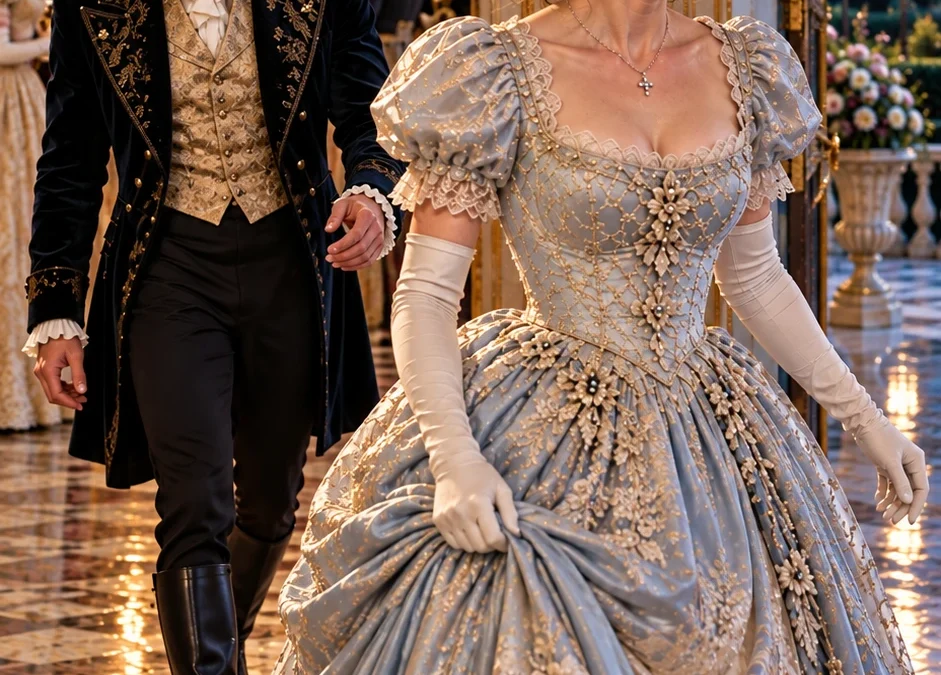
HE PROPOSED AT MIDNIGHT AND SHE VANISHED BEFORE THE LAST DANCE. SIX YEARS LATER, HE FOUND HER ON A MUDDY ROAD WITH TWO LITTLE GIRLS WHO HAD HIS MOTHER’S EYES… BUT WHO FORGED THE LETTERS THAT TORE THEM APART? 😱💔
Part 1
The Duke of Haramir had imagined seeing Catherine Whitcomb again so many times that when it finally happened, he did not recognize the moment.
There was no ballroom. No London drawing room. No dramatic confrontation beneath chandeliers.
There was mud, a broken cartwheel, three apples rolling slowly toward a ditch, and a small girl standing in the middle of the road, glaring up at him.
“You’re standing on my scarf.”
Nicholas Arden looked down. A strip of blue wool disappeared beneath his riding boot. He stepped aside at once. “My apologies.”
The child rescued it and shook the mud from one end. “You made it worse.”
“I fear I did.”
She looked him up and down. “You’re very large.”
Behind him, his steward, Mr. Pritchard, became deeply interested in the hedge.
“I have been accused of that before,” Nicholas said.
Before she could answer, another child ran from the village shop. Same age. Same height. Same dark curls beneath a knitted bonnet.
Twins.
“Rose!”
Then Nicholas heard a woman’s voice. “Lydia, don’t run.”
The world stopped.
“Catherine.”
She stepped out of the shop carrying a paper parcel. She saw him. The parcel slipped from her hands and struck the road. Three onions rolled toward his boots.
The first little girl looked from Nicholas to Catherine. “Mama?”
Mama.
Nicholas felt the word like a physical blow.
Catherine was older. Of course she was. So was he. There were faint lines beside her eyes that had not existed at twenty-four. Her brown hair was pinned simply beneath a dark bonnet. Her coat was practical, not fashionable. Nothing remained of the young woman he had last seen beneath a hundred candles.
Except her face.
He knew exactly how she looked when she wanted to laugh. He knew how her mouth tightened when she was angry. And he knew that when she was frightened, she became very still.
She was very still now.
“Your grace,” she said.
Not Nicholas. Your grace. Six years of distance in two words.
“You know the Duke?” Rose asked, delighted.
Nicholas looked at the children again. Rose had Catherine’s mouth. The quieter girl, Lydia, had Catherine’s dark hair. But the eyes…
He stared. Gray-green, with a darker ring around the iris. His mother’s eyes. He had seen them in a miniature portrait all his life.
Lydia shifted closer to Catherine. Catherine rested a protective hand on her shoulder.
“How old are they?” Nicholas heard himself ask.
Catherine’s face changed. “Five.”
“And when do they turn six?”
“Nicholas.” His name was barely a whisper. A warning, and an answer.
“You disappeared six years ago. Five-year-old twins. Catherine, when were they born?”
“Not here.”
Curtains had begun moving in the nearby cottages. The butcher stood openly in his doorway. The postman had stopped walking altogether.
“Please,” she said.
Then she gathered her daughters and was gone around the bend. Rose looked back twice. Lydia once.
Nicholas stood in the road. “Cancel the tenants’ meeting,” he told Pritchard.
“The entire meeting, your grace?”
“And find out everything you can about Miss Whitcomb.” A pause. “Discreetly.”
“Extremely discreetly,” Pritchard said.
Six years earlier, Catherine Whitcomb had attended the Haramir Winter Ball only because Lady Margaret Fenwick, her employer, refused to go without her.
She was a paid companion, the daughter of a provincial solicitor whose practice had withered after illness and poor investments. Nicholas Arden was a duke. She had met him nine months before, when he knocked a porcelain shepherd off a table and she caught it. They had met again at dinners, a concert, a bookshop where he tried to justify owning three copies of the same Roman history.
“You are a duke,” she had told him. “Surely someone must tell you unpleasant truths.”
“My staff have families to support.”
By December, she loved him. She also knew love did not rearrange society merely because two people wished it to.
At the ball, in pale blue silk, she danced with him. He stepped on her foot and denied it. Then, at the end, he whispered, “Meet me in the conservatory at eleven.”
There, beside the fountain, with rain whispering on the glass, Nicholas Arden looked nervous. That frightened her.
“I have spent four years being introduced to women everyone assures me are suitable,” he said, taking her hands. “You are the only woman whose arrival changes a room for me. I don’t want suitable. I want you. Marry me.”
Catherine laughed, pure shock.
“I imagined several reactions,” he said. “That was not one.”
“You are a duke.”
“And you are the woman I love.”
All her arguments disappeared.
“Yes,” she whispered.
For perhaps thirty seconds, Catherine Whitcomb believed happiness could be simple.
Then someone appeared in the doorway. Alistair Crane, the Duke’s private secretary. Immaculate. Controlled. A man so indispensable that no one noticed how much passed through his hands.
“Miss Whitcomb. Your father has arrived. He asked for you urgently.”
Nicholas offered to come. “Mr. Whitcomb specifically requested his daughter,” said Crane.
“I’ll wait,” said Nicholas.
It was the last ordinary promise either of them made that night.
In a small morning room, Samuel Whitcomb waited, pale and afraid. “We are leaving. Tonight. I questioned numbers I should have left alone. Money is disappearing from Haramir accounts.”
“Then tell Nicholas.”
“I intended to.”
The door opened. Crane entered. Samuel went white.
“Your father believes he has found misconduct,” Crane said, almost regretfully. “Unfortunately, there are documents suggesting Mr. Whitcomb himself authorized the transfers.”
Samuel seized a page. “That is not my signature!”
Crane said nothing.
“What do you want?” Catherine asked.
“Your father will leave London. And you will leave Haramir.” Crane produced a sealed note. Nicholas’s seal. Nicholas’s stationery.
She broke it open.
Miss Whitcomb, in light of certain matters regarding your father, what passed between us tonight cannot continue. Do not contact me again. N. Arden.
She read it twice. Something inside her collapsed quietly.
Forty-seven minutes later, Nicholas went looking for her, and found Crane in the corridor holding a letter in what looked like Catherine’s handwriting.
I do not want the life you offered. Please do not follow us.
She said yes, Nicholas thought. Less than an hour ago.
He searched for almost a year. Letters were sent. Some returned. Some vanished.
Because the man who controlled Haramir’s correspondence was the man who had written both letters.
But Nicholas did not know that yet. And now, on a muddy road, a five-year-old with his mother’s eyes had just changed everything.
👇 Want Part 2? Comment any word and I’ll send it to you privately, or look for it in the comments!
Part 2
The morning after the road, Catherine attempted fractions.
“If one pie is divided equally among four people, each receives a quarter.”
Rose raised her hand. Catherine already regretted it. “What if you dislike the fifth person?”
“That does not change the mathematics.”
“It changes how much pie you want them to have. That is morality, not arithmetic.”
“An important distinction,” said a male voice from the doorway.
Eighteen heads turned. Nicholas stood there, hat in hand.
“The Duke!” Rose brightened.
“So I continue to be told.”
Catherine marched him outside. “What do you want?”
“The answer. Are Rose and Lydia mine?”
“Yes.” No hesitation.
The certainty struck harder than suspicion. “Why didn’t you tell me?”
“I did. I wrote when I discovered I was carrying your child. I wrote again after they were born. Nothing.”
“I received nothing.”
“You told me never to contact you. And I never did. I still have the letter.”
Nicholas went still. “So do I.”
That afternoon, the two forged letters lay side by side on a table. For six years, each of them had lived with the consequences of a lie written in a familiar hand.
“Crane gave me mine,” Catherine said.
“He gave me mine.”
Neither apologized. Not yet. There were too many years between them.
Nicholas looked at the girls’ drawings on the side table. “Tell me about them. Everything.”
That question hurt more than any accusation, so she did. Rose spoke first and regretted things later. Lydia spoke last and noticed things first. Rose broke her arm at three climbing a pear tree. Lydia hated thunder. Both loved sugared almonds. Rose’s first word was mama. Lydia’s was book.
Nicholas laughed. Then stopped, because he had not been there.
Catherine saw it, and her anger gave way to something worse. Grief.
The first real clue came from Samuel, from beyond the grave. Before he died, eight months after they fled, he had made Catherine write down one name. Erasmus Bell, former banking clerk, Bath.
Nicholas went himself. Bell lived in a narrow house with too many clocks. He was seventy-three and unimpressed by titles.
“Samuel said someone might eventually come.”
From a cabinet came a sealed packet. Bank transfer records. Duplicate receipts. Notes in Samuel’s hand. And the dates mattered most. Samuel had documented the irregular transfers before the documents supposedly proving his own fraud had been created.
“Why did he never take this to a magistrate?”
“Because he believed the people involved had more influence than he did.” Bell hesitated. “And he said, if matters became public, you might prefer silence. He believed the irregularities began before you inherited.”
Nicholas stopped moving.
Back at Haramir, he sat beneath his father’s portrait, Bell’s papers in his hand. He found his father’s signature on the first transfer. Real. Not forged.
“You left him to clean it up,” he told the painted duke. “And I inherited the clean version.”
He had never considered that a man might inherit another man’s excuses.
Then he visited a tenant named Arthur Meling, nearly seventy. “Did Mr. Whitcomb ever give you money?”
“After the flood, yes. We were told the relief fund was empty. Mr. Whitcomb said the estate owed us whether someone had misplaced the numbers or not.” Mrs. Meling brought out a folded receipt in Samuel’s handwriting. “He said it wasn’t his money. He was only putting it where it should have gone in the first place.”
Nicholas stared at the page. For the first time, Samuel Whitcomb stopped being merely Catherine’s dead father.
He took it to her. She read the last line and sat down on the stone wall outside the school.
“I doubted him,” she whispered. “When he died, he still believed those forged papers might surface. I told him I believed him. I said it.” Tears slid down her cheek. “I never told him I was sorry for wondering.”
Nicholas held her while grief caught up with six years.
“He thought his name was ruined,” she said. “I will clear it,” Nicholas said. “Not because I think I can command it. Because I intend to prove it.”
That became their shared purpose. Not revenge. Truth.
But Crane was still at Haramir, calm as ever, signing letters. And Nicholas was about to set a trap for him with a box, a lie, and Lady Augusta’s plum pudding recipe.
👇 Want to know what Crane did that midnight? LIKE or COMMENT “REVEAL” and Part 3 will be posted once we reach enough comments!
Part 3
Nicholas planned carefully.
First, Henry Bell, Haramir’s humorless accountant, began reviewing every transfer through the private office. Crane was not told.
Then Nicholas created a rumor. Erasmus Bell, it was whispered through channels Crane would trust, had found a second sealed packet from Samuel Whitcomb. Original documents this time. A locked dispatch box arrived from Bath. Three servants saw it. Crane happened to be crossing the hall.
He did not look at the box. That interested Nicholas more than if he had stared.
Inside the box were twenty sheets of blank paper and Lady Augusta’s plum pudding recipe, which she had contributed personally.
“If he goes to prison, I should like him to remember that my cook never learned what to do with raisins.”
“This is an investigation, Aunt.”
“I am old. Entertainment must be taken where it appears.”
The first two nights, nothing. On the third day, Crane suggested Pritchard ride to a distant estate about a rent dispute. The problem was real. It was also six months old, and resolved. Crane wanted the house thinner.
So that night, Nicholas’s carriage departed on the southern road with no one inside. He slipped back through the servants’ passage and waited in the dark behind his father’s study door.
At midnight, a door opened softly. Not the records room. Crane’s own office.
Through a gap, Nicholas watched Crane remove his bottom drawer entirely, reach into the cavity behind it, and find a hidden catch. A panel shifted. He drew out a wrapped packet. He did not search it. He checked it, page by page, confirming it was still there.
The box had never been the point. The trap had made Crane check what truly frightened him.
Once Crane left, Henry Bell slipped into the office and took the packet. Nicholas followed Crane to the records room, where he unlocked the door with a key he was supposed to have surrendered. He opened the dispatch box and read the first line of the recipe. He laughed once, quietly.
“I wondered.”
“You expected me to open this?” Nicholas stepped into the doorway.
“No. I expected you to show me what you were afraid it might contain.”
Bell laid the hidden packet on the table. The first papers were Nicholas’s father’s own instructions, moving estate money to conceal personal losses. It still hurt. Then came documents dated after the old Duke’s death. Crane’s handwriting. Larger amounts. The moment concealment had become theft.
Then a folded instruction addressed to a clerk:
Any correspondence received from Miss Catherine Whitcomb, addressed privately to his grace, is to be delivered first to this office and entered nowhere in the general register.
Nicholas’s hands went very still. “She wrote.”
Crane said nothing.
“You knew she was pregnant.”
“Miss Whitcomb was not supposed to remain relevant,” Crane said at last. “Her father had begun examining matters that were not his concern. Then she began asking questions at dinner.”
Nicholas remembered fragments. Catherine pointing at two estate figures. Why did the same bridge repair appear under two properties? He had laughed. Crane had changed the subject.
“You separated us.”
“Your father left me to manage creditors, failed investments, gambling debts. I moved money to keep Haramir from disgrace.”
“And then you stole.”
“Yes.” One word. Almost weary. “I eventually decided I was entitled to something for maintaining the illusion.”
“She would have lived here and asked questions,” Nicholas said slowly. “That frightened you more than Samuel.”
“She had your attention.”
Crane lunged for the papers. Two tore. Crane snatched three sheets and threw himself toward the fireplace. Pritchard seized his shoulder. A page caught fire. Nicholas tore it away and crushed the flames beneath his boot. Another page slid toward the hearth, Catherine’s name across the top. He caught it just in time.
The fight left Crane almost at once. There was nothing left to save.
“Take those to a magistrate,” Crane said hoarsely, “and your father’s name goes with mine. Every newspaper in London will print it.”
“I know.”
“You would expose your own father?”
Nicholas looked at the papers scattered across the floor. His father’s signature. Samuel’s name. Catherine’s intercepted letters.
“My father is dead. Samuel Whitcomb died believing his name was ruined. Catherine spent six years believing I rejected her. My daughters spent five years without their father. And you think the most important thing in this room is whether society laughs at Haramir.”
He turned to Pritchard. “Send for the magistrate.”
At the door, Crane tried once more. “Your father would never have allowed this.”
“No,” said Nicholas. “That is precisely why I will.”
The scandal was ugly, and Nicholas did not hide it. The scorched documents made the newspapers especially eager. Lady Augusta found that grimly satisfying. “People prefer a burned document to ten accurate ledgers.”
“That is depressing.”
“It is journalism.”
Samuel Whitcomb’s name was publicly cleared. Nicholas visited the tenant families who had been cheated, and ordered repayments, not charity. At Arthur Meling’s cottage, the old man tried to bow.
“You do not need to do that.”
“I always have.”
“Perhaps that is part of the problem,” said Nicholas.
But the end of Crane exposed a problem no lawyer could fix. Now the papers knew who Catherine was, who the twins were, and why she had vanished. One called her the schoolmistress who succeeded where duchesses failed. Another suggested she had hidden the girls to manipulate a duke.
Nicholas went to her at once. “Marry me.”
“No.”
He looked as though he had misheard. “I heard the word. I am questioning its use.”
“You want to fix everything. You feel guilty.”
“I feel many things.”
“And you think marriage repairs them?”
“No. I owe you apologies. I owe Rose and Lydia years I cannot return. But I do not owe you marriage.” He paused. “Then wait?”
“I waited six years.”
“No,” Catherine said gently. “You were angry for six years.”
“That distinction feels unnecessarily cruel.”
“It is accurate,” came Lady Augusta’s voice from the doorway.
“Aunt, you were listening!”
“The door was open.”
“It was not.”
“Then someone should repair the hinges.”
Catherine laughed. Then she went home to Little Fenwick and reopened her school. She refused to vanish into his life simply because society wanted a wedding to close the scandal.
And Nicholas understood. He did not propose again. He simply became present. If he said Tuesday, he came Tuesday. If Lydia wanted a book, he remembered. If Rose had a school performance, he arrived early and sat through forty minutes of forgotten lines. He tried to repair the school gate and made it worse, while Rose stood beside him holding a hammer.
“Dukes are less useful than people say,” Rose sighed.
“I am learning humility at alarming speed,” Nicholas said.
Catherine had once loved him because he made rooms feel different. Now she loved him because he stayed after the room became ordinary.
One spring evening, beside the lake at Haramir, with the girls ahead arguing over whether ducks recognized individual people, Nicholas stopped.
“I have something.”
“If it is another financial document, I am going home.”
“It is not.”
He took out his grandmother’s sapphire ring. He did not kneel. “No ballroom. No conservatory. No forged letters.” He smiled, then grew serious. “I loved you when I was thirty. But I think part of what I loved was how you made me feel. I love you differently now. I know what you built without me. I know you can survive without Haramir, my money, my name. And that matters, because I do not want you here because you need me. I want you here because you choose me.”
Her eyes filled. “If I say I need another six months?”
“I will behave with extraordinary dignity. I may complain privately. To Pritchard.”
She laughed through tears. She let him wait, not cruelly, just long enough that the answer belonged entirely to her.
“Yes.”
“Thank God.”
From behind the hedge came Rose’s voice. “Did she say yes?”
“You were spying!”
“We were listening,” said Rose.
“Technically,” added Lydia, “we were here first.”
“Will there be cake?” Rose demanded. “How large?”
Nicholas looked at Catherine. “Negotiations have begun.” 💍
They married that summer at Haramir, not in London. Lady Margaret, seventy-seven, walked in with a cane she mostly used for emphasis. Before the ceremony, she inspected Catherine. “You’re late.”
“Six years.”
“Exactly.” Then she embraced her.
At the wedding breakfast, Rose climbed onto a chair. “I have a speech.”
“Let her,” said Lady Augusta.
“Mama says you should not marry someone only because they are rich. And you should not marry someone only because they are a duke. But Papa is both.” Nicholas placed a hand over his heart. “So Mama must like him for another reason. I think it is because he listens when she talks.”
The laughter faded. Catherine stared at her daughter.
Rose shrugged. “And he gives us chocolate when Mama says no.”
The room erupted.
Years later, people told wild versions of Catherine Whitcomb’s disappearance. One involved France, a vineyard, and a duel with a countess. Rose adored that version. Lydia called it structurally unlikely.
The truth was quieter. A man who had convinced himself he was protecting a great house forgot the difference between protecting and controlling. He forged two letters. A frightened young woman believed one. A proud young duke believed the other. Neither asked the question that might have changed everything: Did you really write this?
The forged letters remained locked in the Haramir archive. Not displayed. Not romanticized. When the girls were old enough, Lydia asked, “Why did you believe them?”
Nicholas answered carefully. “Because sometimes the lie we fear most is easier to believe than the truth we hope for.”
“Would you make the same mistake now?”
He looked at his wife. Catherine raised one eyebrow.
“No. I would make entirely different mistakes.”
“That,” said Catherine, “I believe.”
And Rose, at eighteen, at twenty-two, and once at her own wedding breakfast, never let her father forget how it all began.
“You nearly ruined it. You stood on my scarf.”
“It was already muddy.”
“That is not how I remember it.”
“You were five.”
“I had excellent judgment.”
Across the library, Catherine looked up from her correspondence. Even after all those years, something passed between them. Recognition. Amusement. Memory.
Six years had once seemed like the ending of their story.
It was only the distance between the people they had been and the family they became. 💛
This story is entirely fictional and created for entertainment purposes only. It does not represent any organization or individual, nor does it encourage inappropriate behavior. The content was generated with AI assistance.








