He Pulled a Freezing Woman and Her Baby From the Blizzard. Three Days Later, a Silent Tribe Walked Up to His Gate… and Everything He Knew Changed!
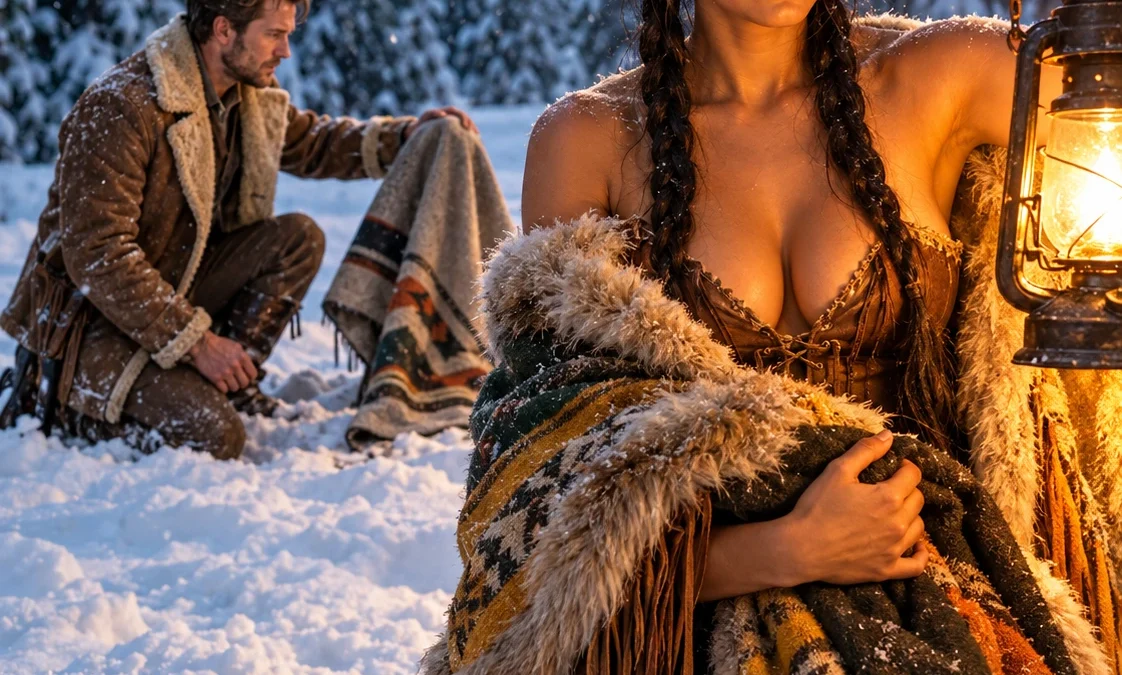
He Pulled a Freezing Woman and Her Baby From the Blizzard. Three Days Later, a Silent Tribe Walked Up to His Gate… and Everything He Knew Changed! ❄️😱
PART 1
Snow had sealed Tomas’s eyelashes shut, and Nayeli was dying on her knees in a drift.
It was the winter of 1878 in the New Mexico Territory. The worst storm in eleven years had come down off the Sacramento Mountains three hours before dusk. By nightfall there was no difference between sky and ground. There was only white, moving so hard that a man could lose his own hands in front of his face.
Cattle froze standing against the fence lines. A line-shack roof folded under the drifts by midnight. And somewhere in all that fury, a young Mescalero Apache mother was still walking, because walking was all that stood between her and lying down for good.
She had left her people’s winter camp two days before on an errand of ceremony. She carried prayer feathers and tobacco to her aunt’s family by the river, where an elder was failing and wished to see them blessed before he crossed over. Her son was not yet a year old. There had been no one else to send, and she trusted no one else with words of that weight.
On the walk home, the sky betrayed her.
Her horse bolted at the first scream of wind, snapped its tether, and vanished into the white. Nayeli wrapped her son inside her blanket and her coat, skin to skin, and walked with her head down. She counted her steps, because counting was the only way to keep her mind from quitting before her legs did.
By nightfall she had lost the trail. Tomas had gone from squirming to still, and that stillness frightened her more than any cry. She fell twice and rose twice. The third time her legs would not answer.
She sank into the snow at the base of a jagged rock. Only to rest, she told herself. She held her son against her heart, because her grandmother had taught her that a mother’s heartbeat is the last fire a child can borrow when every other fire has gone out.
She did not stop fighting because she wanted to die. Her body had simply run out of answers.
Half a mile away, Gideon Marsh was losing his own argument with the same storm.
He was thirty-one, broad through the shoulders from building his own barn with his own hands. His face still held more youth than the life behind it should have allowed. Three winters earlier, a fever had taken his wife, Sarah, in eleven days, along with the daughter she carried. He had built both coffins himself because he could not bear another man’s hands doing it. He had barely spoken a spare word to anyone since.
His grey gelding, Ash, was closer to him than most people.
He had left the line camp two days early, sensing the sky’s temper, hoping to beat it home. He hadn’t. A mile short of his gate, Ash planted all four feet in a drift and refused to move. Gideon cursed and pulled the reins, and then he finally looked at what his horse already knew.
Two small shapes lay at the base of a rock. Unmoving.
He was off the saddle before he had decided to be.
A young woman lay there with black hair frozen to her skull. She was curled around a bundle she would not surrender, even as he tried to lift her. He peeled the blanket back with clumsy, frozen fingers and found a baby’s face. The lips were a shade of blue that left no doubt how little time remained.
He did not think about her beaded moccasins or her deerskin dress. He did not think about what the men in Tularosa would say. He thought only: This child is dying in front of me, and I have a fire three miles from here.
He tore off his heavy wool coat, the one his father had left him, and wrapped the baby in it. The boy weighed almost nothing. That lightness frightened Gideon more than any weapon ever had, because he knew exactly how it felt to hold a child who would not grow up.
He held out his hand to the woman. Her fingers, inside his glove, were solid ice. He hauled her up, lifted her onto Ash, and settled the baby back into her locked arms. Then he took the reins and walked, because a horse that had given him one warning that night should not be asked for more.
Three miles. In summer, less than an hour. In that storm, it was a war.
He did not look back. He counted his steps, exactly as Nayeli had, though neither of them would ever know they had shared that small, stubborn trick for staying alive.
When the black shape of the cabin finally rose out of the white, his knees nearly buckled. He lit the fire, wrapped the baby in the quilt from his own bed, and set broth to heat. Nayeli sat on the floor beside her son and would not eat, or rest, or blink until she saw him swallow. Gideon set a bowl within her reach and retreated across the hearth, the way a man gives space to a wild thing he is trying to earn, not corner.
Through the long night, he did not sleep. He knew what he had done. A white rancher carrying an Apache woman into his home, in that country, was not a neutral act. It was a declaration.
He found, staring into the fire, that he did not care.
What he did not yet know was that the silent woman across from him was the daughter of Amaya Storm Eyes, a headman whose word carried the weight of an entire band. Her survival, and the manner of it, was about to travel a great deal farther than either of them could imagine.
Three days after she rode away, two riders on the ridge trail saw something they could not unsee. By the time the story reached the saloon in Tularosa, it had already been twisted into something ugly.
PART 2
Three days after she rode away, two riders on the ridge trail saw something they could not unsee. By the time the story reached the saloon in Tularosa, it had already been twisted into something ugly.
Old Silas Pruitt carried it there himself. He was a rancher whose opinions were as rigid as his arthritic knuckles. He had seen Gideon walking below the ridge with an Apache woman and child on his horse, and he could not reach the bar fast enough to tell it.
Within a day, the whole settlement knew. Within two, it had chosen sides.
Some men spoke of betrayal in low, bitter tones. They had buried kin in the raids and reprisals that had scarred that country for a generation. To them, Gideon had not saved two lives. He had chosen the wrong side, and lines drawn in blood are not crossed for free.
The price came quickly. Two ranchers canceled his fencing contracts with a folded note left at his gate. One morning he found fifty feet of his own fence torn down in the night. Supplies vanished from his wagon.
Gideon absorbed every blow in silence. To bend now would be to admit the night in the storm had been a mistake, and he would not believe that for any price the valley could name.
It came to a head at the mercantile. Silas Pruitt was holding court by the counter, his voice pitched to carry.
“Ain’t natural, taking savages into a Christian home. Man does that, can’t rightly complain when decent folk stop trusting him.”
The room went still. Gideon set his coin on the counter and looked at Pruitt for the first time.
“That woman’s boy was turning blue in a snowbank, Silas. You’d have ridden past. I didn’t. If that’s the measure of decent folk around here, I expect I can live without the title.”
He walked out without slamming the door.
But something stirred beneath the surface. A sack of provisions appeared on his porch, more than he needed. The torn fence was mended overnight by hands that left no name. A neighbor who once looked away gave him a short, unmistakable nod.
Meanwhile, at the winter camp near the White Sands, Nayeli gave the whole of that night to the council of elders. She told them about the cold, the dark, and the stranger who had climbed down off his horse when every rule of that hard country said keep riding.
Amaya Storm Eyes heard his daughter to the end without a word. Then he rose, with the dignity of sixty winters in every motion, and said only: “That man deserves to be known.”
A small delegation set out toward Gideon’s ranch on a morning of hard, brilliant blue. They carried a hand-woven blanket, ceremonial tobacco wrapped in doeskin, and a necklace of turquoise, given only to true friends. They walked without weapons and without haste.
Gideon saw them coming from his porch. His pulse tripped in his chest. It was fear, but it was something else too, something that felt almost like hope, which frightened him more.
Amaya stopped before him, set the gifts at his feet, and extended an open hand.
Gideon took it.
Then, from a step behind her father, Nayeli spoke. Her English was halting but clear, practiced carefully in the days since he’d sent her home.
“I did not come only to thank you. I came because my father wishes to know the man who did this.”
She paused. Something that was almost a smile touched her mouth.
“And because I wished to see if the cabin still smells of woodsmoke and dried onion.”
Gideon felt his own mouth betray him. “It does. I could put more onion in, if that would improve your opinion of it.”
But as the delegation turned to leave, Amaya lingered at the gate. His eyes fixed not on Gideon, but on the ridge line behind him. Then he said quietly, in careful words, something that drained the color from Nayeli’s face.
“Six riders have been seen north of the camp. Strangers. Not hunters.”
Gideon looked at the ridge, and a dread colder than the storm settled in his chest.
PART 3
Amaya’s warning stayed with Gideon through the next weeks. The riders did not come, and the camp saw nothing more of them. Winter loosened its grip slowly, the way it always does in that country, one inch at a time.
And Nayeli began to return.
She came first on errands her father blessed, trading wild onion and sage for salt and tools. Then she came on errands that needed less and less explaining, until the truth beneath them was something both understood without saying. Tomas, sturdier every week, followed Gideon around the yard with the fearless devotion small children give the first adult who has proven safe.
Gideon fought it for a while, the way a careful man fights anything that threatens the fortress he has built around a wound. But a fortress made only to keep pain out eventually keeps everything else out too. Slowly he began to understand the difference between grief that protects a man and grief that has simply become a habit.
Their conversations grew longer as her English sharpened and his handful of Apache words grew into something closer to fluency. She seemed to enjoy watching him struggle with a hard sound, and she did not hide it.
It was a courtship of small things. He fixed a gate hinge she had complained about. He left dried meat where she would find it before a long ride home. He mended a rocking chair because he’d noticed Tomas liked to be rocked in it. She left a woven cord for his hat, a poultice for a stove burn he’d tried to hide, and a corn cake on his table with no comment at all.
Neither of them called it courtship. Both knew exactly what it was.
One afternoon she took the scraper out of his hands and showed him how to cure a hide properly. She corrected his grip twice before declaring his third attempt merely adequate, rather than an insult to the animal.
“You are better with your hands than with your tongue,” she said, not unkindly.
“My tongue’s had less practice. Wasn’t much call for conversation, out here alone.”
“There is call for it now.”
He smiled down at the hide in a way that had nothing to do with leather.
On a late spring evening, with the fire low and Tomas asleep in the corner, she told him more of her story. Her mother had died giving her life, and she’d been raised by her grandmother and the women of the band. Tomas’s father, a young warrior, had been lost two winters earlier in a skirmish with soldiers.
“You do not ask me to stop grieving him,” she said, watching the fire.
“I wouldn’t know how to ask that of anyone. I haven’t managed it myself.”
Then he gave her Sarah, the daughter who never drew breath, and the two coffins. He had not spoken of it aloud to a single soul in three years. Nayeli held the weight of it with him instead of trying to lift it away too quickly.
“Grief like that does not leave,” she said at last. “It only learns to sit beside the other things in a life, instead of standing in the doorway blocking them out.”
He thought about that long after she had gone. For the first time in three winters, the cabin had stopped being a room he endured and had become a place he wanted to come home to.
When Tomas took a fever, Gideon watched her work through the night with cool cloths and a bitter tea from her own pouch, never letting her fear reach her voice. He hauled water and fed the fire and felt, for the first time in years, truly useful. At midnight the fever broke, and her hands began to shake the way his had once shaken in the snow.
“You did that,” he said.
“We did that.” She nodded at the fire. “A fire does not tend itself, cowboy.”
It was the first time she had called him that with warmth in it. He liked the sound of it more than he expected.
That was when he realized he had stopped looking forward to her visits and started dreading her absences.
The trouble came from a direction neither of them was watching.
A gang of horse thieves had been working the territory, led by a hard case named Royce Tanner, who took what he wanted and left no one alive to name him. When word came that they were heading for the White Sands basin, Gideon’s blood ran colder than the storm ever had. He rode for the winter camp and arrived at dusk to find it already stirring with the calm of a people who had caught wind of danger.
Nayeli saw the riders first, six of them, moving along the ridge with the unhurried confidence of men who thought the camp below an easy target. She did not scream. She did not freeze. She moved through the camp with low, quick words, rousing the warriors and herding children and elders toward the rocks. In minutes she accomplished what panic would have cost twice as long.
Gideon found her there, shepherding an old woman and two children. In that moment he understood the debt between them had been repaid long ago. She did not need saving. She needed someone to stand beside her while she did the saving herself.
The fight was short, brutal, and close. Tanner’s men expected a thin camp. They met a defended position with a white rancher’s rifle beside the warriors’ bows. A shot grazed Gideon’s ribs, and his legs went. Nayeli dragged him behind the rock wall and pressed a folded hide hard against the wound with hands that did not shake.
“You do not get to leave now,” she said, low and furious, her hands slick with his blood. “Not after everything it cost to keep you.”
It was the closest thing to a declaration either of them had ever spoken, and it came in the middle of gunfire. On reflection, that seemed exactly right for the two of them.
Within the hour Tanner’s gang had scattered, chased off by warriors who knew the ground. Amaya himself brought down the last of them at the camp’s eastern edge.
Gideon spent three days healing in the camp, tended by Nayeli and teased by women who had decided, without ceremony, that he belonged. An old one-legged elder named Nantan sat with him one afternoon and offered, through halting words, a lesson. Courage is not the absence of fear. It is choosing to stand inside the fear for people who need you standing there.
Amaya came to sit with him by the fire, too.
“My daughter does not give her heart easily. She gave her first husband to a soldier’s bullet and swore she would not risk it again.”
“I know what that kind of vow costs to make. And what it costs to break it.”
“Then you understand what I am asking, without my needing to ask it plainly.”
“I do. And I intend to earn the answer, not assume it.”
It satisfied the headman more than any grand promise could have. He rose, clasped Gideon’s hand once more, and left the rest to the two people who owned the choice.
Three weeks later, with his ribs mended and the first green pushing up through the ground, Nayeli rode to his gate alone, without errand or excuse.
“I did not come to trade today.”
“I didn’t think you had.”
“I came because Tomas wants to know when we are going to stop pretending we come here for onions and salt.” Her almost-smile appeared. “He is young, but he is not foolish.”
“No. He never has been.”
She grew serious. “My father wanted to know what I intend. I did not know when he asked. That was true then. It is not true anymore.”
“What do you intend?”
“To stop counting the reasons this should be difficult, and start building a life instead. If you are willing to build it with me.”
Gideon crossed the distance and took both her hands in his, the same hands that had once been frozen in his grip on the worst night of their lives. Now they were warm and steady, and hers to keep.
“I have been building toward this since the night your horse bolted and left you to a storm I still thank some higher mercy for putting me in. I intend to keep building it, every day, for as long as you’ll let me.”
She did not answer in words. She laid her hand flat over her heart, the same gesture she had offered him the morning she first rode away. This time she did not ride away at all. She stepped forward and let him fold his arms around her, as he had once folded a coat around her freezing son. Now there was no storm to survive, only a spring afternoon and a future neither had dared to want so badly.
They married that summer, in a ceremony that belonged wholly to neither world and fully to both. Reverend Cole spoke blessings under a brush arbor raised by Gideon and by warriors from Nayeli’s band, working side by side. Amaya gave his daughter’s hand and tied a turquoise band at Gideon’s wrist. Tomas ran between the two gathered peoples as though he had never known there was supposed to be a line.
Not everyone in Tularosa came around. Some grievances run too deep for a single season. But enough doors opened, the Reverend’s among them. Even Silas Pruitt appeared at the wedding with a gift and an unspoken apology in his eyes, which Gideon generously accepted without a word.
They raised Tomas together, and in time two more children besides. The ranch became a home of two languages and two sets of stories, with a garden where settlers’ corn and squash grew beside Nayeli’s wild herbs. More than one neighbor’s wife, curious despite herself, came by to ask what she used for a fever or a winter cough, and stayed to talk.
Trust, Gideon learned, is rarely won in one grand gesture. It is won the way Nayeli had mended his grief, a little at a time, sitting patiently beside the old suspicion until it had less room left to occupy.
Years later, when their eldest daughter asked how her parents had met, Nayeli told it the same way every time, without embellishment. A storm had tried to take everything from her. Instead it gave her a man willing to walk three miles through the worst night of his life rather than leave two strangers to freeze. In return she gave him a reason to stop merely enduring his life and start living it.
Gideon would only add that Ash deserved at least half the credit. Nayeli would laugh and agree that the old grey gelding had seen the truth of things before either of his humans had the sense to.
And Tomas, grown, would ride the ridge trail above the ranch with his own children. He would point at the cabin roof and tell them exactly how his mother had once nearly died in the snow half a mile from where they stood. And he would tell them how a stubborn cowboy and a stubborn horse had refused to let that be the end of the story.
💬 Would you have climbed down off your horse in that storm, knowing what it might cost you? Tell me below. 👇
This story is entirely fictional and created for entertainment purposes only. It does not represent any organization or individual, nor does it encourage inappropriate behavior. The content was generated with AI assistance.








