HE PULLED AN APACHE GRANDMOTHER FROM UNDER A BROKEN WAGON. WEEKS LATER, THE TURQUOISE STONE SHE PRESSED INTO HIS HAND PUT HIM BETWEEN TWO ARMED MOBS WITH ONE SHOT AWAY FROM A MASSACRE
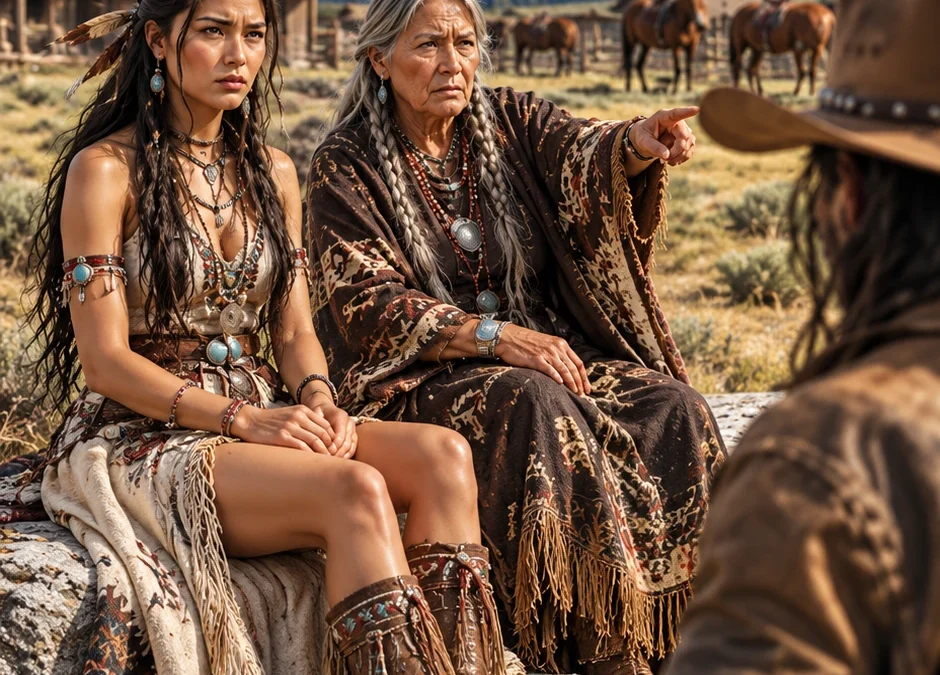
HE PULLED AN APACHE GRANDMOTHER FROM UNDER A BROKEN WAGON. WEEKS LATER, THE TURQUOISE STONE SHE PRESSED INTO HIS HAND PUT HIM BETWEEN TWO ARMED MOBS WITH ONE SHOT AWAY FROM A MASSACRE 😱🔥
Part 1
The sun was bleeding into the Arizona mountains when Daniel Carter heard the cry. 🌄
It wasn’t human. It was the sound of a horse that knows it is trapped.
Daniel was thirty-two, a quiet cowboy with weathered hands and a scar above his eyebrow. He had spent most of his life driving cattle between small frontier towns, and he had learned early that the West could be beautiful one moment and deadly the next. Outlaws. Wild animals. Hunger. The violent hatred between settlers and native tribes.
Of all of them, Daniel feared hatred most.
He pulled back on Blue’s reins and listened. Beneath the wind came a faint cry, then the unmistakable thrashing of a mule fighting its harness. His hand went to his rifle. Danger or someone desperate for help, he couldn’t tell.
He climbed the ridge and looked down into a narrow canyon.
Beside a fallen cottonwood lay a broken wagon. Pinned beneath one heavy wooden wheel was an elderly Apache woman, her silver hair tangled with dust, her breath coming in short, painful gasps.
Daniel froze.
He knew the stories told in every frontier saloon. Never approach an Apache traveler. Never get close to their camps.
But the woman was hurt. She was alone. And whatever history lay between their peoples, Daniel could not ride away from an old woman crushed beneath a wagon.
He descended slowly, rifle lowered. Her dark eyes tracked every step. Her hand crept toward a small knife at her waist, but she didn’t have the strength to lift it.
Daniel stopped several feet away.
“I’m not here to hurt you,” he said gently. “Let me help.”
She answered in Apache, her voice weak but firm. He understood none of it. So he pointed to the wheel, then to himself, and mimed lifting.
A long silence.
Then her hand fell away from the knife. 🤍
Daniel tied Blue to a branch, braced himself against the wagon, and pushed with everything he had. The wheel barely moved. He pushed again, teeth gritted, until the heavy wood finally rose enough for her to drag her leg free.
She cried out, but she was free.
He tore a strip from his own shirt and wrapped her injured leg. She watched his hands the whole time. When he finished, she touched the cloth, then pressed her palm flat against her heart.
“You’re welcome,” Daniel said quietly.
He gathered her scattered belongings from among the rocks: a small woven blanket, dried meat, clay pottery. He set everything beside her. Then he repaired the wagon as best he could.
By the time he finished, the sun was gone. The cold came fast. Somewhere beyond the canyon walls, wolves were moving. Her leg meant she couldn’t run, and Daniel wasn’t about to leave her.
He built a small fire beneath the cottonwood. She sat close, wrapped in her blanket. He shared his water and food and asked for nothing.
For hours neither of them spoke, yet somehow the silence stopped feeling dangerous.
Near midnight she touched her chest. “Amaya.”
Daniel smiled. “Daniel.”
She repeated it slowly, as though learning its shape. “Daniel.”
“That’s right,” he laughed softly.
And for the first time, Amaya smiled. 🔥
At sunrise Daniel expected her to leave in the repaired wagon. Instead she pointed to the mountains, then to herself, then to a distant trail leading east and to his horse.
She wanted him gone.
He almost obeyed. But he looked at her leg and knew she couldn’t make the journey alone. So he stayed.
They walked most of the day, Daniel beside the mule while Amaya guided it. The desert heat was brutal, but she never once complained. Even injured and old, she carried herself with remarkable dignity.
By late afternoon they reached a hidden valley ringed by red cliffs.
Apache riders appeared along the ridge, weapons raised.
Daniel stopped and lifted both hands. Amaya shouted something at them. Slowly, the rifles lowered. An older Apache man rode forward, hard-faced, until he saw her. Then his whole expression broke. He lifted her from the wagon as if she were made of glass.
Then he turned to Daniel.
“You saved her,” he said in broken English. “She is my mother. Her name is Amaya. She is grandmother to many.”
“I couldn’t leave her.”
“What do you want?”
“Nothing.”
That answer stunned everyone.
Daniel turned Blue toward the trail, but Amaya called his name. She limped toward him, reached up, and lifted a small turquoise pendant from around her neck. She pressed it into his hand.
“I can’t take this,” he said.
She folded his fingers closed around it.
“She gives it only to those she considers family,” her son explained.
The word hit Daniel harder than he expected. His parents had died when he was young. The ranch where he grew up had been sold. Since then he’d drifted from town to town, never staying long enough to call anywhere home.
“Thank you,” he whispered.
Then he rode away. 🌅
Weeks later, in the crowded frontier town of Red Hollow, Daniel overheard a rancher named Samuel Briggs holding court at the saloon.
“They’ll bring trouble. Everyone knows what they are.”
Daniel turned. “No. Everyone knows what they’ve been told.”
The room went silent. Briggs stepped closer. “You defending them, Carter?”
Daniel touched the pendant beneath his shirt. “Yes.”
“You’re making a mistake.”
“Maybe. But I’d rather make my own mistake than live by somebody else’s hatred.”
The sheriff stepped between them. Daniel walked out into the sunset.
Three days later, the news hit town like a thunderclap. A group of settlers had vanished near the mountains. Rumors blamed Apache raiders before anyone had checked a single fact. Briggs gathered armed men and announced they would search the valley.
Daniel knew exactly which valley.
He rode hard through the night, Blue’s hooves hammering the dark. At dawn he reached the ridge and looked down.
Amaya’s people were not waiting to attack. They were waiting to defend themselves, and they were ready to die doing it. Beyond them, in the surrounding hills, Briggs’s men had already taken position.
One gunshot could start a massacre, and Daniel Carter was about to ride straight into the middle of it. 😱
📖 Part 2 is waiting in the comments! Drop any word below and I’ll send it to you privately. 👇
Part 2
One gunshot could start a massacre, and Daniel Carter was about to ride straight into the middle of it.
He didn’t think. If he had, he might have stopped.
Daniel dug his heels into Blue’s ribs and the horse plunged down the slope in a spray of dust and loose stone. Wind tore at his hat. The pendant bounced against his chest. In the valley below, rifles swung toward the sound of hooves.
He burst out into the open ground between the two lines and hauled Blue to a sliding halt.
“STOP!”
His voice cracked across the valley and rang off the red cliffs.
Silence. No one fired. Not yet.
On one side stood the Apache families, the older man at the front with his rifle half-raised. Behind him, women and children were pressed back against the rocks. And there, among them, leaning on a young woman’s arm, was Amaya.
On the other side, Samuel Briggs rose from behind a boulder, rifle leveled at Daniel’s chest.
“Move aside, Carter.”
“No.”
“You’re standing between us and the people who murdered those settlers!”
“Nobody murdered anybody.” Daniel kept his hands where everyone could see them, his heart slamming against his ribs. “You don’t understand what happened here.”
“I understand exactly what happened.” Briggs’s face had gone dark red. His men were shifting behind him, fingers tight on triggers. “They attacked. They took those people. And I’m not going to stand here and let you protect a pack of…”
“Then show me the proof, Briggs.”
The words hung in the air.
Daniel could feel the weight of a dozen rifles pointed at his back and a dozen more pointed at his front. Somewhere above him a hawk circled in the pale morning. Time slowed to a crawl.
“Show me one body,” Daniel said, low and steady. “One burned wagon. One single thing that proves it. If you’ve got it, I’ll step aside myself.”
Briggs said nothing.
His jaw worked. His men glanced at each other. For one terrible second Daniel saw something in the rancher’s eyes. It wasn’t certainty. It was something closer to fear: the fear of a man who has built his whole life on a story and suddenly isn’t sure it’s true.
Then a sound came from the rocks.
A small, shaky sound. A foot scraping gravel.
Everyone turned.
From behind a boulder near the Apache line, a frightened young boy stepped into the light. His clothes were torn. His face was streaked with dried mud and tears. He was clearly one of the missing settlers.
Nobody breathed.
The boy looked at the rifles. At Briggs. At the Apache elders. At Daniel.
His mouth opened to speak, and in the hills above, a man’s finger tightened on a trigger. 😳
🔥 Want Part 3, the full ending, with what the boy said, the shocking truth about the missing settlers, and the final secret of the turquoise pendant? LIKE this post or comment “REVEAL” below! Part 3 will be posted once we have enough comments. 👇💬
Part 3
“Don’t shoot!”
The boy’s cry cracked through the valley like a whip.
For a heartbeat, the trigger finger in the hills froze. Then the man lowered his rifle, face white. The boy had been standing in his line of fire the entire time.
Daniel was off Blue in a second, dropping to one knee in the dust. “Easy, son. Easy. You’re all right. Nobody’s going to hurt you.”
The boy was shaking so hard his teeth rattled. He couldn’t have been more than ten. “They didn’t take us,” he sobbed. “They saved us.”
Briggs lowered his rifle an inch. “What did you say?”
The words tumbled out of the boy all at once. His family’s wagons had been crossing a dry creek bed when the flood came. A wall of brown water, roaring out of the mountains from rain that had fallen miles upstream. It had swept the wagons apart in seconds. Horses screaming. Mothers calling names into the roar. He remembered nothing but cold water and the sound of everyone he loved being torn away.
“I thought I was going to die,” he whispered. “Then somebody grabbed my arm.”
He pointed a trembling finger toward the Apache line.
“It was him.”
A young Apache man at the edge of the crowd stood very still, soaked to the knees even now, a bandage wrapped around one hand. He had gone into the floodwater without a rifle, without a thought, and pulled the boy out.
“They found everyone,” the boy said. “They carried us up here. They gave us blankets and food and fixed my uncle’s arm. They said they’d take us home when the water went down. We were going to go home.”
“Then why didn’t you send word to town?” Briggs demanded, his voice rough.
“The trail was washed out,” the older Apache man said quietly. His English was careful. “No horse could cross. We sent two riders. They have not returned. Perhaps the mountain took them.” His eyes moved over the rifles still aimed at his people. “We did not know your men were coming. We only knew they came with guns.”
From behind the boulders came voices, thin and cracked. A woman’s. A man’s. Then a dozen settlers stumbled out of the Apache camp, wrapped in woven blankets, alive and bewildered, blinking at the rifles aimed at the people who had kept them alive.
A mother dropped to her knees and screamed her son’s name.
The boy ran to her.
And the whole valley seemed to exhale.
One by one, the settlers’ rifles came down.
Nobody spoke. Nobody needed to. Every man in that valley was looking at the same terrible thing: how close they had come. A single shot, a single twitch of a nervous finger, and every person standing there could have been dead by noon, with a lie left standing over the graves.
Samuel Briggs stood motionless, his rifle hanging at his side. The red had drained out of his face. He looked, suddenly, like an old man.
His eyes found Daniel’s.
“You knew,” Briggs said hoarsely. “You knew it wasn’t them.”
“I didn’t know,” Daniel said. “That’s the point. You didn’t either.”
Briggs opened his mouth. Closed it. For a long moment he said nothing at all.
Then he turned and walked slowly toward the Apache elder. Daniel watched the entire valley watch him. It cost the man something. It showed in every step, in the stiffness of his shoulders, in the way his hand opened and closed at his side.
“My men and I,” Briggs said, and the words seemed to scrape his throat, “came here believing something that wasn’t true.” He stopped. “I’m sorry.”
It wasn’t a speech. It wasn’t graceful. But the older Apache man studied him a long moment, then gave one slow nod.
Briggs’s men started to turn their horses. The settlers were already being gathered toward the wagons. And Daniel realized, somewhere beneath the pounding of his own pulse, that his hands had finally stopped shaking.
“Go home,” he said to the Apache elder, quietly.
The man nodded. “Yes.”
Then a small, slow footstep sounded behind Daniel.
He turned.
Amaya was walking toward him, supported by a young woman at her elbow, her injured leg healed enough to bear her weight. Her silver hair was braided now. Her dark eyes were clear and steady.
She placed her hand on his shoulder.
“You came back,” she said.
Daniel smiled, and his throat caught. “I told you. I couldn’t leave you.”
The words carried more than either of them had expected. 🤍
In the months that followed, Daniel found himself riding to the valley more and more often.
At first it was small things. He helped repair fences. He traded supplies. He shared what he knew about cattle, and the Apache families shared what they knew about the desert in return: which plants healed and which killed, where hidden springs ran year-round, how to read the mountains the way other men read books.
And Amaya, always Amaya, was there.
She told him about her childhood. About her husband, her sons, her grandchildren. About the land before fences cut it into pieces. Daniel listened for hours, and the more he listened, the less lonely the world seemed.
“Belonging is not always about blood,” she told him one evening, in the halting English he had slowly taught her and the Apache she had slowly taught him. “Not always about where you were born. Sometimes it is earned. Through kindness.” She tapped his chest, right above the turquoise stone. “Sometimes family is chosen.”
Daniel looked into the fire and said nothing. He didn’t trust his voice.
One winter night, with snow dusting the distant peaks, Daniel sat beside her near the fire.
“You saved my life,” Amaya said.
He smiled. “You saved mine, too.”
She looked surprised. “How?”
He touched the pendant. “Before I met you, I thought I was alone.”
“You were,” she said simply.
Daniel burst out laughing. “That’s a strange way to comfort someone.”
Amaya smiled, her eyes crinkling. “But now?”
He looked around the valley. The glow of the fires. The children chasing one another between the wickiups. The red cliffs holding the last light of the day.
“Now I know where I belong.”
Years passed. Railroads cut across the country. Towns grew. Old trails became roads. Some of the old conflicts faded and others hardened, but Daniel never forgot the day he found an injured Apache grandmother beneath a broken wagon.
He built a small ranch near the valley, a home that stood between two worlds. Its gate was open to travelers, to settlers, to native families alike.
He refused to allow hatred inside.
Amaya lived long enough to see it flourish. On summer evenings she sat on the porch and watched Daniel work with his horses while children from both communities played in the dust below, laughing, with no idea why their grandparents had once been afraid of each other. 🌾
One evening she called him to her side.
“You remember the canyon?”
“I remember.”
“You thought you were saving me.”
Daniel looked at her. “Wasn’t I?”
Amaya shook her head, slow and certain, the way she did everything.
“No. We saved each other.”
Daniel turned toward the sunset, the same desert that had once seemed so empty now glowing gold, and understood at last.
Courage wasn’t always about holding a rifle or defeating an enemy. Sometimes courage meant refusing to hate someone simply because others told you to. Sometimes it meant helping a stranger. And sometimes the person you rescued turned out to be the one who rescued you. 💛
Amaya died peacefully many years later, surrounded by family.
Daniel buried her beneath an old cottonwood overlooking the valley. Around her grave, Apache elders and frontier settlers stood together in silence. Even Samuel Briggs, silver-haired now and leaning on a cane, stood at the back with his hat in his hands. He and Daniel had never become friends, exactly. But Briggs had never again spoken of any people as less than human, and in the end, that was its own kind of answer.
Daniel knelt at the grave and, for one long moment, set the turquoise pendant on the earth beside her.
Then he picked it up again.
He couldn’t leave it there. It was no longer just a stone. It was the promise she had given him on the day he’d thought he had nothing: that family could cross every boundary people built. 🤍
He closed his hand around it, rose slowly, and walked home as the sun slipped behind the Arizona mountains.
On the porch, his grandchildren were waiting.
“Tell us the story again, Grandpa.”
“You’ve heard it a hundred times.”
“We want to hear it again.”
So he sat down beside them, the pendant warm against his chest, and began. He told them about a lonely cowboy. An injured Apache grandmother. A broken wagon beneath a desert sky.
But most of all, he told them about the day he learned that courage was never about choosing sides.
Courage was choosing humanity.
And in the wide, unforgiving American West of the 1800s, that lesson became the greatest inheritance he could ever leave behind. 🌅
If this story touched your heart, leave a like, share it with someone who needs it, and tell us in the comments: what would you have done if you’d found Amaya beneath that wagon? 💬
This story is entirely fictional and created for entertainment purposes only. It does not represent any organization or individual, nor does it encourage inappropriate behavior. The content was generated with AI assistance.








