HE PULLED HER FROM A KILLING DUST STORM AND ASKED FOR NOTHING… BUT WEEKS LATER SHE LOOKED HIM IN THE EYE AND SAID SIX WORDS THAT CHANGED HIS LIFE FOREVER: “YOU NEED A WOMAN LIKE ME”
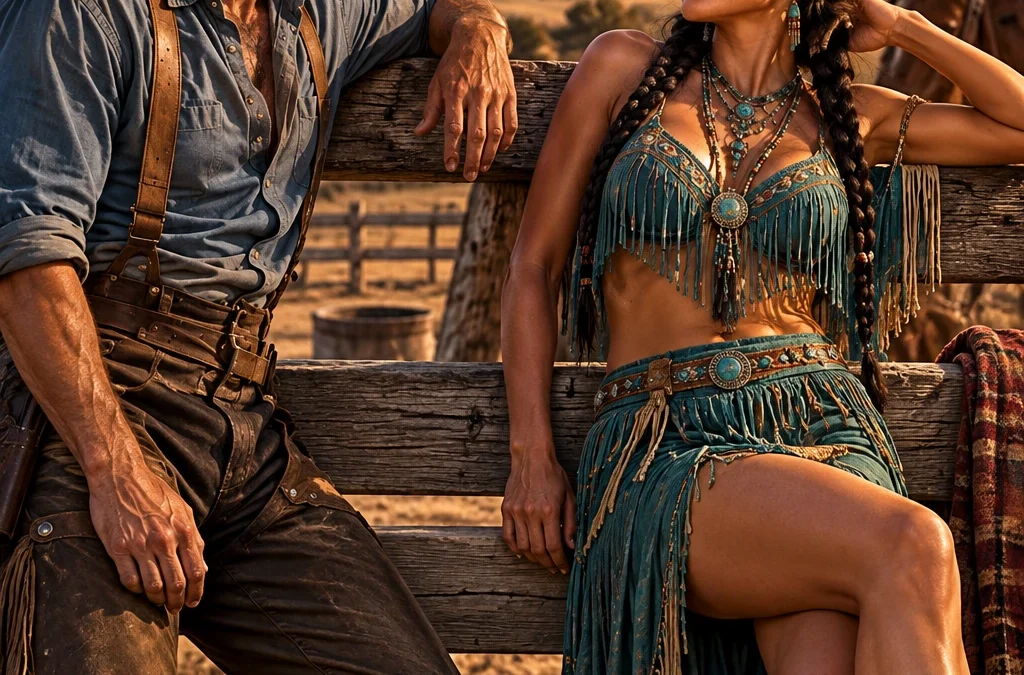
HE PULLED HER FROM A KILLING DUST STORM AND ASKED FOR NOTHING… BUT WEEKS LATER SHE LOOKED HIM IN THE EYE AND SAID SIX WORDS THAT CHANGED HIS LIFE FOREVER: “YOU NEED A WOMAN LIKE ME” 😱🔥
Part 1
The wall of dust came out of the south like a living thing.
Half a mile high. Brown as old blood. And Jubal Renner saw it from three miles out and knew it was going to be bad. 🌪️
He had lived in the Sonoran basin long enough to read a haboob the way a sailor reads a squall. This was not a storm you waited out in the saddle. This one buried fence posts, pushed cattle into draws, and turned a man around backward in ten steps until he had no idea which direction his own house was.
He almost made it home.
Almost.
It was the late summer of 1883, and the San Pedro Valley of Arizona Territory was not a place that forgave much. The rains had been scarce. The grass in the lower pastures had gone crisp and yellow by June, and by August his second well was pulling mud at the bottom of every bucket.
Jubal was thirty-eight years old. He had worked this land for eleven years, starting with a two-room adobe, two hundred head of cattle, and a letter confirming that three hundred and sixty acres were his, provided he could prove continuous use. The adobe had become a proper four-room house. The herd had grown. The proof was in every post he had set and every drought he had ridden out.
He had done all of it alone.
That had never been the plan. His wife, Margaret, had died of typhoid in the spring of 1878, leaving him with a going concern and no clear reason to keep going. He kept going anyway. He became the kind of man who did what was in front of him and never thought much past the day’s work.
Some people called that stoic. Others called it grief wearing a hat. 💔
Both were probably right.
He rose before light, worked until dark, and slept the flat sleep of a man who has nothing left to keep him awake. It was not a bad life. It was not a full one.
Then the haboob caught him a mile and a half from home.
One moment he was in clear air with the ranch ahead of him. The next, the wall hit and the world went brown and close. He rode by instinct alone, head down, his handkerchief doing almost nothing against the grit. His blue roan, Gable, kept moving, but she was unhappy and let him know it.
He was skirting the edge of the dry wash when Gable threw her head and shied hard to the right.
There was a mesquite at the crumbled lip of the wash, twisted and gray-barked. And wrapped around its base, arms locked around the trunk, was a person.
For two full seconds he thought it was a piece of canvas the storm had wrapped around the tree.
Then she moved. Just her head, turning toward the sound of his horse.
He dismounted and went forward low, one hand up against the blowing sand. A woman. Apache, from the buckskin dress and the moccasins laced to the knee. She was on both knees, forehead against the bark, curled around the trunk with the desperate efficiency of someone who understood that the tree was the only fixed point in a world gone completely unstable. Sand had drifted four inches deep across her shoulders.
He put his hand on her shoulder.
She turned and pulled back in the same instant, and for a moment they were face to face. Her eyes were wide and dark and sharp despite the storm. Her jaw was set. A cut ran across her left cheekbone, the blood already dried pink with dust.
She was maybe twenty-five. She had the look of a woman who was afraid and was not going to let that stop her from doing what needed to be done.
He held up his hands, open. He pointed at himself, then at his horse, then north toward the ranch.
She looked at him for a count of five while the wind hammered them both. He watched her do the arithmetic. The storm. The exposed wash. A man she had never seen before.
She nodded once, sharp, and stood up on her own.
He boosted her onto Gable and led the horse by the bridle through the last half mile, following the fence line by feel because he could not see it. It was the longest half mile he had ever walked.
Inside the house, with the door shut against the roar, the woman stood in the middle of his front room and looked at it the way people look at an unfamiliar space. Taking inventory. Noting the exits. Deciding whether this was a room she could safely be in.
He pointed to a chair near the stove. She looked at the chair. She looked at him.
She sat, upright, hands in her lap, and watched him.
He made coffee and left a cup beside her without a word. He cooked what he had, beans, hardtack, the last of a smoked venison shoulder, and she watched him the whole time. Not with hostility. Not with idle curiosity either. It was the attention of someone taking a careful measurement. ⚖️
She ate because she was hungry and eating was the sensible thing to do, and she did not seem to feel it obligated her to anything.
He gave her the bedroom. He slept on the porch bench, listening to the storm taper from a roar to a groan to nothing at around three in the morning.
The silence after a haboob is its own strange thing. Absolute. Like the world has stopped to take stock.
He lay there thinking about the woman in his house. How fast she had turned when he touched her shoulder. How she had cleaned her own wound without being asked. How she had been in a stranger’s home for six hours and had not shown fear once, only wariness, and there was a difference between the two that he was only now beginning to understand.
She would go in the morning, he told himself. And that would be that.
But at first light he found her standing in the yard, looking south at the strange, altered landscape the storm had left behind. New dunes where the ground had been flat. Fence posts leaning at angles.
“You have cattle in the south draw,” she said, without turning.
“How do you know that?”
“Dung on the prevailing side of the brush. Two, three days old. Cattle come to that draw for shade in the afternoon.”
She turned. In daylight, her eyes were very dark, steady, the kind that do not give you more than they have decided to give.
“There will be some in the east drainage too. The storm would have pushed them.”
“I was going to ride out this morning.”
“I will come.”
It was not an offer. It was a statement of what she intended to do.
Her name was Talise. She was Chiricahua Apache, the daughter of a headman, a healer in training, and she had been making her own way in this territory since she was sixteen years old.
The storm had knocked her down.
It had not broken her.
And what she would say to him in the weeks to come would cost him more than any storm ever had. 🌅
Part 2
The storm had knocked her down. It had not broken her.
They found eleven cattle in the south draw, bunched tight in the deepest corner. Eight more in the east drainage, exactly where she had said they would be. Riding back with the strays moving ahead of them, Jubal tried to remember the last time he had worked cattle with someone who knew what they were doing.
There was a real pleasure in it. A person who did not need to be told what to do next.
He did not say so. He rode. She rode. The cattle moved.
She left the next morning, her dun mare sound and saddled. But at the gate she turned in the saddle and looked at him with those direct eyes.
“Jubal Renner. You should fix the south gate hinge before it fails. And the east windmill is two or three weeks from a bearing problem. You can hear it in the pitch of the turning.”
“I’ll do that.”
“And you should plant something in the garden bed on the south wall. The soil there is good. It is wasted.”
“I appreciate the advice.”
“It isn’t advice. It’s just what I see.”
She rode south, and within minutes the land had taken her in the way land takes people. One moment there, the next only distance.
He went and looked at the south gate hinge. It was close to failing. He fixed it that afternoon. 🔧
He expected to think about her for a day or two. He thought about her for three weeks.
He remembered what she had said on the second night, sitting across the lamp from him. “The house is clean, but it is empty in a specific way. Like it is being kept rather than lived in.” She had noticed the closed door of Margaret’s room without being told. “I notice things,” she had said. “I’m sorry about your wife.”
He started sitting in the front room in the evenings. He left Margaret’s door open sometimes. He fixed the windmill bearing before it failed. He planted herb seedlings in the south bed, ones he found growing wild along the wash.
Then, three weeks after the storm, in Benson, a man outside the land office called his name.
He was well dressed for the territory, in a wool suit and a hat that had never been worked. He carried himself with a clerk’s precision. His name was Aldrich, from the Arizona Improvement Company, and he had, he said with great pleasantness, a few questions about the south section of Jubal’s spread.
“Our surveyors believe a narrow strip along the east side of the wash may fall outside your deeded acreage.”
“The wash has been part of my working range for eleven years.”
“Working range and titled acreage aren’t the same thing in territorial law, Mr. Renner. We may need to put flags on it.”
Aldrich smiled in a way that did not involve his eyes.
Jubal rode home with a cold feeling in his chest. He knew what a preliminary move looked like. Aldrich was not there to survey anything. He was there to open a conversation that could become a dispute. And a dispute was expensive and slow enough that many men found it easier to settle.
At five the next morning, while he was fixing a broken post, he heard the dun mare’s particular canter on the east road.
Talise rode in, dismounted, and came through the gate. “You’re fixing fence at five in the morning. Good habit.” She helped him with the posts without being asked, filling the gaps in the work the way water fills the low places in rock.
When he told her about Aldrich, she listened without interrupting. Then she said quietly:
“The Arizona Improvement Company. They have been pushing on three other properties in this valley. One family has already left. The other two are fighting. The wash feeds the springs that water the whole valley. Whoever controls the wash controls the water.” 💧
“And the strip along my east section.”
“Yes. And the springs feed the winter camp my father’s family has used for generations. So I have as much stake in this as you do.” She met his eyes. “More. I came back because of the windmill. I stayed because of this.”
She knew an attorney in Tucson named Vasquez, who won land cases for Apache families and for ranchers who shared boundaries with Apache range. She would send a rider with a letter from her father. “Two parties disputing the same claim are harder to ignore than one.”
“You have done this before.”
“Twice. Once before the land office and once in federal court. We won the federal case. I was twenty-one.”
“You didn’t mention that.”
“You didn’t ask.”
She came back again and again. Two weeks later. A week after. A second hook appeared on his barn wall for her saddle, though he could not have said when he had decided to put it there. They fell into a rhythm neither of them named. Work by day. Coffee in the evening. The lamp between them. And a silence that was no longer careful, no longer the absence of the wrong thing, but the presence of the right one. 🕯️
He learned that she had been married at nineteen to a good-natured young man named Nayatan, who had been a poor judge of weather and had died in a clash with the Army two years later. He learned that she was funny, in a dry, flat way he missed the first three times and never missed again.
“You did not remarry.”
“I have been deciding what I wanted.”
“Have you decided?”
She looked at him for a long moment.
“I’m still deciding.”
But Aldrich had not stopped. And what Jubal learned the following week made his blood run cold.
Aldrich had approached Talise’s father too. Not with money. With a letter, wrapped in the language of friendly advice, hinting that her band’s use of the springs might attract unwanted federal attention if they chose to publicize the dispute.
It was a threat.
Talise laid the letter on his kitchen table without a word. He read it twice.
“My father is not going to cooperate,” she said. “He is asking if you will hold your position as well. He needs to hear it said directly. He wants to meet you. Saturday, at the spring near the east wash.”
She paused, and her voice changed, becoming something he had not heard from her before, as if something carefully held was being set down.
“My father does not meet with many white men. He is meeting you because I asked him to. That counts for something to him. It is not a small thing.”
“I won’t waste it.”
She looked at him a moment more.
“No. I don’t think you will.”
On Saturday, he rode half a mile into the rock on the east side of the wash, to a hidden canyon he had passed a hundred times without knowing it was there. A seep of clear water ran from the base of a red sandstone wall.
And standing beside it, flanked by two silent men, was Chato, the father of the woman who had been quietly rearranging Jubal’s life.
Chato looked at him without expression for a very long time.
Then he spoke.
Part 3
Jubal took off his hat and held it in both hands.
“I’m grateful for the time.”
Chato was a compact man, late fifties perhaps, with the same contained watchfulness Jubal had learned to recognize in Talise. He had no rifle visible. A man who had survived what Chato had survived did not need to look dangerous.
“My daughter tells me you are a man who does not waste what he is given.”
“I try not to be.”
“She does not say things she doesn’t mean.”
“I’ve noticed that.”
Something moved in Chato’s eyes, just slightly.
“The land along the wash. You will not sell it to this company.”
“No.”
“Even if the cost is high.”
“Even then.”
Chato was quiet. He looked at Talise, and she looked back, and something passed between them that Jubal was not part of and did not try to be.
“The springs are older than the law you brought with you,” Chato said at last. “We have tended them for a long time. A man who protects what he is given to protect is a man we can share a boundary with.”
“A shared boundary is what I’d like.”
“Yes. My daughter has her own judgment. I do not interfere with it.” His glance at Talise was brief and deliberate. “I only confirm what I see.”
He offered his hand. Jubal shook it. 🤝
Riding home through the gold light, with the rock walls glowing and the Dragoons standing enormous to the east, Jubal finally asked the question.
“What did he see?”
“What I told him he would see.”
“And what was that?”
“A man who stays open in hard country.”
“That’s a lot to live up to.”
“Yes.”
She looked at him, and there was something in her eyes he had not seen there before. Not softer, not warmer, but resolved. Settled. The way ground looks when it has been rained on after a drought.
“I’ve been deciding, Jubal Renner.”
“And?”
She held his gaze steadily.
“A man like you needs a woman like me.” 🌵
He did not speak for a moment. Not because he was surprised, but because he wanted to feel the weight of it. It was not a small thing she was saying. In the way she meant it, it was not even a romantic thing first. It was the most practical thing he had heard in years. She had looked at him the way she looked at the south gate hinge, and she had decided that here was something that needed what she had to give, and that she was the right person to give it.
“You’re not wrong.”
“I know.”
“I have been alone a long time.”
“Yes.”
“And the house has been kept rather than lived in.”
“It has. That can change.”
“My people marry differently than yours.”
“We will do both. I have thought about this. We honor both.”
“I’ve been trying to learn Apache.”
“I know. Your pronunciation of the word for juniper is still wrong.”
“You’ll have to keep correcting me.”
“I intend to.”
They rode the rest of the way in a silence that was not words held back, but words already said, landing at their full weight. The ranch appeared around the last bend. The plank house. The barn. The south garden bed, with its seedlings coming up in a line along the warm adobe wall.
“The herbs need another three weeks,” she said.
“I’ll wait.”
And she almost smiled. It was the fullest version he had yet seen, the corners of her eyes, the line of her mouth, and something behind it, a warmth that had been building for weeks and had finally decided it had waited long enough. She pulled it back in a moment, but not before he had seen it clearly.
He thought he would spend a long time seeing it again. ❤️
The land claim took four months to resolve.
Vasquez filed the formal challenge. Chato’s letter went to the federal land office. The disputed strip, it turned out, had been in continuous use on both sides for longer than the company’s survey had existed. The judge dismissed the claim.
The spring stayed. The wash stayed.
And Aldrich was never seen in the valley again. ⚖️
Talise rode in one Thursday with the news and a saddlebag full of seedlings her grandmother had sent, plants that grew in no catalog, meant for the south garden bed. Jubal planted them with her that afternoon. She told him what each was for and what it required, and she corrected his pronunciation of the Apache names twice each, because the names had meaning in them and she did not see any reason to let imprecision stand.
In the spring they were married twice.
First in the manner of her people, with her grandmother and three elder women from the band, in a ceremony in the canyon near the spring. Jubal stood at the edge with his hat in both hands, understanding perhaps a third of what was said.
A month later, they were married again before the territorial judge in Benson, with Félix and old Bascomb Hale as witnesses. It was over in ten minutes. Chato stood through it with a grave and courteous attention that Jubal would later understand was its own very large and careful gift. 🕊️
The south garden grew things it had never grown. The house held two voices in the kitchen, and a lamp that stayed lit in the evenings because two people were using the evening rather than enduring it.
Talise still spent part of every month with her grandmother, learning medicine, and when she came back she brought the knowledge with her and used it on whatever needed it. The cattle. The neighbors. On one occasion, a territorial surveyor who had gotten cactus spines deep in his hand and went away impressed and a little puzzled.
She never stopped correcting his Apache.
He never stopped trying.
By the second winter, he had the juniper right.
The Dragoons stood above the valley through all of it, as they had stood for ten thousand years before either of them, patient and enormous and not particularly concerned with the small human dealings below.
But those small dealings turned out to be everything. One gate hinge. One windmill bearing. One letter to Vasquez. One spring. One afternoon in a hidden canyon. One sentence said on horseback in the late gold light.
The accumulated weight of them was the whole of it. And the whole of it was a life. Not kept, but lived. Not held at a respectful distance, but entered into completely, with all the difficulty and all the good of that.
Jubal Renner had needed something for a very long time that he had not known how to ask for. He had needed someone who would look at what was in front of her and tell him the truth about it. The windmill before it failed. The hinge before it broke. The attorney who could win the case. The plant growing along the fence that he had stepped over for years.
Someone who would walk into a house being kept rather than lived in and decide, without sentiment and without hesitation, that this was something she could fix.
A man like you needs a woman like me.
She was not wrong. She was, in fact, rarely wrong.
He told her so once, the way you tell someone a thing you have understood for a long time and have finally found the right moment to say.
“I know,” she said.
And then, after a pause:
“Your grandfather’s quince is still in the wrong spot. It needs more eastern light.”
He moved the quince.
She had been right about that, too. 🌅
THE END
This story is entirely fictional and created for entertainment purposes only. It does not represent any organization or individual, nor does it encourage inappropriate behavior. The content was generated with AI assistance.








