He Pulled Her Half-Buried From the Sandstorm — Then She Said Something That Left Him Completely Speechless
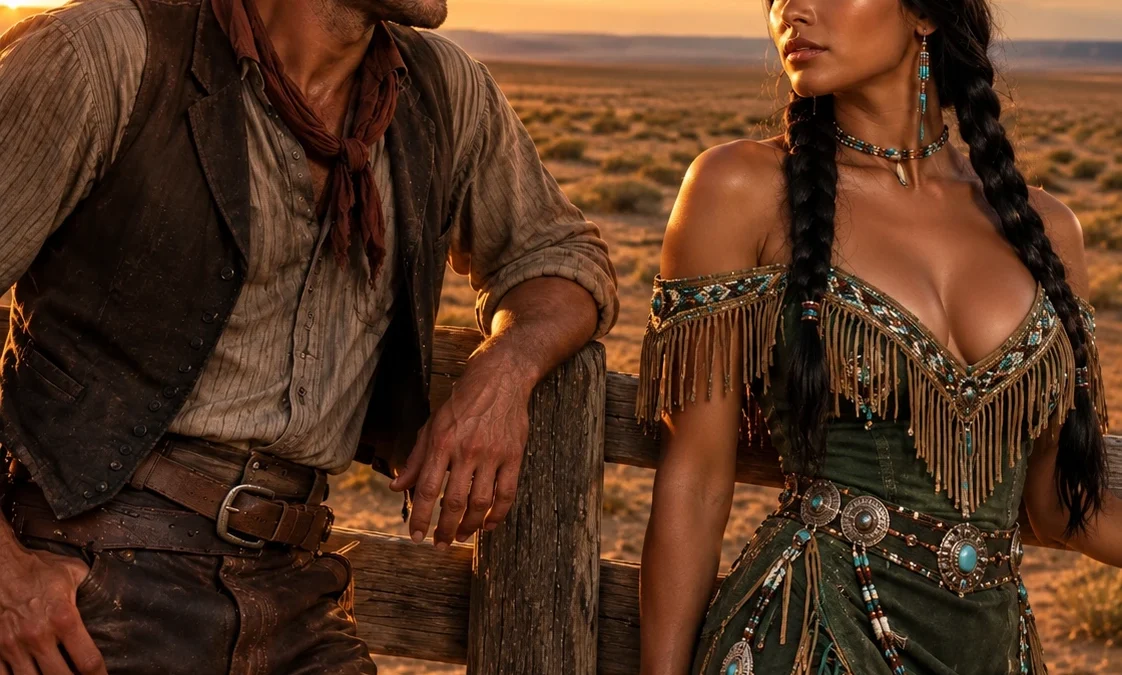
He Pulled Her Half-Buried From the Sandstorm — Then She Said Something That Left Him Completely Speechless 😱💔
Part 1
The Llano Estacado, New Mexico Territory — 1884.
The sky turned the color of dried blood at noon.
By mid-afternoon, the storm hit: a wall of red-brown sand two hundred feet high, roaring out of the southwest, swallowing the caprock whole.
Eli Hartman saw it coming from the ridge where he’d been checking the water hole.
He had barely three minutes before it would swallow him too.
He jammed his bandana tight over his face, wheeled his horse, and rode hard for home.
The wind struck before he made it.
It howled sideways, stinging his eyes, choking his breath, blotting out the world until there was nothing but swirling red dust.
He could not see the fence posts ten yards ahead.
He could barely see his own hands on the reins.
His horse reared suddenly, nearly throwing him.
When Eli got the animal under control and dropped to the ground, his heart stopped.
Half-buried in the sand at the base of a mesquite thicket was a woman.
Her doeskin dress was caked with grit.
Her face was pressed into the earth as if she’d tried to shield herself from the wind.
One arm stretched out ahead of her, moving — faintly, desperately — like she was still trying to crawl.
She was light, but the sand held her tight; he had to pull hard to free her.
Somehow he got her across the saddle and led the horse home through the screaming gale, every step a fight against the wind.
When he got the door shut behind them, she was still breathing.
He laid her near the stove, brushed the sand from her face, gave her water a sip at a time, and wrapped her in his heaviest wool blanket.
Her clothes were Mescalero Apache — fine beadwork along the yoke, a weaving bag still strapped to her back.
She looked younger than he’d first thought — early twenties.
He did not wonder who she was or where she came from.
He only knew he would not leave her to die in the dust.
She woke after midnight.
He was sitting by the stove with cold coffee in his hand when he heard her move.
She sat up, blanket pulled tight, and looked straight at him — dark eyes sharp and steady, no fear in them, only a terrible quiet focus.
“You’re safe,” Eli said gently.
“The storm’s passed.
I found you in the sand.
”
She held his gaze.
Then she spoke — clear, unhesitating English that startled him more than the storm itself.
“I know what you did,” she said.
“And a man like you needs a woman like me.
”
Eli stared.
Surely the ordeal had addled her mind? “Ma’am — you don’t know anything about me.
”
“I know plenty,” she replied, as calm as if she were reading the day.
“You live alone.
Your horses are thin.
Your fences are falling.
The playa north of here is drying up — I saw it two days ago.
And you dragged me out of the ground without asking my name first.
”
He didn’t know what to say.
“I’m Eli Hartman.
”
“I’m Doli.
”
Morning broke bright and eerily quiet.
The storm was gone, leaving the world scoured clean.
Eli went out to check the stock.
When he returned, Doli was standing at his stove stirring something in his only pot — corn porridge mixed with dried herbs from her bag.
She handed him a bowl.
It was simple, nourishing, better than anything he’d cooked in two years.
“I was separated from my band near the escarpment,” she told him.
“The storm changed direction too fast.
They’ll look east, toward the Guadalupes — not here.
I cannot walk back across this land alone without water.
”
Eli thought of his own drying wells, the bank note coming due, the ranch fraying at the edges since his wife Margaret died two years ago.
“You can stay a few days,” he said.
“I’ll get you a horse when you’re ready.
”
She looked at him as if he’d said something she already knew.
“You have thistle along the north draw.
Narrowleaf yucca at the caprock base.
Do you know what that means?”
He shook his head.
“Water,” she said.
“Underground.
Thirty, forty feet down.
Your people dig with metal but you don’t know where to dig.
My people have known this land for centuries.
I can show you.
”
Eli hesitated.
He was not a man who trusted easily — not since grief had settled heavy over this place.
But there was something in her voice, something sure and steady, that made it impossible to look away.
“I’m not used to taking advice from someone I pulled out of the sand yesterday,” he said quietly.
She almost smiled.
“No.
I suppose you aren’t.
”
Part 2
He didn’t take her advice that day.
Or the next.
He moved slow — that was his way.
Margaret had teased him about it often: “You think so long you miss the sunrise.
” But he watched her.
On the fourth morning, he found her behind the barn tending his bay gelding — the one with the swollen leg that had been lame for weeks.
She had packed a warm, greenish poultice around the joint.
“Yucca root mashed with water,” she said simply.
“And piñon resin.
Bruising, not bone.
He will walk sound in four days.
”
“That’s my horse,” Eli said — though he made no move to stop her.
“He was in pain,” she answered, meeting his eyes over the horse’s back.
“And shoeing a bruised foot makes it worse.
You know that.
”
The bay was sound on the fifth day.
Close enough.
That was what broke something open in Eli — just a little.
He started listening.
Doli showed him where to dig — where the thistle grew thick, where the soil changed color, where the yucca roots spread wide before diving deep.
“Thirty-eight feet,” she said.
“Right here.
”
Eli and his hand Teo dug for four days.
When the water came — clear, cold, steady — Eli stood at the bottom of the shaft and felt something inside him unclench that had been tight since Margaret died.
Three weeks later, they sat by the fire late at night.
Doli spoke of her people — her father, a healer who had died at the agency; her mother, who wove stories into every pattern.
Eli told her about Margaret — how she’d come west with him, how she’d loved this land even when it was hard, how she’d left him too soon.
For the first time in two years, he spoke her name aloud and did not feel like he was breaking.
Then came the day they rode into Callahan Wells together.
The silence in the general store turned sharp.
Eyes followed them.
Men muttered.
On the ride home, Doli said quietly, “You should not have brought me.
Their thoughts will follow you.
”
“Let them follow,” Eli said.
“I don’t have to invite them in.
”
The real trouble came in late August.
A man named Gideon Purse rode out from Las Cruces with two others — bank men, here to claim the ranch early on a technicality.
“You’re running horses on land zoned for sheep,” Purse said, smiling like he already owned the place.
“Bank wants to discuss arrangements.
”
Eli sent him away — but they both knew he would return.
He did — on a Saturday in September — with six men.
They spread out across the property, blocking the trails, cutting off the corral.
This was no inspection.
They had come to take everything.
Eli stood in the doorway, rifle in hand.
Doli stood beside him, holding the old Henry rifle he hadn’t touched in years.
“I’m not hiding in the back room,” she said, calm and unshaken.
“This is my ranch too.
”
The standoff stretched on for an hour — hot, tense, unbearable.
Then Doli’s hand tightened on his arm.
“Look — northwest.
”
A cloud of dust was rising fast across the flats.
Not one rider — fifteen.
Mescalero, moving like the wind itself, coming straight for them.
Purse and his men saw it too.
They froze.
Part 3
Purse’s face went pale.
He stared at the approaching riders, then at Eli, then back at the dust cloud growing larger by the second.
The man who had circled toward the corral was the first to break — he turned his horse and rode away fast, trying to look casual but failing.
Then another followed.
Then a third.
Purse lingered only a moment longer.
“This isn’t over, Hartman,” he called — but his voice had lost its bite.
He wheeled his horse and galloped after the others.
Eli let out a breath he felt like he’d been holding for an hour.
The riders slowed as they reached the ridge — fifteen of them, sitting their horses quiet and watchful.
One man, older and leaner, rode forward alone.
He spoke in Mescalero — a few short words.
Doli answered, her voice steady but softer than Eli had heard it.
Then the man turned to Eli and spoke in Spanish: “She told us you would be worth finding.
”
Eli replied in the same language — slow but sure.
“She has been worth everything to us.
”
The man gave the faintest nod, almost a smile.
He turned back to the ridge, and the group rode away — not in haste, not in triumph, simply — leaving the land quiet once more.
Doli lowered the rifle and set it back in its place.
“My uncle,” she explained.
“I sent word with Teo last week.
I wasn’t sure it would reach them.
”
Eli looked at her — really looked at her — understanding hitting him slow and bright as sunrise.
She hadn’t just been waiting.
She had been planning, protecting, making sure help would come if they needed it.
“They will go to the Guadalupes now,” she said.
“My mother is there.
She will be waiting.
”
“You should go with them,” Eli said — and his heart ached to say it.
She turned to him, standing in the golden light of late afternoon.
“If I go,” she said clearly, “I will come back.
”
He met her gaze.
“I know.
” It was all he could say — no plea, no demand, just the truth.
He would be here.
That was enough.
She picked up her weaving bag.
“The bay will need the yucca poultice again in spring — right rear this time,” she said, as if making sure he would be all right.
“Don’t forget.
”
“I won’t.
”
She stepped out into the yard, then paused and looked back.
“You are not done, Eli Hartman.
Don’t let yourself believe it.
”
Then she was gone — across the flats, following the trail north — and Eli stood in the doorway long after she had vanished, watching the empty horizon.
The months that followed were quiet.
He finished the well.
Teo stayed on full-time.
The lawyer sent word the bank had dropped its claim — they had no leg to stand on.
Eli mended the fences, planted a garden by the house, fixed the barn door that had hung crooked since Margaret died.
He did not wait, exactly — he lived.
He proved he belonged here, day by day.
May came.
The mesquite bloomed sweet across the flats.
He heard the hooves before he saw her — one horse, coming slow and steady down the trail.
He walked out to meet her.
She pulled up and looked down at him, sunlight catching the beadwork on her collar.
“Well,” she said, a faint smile touching her lips.
“You’re still here.
”
“I told you I would be,” he said.
“You didn’t say it in words.
”
“I know.
” He stepped closer.
“But I meant it.
”
She looked at the garden, the new well, the fat glossy horses grazing the draw — all of it.
Then she swung down from the saddle and stood before him, close enough that he could see the dust on her moccasins and the light in her eyes.
“I have something to ask,” he said.
His voice was steady — he had practiced this a hundred times in the quiet nights.
“I don’t have much.
The land is hard.
People will talk.
But I want you to stay — not as a guest, not as someone passing through.
I want you to stay as my partner.
As my wife.
”
He took a breath.
“A woman like you — would you have a man like me?”
She reached out and covered his hand with both of hers.
Her smile deepened — warm, sure, radiant.
“I told you that first morning,” she said softly.
“A man like you needs a woman like me.
”
She squeezed his hand.
“I said yes then.
I’m still saying yes.
”
They were married under the mesquite that summer.
Some folks in town whispered — but seasons turn, and life goes on, and eventually even the gossips fell quiet before the truth of what they had built.
The well never ran dry.
The horses became the finest in the territory.
The weaving Doli made hung on the wall — red for the mountains, interwoven threads for the path between their worlds, pale gold for the light that had found them both.
They walked the land together every morning — Eli listening now, really listening, to what the earth said — and the silence between them was full, warm, alive.
She had pulled him out of his own darkness, just as he had pulled her from the sand.
And neither of them would ever be alone again.
This story is entirely fictional and created for entertainment purposes only.
It does not represent any organization or individual, nor does it encourage inappropriate behavior.
The content was generated with AI assistance.








