He Said “I Do” With Revenge in His Heart. Then the Duke Discovered the Quiet Bride He Planned to Lock Away Now Held the Deed to His Own Home
He Said “I Do” With Revenge in His Heart. Then the Duke Discovered the Quiet Bride He Planned to Lock Away Now Held the Deed to His Own Home
PART 1
He said I do with murder in his heart. 🕯️
Arthur, Duke of Rothley, did not want a wife. He wanted a weapon.
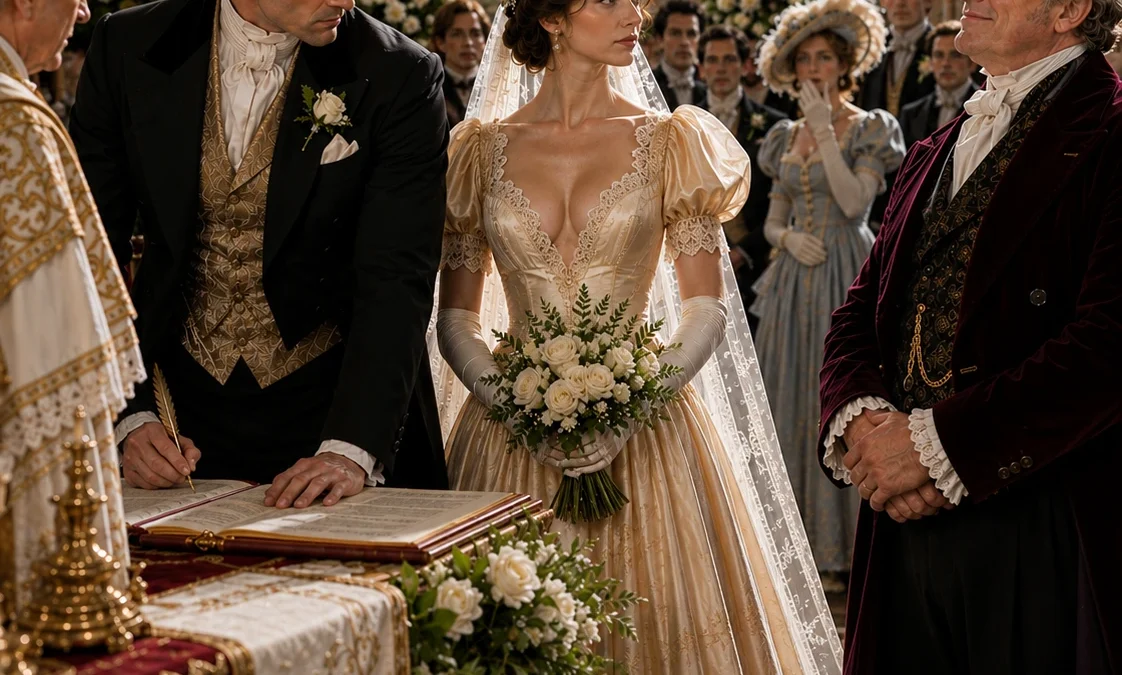
Standing at the altar, he looked at the quiet bride beside him and saw only her father, the man who had ruined his family. Marrying her was the perfect revenge. He would lock her away, spend her dowry, and watch her father break.
But Arthur made one fatal miscalculation.
He did not read the fine print. 📜
The chapel smelled of damp stone and old wax, a suffocating scent suited to a funeral or a marriage of convenience. Arthur stood rigid, eyes on the gilded cross. He was not praying. He was calculating.
To his right stood Lord Thomas Linfield, Earl of Harrow, built like a bulldog, all heavy jowls and tailored broadcloth. Harrow was smiling, a greasy, victorious smile that made Arthur want to wrap his hands around the older man’s throat.
Harrow had bled Arthur’s father dry. First came the bad railway investments, then the predatory loans, then the systematic acquisition of the Rothley family’s ancestral lands. The old Duke had died of a stroke at his desk, staring at a ledger that proved he owned nothing. Arthur inherited a title, a crumbling Yorkshire abbey, and a mountain of debt held entirely by the man standing three feet away.
So Arthur had made a deal. He would marry Harrow’s spinster daughter. In exchange, Harrow would clear the debts and provide a dowry large enough to restore the Rothley name. The Earl, desperate to secure a duchess’s coronet for his bloodline, agreed at once.
Arthur finally turned to look at his new weapon. Beatrice Linfield was twenty-six, well past the usual sell-by date of the London marriage mart. Not ugly, but entirely forgettable. Pale skin, dark hair pulled back far too tightly, a severe unsmiling mouth, a heavy silk gown that looked as if it weighed more than she did. Her hands, clasped around white roses, were perfectly steady.
She had not said a word to him since he coldly proposed in her father’s drawing room three weeks ago.
“I will,” said Arthur, the words tasting like ash.
“I will,” said Beatrice, flat and motionless.
Good, he thought. If she expects romance, she will have a miserable life. I intend to make it miserable anyway, but a lack of tears will make the process quieter. 😶
Within the hour they were in a carriage heading north, no joy to celebrate, the sky outside London already a bruised, sullen gray. They sat on opposite benches. Beatrice looked out the window, her profile sharp against the glass. She had not even changed from her wedding silk, just thrown a wool cloak over it.
Arthur wanted her to cry. He wanted her to ask what their life would be, so he could lay out his cruelty. When she stayed silent, his jaw tightened.
“I want to make our arrangements perfectly clear, madam. I married your money. You came attached to the draft. You are now the Duchess of Rothley, which is exactly what your father paid for. You will live at the Abbey. You will manage the country staff. You will not embarrass the name.”
She blinked. “And you, Your Grace?”
“I return to London at the end of the week. We will live entirely separate lives. Do not expect letters. Do not expect visits, save for when an heir is strictly necessary. And given my current distaste for your family’s blood, I am in no rush for that.”
It was a brutal speech. He had rehearsed it for days, polishing the edges until they could draw blood.
Beatrice held his gaze. She did not flush. Her breathing did not hitch. She simply reached into the leather satchel at her feet, drew out a small notebook, and opened it to a marked page.
“Very well. If you are to be in London, I will need the names of the Abbey’s suppliers. The butcher, the coal merchant, the blacksmith. Do they bill monthly or quarterly?”
Arthur stared, thrown completely off balance. “What?”
“The accounts. From what I understand of your estate’s condition, I imagine the local merchants demand cash on delivery.”
“You will speak to my steward about such things.”
“I prefer to see the numbers myself.” She looked back down at her book. She dismissed him. She actually dismissed him. 😤
Rothley Abbey was a decaying monument to better days. Built in the sixteenth century, it sprawled across a wet, windswept Yorkshire valley, majestic from a distance and dying up close. Half the east wing’s windows were boarded. The ivy on the gray stone was dead, leaving thick brown veins across the masonry.
Inside, the grand foyer was freezing, smelling of mildew and old ash. No fire in the hearth. One shivering footman, and a housekeeper far too exhausted for her station.
“Mrs. Gable,” Arthur nodded. “Have my bags taken to the blue room. Put Her Grace in the south wing.”
The blue room and the south wing lay on opposite sides of the house, a five-minute walk apart. “The south wing is a bit drafty, Your Grace. We have not had the coal to warm it.”
“It will do.” He strode away toward the library, his boots echoing on bare floorboards. The Persian rugs had been sold three years ago.
Beatrice stood in the dim foyer, taking in the water stains on the ceiling. “How many staff do we have, Mrs. Gable?”
“Just me, the footman, a cook who is half blind, and two village maids who come Tuesdays and Thursdays.”
No pity. No shock. Just data. “I will take the room next to the Duke’s, the west room, if it has a working fireplace. I have no intention of catching pneumonia to satisfy his theatrical need for distance. And please bring tea, strong, no sugar. And the household ledgers from the past five years.”
At dinner, Arthur called down twenty feet of cold table, “I see you ignored my instructions regarding your rooms.”
“The south wing has a leak in the roof and the floorboards are rotting. I am practical, Arthur. I do not sleep in damp rooms. You owe the butcher fourteen pounds. The roof needs three hundred pounds of slate. Your tenant farms yield half their crop because you have not bought fertilizer in four years. You are living in a shell.”
He threw down his fork. “It was your father who stripped this estate bare!”
“My father is a shark. He smells blood and he bites. Your father panicked after the South American mining bubble and took loans at exorbitant interest. My father capitalized on another man’s stupidity.” She looked up, unbothered. “I am not insulting him. I am reading his math. Numbers do not care about your pride. Finish your stew. It is terrible, but we cannot afford to waste it.”
Arthur stormed out. Tomorrow, he thought, Mr. Abernathy would arrive with the dowry papers. He would have his money, pay the merchants, and leave her in this tomb forever.
In the morning, the little London solicitor bustled into the study, ink-and-peppermint scented, and would not look Arthur in the face.
“Your Grace, I must draw your attention to the structuring of the trust.”
“The trust?”
“Lord Harrow transferred one hundred thousand pounds. He transferred the deeds to the mortgages on this abbey and the Sussex lands.” Abernathy wiped his brow. “He did not transfer them to you.”
The room went dead silent.
“The liquid capital, the mortgages, the deeds have been transferred in their entirety to the Beatrice Linfield Trust, upon her marriage to you. Legally speaking, Her Grace holds the mortgage on this very house, and she controls the accounts holding the dowry.”
Harrow had not bought him off. Harrow had bought him, and handed the leash to his quiet, plain, forgettable daughter. 😱
Arthur walked out without a word. He threw open the library doors with a crash that rattled the stained glass. Beatrice sat at a reading desk, ledgers stacked around her, ink on her fingers. She did not flinch.
“You knew,” he snarled, slamming his hands on her desk.
“I assume Mr. Abernathy has explained the settlements. You may have a modest quarterly allowance. Ten pounds this month. That might buy you a week at your club.” She dipped her pen. “My father did not hand over a hundred thousand pounds to a man who openly hates him. He wanted his bloodline in the peerage, but he was not going to finance your gambling and London mistresses to get it.”
“I am the Duke of Rothley!”
“You are a duke in name. You told me in the carriage that I was merely a draft attached to a title. Well, Arthur, it seems I am the bank.” Her voice dropped its polite veneer, cold iron. “And the bank is closed.”
The mousy spinster from the altar was gone. In her place sat a woman who looked exactly like Thomas Linfield.
PART 2
“And the bank is closed.”
“I will have Abernathy challenge the trust,” Arthur hissed.
“Challenge it all you like. My father’s lawyers drafted it. It is ironclad.” She picked up her pen. “Or you can stay, and help me fix this rotting house, because I refuse to be the Duchess of a ruin. Unpack your bags, Your Grace. We have a meeting with the coal merchant at noon. And I need you to translate his Yorkshire.”
The meeting happened in the mud of the stable yard. Mr. Higgins, broad and soot-stained, did not bother to remove his cap. “I ain’t delivering a lump of anthracite until the arrears are cleared. Forty-two pounds, six shillings.”
Beatrice stepped forward. “Paid in full by draft tomorrow. Moving forward, we will not pay your premium for delayed credit. Twenty-eight shillings a ton, cash on delivery, or I wire a supplier in Leeds.”
Higgins sneered. “And who’s asking, miss? The housekeeper?”
“The Duchess of Rothley,” Arthur said. The words tasted like bile, but he found he disliked Higgins’s disrespect more than he disliked his wife. “You will address her as such.”
Higgins blinked and tugged off his cap. In the end it was twenty-nine shillings, and Arthur watched with strange, clinical fascination. She had not wept at the rotting floors. She was bargaining like a dockside trader.
“Why are you doing this?” he asked her afterward. “You belong in a London townhouse.”
“Because my father expects me to fail,” she said softly. “He thinks I will panic, hand back the reins, and let him carve up Rothley Abbey for parts. I refuse to give him the satisfaction. And I refuse to be a ghost haunting a ruin.”
He noticed for the first time that her knuckles were red from the cold, a smudge of ink on her cuff. He did not say anything. But he did not pack his bags. 🕯️
In November a gale battered the Abbey for three days. At two in the morning Arthur woke to a sound like a cannon shot, and a splintering crash, and then rushing water. In the old library, the one room his father had forbidden anyone to gut, part of the slate roof had collapsed. A torrent of black, icy rain poured onto the tables and across the floor toward thousands of rare volumes.
And in the center of it stood Beatrice, drenched in a thin white nightshift, bare feet splashing in freezing water, dragging ledgers off the table.
“Arthur! The bottom shelves on the north wall! Get the folios!”
The aristocratic detachment of his adult life vanished. He waded in, dropped to his knees in the icy water, and began hauling centuries-old family histories into his arms. For two hours they did not speak. They worked in a frantic, exhausting rhythm, Arthur carrying furniture and canvases out, Beatrice organizing dry stacks and directing a terrified footman. By four, the leak was contained by a ring of iron pots and tin basins.
Arthur collapsed against the paneled wall of the hallway, chest heaving. Beatrice sank down beside him, hair in wet tangles, a streak of mud across her cheek, teeth chattering. He threw a dry wool blanket roughly over her shoulders.
“Thank you,” she whispered.
“You are bleeding.”
“A nail in a crate. It is shallow.” She leaned her head back. “The whole east roof must be rebuilt. Five hundred pounds at least.”
He laughed, a short, hollow sound. “Always the ledger. Even when you are freezing to death.”
“If I do not watch the ledger, who will? Your father did not. You did not. The math is the only thing keeping the rain off our heads.” 😮💨
“Why did you not let it rot? You could have stayed in your dry room.”
“Because they belong to Rothley. And I am Rothley now. I care about having something that is mine, that I built, that my father cannot touch.”
He looked at his own blistered hands. A crack ran through the ice in his chest.
“I know an architect in York. My father insulted him five years ago, but he does good work. I will write the letter. I will apologize.”
Beatrice’s expression softened by a fraction. “Thank you, Arthur.”
By Christmas the Abbey smelled of fresh pine, beeswax, and coal smoke. The east roof gleamed. Two dozen local men were paid at noon every Friday by a duchess with a ledger, who knew their names and whose wives were expecting. Arthur woke early now. He walked the fields with tenant farmers, found a drainage problem his father had ignored for a decade, and ordered new trenches on the spot. He was acting like a duke again.
Then Squire Harland, a mill-money landowner, tracked mud across the clean drawing-room floor and slapped a crude IOU from the late Duke onto Beatrice’s desk. “Two hundred pounds. A debt is a debt in Yorkshire, little miss. Hand it over, or I will tell every tradesman to Leeds the Rothleys do not pay their markers.”
“A gambling debt is not binding against the estate,” said Beatrice, not flinching. “You let a bankrupt man bet money he did not have. That is your foolishness, Mr. Harland.”
“You insolent little…”
The drawing-room doors opened with a quiet click. Arthur stepped in, boots muddy, a riding crop tapping against his thigh, his face a mask of cold, terrifying stillness.
“Harland. You raised your voice to my wife. You tracked mud into her drawing room. And you tried to extort her for a debt that died with my father.” He flicked the IOU off the desk with the leather tip. “You bought that marker from a bookie for twenty pounds. Do not speak to me of honor. If you ever walk into this Abbey uninvited again, I will have the gamekeeper drag you off my land behind a horse.”
Harland fled. Arthur tossed the IOU into the fire and turned to find Beatrice staring at him, her calm mask fractured, stunned.
“He should not have spoken to you that way. Your father’s money saved this house, but you are the one rebuilding it. You are the Duchess of Rothley, and I will not allow anyone to forget it.”
“Arthur,” she said softly. It was not clinical this time. It was a question. 💛
In January snow buried the moors in three feet of blinding white and cut them off from the world. Three months earlier he would have called it a prison sentence. Now it was a logistical problem. In the library, he tried to find a loophole to reclaim timber rights his father had sold. Beatrice came and read the contract over his shoulder, close enough that he could smell lavender soap and old paper.
“It is poorly drafted. He sold only the trees mature at the date of signing. Any tree that has matured since belongs to Rothley, and the buyer must prove the age of every tree. If we threaten an injunction, they will sell the contract back for a fraction.”
It was brilliant, and entirely ruthless. “You have a terrifying mind, Beatrice.”
“I am a Linfield.”
“No.” He reached up and brushed a stray lock from her cheek. “You are a Rothley.”
She did not pull away. And the library doors opened.
“Beg pardon, Your Grace. A telegram, from London.”
Beatrice read the yellow slip. The pink drained from her cheeks. For the first time since he had met her, she looked afraid.
“My father is coming. He arrives on Tuesday.” 😨
PART 3
The Earl of Harrow did not travel lightly. His carriage crunched onto the gravel the following Tuesday, with two outriders and a second carriage for his luggage and his secretary. He stepped out in a heavy sable coat with a victorious sneer.
The sneer faded. He had expected boarded windows and rotting wood. He had expected his daughter miserable and the Duke drinking himself to death in a frozen parlor. Instead he saw a newly slated roof, repointed masonry, smoke rising steadily from six chimneys, and a stable yard bustling with well-fed horses.
Arthur and Beatrice stood on the front steps, side by side. He in a dark tailored suit. She in deep navy silk with a heavy silver necklace at her collarbone. They did not look like hostages. They looked like a duke and duchess.
“Lord Harrow,” said Arthur, not bowing. “Welcome to Yorkshire.”
In the drawing room Harrow warmed his hands at the fire, his nervous secretary in the corner. Beatrice sat at her desk. Arthur stood right behind her chair.
“The trust was a temporary measure,” said Harrow, dropping all pretense of warmth. “A safeguard, to ensure the Duke did not squander the capital before the estate could be properly liquidated. I expected Rothley to fail. I see you have played at being a steward, Beatrice. It is quaint. It ends today.”
The secretary laid a thick sheaf of papers on her desk. “The Sussex lands, which the trust holds, have quadrupled in value with the new railway. I have a buyer in London. Sign the release transferring the deeds back to my holding company.”
Arthur stiffened. Sussex was the most fertile property the Rothleys owned. Selling it would gut the estate’s income for generations. Harrow was not checking on them. He had come to strip the copper wire from the walls.
“No,” said Beatrice.
The word was quiet. It dropped into the room like lead. 🔥
“The Sussex lands fund the Abbey’s repairs for twenty years. They are not for sale.”
Harrow’s face flushed a dangerous mottled red. He stepped toward the desk, but Arthur moved around the chair and placed himself between the Earl and his daughter. “You heard the Duchess. Step back.”
“You arrogant, penniless fool! She controls the trust, and I control her. Sign, Beatrice, or I will tie this trust up in Chancery for a decade and you will both starve in this freezing stone box!”
Beatrice stood. She handed the papers back to the trembling secretary. Then she opened a drawer and drew out a single, heavily stamped sheet of vellum.
“You cannot freeze the trust accounts, Father, because the trust no longer exists.”
Harrow froze.
“You included a standard dissolution clause. The trust could be dissolved if the initial capital, the hundred thousand pounds you deposited, was returned to you in full.”
He laughed, a harsh bark. “And where would you get a hundred thousand pounds? You cannot use trust money to pay the trust.”
“I did not. Arthur and I used the newly appraised value of the repaired Abbey, the restored tenant farms, and the Sussex lands to secure a private mortgage from the Bank of Yorkshire. We borrowed one hundred and twenty thousand. Yesterday morning I wired your capital back to your London accounts, with five percent interest.”
Harrow stared at the Bank of Yorkshire stamps, his hands beginning to shake.
“The debt is now ours, not yours. The mortgages, the deeds, the estate belong jointly to Arthur and me. You have your money back, Father. Which means you have absolutely no leverage left in this house.” 😮
The silence was absolute. Harrow looked from the paper to his daughter, and finally to Arthur, at the grim, unyielding pride in the Duke’s eyes, the cold, brilliant defiance in his daughter’s posture. They were a fortress.
“You are a fool, Beatrice. You tied yourself to a dying name, took on a mountain of debt for a man who married you out of spite.”
“No,” she said softly. “I took on debt for my home. And for my husband.”
Harrow crumpled the vellum, threw it on the floor, and stormed out. They listened to his carriage wheels fade across the gravel. The silence that followed was not heavy. It was lighter than air, the sound of a cage door swinging open. 🥹
“When did you go to the Bank of Yorkshire?” Arthur whispered.
“Three weeks ago, when you went to York to buy plow horses. The director agreed on Friday.” She looked down at her hands. “We have a massive mortgage now, Arthur. Nearly a thousand pounds a month. We will not afford a London season for years. The south wing will have to wait until the fall harvest.”
He did not care about the south wing. He did not care about London. He closed the distance in two strides and took her face in his calloused hands.
“I never want to see a ballroom again.”
“You married me to punish him,” she whispered.
“I was an idiot. I wanted a weapon. I did not realize I was getting a partner. I did not realize I was getting the only person strong enough to pull me out of my own grave.” His thumb brushed her cheekbone. “I am not a rich man, Beatrice. You just traded a wealthy father for a husband with a mortgage.”
A small, genuine smile broke across her face. It transformed her entirely, lighting the quiet corners of her eyes. “I have seen the ledgers, Your Grace. The math is sound. We will survive.”
He kissed her. It was no polite aristocratic kiss, but deep and desperate and full of the raw reality of the last four months, every ounce of his gratitude and respect and the fierce love he had unknowingly cultivated. Beatrice made a small sound and wound her arms around his neck, anchoring him exactly where he belonged. 💛
Spring came early to Yorkshire that year. The mortgage was tight, but the Sussex rents were steady, and Beatrice’s ledger always balanced. The fence timber came back to Rothley for a tenth of its price, just as she predicted. The tenant farms yielded their best crops in a decade. The county, which had written the Rothleys off as a dead lineage, began to say that the Duchess was entirely without charm, but her coin was heavy and her word was iron, and that the Duke had finally learned to be a duke. 🌱
Mr. Higgins delivered coal at twenty-nine shillings and took off his cap every time. Squire Harland sent a stiff letter of apology, and a barrel of cider. Mrs. Gable got a cook with eyes, and a staff of twelve, and a new black dress she pretended not to love.
One evening in June, Arthur found Beatrice in the old library. The slates above were whole, the floor dry, the shelves restored. She was alone, sitting in the window seat with a book she was not reading, golden light on her hair.
“Do you remember what you said that night in the flood?” he asked. “That you cared about having something that was yours, that your father could not touch.”
“I remember.”
“I wish to give you something. Not a title. Not a house. I have nothing to give you that you did not build yourself.” He sat beside her and drew a small object from his pocket. It was a simple gold ring, worn thin, with no stones. “It was my grandmother’s. She was a baker’s daughter from Leeds who married the third Duke against every rule of society. She ran this estate for forty years. My father sold every jewel in the family, but he never found this. It was in a tin of buttons in the old nursery.”
Beatrice’s eyes filled. “Arthur.”
“I married you with murder in my heart. I would like to marry you again with love in it, in the chapel where I lied. And this time I will read every word.”
She laughed through her tears. “You had better. I will check the fine print.”
They were married a second time on a bright morning in July, in the damp, cold chapel that smelled of stone and old wax, though today it smelled of roses. The whole village came. Higgins sat in the third pew, Mrs. Gable wept in the front, and the footman, now a proper steward’s apprentice, stood proudly by the door. There was no Earl of Harrow. But there was a single letter, delivered that morning, in a stiff, crabbed hand: Congratulations. You have proved more of a Linfield than I ever suspected. Do not mistake this for a blessing. T.H.
Beatrice read it twice, and folded it into her bouquet.
“From my father.”
“Is it a blessing?”
“It is the closest thing he knows how to write.” She squeezed Arthur’s hand. “I will take it.”
They stood at the altar once more, the Duke and Duchess of Rothley, in the place where it had begun as revenge.
“I will,” said Arthur, and for the first time the words tasted like bread.
“I will,” said Beatrice, and her voice was not flat at all.
The bells rang across the valley, over the new roof and the green fields and the smoke rising from six warm chimneys. Rothley Abbey, which had been dying, was alive.
They had started as a transaction, a bitter deal signed in ink and spite. But the ledger was finally closed. They owed nothing to the past. The future belonged entirely to them. 🕯️💛
💭 Isn’t it something, how the very thing meant as a weapon turned out to be the only thing that could save him?
If this story moved you, a LIKE genuinely helps. 👍 Share it with anyone who loves a quiet heroine with a sharp mind. And tell me in the comments: would you have read the fine print? 👇
Disclaimer: This story is entirely fictional and created for entertainment purposes only. It does not represent any organization or individual, nor does it encourage inappropriate behavior. The content was generated with AI assistance.








