HE SAVED 40 DYING STRANGERS IN THE DESERT, BUT THEIR CHIEF SAID HIS LIFE NOW BELONGED TO THEM, AND HE WAS BROUGHT BEFORE 22 WOMEN
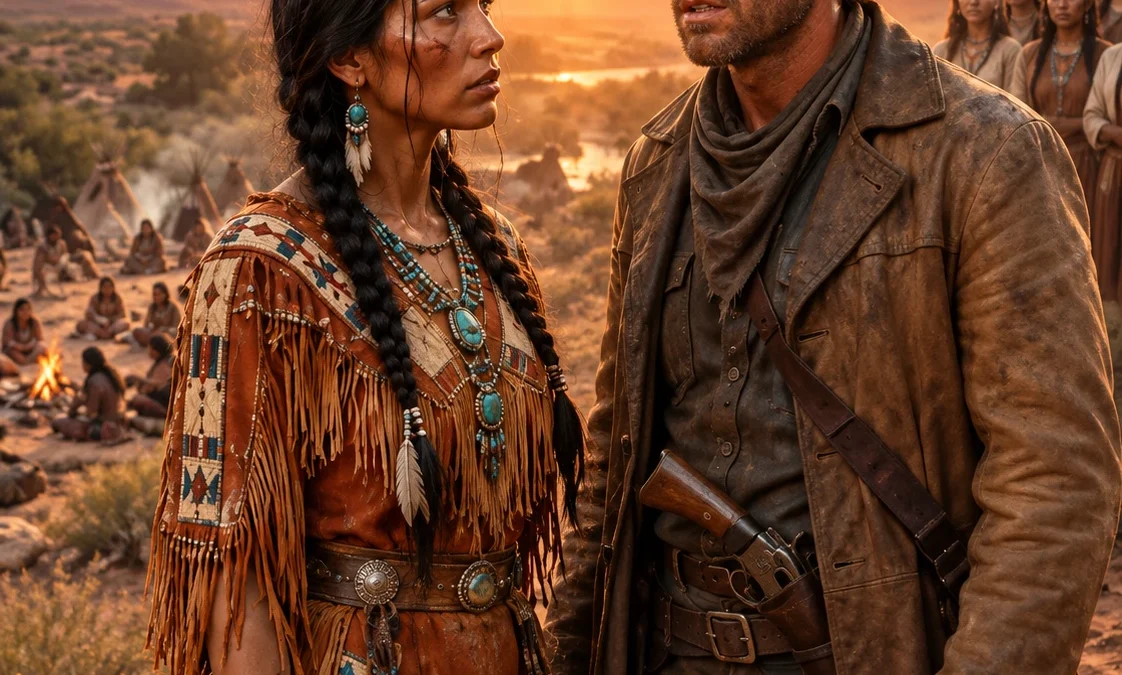
HE SAVED 40 DYING STRANGERS IN THE DESERT, BUT THEIR CHIEF SAID HIS LIFE NOW BELONGED TO THEM, AND HE WAS BROUGHT BEFORE 22 WOMEN 😳🏜️
Part 1
What would a man sacrifice to save forty strangers, when the only thing that could save them was the very thing he had spent his life running from? 💔
Arizona Territory, 1883.
The sun hung over the desert like a hammer. Elias Boone, thirty-one years old, rode alone through a brutal stretch of sand and stone. He carried three things: an aging horse, a rifle, and a weather-stained leather journal that had belonged to his late father.
He had spent years avoiding settlements. Avoiding people. Avoiding anything that might become a reason to stay.
He had lost his family. He had been betrayed by people he trusted. And somewhere along the way, he had convinced himself that loneliness was safer than belonging.
The journal was the last thing that connected him to his father. Its pages were filled with strange notes: hidden springs, odd rock formations, underground water, forgotten trails. Elias had never fully believed them. But he kept the book close all the same, the way a man keeps a photograph of someone he can no longer touch. 🤎
That morning, crossing a dry riverbed, his horse suddenly stopped.
It would not take another step.
Elias frowned, patted the old animal’s neck, and urged him forward. Nothing. The horse stood trembling, ears turned toward the ridge ahead.
So Elias dismounted and climbed.
At the top, he stopped breathing.
Below him, struggling across the burning desert floor, were nearly forty Apache people. 😨
Men. Women. Children. Elders.
They had been driven from their homeland by soldiers and forced to walk through a region where every water source had dried to dust. Many were too weak to stand straight. Several children were barely conscious. An old man had collapsed in the sand, and no one had the strength left to lift him.
And near the middle of the line, a mother carried an infant in her arms.
The baby had stopped crying.
Elias stood frozen on the ridge, and every instinct he had trained for years spoke at once. Ride away. Helping them will bring soldiers. Or settlers. Or Apache warriors who will not trust a white man’s face. This is not your fight.
He turned back toward his horse.
And then he heard his father’s voice, as clear as if the man were standing beside him in the heat.
“A man isn’t measured by the trouble he avoids, son. He’s measured by the lives he refuses to abandon.” 🥺
Elias closed his eyes.
Then he turned his horse around.
He approached slowly, hands visible, rifle slung and silent.
A man stepped out of the line to meet him. Tall, gray-haired, perhaps fifty-eight years old. His body was nearly spent, but he carried himself with the unshakable authority of a chief.
Red Hawk.
Elias said nothing. He simply unhooked his canteen and held it out.
Every eye in the column fixed on that canteen. Cracked lips. Hollow cheeks. Hands trembling at their sides.
Red Hawk took it.
And he did not drink.
Instead, without a word, he turned and passed it to the weakest of his people, the children, the elders, the mother with the silent baby. The chief of forty dying people stood in the sun with a dry throat, watching others drink first.
Something in Elias shifted. 💛
“I think I know where water might be found,” he said quietly.
Red Hawk studied him. His eyes held decades of lies from white men who had smiled and promised and betrayed.
“Why should we believe you?”
Before Elias could answer, a younger warrior stepped forward, tense as a drawn bow. Tomas, twenty-seven, Red Hawk’s nephew.
“He is leading us into another trap,” Tomas said. “They always do.”
Elias did not blame him. Not one bit.
But he opened the journal.
One passage stood out, written in his father’s cramped handwriting. A strange rock formation called the Stone Hawk. According to the notes, when the afternoon shadow of that rock pointed toward the eastern ridge, hidden water could be found beneath the ground.
There was only one problem.
Elias had never actually seen the Stone Hawk. He had never even been certain it existed. 😰
He searched the surrounding cliffs for hours while forty people waited behind him in the heat. Tomas watched his every step. Every failed turn. Every pause.
Then, finally, against the burning sky, he saw it.
A massive natural formation shaped exactly like a great bird with its wings spread wide.
“There,” Elias whispered.
The group followed him. Tomas challenged him at every step, and Elias refused to argue. He simply kept reading the land, one rock, one shadow, one trail at a time.
The journey grew crueler by the hour. One woman collapsed in the sand. Before Elias could move, Tomas was already there, lifting her into his arms and carrying her forward without a word.
Elias watched him.
He isn’t cruel, he realized. He’s terrified. Terrified of losing everyone he loves.
A fragile, tense respect began to grow between the two men.
When they finally reached the foot of the Stone Hawk, Elias felt his stomach drop.
The journal was specific. They had to wait until the sun reached the exact position that would cast the correct shadow.
And the people had almost no water left. 😓
Hours crawled by. Then a small child, barely four years old, went limp in her mother’s arms.
Elias had been secretly saving a few drops in his canteen. Just a few. Enough to survive the ride back alone, if it came to that.
He looked at the child’s gray lips.
And he knelt down and gave her every last drop.
The child coughed. Her eyelids fluttered. She breathed.
Across the circle, Tomas had watched the whole thing. And for the first time, the hatred in his eyes began to crack. 💔
Then the sun slid into place.
The Stone Hawk’s shadow stretched across the ground and pointed at a single patch of sand.
Elias counted the steps his father had written. He fell to his knees. He began to dig.
Sand. Only sand. His hands were bleeding.
Then his shovel struck stone.
And as Red Hawk knelt beside him and helped drag those stones aside, Elias heard something he had not dared to hope for.
A low, wet, trembling sound from deep underground.
But what Elias did not yet know, as the water began to rise, was that saving these people had just created a debt that would change his life forever…
👉 Part 2 is waiting in the comments! Can’t find it? Leave any word below and I’ll send it to you privately. Don’t leave this story hanging! 👇
Part 2
The water rose.
Slowly at first, then in a steady, glittering flow, filling the hollow Elias had dug with his bare hands. Forty exhausted people stared at it as if it were a dream. Then a child cried out, and the whole camp broke.
They drank. They wept. They laughed. A grandmother pressed wet fingers to her face and whispered something Elias could not understand but felt in his chest. 💧
His father’s forgotten journal had led them to a hidden spring.
In the days that followed, the camp came back to life. Children regained their strength. Families built temporary shelters. The once-silent desert filled with cooking fires and laughter and the low murmur of conversation.
Elias told himself he would leave. He had only done what any decent man would do.
But he kept finding reasons to stay.
Red Hawk invited him into the council circle. Elias listened more than he spoke. Slowly he began to understand that these were not strangers anymore. Even Tomas, though cautious, no longer looked at him like an enemy.
Then one evening, Red Hawk sat beside him at the fire.
“You gave my people something beyond ordinary help,” the old chief said. “You saved all of them from death. In our tradition, such a debt must be repaid with something of equal importance.”
“I want nothing,” Elias said at once.
“Refusing the gift entirely,” Red Hawk answered gently, “could be seen as rejecting our honor.”
Elias felt the ground tilt beneath him.
The next day, he was brought before the council.
A line of unmarried women entered, one after another. Twenty-two of them, in all. Each carried herself with quiet dignity, and each wore the weight of an arrangement she had not chosen.
Among them stood Mara, Red Hawk’s twenty-five-year-old daughter.
She was intelligent, confident, and observant. And unlike the others, she did not look comfortable. Her eyes kept drifting, almost against her will, toward one man at the edge of the circle.
Tomas.
And in that moment, Elias understood everything. 😳
Mara and Tomas loved each other. They had always been expected to marry, but tradition and family duty had tangled their future into something neither could untie.
“You may choose a bride,” Red Hawk said, “as repayment of the debt.”
Elias could not breathe. He did not want a wife handed to him like payment. And he especially did not want Mara, whose heart so plainly belonged elsewhere.
That night, Mara found him alone by the spring. Her voice was low and steady.
“I do not want to be chosen.”
“I won’t take you,” Elias promised. “You have my word.”
But he knew the truth. Simply rejecting the arrangement could insult Red Hawk and spark a conflict that might undo everything they had survived.
Then Tomas found him.
His face was hard, his jaw clenched. “You plan to take her.”
“No,” Elias said. “I will never take someone who does not freely choose me.”
Tomas stared at him, thrown completely off balance. Slowly, the fight drained out of him, and what remained was raw and honest.
“I love her,” he admitted. “But I fear losing her. My uncle’s honor must come before my own happiness.”
Elias looked him in the eye. “Love without choice isn’t love, Tomas.”
The words hung between them in the desert dark. 🌙
The next morning, Elias asked Red Hawk for another way.
The old chief was quiet for a long time. Then he spoke of an ancient tradition: the three challenges. A man who refuses an offered gift may prove his character through trials. If he succeeds, he earns the right to choose his own future.
The council agreed.
The first challenge was a race through the harshest stretch of desert, and Tomas was the clear favorite. He knew every rock and wash. He rode the faster horse. Elias fell behind almost at once, dust choking him, his old horse straining.
Then, halfway through, Tomas’s horse stumbled. It cried out and began to limp, favoring a badly injured leg.
Elias could have flown past him. The race would have been his.
He pulled back instead. 🐴
He slowed his horse to a walk, refusing to win while another animal suffered. The two men crossed the finish line almost side by side, and Tomas, in front of the whole community, raised his voice.
“Elias is the true winner. He chose compassion over victory.”
Something changed in the faces around them. Whispers turned to quiet respect.
The second challenge was stranger still. Elias had to find a rare desert animal and place a colored ribbon on it without frightening or harming it.
He searched the whole day and found nothing. Frustrated, he chased tracks until his legs ached, and the animal only fled farther.
At last, he stopped.
Some creatures cannot be caught through force, his father had always said. They must be approached through patience.
So Elias sat down beside a small water source at sunset. He stilled his breath. He stilled his hands. He became part of the stone and the shadow.
And as the sky turned amber, the creature stepped out of the brush.
Elias did not move. Minutes passed like hours. Slowly, impossibly slowly, he lifted the ribbon and let it settle on the animal’s antler. The creature lifted its head, looked at him for a long moment, and vanished into the dusk.
Behind a ridge, the community’s scouts had witnessed every second of it.
Elias had passed the second challenge.
But as the third trial approached, something else was happening that he had not planned for. During those long evenings, Mara and Elias had begun to talk. They disagreed. They laughed. She told him about her dream of building a permanent trading relationship between her people and the nearby settlements. He told her about his years of loneliness, and why he had stopped trusting anyone.
And Elias realized, with a terrible, wonderful jolt, that he might have just found someone he genuinely wanted in his life.
Right when the council was about to announce the third and final challenge, Red Hawk stood up and said four words that silenced the entire camp:
“Elias has passed. All of it.” 😮
👉 Want to see what Elias asked for instead of a bride? LIKE or comment “REVEAL” below! Part 3 will be posted once we have enough comments! 🔥💬
Part 3
The camp held its breath.
Red Hawk had expected the third challenge to be the hardest. But when the council looked to Elias, he rose to his feet and did something no one expected.
He declined the prize.
“I do not want this debt settled through a woman,” he said. His voice was steady. “But I do not want to dishonor you either. So let me propose something different.”
Murmurs rippled through the circle.
“Let me build a permanent trading settlement beside this spring. A place where Apache families can trade their woven goods, their turquoise, their leather and food with nearby settlers, in exchange for tools, metal, horses, and supplies. A place where this water becomes something people share instead of fight over.” 🌵
Red Hawk was silent for a long, long moment.
He had waited his whole life for someone to offer his people something beyond survival. He realized that Elias was not offering a personal reward. He was offering a future.
At last, the old chief spoke.
“The debt is paid.”
A soft cheer rose from the council, then spread through the camp like wildfire. 💛
But one question still hung in the air, heavier than the rest.
What would happen between Mara and Tomas?
Elias refused to interfere. He found Mara alone and told her plainly.
“If you choose Tomas, I will respect it. If you choose nobody, I will respect that too. I will never claim you because of a debt.”
Mara looked at him for a long time. She said nothing.
Tomas, meanwhile, was fighting the hardest battle of his life.
He could have continued to oppose Elias. He could have let jealousy turn him cold again. But he kept hearing the same words over and over: Love without choice isn’t love.
At last, one evening, he sought Elias out.
“I no longer consider you an enemy,” he said quietly. It was hard for him to say, and he said it anyway.
Then he went to Mara.
“I release you from the childhood promise that bound us,” he told her, though it cost him dearly. “If you still want me, I will be here. But you must choose me freely. Not because of tradition. Not because of duty.”
Mara’s eyes filled. She thanked him. She did not answer.
And Tomas walked away, knowing he might have just lost her forever. 💔
Several nights later, Mara found Elias at the spring.
The moon was high. The water shimmered silver. She stood at the edge for a long time before speaking.
“I have been thinking about the difference between being offered to someone and choosing someone.”
Elias did not move.
“I choose you,” she said.
His breath caught.
“Not because my father offered me. Not because you saved my people. Not because tradition demanded it.” She stepped closer. “Because I have come to love the man you are.”
Elias, who had spent years running from anything that could hold him, felt something inside him finally stop running.
“I love you too,” he said. His voice cracked on the words. “I think I have since the day you told me you did not want to be chosen.”
She laughed through her tears. And in the shadow of the Stone Hawk, beside the spring his father’s journal had led him to, Elias Boone kissed her. 🥹❤️
Construction began before the first frost.
Elias worked shoulder to shoulder with Apache craftsmen and local settlers, hauling timber, setting stone, raising walls. Tomas became one of the project’s strongest supporters, throwing himself into the work with the same fierce loyalty he had once used to distrust Elias. Red Hawk oversaw the negotiations, and Mara organized trade routes and taught Elias about desert plants, hidden paths, and local traditions he would never have learned alone.
The trading post grew, board by board and handshake by handshake. The spring became a meeting place where people who had once crossed the road to avoid each other began exchanging goods and stories. 🤝
And Elias changed.
He realized that his whole life had been built around leaving. He had believed that survival meant staying unattached. But now he understood something he had never grasped before.
Surviving and living are not the same thing.
He no longer wanted to ride endlessly toward another horizon. He wanted a home. He wanted Mara. He wanted the community he had accidentally become part of.
Tomas, too, found his own path. In time, he stopped seeing his broken childhood promise as a tragedy. He met a woman from a neighboring community who challenged him, understood him, and chose him freely. Their story mirrored Mara and Elias’s, and Tomas realized that the greatest lesson he had learned was not how to win a fight.
It was how to let someone choose. 🌿
Elias and Mara were married beside the spring.
The ceremony wove together both of their worlds. Apache families and settlers gathered under the same wide sky. Red Hawk blessed the union with words that rose and fell like a prayer. And standing beside Elias, instead of against him, was Tomas. 🤍
The wedding was more than a celebration. It was a symbol of everything that had changed.
And it was not repayment of a debt. It was a choice.
Years passed. The trading post flourished. Travelers began arriving from distant settlements. Children who had once nearly died in the desert grew up playing around the spring. The place became known far and wide as a symbol of cooperation.
People told different versions of how it all began. Some settlers said a wandering cowboy had discovered a hidden spring. Others said an Apache chief had trusted a stranger when nobody else would.
But the people of the spring remembered the truth.
A dying group had survived because one man chose not to ride away. 💛
Many years later, Elias sat beside the water with Mara, his hair streaked with gray.
He thought about the man he used to be. The lonely cowboy who believed he needed nobody. The man who had nearly turned his horse around on that ridge.
He realized that the greatest thing he had received was not the spring. Not the trading post. Not even the gratitude of forty people.
It was the chance to belong. 🥺
Some debts, he understood now, should never be repaid by taking something from another person. Sometimes the right way to repay a life is to build something that gives other people a better life, too.
Around them, the spring flowed quietly beneath the Stone Hawk. Children played at its edge. Traders swapped goods and stories. Families gathered around evening fires. And Elias and Mara stood together, watching the settlement they had built.
The same desert that had once meant death had become a place of life.
And the lonely cowboy who once believed his greatest strength was walking away finally understood that sometimes, the bravest thing a person can do is stay. 🌅❤️
This story is entirely fictional and created for entertainment purposes only. It does not represent any organization or individual, nor does it encourage inappropriate behavior. The content was generated with AI assistance.








