HE SAW SIX OUTLAWS CORNER TWO APACHE SISTERS—THEN THE LONELY RANCHER MADE A CHOICE THAT CHANGED ALL THREE LIVES
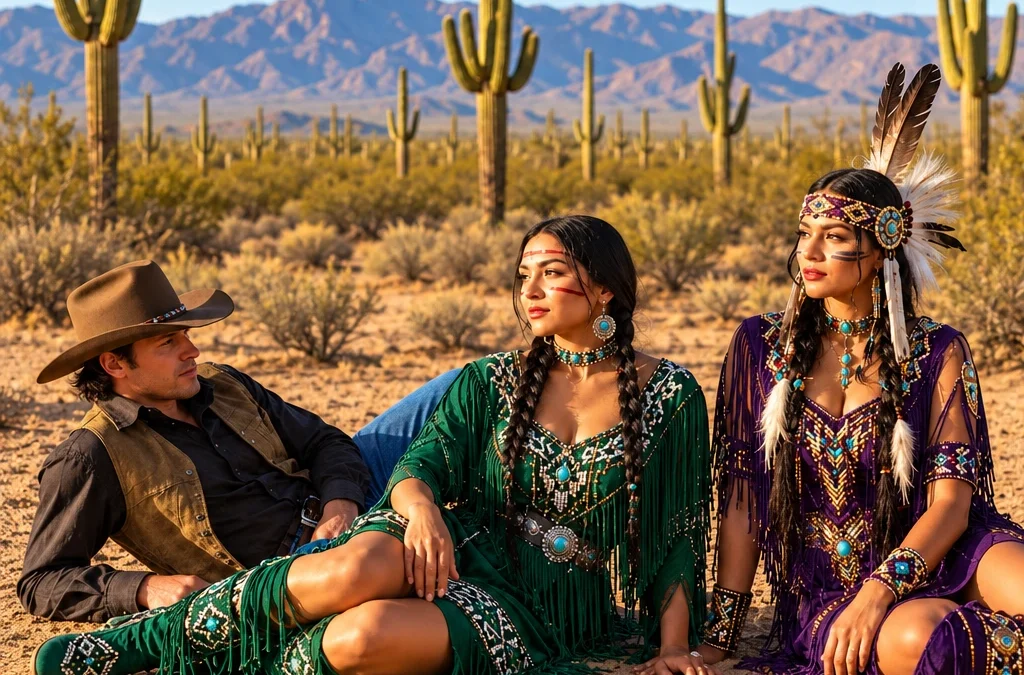
HE SAW SIX OUTLAWS CORNER TWO APACHE SISTERS—THEN THE LONELY RANCHER MADE A CHOICE THAT CHANGED ALL THREE LIVES 🌵🐎❤️
Part 1
In the summer of 1882, Elias Cole had almost nothing left worth losing.
Maybe that was why he risked his life for two strangers.
The Arizona sun hung mercilessly above the desert when Elias rode alone through country most settlers avoided.
He was thirty years old.
Quiet.
Weathered.
His horse, Mercy, carried a rifle, blankets, water, and nearly everything Elias still owned.
Once, he had dreamed of building a peaceful ranch near Tucson.
Then drought came.
War came.
Bad luck followed both.
His parents died during a brutal winter, leaving Elias with a half-finished ranch and no family nearby.
Over the years, he survived however he could—guiding cattle, repairing fences, taking work wherever someone needed a strong back and asked few questions.
He had grown accustomed to loneliness.
Then gunshots echoed through a canyon.
Mercy’s ears lifted.
Elias stopped.
Another shot.
Then another.
He should have ridden away.
Men who survived the frontier usually learned when trouble belonged to somebody else.
But Elias had never been particularly good at that lesson.
He turned Mercy toward the sound.
Near the canyon entrance, he dismounted and moved carefully among the rocks.
Then he saw them.
Six armed men had surrounded two Apache women against a cliff wall.
One woman was injured.
Her arm hung stiffly beside her body.
The other stood in front of her with a knife.
Six rifles against one knife.
Elias could hear the men demanding information.
A hidden trail.
A route through the mountains.
The younger woman refused to answer.
One outlaw raised his rifle.
Elias counted again.
Six.
Charging openly would be suicide.
So he tied Mercy behind a ridge and climbed.
Slowly.
Patiently.
He found higher ground just as one outlaw wandered away from the others.
Elias raised his rifle.
Fired.
The man’s weapon flew from his hands.
Chaos erupted.
“Get down!” Elias shouted.
The second shot forced two men behind rocks.
The sisters immediately understood what he was doing.
The younger one grabbed the wounded woman and dragged her toward cover.
Smoke filled the canyon.
Gunfire cracked against stone.
Elias shifted positions, making the outlaws believe more than one shooter had them pinned.
“Passage on your left!”
The younger sister saw it.
They ran.
Elias fired again.
Then scrambled down from the ridge and followed.
The three escaped into a narrow passage before the remaining outlaws understood they had lost their advantage.
They did not stop until sunset.
At a dry wash, the wounded woman collapsed beneath a mesquite tree.
Elias knelt beside her.
The younger sister immediately raised her knife.
“Easy.”
Elias held both hands where she could see them.
“I’m trying to help.”
Her dark eyes stayed fixed on him.
“You shot men.”
“They were shooting first.”
“That does not make you safe.”
Elias nodded.
“Fair enough.”
Something about that answer made her hesitate.
Finally, she lowered the knife.
“My name is Livia.”
She pointed toward the wounded woman.
“Mara. My sister.”
Elias introduced himself.
Then carefully examined Mara’s arm.
The bullet had torn through flesh but appeared not to have shattered bone.
He boiled water.
Tore a strip from his own shirt.
Cleaned the wound.
Mara endured it without crying.
When Elias finished, she looked at him.
“Thank you.”
Her English was quiet but clear.
Elias nodded.
Something in her eyes stayed with him longer than it should have.
That night, he divided what food remained among all three of them.
Livia sat across the fire.
“Why?”
Elias looked up.
“Why what?”
“Why risk yourself?”
He shrugged.
“Couldn’t watch innocent people die.”
Mara studied him.
Not suspiciously anymore.
More as though she were trying to understand what kind of man said something like that as if it were ordinary.
Before dawn, Elias heard horses.
He extinguished the fire instantly.
“Up.”
They hid inside a narrow rock crevice.
Hoofbeats approached.
Stopped.
Then continued.
Nobody breathed normally until the sun returned.
They traveled north toward a trading settlement.
Mara’s injury made riding painful.
Without hesitation, Elias gave her Mercy.
Then walked beside the horse beneath the Arizona sun.
Livia noticed.
So did Mara.
At the settlement, they found no doctor.
The nearest physician was two days away.
Elias bought medicine and supplies.
Before he left, the shopkeeper pulled him aside.
“Men are asking after those women.”
“Who?”
“Bounty hunters.”
“What crime?”
The shopkeeper shrugged.
Elias looked toward Mara and Livia.
He did not ask them either.
He simply loaded the supplies.
“They deserve the chance to reach safety.”
Three days followed.
Hard country.
Little water.
Constant fear that riders would appear behind them.
But somewhere along the trail, their escape began to feel different.
Livia learned how Elias read the landscape for water.
Mara learned how he judged distant ridgelines.
In return, the sisters showed him which desert plants could be eaten and which could make a person dangerously sick.
They stopped becoming rescuer and rescued.
They became three people surviving together.
One evening, Livia fell asleep beside the fire.
Mara remained awake.
She asked:
“Your family?”
Elias stared at the flames.
“Gone.”
Then he told her.
Parents dead in winter.
Half-built ranch.
Years alone.
Mara listened.
Then spoke of her own father.
Two brothers.
Killed during a violent raid.
Her voice remained steady.
But Elias heard pain beneath it.
The same quiet pain he carried.
Something changed between them that night.
Neither named it.
Neither would have dared.
But when Mara looked toward the stars, Elias found himself watching her instead.
The next morning, Livia noticed.
Her smile made both of them uncomfortable.
“Say nothing,” Mara warned.
“I said nothing.”
“You are smiling.”
“I cannot control my face.”
Elias coughed to hide a laugh.
By afternoon, they reached a river crossing.
Elias rode through first.
Then returned.
Halfway across—
gunfire exploded from the trees.
“Ride!”
Bounty hunters.
Elias turned Mercy toward the attackers.
“I’ll cover you!”
Mara refused.
She dismounted.
Raised a rifle.
Livia joined her.
Elias stared.
They were not helpless women waiting for him to protect them anymore.
They were partners.
Together, they fought their way toward the opposite bank.
Bullets struck trees.
Water exploded around their horses.
Then a shot grazed Elias across the ribs.
He nearly fell.
They escaped into cover.
Mara made him stop immediately.
“It’s nothing.”
“Sit.”
“Mara—”
“Sit.”
Elias sat.
She cleaned his wound with the same calm hands he had once used on hers.
Then she looked directly into his eyes.
“Your life matters too.”
Elias forgot how to answer.
Nobody had said anything like that to him in years.
Mara touched his cheek.
Just once.
Then withdrew her hand.
And Elias Cole realized the most dangerous thing waiting at the end of this journey might not be the bounty hunters chasing them—
it might be reaching Mara’s people and discovering he no longer wanted to leave her.
👉 Find Part 2 in the comments—or leave ANY WORD and I’ll send it to you privately.
Part 2
it might be reaching Mara’s people and discovering he no longer wanted to leave her.
Two days later, they entered a secluded valley surrounded by riders.
Weapons appeared first.
Then faces.
Livia immediately called out.
“He saved us!”
An elderly man stepped forward and listened while Mara explained everything—the canyon, the wound, the settlement, the bounty hunters, the river.
His name was Tomas.
He studied Elias carefully.
Then offered him food and shelter for one night.
Elias intended to leave the following morning.
His presence might bring danger.
Mara stopped him.
“You are already part of what happened.”
That evening, Elias sat among fires while children laughed and elders spoke nearby.
The feeling unsettled him.
Not because it was unfamiliar.
Because it felt too familiar.
Like something he had lost.
Home.
Mara sat beside him.
“You thought you would leave after bringing us here.”
“Yes.”
“And now?”
Elias looked toward her.
“I want to know what happens to you.”
Mara smiled softly.
Livia appeared carrying blankets.
“My sister has finally found a man capable of making her speechless.”
“Livia.”
Elias laughed.
Mara glared at both of them.
For one evening, danger seemed far away.
Then scouts returned.
The bounty hunters had found the valley.
Elias immediately stood.
“I should leave.”
Mara’s expression hardened.
“No.”
“They followed me too.”
“They were hunting us before you arrived.”
“I will not bring a war into your home.”
Mara stepped closer.
“And you will not face one alone.”
Before sunrise, riders appeared along the eastern ridge.
Gunfire erupted near the horses.
Tomas ordered families toward shelter.
Livia led children deeper into the rocks.
Mara carried ammunition.
Elias helped organize defenders around the terrain.
The valley became smoke and echoes.
Then Elias saw the bounty hunter leader riding straight toward Mara.
“Mara!”
He ran.
Hit the man from the saddle.
Both crashed into the dirt.
The bounty hunter drew a knife.
Elias caught his wrist.
They rolled.
The blade moved closer.
Then Mara arrived.
Together, they disarmed him.
When their leader fell, the remaining attackers broke.
Some fled.
Others surrendered.
Then silence returned.
Mara found Elias near the river.
For once, she did not hesitate.
She threw her arms around him.
Elias held her.
And the truth he had been refusing finally became impossible to hide.
“I love you.”
Mara slowly pulled back.
Fear passed across her face.
“Elias…”
“I’m not asking you to leave your people.”
She stared.
“I’m not asking for promises.”
His voice softened.
“I just want the chance to build something honest. Slowly.”
Mara’s eyes filled.
“I was afraid.”
“Of me?”
“Of loving someone from a world so different from mine.”
Elias nodded.
“That frightens me too.”
Mara gave a broken laugh.
Then whispered:
“I want the chance too.”
Their first kiss was quiet.
Uncertain.
Almost shy.
But when they separated, Elias saw Livia standing twenty feet away with both hands over her mouth.
Mara closed her eyes.
“Livia.”
“I saw nothing.”
“You’re staring directly at us.”
“I am staring respectfully.”
And for the first time since the canyon, Mara laughed without fear.
But winter was coming—
and Elias still had to decide whether love meant staying forever in Mara’s world, asking her to enter his, or finding a way neither of them had imagined yet.
👉 LIKE and COMMENT “VALLEY” if you want Part 3. Once I receive enough comments, I’ll post Part 3.
Part 3
But winter was coming—
and Elias still had to decide whether love meant staying forever in Mara’s world, asking her to enter his, or finding a way neither of them had imagined yet.
He stayed.
Not for a week.
Not merely until the bounty hunters were gone.
Through winter.
At first, Elias told himself he remained because repairs were needed.
Several fences had been damaged during the attack.
Shelters needed reinforcement before the cold.
The community wanted someone familiar with the weapons abandoned by the attackers.
Those reasons were all true.
They simply were not the entire truth.
Every morning, Elias woke and saw smoke rising from the valley.
Children carrying water.
Older men checking horses.
Women repairing blankets.
Tomas speaking with scouts near the ridge.
Livia appearing wherever silence became too comfortable.
And Mara.
Always Mara.
Sometimes she was helping an elderly woman prepare food.
Sometimes checking horses.
Sometimes sitting alone near the river.
Elias gradually understood something.
Loving Mara could not mean rescuing her from her own life.
She had already survived men who believed they could decide where she belonged.
He would not become a gentler version of the same mistake.
So he learned.
Not perfectly.
Not quickly.
He listened more than he spoke.
When Tomas explained why certain trails were never used during particular seasons, Elias did not answer with what ranchers near Tucson would have done.
He asked why.
When the community chose to relocate certain horses rather than build another fence, he helped.
When he misunderstood something, Mara corrected him.
Occasionally with patience.
Occasionally without it.
“You tied this wrong.”
Elias stared at the rope.
“I’ve tied cattle for fifteen years.”
“That is a horse.”
“I know what a horse looks like.”
“Apparently not what this horse needs.”
Livia walked past.
“She means she loves you.”
Mara turned.
“I mean his knot is wrong.”
Livia nodded wisely.
“Love.”
Elias learned to stop arguing whenever Livia became involved.
Mara, meanwhile, learned his habits.
Elias woke before sunrise.
Checked every perimeter twice.
Sat with his back toward walls.
Slept lightly.
Kept his rifle within reach even when everyone else relaxed.
One night she found him awake beside a dying fire.
“You do not sleep.”
“I sleep.”
“Poorly.”
“That still counts.”
Mara sat beside him.
Snow dusted the upper ridges.
“You still expect danger.”
Elias looked into the dark.
“Usually shows up eventually.”
“You know what my father used to say?”
“What?”
“If you spend your whole life waiting for enemies, one day you realize they have taken every peaceful hour without firing a shot.”
Elias considered that.
“Your father sounds irritatingly wise.”
“He was.”
Mara smiled.
“I miss him.”
Elias understood.
They sat together until the fire burned low.
No need to solve grief.
No need to make promises.
Just company.
Their relationship grew that way.
Slowly.
Without ceremony.
Elias never demanded that Mara explain every tradition.
Mara never demanded that Elias become someone without a past.
Instead, they learned where the past could instruct them without ruling them.
By late winter, the valley had settled again.
The bounty hunters’ surviving leader was handed over to local authorities when traders traveled through the region.
The source of the story does not describe a sweeping legal victory afterward.
There was no magical transformation of the frontier.
Danger did not disappear.
Suspicion between communities did not vanish because one white rancher behaved decently.
Elias understood that too.
Whatever existed between him and Mara could not repair history.
It only meant two people had chosen how they would treat each other.
That was enough responsibility for one love story.
When spring approached, Elias finally said:
“I need to return to the ranch.”
Mara was repairing a saddle strap.
Her hands stopped.
“For how long?”
“I don’t know.”
He hated the answer.
But lying would have been worse.
“My place has been sitting empty.”
Mara nodded.
“You should see what remains.”
Elias watched her.
“I’m not asking you to come.”
Her eyes lifted.
“Why not?”
“Because this is your home.”
Mara looked almost offended.
“You think you are the only person allowed to choose?”
Elias opened his mouth.
Then closed it.
From behind them came Livia’s voice.
“Excellent. He is learning.”
Elias turned.
“Were you listening?”
“Yes.”
“Why?”
“You are both slow.”
Mara threw the saddle cloth at her.
Livia ducked.
A week later, Elias rode toward his ranch.
Mara came.
So did Livia.
Elias had expected to feel awkward guiding them toward the abandoned house.
Instead, something inside him felt almost young.
Mercy recognized the route before Elias did.
The horse picked up speed.
When the ranch appeared between the low hills, Elias stopped.
The house had survived.
Barely.
One shutter hung crooked.
Part of the porch roof had collapsed.
The garden was completely gone.
The fence leaned.
Livia studied it.
“This is your great ranch?”
Elias looked at her.
“It has character.”
“It has termites.”
Mara covered a smile.
Elias sighed.
“I am beginning to regret saving both of you.”
Livia grinned.
“No, you aren’t.”
She was right.
They repaired the house together.
Mara fixed curtains from old cloth.
Livia discovered the roof leaked directly above the room Elias had intended for guests.
Elias repaired it.
Then repaired it again after the first rain proved his work inadequate.
Mara found an unused patch of earth near the house.
“What grew here?”
“Nothing recently.”
“We should plant.”
“The ground is stubborn.”
“So are you.”
Elias could not argue with that.
They planted a small garden.
Beans.
Squash.
Herbs.
Nothing impressive.
But when the first green shoots appeared, Elias stood looking at them longer than necessary.
For years, the ranch had represented failure.
Half-built dreams.
Dead parents.
Loneliness.
Now Mara was kneeling in the dirt beside the garden.
Livia was arguing with a chicken she had somehow acquired from a neighboring homestead.
Mercy grazed near the fence.
The same land looked different.
Not because it had changed.
Because Elias had.
Mara did not remain permanently.
Neither did she leave permanently.
Instead, she made a choice Elias had never considered.
She divided her time.
Some seasons at the ranch.
Some with her community.
Elias sometimes went with her.
Sometimes he stayed behind.
Their love did not require them to erase the places that had shaped them.
That mattered.
At first, Elias worried the arrangement meant they were avoiding commitment.
Mara saw through him immediately.
“You think home must be one place.”
“Doesn’t it?”
“No.”
She pointed toward her heart.
“Sometimes.”
Then toward the mountains.
“Sometimes there.”
Then toward the ranch.
“And sometimes here.”
Elias looked around.
“So I am competing with geography.”
Mara smiled.
“You are losing badly.”
He kissed her anyway.
Livia became a frequent visitor.
Far more frequent than Elias considered reasonable.
She arrived without warning.
Ate enormous amounts of food.
Criticized his fences.
Brought news from the valley.
Then stayed twice as long as she originally claimed she would.
One summer evening, Elias found her teaching a neighbor’s child how to identify tracks.
“You live here now?”
Livia looked thoughtful.
“Possibly.”
“I knew it.”
“No one told you to build an extra room.”
“I built it for travelers.”
“You keep saying that.”
Mara laughed from the porch.
Elias accepted defeat.
Over time, their unlikely family expanded in quiet ways.
Neighbors who once knew Elias only as the withdrawn rancher started stopping by.
Travelers occasionally slept in the spare room.
Mara brought medicinal knowledge from her community.
Elias helped repair wagons and fences.
They did not build some impossible paradise untouched by the tensions of the wider frontier.
There were uncomfortable encounters.
People who stared at Mara.
People who distrusted Elias when he entered the valley.
People who believed the relationship should not exist.
Neither pretended prejudice vanished because they loved each other.
When strangers made cruel remarks, Mara did not become a symbol Elias needed to defend theatrically.
Sometimes she answered herself.
Sometimes Elias did.
Sometimes both simply walked away.
Respect remained the foundation.
Years passed.
Travelers began telling exaggerated stories.
They spoke of Elias Cole fighting twelve men alone.
“Six,” Elias would mutter.
In another version he rode into the canyon firing two pistols while standing on Mercy’s saddle.
“That absolutely did not happen.”
Livia loved that version.
“You should have done it.”
“I would have fallen off the horse.”
“It sounds better.”
Mara remembered the story differently.
She remembered Elias giving her Mercy because riding hurt less than walking.
She remembered him walking beneath brutal heat while she sat in his saddle.
She remembered him never once asking for payment.
Never demanding gratitude.
Never treating saving her as a debt.
When people called him fearless, Mara would shake her head.
“He was afraid many times.”
Elias never contradicted her.
Courage had never been absence of fear.
It was what they all kept choosing while afraid.
Elias remembered Mara’s hands cleaning the bullet graze at the river.
“Your life matters.”
Four simple words.
They changed something inside him.
A man alone for too long can begin believing his survival matters only because dying would be inconvenient.
Mara taught him otherwise.
Livia did too, though she would never describe herself sentimentally.
One winter, Elias became ill.
Nothing dramatic.
A fever.
Enough to keep him in bed for several days.
Mara stayed beside him.
Livia arrived with medicine and announced:
“If he dies, can I have Mercy?”
Elias opened one eye.
“Get out.”
Livia smiled.
“Good. He is recovering.”
Mara laughed so hard she had to leave the room.
Elias survived.
Mercy remained his.
For many more years.
Tomas grew older.
Whenever Elias returned to the valley, they sometimes sat together in the evening.
One night Tomas asked:
“When you saw six men surrounding the sisters, did you think about what might happen afterward?”
“No.”
“Good.”
Elias looked at him.
“Good?”
“You might have frightened yourself into leaving.”
Elias considered that.
Tomas continued.
“People sometimes believe important choices arrive with time to understand them.”
He looked toward the fire.
“Usually, they arrive before we are ready.”
Elias thought about the canyon.
He had not known Mara.
Had not known Livia.
Had not known helping them would bring bounty hunters, gunfire, a winter in the valley, or a life he never expected.
He had known only one thing.
Leaving them there felt impossible.
That small certainty had been enough.
By the time Elias’s hair turned gray, the Arizona desert no longer seemed as cruel as it once had.
Still hard.
Still indifferent.
Still capable of taking without warning.
But no longer empty.
On many evenings, he and Mara sat outside the ranch watching sunset spread across the mountains.
Sometimes Livia was there too.
Often talking.
Always claiming she was about to leave before staying for supper.
One evening, Mara leaned against Elias.
“Do you remember the first night?”
“Which part?”
“When Livia held a knife on you.”
“She liked me immediately.”
Mara laughed.
“She thought you were dangerous.”
“She was correct.”
“No.”
Mara looked at him.
“She was cautious.”
Elias nodded.
“That was fair.”
Mara became quiet.
“I thought you would leave us once I could ride.”
“So did I.”
“What changed?”
Elias looked toward the horizon.
“You.”
Mara raised an eyebrow.
“And Livia?”
“She made leaving more tempting.”
A voice called from inside the house.
“I heard that.”
Elias smiled.
Then he looked back at Mara.
“The truth?”
“Yes.”
He reached for her hand.
“I spent years thinking home was something I had lost.”
Mara waited.
“Then I realized home could also be something built later.”
Her fingers tightened around his.
Their story had started with violence.
Six outlaws.
Two trapped sisters.
One lonely man making a decision without knowing what it would cost.
But violence was not what gave the story meaning.
The meaning came afterward.
The water shared.
The wounds cleaned.
The miles walked beside a horse so someone else could ride.
The quiet conversations under stars.
The decision not to demand that love erase culture, family or belonging.
The courage to create a life flexible enough for both people to remain themselves.
Elias had saved Mara and Livia from a canyon.
Mara had saved Elias from something less visible.
A life where survival had become the only goal.
And Livia?
She would insist she saved everyone from becoming unbearably serious.
She was probably right.
Years later, when travelers asked Elias about the famous rescue, he rarely described the gunfight.
He would simply say:
“Two people needed help.”
Then shrug.
“I happened to be there.”
Mara always understood what that modest answer left out.
He had been there.
But he had also chosen.
That was the difference.
Plenty of people see suffering.
Not everyone moves toward it.
And sometimes one decision—to help when walking away would be easier—does more than save a life.
Sometimes it builds a family.
Sometimes it gives a lonely man another chance at home.
Sometimes it creates a love neither person expected because neither was looking for romance when they met.
They were simply trying to survive.
Everything else grew afterward. 🌵🐎❤️
Disclaimer: This story is entirely fictional and created for entertainment purposes only. It does not represent any organization or individual, nor does it encourage inappropriate behavior. The content was generated with AI assistance.








