HE SHOWED MERCY TO A DYING APACHE STRANGER… FOUR DAYS LATER, HIS RIFLE WAS ALREADY RAISED WHEN HE SAW WHO WAS STANDING IN HIS KITCHEN
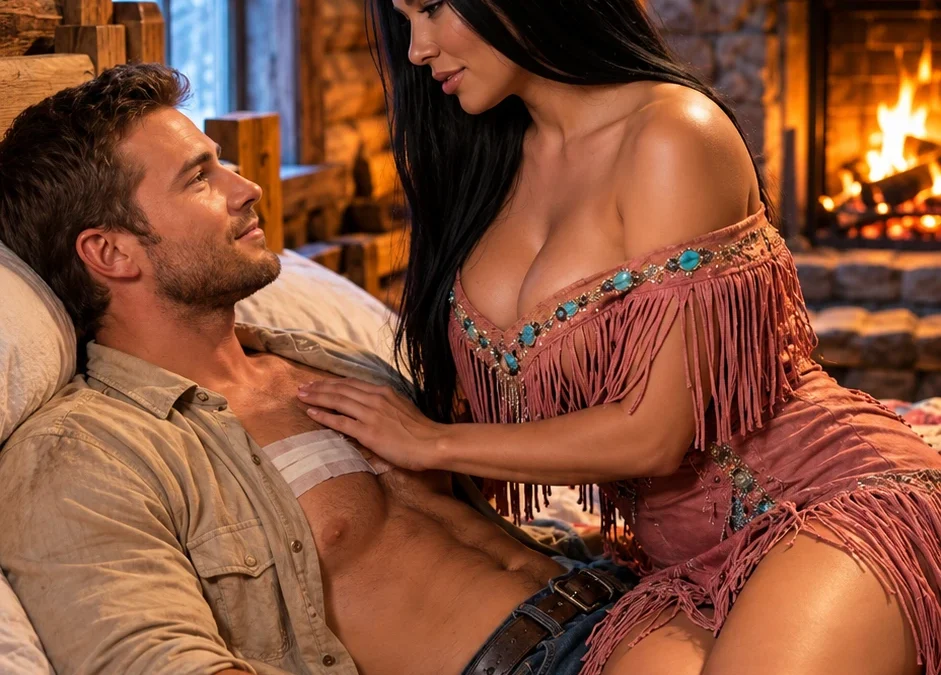
HE SHOWED MERCY TO A DYING APACHE STRANGER… FOUR DAYS LATER, HIS RIFLE WAS ALREADY RAISED WHEN HE SAW WHO WAS STANDING IN HIS KITCHEN 😳
Part 1
His rifle was up before his eyes were fully open.
Caleb Hurst rolled to the edge of the cot in the gray pre-dawn light, weapon raised, heart hammering against his ribs. Someone had lifted the latch of his front door. Not a knock. The soft, deliberate sound of a latch.
And there, beside his kitchen table, stood a woman.
Apache. Young, not much past twenty. A doeskin dress, dark hair loose over her shoulders, a short knife at her belt. She had not drawn it. She was watching him with calm, steady eyes that held no fear at all. 😶
She looked like a woman who had walked a very long way, and was not even surprised to find a rifle pointed at her chest.
His finger stayed off the trigger. Something in her stillness stopped him.
“How did you get here?” he said. It came out flat.
“The door,” she answered. Her English was careful, each word placed like a stone. “I knocked. You did not wake.”
Caleb lowered the rifle by half. “Who are you?”
“My name is Nahda. My father was Luka. He was a healer of the Mescalero.” She paused. “He died four days ago on the trail south of Ruidoso, beside a piñon grove.”
The air in the cabin changed.
“You stayed with him,” she said.
Caleb said nothing.
To understand why a stranger had just walked into his home, you have to go back four days.
Caleb Hurst was a rancher in the high Mescalero country of New Mexico Territory, in the autumn of 1878. He had no family left to speak of. No neighbor within eight miles. The ranchers of Lincoln County called him decent but closed off, a man who kept his word and kept his distance in equal measure.
He had come west after the war, chasing the kind of quiet that only wide land can give a man who has seen too much. 🌄
On that dry afternoon he was moving a small herd to the lower pasture before the first hard frost. Three horses. Two dogs. A water bladder more than half full.
Then he saw the moccasins.
A man lay face down in the red dirt behind a cluster of sage, perfectly still. Caleb almost didn’t stop. He sat his horse for a moment, listening to nothing but wind and the low protest of cattle.
Then he rode over.
The man was Apache. Old, maybe sixty, with a long gray-streaked braid come loose. He was breathing. Barely. Blood had soaked through the left side of his shirt, a wound days old by the smell of it. No water. No pack. No weapon. Only a beaded cord around his wrist and a small medicine pouch at his belt.
Caleb climbed down. He did not ask himself why.
A man either has that reflex or he doesn’t, and Caleb had it. It was the same impulse that once made him drag a Confederate drummer boy from a creek bed in Virginia, back when he was seventeen and the war had not yet taught him to stop caring. 💔
He lifted the old man’s head and gave him water slowly. The man’s eyes opened, black and deep, and he looked at Caleb the way you look at something you never expected to see.
Caleb tore two strips from his own shirt, pressed them to the wound, and tied them with leather from his saddlebag. He talked the whole time in a low voice. Not because the man understood English, but because silence felt wrong.
He built a fire. He stayed.
Through the heat of the afternoon and into the evening, he gave water in careful amounts and kept the dogs back. Sometime before midnight, the old man spoke. His voice was thin but deliberate, the words Mescalero Apache, short and measured. He looked directly at Caleb the whole time, which told Caleb that whatever it was, it mattered.
By first light, the old man was gone.
Caleb dug a shallow grave in the red earth, wrapped the body in his own bedroll, and marked it with a cairn of white stones from the dry creekbed. He left the beaded cord on the man’s wrist. He did not know the custom, but leaving it felt right.
He told no one. There was no one to tell.
And now, four days later, the old man’s daughter stood in his kitchen.
“Before his spirit left,” Nahda said quietly, “he spoke. There were two of my people nearby, too far to reach him in time, but close enough to hear.”
She met Caleb’s eyes.
“He said a white man with a brown horse stopped. That the man gave water. Tore his own clothing to bind the wound. Sat with him through the night. Built a fire. Marked the ground.”
The words settled into the cold quiet of the cabin.
“Among my people, such a kindness cannot go unanswered,” she said. “It must be returned. That is our way.”
“I didn’t do it expecting anything back,” Caleb said.
“I know,” said Nahda. “That is why it matters.”
He asked what she wanted. She told him that was the wrong question. The question was what he needed.
“I have come to work this land beside you through the cold months,” she said. “To pay the life-debt my father’s spirit carries. A debt unpaid is a weight that stays with the dead.”
“You don’t have to do this.”
“No,” she agreed. “I am not traded like a horse, rancher. I chose this. There is a difference.”
Caleb looked at her for a long moment. Outside, the sky was turning pale pink above the Sacramentos.
“There’s a room off the back,” he said. “It has a door with a latch.”
“I saw it.”
He hung the rifle on its pegs and went to start the fire.
He thought the hardest part was over. He thought a woman, a debt, and a long winter were all he would have to carry.
He was wrong.
Because what Nahda had not told him, what she carefully chose not to say that first morning, was that her people had been watching his ranch since the day her father died.
And so had someone else. 😨
👉 Want Part 2? Find it in the comments, or leave any word and I’ll send it to you privately!
Part 2
And so had someone else.
The first week was not easy. It wasn’t supposed to be.
Nahda rose before Caleb every morning and started the cookfire, then moved to whatever work needed doing without being asked. She mended the north fence. Cleaned the tack. Found the feed sacks rotting at the base and moved them without a word. She read the ranch the way a doctor reads a patient, quickly and without sentiment.
Caleb watched and felt the discomfort of a man who doesn’t know whether to help or stay out of the way. Mostly, he stayed out of the way.
Their meals were quiet in the way that isn’t peaceful, just compressed. He passed things across the table unasked. She refilled his coffee before he could stand.
On the eighth day he drove the wagon to Crestfield for supplies and returned to find she had patched the lean-to roof with pine boards she’d shaped by hand.
“The gap was letting water in,” she said.
“It was,” he said, and put the horse up without another word.
In town, he said nothing about her. He didn’t know how to begin. The territory had a long and ugly memory of conflict with the Apache, and opinion moved slow.
He was right to be careful. 😟
On his second supply run, Garrett the storekeeper asked him straight: was it true he had an Apache woman living at his place?
Word travels on the high desert the way it always does. On the wind, with embellishment.
“She’s working the ranch through winter,” Caleb said. “Helping with repairs.”
Garrett looked at him the way men look when they’ve already decided what they think. “People are going to talk, Caleb.”
“People talk about everything.”
He paid and left. But the words followed him home.
Back at the cabin, something was happening that Caleb hadn’t expected. He started learning her language. One evening she murmured a phrase while washing the pan, and he asked what it meant. The work is finished and the day was honest. He repeated it badly. She corrected the vowel. He tried again.
After that, most nights he asked for a new word. Water. Horse. Thank you. Stranger. Home. He wrote them on a card in his breast pocket and studied them as he worked.
In return, he talked. More than he ever had. He told her about Ohio and the family farm. And one afternoon, setting fence posts, he told her something he had never said to anyone in the territory.
His younger brother had died at Cold Harbor.
She didn’t rush to comfort him. After a long moment she said her father had lost a son too, three winters back, to fever.
“Grief that size doesn’t leave,” Caleb said.
“No,” said Nahda. “But it changes shape.” 💔
Something was shifting between them. Slowly. Quietly. Like grass through stone.
Then came the third week of December.
Caleb rode home from the north pasture and found four horses tied at his fence and four men on his porch.
He knew two of them. Dorn Fitch, who ran cattle east of Crestfield, and his younger brother Ray. The other two were range riders he’d never seen.
Nahda stood in the doorway. She had not backed inside.
“People in town are concerned,” Fitch said, resettling his hat. “About you housing a Mescalero woman out here.”
“I run my land the way I see fit.”
“She needs to go. Before this becomes a problem for the whole county.”
“You’re on my land without invitation,” Caleb said. “I’ve asked you to leave. I’ll ask once more.”
Fitch’s jaw tightened. He looked at Nahda. Then at Caleb.
“Think about what you’re doing.”
“I am,” said Caleb.
The four men rode away. Nahda watched the dust trail on the north road.
“This will come back,” she said.
“Probably,” said Caleb.
It came back three weeks later, in January, on the coldest night of the winter.
Caleb had been fighting a fever for two days and told no one. Before dawn, he went out to tend the horses, lost his footing on the ice by the water trough, and went down hard.
He lay in the dark, the frozen ground seeping through his coat, and realized with cold certainty that he could not get up.
Nahda saw the barn lantern go still when it should have been moving. She crossed the yard and found him shaking on the ground, lips pale, the fever finally breaking the last of his strength.
She did not panic.
She looped a rope under his arms, planted her feet on the ice, and dragged a man twice her weight sixty feet to the cabin, talking to him the entire way, keeping him awake.
She worked for three hours without stopping. Willowbark tea, spoonful by spoonful. Wild onion compresses on his chest and neck. The fire stoked to exactly the right heat.
By midmorning, the fever broke. Caleb opened his eyes to find her in the chair beside the cot, hands folded in her lap. She had been there all night.
“You were going to say nothing about being sick,” she said.
“I thought it would pass.”
“Men always think that.” She handed him the tea. “Drink all of it.”
That afternoon, while he sat weak against the wall, the sound came from the yard.
Hooves.
Eight riders. Fitch was among them. Others from Crestfield. And two men with badges pinned to their coats. Not county law. Something unofficial. 😨
Caleb pulled on his coat and reached for his rifle, barely able to stand.
“I can go out,” Nahda said.
“No.”
Then a second sound rose from the south side of the property.
More horses. Not eight.
Many more.
Caleb moved to the south window, and his breath caught.
👉 Want to know who was waiting on that ridge? LIKE or COMMENT “REVEAL” to see Part 3! It will be posted once we have enough comments! 🔥
Part 3
Caleb moved to the south window, and his breath caught.
Apache riders. A dozen at least, sitting their horses on the ridge above the creek, wrapped in blankets, rifles and bows visible. Silent. Watching the yard.
Nahda stood beside him, looking out at her people.
“My father had friends,” she said quietly. “People who loved him. They have been watching this place since I came here. I asked them to keep their distance.” She paused. “I stopped asking when Fitch came the first time.”
Caleb turned to her. “You could have told me.”
“You had enough to carry.”
In the yard, Fitch had seen the ridge. His horse shifted beneath him, reading what the rider hadn’t yet understood. The men with the unofficial badges had gone very still. 😳
Caleb opened the door and stepped onto the porch.
He was sick. He could feel it in his legs. But he stood straight.
“I’m only going to say this once,” he said. “This woman is here by choice and by her own right. She owes me nothing, and I owe her more than I can measure. You ride onto my land again, with or without badges, and there will be consequences I won’t apologize for.”
He looked at Fitch.
“Go home, Dorn.”
For a long moment, nobody moved. The wind pulled at the porch boards. Somewhere on the ridge, a horse stamped in the snow.
Then, slowly, Fitch turned his horse.
The others followed. The two men with the unofficial badges went last. Nobody said a word.
The Apache riders waited until the party had cleared the north road. Then, without ceremony, they turned and rode quietly back into the Sacramentos. They had come. They had stood. They had left when the matter was finished.
Caleb walked back inside and sat down because his legs had decided they were done. Nahda put the tea back in his hand.
“That was a foolish thing to do,” she said. “Standing out there sick.”
“Probably.”
“You could have sent me.”
“No,” he said. “I couldn’t.”
She looked at him over the rim of her cup. Not with surprise. With the look of someone who already knew what she was seeing and was measuring whether to say it aloud.
She didn’t. Not that day.
Instead she stayed in the chair beside the cot through the rest of the afternoon, made sure he drank the tea and ate by evening, and tended the fire so the room held its warmth through the night. 🔥
Two days later, Caleb sat outside in the pale winter sun and finally asked the question he’d been turning over since the ridge.
“How many of them were there?”
“Fourteen.”
“Your father’s friends.”
“And their sons. Two of his cousins. And a woman named Itza, his oldest student. She came farthest.” Nahda paused. “She is better than I am with the plants. She would have been his successor, if he had stayed with the main band.”
Caleb looked at the south slope. Fourteen sets of tracks came down through the snow and went back up, clean and decisive.
“You could have told them to stay away. That I could handle it.”
“I thought about it,” she said. “Then I thought about your face the first time Fitch came, how you stood between him and the door. You are the kind of man who would stand there sick or well and never ask for anything.” She looked at him. “My father would have said a man who will not accept help cannot truly be helped. He said it about patients. It applies.”
Caleb sat with that for a long time.
“What do I owe them?”
“Nothing. They came because they chose to. Same as me.”
The sun was thin and cold, and it made her face clearer than the lantern light ever had. He had known her for two months now. He had watched her work, grieve, teach, and stay. He knew the shape of her patience. He knew the difference between her silence that was peace and her silence that was thinking.
He knew her. That was not nothing.
“You said you’d decide in spring,” he said.
“Yes.”
“You have time yet.”
“I have some,” she said. “But I have been deciding since November.”
He didn’t ask what she’d decided. He wasn’t ready, and she knew it, and she gave him room the way you give room to a wild thing learning to trust. Not with pity. Not with strategy. Just with steadiness.
He had never known, before her, that he needed that. 💛
There were quieter things, too, that had been growing all winter.
The coffee she made her way, less water, longer on the heat, a pinch of dried sumac to cut the bitterness. The morning he made it for her without being asked, and she wrapped both hands around the cup like something that was right.
The bundle of dried sage by the door. The horsehide rug by the stove. The woodpile restacked in a cross-pattern that kept it dry.
The evening she told him her father used to say the stars over the Sacramentos were closer than anywhere else. “I think he said it to make the cold feel purposeful.”
“It’s a decent thing to say,” Caleb answered.
The night she showed him how she cleaned a ewe’s septic wound with prickly pear pulp and charcoal ash, and he wrote every step down, unashamed to admit he didn’t know. Begin from what you can see and know for certain, her father had taught her. Hope is useful for endurance. It is a bad guide for medicine.
“That’s good advice for more than medicine,” Caleb had said.
That night he added a word to the card in his pocket. Not Apache. Just the English word healer, and beside it, the name Luka, because it seemed wrong not to write it down somewhere, in someone’s hand.
And the first snow of the season, when he found her standing motionless in the white yard at dawn, whispering a prayer in Mescalero, three lines of her father’s words.
“Did you understand any of it?” she asked.
“One word,” he said. “Sky.”
The corner of her mouth moved. The closest thing to a smile he had ever seen from her that wasn’t about the dogs. 🌨️
In February, when the slopes were still white but the air carried the first thin smell of spring, Nahda sat across from him at the kitchen table while the coffee made its noise on the stove.
“I have made my decision,” she said.
Caleb’s hands went still.
“I am staying. Not through the season. Not for a debt.” She said it plainly, without decoration, without waiting for the right moment. “The debt is paid. Many times over. What stays now stays because I choose it.”
Caleb looked down at the grain of the wood. When he spoke, his voice was rough.
“I don’t know what I have to offer. This is a hard piece of land in a hard part of the territory. I don’t have money or standing. Nothing that would look like much from the outside.”
“From the outside,” she said.
“Yes.”
“I am not asking from the outside.”
He held her eyes. Then he nodded. Once. Slowly. 💔
That evening, the sun went down behind the Sacramentos in long orange bands, and the cold was the kind that no longer hurt, only cleared the mind.
Caleb built a fire in the old ring of stones by the fence. Not for cooking. For sitting beside.
Nahda came out with something in her hands.
Her father’s beaded cord.
The same cord Caleb had left on the old man’s wrist beneath the white-stone cairn. Two of the Apache riders had recovered it and returned it to her the day she came to the ranch. All winter she had kept it, saying nothing.
She held it a moment. Then she tied it around both their wrists together, not tight, just resting there. The Mescalero way of marking a promise. A binding without words, because some things are too large for words and too real for ceremony.
Caleb looked at the cord. He looked at her.
He turned his hand slowly, palm up.
She placed her hand in his.
They sat in the firelight with the dark mountains above them and the cold stars coming out one at a time, and neither spoke for a long while. The fire burned down. They did not move. ✨
Later, inside, he made the coffee her way. She sat at the table while it steeped. The dogs settled by the stove. The lantern cast its familiar yellow light across the kitchen boards, and the room felt exactly as it always had, and also completely different, and there was no way to explain that to anyone who wasn’t there.
There is a particular thing that happens when two people from separate worlds, worlds that were supposed to stay apart, find that they fit together without asking permission.
It is not loud. It announces nothing. It doesn’t ask the county for approval or wait for the right climate or calculate the odds. It just grows, like grass through stone, patient and stubborn, finding the light through whatever small opening it is offered.
Caleb Hurst had stopped on a trail for a dying man he didn’t know, because the reflex to stop lived in him and had nowhere else to go. He had given water and cloth and a piece of his own warmth, sat in the dark with a stranger, and asked for nothing.
Nahda had walked twelve miles across hard country to honor what that meant among her people. She had come by choice, which is the only way any of it works. She had stayed because the man she found was worth staying for, and she was not a woman who confused duty with desire, or mistook one for the other.
The debt her father’s spirit carried had been paid long before the cord was tied.
What they built after that was not a debt. It was not a reward. It was not a rescue, or an obligation, or a gesture.
It was two people at a kitchen table, in a cabin in the Mescalero country, making coffee in the cold morning and deciding, each day, to keep showing up. 💛
That was enough.
That was everything.
Outside, the mountains stood exactly as they always had, indifferent and enormous. The high desert spread in every direction without apology. Somewhere on the south ridge, horses were moving in the early light, and the world went on in its usual way.
The only thing that had changed was everything. 🌄
This story is entirely fictional and created for entertainment purposes only. It does not represent any organization or individual, nor does it encourage inappropriate behavior. The content was generated with AI assistance.








