He Slapped the Duchess at a Glittering Ball. He Never Knew Her Husband Was Standing in the Shadows
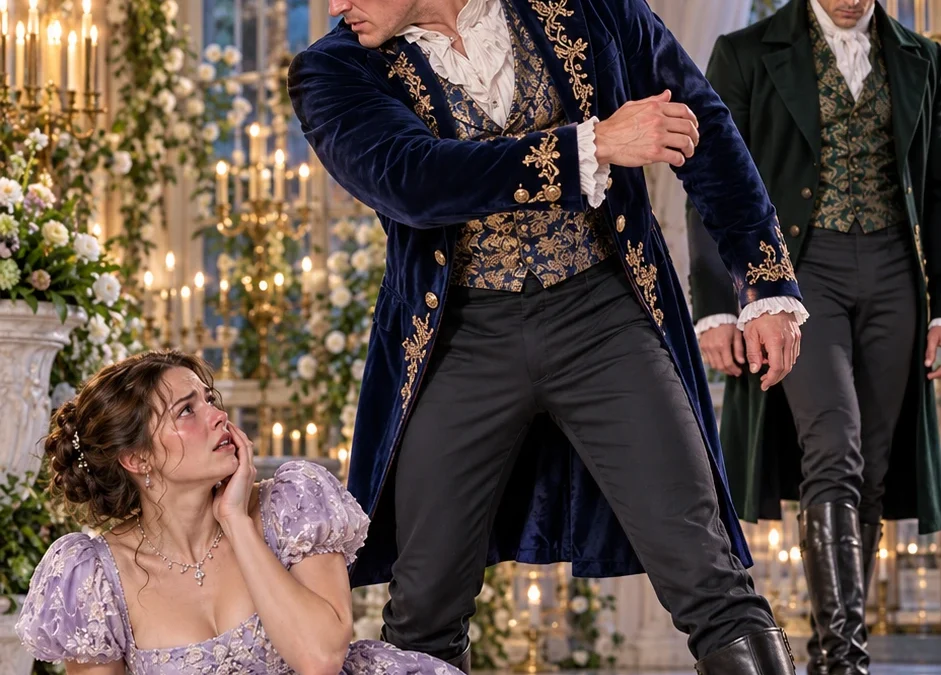
He Slapped the Duchess at a Glittering Ball. He Never Knew Her Husband Was Standing in the Shadows 😱👑
Part 1
The music swelled over the stifling heat of the ballroom, hiding the sharp crack of a hand against a cheek.
Beatrice stumbled. Her face burned, and the taste of copper flooded her mouth. Lord Rowley adjusted his cuffs, pleased with his petty violence. He believed he had cornered a helpless woman in the damp shadows of the conservatory.
He was wrong. 🕯️
But let us go back to the beginning, because the night had started with a suffocating ballroom.
Lady Cavendish’s ballroom was so thick with melting beeswax, wilted flowers and nervous sweat, masked by cheap rosewater, that you could almost chew the air. Beatrice stood rigid beside a marble pillar, letting the cool stone seep through her silk gown. She hated the London season. To her it was a glittering meat market, an auction block wrapped in waltzes. She had been sold to the highest bidder six months ago, yet society still demanded she parade her good fortune.
Across the room stood her husband, Arthur, the Duke of Rothbury.
He was not built for ballrooms. He was a creature of the harsh northern estates, broad-shouldered and weather-beaten, with a face of sharp, unyielding angles. Beside the powdered, perfumed dandies he looked like a mountain lion forced into a birdcage. Two ancient earls had trapped him in a corner to drone about grain tariffs. But every few minutes his dark eyes cut across the room and found Beatrice, as steady as a compass needle finding north.
She let her shoulders drop one inch. I am surviving.
He gave the smallest nod. I know. Not much longer. 🤍
It was a strange marriage. When Beatrice’s father died of bad gin and worse gambling debts, he left her a ruined name and a stack of promissory notes. The estate was foreclosed. The silver was auctioned. The creditors circled like crows.
The worst of them was Lord Henry Rowley, Viscount Tipton, a man of inherited money and zero discipline. He had wanted Beatrice for years, the way a man wants a stubborn mare he longs to break. When her family collapsed, he arrived with a greasy smile and a contract. He would forgive every debt if Beatrice warmed his bed and bore his children.
It was not a proposal. It was an ultimatum of ownership.
She was twenty-four hours from throwing herself into the Thames when Arthur stepped in. He bought every last debt. He did not do it out of charity. He wanted a duchess who understood duty, who would not squander his fortune on Parisian lace or weep when he vanished to his northern foundries for months. He married her on a Tuesday morning in a joyless ceremony.
But something cold had slowly begun to thaw.
Behind closed doors, Arthur never demanded. He asked. When she flinched at sudden movements, a scar left by her father’s temper, he learned to walk heavily so she would always hear him coming. He never spoke of love. He simply made sure her tea was hot and her fires never died.
And Beatrice had begun, dangerously, to lean on him. 🔥
“She looks terribly pale, doesn’t she?” Three debutantes whispered behind ivory fans. “I heard he only married her out of pity.” “Or to spite Lord Rowley. Have you seen him tonight?”
Beatrice looked. Henry Rowley slumped against a drinks table, bloodshot and unsteady. His West Indies investments had sunk to the bottom of the Atlantic, and losing her estate had finished his ledgers. When he caught her eye, he raised his glass and sneered. A cold prickle crawled up her spine.
Then a warm weight settled on her lower back. Arthur.
“You’re rubbing your thumb,” he said in his low, gravelly voice.
She looked down. She was worrying her fingers, a habit she thought she had buried.
“I can have the carriage brought round.”
“No.” She forced a tight smile. “Lady Cavendish would never forgive us. And you need her husband’s vote in the Lords next week.”
His jaw tightened. He did not care about any vote if she was miserable, but he respected her pragmatism.
“I must speak with a minister. Ten minutes. Will you be all right?”
“I can survive ten minutes of bad music, Arthur.”
His thumb brushed her waist, lingering a moment too long to be proper. Then he cut a path through the crowd. Men stepped aside for those shoulders without even realizing it.
Beatrice needed air. Real quiet. She slipped through the glass doors into Lady Cavendish’s conservatory, where the ballroom noise dulled to a distant thump. The air was heavy with wet earth and overripe blooms. Moonlight cut silver and black across the tiles. She sank onto a stone bench beneath a weeping fig and closed her eyes.
For one moment she was not the ruined daughter or the rescued duchess. She was just a tired woman in the dark.
A boot scraped on tile. 👣
“Hiding, Your Grace?”
Lord Rowley stepped into the moonlight, swaying, reeking of brandy and tobacco. Her heart kicked against her ribs, but she had survived her father. She never showed fear to a drunk.
“You are in the wrong room, Henry. The punch bowl is that way.”
“I bought you,” he hissed, the drunkenness suddenly gone from his voice. “You were supposed to be mine.”
“You bought my father’s debt. You never bought me. And my husband repaid every shilling, with interest.”
At the mention of Arthur, his face twisted. “That northern brute. Do you know what they say about me in the clubs?”
“You are not a victim,” Beatrice said coldly. “You tried to extort a woman into your bed, and you failed. Step aside.”
His fingers clamped around her arm with bruising force. “Underneath the silk you’re just a bankrupt who got lucky. You are nothing without him.”
White-hot fury burned away her fear. She leaned in and whispered, “If I am nothing, Henry, what does that make you? You couldn’t afford me then, and you can’t touch me now. Let go, or I’ll scream and have you thrown into the street like the trash you are.”
For one second, there was perfect silence.
Then Rowley’s face contorted in blind rage, and his open palm struck her cheek like a hammer. 💥
Beatrice fell hard against the tiles, her ear ringing, blood on her tongue. Rowley stared at his own shaking hand. He had just struck a duchess.
Then came the slow scrape of a boot from behind the velvet curtains, and out of the shadows stepped a man who had stood there for three full minutes, hearing every word.
He had seen the blow. And his face had gone completely, terrifyingly blank. 😳
👇 What does a gentle husband do when he sees the unthinkable? Comment “PART 2” below or leave any word and I will send it to you privately!
Part 2
His face had gone completely, terrifyingly blank.
The man who stepped out of the shadows was not the husband Beatrice knew. The grim pragmatism that usually defined Arthur’s features had been wiped clean, leaving cold granite and eyes that had stopped seeing a human being at all.
Rowley stumbled backward, the color draining from his face. “Rothbury! My lord, it was an accident. She slipped, I swear to God, she slipped.”
Arthur did not look at him. He did not even seem to know Rowley was in the room. He walked straight past, boots crushing the spilled dirt, and knelt beside his wife. He did not crowd her. He made himself a massive, solid wall between her and the rest of the world.
“Beatrice,” he said, almost conversationally.
The left side of her face was already swelling into an angry bloom. A thin red line ran from the corner of her mouth. A muscle ticked in his jaw, once, twice. He drew a white handkerchief from his pocket. His hand was perfectly steady.
“Do not speak. Can you stand?”
“Yes.”
He lifted her as if she weighed nothing, then tucked her behind his shoulder and did not let go of her hand. Only then did he turn. 🌑
Rowley was backed against a plant stand, glass on one side, thorns on the other. “Arthur, listen. It was a lover’s quarrel. You know how women are, they get hysterical, they say things…”
Arthur crossed the room faster than a man his size should be able to. His left hand closed around Rowley’s throat and cravat, and he drove the viscount backward until his spine slammed against an iron pillar. Rowley clawed at his wrist. It was like clawing at cast iron.
“A lover’s quarrel,” Arthur repeated, in a flat whisper. That was the most terrifying thing of all. He was not enraged. He was executing a task.
“I bought your debts, Henry, because I thought you were a mosquito. A pathetic little man clinging to a title he could not afford. I let you keep your miserable life because you were not worth the effort of destroying.” His grip tightened. “But now you have struck the Duchess of Rothbury.”
“Please,” Rowley gagged.
“I will not duel you. A duel implies honor. It implies we are equals. If I shoot you at dawn, you die a gentleman, and you do not deserve that.”
He eased the pressure just enough for Rowley to sob in a breath.
“Tomorrow morning, my solicitors visit the Bank of England. They will call in every loan on your townhouse. By noon, I will own the notes on your carriage, your horses and your servants’ wages. By sunset you will not have the credit to buy a loaf of bread in this city.”
Real tears slid down Rowley’s face. “My title…”
“Is worthless in a debtor’s prison. And if I ever see your face in the same city as my wife, I will not use banks. I will use my hands.”
Three agonizing seconds passed. Beatrice saw the brutal arithmetic in her husband’s eyes, as if he were weighing whether it would be simpler to snap the man’s neck and pay a magistrate to look away. 😨
“Arthur,” she said quietly. “It was just his name.”
It cut through the red haze. Arthur let go. Rowley crumpled to the tiles, retching into the dirt, then scrambled toward the servants’ exit like a beaten dog.
Arthur watched him go, chest rising and falling slowly. He did not look triumphant. He just looked tired.
The cold machinery shut down, and the careful man she knew came back. He stopped a foot away from her and did not presume to touch.
“You did not have to ruin him,” Beatrice whispered.
“Yes, I did.” He raised a calloused thumb and paused, letting her pull away. She did not. He traced her jaw just below the bruise. “Are you all right?”
“I am angry.”
“Good. Stay angry. It keeps you warm.”
He wrapped his arm around her waist, shielding her swollen cheek from prying eyes as he led her into the cold London night. But in the silent carriage, Beatrice noticed something strange. Her husband’s hands, the hands that had just held a man off the ground, would not stop shaking.
And when they reached Rothbury House, he led her past her own bedchamber to his private rooms and said the one word he had never said to her before: “Sit.” 🕯️
💬 What did the Duke do next, and what secret did he finally confess? Comment “DUKE” or LIKE this post, and once we reach enough comments I will post the final part! 👑❤️
Part 3
Beatrice sat in the leather wingback near the dying hearth, feeling absurdly small in her ruined silk.
Arthur shrugged off his coat, rolled his sleeves over forearms scarred from his youth in the foundries, and vanished for three minutes. He returned carrying a silver basin of cold water, a linen cloth and a tumbler of ice wrapped in a kitchen towel. He had gone down to the icebox himself rather than ring for a servant.
He pulled a footstool close and sat. Their knees brushed. In six months of marriage he had never entered her space uninvited.
“Let me look.”
She flinched as he reached toward her. Arthur froze, his hand hovering an inch from her skin. A dark shadow crossed his face, directed not at her but at the ghost of the man who had taught her to flinch, and at the one who had reinforced the lesson tonight.
“I am sorry,” she whispered. “It is a reflex.”
“Do not apologize.” He moved slowly, so she could see every motion. “I will never strike you, Beatrice. Never.”
He washed the dried blood from her lip with astonishing gentleness. Then he pressed the ice to her cheekbone, and the cold was a brutal, blessed relief. When she took the towel, his hand lingered over hers for a heartbeat, grounding her.
“You will stay in bed tomorrow. I will tell the staff you have a migraine from the heat. No one will bother you.”
“People will notice when Viscount Tipton is ruined overnight, Arthur. Society will say you are a tyrant.”
“Mayfair already thinks I eat coal for breakfast.”
“The shipping tariffs…”
“To hell with the tariffs!” His voice rose, hard and decisive. “You think I care about a parliamentary vote when a degenerate puts his hands on my wife?”
She stared at him. Her father had traded her life for a ledger. Rowley had tried to steal her for one. Yet the wealthiest man she knew was burning his own political capital without a second thought.
“Why?” The question slipped out, small and fragile. “You paid my debts. You did not have to start a war for me.”
The ice dripped into the basin with a hollow plink.
“You are not an investment, Beatrice.” He tucked a loose strand of hair behind her uninjured ear. “You are my wife, and I protect what is mine.”
It was not poetry. It was territorial, immovable fact. And for the first time in her life, being claimed did not feel like a cage. It felt like a fortress. 🏰
The morning sun was hostile. Beatrice woke to a face that felt struck by an iron mallet. Her maid Clara, a fiercely loyal girl from Arthur’s northern estates, nearly dropped the tea tray.
“Your Grace, I will fetch the physician!”
“No. The carriage lurched and I struck the window frame. That is all.”
Clara clearly believed none of it, but she nodded. “His Grace has been locked in his study with Mr. Abernathy since seven. They have sent a footman to the city three times already.”
Downstairs, among maps of rail lines and coal seams, the Duke of Rothbury was dismantling a man’s life.
Mr. Abernathy, his dry, skeletal solicitor with the moral compass of a shark, read from his ledger. “The notes on the Mayfair townhouse are held by the Bank of England, Your Grace. Viscount Tipton has paid only interest for three years.”
“Buy it. Pay a five percent premium if the deeds transfer before noon. Then find the man named Higgins in Covent Garden and purchase the stable debt at double. I want the horses seized by three.”
Abernathy cleared his throat. “Your Grace, this will cost upward of twenty thousand pounds. There will be whispers in the clubs.”
Arthur raised his muddy hazel eyes, and the room seemed to drop ten degrees. “I did not hire you for your opinions on high society. I hired you because you wield a contract like a butcher’s knife. If I wanted a moral philosopher, I would go to church. By sunset, I want Henry Rowley to realize he does not own the clothes on his back. I own them.”
Abernathy practically fled.
Yet when Arthur looked down at his white-knuckled hand, the satisfaction was hollow. It did not erase the crack of flesh against flesh in his memory. He built things, factories, canals, empires of steel. He took no joy in tearing things down. But for Beatrice, he would burn London to the bedrock. 🔥
By late afternoon, rain streaked the parlor window. Beatrice heard his heavy boots in the corridor. He always made sure she heard him.
“Rowley’s townhouse is foreclosed,” Arthur reported, entirely without triumph. “His horses are sold to a cab company in Cheapside. His club refused him entry. The last my men saw, he was walking toward the docks.”
The shadow that had loomed over her family for years had been vaporized in a single morning. Beatrice let out a long breath.
“I am not angry with you,” she said honestly. “But I am trying to understand you. We have an arrangement, Arthur. You bought my father’s debts. You acquired me.”
He stood so sharply the chair scraped. He turned his back, staring into the unlit grate. When he spoke, the commanding resonance was gone.
“I did not acquire you. When I saw what Rowley demanded of you, I did not buy the debt to own you. I bought it to free you.” He faced her. “Yet I also asked you to marry me because I am a selfish man. I saw a woman standing in a ruined house, surrounded by creditors, who did not weep. A spine made of iron. I wanted that. I wanted you.”
He knelt before her chair, an astonishing act of vulnerability from a man who commanded thousands.
“I am not a gentleman. My hands are rough. I do not speak in poetry. But I swore vows to you in that church, and my word is the only currency that matters to me. There is no contract. There is no ledger. There is only us.”
The cynical armor she had worn for years suddenly felt unbearably heavy. She laid her palm against his weather-beaten cheek. He leaned into it, eyes closing.
“I am not a fragile thing, Arthur. You do not need to wrap me in glass.”
“I know. But you should never have had to be this strong.” 💛
It took twelve days for the bruise to fade to a yellow shadow. Society, meanwhile, rioted with rumors. Some said Rowley had challenged the Duke and fled. Others whispered the Duke had caught him trying to steal the Duchess away.
On the thirteenth day, Beatrice dusted her cheek with powder. Arthur stood behind her in the mirror, dressed like an undertaker come to collect a debt. “The carriage is ready, if you are.”
She chose the open phaeton. If London wanted to look, she would give it a clear view.
Hyde Park fell silent as they turned onto Rotten Row. Two hundred pairs of eyes searched her powdered face for a ghost of weakness. They found nothing. Beatrice held her parasol and her chin high, while Arthur drove the black geldings one-handed, a wolf parading his mate through enemy territory.
Lady Haddington’s carriage blocked their path, the cruelest tongue in Mayfair. “We heard you fell ill, Your Grace. Or perhaps simply… fell.”
Arthur’s hands tightened on the reins. Beatrice laid a gloved hand over his wrist.
“I did not fall, Lady Haddington. The air in London simply became too polluted for my liking. Fortunately, my husband is very efficient at removing refuse.”
Lady Haddington’s mouth snapped shut. She jabbed her driver with her fan and fled. Arthur let out a rough breath that sounded suspiciously like a laugh. “We leave for the north tomorrow. I am sick of the stench of this city.”
Highcross was not a country estate. It was an industrial fortress, with a sky stained by a dozen chimneys and the air shaking with the thud of steam hammers. Where other wives held perfumed handkerchiefs to their noses, Beatrice simply looked and said, “It is loud.”
“It is progress,” Arthur replied.
“Then I will come inspect your blast furnace.”
“The foundry floor is no place for a duchess. Your gown will be ruined.”
“Then Clara will burn it when we return.”
Inside the roaring ironworks, white-hot metal poured into sand trenches. Arthur was testing her, waiting for her to break. “If the valve sticks,” he shouted, “the boiler fractures and takes out half the wall.”
“Then install a secondary release valve,” she called back, a smudge of soot on the very cheek where the bruise had been. “Redundancy is cheaper than replacing a wall and paying widows’ pensions.”
Arthur stared. And with terrifying clarity he realized he did not merely want to protect her. He worshipped her. His thumb wiped the soot from her cheek. For the first time since girlhood, Beatrice laughed, bright and real. 😂
Over the next month she transformed the drafty manor into a home, with heavy oak and Scottish wool, and learned every foreman’s name. She found a rail-fee discrepancy that saved £4,000 in one afternoon. The ghosts of Rowley and her father burned away in the northern fires.
One stormy midnight, Arthur came home from fourteen hours at a collapsed bridge, muddy and exhausted. He did not take the opposite chair. He sat on the rug before her armchair and leaned his back against her knees, the duke who terrified Parliament offering unguarded trust. Her fingers slid into his damp hair, and the tension drained from his shoulders.
“I have something for you.” He drew a sealed parchment from his coat.
It was a deed to her family’s Surrey estate, repurchased and consolidated, with a single name as sole proprietor: Beatrice. Not Rothbury. Not his holding company. Hers, unencumbered and independent of his fortune, in a world where a wife’s property became her husband’s the moment she married.
“Why?” she breathed.
“Because I need you to know I did not buy you.” His voice rasped. “You married me to survive, Beatrice. But I will not keep a captive bird. If you despise the cold here, or if you despise me, you can go to Surrey and never answer to another man again. You have a choice now. You are free.”
The storm raged against the glass. Beatrice looked at the man kneeling before her, who had destroyed another man for touching her and was now willing to let her walk away simply because he loved her.
She pulled her hands from his. Arthur flinched, agony flashing across his face.
Then she picked up the deed and tossed it into the fire. 🔥
He lunged to save it, but she caught his face in both hands. The parchment curled and flared orange.
“I do not want Surrey,” she said fiercely. “I do not want to escape you, Arthur. You are a fool, a brilliant, terrifying, beautiful fool. I survived the South, but this is where I live. You are my home, and I am not going anywhere.”
He made a sound that was half groan, half prayer. His arms pulled her down onto the rug and crushed her against him, face buried in her neck, anchoring himself to the one thing in the world he feared losing. She held him just as fiercely, breathing rain and coal smoke and the man who had burned her cage to the ground.
They stayed there, tangled in the dark, while the paper turned to ash.
The transaction was over. The marriage had finally begun. 🤍
If Beatrice and Arthur’s journey from a cold transaction to a fiercely protective love moved you, please LIKE and SHARE this story with someone who loves a good slow-burn romance. 💬 Tell me in the comments: which moment was YOUR favorite?
Disclaimer: This story is entirely fictional and created for entertainment purposes only. It does not represent any organization or individual, nor does it encourage inappropriate behavior. The content was generated with AI assistance.








