HE SPENT HIS LAST $3 TO BUY AN APACHE WOMAN AT AUCTION… BUT HE DIDN’T BUY HER TO KEEP HER
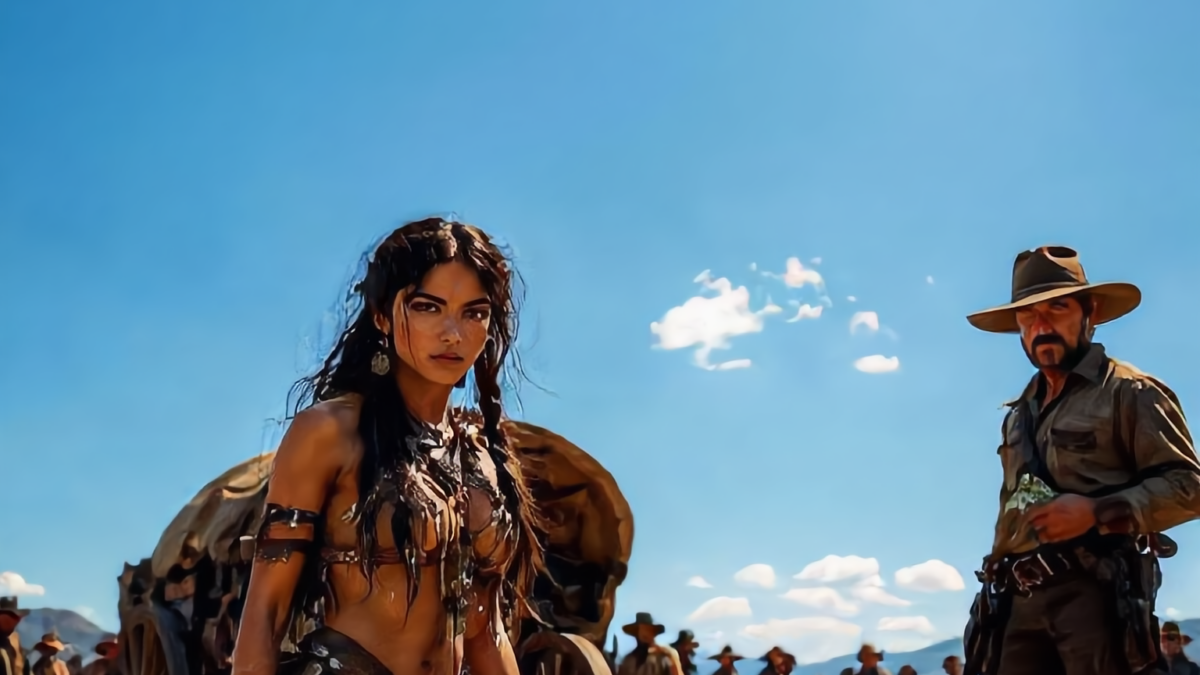
🤠🔥 HE SPENT HIS LAST $3 TO BUY AN APACHE WOMAN AT AUCTION… BUT HE DIDN’T BUY HER TO KEEP HER 💔
PART 1
The trading post at the edge of town wasn’t much to look at. 🏚️
Its boards were sun-bleached and warped, patched with rusted tin, a broken wagon wheel, even hide stretched across gaps where daylight slipped through. Inside, it smelled of sweat, damp leather, stale tobacco, and whiskey spilled too long on the floorboards.
Clay Mercer pushed the door open with his shoulder, trail dust caked on his boots, his sweat-stained hat shading most of his face. He had come for flour, beans, and salt. Nothing more. He meant to buy what he needed and be gone before the evening crowd arrived.
But the room wasn’t quiet.
At the far end, where sunlight bled through cracked boards, a man in a greasy vest dragged a young Apache woman forward by a rope. Her wrists were bound, the skin rubbed raw. She was barefoot, her toes bleeding from splinters. Her deerskin dress hung in torn shreds. Still, she held herself upright, chin raised, refusing to meet a single eye in the room. 🩸
“Strong enough to work,” the trader barked, drunk and grinning. “Quiet enough not to cause trouble. You won’t find better stock in this territory.”
The words turned Clay’s stomach.
Men began to laugh. One tossed a coin in the air and caught it. Another leaned forward with a look Clay wanted to knock off his face. Then the bidding began, half-joking, half-hungry.
“Two dollars.”
“Three.”
She didn’t flinch. But Clay saw her chest rising faster, her jaw clenching with every shout.
He told himself it wasn’t his problem. He barely held his own place together: eighty dry acres, two horses, three scrawny cattle, a barn that leaned like a drunk. He had no business taking on anyone else’s fight.
The trader yanked the rope. She stumbled, and her knees struck the plank with a hollow crack. Pain flashed across her face. Then she straightened again, back stiff, pride keeping her standing.
Something twisted in Clay’s chest. 😔
He thought of his wife and his boy, taken by fever in the same cruel winter, and of the silence he told himself was freedom. Some nights it felt a lot more like punishment.
His hand went to the pouch at his belt. He knew what was inside. Three dollars. Just enough for flour, beans, and salt, enough to last until spring if he stretched it. Spending it here meant weeks of hunger. Maybe worse.
If he walked out, she would belong to one of the men circling like vultures. Men who wanted her for reasons that had nothing to do with shelter or respect.
His boots moved before his mind finished deciding.
“I’ll take her.”
The room went still. A few men laughed, thinking it was a joke. Then Clay dropped the pouch on the table, and the coins spilled out, clinking sharp in the silence. It wasn’t much. It was everything. 💵
The trader’s grin widened. “Not much left in your pocket, cowboy. But it’ll do.” He swept up the coins and shoved the rope into Clay’s hand.
Clay looked at the woman. Her eyes flicked to his, sharp with suspicion. Beneath it flickered something else, faint and buried. Why? She wasn’t thanking him. She was asking.
He had no answer he could put into words.
He loosened the knot at her wrists just enough that it wouldn’t tear her skin, and lowered his voice. “Come on. Outside.”
Townsfolk stopped to watch as he led her to his horse. Some muttered. Others sneered. For one second, he thought she might run. Instead she gripped the saddle and climbed up, unsteady but determined. 🐎
They rode until the town was a smudge behind them. The sun bled red over the scrub and mesquite. The silence between them stretched for miles, until Clay finally cleared his throat.
“Name’s Clay Mercer. Got a place a ways out. Ain’t much, but it’s dry and there’s food.”
She didn’t turn her head. Then, so softly he almost missed it:
“Nia.”
He nodded, though she couldn’t see. At least he had a name to hold on to.
At the cabin, he lit a lantern, stirred the ashes back to life, and cooked beans. He set a plate on the table and stepped back, folding his arms. She watched him for a long moment, then sat and ate, careful and quiet, though the speed of her swallowing told him how hungry she was. 🍲
“You’ll sleep by the fire,” he said. “Tomorrow I’ll see about shoes. You can decide if you want to stay or go when you’re stronger.”
Her expression didn’t change. But her eyes lingered on him a moment longer before she lowered them.
Days passed. She swept the floor. Stacked his wood. Twisted willow bark into cord with quick, precise hands. She never ran, though she could have a dozen times. When he asked why, she answered in her clipped, careful English: “No shoes. No water. No tribe. Nowhere to go.”
Slowly, the silence between them softened. But the world outside was watching.
On the fourth day, Clay was fixing the corral gate when hoofbeats rang across the ridge. He looked up and felt his blood run cold. It wasn’t the neighbor, Jeb Rollins, this time.
It was the trader in the greasy vest, flanked by two riders with rifles. And he was grinning.
“Evening, Mercer,” he called. “Hope you enjoyed her. Because that woman was never mine to sell.”
👉 Who does Nia really belong to, and what did the trader come to take? Find PART 2 in the comments, or leave any word and I’ll send it to you privately! 🤠🔥
PART 2
“That woman was never mine to sell.”
Clay set the hammer down slowly. His hand drifted toward the revolver on his hip, but he didn’t draw. Behind him, the cabin door creaked. Nia stood in the shadow of the doorway, one hand gripping the frame. 😨
“What are you talking about?” Clay said.
The trader leaned on his saddle horn. “She’s army property. Picked up by a patrol, held for transfer to the reservation at Fort Sumner. I was supposed to watch her overnight. Man’s got to eat.” He smirked. “Your three dollars won’t cover what the Captain will do to me when he finds out. So I’m taking her back. Quiet, or loud. Your choice.”
The two riders raised their rifles.
Clay didn’t move. He stood with his boots planted in the dirt, thinking of the rope burns on her wrists, of the way she had flinched at the sound of every unfamiliar step. Property. The word tasted like ash.
“You sold her to me,” he said, voice low. “In front of half the town. You took my money.”
“And I’m giving you the chance to walk away without a bullet in you.”
From the doorway, Nia stepped forward. Clay felt her beside him before he saw her, her shoulder almost brushing his arm. Her eyes were fixed on the trader, black and steady.
“I am not going back,” she said.
“You don’t get a say, girl.”
“Then I say it anyway.” Her voice didn’t shake. “My husband died when soldiers came. My people were scattered. You sold me like cattle.” She lifted her chin. “I have seen what is in that man’s heart.” She nodded toward Clay. “I have not seen it in yours.”
The trader laughed, but there was something brittle in it. 😤
“Get her,” he told his men.
One rider swung down from his horse. Clay stepped in front of Nia, his heart pounding, his hand closing around the butt of his revolver. He had been a soldier once, a long time ago. He had put that life behind him. He had promised himself.
But promises changed when someone’s life stood behind you.
“I’m going to ask you once,” he said quietly. “Get back on your horse.”
The man took another step.
Then a voice rang from the ridge, loud and clear as a gunshot:
“I’d listen to him, boys. That is, if you ever want to see your next payday.”
Every head turned. 😱
A rider sat silhouetted against the setting sun, a tin star glinting on his chest and a shotgun resting across his knees.
👉 Is the sheriff here to save them, or to take Nia away? LIKE this post and COMMENT the word “FREEDOM” 🤠 to unlock PART 3! As soon as we reach enough comments, I’ll post it! 🔥🐎
PART 3
“I’d listen to him, boys.”
The sheriff rode down the slope slowly, his shotgun never lifting but never needing to. He was a lean, gray-whiskered man named Walt Harlan, with eyes like flint, and he stopped his horse squarely between the cabin and the trader.
“Afternoon, Dobbs.”
The trader’s grin faltered. “Sheriff. This is a private matter.”
“That so?” Harlan took his time rolling a cigarette. “Funny. Because I got a telegram yesterday from Fort Sumner. Seems a woman went missing from a patrol camp. And the officer in charge says the man who was supposed to be guarding her has been selling government prisoners to anyone with a pocketful of change.” He licked the paper. “You wouldn’t know anything about that, would you?”
The color drained from Dobbs’s face. “That’s a lie.”
“Might be. Might not.” Harlan struck a match. “Guess we’ll find out when the Captain gets here. He’s about two hours behind me.” 🔥
The two riders exchanged a glance. One slowly lowered his rifle. The other turned his horse and bolted, leaving a cloud of dust behind him.
“Coward!” Dobbs shouted, but his voice cracked. He looked wildly at Clay, at Nia, at the sheriff. Then he spurred his horse and ran too, straight into the open scrub.
Harlan watched him go and didn’t bother giving chase. “He’ll be caught by supper. Man like that never learned to ride away from trouble. Only toward whiskey.” He turned to Clay and tipped his hat. “Mercer.”
Clay released a breath he hadn’t realized he was holding. “Obliged, Sheriff.”
“Don’t be. I’m not doing you a favor.” Harlan’s gaze moved to Nia, steady and unreadable. “Ma’am. When the Captain arrives, he’s going to want to talk to you. Might want to take you back.”
Nia’s hand tightened around Clay’s sleeve.
“But,” Harlan continued, “I’ve been sheriff in this county for twenty years, and I know the law better than most Captains. A woman bought out of slavery by a free man ain’t a runaway prisoner. She’s a person with the right to speak for herself. If she wants to stay, I’d say that’s a matter for a judge, not a soldier.” He glanced at Clay. “That, and I seem to remember Mercer here being a decorated veteran. The Captain might think twice before picking a fight with him.”
Clay stared. “You knew.”
“Everyone in this county knows what you did at Shiloh.” Harlan’s mouth twitched. “Most folks just figured you’d earned your quiet.”
The Captain arrived at dusk with six soldiers. He was young, stiff-backed, and furious at first. But when Harlan laid out the facts, and when Nia stepped forward and told him in her own halting English everything that had been done to her, his expression slowly changed.
“Ma’am,” he said at last, taking off his hat. “I owe you an apology. What was done to you was not sanctioned by the army. It will be investigated.” He looked at Clay. “And you, sir, spent your own money to stop a wrong my men should have prevented.”
“Wasn’t about the money,” Clay said quietly.
“No,” the Captain agreed. “I don’t think it was.”
By morning, the paperwork was signed. Nia was released from all military claim and recognized as a free woman, with the right to go wherever she chose. Dobbs was arrested two miles down the road, hiding in a dry creek bed, still clutching Clay’s three dollars. The sheriff returned the coins himself.
“Keep them,” Clay said. “Buy yourself a drink.”
Harlan laughed for the first time. “I’ll buy Nia a pair of good boots.”
Spring came early that year. Rain greened the scrub, and wildflowers pushed up through the cracked earth. 🌸
Nia stayed.
She told Clay she needed no permission, and he told her he’d never ask for any. She moved through the cabin as though it had always been hers: folding blankets, planting seeds by the porch, humming low songs in a language he didn’t know but loved to hear. She laughed once at the stubborn old gelding and Clay stopped mid-swing with his hammer, because it had been so many years since a sound like that had filled his home. 🥹
Town talk didn’t stop right away. Jeb Rollins and his friends rode by twice more, muttering. The second time, Nia walked out to the fence herself.
“You think you know me,” she said, her voice calm and clear. “You do not. You know a word. You know a story you tell each other to feel big. But I am here because I choose. If that hurts you, it is yours to carry.”
Jeb stared. Then he spat in the dirt and rode away, and he never came back. Over the following weeks, one by one, a few of the townspeople did. A widow brought a basket of eggs. The storekeeper’s wife traded fabric for Nia’s beadwork and stayed to talk. Old Mrs. Whitcomb, who had once clucked her tongue at the whole business, left a jar of peach preserves on the porch without a word.
Clay noticed. So did Nia. Neither said anything, but the corners of their mouths lifted when they caught each other’s eyes. 💛
One evening in late spring, after the stew was cooked and the cattle fed, Clay took her hand and led her out to the corral. The sunset burned orange and gold over the mesquite, and a warm wind moved through the new grass.
He had spent three nights hammering something at the forge in secret. It sat in his palm, a thin band of iron, smoothed and polished.
“It ain’t gold,” he said, his voice rough. “It ain’t silver. It’s just what I could make with my own two hands.” He swallowed. “I ain’t buying anything. I ain’t owning anything. I’m asking. You can say no, and nothing changes. You stay or you go. It’s yours either way.”
Nia looked at the ring. Then at him.
“You keep saying that,” she said softly. “That it is my choice.”
“It is.”
She took the band from his palm, turned it over in the light, and slid it onto her finger herself.
“Then I choose,” she said.
He laughed, a short, broken sound, and pulled her close. For a long moment they stood there in the blazing light, her forehead resting against his chest, his arms wrapped around her shoulders, a lonely man and a woman who had been taken from everything, two people who had refused to stay broken. 🌅
Out on the ridge, a coyote began to sing. Behind them, the cabin windows glowed gold, and the smoke from the chimney curled into the sky.
Years later, folks in that county still told the story, though each teller changed it a little. Some said the cowboy was a fool who threw away his last dollar. Others said he was a saint. Nia, when she heard it, only smiled.
“He wasn’t a saint,” she’d say, shelling peas on the porch with a dark-haired little girl climbing into her lap. “He was a lonely man who couldn’t stomach watching a wrong. That is all. That is enough.”
And Clay, listening from the corral with a boy on his shoulders, would tip his hat and say nothing, because she was right.
He hadn’t bought her. He had freed her. And in return, she had given him back something he thought was gone forever: a family, built not by blood or law, but by choice. 🤍
THE END
Did this story move you? Drop a 🤍 in the comments, share it with someone who needs to know kindness still matters, and tell me which state you’re reading from so I can give you a shout-out in the next story!
Disclaimer: This story is entirely fictional and created for entertainment purposes only. It does not represent any organization or individual, nor does it encourage inappropriate behavior. The content was generated with AI assistance.








