He Stole Her Work, Won a Gold Medal, and Dumped Her Before the Whole County… Then His Father, the Cold Duke, Offered Her a Wedding Ring
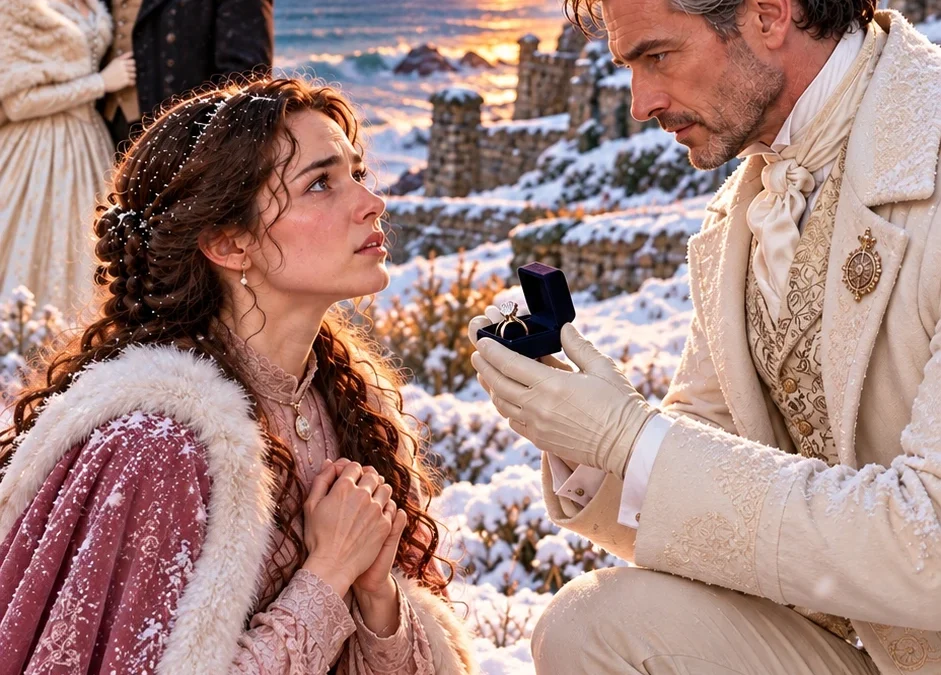
❄️ He Stole Her Work, Won a Gold Medal, and Dumped Her Before the Whole County… Then His Father, the Cold Duke, Offered Her a Wedding Ring 😱
PART 1
Her betrothed humiliated her before the entire county on the coldest night of winter.
He stood beneath the crystal chandeliers, accepted a gold medal for the work she had spent two years creating, then announced that another woman would become his wife.
Clarabel Rose did not cry. She simply removed his ring and walked into the falling snow. ❄️
Two days later, his father, the feared and emotionless Duke of Frostmere, summoned her. He knew the truth about the stolen work. What Clara never expected was his proposal.
The snow had been falling over Wintermere since noon.
Inside the grand hall of the Western Agricultural Society, crystal chandeliers burned so brightly that the frost on the windows glittered like broken glass. Clara stood near the far wall in a gray silk gown that had once belonged to her mother, faded to the shade of winter rain. She did not mind. Tonight was not about the dress.
On the walls hung enormous drawings of the Frostmere Marsh, the drowning stretch of land between the eastern hills and the sea. Every line was familiar to her, because she had drawn them first, by candlelight, at her father’s old desk. Thomas Bellrose had been a land surveyor who spent his life studying that marsh, convinced it could become living farmland. He died with the work unfinished, and his daughter picked up his pencil the week after the funeral.
Clara had walked the marsh in every season. She had stood waist-deep in freezing water with an iron sounding rod, pushing it down through the black mud again and again until her hands bled through her gloves. And she had found what her father never lived to see. Exactly nineteen feet down lay a shelf of solid bedrock. A seawall built on that rock would hold a hundred years. A seawall built on anything less would fail the first time a true storm came calling.
Two years ago, she had placed every page of that research into the hands of the man she was going to marry. Julian Ravenscroft, Earl of Ravenscroft, heir to the Duke of Frostmere, had kissed her knuckles and made a promise. The society would never accept a scheme from an unmarried woman, he said. But once they were wed, he would present it under her name. Under their name.
She had believed him, because believing him had felt like the natural shape of love. She had never imagined that a promise could be a door left open for a thief. 🚪
Now the president of the society rose to the podium and the room quieted. He spoke of vision and courage, of a work so precise it would change the eastern coast forever. Then he called Julian’s name.
Clara smiled, waiting for Julian to turn and find her in the crowd.
He did not turn.
He walked to the podium, unfolded a sheet of paper, and began to read. “The sea is patient,” he said, his voice warm and steady, “but the land can learn to be more patient still.”
Clara’s breath stopped. She had written that sentence on a cold March night with her father’s coat around her shoulders.
Julian read on, and every word was hers. The measurements. The tidal tables. The six surveys. The nineteen feet. He spoke them as though they had grown out of his own mind, and the room leaned toward him, enchanted. When he finished, the president hung a gold medal around his neck and the applause rolled through the hall like thunder.
Clara stood perfectly still. Somewhere inside her, a door was quietly closing.
Then Julian lifted a hand. “And tonight, I have one more happiness to share.”
Her heart gave a foolish, painful leap. For one breath, she believed he would call her forward and say her name at last.
Instead, he turned toward a young woman in pale blue silk near the front. Beatrice Whitmore, daughter of the richest banker in the county, rose with a practiced blush.
“Miss Whitmore has done me the honor of agreeing to become my wife.”
The hall erupted. Glasses rang. Ladies pressed gloved hands to their hearts. And Clarabel Rose was replaced in front of the entire county without a single word spoken to her. 💔
At the far end of the room, one man did not applaud. Sebastian Frostmere, Duke of Frostmere, stood beside a marble pillar in black, silver-streaked hair catching the light, eyes the color of frozen slate. He saw what no one else noticed. Julian kept glancing toward the back wall, toward the woman in faded gray, and it was not the look of a happy man. It was the look of a thief checking whether the door was locked.
Clara took a glass of wine from a passing tray. She walked forward until she stood at the edge of the crowd, close enough for Julian to see her clearly. She raised the glass.
“To you, my lord. May you have exactly the happiness you deserve.”
She drank, set the glass down, and walked out through the great doors into the falling snow.
Julian caught her on the snow-covered steps, where the wind came off the sea sharp enough to cut. “Clara, wait. Please. Let me explain.”
She stopped, but did not turn. Snow settled on her shoulders and in her dark hair, and she let it.
“Beatrice is a practical choice. Her father is funding the marsh project. Without his money, there is no seawall, no farmland, nothing. You understand these things better than anyone. You have always been the sensible one.”
Clara finally looked at him. “And what am I, Julian?”
He softened his voice the way he always did when he wanted something. “You are different from her.”
He said it as though it were a compliment. Clara heard what lay beneath it. Beatrice was the woman he would marry. Clara was the woman who had made him impressive enough to be married. She had been the engine, never the passenger, and he had never once offered her a seat.
“There is one more thing,” Julian said, glancing back at the lit windows. “You must not tell anyone the work was yours. Not now, not ever.”
“Is that a request?”
“It is for your protection. A woman claiming she wrote an engineering scheme? They will call you bitter. They will call you mad. Your name will be finished in this county.”
He said it gently, and that was the cruelest part.
Clara looked down at the small sapphire on her left hand, chosen because it was modest and suitable. She slid it off. It came easily, as though it had been waiting. She turned Julian’s palm up, placed the ring in the center, and folded his fingers closed over it, one by one.
“Keep it. You are very good at keeping things that belong to other people.”
She walked down the steps into the white road, and she did not look back.
Two days later, a letter arrived at Bellrose House, sealed with the crest of the Duke of Frostmere. He wished to see her the following afternoon. No explanation. No warmth.
Frostmere Castle rose from the eastern cliffs like something carved from winter itself. A servant led her through corridors of gray stone into a study where a fire burned low and books climbed to the ceiling. The Duke stood at the window with his back to her.
“Miss Bellrose,” he said. “Was my son’s work yours?”
The question landed in the quiet room like a stone dropped into still water.
She said nothing. The Duke turned, crossed to his desk, and slid the bound copy of the award-winning scheme toward her. “The measurements, taken across six surveys in seasons my son spent in London. The bedrock at nineteen feet. And this.” He turned to the final page, where the line about the patience of the sea sat in neat print. “My son has never been patient a day in his life. He could not have written this sentence. He could not have measured this mud.”
Clara looked at her father’s work lying on the desk of the man whose son had stolen it. She could speak now. Perhaps he would believe her.
Instead she lifted her chin. “Your Grace, I will not spend what remains of my dignity proving I was once useful to your son.”
The Duke went very still. Something moved behind his cold gray eyes, not quite surprise and not quite admiration, but somewhere between the two.
“You may go, Miss Bellrose.”
She curtsied and left. Sebastian watched her small dark figure cross the snowy courtyard alone.
She rode home believing the matter closed. She did not know that the most powerful man in the county had already decided whose side he was on. ⚔️
A week later, Julian came to Bellrose House with no flowers and no apology, only a leather folder and the impatient look of a man with somewhere better to be.
“There is a matter of the loan.”
Eighteen months earlier, he had borrowed money for the first marsh surveys from the Whitmore Bank, with the rents of the Bellrose estate as security. Clara had signed because they were going to be married.
“Now that I am to marry Miss Whitmore, my name has been removed from the agreement. The debt is entirely yours.”
“The bank will call it in.”
“Very likely.” He smoothed his gloves. “I am sorry, Clara. Truly. But these things are business.”
The front door closed behind him with a click so small and so final it seemed louder than a gunshot.
The bank intended to seize Bellrose House by the first of February. Her father’s house. The house where her mother had played piano on winter evenings, and where every map of the marsh had been born. 🏚️
Clara sat at her father’s desk all night with a single candle and a column of numbers that refused to add up. She could sell the North Fields. She could sell the horses, even old Juniper, who had carried her father into the marsh for twenty years. She could sell her mother’s piano. When dawn crept gray through the window, she was still three hundred pounds short of saving her home.
Sebastian learned of it the next morning from his steward. He set down his coffee cup without a sound. His face did not change, but the steward quietly left the room, because he knew the Duke’s silence was far more dangerous than any shout.
An hour later, Sebastian rode out alone. The wind off the sea was savage, and the marsh lay white and gray under a sky the color of iron.
He found her where he somehow knew she would be. Clara stood knee-deep in freezing mud at the edge of the eastern channel, skirts tied up, her father’s old iron sounding rod in her gloved hands, pushing down with her whole weight. Sebastian dismounted and watched. Ten feet. Fifteen. Eighteen. Then, with a sound like a bell struck underwater, the iron stopped.
Nineteen feet. Solid rock.
Clara closed her eyes and exhaled as though she had just heard an old friend’s voice.
“You still test it,” Sebastian said.
She spun around. “Your Grace.”
“Even now, after everything.”
She wiped the rod with a rag. “The mud changes. The rock does not.”
He looked at her for a long, long time. At the mud on her face, her raw red hands, the stubborn steadiness in her eyes that had not broken in a hall full of nobility, nor in his study, nor now, on the edge of losing everything. Something in his chest that had been locked for a very long time turned over once and settled into a new shape.
“Miss Bellrose, I came to discuss your debt.”
Her spine stiffened. “If you have come to offer me money for my silence, Your Grace, I must decline.”
“I have not.” He stepped closer, to the very edge of the frozen bank. “Clara Bellrose, will you consent to become my wife?”
The wind died, as if the marsh itself were holding its breath. 😳
👇 Part 2 is in the comments. Can’t find it? Leave any word below and I’ll send it to you privately.
PART 2
“Clara Bellrose, will you consent to become my wife?”
Clara stared at him, certain she had misheard. But the Duke of Frostmere was not smiling, and he was not mocking. He was waiting.
“You cannot be serious.”
“I am rarely anything else.” He held out a hand to help her up the frozen bank.
After a moment’s hesitation, she took it. His grip was warm through the leather glove, steady as the rock beneath the mud. When she stood beside him on solid ground, he did not let go at once. Then he did, stepped back, and spoke the way a man presents a contract.
“If you become my wife, the debt is mine to settle, every pound of it. Bellrose House will be written into the settlement so that no bank, no court, and no husband may ever touch it. You will keep full management of your own estate. You will have a seat at the table of the Frostmere Marsh project, not as a guest, but as its rightful architect. And no one will ever take that work out of your hands again.”
“And what do you gain, Your Grace? A wife half your age, whom half the county pities and the other half mocks?”
His mouth tightened. “Understand me clearly. I am not buying you. I have run this duchy alone for nineteen years, and I am tired of being surrounded by men who agree with me. I need a duchess who thinks. Someone who tells me when the foundation is wrong.” He paused. “Someone who still tests the rock.”
She looked away toward the gray sea. “And Julian?”
Something hardened in the Duke’s face, like water turning to ice. “My son has taken enough from you already.”
“I will need three days.”
“Take them.” He mounted and rode back toward the cliffs, a dark shape vanishing into the white. 🐎
For three days, Clara walked the empty rooms of Bellrose House. The hardest question was not whether she could trust the Duke. It was whether she could trust herself to want something without losing it.
On the third morning she rode to Frostmere Castle with a list in her own firm hand. She did not sit. She read aloud.
“Bellrose House remains my sole and separate property. We will keep separate rooms. I will manage my own land without interference. I will have a true voice in the marsh project, not a decorative one. No one will ever ask me to stand behind another person and pretend the work was theirs. And you, Your Grace, will never lie to me.”
Sebastian took the list, read it again in silence, dipped a pen, and signed the bottom without a single change.
“Accepted. All of it.”
Clara blinked. She had prepared her arguments.
“I have one condition of my own. Never lie to me, Clara Bellrose. Whatever else passes between us, I will not live with lies under my roof. I have done that once before.”
Clara thought of the bundle of letters tied with blue ribbon in the bottom drawer of her desk. Two years of Julian’s promises, including the one where he had written, in his own careless hand, that he would present her scheme under his name. Only for now. She had not burned them. She had told no one they existed.
She met the Duke’s eyes and said nothing about them.
“I agree. I will marry you.” 🤫
Julian heard the news at his club between a glass of brandy and a hand of cards, and he laughed out loud. “Clara marrying my father? She wants revenge and she has no idea how to get it.” He laughed again, louder, so the whole room would hear.
Then a second letter came, from his father’s steward, confirming the date and the signed settlement. Julian stopped laughing. He left for Frostmere that same night and burst into his father’s study near midnight, snow melting on his coat.
“You cannot do this. She was my betrothed. People will talk.”
Sebastian did not look up from his ledger. “People are already talking, Julian. About you.”
“She is using you to punish me!”
Sebastian closed the ledger slowly, rose, and stood before his son. “Then you should hope she never realizes how easy you made it for her.”
Julian married Beatrice Whitmore first, in the great cathedral at Windermere, before three hundred guests. Two weeks later, in a small stone chapel on the cliffs above Frostmere, the Duke married Clara Bellrose in the snow.
She did not wear white. She wore pale gray silk the color of a winter dawn, with snowdrops picked that morning from the frozen hillsides tucked into her dark hair. She walked down the narrow aisle alone, because her father was gone and she would let no other man give her away. 🤍
Julian and Beatrice sat in the second row. He had seen Clara in faded dresses and muddy boots, bent over his desk. He had never seen her like this. She did not glance at him once. For the first time, Julian understood that she no longer belonged to his world.
At the altar, Sebastian looked at her a moment longer than the ceremony required. When he slipped the plain gold band onto her finger, her hand did not tremble.
At the wedding supper, custom required the Duke’s son to offer congratulations. Julian walked the length of the great hall with every eye upon him. He bowed to his father, then turned to Clara and opened his mouth to say her name, Clara, just Clara, the way he had said it a thousand times across his desk and across the marsh.
The word would not come. Etiquette stood between them, cold and unbreakable as a wall of stone.
“Your Grace,” he said.
Clara inclined her head, the barest movement. “Lord Ravenscroft.”
The hall went utterly silent. Behind Julian, Beatrice came forward and sank into a deep curtsy before the new Duchess of Frostmere, and held it, as rank demanded, waiting. Clara let the moment breathe one heartbeat longer than necessary.
“You may rise, Lady Ravenscroft.”
Beatrice rose with burning cheeks. Julian’s jaw tightened. The music began again, a little too loudly, as though the musicians were trying to cover something broken.
Sebastian leaned toward his bride so that only she could hear. “Well played, Duchess.”
Clara felt something flutter beneath her ribs. Not triumph. Something warmer and more dangerous. She liked the way he said the word, not as a title, but as a recognition. 🥂
Married life began without ceremony. Clara took the east rooms, Sebastian kept the west, and they met at dinner like two neighboring nations sharing a border. They discussed rents and roads and the price of timber. There was no tenderness, no touching, only politeness, precise and careful.
Yet Clara began to notice small things. She never ate breakfast when she was anxious, and apparently someone had noticed. Each morning a tray appeared beside her worktable in the library with hot tea, fresh bread, and two soft-boiled eggs. When she asked the housekeeper, the woman only smiled. “His Grace mentioned you work early, ma’am.”
Clara looked at the tray for a long time. She ate every bite. She did not ask again.
One night she found a lamp burning in Sebastian’s study. Through the half-open door she saw him reading letters from his tenant farmers, some in clumsy pencil, some spotted with what might have been tears. He read every one and made notes in the margins. Clara understood, quietly and completely, that this cold man was not careless at all. 🕯️
The trouble arrived in February, on the back of the worst frost in a decade. Twelve tenant families in the lower valley could not pay their quarter-day rents. The autumn harvest had rotted in the fields, and the winter had killed what little survived. At the morning council, the land agent, Mr. Garrett, presented his recommendation.
“Evict them. Bring in new tenants by spring. It is regrettable, Your Grace, but the accounts must balance.”
Clara, seated at the far end of the table as a courtesy, set down her pen. “That would be a mistake.”
Mr. Garrett turned with the thin, patient smile men give to children who interrupt. “With respect, Your Grace, these matters are rather complicated.”
In the past, Clara would have stopped there. Julian had taught her that. Every time she had spoken in front of others, he had laid a hand on her arm and murmured that she should leave such things to him, and she felt the old habit tighten around her throat.
Then Sebastian spoke from the head of the table.
“Convince me.”
Two words. Clara looked up and found his gray eyes fixed on her. Not indulgent, not amused. Genuinely waiting. No one had ever handed her the floor and stepped aside.
She rose, crossed to the cabinet, and pulled out ten years of rent rolls. “These twelve families have paid in full for ten consecutive years. The failure was not theirs. It was the weather. Replacing a tenant costs this estate forty pounds in repairs, advertising, and lost rent. Twelve tenants, nearly five hundred pounds. New tenants arriving in spring will plant late, so the land will yield less for two seasons. Fields left empty will flood and choke the drainage ditches with silt.” She looked up. “Lend them seed instead. Recover the cost from the summer harvest. You keep good tenants, the land stays worked, and the estate loses almost nothing.”
The room was silent. Mr. Garrett’s smile had vanished.
Sebastian studied the ledgers for a long moment. Then he took Garrett’s written recommendation, picked up a pen, and drew a single unhurried line through it from top to bottom.
“The Duchess is correct. Arrange the seed loans by Friday.”
For the first time in her life, a powerful man had not merely listened to her. He had changed his decision because she was right. 🌾
And he did more. The following Sunday, after services, he addressed the gathered tenants himself, so that every farmer and wife and child could hear. “This plan belongs to the Duchess. You may thank her, not me.”
An old farmer named Walter Hayes took off his cap and bowed to Clara with tears in his eyes. She had been praised before, in whispers, for being helpful. She had never been honored out loud, in daylight, for being right.
Julian saw it all from the edge of the churchyard, watching his father’s tenants crowd around Clara while his father stood behind her, solid as a wall. Something sour twisted in his chest. When Clara walked alone toward the carriage, he stepped into her path.
“You do not love him. You married him to punish me. Every time I call you Your Grace, that is what you wanted. You wanted me on my knees.”
“If that is true,” Clara said steadily, “then perhaps you should ask yourself why you made revenge so very easy.”
He flinched as if struck. Then a slow, ugly smile appeared. “You still have my letters, don’t you? You never burn anything. What would my father think, I wonder, if he knew his new bride keeps her old lover’s letters in a drawer?”
Clara did not blink. “Then tell him. Go on. He is standing right over there.”
Julian glanced toward the church door, where the Duke stood with the vicar. His smile faltered. He said nothing. Clara stepped around him and climbed into the carriage, leaving his threat to die in the cold air.
That night, Sebastian returned late from Windermere, where he had spent the day with lawyers and bankers settling the last of the Bellrose debt. A thin line of lamplight glowed beneath the library door. He pushed it open.
Clara was asleep at her worktable, head on her folded arms, a pencil loose in her fingers. The fire had burned to embers. He meant only to cover her with his coat and leave. But beside her elbow sat an old wooden box with brass corners, lid open, and he knew at once it had belonged to her father.
Inside lay yellowed survey sheets, tidal charts, field notebooks. He draped his coat over her shoulders. Then, almost without meaning to, he lifted the top notebook and began to read.
He read for an hour, then another. He followed two years of her life across the marsh. Notes in a small shaking hand that the water was too cold to stay in longer than ten minutes. Calculations crossed out and redone. Margins full of her questions. And not a single line in Julian’s writing.
Sebastian had believed Clara had contributed to his son’s scheme. A significant part, perhaps. He had not understood until now that the entire thing was hers. And there, on a page dated nearly three years ago, long before Julian had ever seen it, was the sentence in her own hand. The sea is patient, but the land can learn to be more patient still.
Beneath the notebooks, tied with faded blue ribbon, lay a bundle of letters. He recognized his son’s handwriting. He did not open them. He did not need to. 📖
Clara woke at dawn to find the Duke’s coat around her and the Duke himself sitting across the table, the open notebooks before him. She went very pale.
“Why didn’t you tell me,” he asked quietly, “that it was all yours?”
For a long moment she said nothing. Then, because he had asked her never to lie, she told him the truth.
“Because I wanted Julian to regret it. I wanted him to bow to me. I wanted him to see me every day and know what he had thrown away. I did not want your pity, and I did not want your justice. I wanted his shame.”
She waited for his anger. It did not come. Sebastian looked at her across the cold ashes of the fire and asked something she had not prepared for.
“Do you love me?”
Clara opened her mouth and found she had no answer. Not because there was none, but because she was afraid of the one she had.
Sebastian waited. When the silence went on too long, he said her name. “Clara.” Not Miss Bellrose. Not Duchess. Just Clara. And she realized with a jolt that she wanted to hear her name in his voice more than any praise she had ever received.
He rose and walked to the window, where dawn spread pale gold across the snow. “My wife died when Julian was six. A fever. Four days, and she was gone. I did not know how to grieve, so I worked. I gave my son everything except myself.” His voice dropped. “He learned that what matters is what can be displayed, that a man’s name is worth more than his work. I taught him that, Clara. Not with words. With absence.”
He turned, and for the first time she saw that the coldness in his eyes was not ice at all. It was an old wound, frozen over long ago so it would stop bleeding.
Clara rose slowly. The coat slid from her shoulders to the floor. She looked at the Duke, tall and terribly tired in the morning light, and understood she was not the only one in this house who had learned to survive by being useful instead of being loved. 💔
By early March, the winter turned savage. Snow fell for nine days without stopping. The sea wind shifted east, pushing great gray swells against the coast. The first stage of the Frostmere seawall had been completed under Julian’s supervision, and the society had scheduled a grand unveiling for the twelfth. Clara had never been permitted to inspect the work.
Now, studying the construction ledgers, she found a page that made her blood run cold. At the deepest point, where the old channel met the sea, the foundation was recorded at only eight feet. Not nineteen.
Someone had altered the specifications and saved a fortune on excavation. That section of the wall stood on packed gravel and mud dressed up to look solid. A spring tide was due within days, and with the wind in the east, a storm surge would strike exactly that point.
She wrote at once to the society and to Julian. The society replied that the unveiling would proceed. Julian did not reply at all.
👇 Want to know what happened when Clara walked onto that platform with her father’s iron rod… and what the sea did that night?
LIKE ❤️ and COMMENT with any word you choose to unlock Part 3. Once we reach enough comments, I’ll post it!
PART 3
On the morning of the twelfth, beneath a sky the color of pewter, the county gathered on a wooden platform facing the new wall. In the center, draped in velvet, stood a great carved stone.
Julian climbed the platform with Beatrice on his arm. He spoke of progress and courage and the conquest of the sea. Then he pulled away the velvet.
In deep gold letters, the stone read: The Frostmere Marsh Improvement, designed by the Earl of Ravenscroft.
The crowd applauded. At the back, Clara stood beside her husband and read her stolen work carved into granite for a hundred years. Sebastian did not move. He was watching her, not the stone.
“Is it safe?” he asked quietly.
“No.”
Julian was still speaking when Clara stepped forward. She walked through the crowd, past the startled faces, up the steps of the platform. In her hand she carried her father’s iron sounding rod. The applause stuttered into silence.
“Your Grace, this is hardly the time.”
“Give me five minutes.” Her voice carried across the cold marsh like a bell. “Only five minutes, my lord. Then you may have your ceremony back.”
She walked down to the base of the wall at its deepest point. The crowd surged after her. She set the iron rod against the frozen ground beside the foundation stones and drove it down with all her weight.
Eight feet. The gravel crunched and gave. Ten feet. The rod slid easily through soft wet mud, the false foundation collapsing around it like wet sand. Twelve. Fifteen. Her arms trembled. Eighteen.
Then the iron struck something hard with a deep, ringing sound.
Nineteen feet. Bedrock. 🔔
Clara straightened and faced the crowd. “The rock is nineteen feet down. This wall is standing on eleven feet of mud.”
No one spoke. The wind howled across the marsh. Then a broad-shouldered stonemason named Samuel Bradley pulled off his cap.
“It’s true,” he said, his voice rough. “His lordship told us not to dig to the rock. Said it cost too much. Said no one would ever know.”
A murmur rolled through the crowd like distant thunder. Julian’s face went white, then red. He came down from the platform, pushing through the guests, and something in him finally broke.
“What does it matter? It was her work! It was always her work! All I did was put my name on it!”
The words rang out across the snow. Julian stopped, breathing hard, and saw the faces around him. The president of the society. The bankers. Beatrice. His own tenants. Every one of them had heard. He had confessed in front of the entire county in his own voice. 😶
Sebastian walked forward through the stunned crowd. He did not raise his voice. He did not need to.
“You have all heard the Duchess.” He looked at the stone with his son’s name carved upon it, and then at his wife. “This work was designed by my wife. Every line of it. Every measurement. Every calculation. It was hers before it was ever my son’s, and it will be hers long after.”
Clara stood very still beside the iron rod, snow falling on her hair, unable to speak.
Then the wind changed.
Everyone felt it at once, a sudden icy shift, a new sound in the air like the low groan of some great animal waking. Sebastian turned toward the sea. Beyond the wall, the gray horizon had gone black, and the waves were rising higher than any of them had ever seen.
His voice cut through the silence like a sword. “Get everyone to the high ground. Now.” 🌊
The snow turned to blizzard within the hour. By dusk, more than forty families from the lower marsh had climbed the cliff road to Frostmere Castle, carrying children and blankets. The great hall became a refuge. But Clara did not stay inside. She stood on the old watchtower with a lantern and her father’s tide charts, watching the water rise.
In a corner of the great hall, Julian sat alone, insisting to anyone who would listen that the Duchess was mistaken. No one answered him.
At last Beatrice walked over and stood before him. “I married you because I thought you were ambitious. I could live with ambition. My father is ambitious. But I see now that you are not ambitious, Julian. You are only something other people built.”
She pulled off her wedding ring and set it on the table beside his untouched glass. “I’m going home to my father in the morning. Do not follow me.”
She walked away, her blue skirt sweeping across the stone, and Julian stared at the small gold circle as if he had never seen one before. 💍
At midnight, the sea came.
From the watchtower, Clara saw it first. A great dark wall of water rolling in from the east beneath the screaming wind. It struck the seawall at its deepest point, precisely where she had driven her rod that morning.
For a moment, the wall held. Then the false foundation gave way. The stones tilted, cracked, and toppled into the surge with a roar that shook the cliff. Seawater poured through the breach and spread across the marsh in a black, churning flood, and the carved stone bearing Julian’s name tipped forward and vanished beneath the mud.
By dawn, the storm had blown itself out. The marsh lay drowned under gray water and broken ice. But not a single family had been lost, because Clara had told the truth in time. 🙏
Sebastian found her at midmorning, alone at the edge of the flooded marsh where the wall had stood. Her boots were soaked, her cloak torn, her face pale with exhaustion. She did not turn when he approached.
“I lied to you,” she said, staring at the water. “Not in words, but in silence. I kept the letters. I kept my reasons. I wanted my revenge more than I wanted your trust.” She drew a shaking breath. “I understand if you wish to end this. The settlement can be undone. I will not fight it.”
She turned and saw that he was holding something out to her. Her wedding ring. She had taken it off in the watchtower to work the frozen iron levers of the old floodgates and left it on the windowsill without noticing.
“I did not come to forgive you,” Sebastian said.
Clara’s heart dropped.
“Forgiveness would mean I believed you were the only one who was wrong. You were not. I married you half believing you wanted revenge, and I kept myself at a distance so it could not hurt me. I demanded honesty from you while I hid everything in my own heart. I have been a coward, Clara, in a very well-tailored coat.”
He stepped closer, snow crunching softly under his boots. “I came to tell you that I understand now why you became the woman you are. Why you test the rock. Why you never trusted anyone to hold what was yours. You learned that every time you gave something away, someone took it and called it theirs.”
Tears burned in her eyes. “If I come back,” she whispered, “is it because you saved me?”
“No. You saved yourself. You saved forty families last night. You did not need me for any of it.”
He held out the ring on his open palm, the same way she had once placed Julian’s ring in Julian’s hand on the snowy steps. But this time, no fingers were folded closed. This time, the hand stayed open.
“I am only asking whether my wife would like to come home.” 🥹
Clara looked at the ring resting in his palm. She looked at the drowned marsh, the broken wall, the gray sea that had finally gone quiet. And for the first time since that night beneath the crystal chandeliers, she did not think of Julian at all. She thought only of Sebastian standing before her in the snow with his hand held open, asking for nothing but her.
Clara went home to Frostmere.
Not because of the title of Duchess. Not because of the money or the castle or the safety of Bellrose House. Not because she wished to see Julian suffer. She went home because she loved Sebastian Frostmere, and she finally allowed herself to know it.
When she slipped the ring back onto her finger, he took her cold hand in both of his and held it for a long time, saying nothing. Neither of them needed to. 💞
Rebuilding began in April. This time, every foundation stone was laid on bedrock, nineteen feet beneath the mud. Clara stood in the trenches with the workmen, her father’s iron rod in her hands, and Sebastian stood beside her with the survey charts, arguing with her about drainage in a way that made the foreman grin.
Julian left the county in May. The society stripped him of his medal. Beatrice returned to her father’s house. Julian took a position as a clerk with a shipping company in Liverpool, where he would spend years repaying his debts. But the deepest loss was his father’s trust. He would never again manage a Frostmere estate or stand where he could take credit for another person’s work.
Spring passed into summer, and the seawall rose stone by stone. Behind it, the marsh began to dry, and wildflowers crept across land that had been underwater for a century. 🌼
One year after the night of the stolen medal, the work was complete. Sebastian came to Clara in the library carrying a thick bound report, its cover still smelling of ink. He set it on the table before her.
“The society wishes to publish the official account. The first page requires a name.” He paused. “Whose name belongs upon it?”
She did not reach for it at once. She had spent too many years watching her work walk away from her into other hands. Slowly, she opened the report.
On the first page, in clean black letters, her name was already there. The Frostmere Marsh: A Survey and Scheme of Improvement, by Clara, Duchess of Frostmere.
Clara pressed her hand to her mouth. Her eyes filled. “You put my name first. You did not even ask me.”
Sebastian sat down beside her. “I did not need to ask. It is your work. It has always been your work.” He was quiet a moment. “Your father’s name is on the second page. I thought you would want him there, too.”
She turned the page and saw it. In memory of Thomas Bellrose, surveyor, who first believed the land could be saved. 😭
She laid her hand over his on the table. This time, she did not need to prove she was worthy. She did not need to be useful in order to be loved. She did not need to win against Julian or the society or the cold world that had once looked straight through her. She had taken back the most important thing she had ever lost.
Her own name.
Sebastian lifted her hand and pressed his lips to her knuckles, then leaned forward and kissed her, slowly and gently, as if he had all the time in the world. Clara smiled against his mouth.
Outside the tall windows, the winter snow was falling again, soft and silent, across the land the sea had once swallowed whole. Behind the great stone wall, new fields slept beneath the white, waiting for spring. Families who had nearly lost everything would plant there in April. Children not yet born would one day run across that ground and never know it had once been drowned.
And on the first page of the work that saved it, for the first time, Clara’s name stood exactly where it had always belonged. ❄️
If a room once failed to see your worth, it does not mean you were ever worthless. Sometimes you simply have to walk out of that room, into the cold and the falling snow, to find someone wise enough to see what the old one never could.
💬 Have you ever had your hard work taken by someone who got the credit? And did anyone ever stand up and say, “This was yours”? Tell me your story in the comments. I read every one. ❤️
Disclaimer: This story is entirely fictional and created for entertainment purposes only. It does not represent any organization or individual, nor does it encourage inappropriate behavior. The content was generated with AI assistance.








