He Walked Into a Saloon and Begged for a Wife by Sunrise. The Room Laughed, Until One Woman Stood Up and Asked the Question That Silenced Them All
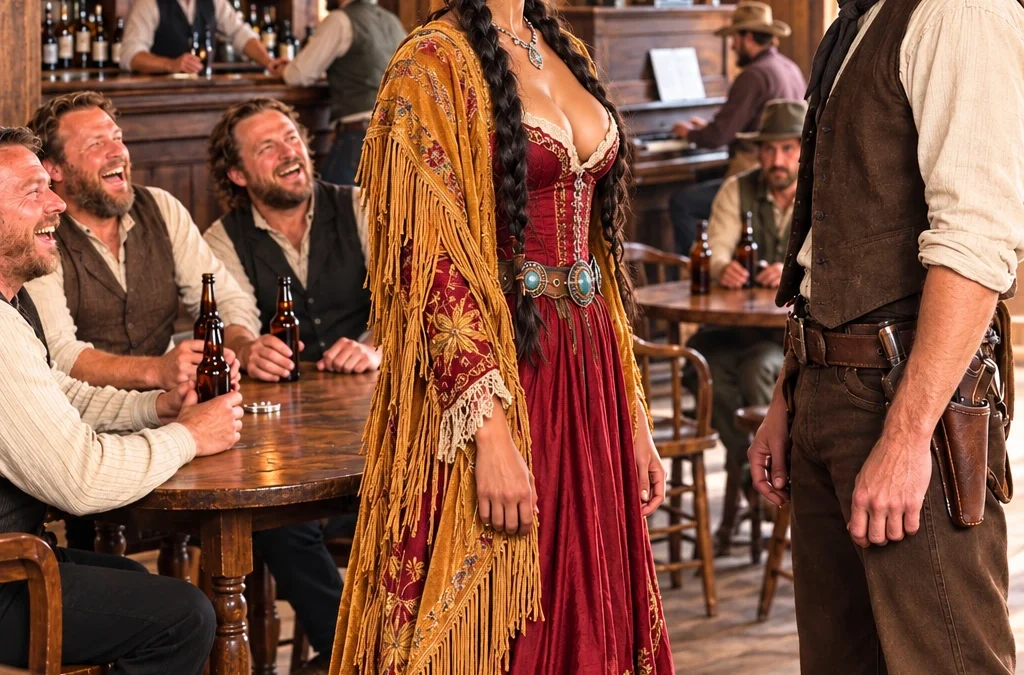
He Walked Into a Saloon and Begged for a Wife by Sunrise. The Room Laughed, Until One Woman Stood Up and Asked the Question That Silenced Them All 😳🔥
PART 1
Arizona Territory. Summer, 1879.
The drought had turned Copper Hollow into a town that argued about one thing only: water. 🌵 Wells ran low, cattle crowded into any scrap of shade, and the man who controlled water controlled everything else.
On a Tuesday evening in July, a gray horse limped up to the Copper Hollow Saloon. Its rider was Gideon Vale, six feet four inches and 240 pounds of timber-cutter muscle. His beard was streaked with early gray, and his hands could close around a fence post and make it look like a twig. He had run Black Pine Ranch alone for fifteen years. In all that time, nobody in town could remember him asking for a single thing.
Tonight he walked in with a folded paper in his fist and the look of a man who had already rehearsed being laughed at.
The piano stopped. Gideon set the paper on the bar, turned to face the room, and counted three seconds of silence.
“I need a wife before sunrise.”
For one heartbeat, nobody breathed. Then the saloon exploded. 😂
Cal Dudley nearly fell off his stool. A card player dropped his hand face-up. “Somebody go wake the preacher!” a voice howled. “He walked in here for a wife like he’s buying a sack of flour!” Another bellowed, “I’ll marry you, Gideon, if you throw in the cattle!”
Gideon didn’t cross his arms. He didn’t look at the floor. He stood like a mountain in a storm and waited for the laughter to blow itself out.
“I’m aware of how it sounds,” he said. “I have a reason.”
He unfolded the paper. His late uncle’s will left him Black Pine Ranch, and with it Black Pine Spring, the only reliable water for three cattle routes in the upper basin. But there was a condition. He had to be married before his forty-third birthday.
That birthday was tomorrow. ⏳
“The probate notice came this morning,” Gideon said. “It was dated three weeks ago. I believe it was delayed on purpose. If I don’t show a marriage certificate to Judge Kesler at nine o’clock, the ranch and the spring go to the next name in the will.”
“And who’s that?” Cal asked, no longer smiling.
“Orson Bell.”
The room went cold.
Orson Bell dressed well, spoke softly, and sat in church on Sundays. He had also bought three ranches in four years from men in debt, from widows who couldn’t hold on, and from anyone who couldn’t compete with his prices. If Bell got that spring, every small rancher in the basin would pay his rate or sell out by fall.
Gideon looked around the room. Two women were married. One was a widow. Two worked the saloon floor, and each looked away with something close to regret.
“I’m asking if any woman here is willing to marry me tonight,” he said. “Legal, recognized by the court. Whatever happens after, I’ll discuss honestly with anyone who says yes.”
Nobody moved.
Then a chair scraped.
From the darkest corner, a woman rose from a table where she’d been nursing coffee with her back to the wall and her eyes on everything. She walked through the center of the room, not hurrying, not performing. About thirty years old. Dark braid, canvas trousers, boots that had logged serious miles.
She was Apache. And the room registered it in one collective, stiffening breath. 😶
She stopped in front of him. She had to look up a full foot, and she did it without tilting her head back.
“Before I say anything else,” she said, “I want to know something. When this is over, when the judge rules and you have the paper that says Black Pine belongs to Gideon Vale, what happens to the wife?”
Gideon had faced three stampedes, a blizzard that killed four men, and a cougar with only a hatchet in his hand. He had never been stopped cold by a question.
“You can leave,” he said. “I wouldn’t hold you.”
“That’s not what I asked.” Her voice was level. “Will you still be kind when you no longer need anything from me?”
The saloon was dead silent.
“I can’t promise I’ll always know the right thing to say,” he said slowly. “I can promise I won’t own you. I won’t shame you. I won’t raise my hand to you. And as for kindness, I’ll keep trying.”
She studied him for a long time. “Elena Nail,” she said. “Then I’ll marry you.”
A voice from the back called out, “She’s Apache.” Elena didn’t turn around.
“I noticed,” Gideon said flatly. “Was there something else you wanted to say about it?”
Nobody did.
She named her terms in front of twenty watching faces: a legal marriage, but never his servant, his property, or his obligation. Her own name. Her own money. An equal voice. Separate rooms unless they both chose otherwise.
“Every one of those is acceptable,” Gideon said.
By 11:45 that night, Judge Kesler had pronounced them married in the middle of the saloon. Orson Bell watched from the back wall, smiling like a man three moves ahead. He stepped into their path as they left. “A bold solution,” he said. “Though you married a mountain tonight, Miss Nail, because you thought mountains don’t move.”
Elena held his gaze. “No. I married a man. Because you were too certain nobody would.”
The smile faded, slowly, like light at the end of a long day.
That night, in a narrow bed in a cabin she had never seen before, Elena stared at the ceiling and admitted something she would never say aloud to a room full of strangers.
She hadn’t stood up for Gideon Vale. Not at first.
She had stood up because her cousins ran horses along the North Trail, and Black Pine Spring was the only summer water they had left. 💧
PART 2
Dawn found Elena awake before the rooster, coffee already on, eggs in the pan, and Gideon staring at her from his doorway like she’d rearranged the furniture of his entire life.
“You don’t have to do that.”
“I know. I’m awake.”
By nine o’clock, they stood in the courthouse. Orson Bell had brought a Tucson lawyer with an aggressively expensive briefcase. The attorney’s argument was simple: this was a marriage of convenience, announced in a saloon, with no history and no love.
Judge Kesler turned to Gideon. “Did you marry this woman to satisfy the probate condition?”
“Yes, sir,” Gideon said. Bell’s smile bloomed. “That was why I asked. It isn’t why I’m still married.”
Elena looked at him sharply. She hadn’t known he’d say that.
When the judge asked if she had loved him when they wed, she answered honestly. “No.” The room exhaled. “What I had was his word. He gave me the better horse last night without mentioning it. He knocks before he enters my room. In a world that has given me few reasons to trust a stranger, he was the first man I watched stand in a room full of laughter and refuse to get smaller.”
In the hallway, Bell approached her alone. “Eight hundred dollars and a good trail horse,” he murmured. “Tell the judge it was temporary. Copper Hollow will never see you as his equal, Mrs. Vale.”
“I know exactly what that looks like,” she said. “I’ve been looking at it since before you arrived. The difference between us is that you think the way people look at me is a weapon. I know it’s only weather.” ⛈️
The judge ruled that afternoon. Black Pine Ranch belonged to Gideon. Then Gideon did something that stopped the room. He asked the judge to write Elena onto the deed as co-owner.
“I don’t want half of something because I helped in a crisis,” she said. “That’s payment.”
“It’s not payment,” he answered. “It’s a partnership I intend to make real.”
She set a condition: her ownership independent of the marriage, hers regardless of what happened between them. Kesler wrote it down.
Three mornings later, Elena climbed above the north pasture alone and found shovel marks. Fresh. She followed them forty yards uphill to a rocky channel, where the upper stream of Black Pine Spring had been bent west by a brand-new iron pipe, away from Gideon’s land and toward Bell’s cattle.
Gideon ripped it from the rock with his bare hands. Stamped on the collar: BC. Bell Cattle Company. 🔥
Two days later, the spring dropped to half its flow.
Then, on a Thursday, Elena smelled smoke in the barn. By the time she reached the ridge, the upper pasture was running with fire, and two of their ranch hands were somewhere on the wrong side of it.
Gideon grabbed his reins. “Wait,” she snapped. “The lower route’s already cut. You’ll ride straight into the flames.”
PART 3
“There’s a rocky wash twenty yards north of the main channel,” Elena said. “Fire can’t carry across stone the way it runs through grass. We get above it and come down behind them.”
“You’re sure?”
“I’ve moved through fire before. Follow me.”
She went first. Heat pressed against her left side like a hand. Behind her, the fire made a sound like something breathing wrong. They found young Tommy Reeves on foot, running toward a narrow draw that would funnel the flames straight at him. Elena swung him up behind her saddle and turned back into the smoke. Gideon reached old Russ Abel, who had wedged his horse into a rocky hollow and wet its head with his canteen, and got him moving.
They came out on the flat east of the pasture, four people on three horses, coughing and alive. 🙏
Gideon checked both hands for burns before he looked at anything else. Then he turned to the ridge. The best grazing on Black Pine was black and smoking. And in the scorched earth above the channel sat Bell’s diversion, fully exposed: iron pipe, survey stakes, and a charred crate with the BC stamp still visible from forty feet away.
Four witnesses were looking at it.
“You knew the wash,” Gideon said quietly.
“I always map the terrain.” She paused. “Knowing where the exits are is how you survive a room that doesn’t want you in it.”
Something moved across his face. It wasn’t pity. It was a man realizing the picture was larger than he’d understood.
That evening, he said it plainly. “I almost rode the wrong way today, out of habit. You had to stop me. I’m sorry.”
No excuse. No hook of “forgive me” attached. She had heard many apologies in her life, and most were wrapped around a request. This one was just the truth.
“Then try again tomorrow,” Elena said.
Surveyor Aldis Fitch arrived Friday and spent five hours on the hillside. His verdict was exact. The diversion sat eleven yards inside Gideon’s property. “Whoever laid this pipe knew it was your land.”
It was deliberate trespass, not a mistake.
Bell’s next move was personal. He sent a well-dressed woman named Clara to Black Pine, the wife of a lower-basin cattleman. She delivered Bell’s message: women in your position can’t afford enemies with long memories. Then she put down her cup and added something of her own. “I think Orson Bell is afraid of you. Not Gideon. You. And at least four women in this town are watching what you do here, and they aren’t hoping you’ll fail.” 💪
Elena stood alone in the cabin long after Clara’s horse faded down the trail. She had spent her whole life assuming she was alone in rooms that weren’t built for her. She had been wrong.
That night, Gideon sat across the table and said, “When I walked into that saloon, I thought I needed a signature. I was wrong. I needed a partner. I just didn’t have the word for it.”
She picked up his work shirt, the one with the torn collar hanging on the chair for two weeks, and began to mend it with her own needle. “Don’t make it sentimental,” she said. “It’s a collar.” They both knew it wasn’t.
Fitch’s report and Cal Dudley’s evidence reached the land office. Bell received a notice: a criminal referral, ten days to respond. Judge Kesler quietly began negotiating on their behalf. Three upper-basin ranchers rode to Black Pine to be seen standing beside Gideon on his porch.
Elena wrote out what they wanted: the pipe removed and the spring restored, payment for the cattle and fire losses, and a legal covenant protecting the spring from any future attempt to divert, fence or buy it apart from the land.
“He’ll never agree to that last part,” Gideon said.
“Then we go to the criminal referral,” she answered. “The covenant is the only thing that protects the small ranchers five years from now.”
Gideon thought for a long moment. “All right. We hold.”
Bell’s final offer arrived on a Friday evening. Full restoration under Fitch’s supervision. Nine hundred and forty dollars in damages. A signed, public admission of trespass. And the covenant, in narrower language than Elena had written, but strong enough to hold.
She read every line herself. She never took anyone else’s reading as hers. “It’s enough,” she said.
She signed beneath Gideon, her own name on the same line, not absorbed into his.
“One more thing,” Cal Dudley said, turning his hat. “Bell left for Tucson this morning. He’s put his lower basin land up for sale.” ✨
Weeks later, a Tuesday morning, Gideon came in from the corral and froze at the door. A single packed saddlebag sat there.
He did not ask her to stay. “Are you leaving?” His voice was perfectly level.
“The agreement said I could, once the dispute was settled,” Elena said.
“You’ve always been within your rights,” Gideon said. “That isn’t what I asked.”
“If I left, what would you do?”
“Saddle the fastest horse. Make sure you had enough water for the trail.” He didn’t hesitate. “Then I’d come back here and probably buy another chair anyway. I’d gotten used to two cups on the counter.”
She crossed the room without hurrying, the way she walked when a decision was already made, and stopped close enough to look up. She didn’t tilt her head back, just as she hadn’t that first night in the saloon.
“I need two more chairs,” she said. “In case Clara comes. And Patterson’s wife.”
The corner of his mouth moved. “I’ll make them today.”
She picked up the saddlebag, carried it back to her room, set it against the wall, and came out again.
“It felt wrong,” she said. “Leaving.”
“Thank you,” Gideon said quietly, “for staying. Not for saving the ranch. Just for staying.”
The final blow came from Bell’s lawyers: a last complaint to the land board, claiming the marriage clause itself was invalid. Elena wrote a single letter to Clara explaining the situation and asking if “watching had room for one word in the right ear.” Six weeks later, the complaint was dismissed in under a week. 🏆
By September, Black Pine’s spring ran full, the north pasture was greening, and Elena had three new horse-training clients. Four chairs stood at the table now, and on Tuesday evenings they were all full.
On the last night of August, they sat on the porch under a sky packed with stars, Gideon in the good chair and Elena on the step.
“Were you kind today?” he asked.
“Mostly.” She smiled. “You?”
“I argued with the mule again.”
“Was the mule wrong?”
“Completely.”
“Then try again tomorrow,” she said.
He reached for her hand, carefully, with the full understanding that careful was not weakness but the hardest kind of strength, and held it. She held it back.
Copper Hollow would remember that summer for years. They would tell about the saloon, the midnight wedding, the fire and the settlement. But the thing that lasted, the one that got told and retold until it stopped being about a desperate rancher and became the way people explained the word partner, was simpler.
A woman crossed a room full of laughter and asked one question.
A man answered it honestly.
And every evening after, when the sun slipped behind the red mesas and the spring ran cold in the rock, one question stayed between them: Were you kind today?
The answer was always the same.
I tried.
It had always been enough. ❤️
The End.
This story is entirely fictional and created for entertainment purposes only. It does not represent any organization or individual, nor does it encourage inappropriate behavior. The content was generated with AI assistance.








