He Walked Into an Apache Camp Alone to Take Back His Dead Wife’s Horse… Then Learned Who Had Opened His Barn Door
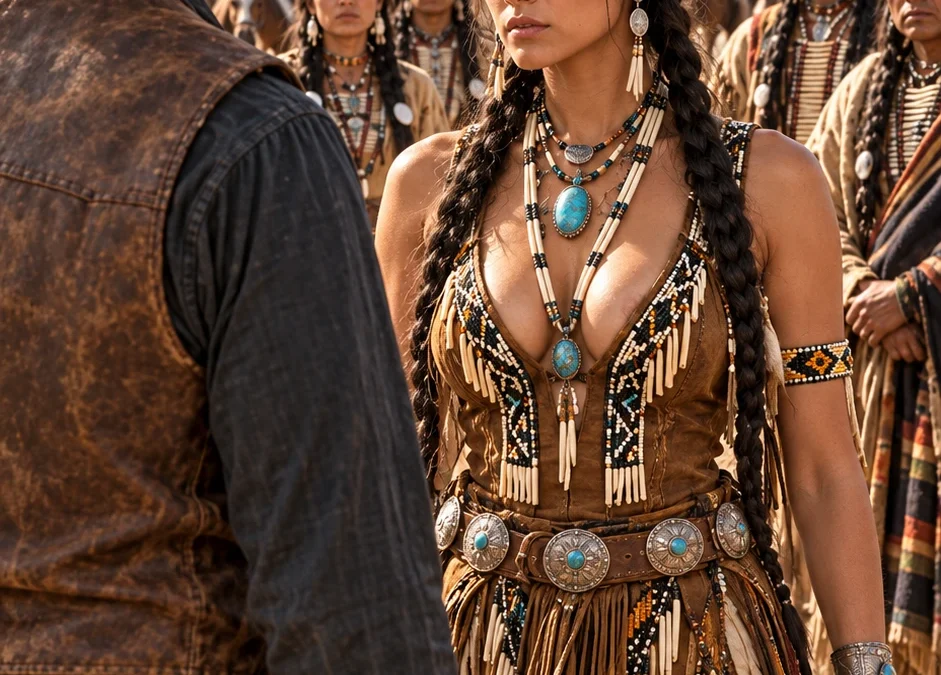
🔥 He Walked Into an Apache Camp Alone to Take Back His Dead Wife’s Horse… Then Learned Who Had Opened His Barn Door 🔥
PART 1
The silence woke Amos Kesler, and silence was wrong.
For three years one sound had dragged him out of bed every morning: a chestnut gelding kicking a stall door. Twice, then a pause, then a third kick, slower, meant to hurt. Harvest never asked for breakfast. He issued demands like a bank clerk collecting interest.
This morning there was nothing. The windmill groaned. A rooster offered one weak opinion and gave up.
“Harvest,” Amos said to the ceiling. “Don’t you dare.”
He pulled on his boots and went out with his shirt half buttoned and his hair standing up like a startled hen. At the barn, the big door stood open a hand’s width, and gray light slid across the dirt floor.
Nine of the ten stalls had been empty since the drought took the cattle prices and then the cattle. The tenth, at the far end, had a brass nameplate screwed crookedly into the post. Lenora had put it there herself, laughing the whole time.
The stall door hung open. The straw was pressed flat in the shape of a body that had lain there hours ago.
No horse.
He walked the yard, slowly at first, then not slowly. The corral lock dangled open on its chain. It had not been broken, pried, or shot off. It hung there as if invited. Amos kept the key on his belt. The only spare hung on a nail in the tack room behind the harness, where a man would find it only if he already knew.
He told himself that meant nothing. He told himself twice.
Past the corral the east fence had been cut clean, four strands curled back like ribbon. Somebody had brought good tools and had known which wire to cut first so the posts wouldn’t sag. It had not rained in fifty-one days. Amos knew because he counted them every night, like a man counting the ribs of something he loved. The hard ground had held three sets of tracks. One was Harvest’s, with the slight drag on the left hind from an old wire cut. The other two were small, narrow, and unshod.
Bare hooves. Light riders.
Near the post, half buried in dust, was a fourth print, iron shod, with one bent nail hooking the dirt behind it like a signature. Amos studied it for exactly one second. Then he shrugged. Old print. Wade had been out checking wire last evening.
Hoofbeats sounded behind the barn. Wade Toiver rode in on his dun with his hat low and a coffee cup steaming in his hand. Ten years he had worked the Kesler place, ten years of bad coffee, worse jokes, and a loyalty Amos had never once thought to question.
“Harvest is gone,” Amos said.
The cup stopped halfway to Wade’s mouth. He walked to the gate and looked at the lock a moment longer than Amos expected.
“Three sets of tracks,” Wade said quietly. “Two barefoot. Apache, maybe. Straight toward the canyon country.”
“Then I’m going after him.”
“You’ll get yourself killed.”
“Then don’t let me go alone.”
Wade sighed the long sigh of a man who had lost the argument before it started. “Ten years, boss. I’m not eating your cooking by myself. Saddle up.”
Amos turned toward the barn so Wade wouldn’t see his face. Harvest was not a horse. He was the last warm thing in a house that had gone cold. Lenora had bought him as a skinny, ornery two-year-old who had already thrown two riders and eaten a third man’s hat. She had talked to him for hours. She told him about the weather. She told him about Amos. Every morning she tied a strip of red flannel to her saddle horn.
“For luck.”
“You don’t believe in luck.”
“I believe in insurance. Red is the only color you can see from a ridge when you’re lost.”
Three years ago the fever swept the settlement in August. It took eleven people. It took Lenora in nine days, while the doctor’s wagon lost a wheel on the road and arrived one day late. Her last clear words were not about love. They were, “Amos, don’t let it make you cruel.”
After that he could not sell a thing she had touched. Not even when the bank’s letters began using words like final. Not even when Harlon Crowe, who owned the mercantile at Sandoval Crossing and the notes on half the county, stood on his porch three days ago in a clean black coat, smiling.
“Everything is for sale, Amos. Sooner or later.”
“Not this.”
Crowe’s laugh had never touched his eyes.
They tracked the prints by midmorning, east across scrub and the cracked bed of Cottonwood Creek, which had run strong every June of Amos’s life until this one. Near noon Amos found something red fluttering on a thorn bush. He pulled it free and knew it before his fingers closed. It was a strip of faded flannel cut from Lenora’s wedding-year petticoat, torn at one end where Harvest had fought. He tucked it into his vest pocket, next to his heart.
At the mouth of a red canyon, smoke drifted out on cool air.
“Camp,” Wade said. “A big one. Let me ride back for help. Three hours.”
“Four is too long.”
Something crossed Wade’s face, fast as a cloud shadow. Amos took it for fear. Later he would understand it was something worse.
“Then wait for me. Promise.”
“I promise nothing.”
Wade rode away. Amos waited about four minutes. Lenora used to say patience was just fear wearing a nicer hat.
He nudged his gray mare, Judge, into the canyon’s shadow.
The shot cracked from the left rim, and Judge folded under him. Amos hit the ground, rolled behind her, and dragged his Winchester free. A second shot never came. The man on that rim had a clean line to his chest and had not taken it.
Which meant somebody wanted him alive. On foot. Walking one direction only.
Toward the smoke.
He found a slab of red rock shaped like a broken tooth and shoved both guns beneath it. If he went in armed, he went in as the enemy. Then he raised his hands to his ears and walked into the Apache camp alone.
Three rifles rose from behind a boulder. He didn’t stop, because across the camp, tied beside a brush shelter, stood a chestnut gelding with a white sock.
“That’s my horse,” Amos said. “I’m taking him home.”
A young warrior with a scar through his eyebrow drew a knife. Two steps, and the blade stopped an inch below Amos’s chin.
Then Amos saw what was tied across Harvest’s back. A small boy, his lips gray, his chest fluttering like a trapped bird.
A limping man pushed between them. “Take the horse. No one here will stop you. But before you go, you should hear what it will cost.”
💬 Part 2 is waiting in the comments! Can’t find it? Leave any word below and I’ll send it to you privately.
PART 2
“Take the horse. No one here will stop you. But before you go, you should hear what it will cost.”
The man’s name was Anselmo. He was perhaps forty-five, with long black hair streaked gray and a right leg stiff from some old injury. He led Amos past shelters of brush and torn canvas. Forty people sat in them, and none of them were laughing.
Children moved slowly. Not one of them ran. Even on the worst day of the worst year, children run.
There was no food anywhere. There were only empty pots and horses with ribs like barrel staves.
A young woman waited beside Harvest, arms crossed, eyes like a hawk that had heard every lie in the territory. “That is a horse,” she said when Amos repeated that he owned it. “Whose he is depends on who stands closest to the dying child.”
Her name was Ines. The boy was Lo, eight years old, nine days sick, the color of candle wax. She said it flatly, but her jaw shook.
“Last night we put him on your horse to reach the post at Sandoval before dawn. He walked as if he understood every word. But the boy could not go on.”
Anselmo held out a small pouch. Inside were six dollars in coins and a scrap of brown paper stamped Crowe Mercantile. Beneath the stamp, in a clerk’s pencil, was one line.
No sales.
“Six days ago two of our women went for medicine,” Anselmo said. “They were told to leave or be shot.”
“That’s a lie,” Amos said automatically.
“I was one of the women,” Ines said.
Amos looked at the empty pots. A small girl with crooked braids was staring at Harvest as if he were made of light. She held a carved wooden horse with a broken leg. Harvest lowered his head and blew warm breath across her hair, and she giggled. It was the first laugh Amos had heard in that camp, and it hit him like a slap.
He thought of the doctor’s wagon and the ten days. He thought of how a house sounds after someone stops breathing in it.
“I’m not a hero,” he said roughly. “I’m a rancher with a mortgage and a bad back.”
“We expect nothing,” Anselmo said. “I only wanted you to know the price. Harvest is the only horse strong enough to carry the boy to a hidden spring two days east. If he leaves, the boy probably dies.”
“That is the most polite blackmail I have ever heard.”
“I am out of impolite options.”
Lenora’s voice rose in his memory, from their last evening. You always do the right thing, Amos. You just take the long way.
He let go of Harvest’s neck. It felt like releasing a rope over a cliff.
“All right. Tell me what you need.”
Then Amos asked how Harvest had been taken. Anselmo frowned. “We cut your fence, yes. But the barn was already open. The lock hung on the chain. The horse was brushed.”
Amos felt the ground shift a quarter inch.
Brushed. Someone with a key. Someone who knew the spare.
And the shot that killed Judge had fallen at the one spot where a man on foot had only one road left to walk. Everything clicked together in his chest like a cold lock closing.
Not a theft. A trap. Somebody had let a starving camp find the one horse strong enough to save their sick. Somebody had known Amos would follow, ride alone, and walk in with his hands up.
They had not set the snare. They were the bait.
They left at first light, with litters rigged from saddle blankets. On the second day a flood came down a dry wash with no warning, brown and roaring. Amos plunged into it after the young warrior, Ignacio, who had turned back for an old man. Amos hauled him out by his shirt. That night Ignacio returned Amos’s buried revolver without a word.
“We are not even,” he said.
“No,” Amos agreed. “But closer.”
At midnight Amos woke to gunfire. Painted riders swept out of the dark. But their horses were shod, and their face paint ran wrong with sweat.
He fired twice and dropped one. The rest scattered, shouting in flat frontier twangs that were not Apache at all.
Amos wiped the paint from the wounded man’s cheek with his thumb. Beneath it, the skin was pale as his own.
“Who sent you?”
The man spat blood and said nothing. Amos pressed the barrel to his shoulder, just once. The man screamed and broke.
“Wade Toiver told us you’d be riding alone.”
💬 What do you think happens next? Can Amos forgive a ten-year friend who set the trap? LIKE or COMMENT “REVEAL” to unlock Part 3! It will be posted as soon as we have enough comments. 🔥
PART 3
The fire crackled. Somewhere behind him Pilar was crying, and Ines was already moving toward the wounded man with cloth and water, because that was simply who she was, even now.
Amos stood very still.
Ten years, he thought. Ten years of bad coffee and a man riding beside him at every branding, burial, and bad winter. None of it meant what he had thought. Wade had asked him to wait three hours. Wade had told him to be a coward for once. Wade had ridden away whistling.
“You could ride back tonight,” Anselmo said quietly. “Settle this with your own hands. No one here would blame you.”
Amos looked toward the dark horizon and the direction of home. Then he looked at Lo asleep against Harvest’s flank, breathing his thin careful breaths. Forty people. One spring. A day and a half away.
“No,” he said. The word cost him something. “I gave my word before I knew any of this. I’m not taking it back because it got complicated. Wade will keep. He’s kept ten years already.”
They reached the ridge above Broken Tooth Spring the next afternoon. There Ines pulled him aside, her face doing something he had never seen it do. She looked unsure.
“There is something I am tired of carrying alone.”
Behind a curtain of scrub she moved a stone aside and lifted out a small tin box wrapped in oiled cloth. Inside were dried herbs, a half-used bottle of medicine, a cracked leather ledger, and a strip of red flannel that matched the one in his pocket.
“Your wife came here twice a season for almost two years,” Ines said. “She brought medicine when the post would not sell to us. She taught me half of what I know about fevers. She tied that cloth to her saddle so anyone watching from a distance would know. Friend. Do not stop.”
Amos opened the ledger. Lenora’s small slanted handwriting filled page after page, with doses, names, and dates. Then came something else entirely: creek levels measured in pencil against a stick, dropping month after month.
Crowe’s new dam holding back nearly all of it above the fork. Told the sheriff. He said it’s Crowe’s water to dam as he pleases. Told Crowe. He smiled at me the way he smiles at everyone he intends to ruin.
“She knew,” Amos whispered. “She knew about the dam. And she never said.”
“She did not want to worry you,” Ines said. “She died two weeks after her last visit here. I have always wondered.”
He sat down hard on the rock. He had believed for three years that a wheel broke on a road. Now the truth ran through a dam, a mercantile, and a smiling man in a clean black coat. It had been waiting in a tin box under a stone for him to be brave enough, or broken enough, to find it.
Below them the spring caught the afternoon light and turned to hammered silver. Forty exhausted people started down toward the water with something that might almost have been hope.
That night, while they drank until their stomachs hurt, Ignacio rode back in from scouting the low road with his face carved tight.
“A covered wagon. Two guards. It carries blasting powder.” His jaw worked. “They said Friday before first light. They said the cliff above this spring comes down easy if you know where to set it.”
“They mean to bury the camp,” Anselmo said. “And the proof.”
“Soldiers will come to rescue anyone left,” Ignacio said. “But no one will be left to argue what happened. Only Apache bones under Apache rock, and a story already written.”
Thirty-six hours.
“I need Captain Hollis at the fort,” Amos said. “Not through anyone who belongs to Crowe.”
Anselmo pressed a rein into his hand, a wiry paint mare who knew the ridge trail. Harvest would stay with the boy. Amos hesitated, then agreed. He rode into the dark with the ledger against his chest, a borrowed revolver on his hip, and the weight of a second saddle on his shoulders.
At dawn he met Warren Pike’s party on the ridge trail. Pike was a rancher who had buried his son four years earlier, killed on a road everyone swore was raided by Apache. He raised his rifle.
“I heard the Apache took you.”
“I’m riding to stop something worse,” Amos said. He told him everything, the powder wagon and the plan. “I’ve got a ledger that says it’s more than a story.”
“Ledgers can be written by anybody.”
“This one was written by my wife.”
Behind Pike, one rider’s hand drifted to his belt. Amos shouted. The man fired first and missed. Amos did not. The rider dropped from his saddle and did not move again.
Amos knelt and went through the dead man’s pockets. A cartridge. He turned it in the light and saw a small triangular notch in the crimp, the same notch he’d found on the casing above Judge’s body. Crowe’s reloading press.
“The night your son died,” Amos asked quietly. “Do you remember the date?”
“Every day of my life.”
Amos flipped through the ledger to a line in Lenora’s hand. Ike Sutter rode out again tonight on Crowe’s business. Does not ask what for anymore. The same date, three years before anyone had told her why it mattered.
Pike read it twice. His face went the color of old ash.
“Everybody said Apache,” Pike whispered.
“Everybody said what Crowe wanted said.”
The second rider broke at once and told them everything. When he finished, Pike looked twenty years older. “I want him,” he said.
“You’ll get him. But tonight I need your men on the east ridge above the spring.”
Pike nodded once. “Dawn.”
Amos rode hard for his ranch. He smelled the smoke before he saw the house. His porch, his kitchen, and his barn were wrapped in orange light. In the yard, calm as Sunday, stood Harlan Crowe.
“You’re alive. How disappointing for my schedule.”
Captain Hollis, Crowe explained pleasantly, had ridden for Broken Tooth with a guide Crowe had provided. “Should make quite a rescue.”
Two riders stepped from beside the barn. Amos lunged, and a rifle stock cracked across his skull. When the world steadied, his hands were chained and the ledger was in Crowe’s fingers. He fed the pages into the fire one by one, watching Amos’s face.
“Your wife was thorough. A shame she spent it getting in my way.”
Wade Toiver stood near the barn with his hat pulled low and would not look up. Not once. That hurt worse than the chains.
When Crowe rode off laughing, Wade walked past Amos and let something small drop into the folds of his shirt. Hours later he returned alone, trembling, and fumbled with the lock three times before it opened.
“Don’t say my name like we’re still friends.”
Amos looked past him and saw a single hoof print in the ash-gray dirt: iron shod, one nail bent outward and hooking the dirt. He had seen it by his own barn five days ago.
“Say it, Wade.”
“I owed Crowe a gambling debt from before I ever rode for you.” Wade’s voice came low and raw. “He held it over me for years. I unlocked the gate. I brushed Harvest myself so he’d walk out calm. I swear I didn’t know there was a dying boy.”
“And Lenora?”
Wade didn’t look up, which was the worst answer Amos had ever heard.
“She’d found out about the dam. Crowe told me to slow the doctor’s wagon. Just slow it. I cut a wheel bolt halfway through. I never let myself finish the thought of what a day’s delay would cost a woman burning with fever. I was hiding in the rocks when it gave. I watched, and I did not move.”
Amos had him by the collar before he knew his hands had moved. “I should kill you right here.”
“I wouldn’t stop you,” Wade said. “I’ve waited three years for somebody. Might as well be you.”
Amos’s fingers tightened. Then Lenora’s voice spoke inside his chest, patient, a little amused even now.
Don’t let it make you cruel.
He let go so suddenly Wade fell backward into the dirt.
“Get up. I need you, and God help me, that’s the worst sentence I’ve ever spoken. Ask me again once that camp is safe.”
Wade reached into his coat and drew out a bundle wrapped in oilcloth, worn soft at the corners. “I found this behind a board in the tack room after she died. Your name on the front, in her hand. I never had the stomach to give it to you.”
Amos tucked the letter inside his shirt beside the two strips of red flannel. “Later.”
They rode double on the paint mare. The powder wagon labored up the rutted track toward the cliff with Ike Sutter on the box, a lantern swinging. Amos came the last hundred yards on foot. Sutter heard him at thirty feet and fired. Wade shouted from the other side and was shot down. Amos hit Sutter at a dead run, and the two men rolled in the dirt beside enough powder to erase a mountainside.
In the struggle the lantern tipped. A fuse coil caught a spark and began to hiss.
Amos saw it from the corner of his eye. Thirty seconds, maybe less. He drove his knee into Sutter’s chest, dove for the cord, and pinched it flat between his fingers. It scorched through skin. He held on until the hiss died and there was only his own ragged breath and the smell of burned flesh.
Sutter lunged for the rifle. Wade, bleeding, one arm useless, had crawled the last six feet on pure stubbornness and put his whole weight down on it first. Sutter looked at the pale gray sky and ran.
“Guess we’re a little more even now,” Wade rasped.
“Don’t die on me. I haven’t decided if I’ve forgiven you, and it’d be rude to do it after.”
They turned the wagon well clear of the cliff. Then Amos ran for the spring.
He came over the last ridge as the sun cleared the horizon. Below, Captain Hollis’s column stood drawn up in a long blue line facing the camp. Pike’s men were riding hard down the eastern slope. And standing alone between both lines, one hand raised, was Anselmo on his staff, buying time with nothing but his body.
Crowe sat his horse behind the soldiers, already shaping the story.
Amos ran down the slope with no ledger and no proof but a burned hand, shouting Anselmo’s name. Every rifle swung toward him.
“Captain Hollis. My name is Amos Kesler. Everything you’ve been told is a lie built by that man.”
“He conspired with hostiles,” Crowe said smoothly. “He has no evidence.”
“Ike Sutter’s powder wagon sits two hours south, turned back from the cliff, and a man bleeding who will tell you everything.”
Hollis turned to Pike. “What do you know?”
Pike was silent a long, terrible moment. “I know my son died on the Sandoval Road four years ago on a night Ike Sutter rode out on Crowe’s business. I know Kesler’s dead wife wrote that date down before she knew it would matter to me.” His voice roughened. “I spent four years hating the wrong shadow. I’m done.”
Crowe’s hand moved toward his pistol. Anselmo stepped between him and Amos and called out in his own language, a single word with the weight of a command. From the ridge above, Ignacio answered. Forty rifles that Amos had not known were there rose together and settled on Harlan Crowe.
“I believe that settles who came to talk,” Hollis said quietly, “and who came to bury the talking.”
Soldiers closed around Crowe from three sides. The man who had smiled from Amos’s porch stopped smiling all at once, like a candle pinched out.
“Amos.”
Ines stood behind him. Beside her, Lo was on his own two feet, thin and pale but upright, one hand in Harvest’s mane. Pilar held the wooden horse, its leg mended with a splint of matchwood and Ines’s careful thread.
“You fixed it,” Amos said stupidly.
“Ines fixed it. You promised, then disappeared a whole day. So I made her.”
“That’s fair,” Amos said, and his voice broke on the second word. He sat down in the dirt and let the rest of it break too.
That night, with the spring running loud and steady below the camp, he finally opened Lenora’s letter.
If you are reading this, either Wade has found his conscience or you’ve found this some other way. I’m sorry I’m not there to see your face doing that thing it does when you realize halfway through an argument that I’m right. I knew about the dam long before I told anyone. I chose to help anyway. I would do it again tomorrow.
Betrayal from a stranger is easy to carry. Betrayal from a friend sits in the chest like a stone. Let it go. Not because he deserves it. Because you do.
Don’t let any of it make you cruel. And whatever you build after this, build it wide enough for more than just us.
He sat a long time with the letter on his knee. Ines settled nearby, giving him the privacy of someone who already half knows what a letter says.
“There is a young mare in our herd,” she said carefully. “Ours, not stolen. Anselmo says she is strong enough now to be given, not lent. I would like her to go to your ranch when you rebuild. Not as payment. As a beginning.”
“A beginning of what?”
“That is for you to find out. I am only delivering the horse.”
Amos almost laughed. It was closer to a breath, but it was the first laughter he’d had in five very long days.
“I’m thinking of moving closer to the water. If nobody minds a rancher near the spring.”
“Nobody minds. Some of us may even visit to check on the mare’s manners. She has opinions.”
“Sounds like someone I’ve met recently.”
“I have no idea who you could mean.”
Pilar wandered over half asleep and climbed into the space between them without asking. Lo followed, steady on his feet, and sat close enough that his shoulder touched Amos’s arm. Harvest, tethered nearby, blew a long unimpressed breath into the dark and finally put his head down to the water, with nobody left to take him from it.
Amos closed his eyes, a letter warm against his heart, two strips of red cloth beside it, a girl asleep against his ribs.
For the first time in three years the silence around him did not feel like a tenant that had moved in to stay. It felt like a house with room left in it. Room enough for a mended wooden horse, a young mare with opinions, a boy who had learned to breathe easy again, and a woman who was in no particular hurry.
Neither, for once, was he.
💬 If someone you trusted for years turned out to be part of the trap, could you forgive them? Or would you walk away like Amos almost did? Tell me in the comments. I read every one. ❤️
This story is entirely fictional and created for entertainment purposes only. It does not represent any organization or individual, nor does it encourage inappropriate behavior. The content was generated with AI assistance.








