He Was About to Fire the Widow He Hired to Mend Shirts… Then His Deadliest Horse Walked Straight to Her
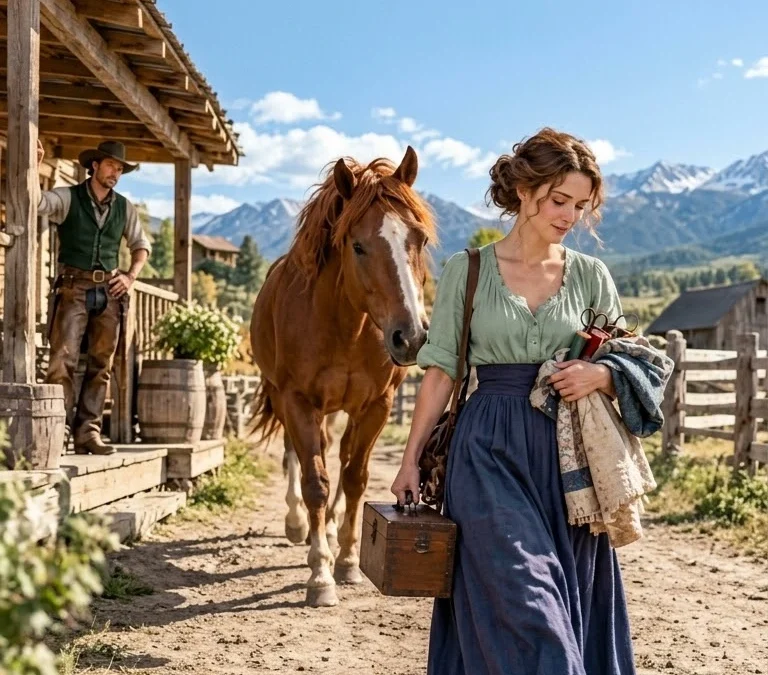
😱 He Was About to Fire the Widow He Hired to Mend Shirts… Then His Deadliest Horse Walked Straight to Her 🐎💔
PART 1
The morning Wade Holloway decided to fire Rosalie Bennett, she was standing in the middle of his ranch yard with a chestnut horse’s enormous head pressed against her chest. Her eyes were closed, as if she were listening to something nobody else could hear. 🌄
He had the words ready. He’d been rehearsing them since before coffee. It isn’t going to work out. Collect your wages through Friday. Amos will drive you to the station.
He never said them.
What stopped him was the horse. Copper was eight years old, built like a cavalry mount and meaner than a March storm. Three experienced riders had tried him in four months, and all three had been thrown. Yet there he stood with his neck slack and his eyes half closed, while a woman in a patched work apron hummed something tuneless and low against his nose.
Wade had spent twenty years around horses. He had never seen that horse stand still for anyone.
👉 If you’ve ever been underestimated so badly that people forgot you were in the room, you’ll understand Rosalie. Follow along, and tell me where you’re reading from. I want to see how far this story travels. 🌍
Colorado, 1891.
Rosalie Bennett stepped off the stage on a Tuesday in late September, which was a terrible time to arrive anywhere in that country. The autumn cattle drive was three weeks away. Wade’s seven hands were running on bad coffee and short tempers, and the kitchen was three meals behind. A grain sack of torn shirts, trousers and coats sat unmended in the bunkhouse.
His foreman, Amos, had found her name in town. A widow, thirty-two, with five years of references from Denver. Amos had heard she’d hemmed a dress in under an hour that three other women had given up on.
Her reply to Wade’s offer was almost curt: I expect regular wages, a private space to work, and to be addressed as Mrs. Bennett rather than “the seamstress.”
Wade read it twice. He told himself the handwriting was just unusually clear.
She stepped off the stage with a trunk, a case, and a sewing machine wrapped in canvas. Auburn hair under a plain hat. Eyes somewhere between gray and green, a color he would spend months trying to name. Her good coat was old, and the buttons on her left sleeve didn’t match the right.
“I’d like to see where I’ll be working before I unpack,” she said.
It wasn’t a request. It was an itinerary.
The mending room was small, with decent light and a chair that wobbled. She tested the table, studied the window, and turned.
“I’ll need a second chair. And that window unobstructed from seven until noon. That’s when I do close work. Dark thread on dark cloth in bad light gives me headaches that last two days.”
It was completely reasonable. That was the irritating part. He couldn’t find one thing to object to. 😤
He’d hired seamstresses before. They were quiet, grateful, and stayed out of his way. This one, he suspected, would not.
For the first day, he was wrong. By noon she had repaired six shirts, rehemmed two pairs of trousers, and rescued a coat lining that the hand called Pete had given up on. Pete wore it to supper without a word, which was the closest Pete came to gratitude.
Wade saw her once through the window, bent over the machine, so absorbed she never noticed him. He thought of a hawk on an updraft. Effortless, because there was no wasted motion in her.
He kept walking. He had a cattle count to think about.
Then, at 5:40 the next morning, the latch on Copper’s corral gave. It was a bad latch that Wade kept meaning to rebuild after the drive.
The chestnut gelding burst across the yard at a trot full of speed and purpose. Amos came out shouting. Pete grabbed a rope. A hand named Garrett stepped into the horse’s path and lived to say he’d felt the wind off its shoulder. The men spread wide, because they’d all learned that lesson the hard way.
The trouble with Copper wasn’t cruelty. It was fear. Something had taught him to expect pain from every touch, so he prevented contact the only way he knew. He made himself huge, fast and terrifying. 🐴
He ran the length of the yard, cut left at the trough, ran back, and stopped.
Completely stopped.
Rosalie was coming out of the cottage with a sewing basket in one hand and her apron in the other. She took in the scene: the scattered men, the rope Pete held like he didn’t know which end to throw, the eight-hundred-pound animal in the dust.
She looked at Copper. Copper looked at her.
Then she turned and walked back toward her door. Not away from him exactly. Just away, as if he were interesting but not her problem.
And Copper followed. He turned his head, then his shoulders, then his whole body, and walked after her at a pace you could almost call polite. Pete’s mouth fell open. Six feet behind her, the horse stopped, dropped his head, and blew out a long breath like he’d been holding it for weeks.
Wade stood frozen with his coffee. “Why’d he follow you?”
“Because I was the only one walking away,” she said, as if the answer were obvious.
She didn’t go back inside. Instead she picked up the saddle Garrett had abandoned by the fence, turned it over, and ran her thumb along the padding. Her frown deepened.
Then she went very quiet.
“Mr. Holloway,” she said. “Come here. I think I know why your horse has been trying to kill everyone.” 😳
👉 Want to know what she found? Find PART 2 in the comments, or leave any word and I’ll send it to you privately! 💬
PART 2
“Mr. Holloway,” she said. “Come here. I think I know why your horse has been trying to kill everyone.”
Wade crossed the yard. Rosalie lifted a corner of the padding and pressed her thumb against the wood underneath. It gave. The saddle’s frame, the tree that gave it shape, had cracked down the left side. From outside, nothing showed. But under a rider’s weight, that broken edge would drive straight into a pressure point on the horse’s back. 😨
“He’s been in pain,” she said, and her voice went flat the way a door goes flat when it closes. “Look at the wear on the leather above it. Months, maybe longer.”
Behind them, Amos spoke quietly. “Three riders.”
“Three riders put a broken saddle on a horse who couldn’t tell them it hurt,” Rosalie said. “Then they decided the horse was the problem.”
It wasn’t an accusation. It landed like one anyway.
Wade looked at Copper, standing near her cottage with his head low, watching her. Something cold settled in his stomach: the sensation of a man shown a thing he should have seen long ago.
“Get a vet out,” she said. “That’s your business, Mr. Holloway. I was hired for shirts.” And she went back inside.
He went to her cottage that evening. She answered the door with thread on her fingers and a pin between her lips.
“Would you work with him?” he asked.
“I’m a seamstress. You know what I was hired for.”
“What would it take?”
She looked at him the way people look at a page they’re reading. “Separate wages, and my sewing contract doesn’t change. If I say the horse needs to stop, you respect it without negotiation. And if I tell you he can’t do the cattle drive, that’s a real answer. Not a starting position.”
It was a lot of trust to ask of a man she’d known two days. Wade thought about the winter bills stacking up like wood against the barn.
“Agreed.”
Something crossed her face, the absence of a weariness he hadn’t known was there.
“Where’d you learn horses?” he asked at the door.
A pause. Small, but he noticed. “My father bred them.” It was plainly said. Under it was a longer answer she had decided not to give. 🤫
For three days she did nothing at Copper’s fence but stand. Twenty minutes morning, twenty afternoon. Sometimes eating an apple. By day two, Copper drifted nearer. By day three, he let her touch his neck.
The vet confirmed it: an old rib fracture, healed crooked, aggravated by months of the wrong pressure. Schroeder spent three hours in the corral and spoke to Wade the entire time, until Rosalie started asking questions. By the end he was answering her directly.
Wade stood back and let it happen. Rosalie noticed that. 👀
Then came the question Wade dreaded. “When can someone ride him?”
“I don’t know.”
“That’s your full answer?”
“It’s my honest answer, which I thought was what you hired.” She turned to him, level and unbending. “The drive is in three weeks, and I won’t give you a date that means nothing.”
He walked to the house and sat over his account books for an hour. Then he found Amos.
“Take Copper off the drive list. Write to Brennham for replacement horses. It’ll cost extra.”
“Know it will.”
That evening he crossed the yard to tell her, though no one had asked him to. She sat on the porch with a shirt in her lap and a strand of deep blue thread looped around her finger, catching the last of the sun.
“I took him off the drive,” he said. “You were right. I didn’t know what I was asking him to do.”
She was quiet for a moment, a different quiet than before. “That was a hard call. It was the right one. Those aren’t always the same thing.”
“No,” he said. “They’re not.”
He stood a moment longer than he needed to. Something had shifted, some small weight balancing differently. Neither of them named it.
Then the real storm arrived.
On Christmas Eve, a wind rose that made the horses restless and sent Amos walking the barn twice without knowing why. At ten minutes to eleven, canvas tore loose from the unfinished barn roof, whipping against Copper’s corral. A frozen post gave way with a grinding crack.
Copper was through the gap and gone into the dark, with the first snow of the season driving sideways. ❄️🐎
Rosalie was in the yard before Wade could shout, a lantern in her hand and her hair half pinned.
“Which direction?”
“East, toward the tree line.”
“He won’t go there. Not in this wind. He’ll find somewhere enclosed, where the sound is smaller.” She stopped. “If you chase him, he’ll run until…” She didn’t finish.
“What do you want to do?”
“I’ll track on foot. You ride wide and don’t push him toward the mountains.”
He handed her the pad and the long rope. “Rosalie.”
It was the first time he’d said her name without “Mrs.” in front of it. They both noticed. Neither said a word.
“If the weather turns, come back,” he said. “The horse matters. You matter more.”
She held his gaze for one second. Then she walked out into the storm.
👉 Did Copper survive the night, and what happened between Wade and Rosalie in that frozen hollow? Comment “COPPER” or tap LIKE ❤️ to unlock PART 3!
PART 3
Rosalie found the old line shack by the sound of it, which was the absence of wind.
The shack sat in a hollow where a rock face broke the worst of the gale. The silence when she stepped inside it was so complete that she stood still, letting her ears adjust. Her lantern stopped shaking.
Thirty feet away, Copper stood against the rock, his sides heaving, his legs planted. He had found shelter the way animals do, not by calculation but by the old instinct that says find where the bad thing is smaller.
She set down the lantern. She sat on a flat stone. And she did what she had done every day since September: nothing.
This was the moment most people reached for the horse, and reaching was the thing that undid the work. You could spend ten weeks building trust and lose it in thirty seconds by grabbing for it before it chose to come to you.
So she waited. She folded her hands in her lap, looked at him without staring, and let the cold seep into her boots. Four minutes. Five.
Then Copper moved. Three steps, stop. Two more. His nostrils worked at the familiar smell of the saddle pad she’d unrolled beside her: leather, lanolin, and months of something that apparently smelled like safety. 🤍
He lowered his nose to the pad. Then he lifted his head and looked at her from two feet away.
She raised one hand and touched the bridge of his nose. He let out that long, slow breath she had learned to wait for.
“There you go,” she whispered. “It’s all right now.”
When Wade came around the rock face on foot, having dismounted at the edge of the hollow without being told, he found her sitting on the stone with Copper’s head over her shoulder and the horse’s eyes half closed.
“Took you long enough,” she said.
He let out a breath he’d been holding for an hour.
A small cut on the foreleg needed wrapping. She pulled a strip of cloth from her pocket, the same deep blue as her thread, and bound it while the horse stood quiet under her hands. Wade watched. In the stripped-down clarity that hard nights give, he understood that this woman had tracked a horse two miles through a snowstorm because she wouldn’t let a mountain kill it. And she’d done it alone, without drama.
They walked back with both horses loose behind them. No pressure, no ropes. When he noticed her shivering, Wade took off his coat and put it around her shoulders.
“I’ve been riding,” she started to object.
“You’ve been walking.”
She pulled it tight and didn’t argue.
Halfway home, in a level voice she used for things she’d decided to say aloud, she spoke.
“When Henry was sick, I found out how much of the work had always been mine. The things that kept us solvent. And when he died, people talked about what Henry had built. What Henry left.” She paused. “I never got to grieve the farm separately. It stopped being mine the moment there was no man’s name on it.”
Wade didn’t reach for a clever answer. “I hear you.”
“I know you do. You’ve been decent. Genuinely decent. I can see the difference.”
“That should be the minimum.”
“It should be,” she said. “It isn’t always.”
By the time they reached the ranch, gray dawn was creeping over the mountains. Copper walked through the broken fence on his own and dropped his head in the familiar space. Pete looked at the horse, at Rosalie, at the coat on her shoulders, and said nothing, which was the most eloquent thing Pete said all year. 😌
In Wade’s kitchen she sat with both hands around a coffee cup until she stopped shaking. He built up the fire and sliced yesterday’s bread without asking. It was as close to vulnerability as either of them came at six in the morning.
“Trust isn’t knowing he’ll come back,” Rosalie said at last, watching the flames. “It’s giving him the choice.”
“You’re not only talking about the horse.”
She looked at him, careful but not closed.
“You took Copper off the drive. You stepped back when Schroeder was talking to the wrong person. You let me write my own contract and signed it that same night. May I ask you something direct?”
“You’ve been asking me direct things since the first hour.”
“Do you want me here because I’m useful to this ranch?” Her gaze didn’t soften. “Or because you respect what I’ve decided about my own life, and want to be near it?”
He didn’t give the easy answer.
“Both. One I’m allowed to need from you. The other…” He stopped. “I don’t think I’m entitled to it. Not until your work here is so clearly your own that there’s no question what you’d be choosing.”
Something in her face shifted, like a door that hasn’t opened but has stopped being locked.
“That’s an honest answer.”
“I was going for honest.”
She looked back at the fire. A long pause. “Ask me in spring.”
“Spring,” he said. 🌱
She stood, paused at the doorway, and said dryly, “The coal held through. The supply shed’s fine.”
He nearly laughed. She had checked the supply shed on her way in from two hours of tracking a horse through a snowstorm. “Of course you did.”
“Someone had to.”
Winter passed on the quiet rhythm of mornings at the sewing machine, afternoons with Copper, Friday account reviews that were never really only about accounts. In February, Copper moved into a full trot. By March, word of Rosalie had spread. A rancher named Holt brought a mare with a bolting problem that three trainers had given up on. After an hour of watching, Rosalie explained her theory to him, and Holt, for once, simply listened.
“She sets the terms,” Wade told him, standing to the side where he now always stood.
In early March Wade wrote it into the ranch books: Head Trainer, full authority over all training decisions.
“One addition,” Rosalie said. “Two free days a week, written in specifically for me.”
He understood why the word specifically mattered. “Done.” ✍️
Then, on a Thursday in late March, a letter arrived from Denver. Carver Valley Ranch, one of the three most prominent horse operations in the state. They wanted her as head trainer, at nearly twice her combined wages.
She put it in her box of papers and worked Copper all afternoon without saying a word. The next day, in the kitchen, she handed it to Wade and watched his face. Something cost him, passed through his expression, and was held still.
“You should go see them,” he said.
“You’re not going to tell me what you’d prefer?”
“I’d prefer you not choose based on what you think I want.” He set down his cup. “There’s something else. I love you.”
Spring rain started on the roof.
“I’ve known since around October. This is probably the wrong moment. But if you’re leaving for Denver, I’d rather you went knowing. I won’t turn loving you into another reason you aren’t free.” 💔
She stood with the rain loud against the window.
“I’ll go Thursday,” she said. At the door, she stopped, the mirror of the night he’d let her leave before. “Ask me again when I get back.”
She didn’t wait to see his face.
Carver Valley was everything the letter promised: beautiful barns, sixteen working horses, coffee better than anything in Glenbrook. Aldis Carver was courteous and polished. But when she asked what happened if a horse wasn’t ready for market, he paused.
“Our trainers are skilled at bringing horses through on schedule.”
She asked three more questions, each more specific. Each answer said the same elegant thing: the horse serves the timeline.
The next morning she rode a gray gelding from their string, correct in every movement. Underneath the correctness she felt the overbending that came from pressure, the too-quick response of a horse pushed past hesitation instead of through it. He was good. He was not well. Those were different things. 🐴
That night, alone in a fine hotel room, she sat with the money and the facilities and the prestige, and with the one thing the Carver name could not give her: the right to say this horse isn’t ready, and have that be the end of the conversation.
By nine o’clock she was certain. She slept soundly, which told her the certainty was real.
She declined politely. A second, better offer got the same answer. Four days later, Amos met the stage in Glenbrook without being asked, and drove her home without mentioning Denver.
Wade came out of the house when he heard the wagon. His face held the particular blend of relief and caution of a man who has spent a week being careful about hope.
“How was Denver?”
“Beautiful facilities. Very good coffee. The authority wasn’t real.” She met his eyes. “I came back because the work is better here. I want that clear first. The decision was about the work.”
“I understand.”
“I need a new contract. One year. Head trainer. Independent wages. Full authority. Two free days. And an explicit statement that none of it depends on any personal arrangement between us.”
He was quiet. Not discomfort, but the stillness of someone who’d heard exactly the right thing in exactly the right order.
“Write it up. I’ll sign tonight.”
She wrote it in an hour. She did not make it easy; the salary was higher than her current rate because she was worth more now, and they both knew it. He read it by lamplight, paused at the figure, ran it against what he could afford, and signed. Amos witnessed it and left.
They sat with the document between them.
“May I court you now?” Wade asked.
She looked at the man who had told her to go to Denver when he plainly didn’t want her to. The man who’d stepped back in the corral, taken Copper off the drive, and said I love you on the worst possible morning without trying to shrink it afterward.
“Now you may,” she said. 💛
Courtship, Wade discovered, was not something he was good at. He fixed her cottage fence post. He stacked firewood higher than necessary. He moved a storage shelf six inches to improve her morning light, then moved it back when he realized it looked exactly the same.
“You moved the shelf,” Rosalie remarked one morning. “And moved it back.”
“The original position was correct. I know that now.”
Amos had advice. “Just be what you’ve been for six months. A man who listens more than he assumes.” Pause. “The moving-it-back part was good. Shows you know when you’re wrong.”
In June, Rosalie wrote her first article, on the hearing-sensitivity work with Holt’s mare, and sent it to a Denver trade journal. They published it in August, under her name. She set the journal on the account table, pointed to the byline, and sipped her coffee while Wade read.
“Rosalie Holloway,” he said quietly, then stopped. “I’m sorry. It says Bennett. I read it wrong.”
“You didn’t read it wrong.”
He went very still.
“I’ve been thinking about names,” she said. “Henry’s was good. I wore it honestly while it was mine. But choosing a name because the order of things told you to is different from choosing it after you’ve looked at everything it comes with.” She met his eyes. “I’m not agreeing yet. I’m listing the parts. A ranch I’m already contracted to. A horse I’ve already repaired. An account system I’ve already reorganized. And a man who moved a shelf and moved it back and didn’t expect thanks for either.”
“Rosalie,” he said plainly. “Will you marry me?”
“Yes.”
There were no witnesses and no ring yet. Just two people settling something that had been finding its shape for nearly a year. 💍
“I keep Bennett professionally,” she added. “The reputation is built under it.”
“That makes complete sense.”
“Holloway at the ranch. Bennett in the journals.”
“Both true.”
They married in late August on the ranch, under the open sky. Amos stood up with Wade. Clara Schaefer from the Glenbrook general store, the closest thing Rosalie had found to a friend in the county, stood up with her. Pete shook Wade’s hand and said, “Good,” which was the entire sentence. Garrett told her she’d done more for the horses on this ranch than anyone, then looked startled he’d said it aloud and fled to the bunkhouse. 😂
That night on the porch, with stars thick above the mountains, he asked about the blue thread on her finger.
“I started it when Henry was sick,” she said. “It gave my hand something to do that wasn’t wringing. After he died, I kept doing it. The things that survive bad years deserve to stay.” She looked at the mountains. “Maybe especially small things.”
“I’m glad you came off that stage.”
“You were going to fire me the next morning,” she said. “Amos told me. So I made it hard to fire me before the conversation happened. I wanted you to see what I saw first.” A soft pause. “Sometimes that works. This time the man was paying attention.”
A year to the morning after the stage, Wade walked across the yard and saw something that stopped him cold.
The corral gate stood wide open. Amos was replacing the hinge piece by piece. Beyond the gap lay four hundred acres of open Colorado grassland, and Copper was grazing three feet from it.
Wade stood very still, the way Rosalie had stood one year ago, and watched.
Copper raised his head. He looked at the gate. He looked at the pasture. His nostrils worked the air. He took two steps toward the opening. Then he turned back toward the barn, toward the smell of his water trough and morning hay, walked to the center of the corral, and kept grazing. 🐎✨
Rosalie came out with two cups of coffee. “He’s been standing near that opening for ten minutes.”
“I know. I watched.”
“Do you think he knows it’s open?”
“Yes,” Wade said. “I think that’s the whole point.”
They stood together watching a horse choose to stay. Not because he couldn’t leave, but because he understood completely that he could, and had made a different calculation. The kind that only becomes possible after enough ordinary mornings pile up to outweigh whatever he once had to run from.
“You changed this ranch,” Wade said.
“You did. I only told you what I saw. You already knew how to listen. You hadn’t decided it was worth doing with everyone.”
“Are you content?” he asked. “Not happy. Content with the work. With what we built.”
She held his gaze, as long as she always did when she was looking for the exact answer instead of the available one.
“Yes.”
She handed him her empty cup and walked toward the barn. At the door she stopped, the way she always stopped at thresholds, and looked back.
“Wade. Order the coal Tuesday.”
He laughed out loud, alone in the yard with two empty cups and a horse grazing by an open gate. “Tuesday.”
And that was what the year had taught Wade Holloway, though he could never have taught it. Trust is not a lock. It is not a gate, a contract, or a firm grip on the reins. It is what remains when you remove everything holding something in place by force, and you wait, and it stays anyway. Not because it has to. Because it has decided that here, with you, is where it wants to be.
He’d spent twenty years learning to run a ranch. It took one year, one widow, and one chestnut horse to teach him how to deserve what stayed. 🌄
💬 If this story moved you, share it with someone who deserves to be seen. And tell me in the comments: who was the person who finally saw YOU for who you really are? ❤️
Disclaimer: This story is entirely fictional and created for entertainment purposes only. It does not represent any organization or individual, nor does it encourage inappropriate behavior. The content was generated with AI assistance.








