HE WAS RIDING PAST TWO APACHE BRIDES SITTING IN THE MUD 😢 THEN ONE SENTENCE FROM THE TRADING POST OWNER MADE HIM TURN HIS HORSE AROUND… AND WHAT HE PROMISED THEM COST HIM EVERYTHING HE OWNED 🌧️
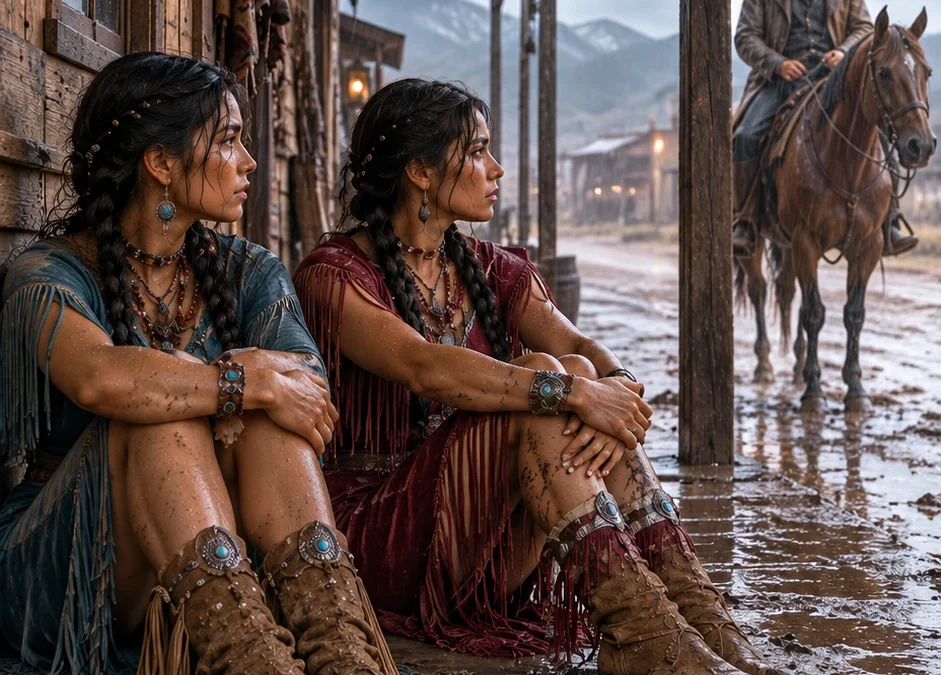
HE WAS RIDING PAST TWO APACHE BRIDES SITTING IN THE MUD 😢 THEN ONE SENTENCE FROM THE TRADING POST OWNER MADE HIM TURN HIS HORSE AROUND… AND WHAT HE PROMISED THEM COST HIM EVERYTHING HE OWNED 🌧️
Part 1
The rain had been coming since before first light, and it wasn’t the kind that cleans anything. 🌧️
It was a November rain, gray and thin and cold, the kind that gets inside your collar and stays there.
Cal Rourke rode a blue roan mare named Kuster, not his choice of name. She came with it. She picked her way carefully through the mud ruts of the Delaney road, because she’d stumbled twice already that morning and didn’t care for it any more than he did.
He was forty-nine years old. His left knee still held a piece of Comanche arrowhead against the bone, from a night in ’71 he didn’t talk about, and in wet weather it let him know it was there. His bedroll was about sixty percent dry. His saddlebag held three biscuits and a piece of hardtack he’d been carrying since Laramie.
The job he was riding toward paid forty dollars a month, pulling fence line for a rancher named Gruber north of Tres Cruces. He’d ridden two days to get there, and he was in no mood to stop.
The trading post at Delaney Crossing sat back from the road, a low adobe building with a brush ramada along one side. Smoke curled from the chimney. Four, maybe five horses stood at the rail. Warmth inside, and men arguing by a stove about nothing.
Cal was going to ride past. He wanted to be plain about that.
But something at the corner of the ramada, close against the wall and out of the worst of the drip, made him pull up. He did it before he decided to do it. Kuster stopped and put her ears forward.
Two women sat in the mud against the adobe, under the edge of the roof where it stopped most of the rain, but not all.
They were young, both of them, younger than he first thought. And they were Apache, dressed the way Apache women dress for a marriage. They had their good clothes on, in the cold mud of a November morning, outside a trading post on a lonely road. A single blanket lay between them, held together over their laps.
One of them looked up at him. Her face didn’t ask him for anything, and didn’t expect anything either. There was a cut above her left eye, days old, gone to a dark line. Her jaw was set the way jaws get set when they’ve been set that way a long time.
“You all right?”
She didn’t answer. Her eyes went back to the ground.
Cal sat there another moment.
Then he got down.
Inside, five men stood around a potbelly stove. The owner, a heavyset German named Brandt, stood behind boards laid across barrels with his arms crossed, looking like a man who’d swallowed something that disagreed with him. The room smelled of wet wool and tobacco. One of the men by the stove was Bud Teller, who ran a small spread nearby and had a reputation for doing what was easy rather than what was right.
Cal asked for coffee. Brandt poured it without looking at him.
“Those women outside. How long have they been there?”
“Since yesterday evening.”
Yesterday evening. A whole night in the rain.
“What happened to them?”
Brandt finally looked up. Small pale eyes in a big face, the eyes of a man who had made his peace with not getting involved.
“Their men brought them up from the south. Two brothers, coming to trade in Tres Cruces. They got into a card game last night with some fellows passing through.” He picked up a rag and set it down again. “Lost about everything they had. Horses. Trade goods.”
A pause.
“Then they rode on.”
“Rode on.”
“That’s what I said.”
Teller muttered, “Hell of a thing,” in the tone of a man who has already decided it isn’t his problem.
Cal set the cup down. He walked back outside into the rain and stood in front of the two women, still not sure what he was going to do.
The younger one raised her head. Round face, eyes red from cold or crying, he couldn’t tell which. She said something in Apache. The older one answered flat, two words.
“I speak some,” Cal said. “Not much.”
The older woman looked at him. When she spoke, her English was careful, every word deliberate.
“You are going to Tres Cruces.”
“North of there.”
“We have people north of there. On the Gila.”
“How far?”
“Two days. Maybe three.”
Cal stood in the rain. Kuster had her head down, water running off the end of her nose. He thought about Gruber and the forty dollars a month. He thought about the knee, the wet bedroll, the biscuits. He thought about how a man could make a very clear case, standing in that mud, for getting back on his horse and telling himself the world had more troubles than one man could answer for.
Then he thought about two women sitting through a November night in their wedding clothes.
“What’s your name?”
“Nouch.”
“I’m Cal Rourke. I’ll take you north.”
She looked at him for a long time. Not with gratitude. Not with relief. Just that same level look, reading him the way you read a piece of country you don’t know yet, figuring out where the bad ground is.
And what she said next told him exactly why she’d been sitting in that mud…
👉 Want Part 2? Find it in the comments, or drop any word below and I’ll send it to you privately! 👇
Part 2
“Your horse was pointed north,” Nouch said. “You stopped.”
That came later, at the first fire. But in that moment, outside the trading post, she said nothing at all. She simply said something to the younger woman, and both of them rose, slower than they should have had to at their age, stiff from the cold and the long hours on the ground.
Cal went back in and bought a horse from Brandt. A tired dun gelding, past his best days but sound. Twelve dollars, which was four more than the horse was worth. Brandt knew it. Cal knew it. They both left it alone.
Asella, the younger one, rode the dun. Nouch rode behind Cal on Kuster. They started north.
They didn’t talk much that first day. The rain made talking feel like effort. Nouch sat behind him with her hands resting lightly at his sides, not holding, just keeping her balance, and he could feel the cold coming off her through his coat. She weighed about what a bedroll weighs. She sat a horse like she’d been born on one.
At noon they sheltered under a limestone overhang. Cal broke up the biscuits and hardtack, and Asella added a piece of jerked venison from her blanket without being asked. When Nouch took a biscuit from him, he noticed her right hand. The knuckles were bruised in a particular way. He’d seen that bruising before. It comes from hitting something hard with a closed fist.
He didn’t ask. Not then.
That evening they reached an old scouts’ camp Cal remembered, a hollow in the pines with a rock wall breaking the wind and a clear spring coming up through the limestone. He built a real fire, not a traveling fire. Asella opened a small pack, took out needle and thread and dried herbs, and cleaned the cut above Nouch’s eye with spring water while Nouch held perfectly still, face giving nothing away.
Cal thought that was a particular kind of courage. The quiet kind. The kind that doesn’t need anyone to see it.
“You want to tell me what happened back there?”
Nouch looked at the fire. “You heard from the German.”
“I heard his version.”
“His version is close.” She was quiet a moment. “They brought us up to be sold. We were told we were being taken to marry men in Tres Cruces. There is an arrangement some men make. They pay the family and take the women north. We did not know until we were two days from home. When Asella understood, she fought. They hit her. When I said I would go back alone on foot, one of them hit me.”
“And the knuckles on your right hand?”
She looked at them. The first near-smile crossed her face. “I hit back.”
“Good.”
“Then they lost us in the card game. Like horses.”
Cal sat with that. You can be angry about a thing like that. He was. But anger spoken out loud in front of someone who lived it comes out sounding like you’re making it about yourself. So he kept it where it belonged, in the back of his throat.
“Well. You’re not horses. And we’re heading north.”
She studied him. “Why did you stop?”
“I don’t know exactly. I just stopped.”
“Most men don’t stop. The ones inside didn’t.”
“I know.”
Later, she said something that landed harder than he expected. “You are lonely.” Not unkindly. Just plain. Nobody had said that word to him in years, not because it wasn’t true, but because everyone around him was the same kind of lonely, and so nobody said it.
“I suppose I am.”
“It sits on you. Not the bad kind. Not the kind that makes a man mean. The kind that comes from living too much alone.” She pulled her blanket tighter. “Go to sleep, Cal. I will watch first.”
“You don’t need to…”
“Go to sleep.”
There was something in her voice that ended the argument before it started. So he lay down with his saddle for a pillow, the way he had ten thousand nights, listened to the fire and the wind in the pines, and for the first time in a long while, he slept like a man who wasn’t alone.
But the next afternoon, hooves came pounding up from the south, four or five riders, moving fast. And when Cal pulled the women into the scrub oak and watched them pass below, he recognized two of the faces…
👍 LIKE or COMMENT “REVEAL” to see Part 3! It will be posted once we hit enough comments! 💬
Part 3
Teller. And a tall man with a red beard who’d been standing closest to the stove. Two others Cal had never seen. They went north, fast and silent, and Cal and the women stayed hidden in the oak until the sound died, and then a while longer, because a man who means to double back and watch usually does it about three minutes after you think he’s gone.
Asella had her hand on Nouch’s arm. Nouch’s breathing had changed.
“The two white men with the Apache brothers last night. Those two.”
“You’re sure?”
“Yes.” Then, quietly: “And they know we are going to the Gila. Brandt listened to everything you said.”
Cal didn’t like what he made of that. A man who watered his whiskey and let two women sit through the night in the mud was probably not above sending word down a chain when a stranger made plans out loud in front of him.
“We’ll go east for a while. There’s another way north. Takes longer, but it stays off the main trail.”
“How much longer?”
“Half a day. Maybe more.”
“All right.”
She had the Winchester he’d handed her, held at her side in a grip that told him she’d handled one before. The hold of someone who knows the weight and doesn’t let it tire them.
“My husband taught me,” she said. “He was a good shot. He thought a woman should be able to defend herself.” A pause. “He was right.”
“He was.”
They left the trail and went east and north into rough country that cost them time and cost the horses effort. A long traverse across a mesa face of loose shale. A canyon crossing marked in Cal’s memory by a red rock formation shaped like a kneeling man. The four riders didn’t show again, but that kind of not-showing can mean they’ve gone about their business, or it can mean they’re running parallel to you in the trees. He couldn’t tell which, so he watched the country.
They reached the creek at the bottom just as the light was going. It ran fast and cold from the rain. Cal walked the horses across one at a time, talking them through the current. Then he helped Asella over on the dun, the water at her stirrups. Then he came back for Nouch.
“I can cross.”
“I know you can.”
He held out his hand anyway.
She looked at it for a moment, not a long one, just long enough to acknowledge what was being offered. Then she took it. He walked her across with the current pushing at his legs, her hand cold in his, small in the way things are small when they aren’t what you expected.
On the far bank she let go. Neither of them said anything.
That night he cut pine boughs for the ground, because the cold coming up through wet earth is the kind that gets in your bones and stays. Asella went out fast. Nouch stayed up by the fire and they talked more. She asked about the woman in Santa Fe.
“Her name was Marta. A patient woman. I was gone more than I was there, and she waited longer than she should have, and then she stopped waiting. I came back one spring and she’d married a man who ran a hardware store. She looked happy.”
“You don’t blame her.”
“No. I just couldn’t be what she needed. Never figured out how to stop moving long enough to be any good to anyone who needed something steady.”
“You have been steady for two days.”
“That’s different.”
“Is it?” She was looking at the fire. “You stopped your horse. You bought another horse. You left the job you were going to. You brought us off the main trail when the men came. You cut boughs for the ground because you saw we were cold.” She turned to him. “That is steady, Cal. You think steady means a hardware store? It does not. It means a man who does what needs doing and does not look for a reason not to.”
The fire popped. A pine cone fell somewhere in the dark.
“You don’t know me well enough to say that.”
“I have been reading people since I could walk. It is a thing you learn when you are small and need to know who is safe. I read you outside the trading post. I have been reading you for two days.” She said it simply, no sentiment. “I see a man who has not been seen in a long time. Who has done good work his whole life and had nobody to notice.”
Cal looked into the fire for a long time.
A man passing through. The polite word for invisible. A rancher sees you pull fence for a season, you ride on, and a year later he couldn’t say your name. He’d told himself for most of his life that it suited him. But there is a gap between not needing to be seen and not being seen.
“When we get to the Gila,” he said finally, “what happens?”
“I go back to my family. And then I live my life. And you?”
“I’ll find Gruber’s fence line. Or another one.”
“More moving.”
“It’s what I know.”
She looked at him, the fire caught in her eyes. “The camp where my family winters. There is room. There is work. Horses. Building. My brother’s children need someone who knows horses.” She paused. “I am not asking you to stay. I am saying there is room if a man wanted to stay. A man who knew how to be steady.”
He put another piece of pine on the fire and watched it catch and throw a shower of sparks into the dark.
“I’ve never wintered with Apache people.”
“There would be things to learn.”
“I’m not a young man.”
“I know that too.”
“Forty-nine is a long way from young.”
“Forty-nine is not dead.” The corner of her mouth moved, not quite a smile, but the geography of one. “Age is not the question.”
“What is the question?”
“Do you want to stop moving?”
Above them, the pines made their long night sound. Asella slept deeply, her face finally clear of the tightness that had been there since the trading post. Cal thought about the hardware store man in Santa Fe, standing at a counter all day measuring nails, sleeping in the same bed every night. He’d thought of him as a lesser thing for years. Now he wasn’t sure. The man had been there. Reliably, consistently there. That counted for something Cal had never properly counted.
“I think I’ve been wanting to stop for a while. I just never had a place worth stopping for.”
Nouch looked at the fire. “Now you might.”
“Yeah.” 🔥
On the third day they came down out of the rough country onto a bench above the Gila, the river flashing brown through the cottonwoods below. Teller and the Redbeard never showed again. Cal kept his eyes on their back trail anyway.
“There,” Nouch said.
A mile east, smoke curled from cooking fires among the cottonwoods. Brush shelters. A pole corral. Children saw them first, ran toward them, stopped, ran back. An older woman came out and shaded her eyes, and said something that carried on the cold air.
Then Asella was off the dun before Cal had fully stopped, and an older woman was running toward her, and they met in the middle and held each other. The woman said something over and over in Apache. Asella’s shoulders began to shake, then stilled.
Cal stayed on Kuster and let it happen without riding closer.
A man came to the edge of the corral, Nouch’s age or younger, broad-faced, with the watchfulness of a man who’d learned to read approaching things quickly. An old white scar ran from his wrist to his middle knuckle. He asked Nouch a short question in a voice with an edge, the voice of a man asking something he’s been dreading the answer to. She answered at length, calm and detailed. He looked at Cal while she talked. Not hostile. Not friendly. Measuring.
When she finished, he spoke in careful English. “You brought them from Delaney.”
“Yes.”
“Alone.”
“Just me.”
He looked at Cal’s hands, at the way he sat the horse. “I am Nouch’s brother. Dosla.”
“Cal Rourke.”
“You left a job.”
“I’ll find another one.”
“November.”
“I know the month.”
Something passed between Dosla and his sister that Cal couldn’t read. She said one short thing. He nodded once.
“There is work here through winter. I have fifteen horses that need a man who knows horses.”
Cal glanced at Nouch. She was looking at the river as though very interested in the water.
“I heard there might be.”
“You will stay.”
It wasn’t quite a question. It had the shape of something already decided.
“I’ll stay.”
Dosla made an open-palmed motion toward the camp, a gesture that needed no translation, and went back to his harness.
Cal got down. Nouch came around the front of the horse and stood close. Near enough that he could see the old cut above her eye, the set of her jaw, and the level reading look that had been there since the trading post. And now something else in it. Not quite relief, because relief implies you doubted. And she hadn’t doubted.
She put her hand flat on his chest, over his coat, over his heart.
“You stopped your horse.”
“I did.”
“I’m glad.”
That was all. She took her hand down and went to her family.
Cal stood with Kuster’s reins in his hand, the river running below, cookfire smoke rising into the clear cold air. And he thought: this is what it feels like when a thing is done right. Not loud. Not celebrated. Just quiet and solid and real, the way things feel when they’re going to last. 🌄
He spent that winter on the Gila.
There’s not a great deal to say about it day by day. The horses were good horses, a mixed bunch that needed sorting, the young ones needed starting, and three of the older ones had bad feet from rough summer ground. He worked with them every morning. Horses answer you in clear terms. A horse either trusts you or it doesn’t, and you can’t talk your way into it. You earn it with patience and consistency, and knowing when to ask and when to quit.
He helped build a better winter shelter from canyon timber, rawhide lashing, and adobe brick where the ground gave good clay. Dosla was a precise man, and they worked together without needing much language. Nouch’s aunt Cha, with a face like weathered saddle leather and eyes that missed nothing, would bring food out to where they worked without being asked, set it down, and go back inside without a word. Cal understood that this was a form of inclusion, and he accepted it the way it was offered, which was quietly.
The children attached themselves to him with the confidence of kids who have no reason to fear you, which he took as its own verdict. A three-year-old girl kept appearing at his elbow at unpredictable moments and vanishing just as suddenly, as though checking a fact she wasn’t sure of. Twin boys of about seven vanished into the cottonwoods for whole afternoons and came back with a hawk feather, a piece of quartz, and once a very confused lizard. And the oldest, a ten-year-old named Nako, stood at the corral rail every morning without being asked, watching young horses for an hour without fidgeting. Patient and hungry both. By December he was doing things with the horses that Cal would have taken two more months to reach with most men.
Asella rebuilt herself slowly. The weight came back into her face. The weariness eased out. She and Nouch spent hours working hides and weaving and talking the way women do who’ve been through something together and are sorting it out.
And Nouch had a way of appearing beside Cal near the fire in the evening without making a ceremony of it. They’d sit. They’d talk. Sometimes they didn’t. He found himself saving up anything from the day worth telling her: something Nako did with a colt, something the twins said, how the evening light hit the canyon wall.
The cold came down hard in December, and they sat closer. In January, she moved her sleeping robes next to his. She did it without announcement, the way she did most things, a plain fact presented. He didn’t say anything and she didn’t say anything, and that was the shape of it. Dosla said nothing. Cha said nothing. Nobody said anything. He suspected they had all decided something before he had.
One night in February, when the river had ice along its edges and the horses were restless, he came in from walking the picket line in the dark. Nouch was awake, sitting up. She reached out, found his hand, and held it. Not pulling him down. Not making anything of it. Just holding it until he stopped being cold.
Then she lay back down, and he lay beside her, and he slept better than he had in years. 💛
The next morning Nako said, “The roan mare will foal early. Maybe tonight.”
He was right. A dark bay colt, and Cal was there, and Nako was there, both of them in the cold and the dark, watching the colt find its legs, that ancient astonishment of a new thing learning what it is. Neither said a word. Sometimes that’s the right amount of words.
Standing there, Cal realized he had not thought once that day about fence line, or forty dollars a month, or any road going anywhere. It seemed like enough.
Spring came slow that year. By April there were seventeen horses in the herd, and Dosla agreed to let Cal take four of the best down to Tres Cruces for the market. Money for the camp, and the start of something that could work year on year.
The morning he left, Nouch stood at the edge of camp in the early light. The cottonwoods were just leafing, pale green. The river ran high with snowmelt. Birds in the willows were making their first serious noise of spring.
She looked at him with the same face she’d worn outside the trading post, that level reading look. Except now he knew what was in it, because he’d had all winter to learn it. She knew him. The whole of him. The good and the worn and the forty-nine years of it. And she wasn’t looking past any of it.
“Come back,” she said.
“You know I will.”
“I know.” She said it the way she said most things. Plain. Final. No doubt in it.
He rode south with the horses, went twenty yards, and stopped and looked back. She was still standing at the edge of camp with the cottonwoods green behind her and the morning light on her face. She raised one hand. Not a wave. Just a raise, like a fact offered up to the sky.
He raised his own in return.
Then Cal Rourke rode south, and for the first time in a long time, he knew exactly where he was going, and exactly where he was coming back to.
That’s all there is to tell.
A man stopped his horse in the rain.
Everything else came from that. 🌧️💛
This story is entirely fictional and created for entertainment purposes only. It does not represent any organization or individual, nor does it encourage inappropriate behavior. The content was generated with AI assistance.








