HE WRAPPED HIS DYING MOTHER’S BLANKET AROUND A FREEZING APACHE WOMAN. A WEEK LATER, THREE WARRIORS RODE OUT OF THE TREES AND TOLD HIM HE’D MADE A PROMISE HE COULD NEVER TAKE BACK
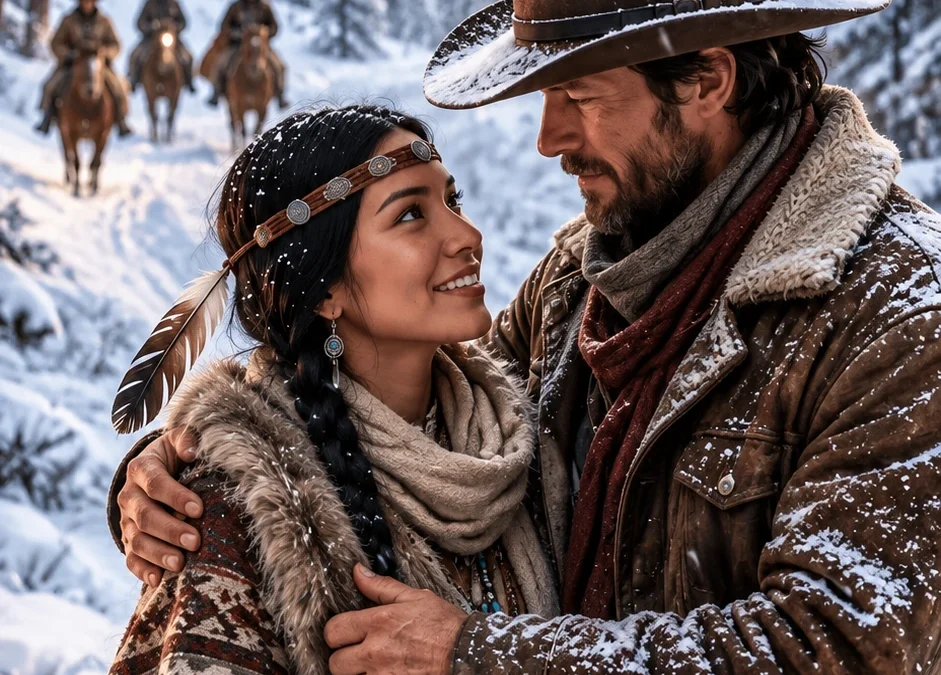
HE WRAPPED HIS DYING MOTHER’S BLANKET AROUND A FREEZING APACHE WOMAN. A WEEK LATER, THREE WARRIORS RODE OUT OF THE TREES AND TOLD HIM HE’D MADE A PROMISE HE COULD NEVER TAKE BACK 😳🔥
Part 1
Snow drove sideways across the Mogollon Rim with a fury that left a man little time even to pray. ❄️
Nate Rollins was three miles from the nearest shelter and had nearly lost the trail beneath the blowing white when he saw her.
A woman lay crumpled beneath a ponderosa pine. Her buckskin dress was soaked nearly black. Her hands were drawn tight against her chest, as though she were trying to make herself small enough for the whole world to pass her by.
Apache.
Nate knew it the moment he saw the beadwork along her sleeve.
Every tale he had ever heard in saloons came rushing back, along with every warning whispered around cattle-drive fires. Don’t help a lone Apache woman. Her people will ride down later to finish what the storm started.
He stayed in the saddle a long moment while the wind clawed through his coat.
Then he looked again at her hands. Her fingers had gone pale and blue.
He swung down.
What Nate did not know was that the blanket he pulled from his bedroll carried a meaning in that woman’s world that few frontier men had ever bothered to ask about.
It was an indigo-and-cream quilt his dying mother had stitched with her own hands. 🪡
The winter of 1881 came early to Arizona Territory. By mid-November, the high trails were buried under two feet of packed snow.
Nate was thirty-one, lean and weathered beyond his years, with the kind of quiet that settles into a man after too much time alone. He owned no ranch. He had no family waiting and no place he could honestly call home. A cattle drive gone sour had left him docked of his pay. He was riding toward a friend’s land outside Show Low mostly because his horse seemed content heading that way.
His father, Earl, had died falling from scaffolding in Prescott. His mother, Martha, followed eight months later.
Nate had been there at the end. He held her hand while she squeezed his fingers with what little strength remained. The last thing she said clearly was his name, the way someone says something they’ve meant to say a thousand times but kept putting off until there was no time left.
One week before that, she had pressed the blanket into his hands.
She had pieced it together in Tennessee over two winters, from scraps of her own dresses and Earl’s old shirts. Indigo squares on cream wool. At the center of every block, a small eight-pointed star.
“Keep it close to you,” she told him.
And he had. Every night on the trail. Beneath an overturned wagon while hail hammered the ground. He had never loaned it or traded it. It was the last thing he owned that connected him to someone who had loved him without asking anything in return.
And now he was about to wrap it around a stranger lying in the snow.
The woman woke when he crouched beside her. Her eyes opened halfway, dark and glassy. Her hand went straight to the knife at her hip.
Nate raised both hands slowly, palms open.
“I’m not going to hurt you.”
He didn’t know how much English she understood. He unrolled the waxed canvas, pulled out the blanket, and snapped it open against the wind.
He didn’t step closer. He didn’t wrap it around her. He simply held it out and let the choice be hers.
Something shifted in her face. Her hand left the knife. She did not take the blanket, not yet. Instead she turned her face slightly to one side, a small, deliberate movement that would make no sense to him until days later.
Only then did Nate step forward and settle the blanket around her shoulders.
Her whole body shuddered once. Then her eyes closed.
He got her to an abandoned line shack a mile and a half down the slope. Inside he found an iron stove and a stack of split pine. Her name, as best he could tell, was Tala. She was Chiricahua Apache. She had lost her horse in the storm and walked for hours until her legs gave out.
She told it without embarrassment and without asking for pity.
The storm held them there three full days. She showed him how to read tracks beneath fresh snow. He cleaned the cut on her arm while she watched his face instead of the wound. They traded words, and she laughed at his mangled Apache. 🔥
On the first morning, he noticed she had folded his mother’s blanket neatly and gone back to her own thin one.
On the second afternoon, she held the blanket out to him and spoke a short phrase in Apache, twice, watching his face.
“I don’t understand,” Nate said.
She folded it again and said nothing.
On the third day, the storm broke. At the valley’s edge, Tala slid down from Dusty, said his name once, and walked south into the trees.
Nate rode on and tried to forget her.
He couldn’t.
A week later, he found himself riding back toward the Rim without knowing why. That was when three Apache warriors came out of the trees.
Two flanked him. The third, a silver-templed man of about fifty, looked him over and spoke a single English word.
“Come.”
They led him four miles south to a hidden winter camp. Tala was waiting beside the largest fire.
She told him, in halting English, what the blanket had meant.
Nate went completely still.
To her people, placing your own blanket around a woman’s shoulders was not kindness.
It was a marriage vow. And there had been witnesses. 😱
📖 Part 2 is waiting in the comments! Drop any word below and I’ll send it to you privately. 👇
Part 2
It was a marriage vow. And there had been witnesses.
Nate sat beneath the weight of that truth while late sunlight stretched long and gold across the canyon wall. Somewhere behind him, a child laughed once. An adult snapped a few words, and the laughter stopped.
“The man who brought me here,” Nate said slowly. “Your father?”
Tala shook her head.
“My father’s brother. Kota.” She searched for the English. “He speaks for my family now. My father died in spring.”
Nate climbed down from Dusty. For some reason it seemed important to have both boots planted on the ground.
“What happens now?”
Tala held his gaze. Her English came carefully, every sentence costing effort.
“Kota wants to know what you meant. If you say it was a mistake, if you say you did not know and you take it back, then it will be as if the promise was never made.” She paused. “You can leave.”
Her voice stayed steady, though each word seemed to take something from her.
“But I will be left in a difficult place. Everyone will know I was promised and then left. That will make things harder for me.”
Nate said nothing.
“And if you say your intention was real, there will be a ceremony.” She said it plainly, without trying to make it easier. “I am not asking you to decide how you feel. I am only telling you what the situation is.”
Behind her, the fire cracked and settled.
Nate thought about everything he had learned about her. She had gone into the mountains alone in November. She knew which plants could heal and which could kill. She had cut her own arm in the dark and bandaged it herself. She was no woman waiting to be rescued. The storm and bad luck had simply put her on the ground, and Nate had happened to be there.
Then he thought of his mother’s voice.
Keep it close to you.
“I need to speak with him,” he said. “Can you translate?”
Kota dismounted and stopped ten paces away. It was not close enough for an easy conversation, and not far enough for the distance to be an accident.
Nate understood exactly what that space meant.
He began to speak, and Tala carried his words across, pausing whenever an idea was hard to move from one language into the other. He told Kota who had made the blanket, and why. He repeated what his mother had said before she died. He explained what it had meant to carry that blanket for three years, the last real thing he still possessed from her.
Kota watched Nate’s face the entire time. He never once looked at Tala.
When Nate finished, Kota spoke. Tala listened, then turned back to him, and her voice was quieter.
“He says this is not about whether you are a good man.” A pause. “There are many good men who are only good to their own people.”
Nate stayed still.
“He wants to know what you will do when your own people tell you that you have disgraced yourself.”
Nate had been asking himself that very question since the shack. He knew the price. He had watched other men pay it. People turning their backs. Jobs quietly handed to someone else. A man walking into town one day as a person and walking out as a warning told around other men’s tables.
The whole camp had gone silent, the kind of silence in which even the air seems to be listening.
Nate drew a breath.
“Tell him,” he said, “that my mother made that blanket for the same reason anybody makes anything with their own hands.”
Tala waited.
“Because she loved the person she was making it for.”
Kota’s eyes had not left him.
And then, slowly, the old man opened his mouth to answer. 😳
🔥 Want Part 3, the full ending, with the answer Kota gave and the secret behind the test? LIKE this post or comment “REVEAL” below! Part 3 will be posted once we have enough comments. 👇💬
Part 3
Kota spoke for a long time. His voice, which had been so distant and formal, no longer sounded quite the same.
Tala translated, and her own voice wavered slightly on the first sentence.
“He says: You speak like a man who understands that true warmth is the greatest kind of wealth.”
Nate let out a breath he hadn’t known he was holding.
Kota added something else. Tala hesitated, then looked at Nate.
“He says his sister, my mother, would have liked you.” She paused before the last sentence. “That is a great compliment.”
Only later would Nate understand what the real test had been. Over the years, Kota had asked the same question of other white men caught in misunderstandings not unlike this one. Most had immediately started listing what they were willing to sacrifice for Tala, as though she were part of a bargain and the whole matter could be measured in losses and gains.
Nate had spoken about his mother. He had spoken about warmth.
That had been the right answer. 🕊️
Nate had assumed the matter was settled. It wasn’t.
“Tala still has to give her consent,” Kota made clear, and Tala made it clear herself. She was not bound to Nate simply because he had made a promise without understanding it. The blanket had created a matter that needed resolving, but marriage was not the only way to resolve it.
She could refuse.
If she did, her name would stay clear. Nate would leave with his blanket and his good intentions, and no one would speak of it again.
She would give him her answer the next day, she said.
That night, Nate lay awake in a borrowed wikiup, listening to the wind move through the canyon, and tried to picture the road north without her. He found he couldn’t.
The next afternoon, Tala found him beside the narrow stream that ran through camp. She stood with her arms folded across her chest, wearing the careful expression he was beginning to recognize. It was not coldness. It was almost the opposite. It was the face she wore when something mattered too much to treat casually.
“I want to tell you something,” she said in English. “So you understand it clearly.”
“All right.”
“On the mountain, when you offered me the blanket, you held it out so I could take it.” She watched him. “You did not put it on me.”
Nate said nothing.
“Most men would not have done that. Most would have wrapped it around me without asking. They would have believed they were being kind.” She looked down at the water slipping between the stones. “When I saw that you were letting me choose, I understood what kind of man you were.”
She lifted her eyes.
“Not because of the blanket. Because of the way you held it.”
“That’s why you turned your face away,” Nate said softly. “On the mountain.”
“Yes.” She answered without hesitation. “It was respect for the weight of the gesture.”
Then she looked straight at him.
“I knew what it meant when you gave it to me, Nate. I am not telling you I planned any of this. I am telling you I knew.”
The creek kept moving over the rocks between them.
“You could have refused it,” he said at last.
“I could have.”
“Why didn’t you?”
She was quiet for several seconds.
Then the smallest change touched her expression.
“Because I was cold.” A breath. “And because of the way you held it.”
Nate laughed, and then found his eyes stinging, and neither of them said anything for a long while.
The ceremony was held beside the largest fire an hour before sunset. The light dropped beneath the clouds and turned the canyon walls amber. 🌅
Kota spoke the words of union. Nate understood none of them, yet he felt their rhythm in his chest, as though they had come down from a time far older than anyone standing around that fire.
Two older women brought gifts: dried venison, trade cloth, a beaded pouch, two eagle feathers gathered near the rim of the canyon.
Nate gave Kota the last twenty dollars in silver he owned, not as payment but as a gift. Kota had made it clear that bringing something of value showed a man understood family was built through effort, not simply expected. At the bottom of his saddlebags, Nate also found a small bottle of whiskey he’d been carrying since Prescott. He handed it over without explanation.
Kota accepted it with a nod that told Nate it had landed exactly where it should.
Nate had carried his mother’s blanket folded across his knees throughout the ceremony. When Kota gave him the signal, he stood and placed it once more around Tala’s shoulders.
This time he knew exactly what the gesture carried.
Tala accepted it with the same calm, careful expression he had come to know. Then the corner of her mouth softened, just slightly, and Nate remembered that almost-smile beneath the ponderosa in the storm.
Something in his chest settled into place, like a coal finally finding its bed among the ashes. 🔥
She had made something for him, too. She reached behind her belt and drew out a small buckskin amulet, beaded in red, black, and white, with a hawk worked into the pattern. Her grandmother, Sani, had taught her the design. The hawk was meant to help a person find the road back home.
She placed the cord around his neck with her own hands, steady and certain.
Nate was not sure he believed in signs. But while she fastened it, he never looked away from her face, and one thought came to him.
This is where I was headed all along.
They stayed in the canyon country through the rest of that winter, living in a wikiup near the edge of the camp. Nate split firewood, hunted, and learned to cross the land without announcing himself to everything with ears. Tala moved constantly between two languages and two ways of life, filling the gaps where his Apache failed and her English fell short.
She was a patient teacher, but not an easy one. She expected the same attention she gave. She taught him to read the canyon not by roads or fences but by shadow, by sound, by how the wind curled around stone, by how the jays changed their behavior as evening settled. She taught him the plants: white-flowered yarrow to slow bleeding, orange lichen scraped from certain rocks and boiled for a deep chest cold. She gave him each Apache name, then the nearest English word she knew, and Nate wrote both into the margins of his battered book of essays, because he trusted paper more than his own memory.
In return, he taught her cards.
It worked a little too well. Tala was beating him at the counting games sooner than he cared to admit, and she had no objection to gathering up the beans they used for wagers and regarding her winnings with quiet satisfaction. 🃏
By spring, Nate knew enough Apache to hold a real conversation. He had also learned something just as important: knowing how to speak did not mean a man should speak every time he could.
The three children who had once stopped running to stare at him were climbing over him like he was another log beside the fire. Kota softened more slowly. But by February he had begun asking Nate direct questions about the cattle trade, the territorial government, and what men around Show Low said when they believed only their own kind was listening. It was not idle curiosity. Kota was gathering information.
Nate told him what he knew, even the uncomfortable parts. Kota respected him more for it. A man who brings only easy truths is less useful than one willing to carry the hard ones, too.
The frontier never fully accepted them. In towns where men had once known Nate simply as a reliable worker, those same men found reasons to be busy when he arrived beside Tala. Some said things Nate answered with silence. Others received a different kind of answer.
But the band accepted him. The canyon country never asked for papers.
In time, they built a small adobe house in the foothills at the edge of the band’s summer country. Nate kept a garden behind it. Tala kept a store of herbs and medicines inside. The door was rarely locked.
Nate never stopped wearing the hawk amulet. Tala never stopped sleeping beneath the blanket that had once belonged to his mother.
The children they eventually raised grew up beneath two kinds of sky. One was the open, endless sky Nate’s people called the horizon. The other was the narrow blue framed between canyon walls, which Tala’s people called home. 💛
Among the Chiricahua Apache, placing your own blanket around another person meant accepting responsibility for that person’s warmth. Not for one night, not for one winter, but for as long as both lives endured. It was a promise that needed no judge, no church, no preacher. Only two people who understood what they were choosing.
Nate had not understood the meaning of the blanket on the day he offered it in the snow. But he had understood something simpler and deeper: the woman shivering beneath that ponderosa mattered more than his own comfort.
And perhaps Martha Rollins had placed that blanket in her son’s hands for reasons that reached all the way to that mountain. Perhaps keep it close had never meant holding on to it forever. Perhaps one day, keeping it close would mean knowing when to give it away.
The blanket lasted another twenty years.
When the wool finally grew too thin to patch again, Tala cut it carefully into squares and stitched them into a vest for Nate. He wore it for the rest of his life. By then, the indigo had faded to a soft gray, worn down by years of weather, sleep, travel, and use.
But the eight-pointed stars were still there, one in every square, exactly where Martha Rollins’s hands had placed them decades before. ⭐
Some people spend an entire lifetime without finding the place where they truly belong.
Nate Rollins found his in a blizzard just below the Mogollon Rim, on the day he climbed down from his horse and held the most valuable thing he owned toward a stranger with open hands.
She accepted it. And from that day forward, he never had to carry its weight alone. 🤍
If this story touched your heart, leave a like, share your thoughts in the comments, and tell us: what would you have done in Nate’s place? 💬
This story is entirely fictional and created for entertainment purposes only. It does not represent any organization or individual, nor does it encourage inappropriate behavior. The content was generated with AI assistance.








