HER AUNT LOCKED HER IN THE KITCHEN SO THE DUKE WOULDN’T SEE HER… THEN THEY CARRIED HIM IN, BLEEDING, AND ONLY SHE KNEW WHAT TO DO
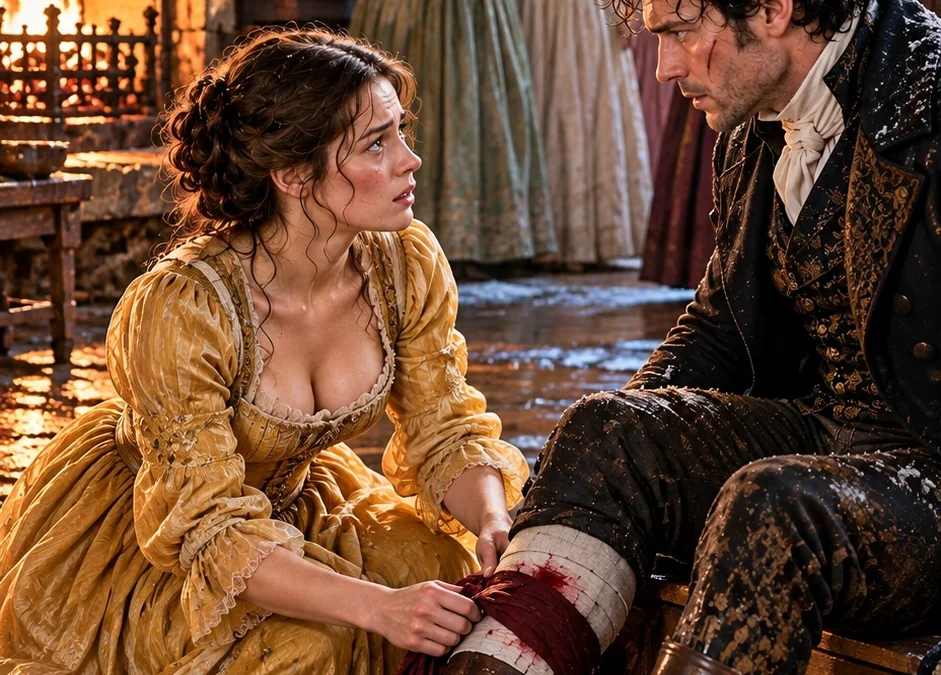
HER AUNT LOCKED HER IN THE KITCHEN SO THE DUKE WOULDN’T SEE HER… THEN THEY CARRIED HIM IN, BLEEDING, AND ONLY SHE KNEW WHAT TO DO 🔥💔😱
Part 1
When the Duke of Weston came to Trevor House to choose one of her three cousins for his wife, Emily Cotter’s aunt sent her down to the kitchen and told her not to come up again until he had gone.
“He will not want to see what we keep for charity,” Mrs. Trevor said, and locked the baize door behind her.
Emily heard the key turn. 💔
She heard her aunt’s silk go whispering back up the passage toward the candles and the music. Then she went down the stone steps because there was nowhere else to go. The kitchen was the warmest room in the house, and it smelled of wood smoke and roasting goose.
Mrs. Gammon, the cook, looked at Emily’s face and asked nothing at all. She only pushed the kettle toward her.
Emily was kneeling at the fire, the iron handle hot through her apron, when the yard door burst open.
Cold came in first. A wall of it, blue and white, with snow blowing off the step. Then two grooms and a footman, stamping and shouting, and between them a man they were half carrying and half dragging.
His head was bare. His black hair was full of snow. One of his boots was dark and wet, and not with water.
“The horse went down on the ice,” the head groom cried. “On the drive, miss. Right on the turn.”
Emily stood up with the kettle still in her hand.
“Put him there. On the settle by the fire. Mind that leg.”
Nobody in that kitchen had ever heard her give an order. They obeyed it anyway.
They lowered him onto the long oak settle by the hearth. He made no sound. His jaw was locked so hard a muscle jumped in it. There was a bright red cut across his cheekbone, and mud up the whole length of his riding coat.
It was a very good coat. Emily knew at once whose it was.
“Mrs. Gammon, more light, if you please. Every candle you have, hot water, and your sharpest knife.”
The cook was already moving. Candle after candle flared, and the copper pans over the hearth caught the light like a row of small suns.
Emily knelt on the wet flagstones at his feet. Blood was welling through the torn cloth of his breeches just below the right knee, where the stirrup iron had caught him. It ran down into the top of the boot.
“This must be bound before anything else. Hold still.”
“I had not planned,” said the man on the settle through his teeth, “to dance.”
She glanced up. His eyes were gray and very steady, and they were fixed on her.
She had no bandage. She had her mother’s shawl, the blue one, the last good thing she owned. She pulled it off her shoulders, set her teeth into the hem, and tore.
The sound was loud in the kitchen. Mrs. Gammon made a small noise. 🧵
Emily tore again, a long strip, and wound it hard around his leg and pulled it tight. He hissed. Her hair was coming down from its pins. She did not stop to push it back.
That was the moment the inner door opened.
Her aunt stood in it with the key still in her hand. Behind her stood the three cousins in their pale silk gowns, pink and primrose and blue, dressed to greet a duke. The candlelight of the passage was behind them. The snow light of the yard was in front.
And there on the kitchen flags, in a plain gray dress and a white apron with her hair falling down, knelt Emily with both hands on the Duke’s leg.
For a moment nobody breathed. Snow ticked against the high window.
“Emily,” said Mrs. Trevor, very quietly and very cold. “Get away from him.”
The Duke did not look at her aunt. He looked at Emily.
“Let her finish.”
So Emily finished.
She took the knife from Mrs. Gammon and slit the boot down its seam. The foot inside was turned out at the wrong angle. A hand’s width above the ankle the shin was already swelling, but the skin was whole. No bone had come through.
“Both bones are broken. Clean, I think. It can be set, and it should be set now, before it swells too far.”
“There is a surgeon in the town,” said her aunt from the door. “Send for him.”
“The town is six miles off, madam,” said the head groom, “and the lanes are drifted to the hedgetops.”
Emily looked up into the gray eyes.
“It will hurt. More than the fall did. I’ll be as quick as I can.”
“Then be quick.”
She put the younger groom at his knee. “Hold it steady and don’t let go for anything.” She put the head groom at his heel, both hands cupped under it. “When I say pull, you pull slow and even, straight toward me. And you don’t stop until I say. Not before my word. Do you understand?”
The groom swallowed and nodded.
“Pull.”
The Duke’s hands closed on the edge of the settle. His knuckles went white. Emily laid her palms along his shin and felt the broken ends of bone grate and shift. She watched his good leg and the bad one side by side. The length of each. The way each foot pointed.
She pressed gently, then harder.
Something settled under her fingers like a key finding its lock.
“Hold it there. Just there.”
The good foot and the mended one pointed the same way at the ceiling, the same length, the same line. She chose two flat lengths of split ash, padded them thick with the rest of her shawl, laid one on either side of the leg, and bound them with linen, firm but not cruel. Then she pinched each of his toes in turn and watched the color return, pink, into the nail.
“Warm,” she said, mostly to herself. “Good.”
Only then did she sit back on her heels and push her hair out of her eyes.
The Duke was very pale. Sweat stood on his forehead. But he was looking at her as if there were nobody else in the kitchen at all.
“Who are you?” he said.
Mrs. Trevor answered before Emily could. “She is the kitchen girl, Your Grace. She is nobody. You must forgive her boldness. Footmen, carry His Grace up to the blue bedroom at once.”
Emily got to her feet. Her apron was red to the knee. Her mother’s shawl was gone. Her aunt’s eyes rested on her for one second, and what was in them was a promise.
Emily lifted her chin.
“I am the kitchen girl, Your Grace.”
They carried him away through the inner door, and the three cousins went with him in a whisper of silk, like doves after a cart. The door shut. The key turned again. 🔒
Emily Cotter was twenty-four years old. Her father had been a country surgeon, and a good one, and when he died two winters ago he had left her a box of instruments and twenty pounds. Her mother had been Mrs. Trevor’s younger sister, and had married beneath her, and had been cut off for it.
So when Emily came to Trevor House with her box and her twenty pounds, her aunt took her in and made quite sure she would never forget it.
For six days the Duke would be their guest. On Twelfth Night, at the ball, he would choose one of the three.
Emily knelt down and began to wash his blood off the kitchen floor.
Upstairs, the blue bedroom was cold. The Duke lay in a great bed hung with faded damask, his splinted leg on a bolster, and listened to the wind try the windows.
His man had given him laudanum in a glass of brandy. The edges of the room had gone soft. The pain had not.
He had come to Trevor House because he was thirty-four years old and the last of his name. Because his mother, before she died, had made him promise to marry. Because Mrs. Trevor had written him four warm letters in one autumn, and the whole county knew what they meant, and in a weak moment in October he had written back that he would come for Twelfth Night and make his choice there.
He had given his word. He was a man who kept it. That was the whole of the trouble.
He had been ready for three daughters in three shades of silk, and a mother counting his acres behind her smile. He had not been ready for the kitchen.
He closed his eyes and saw it again. The copper pans. The heat on his face after an hour in the snow. And the woman on her knees in front of him, tearing a blue shawl with her teeth.
Nobody had ever torn anything for him before. People gave him things. They did not rip them apart.
She had not asked his leave. She had not curtsied. She had looked at him once, straight in the face, and told him it would hurt.
Nobody told a duke the truth about pain.
His right shoulder began its old slow burn. A French musket ball had gone into it on the afternoon of Waterloo, and it had never come out. The surgeons at Brussels said it lay too near the great vessels to cut for. On winter nights it woke like a coal buried in the joint. Tonight the fall had shaken it, and the coal had become a fire.
He lay and breathed through it the way he had learned.
She is the kitchen girl, the girl herself had said. But she had said it the way a soldier gives his name and rank to the enemy. Chin up. Giving nothing.
And he had seen the look on Mrs. Trevor’s face in the doorway. It was not the look of a mistress embarrassed by a bold servant.
It was the look of a woman who had hidden something, and been caught.
His valet came in with a basin and a lamp, holding out a stiff twist of blue wool, dark with dried blood. “The cook sent it, Your Grace. She said it had been round your leg. Shall I burn it?”
The Duke looked at it in the lamplight without a word.
“No. Wash it. Dry it. Give it back to me.” 💙
The surgeon from the town came through the drifts the next afternoon, frost in his whiskers. He unwound the linen. He looked at the splints of split ash and the thick blue padding. He pressed, and frowned, and pressed again.
“Whoever did this knew the work. I could not have done it better myself. May I ask who?”
There was the smallest pause.
“My Isabella,” said Mrs. Trevor, smiling. “My eldest. She sat with His Grace all night and bound it with her own hands.”
Every eye went to Isabella. She went pink to the roots of her hair. She looked at her mother, then at the carpet, and said nothing at all, which was in its way a yes.
The Duke said nothing either. He looked at Isabella’s hands, folded in front of her muslin, long and white and smooth. There was not a scratch on them. Not a mark beneath a single nail.
“Miss Trevor, I must thank you. What did you use to pad the splints? It felt like wool.”
Isabella opened her mouth.
“Flannel,” said her mother at once. “Clean flannel from the linen press.”
In the pocket of his dressing gown, his fingers closed on a strip of blue wool.
He let it lie. He smiled, and thanked Isabella again, and watched her mother’s shoulders ease. It was not the time. He had learned long ago, on worse ground than this, that the man who fires first is not always the man who wins.
Downstairs an hour later, Mrs. Trevor came through the baize door with the key in her hand. Emily was rolling pastry, flour to her elbows.
“The surgeon was very pleased with the leg. He was told that Isabella set it.”
Emily’s rolling pin stopped.
“He was told, because it is true as far as this house is concerned. If one word to the contrary is spoken in this kitchen, I shall know where it came from, and you will be on the road, Emily, with your box and your twenty pounds, in the snow.”
“And if His Grace asks for me?”
Her aunt’s eyes went over her floury arms and plain gray sleeves. “Why should he? What would he want with you?”
The key went round in the lock behind her.
Emily rolled the pastry very thin and very even, and did not cry.
But in the blue bedroom, the chimney smoked every time the east wind blew. By nightfall there was frost on the inside of the window. The Duke lay under three blankets, his shoulder burning, listening to a harp, growing colder, and quieter, and more polite.
On the third morning he sent for Mrs. Trevor.
“The surgeon told me to keep this leg warm. This chimney smokes, madam, and this room is as cold as a church. The only room in this house I have ever been truly warm in is your kitchen. I should like to be carried down to it.”
“The kitchen, Your Grace? It is not at all a fit place.”
“I have slept in a ditch in Spain.”
There was nothing she could say. He was a duke and a guest, and he had asked pleasantly.
They carried him down at ten o’clock. Emily was at the dresser with her back to the door. She heard the key. She heard the valet say, “Mind his leg.” She turned with a stack of plates in her arms and nearly dropped the lot.
The Duke looked round the kitchen as if it were the finest room in England.
“Good morning. I am told this is the warmest room in the house.”
“Your Grace should not be here.”
“My surgeon ordered it.”
“Your surgeon ordered warmth. He did not order you to sit in a scullery.”
“Is there a difference?”
“There is to my aunt.”
“Ah,” said the Duke. “Yes. I had noticed that.”
Then he said the thing that made the whole kitchen go still.
“Miss Trevor was kind enough not to contradict the surgeon. Neither did you. But you are not a kitchen girl. Kitchen girls do not know the names of the bones.”
Emily did not answer. The fire cracked.
And then Mrs. Gammon said, very loudly, to nobody at all: “Her father was Mr. Cotter, the surgeon over at Ashby, the best in three counties. Her mother was the mistress’s own sister, God rest her. And that’s all I’m saying, and I never said it.”
She turned back to her ham.
The Duke was looking at Emily, and his face had changed.
“Miss Cotter,” he said. 💙
And that night, in the blue bedroom, a forged letter was about to arrive in Emily’s hands, one that would put the sea between them, in a hand she would know anywhere…
👇 Want to know who wrote the letter, and what the Duke did when he found out? Comment “PART 2” below or drop any word and I’ll send it to you privately!
Part 2
“Miss Cotter,” he had said, and she wiped her floury hands on her apron.
“My father took me on his rounds from the time I was twelve. He had no son. I held the lamp. Then I held the basin. Then I held the leg. By the end, his hands were not steady any longer, so I did the setting and he told me where.”
“And your aunt locked you in the kitchen the day I came.”
“She did not want you to see what she keeps for charity.”
“I see,” said the Duke. And then, in a different voice: “I do see now.”
Emily turned to the fire because her face had gone hot.
“Your dressing wants changing. Will you let me?”
“I would let you do anything you liked, if you would stop calling me Your Grace in that tone of voice.”
She knelt by the settle and washed the cut below his knee. His hand came down and covered hers. It was large and warm from the fire, with a sword callus along the inside of the fingers.
Neither of them moved.
“Thank you,” he said, very low. “I never said it that night.”
“You were busy,” she said.
He laughed, a real laugh, surprised out of him, and Mrs. Gammon dropped her spoon.
Isabella was sent down at noon with a novel about a nun. She read four pages. Then Mrs. Gammon began to chop onions, a great heap of them, with a heavy knife. Isabella’s eyes began to stream.
“I am so sorry, Your Grace. The smell, I cannot bear it.”
“Then you must go up at once,” said the Duke kindly. “I would not have you suffer.”
Isabella fled. The Duke looked at the onions, then at the cook. “It was a great many onions.”
“The soup wants them, sir,” said Mrs. Gammon, and did not smile.
That afternoon, while the snow came down past the high window, he told her about Waterloo. She had not asked. She had only seen him press his left hand hard against his right shoulder when he thought no one was looking, and put down her knife, and waited.
“A musket ball. It’s still in there. They would not cut for it. I cannot hold a pen with that arm. I write with my left hand now, very badly. My mother used to say my letters looked like a hen had walked through the ink.”
“Then you had better not write me any.”
“I shall write you a great many. And you will have to read every one.”
She brought him a bowl of apples and a small knife because he was restless, and he peeled them left-handed in thick, lumpy curls while she made the pastry. She told him about her father’s rounds in the snow. He told her about the mud in Spain.
It was the happiest afternoon Emily had spent in two years. She knew it while it was happening. That was the strange part.
On the fourth evening, just before the footman came to carry him up, he leaned forward and brushed a streak of flour from her cheek with his thumb.
It lasted less than a second. But the inner door stood open a crack, and Maria, the youngest cousin, nineteen, who had come down for her mother’s shawl, stood in the dark passage and saw it.
She did not come in. She picked up her skirts and ran. 😱
Mrs. Trevor came below stairs herself at eleven that night. The fire was banked. One tallow candle burned on the long table, and Emily sat beside it, darning a stocking.
Her aunt’s face, in the candlelight, looked carved out of tallow itself. She held a folded paper.
“Maria tells me His Grace touched your face.”
“He brushed flour off my cheek. Aunt, that is all.”
“Two days before he chooses a wife from this house.” Mrs. Trevor laid the paper on the table. “It seems His Grace agrees with me. He has written to you. He gave it to me this evening to pass to you privately. Read it.”
On the outside, in a fine and even hand, was written Miss Cotter.
Something slid out when she unfolded it and fell with a soft clink. A little packet of coins.
Madam, I am obliged to you for your services at my accident, which were well meant. I would not wish you to form any expectations from my late kindness, which I fear has been encouraged. A post has been found for you through my agent as companion to an invalid lady at Cork, in Ireland. You will oblige me by taking it. The carrier leaves at first light. I enclose £20 for your trouble. Weston.
Emily read it twice. The words did not change.
Well meant. Twenty pounds for your trouble.
Twenty pounds. The whole of what her father had left her in the world. That was what the Duke thought she was worth.
Her hands, which were always steady, lay on the table and would not move.
“He is very generous,” said her aunt softly. “Most men would simply have had you turned off. You will go at first light. You will not take leave of anyone. You will not embarrass His Grace, or my daughters, or me, with a scene.”
The key turned behind her.
Emily sat until the candle burned to a stub. Then she went up to her attic room and packed. Two gray dresses. Her Sunday bonnet. Her father’s surgical box with its worn brass corners. Her mother’s prayer book.
The blue shawl was gone. She had torn it for him. 💔
She was buckling the strap of the box when somebody scratched at her door. It was the Duke’s valet, in his shirt sleeves, with a candle, his face gray.
“Miss Cotter, forgive me. It is His Grace. The old wound has come on him bad tonight with the cold and the fall. Worse than I have seen since Brussels. And he is burning hot. He won’t let me send for anyone from the family. He wouldn’t ask for you, miss. But you’re the only one in this house who knows what to do.”
Emily looked at the strap in her hands.
He had written her a note. He had sent her twenty pounds. He was sending her across the sea.
And he was in pain.
Her father had gone out on winter nights to men who owed him money, and to men who had insulted him, and to one man who had once set a dog on him. He had gone because they were in pain. That was the whole of what he had taught her.
She stood up.
“Hot water, as hot as the kettle will give it. Flannel. And fetch me the willow bark from the still room. The brown jar on the second shelf.”
The blue bedroom was bitter, the fire sunk to a sullen glow. The Duke lay against the pillows, hair dark with sweat, his face turned toward the wall.
“I told you no one.”
“It isn’t your man,” said Emily.
He turned his head. His eyes were too bright. “You.”
“Me. Lie still.”
She built up the fire and opened the flue, and the smoke began at last to draw. She wrung flannel out in water so hot it scalded her fingers and laid it over the old wound, pressing down with both palms.
“Breathe. Let it go loose under my hands.”
She made him drink the willow bark, bitter as it was, her arm behind his neck. He drank the whole cup and made a face like a boy.
“That is the vilest thing I have ever tasted.”
“Good. It’s working.”
Somewhere past two in the morning, she felt the knot of the muscle loosen under her hands like a fist opening. The fever sweat broke. His left hand found hers on the quilt and held it.
“Stay.”
She did not pull away. She told herself it was because he was feverish.
“When they carried me through that door, I thought I had died. I thought I had been taken somewhere warm.” His thumb moved once across her knuckles. “You are the only warm thing in this house, Emily. Do you know that?”
It was the first time he had said her name.
For one moment she let herself sit there with her hand in his, and pretend he had not written the note in her pocket.
Then she drew her hand back.
“You have a wife to choose the day after tomorrow. From three young ladies in silk.”
“I know what I would choose, if I were let.”
“Don’t.” Her voice shook for the first time. “I have been my aunt’s charity for two years. I will not be yours as well. Not by you.”
He seemed about to speak. Then his eyes went heavy with the laudanum and the long night, and closed.
She sat beside him until the window turned from black to gray. Then she laid the last warm flannel on his shoulder, drew the quilt up, and went out without a sound.
At first light, in her gray dress and Sunday bonnet, with her father’s box on her knees, Emily Cotter rode away from Trevor House on the carrier’s cart through the falling snow.
Nobody came to the door to see her go. 💔
When the Duke woke at nine, the chair beside the bed was empty.
And at breakfast, when Mrs. Trevor smiled across the teapot and said, “She asked me to thank you, I think, for the money,” the Duke went very still.
“What money, madam?”
👇 Part 3 holds the ending that will melt your heart: the forged letter, the ballroom, and the moment the whole county watched a duke choose. LIKE this post or comment “REVEAL” and Part 3 will be posted once we hit enough comments! 🔥
Part 3
“What money, madam?”
The smallest flicker crossed Mrs. Trevor’s face. It was gone at once.
“A little present from the household, Your Grace. For her trouble. It is nothing. Do try the ham.”
He did not try the ham. He sat and looked at her across the teapot until the silence in the breakfast room became unbearable and Maria dropped her spoon.
Then he asked to be carried below.
Mrs. Gammon was at the range, her eyes red. She did not curtsy. She banged the kettle on the hob.
“Where has she gone?”
“Ireland, they say, sir.”
“Did she want to go?”
The cook turned round. Her big face was working. “Want to? She sat at that table at midnight with a letter in her hand, white as that wall. A letter the mistress gave her. From you, the mistress said, with money in it. Twenty pounds.” Her voice shook. “I’ve kept this kitchen eleven years, and I’ll not keep quiet. That girl set your leg on my floor, and sat up all night with you after, and went out of this house like a dog that’s been kicked.”
The Duke’s face did not change. But his left hand closed on the arm of the carrying chair until the wood creaked.
“I wrote her no letter. I have written no letter to anyone since I came into this house.”
Within the hour, two riders had gone out on the fastest horses in the Trevor stable to ride the turnpike toward Liverpool and stop every coach on it.
And the Duke sat by her hearth with his useless leg on a stool and could not follow. He took the blue strip of wool from his pocket. It was clean now and soft, a little frayed where her teeth had torn it. It still smelled faintly of wood smoke.
He wound it round his fingers and unwound it and wound it again. He had fought at Waterloo. He had lain a whole night in the mud with a musket ball in his shoulder and a dead horse across his legs.
He had never felt so helpless as he did now, by this fire, with this scrap of blue in his hand. 💙
The carrier’s cart was slow in the snow. It was dusk before it set Emily down at the coaching inn at the crossroads. The Liverpool coach did not run until morning. The landlady gave her a small cold room under the eaves, with a rush candle and a jug of water with a skin of ice on it.
Emily sat on the narrow bed in her bonnet and cloak and took out the note. She did not know why. She knew every word of it.
Obliged for your services. Well meant. For your trouble. Weston.
She looked at the signature. It was written in a fine, even, sloping hand. The capital W had a small looped flourish at the start of it, like a curl of ribbon.
She looked at it for a long time.
Then she remembered an afternoon at the hearth, and a man peeling apples badly with his left hand.
I write with my left hand now. Very badly. A hen walking through the ink.
This was not a hen’s hand. This was a practiced hand, with a looped W.
She knew that W. She had seen it every week for two years on every list sent down to the kitchen. Four pounds of loaf sugar. Six wax candles for the drawing room. One pound of tallow, and see it lasts. Every list, every order, every cold little note, in that same fine, sloping, looping hand.
Her aunt’s hand.
Emily sat very still. He had not written it. He had never written it. He had not sent her away. He had not paid her off like a servant. He had fallen asleep holding her hand.
And her aunt had forged his name to put the sea between them. 😱
Something rose in her that she had not felt in two years. It was not tears. It was hotter than tears.
She did not want rescuing. She had never wanted it. But she would not be sent away with a lie in her pocket either. Not by her aunt. Not in his name.
The carrier was going back the same road in the morning. She had one shilling of her own, apart from the twenty pounds. The twenty pounds she would not touch.
She would go back. Not to beg. To put the money on her aunt’s table and say what it was.
Emily blew out the candle and lay down in her cloak, and for the first time in two years, she slept without dreaming.
The two riders came back to Trevor House at noon on Twelfth Night, their horses lathered and frost in their beards. They had found nothing on the turnpike. The landlady at the crossroads said a young woman in a gray bonnet had slept under her eaves and gone off again at first light with her box. The riders drew the obvious conclusion.
“She’ll be on the road to the packet by now, Your Grace,” said the head groom miserably.
The Duke thanked them and sent them to get warm. Then he sat a long while by the kitchen fire, the blue strip of wool wound around his left hand.
At last he sent his valet upstairs for a letter he had kept since the autumn. The first of Mrs. Trevor’s four warm letters of invitation. He unfolded it on his knee and read the signature.
He had never seen the note she carried away. He did not need to.
He folded the letter and put it inside his coat.
“Tell Mrs. Trevor,” he said to the valet, “that I shall come down to the ball tonight after all, and make my choice there, as I promised.”
Mrs. Trevor received the message in her dressing room and was seen to smile.
Emily rode back on the carrier’s cart through the white lanes. The snow had stopped. The sky was the hard pale blue of a winter afternoon, and the fields shone so bright they hurt her eyes. The carrier set her down at the lodge gates as the light began to go.
She walked up the drive on foot. At the turn, under the old beech, she saw the place where the horse had gone down. The ice was scored in long raw scratches, and there was still a dark stain under the new snow. She stood and looked at it.
Then she walked on.
Every window of Trevor House was blazing. She could hear the fiddlers through the glass. She did not go to the front door. She went round by the yard, the way they had carried him, and through the kitchen door into the warmth and the roar of the great hearth.
Mrs. Gammon looked up from the range and dropped a whole tray of tartlets.
“Miss Emily! Oh, my dear. Oh, thank God.” The cook came at her with both arms out, floury to the elbow. “He knows, miss. He knows it wasn’t him. He’s sat by that fire all day like a man at a graveside.”
Emily took off her bonnet. Her hair was coming down again. She did not stop to pin it.
“Is the baize door locked?”
Mrs. Gammon looked at her. Then slowly the cook reached into her apron pocket and drew out a heavy iron key.
“The mistress forgot she gave me this the night he fell. I kept it.” 🗝️
The ballroom at Trevor House was a blaze of wax candles. They burned in the chandeliers and the sconces and great branched silver on the side tables, and the whole room smelled of beeswax and hothouse lilies and warm silk. The county was there, the squire and his lady, the vicar, two baronets, a dozen young men in tight coats, and every mother in ten miles with a daughter to show.
The Duke sat in a great carved chair by the fire with his splinted leg on a velvet stool, in black evening dress and a white cravat. He was very pale. He was not dancing, and nobody expected him to. Everybody was looking at him anyway.
Mrs. Trevor stood at his elbow in plum satin and her best garnets. At the end of the second dance she clapped her hands, and the fiddlers stopped.
“Your Grace. My daughters.”
They came forward one by one and curtsied before his chair. Isabella in white satin with pearls. Clarissa in rose. Maria in pale blue, with a wreath of silk flowers. The county watched with its breath held.
“Your Grace promised us a choice tonight. I think we have all waited long enough.”
The Duke opened his mouth to answer.
And at the far end of the ballroom, the baize door to the servants’ stair swung open.
Every head turned.
Emily Cotter stood in the doorway. She wore her plain gray dress, damp to the knee with snow. Her hair was falling from its pins. There was no shawl on her shoulders. In one hand she held a folded paper, and in the other a small packet of coins.
Nobody moved.
She walked down the length of the ballroom between the silk and the satin and the staring faces, and her wet hem left a dark trail on the polished floor. She did not look to the right or the left. She walked straight to the table beside the Duke’s chair and laid the paper and the coins on the white cloth in front of her aunt.
“Aunt.” Her voice was clear and carried to every corner of the room. “You gave me this note two nights ago in the kitchen. You told me His Grace had written it. It sent me to a post in Ireland and paid me twenty pounds for my trouble.”
She looked her aunt full in the face.
“I have brought back the twenty pounds. It was never his to give. And he never wrote a word of it.” 🔥
Mrs. Trevor had gone the color of the candles.
“Footman. Take this girl out. She is not well. She is raving.”
“No one,” said the Duke, “will lay a hand on her.”
He did not raise his voice. He did not need to. The footman stopped where he stood.
“A pen. And ink, if someone would be so kind.”
The vicar brought them with trembling hands. The Duke took the pen in his left hand. He turned the forged note face down on the cloth and wrote on the back of it, slowly, in front of them all. The pen scratched and spluttered. A blot fell. When he held the paper up to the candles, the letters staggered across it like drunken men.
Emily Cotter set my leg.
“That is my hand. The only one I have had since Waterloo. Any man in this room who has had a letter from me will tell you so.”
He turned the paper over.
“And this is not.”
Then he drew the folded letter from inside his coat and laid it open beside the note.
“This came to me in the autumn, madam. It invited me to your house. It is signed by you.” He touched the two signatures, one after the other, with one finger. “The same fine hand. The same slope. The same little loop on the W. You wrote my name the way you write your own.”
The squire leaned in to look. So did his lady. So did the vicar. The room had gone so quiet that the fire could be heard settling in the grate.
Mrs. Trevor drew herself up. “She is my sister’s mistake,” she said, and her voice cracked across the silence like a whip. “A country surgeon’s daughter. I took her in out of charity when no one else would have her, and this is how she…”
“You locked her in your kitchen on the day I came,” said the Duke. “So that I should not see her. You told the surgeon, your household, and me that your daughter set my leg, when your daughter has never touched a wound in her life. And when that was not enough, you wrote my name to a lie, put twenty pounds in it, and sent her out in the snow toward the sea.”
He looked at her steadily.
“I have stood in front of French guns, madam. I have not often seen anything as cold as you.”
Isabella had begun to cry very quietly into her white gloves.
Mrs. Trevor turned on her niece. Her mouth opened, but Emily spoke first.
“You told me, Aunt, that he would not want to see what you keep for charity.” Her voice did not shake at all. “He saw. And you need not keep me any longer.”
Nobody spoke.
Mrs. Trevor stood among her garnets with her mouth still open, and not one word came out of it. The squire’s lady drew her skirts aside.
After a moment, without a sound, Mrs. Trevor turned and walked out of her own ballroom, and nobody followed her. 🕯️
The Duke pushed himself up out of the carved chair.
It was a foolish thing to do. Emily saw the splint shift and his face go white, and she was at his side before she knew she had moved.
“Sit down. Sit down this instant. You’ll undo everything.”
“I will not propose to you sitting down.”
“Then you will propose to me with a crooked leg for the rest of your life.”
He sat.
She knelt at once on the ballroom floor in her damp gray dress, in front of the whole county, and began to retie the loosened linen round the splint, quickly and firmly, the way she had on the kitchen flags five days before. Her hair fell forward. The three cousins in their silk stood behind her and stared.
The Duke leaned down to her.
“I came to this house to choose a wife from it. I gave my word. I choose the one you hid in the kitchen.”
Emily’s hands went still on the linen.
He reached into his pocket. When he opened his hand, the strip of her mother’s blue shawl lay across his palm, clean and soft and frayed at one end.
“I have kept it every day. Marry me, Emily. Tell me when to pull, and I will pull. And I shall never go near another icy drive as long as I live, unless you are at the bottom of it.”
She looked up at him. For a moment she could not speak at all.
“Then you had better stop falling off horses,” she said at last. “Once was quite enough.”
“Is that a yes?”
“It is a yes.”
He took her face gently between his hands there in the candlelight and kissed her forehead. And then, because the county was watching and he did not care in the least, her mouth. 💙
Somewhere at the back of the room, Mrs. Gammon, who had crept up the kitchen stairs to watch through the baize door, burst loudly into tears.
They were married at the end of February in the little church at Ashby, where her father lay, with snowdrops out in the churchyard. The Duke walked up the aisle with a stick. He would always walk with a slight hitch in his step after that winter, and he never once complained of it.
The musket ball stayed in his shoulder. But on cold nights now, there was someone to warm the flannel.
A year later, on Twelfth Night, the snow came down again, thick and soft, over the Duke’s own house in the north. The Duchess of Weston was not in her drawing room. She was in her kitchen, as she often was, sitting by the great open hearth with her feet on the fender and her hands folded over the new roundness under her apron.
Her father’s instrument box stood on the dresser. A strip of blue wool was tied around its handle.
The yard door opened and let in a gust of cold and snow. Her husband came in stamping, snow in his black hair and on the shoulders of his coat, his stick under his arm.
“You’re wet through,” she said.
“I came the long way round, past the stables, so I could come in by this door.”
He crossed the flags only a little unevenly, bent, and kissed her.
“It is the warmest door in the house.”
He sat down beside her on the old oak settle. She took his cold left hand in both of hers and held it to the fire until it warmed.
And that is how the cook found them an hour later. The Duke and his Duchess, side by side by the kitchen fire, her head on his good shoulder, both of them fast asleep. 🔥💙
THE END
This story is entirely fictional and created for entertainment purposes only. It does not represent any organization or individual, nor does it encourage inappropriate behavior. The content was generated with AI assistance.








