Her Dying Mother Left Her Nothing But An Old Cookhouse — Then She Found A Hidden Letter That Exposed A Family Lie Nobody Dared Speak Aloud
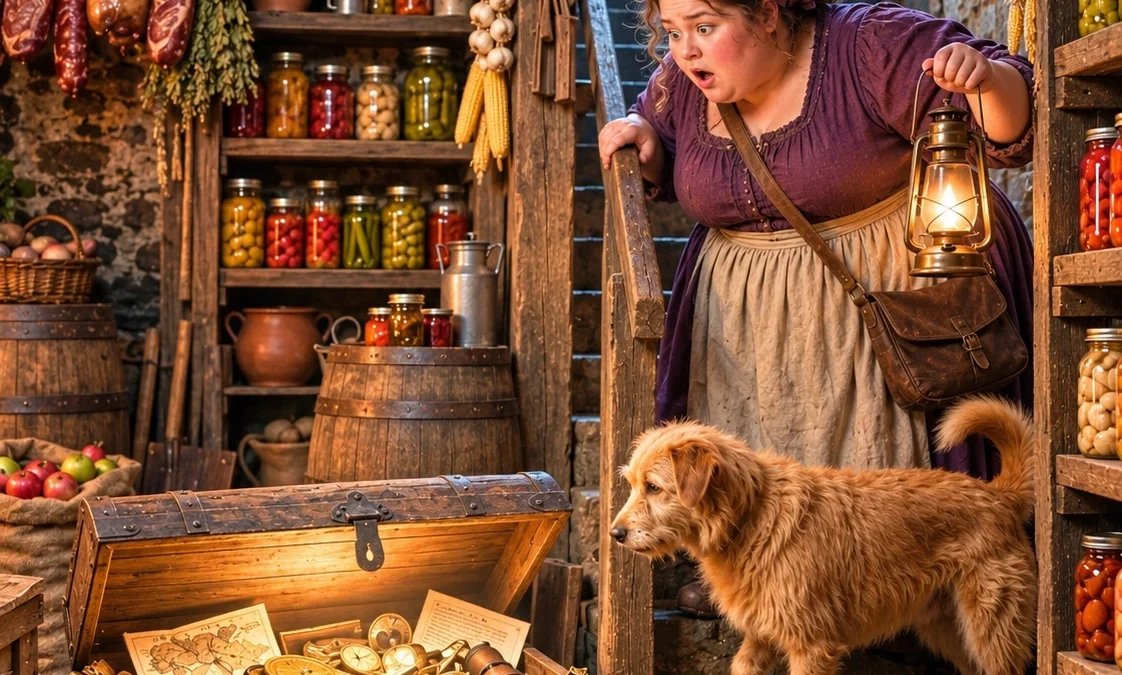
Her Dying Mother Left Her Nothing But An Old Cookhouse — Then She Found A Hidden Letter That Exposed A Family Lie Nobody Dared Speak Aloud 😱
Part 1
The wind bit hard across the Wyoming prairie, sweeping snow dust against the weathered planks of the cookhouse.
Evelyn Whitaker stood in the doorway, hands folded tight, watching her sister Eleanor ride away.
For weeks, they had barely spoken — not since their mother Clara died, not since the will was read, and not since the banker Silas Crowley had come calling with a look that said he already owned the place.
Everyone in Mil Haven whispered about it.
A young woman alone, no husband, no cattle, no fortune — holding land Crowley was determined to claim.
Evelyn knew he’d found something underground: a hidden water source, precious beyond measure in this dry country.
That was why he wanted the cookhouse so badly.
That was why he’d offered her a sum so large it would have seemed a fortune to anyone else.
But Evelyn said no.
And as she stood there, she turned to Eleanor — the sister who had always seemed so distant, so poised, so guarded — and asked the question that had burned in her chest for months.
Eleanor’s hands went perfectly still.
For a long moment, she said nothing at all.
Then her voice broke, raw and quiet, like a wound finally opened.
“Three months before she died… she made me promise.
Whatever happened when the estate was divided, I was to make sure you got this building.
She said you were the one who would figure it out.
She didn’t tell me why.
Only that I had to keep my word.
”
Evelyn felt the ground shift beneath her.
Her mother hadn’t left the cookhouse to her by chance — she’d arranged it.
She’d trusted Eleanor to protect it, and trusted Evelyn to understand what it was truly for.
Days later, Crowley arrived.
He brought Fletcher Cole, a broad-shouldered man who filled the doorway like a threat made solid.
He wasted no time.
“You’re a young woman alone, Miss Whitaker,” Crowley said, voice smooth as cold steel.
“No lawyer, no family backing you, winter coming.
Be reasonable.
Sell now, and I’ll be generous.
”
Evelyn didn’t flinch.
“I know about your water survey.
I know what’s under this ground.
And I know you’re not nearly as sure of your position as you pretend to be.
Make me a real offer — or leave.
”
Crowley stared at her, his smile fading.
He saw it then: she wasn’t the soft target he’d expected.
“You have no idea what you’re standing in the middle of,” he warned.
“I know exactly,” Evelyn replied.
“My mother built it.
”
He left — but not before his eyes hardened with something dangerous.
She’d called his bluff, and now he would move faster.
Evelyn found Caleb Dawson out by the north wall, hammer in hand, repairing timbers.
He’d shown up weeks earlier, quiet and steady, and stayed to help without being asked.
When she told him everything — Crowley’s threat, the water, the hidden promise — he set his hammer down at once.
“You need a lawyer,” he said simply.
“Gideon Marsh in Laram.
He’s straight.
I’ll ride there at first light.
”
“You’ve done enough already,” Evelyn protested.
“You owe me nothing.
”
Caleb looked at her, and his gaze was steady, unhurried, sincere.
“I’ve eaten your bread and your stew.
I’ve seen what you carry here — the women who come quietly, the help you give when no one else will.
I’d like to stand beside you, if you’ll let me.
”
Evelyn’s throat tightened.
For so long, she had stood alone.
“It’s agreeable,” she whispered.
But Crowley struck before Caleb returned.
Hartley, a quiet man who bought bread each week, stopped coming.
Then others.
Word spread fast: those who stood with Evelyn would find themselves on Crowley’s wrong side.
He filed a complaint with the county — claiming she wasn’t using the land “productively,” that a single woman running a kitchen didn’t count.
If he won, the property would be sold, and he would be first in line to buy it.
Evelyn sat at her table late into the night, her mother’s journal open before her.
On its pages were names — fourteen women Clara had helped over the years.
“Someone has to do something,” her mother had written.
Evelyn picked up her pen and began to copy them into a new ledger — her hand beside her mother’s.
This wasn’t just a kitchen.
It was a refuge.
And she would not let it be erased.
Then Eleanor walked in.
Her hair was slightly unkempt, her coat buttoned crookedly — small things, but shocking on the sister who was always perfect.
She sat, hands flat on the table, and breathed out hard.
“Papa knew,” she said, and the words hung heavy in the air.
“He knew what Mama was doing here.
He never said anything… but he knew.
And there’s something else.
Crowley didn’t just ask for this land after Papa died.
He loaned Papa money months before — with a clause.
If the property ever changed hands, Crowley got to buy it first.
At whatever price he set.
”
Evelyn froze.
Her father had signed it — without understanding what it truly meant.
Crowley had been planning this for years.
“Worst of all,” Eleanor whispered, eyes bright with unshed tears, “he has a letter.
Signed by Mama — saying she agreed to it.
Saying it was fair.
”
Evelyn’s blood ran cold.
Her mother would never… but if the letter existed, signed and dated, Crowley could take everything.
Part 2
“Mama would never sign something like that,” Evelyn said, her voice steady even as her heart raced.
“She would never give this place away.
”
Gideon Marsh arrived at dawn two days later, satchel in hand and face grim.
He laid the letter flat on the table.
It looked real — the signature, the looping handwriting, the date September 1882, when Clara had still been well enough to write clearly.
“Crowley’s lawyer will say this settles everything,” Gideon said quietly.
“If the court accepts it as genuine, the land is his.
”
Evelyn leaned in close, studying every stroke.
Then she saw it — small, easy to miss, but unmistakable to anyone who had read her mother’s words a thousand times.
“The J,” she breathed.
“Look at the J in ‘fair.
’ Mama always curved her Js to the left.
Always.
This one curves to the right.
”
Gideon leaned in, his eyes narrowing.
“That’s not the only difference,” he said slowly.
“The ink pressure, the way letters connect… this was copied.
It’s a forgery.
”
A forgery.
Crowley had faked her mother’s signature to steal what she’d spent years building.
But proving it would take time — time Crowley meant to steal from them.
The hearing came fast.
The courtroom was half-filled with people who owed Crowley favors, or feared him, or simply watched to see which way the wind blew.
Fletcher Cole stood at the back, arms crossed, eyes fixed on Evelyn like a hunter marking prey.
Crowley’s lawyer spoke smoothly, confidently, holding up the letter as proof.
“Clara Whitaker herself agreed,” he told the judge.
“This is not a dispute — it is a settled matter.
”
Gideon stood.
“That document is not genuine.
And even if it were — this property is not just land.
It is a community refuge.
Under territorial law, establishments that serve the vulnerable are protected.
It is written into the statute of 1875.
”
A murmur rippled through the room.
Crowley’s lawyer scoffed.
“An unregistered, secret shelter? That is not a community service — that is a nuisance.
If it operates in the shadows, it cannot claim protection.
”
Then Reverend Aldrich took the stand.
The room went quiet.
He was a man everyone respected — and no one had expected him to speak up.
“I knew Mrs.
Whitaker’s work,” he said clearly.
“She came to me years ago, asking if the church could help women in need.
When I told her we could not do so openly, she did it herself.
And I sent people to her.
I knew.
I did not stop her.
I would not stop her.
”
Crowley’s lawyer attacked.
“You admit you helped an unregistered operation? That makes you part of it — not a witness for it.
”
“I admit I helped women who had nowhere else to go,” Aldrich replied steady.
“I would do it again.
”
The judge paused, considering.
Then he turned to the letter.
“We will hold this document for handwriting analysis.
Ruling is postponed until Friday.
”
It was not a victory — not yet.
But they had bought time.
Then Eleanor was called as a witness.
Evelyn held her breath.
Her sister walked to the stand slowly, every movement deliberate, every line of her face unreadable.
Crowley’s lawyer smiled — he had summoned her, and he expected her to tear Evelyn’s work apart.
“Mrs.
Holt,” he said smoothly.
“You are one of the heirs.
Tell the court — does your family support this… unusual activity?”
Eleanor took a breath.
She did not look at the lawyer.
She looked straight at the judge.
“My husband was offered a loan,” she said clearly, her voice carrying across the silent room.
“Favorable terms.
If he would support Mr.
Crowley’s claim to this land.
He told me two weeks ago — he thought I would agree.
”
The room shifted.
Crowley sat very still.
“I did not agree,” Eleanor continued.
“And I have something to say about the letter.
I know my mother’s handwriting as well as anyone.
Her Js curved left.
Every single one.
In that letter, not a single J curves left.
”
She turned then, and looked right at Crowley — and for the first time, Evelyn saw tears glistening in her eyes.
“You forged it,” she said.
“You faked her signature to take what she spent her life building.
”
Part 3
The courtroom erupted.
Crowley stood, face flushed, but the judge banged his gavel hard.
“Order! The witness will be heard.
We will await the handwriting examiner’s report — and until then, that letter remains under review.
Court is adjourned.
”
Outside on the steps, Crowley found Evelyn alone.
He had dropped the polite mask entirely.
“Your mother refused to sell to me,” he said, voice low and tight.
“I asked her myself.
She knew what was under the ground — and she told me she had plans that didn’t involve me.
I waited three years.
I did what I had to do.
”
“You forged her signature,” Evelyn said, quiet and cold.
“You tried to steal from a dead woman.
”
He didn’t deny it.
“You look just like her,” he said, and there was no admiration in it — only calculation.
“Just as stubborn.
”
He walked away, and Evelyn stood trembling — not from fear, but from the sheer weight of it all.
Caleb stepped up beside her, close and steady.
“You all right?”
“I will be,” she said.
“Now we finish this.
”
Friday came.
The examiner’s report was unequivocal: twelve points of difference between the letter and Clara’s real handwriting.
It was a forgery — deliberate, calculated, criminal.
“The promissory note stands as a debt between your father and Mr.
Crowley,” Gideon explained, “but the fraudulent document means he cannot force a sale.
And now — we proceed to the merits hearing.
”
The full hearing lasted barely forty minutes.
Gideon laid out everything: the 1875 statute, the letter Clara had filed with the county describing her work as “charitable community service,” the ledger of names in two hands, Reverend Aldrich’s testimony, and the bread sales that proved the cookhouse was open and known.
Judge Foss read through the papers slowly, then looked up.
“The productive use challenge is denied.
The property qualifies as a Community Welfare Establishment under territorial law.
It remains in Evelyn Whitaker’s possession.
”
It was done.
Hartley was waiting outside the cookhouse when Evelyn returned, hat in hands, looking ashamed.
“Cole told me if I kept coming here, he’d call my loan in,” he said quietly.
“I told myself I was being practical… but it wasn’t practical.
It was cowardly.
I’m sorry.
”
Evelyn touched his arm gently.
“Come in.
The coffee’s on.
”
More followed.
Mrs.
Kavanaugh arrived with her daughter Catherine, who had nowhere to turn two years earlier and had never known help was there.
“I want to help,” Catherine said.
“I can write letters — tell other women there’s a place.
”
Then came a letter from Joanna Peller — the very first name in Clara’s ledger.
She was working in Casper, paying her own rent, and had heard what was happening.
“I want to do for someone else what your mother did for me,” she wrote.
“Tell me what to do.
”
Clara hadn’t just built a refuge — she had started a movement.
Women came forward with food, with time, with stories of who they were and what they could give.
Margaret, Evelyn’s middle sister, arrived without her notebook — the one she’d always hidden behind — and said, “I know every family within twenty miles.
I know who needs help.
” Eleanor stepped forward too.
“I can manage the accounts.
And I know which doors to knock on — and which to close.
”
Gerald, Eleanor’s husband, came too — awkward, sincere, trying to make amends.
“I know a carpenter,” he said.
“He can build the new room — the shelter wing — at a fair price.
”
One evening, as the sun dipped low, Caleb sat across from Evelyn at the table.
He held his coffee cup, and his gaze was steady.
“I’ve been running since Sarah died,” he said — speaking of his late wife.
“Moving from place to place so I wouldn’t have to feel the loss.
This is the first place in four years I haven’t wanted to leave before dawn.
”
He reached into his jacket and set a small wooden box on the table.
“This was Sarah’s grandmother’s ring,” he said softly.
“Sarah would have said give it to someone worth it.
I think she’d have liked you.
I know you’re not looking for someone to take care of you — you’ve been doing that all your life.
But I want to stand beside you.
Whatever you build, I want to help build it.
”
Evelyn opened the box.
The ring was simple silver, set with a pale stone the color of a winter sky — practical, unpretentious, beautiful.
“You’re the only person who has ever looked at what I do instead of who they think I am,” she said, her voice thick.
“You’ve seen it all — and you’ve stayed.
”
She held out her hand.
“Yes, Caleb.
It’s agreeable.
”
He slipped the ring onto her finger, and it fit perfectly.
By spring, the new wing stood ready — a real shelter, with private rooms and a separate entrance, so women could come and go unseen.
Catherine painted a sign: Whitaker Cookhouse — All Welcome.
It hung above the door.
Silas Crowley faced investigation and eventual conviction for fraud.
Fletcher Cole left the territory.
The water rights Evelyn had fought so hard to protect? They belonged to her — and she used the revenue to keep the doors open, to feed the hungry, to give women hope.
The wedding was held in the cookhouse, surrounded by everyone who had become family.
Eleanor cried and pretended she wasn’t.
Margaret gave them cast-iron pans — “practical,” she said, though her eyes glistened.
Hartley brought fresh bread.
Mrs.
Bergson brought preserves.
Joanna sent flowers from Casper.
Evelyn stood beside Caleb, looking out at the faces around her — sisters, friends, strangers who had become beloved — and thought of her mother’s last journal entry: Don’t be small for them, Eevee.
She hadn’t been small.
She had been exactly what was needed — brave enough to carry the torch, wise enough to share it, loving enough to open the door wide.
And as she took Caleb’s hand, she knew: the work was not hers alone.
It was theirs.
And it would continue, growing and glowing, for as long as anyone needed a place to call home.
This story is entirely fictional and created for entertainment purposes only.
It does not represent any organization or individual, nor does it encourage inappropriate behavior.
The content was generated with AI assistance.








