HER HUSBAND LEFT HER 30 GUINEAS “FOR YOUR SEPARATE USE” AND VANISHED FOR THREE MONTHS… BUT WHEN THE BANKER WALKED INTO THE HALL ON LADY DAY, THE “SHOPKEEPER’S GIRL” LAID A BAG OF GOLD ON THE TABLE AND SHOCKED THE ENTIRE COUNTY
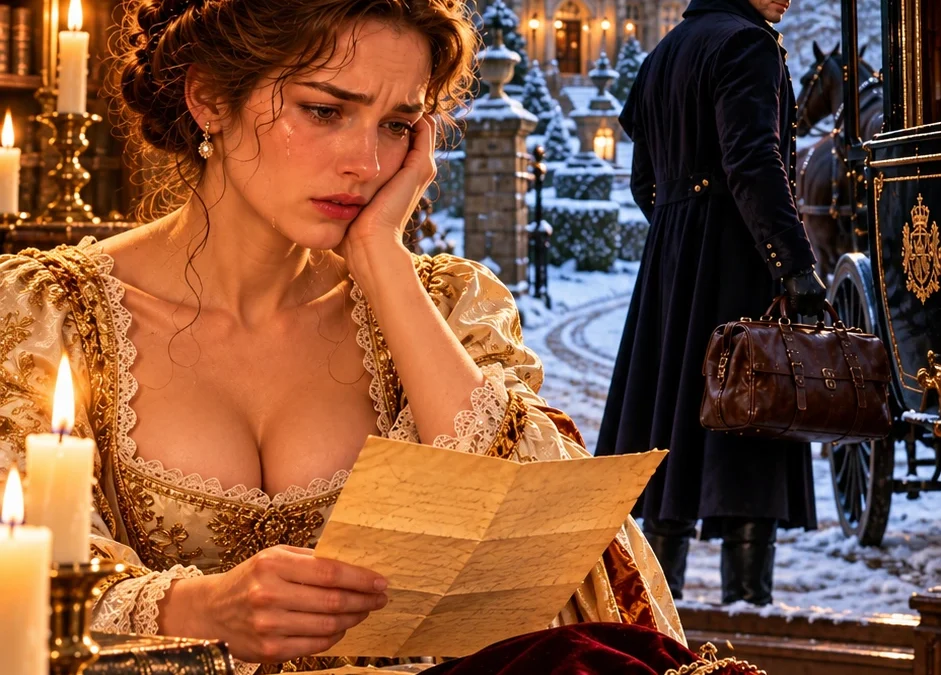
HER HUSBAND LEFT HER 30 GUINEAS “FOR YOUR SEPARATE USE” AND VANISHED FOR THREE MONTHS… BUT WHEN THE BANKER WALKED INTO THE HALL ON LADY DAY, THE “SHOPKEEPER’S GIRL” LAID A BAG OF GOLD ON THE TABLE AND SHOCKED THE ENTIRE COUNTY 😱
Part 1
The purse held thirty guineas in gold.
It lay on the breakfast table at Askern Hall, and beside it was a folded note in a hard, slanting hand.
Thirty guineas for your separate use. I shall not return before Lady Day. A.
It was dated the second of January, 1817. Hannah Calverley, who had been the Duchess of Arkindale for exactly five days, read the words for your separate use and was certain she knew what they meant.
They meant: keep apart from me. 💔
She was wrong. And by the time she found out how wrong, she had turned those thirty guineas into three hundred pounds.
Twelve days earlier, the Duke of Arkindale had knocked on the door of a shop that no longer had anything in it.
It stood on Stonegate in York, between a glover and a print seller. For thirty years the sign above the door had read Thomas Ridley, Bookseller and Auctioneer. Now the sign was gone. The shelves were bare. The great oak counter had been sold, and the brass scales, and every book down to the last torn prayer book. All that remained in the long, cold room was a woman of twenty-seven in a black dress, sitting on a packing case with a ledger on her knees.
She opened the door because she thought he was another creditor. Then she saw his coat, his boots, and the carriage in the street with a crest on the door, and knew he was not.
“Miss Ridley. You will not remember me. I bought a set of Shakespeare from your father’s sale in October. The Boydell edition, in nine volumes. I paid forty-one pounds.”
“I remember the Shakespeare,” said Hannah. “I don’t remember you.”
He was a tall man of about thirty-three, dark, rather thin, with a long face that did not look as if it smiled often. He did not seem offended. He seemed, if anything, relieved.
“Good. Then you will judge what I say on its own merits. I am Edmund Calverley, Duke of Arkindale. I have an estate in Swaledale, forty miles north of here, and I must go to London after the new year and stay until spring. While I am gone, the house and the estate need someone in charge who can count, who will not be cheated, and who will not run away when things go wrong.” He paused. “I watched you sell your father’s stock to pay his debts. You stood at that counter for nine hours. You did not cheat a single buyer, and you did not cry once. I am asking you to marry me.”
Outside, a cart rattled over the cobbles. Somewhere a church clock struck four.
“You are asking a bookseller’s daughter to marry a duke,” Hannah said at last, “so that she can mind your house while you are away.”
“Yes.”
“What do I get?”
He had clearly expected the question, and answered it plainly, like a man reading out a price at a sale. “A roof. My name. Thirty guineas a quarter for your own use. And no one will ever again be able to sell the floor out from under you.”
“And what do you get?”
“A wife who can keep Askern standing until Lady Day.”
She was penniless. Her father had been dead nine weeks. The only other offer she had was a post as companion to an old lady in Scarborough who kept eleven cats and could not abide being read to. She knew exactly what her choices were worth. She had been raised to know what things were worth.
She did not beg. She did not thank him. She closed the ledger on her knee and said, quite steadily:
“Then tell me what you’ve left out.”
Something crossed his face, quick as a shadow. “I beg your pardon?”
“My father taught me that every lot has something wrong with it. A torn page. A missing plate. A crack under the gilt. The honest seller tells you what it is. The other kind waits for you to find it at home. So what is wrong with this one, your grace?” 😳
He looked at her a long time.
“Nothing you need know before the wedding.”
“And after?”
“After,” said the Duke of Arkindale, “you will be my wife, and I will tell you what I can.”
It was not an answer. She knew that. But she married him anyway, nine days later, by license, at eleven in the morning, in St. Michael le Belfrey, in the shadow of York Minster. And for nearly three months she believed that the thing he had left out was the worst thing a man could leave out.
She thought he did not mean to stay married to her at all.
Askern Hall stood at the head of a long valley, with the River Swale below it and the bare brown fells rising behind. It was built of gray stone, built to be looked at from a distance. Close up, in the winter of 1817, it looked tired.
Hannah saw the slates missing from the stable roof. She saw the long gallery with its shutters closed and dust sheets over every chair. She saw the kitchen garden where nothing grew but a few black cabbages, because the summer before had been the coldest anyone in Yorkshire could remember. It had rained in July. It had snowed on the fells in August. The oats had rotted in the fields, and now, in the dead of winter, half the families in the Dale were living on porridge made from seed they should have saved for spring.
What she did not see, that first night, was her husband.
At dinner they sat at either end of a table built for twenty and talked about the weather. At ten, the housekeeper showed her up to the Duchess’s rooms. And Hannah learned that the Duke’s own bedroom was not beside hers, as it should have been. It was at the far end of the old East Wing, as far from her as possible without sleeping in the stables.
His grace had his things moved last week.
She sat up a long time in a strange bed, listening to the wind on the fells. She did not cry. She had made a bargain with her eyes open, and a bargain was a bargain.
Then, five days later, she came down to breakfast and found the purse.
Thirty guineas in gold, in a year when the whole country had lived on paper money for twenty years and a golden guinea was something people hid in a stocking under the floor. Beside it, a note: separate use. Not before Lady Day.
He had gone before dawn. Old Jacob Sowerby, the groom, told her so. “Saddled the gray himself in the dark. Never seen him do that.”
Thirty guineas. A note. A bedroom at the far end of the house. And a husband who had saddled his own horse in the dark rather than wait until his wife came down to say goodbye.
She was wrong about it for eleven weeks and four days.
But she did not yet know that the first person to be kind to her at Askern was also the first person who would break her heart, with a letter that had been left open on the hall table in the rain… 😨
Part 2
A letter, left open on the hall table in the rain.
Mrs. Pratt, the housekeeper, was round and soft-spoken, fifty years old, widow of a former steward, and at Askern since the Duke was a little boy in skirts. She brought Hannah tea in the mornings. She showed her the linen cupboards and the still room and the great household ledgers. She never once looked at Hannah the way the county did, when the county came to call.
And the county did call. In the second week of January, three carriages came up the valley in one afternoon. Mrs. Lumley of Grinton Lodge and her two unmarried daughters, Lady Saltby, the vicar’s wife. They sat in the cold drawing room in their furs and looked at Hannah’s black dress and plain brown hair and hands that had carried boxes of books up and down stairs for most of her life.
“And you were in trade, I think, Duchess,” said Mrs. Lumley with a sweet smile.
“My father was an auctioneer. I was his clerk.”
“How very useful.”
The two daughters looked at each other and did not quite laugh.
When they had gone, Hannah went down to the housekeeper’s room and sat at Mrs. Pratt’s table. After a long silence, Mrs. Pratt said gently, “My dear, may I tell you something I oughtn’t?”
“A letter came last week for his grace from London, from his lawyer, Mr. Ambrose of Lincoln’s Inn. It was left on the hall table, and it came open in the wet. I did not mean to read it. But I did. And I think you should know what it said, so you do not hear it first from Mrs. Lumley.”
“What did it say?”
Mrs. Pratt shut her eyes to see the words. “The deed for Her Grace’s separate settlement will be ready for signing by Lady Day, after which Her Grace will be entirely independent of Your Grace.”
Hannah sat very still.
“I have seen it before, in other great houses. A gentleman marries in a hurry for reasons of his own, and when the reasons are done with, he settles a little money on the lady and sends her to Bath or Harrogate, and they need never meet again. Nobody calls it a divorce. But it is the end of the marriage just the same.” She took Hannah’s cold hand. “Lady Day is the twenty-fifth of March. That’s sixty-four days. I’d not have you be the last to know.” 💔
Hannah thanked her. She meant it.
That night, in the cold bedroom, she took out her father’s old sale ledger, the only thing of his she had left. She turned to a clean page and wrote at the top: Askern. 64 days to Lady Day. And beneath, in a smaller hand:
If I am to be put aside, I will not be put aside with nothing in my hands. Not again.
Her father always said bad years made the best sales. When times are good, my girl, people keep their things. When times are bad, they have to sell, and they sell in a hurry to people who don’t know what anything is worth. That’s when a good eye is worth more than money.
The winter of 1817 was the worst Swaledale had seen in living memory, and every week, somewhere in the Dale, there was a sale. A farmer at Healaugh who could not pay his rent. A widow at Gunnerside who had to go to her sister in Kendal, and everything she could not carry went under the hammer. An old squire at Marrick who died owing half of Richmond, whose whole house was emptied in two days by a bored auctioneer from Darlington, reading out a quantity of books, various, and selling them by the shelf without opening one.
Hannah went to all of them. She went in the old gig with Jacob Sowerby driving, through snow and sleet, once through a flood that came up over the axles. Jacob grumbled the whole way. About the weather. About the roads. About how it was not fitting for a duchess to go to farm sales like a horse dealer’s wife.
He never once refused to take her.
“What’s in the box, any road?”
“Mostly sermons. And a Virgil.”
“A what?”
“A Latin poet, printed in Birmingham in 1757 by a man called Baskerville. It’s the most beautiful book ever made in England.”
Jacob eyed the box with deep suspicion. “And what did you give for it?”
“The whole box was eight shillings.”
“And what’s it worth?”
Hannah smiled for the first time in two weeks. “Four guineas. Perhaps five, to the right man.”
Jacob said nothing for a whole mile. Then: “Well, I’m blowed.” And after that he grumbled a good deal less. 🥹
She kept a record of everything, as her father had. Every lot, every price paid, every price received, in her small square hand. The Virgil: eight shillings, sold to a dealer in York for four guineas and a half. A long-case clock by Thomas Lister of Halifax, bought at Gunnerside for thirty shillings because the case was scratched and the auctioneer said it would not go. Hannah knew Lister clocks went forever. She sold it in Richmond for nine pounds. A portfolio of “engravings, damp,” bought at Marrick, with eleven early Hogarth plates beneath the damp. Twenty-six pounds from a London dealer.
And she never cheated anybody. That was the other rule.
At Gunnerside, the widow whose things were being sold came up shyly at the end of the day with an old brown book wrapped in a cloth. It was her grandmother’s herbal, printed in the reign of Charles II, every plant colored by hand.
“Would you give me a shilling for it, ma’am? For the coach fare?”
Hannah turned the pages. The colors were still bright after a hundred and forty years.
“No. I’ll give you three pounds. That is what it is worth, less what I need to sell it on. And I’ll write you a paper saying so, in case anyone tells you that you were robbed.”
The widow burst into tears. “God bless you, your grace.”
Hannah wrote it in the ledger: Herbal, colored. £3. Sold in York £5 10s. It was not much. But she slept better that night than she had since her wedding.
By the first of February she had sixty-eight pounds. By mid-month, a hundred and twelve. Every evening she wrote the number at the bottom of the page, and beneath it, the other number. Fifty-two days to Lady Day. Forty-five. Thirty-nine.
She had a plan. When Lady Day came, and the Duke returned with his lawyer’s paper, she would sign it without a word. Then she would go back to York with her own money, honestly earned, take a lease on a shop in Stonegate, and put a sign over the door. Not Ridley. That name was gone. Her own name. She did not need a duke for that.
She needed three hundred pounds.
He came home without warning on the fourteenth of February, past nine at night.
Hannah was in the library, the only warm room in the house, working by the fire. Books lay spread across the long table, a lot she had bought that morning at Reeth. Beside them lay her father’s small ivory gavel, which she kept on her desk because she could not bear to put it in a drawer. She was standing on the library steps, trying to lift a great folio atlas from the top shelf, when the door opened and her husband walked in, still in his riding coat, snow on his shoulders.
She nearly dropped the atlas.
He crossed the room in three strides and caught the bottom of it, and between them they laid it on the table.
“I did not know you were coming,” she said.
“Nor did I, until this morning.”
He looked at the books, the ledger, the gavel. He did not ask what she was doing. He picked up the gavel and turned it over in his long fingers.
“This was your father’s. He used it at the sale in October. I remember the sound.”
He held it out to her. She took it, and his hand did not let go.
The long-case clock in the corner ticked. Hannah heard it very clearly, the way you hear a clock in a sickroom. One. His fingers were cold from the ride, and then they were not. Two. Three. He was looking at their hands, not at her face. Four. Five. She felt him draw a breath and hold it. Six. Seven. Eight. The fire settled in the grate.
Nine.
And then he went rigid. Every part of him went stiff and still, as if he had heard a shot. He let go of the gavel so suddenly she nearly dropped it, and stepped back from the table.
“I beg your pardon,” he said in a low, rough voice. “I am very tired. Good night.”
He was gone. She heard his boots on the stairs, going fast, going up, going east, toward the far end of the house.
She stood in the warm library with the ivory gavel in her hand. She thought she knew what it meant. He had forgotten himself for nine ticks of a clock and touched the hand of the shopkeeper’s daughter he had married for a housekeeper. Then he had remembered what he meant to do at Lady Day, and he had been ashamed.
In the morning he was gone again, without so much as a note. 💔
And when Hannah went back through the household ledgers that spring, she found a column of figures that explained everything… or so she thought. 😱
Part 3
After that, Hannah began to keep a different kind of record.
Mrs. Pratt had given her the estate account books in the first week, because old Mr. Harker, the steward, had gout in both feet and could not climb to his office. Hannah went back through them slowly, the way her father taught her to go through a catalog when something did not feel right.
And she found things.
On the tenth of January, the Duke’s four carriage horses had been sold at Tattersall’s in London for three hundred and forty guineas. The same four that had drawn her up from York on her wedding day.
On the twenty-second of January, nine guineas paid to Mr. Ambrose of Lincoln’s Inn for the deed of settlement, first draft.
On the third of February, a receipt from Rundell and Bridge, the king’s own jewelers: one rope of pearls, the property of the late Duchess of Arkindale. Six hundred and twenty pounds. His mother’s pearls, sold.
On the eighteenth of February, the London house in Brook Street let, furnished, to a family from Bristol.
On the first of March, a second payment to Mr. Ambrose, for engrossing the deed of settlement, ready for signature at Lady Day.
She wrote it all in a column at the back of her own ledger. Horses sold. Pearls sold. House let. Lawyer paid, and paid again. She looked at the column a long time, and saw what it meant.
He was turning everything he owned into money, quickly and quietly, before Lady Day. There was only one reason a man would need that much so fast.
He was buying his way out.
You could not simply put a wife aside, even a shopkeeper’s daughter. You had to settle money on her. Enough to live on. Enough that the county could not say you had thrown her into the road. Six hundred pounds of pearls. Three hundred and forty guineas of horses. That was the price of a duchess. That was the price of her.
It was a terrible theory. She wanted with all her heart for it to be false. But she thought of the bedroom at the far end of the house, and the purse on the breakfast table, and the word separate. And the nine ticks of the clock, and the way he had pulled his hand away as if she burned.
On the twentieth of March, she added up her own ledger for the last time. Three hundred and four pounds, three shillings. Beneath it she wrote: Five days to Lady Day. 😭
He came home on the twenty-fourth, the night before Lady Day, at dusk, in a hired chaise, because he had no horses left of his own.
At nine that night, Hannah went to the East Wing and knocked on her husband’s door.
He opened it in his shirtsleeves. He looked very tired. When he saw who it was, he did not step back, and he did not ask her in. He only said, “Hannah.”
It was the first time he had ever spoken her name.
“I have something to say to you. I would like you to hear all of it.”
She did not go in. She stood in the cold passage with her father’s ledger clutched to her chest and said it all. The letter from Mr. Ambrose, and the words entirely independent of Your Grace. The horses at Tattersall’s. The pearls at Rundell and Bridge. The house in Brook Street. She read him the dates one by one, in her clear auctioneer’s voice. She told him about the far bedroom, and the purse, and the word separate, and the library, and the nine ticks of the clock, and how he had run from her as if she were a fire.
“I think you married me because you needed someone to mind your house for a winter. And I think you mean to pay me off tomorrow and send me to Harrogate and never see me again. I think that is what you left out, at the door in York. That was the crack under the gilt.” Her heart was going very fast. “Is it true? Edmund, if any of it is wrong, tell me which part.”
His face was very white.
“None of it is wrong.”
“Then it’s true.”
“I did not say that.”
“Then what are you saying?”
She saw him nearly tell her. Something rose behind his eyes like a man pushing at a heavy door. And then she watched him hold the door shut.
“I am saying that the deed will be ready tomorrow,” he said quietly. “And I hope you will sign it. It is the best thing I can do for you.”
He did not defend himself. He did not explain. He stood there in the doorway in his shirtsleeves and looked at her as though she were something he could not afford.
Hannah turned and walked down the long passage, very straight. She did not let herself cry until she had shut her own door.
She did not go to bed.
She sat at the little writing table with two candles and the ledgers, and did what her father had taught her to do when a sale would not come right at the end of the day. She started again from the first page, and added everything up a second time, as if somebody else had done it.
Every fact was true. He had said so. But a column of true figures can still give the wrong total if one of them has been put in the wrong place.
The horses sold on the tenth of January. The pearls on the third of February. The house let on the eighteenth. Hundreds of pounds, each time.
But where had the money gone?
It had not come to Askern. She had kept the estate books three months. Not one guinea of it had entered the house.
She went back to the first page of the year’s estate book, written out in old Mr. Harker’s shaky hand before his gout got bad. There was a note there that she had read a dozen times without seeing it.
Hutton and Company, Bankers, Richmond. Bill of the late Duke, accepted 25th March, 1812. £300. Falls due Lady Day, 1817.
And under it, another note. And another. A mortgage on the home farm. A mortgage on the lead mine at Hurst. Money owed to a bank in Leeds. Money owed to a bank in London. Money owed, and owed, and owed. All of it signed by the late Duke, Edmund’s father. All of it coming due, one after another, in the spring.
She sat very still.
You do not sell your mother’s pearls to pay off a wife. You sell your mother’s pearls to pay off your father. 😱
She picked up the empty purse, which she had kept all winter in the drawer, and turned over the note that had come with it. She read it slowly, the way she read the description of a lot she was not sure about.
For your separate use.
A hundred times she had read that word as Mrs. Pratt had heard it. Apart. Away. Put aside. But her father had been an auctioneer thirty years. He had sold up many a house after a husband went bankrupt. And she remembered what he had told her once, after a sale in Leeds, when a wife stood in the hall weeping while her own furniture was carried to the cart.
In law, my girl, everything a married woman has belongs to her husband. Her money, her clothes, the very chair she sits on. When he goes down, it all goes down with him, and the creditors take the lot, unless it was given to her separate use. Then it’s hers. Then nobody can touch it. A good lawyer can make a deed that keeps a wife safe even if her husband loses everything. The pity is, so few men think of it until it’s too late.
Hannah put her hand over her mouth.
A deed of settlement for her separate use. After which she would be entirely independent of His Grace.
Not separated from him. Safe from his debts. Safe from whatever happened at Lady Day.
He was not paying her off. He was going under. And he was trying to make sure that when he went, he did not take her with him. 💔
She sat in the cold room until the candles burned out. At five in the morning, when the first gray light came over the fells, she put on her shawl and went back to the East Wing.
He was awake. She had known he would be. He sat by a dead fire in the same shirt, a paper in his hand.
“I know about Hutton’s bank,” she said from the doorway. “The bill, the mortgages, the bank in Leeds. I know you sold the horses and the pearls to pay your father’s debts. I know you let the London house. And I know what separate use means in a deed. My father taught me.” She came into the room. “So now I want the part you haven’t told me. Not the money.”
He looked at her a long time. Then he set the paper down.
“When I was fifteen, the bailiffs came to Askern.”
Hannah waited.
“My father had borrowed against everything. The house, the land, the mines. He was a charming man, and everybody liked him, and he could not say no to anyone, least of all himself. One morning in June, the men came. They went through the house with a list. They took the pictures off the walls. They took my mother’s piano. They put a ticket on the chair she was sitting in, and she sat in that chair very straight, and did not say a word, while they wrote down what it was worth.” His voice was low and steady. His hand on the arm of the chair was not. “My grandfather paid them off in the end. But my mother never sang again. She never played again. She died two years later, and I have always believed it was of shame. I have never told that to anyone. Not Mrs. Pratt. Not a living soul.”
“Oh, Edmund.”
“I swore that no woman would ever sit in a chair in my house while a man put a ticket on it. And then my father died, and I opened his desk, and I found the bills, and I knew that by this spring, the men might come again.” He looked up. “I watched you stand at that counter in York for nine hours while they sold your father’s life out from under you. I thought: there is a woman who could bear it, if it comes. And I was so tired of bearing it alone. So I married you. I told myself it was for the house. It was not for the house.”
“Then why did you leave me?”
“Because I could not tell you. I could not stand before you and say, I have married you into a ruin. So I gave you every guinea of gold I had, and went to London to sell what I could, and told Ambrose to draw a deed that would keep you safe if I failed. And I put you at the other end of the house so that…” He stopped. “So that when the time came, it would not be harder than it had to be for either of us.”
“And the library?”
“In the library, I forgot. For about nine ticks of a clock. And then I remembered what I was, and what I might be by Lady Day, and I could not let you hold on to that.”
Hannah came and knelt beside his chair, so her face was level with his.
“May I?” she said, and held out her hand.
He looked at it. Then he took it.
One tick of the clock on the mantel. Two. Three. And this time he did not go stiff. This time he held on, and on, and she felt the whole of him let go of something he had carried since he was fifteen years old. 🥹
“You should have told me.”
“I know.”
“I am an auctioneer’s daughter, Edmund. I know what things are worth. I have always known.”
And she leaned forward and kissed him. After a moment, very slowly, as if still unsure he was allowed, he kissed her back. 💋
Lady Day at Askern was rent day. It always had been. Every quarter, the tenants came up to the hall to pay what they owed, and afterwards there was a dinner of beef and ale in the great hall, with the Duke at the head of the table.
In good years it was merry. In the spring of 1817, it was not.
The tenants came in slowly in their best coats, hats in their hands, faces closed. They had heard the stories. The Duke had sold his horses. The Duke had sold his mother’s pearls. The Duke was ruined, the estate would be sold, and the new owner would raise the rents or turn them out. And the Duke had married a shopkeeper’s girl from York and left her alone all winter, and everybody knew what that meant.
The county had come too, uninvited, because on rent day the hall was open and Mrs. Lumley could no more have stayed away than flown. She sat by the fire with her daughters and Lady Saltby, whispering behind their gloves.
At two o’clock, a thin man in a black coat entered the hall with a leather case under his arm. A clerk from Hutton and Company, Bankers, of Richmond. His name was Gedge, and he looked deeply unhappy to be there.
“Your grace. I beg your pardon for coming on such a day. I have the bill of the late Duke for three hundred pounds, which falls due today. The partners have instructed me.” He swallowed. “If it cannot be paid, they will be obliged to apply to the court. And once that is done, I am afraid the other creditors will follow.”
The whole hall went silent.
The Duke stood. He was very pale. “Mr. Gedge, I have paid every debt I could reach this winter. I have nothing left in hand. If the bank will give me until Michaelmas…”
“They will not, your grace. I am sorry.”
A murmur ran through the hall. Somebody near the back said, quite loudly, “That’s it, then.”
And Mrs. Lumley, by the fire, said to Lady Saltby, in a whisper that carried to every corner, “Well, I suppose the little shop girl will be going back to her shop.” 😠
Hannah stood up.
She had her father’s ledger in one hand and, in the other, a canvas bag that clinked when she moved. She walked the whole length of the long table, past the tenants, past the servants, to where Mr. Gedge stood. She set the bag down in front of him.
“Mr. Gedge. There are three hundred pounds in that bag. Two hundred and forty in Bank of England notes, the rest in gold. Count it, please.”
He stared at the bag, then at her.
“Hannah, no,” said the Duke.
“You have done enough talking for both of us this winter, Edmund,” she said, without turning. “Now it is my turn.”
She turned to the hall, to the tenants with their hats in their hands, the servants against the walls, Mrs. Lumley by the fire. She did not raise her voice. But she had spent half her life calling lots in a crowded saleroom, and every person in that hall heard every word.
“You have all heard a great many stories about my husband this winter. Let me tell you some true ones. They are written down here in my own hand, so you need not take my word for it.
“On the tenth of January, his grace sold his carriage horses at Tattersall’s for three hundred and forty guineas. Every penny went to the bank in Leeds, so that Mr. Rawson’s farm at Healaugh and Mr. Alderson’s at Low Row would not be taken for his father’s debts.
“On the third of February, he sold his mother’s pearls. Six hundred and twenty pounds. It paid off the mortgage on the lead mine at Hurst, which is why sixty men from this Dale still have work there.
“He let his own house in London and lived in two rooms at Lincoln’s Inn, so that the rents would cover the interest on the home farm. He did not sell one acre of your land. He did not turn one family out. He did not raise one rent. Not in this winter, the worst this Dale has ever seen.” 🔥
She held up the ledger.
“And on the second of January, before he went to London to do all that, he left me thirty guineas in gold. It was every piece of gold he had. He gave it to me for my separate use, so that if the bank took everything else, they could not take that. I have been to every sale in this Dale since. Mrs. Metcalfe, I bought your mother’s clock at Gunnerside. Mr. Keaton, I bought your uncle’s books at Marrick. I paid fair prices and wrote them down and sold everything on again in York and London for what it was really worth. And that is where three hundred pounds came from. Thirty guineas, a good eye, and Jacob Sowerby driving me through every flood between here and Reeth.”
Old Jacob, standing by the door with the other servants, went red to the roots of his white hair.
Hannah turned and looked straight at the fire, where Mrs. Lumley sat with her mouth slightly open.
“In law, ma’am, every penny a wife earns belongs to her husband. So I am not giving his grace anything today. I am only giving him back his own. And yes, I was in trade. I was an auctioneer’s clerk in York. It means I know what things are worth.” She looked at her husband. “And I know what he is worth. I have known it since the night I learned what separate use means.”
For a moment, nobody moved.
Then Mr. Gedge, very carefully, opened the canvas bag and began to count.
And somewhere at the back of the hall, an old tenant farmer named Alderson began to clap, slowly, with his great rough hands. Then another joined him. Then the whole long hall was on its feet, tenants and servants and kitchen maids, and the sound rose into the black rafters and out through the open door and down the valley toward the river. 🥹
Mrs. Lumley did not clap. But after a moment, she did look down at her gloves.
When Mr. Gedge finished counting, he wrote a receipt and handed it to the Duke with a bow. “Paid in full, your grace.” Then, lower, to Hannah: “If your grace should ever want a position at the bank, the partners would be very glad.”
The Duke took the receipt. He did not look at it. He was looking at his wife.
“You told me once that every lot has something wrong with it.”
“Every lot,” said Hannah.
“Then what is wrong with this one?”
She thought about it honestly, as her father would have.
“He saddles his own horse in the dark,” she said. “And he keeps much too far away.”
He moved back to the Duchess’s end of the house that same night. Jacob Sowerby carried his things himself and grumbled the whole way, and was seen afterward in the kitchen telling anyone who would listen that he had always known how it would turn out. 💍
The debts took nine more years to pay. There were hard winters and good ones and a great deal of work. In 1819, the Duchess opened a small bookshop in Richmond under her own name, and the Duke was frequently found behind the counter on market days, wrapping parcels very badly. They had four children. All of them learned to add up a column of figures before they could ride.
Many years later, when their eldest son married, the Duchess gave his bride two things. One was a small ivory gavel, worn smooth by sixty years of hands. The other was an empty leather purse, with a folded note inside it in a hard, slanting hand.
Thirty guineas for your separate use.
“My husband wrote that,” she said. “I read it wrong for eleven weeks. Mind you read your husband’s notes more carefully than I did.”
As for Mrs. Pratt, she stayed at Askern until she was very old, and the Duchess never once reproached her. She had read a letter that was not meant for her, and told Hannah what she thought it meant, so that a lonely young woman would not be shamed before the whole county. She had done it out of love. And she had very nearly broken a marriage doing it. ✨
Some would call that loyalty. Some would call it meddling.
What would YOU have done if you had found that letter on the hall table? Tell me in the comments, and share this with someone who knows that sometimes the coldest-looking gift is the deepest act of love. 👇
This story is entirely fictional and created for entertainment purposes only. It does not represent any organization or individual, nor does it encourage inappropriate behavior. The content was generated with AI assistance.








