Her Mother’s Dead Friend Left Her a Worthless Shop and One Bridal Gown No Bride Ever Wore. Then She Noticed One Seam Had Been Sewn Shut… and the Richest Woman in Town Ordered Her to Burn It
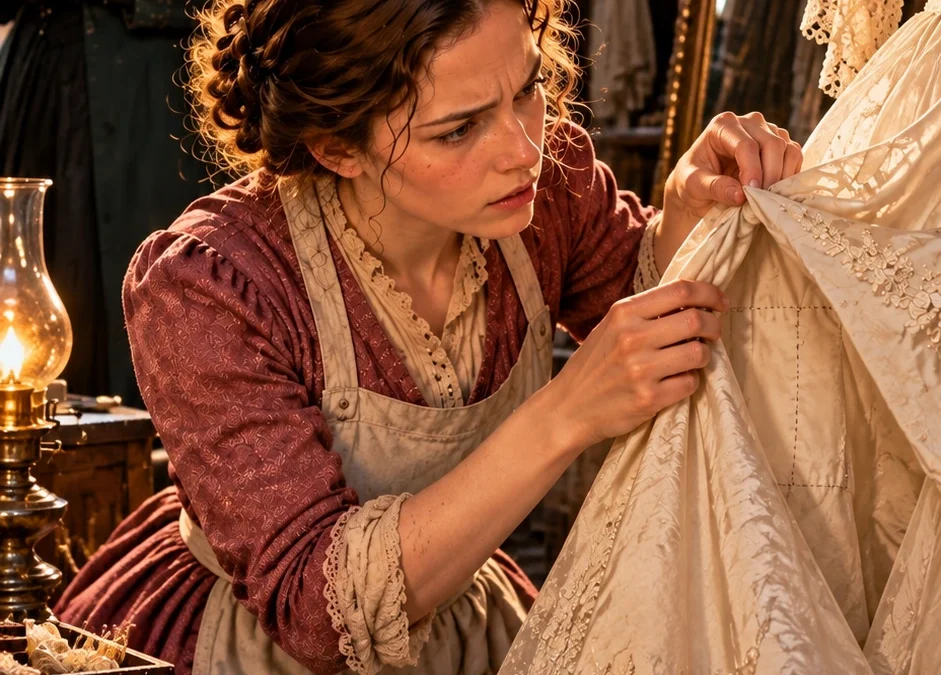
Her Mother’s Dead Friend Left Her a Worthless Shop and One Bridal Gown No Bride Ever Wore. Then She Noticed One Seam Had Been Sewn Shut… and the Richest Woman in Town Ordered Her to Burn It
Part 1
In the back of a shuttered dress shop hung a bridal gown that no bride had ever come to claim. 👰
Someone had finished it with great care. And then, along the inside of the skirt, had sewn one seam completely shut.
The young woman who found it was named Adah Quill. She was twenty-four years old and lately left with nothing but a dead woman’s ruin. Her aunt and uncle had buried her mother in the spring, and by autumn they had sold the cottage and kept every shilling for themselves.
Adah was left the lease of a dead shop on Cinder Row, a place the whole town of Marley agreed was worth nothing at all.
She arrived on a gray morning with a borrowed key, a bundle of thread, and a heart set on making something out of nothing.
The gown hung alone in the workroom, pale as milk in the dust, waiting as though it knew her.
Within the hour, she noticed the sealed seam.
What she did not yet know was whose hand had closed it. Or who in that town would pay dearly if it were ever opened again. 😨
The shop had belonged to a woman named Honoria Slade, dead these four months. A dressmaker Adah had never met.
It had come to Adah by a strange thread of chance. Honoria had left her few worldly goods to the daughter of Margaret Quill, seamstress. Margaret Quill had been Adah’s mother. The two women had apprenticed together as girls, long before Adah was born, and had not spoken in twenty years.
Why Honoria remembered a friend she had lost, the solicitor could not say. He handed Adah the key with the air of a man giving away a debt and warned her the premises were in a condition.
The condition was this. The front window was grimed to the color of weak tea. The counter had warped. Rain had come through the roof and left a brown continent spreading across the ceiling. Pattern books furred with damp. A cutting table scarred by forty years of shears. A cold iron stove.
And the gown.
Adah had learned her trade at her mother’s knee, then through three years of unpaid drudgery under a fashionable modiste who took credit for every gown Adah’s fingers built. She knew cloth the way some people know faces.
She crossed the room and lifted the hem into the gray light, and her breath caught. Not at the dust. At the work.
The cut was two seasons out of fashion. But the stitching was the finest she had ever handled. Ten stitches to the inch, even as printed type. Seams pressed open and flat. Whalebone channels laid in with a patience that bordered on prayer.
Whoever made this had loved the woman who was meant to wear it. 💛
And there, on the left side of the skirt, where a lady might slip her hand to hold her train, was a pocket.
Adah felt for its opening. There was none.
The mouth of the pocket had been sewn shut with tiny deliberate stitches, the same ten to the inch, in thread a half shade paler than the rest. As if to mark it for a knowing eye.
“Why,” she said aloud to the empty room, “would a woman spend a day making a pocket and then sew it shut?”
The room did not answer. But the cold seemed to lean in.
She could not open it. Not yet. To pick out that seam felt like breaking the seal on someone else’s letter. So she did what her mother had taught her to do with any mystery in cloth.
She learned everything around it first.
That first week, Adah made the shop live again by sheer stubbornness. She scrubbed the window until the street showed through. She set a bucket under the leak, and when the rain stopped, climbed up and laid a board over the gap herself. She lit the stove with broken pattern boards. And she hung a card in the door in her own neat hand:
Mending. Alterations. Turning of collars and cuffs. Honest prices.
Marley was a mill town gone genteel at the edges, proud of its assembly rooms and its new bank. And it had a long memory.
The person with the longest memory of all came on the fourth day.
She was a broad, upholstered woman in bottle green, with a face like a closed ledger. She did not knock. She stood in the doorway and looked at Adah as one looks at a stain.
“So it’s true. Honoria’s rat’s nest has a new tenant. I am Mrs. Prudence Loach. My husband holds the mortgage on half this row.” She let that settle. “You’ll not last the winter, girl. Better women than you have starved on Cinder Row.”
“I mend and I alter, ma’am. There’s nothing to object to in a turned collar.”
But Mrs. Loach’s eye had already gone past her, into the dim of the workroom, and fixed on the pale shape hanging there.
Something moved behind her face. Quick. Then hidden. 😶
“That old gown. That’s rubbish. Honoria never finished it. The bride jilted the whole business years back. Burn it, or I’ll send a man to cart it off with the rest of the ruin.”
“I have use for the cloth,” Adah said mildly. “Silk that good doesn’t come cheap.”
Mrs. Loach’s mouth thinned. “Suit yourself. But it is mine to speak of. My family were the only kin Honoria had in this town.”
She turned and went, her heels loud on the boards.
She left Adah with a fact she had not been given: that the closed-up shop and the closed-up seam were somehow the concern of a woman who wanted both left shut.
That night, Adah took the gown to the cutting table by candlelight and did not touch the pocket.
Instead, she read the dress like a book.
The gown had been made for a slender woman, taller than Adah by a hand. It had been finished in a hurry at the end. The hem was the only clumsy line in it, doubled and heavy, stitched twice where once would do, as though the maker’s hands had begun to shake.
And the thread told her when. The silk floss had a soft ply that stopped being sold years ago. Adah’s mother had hoarded the last of it.
The gown was perhaps ten years old. Honoria had died this year, 1898. Ten years back put the making at 1888.
A jilted bride, Mrs. Loach had said. But a jilted bride did not explain a pocket sewn shut with marking thread, or a hem stitched heavy enough to hang wrong on the very woman who made it.
Adah slept badly and dreamed of her mother’s hands.
The town warmed by inches. A washerwoman named Bet brought in a torn Sunday skirt and left with it invisibly mended, and told three neighbors. A railway clerk needed his dead father’s coat taken in, and wept a little when Adah did it kindly. By the second week there was bread in the cupboard and coal in the scuttle, and a lean tabby cat had adopted the warm stove and answered, when it pleased him, to the name Thimble. 🐈
It was Bet who gave Adah the next thread, over tea, unasked.
“Sad place, that shop. There was a to-do ten years since. Honoria made a wedding gown for one of the Marley girls, one of the good families, and it all came to nothing. The girl went away. Honoria never took another bridal order after. Folk said her heart went out of it.”
“Which family?”
“Now there you have me.” Bet tapped the table. “But the girl was cheated of something. That was the talk. Money or a house. Her people saw her off with nothing after her father died. And you mind Mrs. Loach? That green battleship? She was a Marley cousin before she married into the Loach money. Thick in it, whatever it was.”
Adah poured more tea and said nothing.
But a shape was forming in her, cold and clear as the window she had cleaned.
A bride cheated of her share after her father died. A dressmaker who loved her, sewing a pocket shut in her wedding gown and never making another. And a cousin, now rich and respectable, who came in person to a stranger’s shop to say burn it. 🔥
That night, Adah took her sharpest scissors and her seam ripper and sat down before the gown with her heart going hard.
Whatever Honoria Slade had sealed away, she had sealed in trust. And Adah Quill would not honor a dead woman’s trust by burning it at the word of Mrs. Loach.
She began with the pocket, of course. The obvious seam. She picked out the pale stitches one by one, careful as surgery, folded back the pocket bag…
And found nothing.
Clean silk. Not a scrap of paper. Not a coin.
Adah sat back, disappointed to the point of tears. Then her own training reproached her.
A pocket sewn shut is a message, girl. Ask what it says, not what it holds.
The pocket was bait. It said, in the language of the trade, look where I am pointing, not at me.
Slowly, she turned the gown over in her lap. The pocket sat on the left side of the skirt. And below it, where a pocket’s mouth would naturally point, ran the hem. That heavy, doubled, clumsy hem that had troubled her from the first.
A pocket points down.
Down was the hem.
Her hands were steady now. She laid the skirt across the table, hem up, and ran the ripper into that thick, twice-sewn line. The fold gave up its secret in a whisper of silk.
Folded flat, slid the whole way around the skirt so that no lump would ever betray it, was a long sleeve of oiled linen. And inside it, stiff, folded papers.
Adah drew them into the candlelight.
The first was a letter, in a fine old-fashioned hand, beginning with six words that made her blood run cold.
To whoever loves her enough to open this… 😱
👉 Want Part 2? Find it in the comments, or leave any word and I’ll send it to you privately!
Part 2
To whoever loves her enough to open this… 😱
Adah’s fingers trembled as she read on.
My name is Honoria Slade, dressmaker of Cinder Row. I have sewn into this hem the last will and testament of Mr. Edmund Marley, gentleman of Marley House, who died the 3rd of March, 1888. I witnessed him sign it. He gave it into my own keeping on the day he made it, telling me plainly that his house was full of hands that would tear it up, and that a dressmaker’s drawers were the last place his brother’s people would think to search.
When he died, the family swore no such will was ever made, and produced an older one. And I, a tradeswoman with a witness’s mark and no more, could not stand against a great family and their man of law with only my word.
I dared not send it to Cesily. The Loach side had the reading of the post through their bank. They would have called it forgery and burned it, and me with it. I could lodge it with no lawyer in this county, for they all dine at that table.
So I sewed it where only a maker’s hands would look. I made the pocket to draw the wolf’s eye, and the hem to keep the lamb’s inheritance.
Adah set the letter down very carefully, as if it might break. Then she unfolded the second paper.
It was the will.
She could not follow every legal turn, but the heart of it stood plain. Edmund Marley, being of sound mind, left Marley House and the greater part of his estate to his daughter, Cesily Marley. To his brother’s family, a modest sum. His nephew’s wife was named there. One Prudence, lately married to a Mr. Loach. 😳
It was signed in a spidery, failing hand. Witnessed by two names Adah did not know. And below them, by a third.
Honoria Slade, dressmaker.
Adah understood it all at once, sitting in the cold with a dead man’s will in her lap and the cat asleep by the stove.
Honoria had loved that girl. She had hidden the true will in the girl’s own wedding gown, the one thing her enemies would call worthless and want burned. And she had waited for the day the surviving witness might be found. That day never came. She died with the secret still sewn shut.
And then, at the very last, this friendless dead woman had reached back twenty years to the one friend of her youth, Margaret Quill. She had left the shop and everything in it to a seamstress’s daughter. Because a seamstress’s daughter would be the one person in the world who might read the gown as Honoria had written it.
Adah was not chance.
She was the message’s chosen reader. 🧵
She wept a little then, for Honoria, and for Cesily whom she had never met, and for her own mother, whose trade had turned out to be a kind of key.
But the finding did not solve it. It only handed her a problem heavier than the hem.
She had evidence that half the respectable Loach fortune was founded on theft from an orphaned girl. She did not have Cesily, who might be anywhere, or dead. She did not have a solicitor she could trust in a town where the Loaches held the mortgages. And she had a landlord’s wife who had already come to her door to say burn it.
Which meant Mrs. Loach knew, or feared, that the gown was dangerous. And would not stop at one warning.
Adah sat up all night with the papers buttoned inside her bodice, against her skin. By morning she had made three decisions, and each cost her something.
She would go to no one who dined at the Loach table. That closed most doors in Marley.
She must learn what truly happened in 1888, or she would be a nobody waving a paper against a family with a bank.
And she must find Cesily Marley alive. With a shop that barely fed her and a purse near empty.
She began, as she did everything, with her hands and the trade. Because the trade was the one place the powerful of Marley never looked. Gently, through Bet and the washerwomen and the girls who brought their mending, she let it be known she was curious about the old days at Marley House. She had found fine old work in the shop, she said, and wished to know who made it.
It came in scraps over three weeks, paid for in kindness and turned collars.
An old laundress named Mrs. Pruitt, who had done the linen at Marley House, sat by Adah’s stove with a cup and unspooled it all. Edmund Marley, a gentle, ailing widower with one beloved daughter. In his last year, his nephew’s wife Prudence had installed herself at the house to nurse him, and had steadily gotten between the old man and everyone else.
When he died, a will was read that sent everything to the nephew’s side. Cesily got a small annuity and was told, kindly and firmly, to find her own establishment.
“There was a young man. A wedding planned that summer. Then the annuity turned out to be less than she’d been promised, and the young man’s people cooled, seeing her poor. She went north to be a companion. And the gown, poor lamb, she never wore it.” Mrs. Pruitt shook her head. “There was a whisper the old master made a later will, and Miss Slade witnessed it. But the family swore there was none. And you can’t fight what isn’t there.”
Adah looked at her own bodice, where the thing that wasn’t there had been all along.
Finding Cesily took her into November and cost the last of her savings. Letters. Postage. One railway fare she could barely afford. She wrote to a northern parish. To a dressmakers’ benevolent society her mother had once belonged to.
Three dead ends. Then, in the fourth week, a careful letter came back from a clergyman’s wife in a town called Harrow Bridge.
There had been a Miss Cesily Marley, who came as a companion to old Mrs. Danby many years ago. Mrs. Danby had died. But Miss Marley had not gone away. She had married a schoolmaster, a good, poor man named Arthur Hale. She was Mrs. Hale now, mother of two, teaching sewing to the village girls to help the family purse.
Should the lady give Mrs. Hale any message?
Adah read it three times. Then she put her head down on the cutting table among the pins and wept for the second time over that gown.
This time for gladness. 😭
She did not write to Cesily first. A letter might frighten her, or be answered by the schoolmaster, and word would travel. She had learned caution from a dead woman.
Instead she rode the slow train to Harrow Bridge on her last coins, with the will and the letter sewn once more into a hem. Her own petticoat this time. Ten to the inch.
Cesily Hale was a tall woman near forty, worn thin by work, with a face that had been beautiful and was still kind. She received Adah in a scrubbed little parlor with a child’s slate on the table. And she went very still when Adah gently spoke her father’s name.
“I do not go back to that,” Cesily said quietly. “I made my peace. Whatever you’ve come selling, I want nothing from Marley.”
“I’ve not come to take,” said Adah. “I’ve come to bring.”
She asked for scissors.
Then she knelt on the good woman’s floor, unpicked her own hem before Cesily’s eyes, and drew out the oiled sleeve.
She placed into Cesily’s hands the letter of Honoria Slade.
And Adah would remember, to the end of her life, the sound Cesily made when she read that name. A small, broken cry, as if a hand had reached out of a locked room.
But as Cesily read the letter, and then her father’s failing signature beneath her own thumb, she began to say something Adah had not expected. Words that made the schoolmaster, standing in his own doorway with his hat still in his hand, go white as the paper.
“She told me. At the very last fitting, she told me, and I never understood…” 😳
👉 Want to know what Honoria told her, and whether Cesily will dare to fight the Loaches in open court? LIKE or COMMENT “REVEAL” to unlock Part 3! Part 3 will be posted after enough comments. 🔔
Part 3
Cesily laughed and cried together.
“She held my hands and said, Whatever comes, child, the truth is in the work. Come back to the work. I thought she meant I was to keep sewing. To keep myself. And I did keep sewing.” She pressed the letter to her breast. “She meant the gown. She meant come back to the gown.”
She read the will again.
“Father gave it to her. Of course he did. He trusted her more than his own blood. And she could never write to me plainly. Prudence had the post. A letter from Honoria would have been opened, answered by a lawyer, and the will called false. That would have been the end of it. She had to keep it dark, or lose it altogether.”
“She hid it in the hem,” Adah said, “and sewed a pocket shut above it to draw the eye off the truth. Your cousin came to my shop in the first week and told me to burn the gown. She’s Mrs. Loach now. She knew.”
Cesily’s face changed. Not to anger, but to something older and more tired.
“Prudence. Yes. She would.”
They talked long into the evening, Cesily and Adah and Arthur, who came in from his lessons and heard the whole of it standing in his own doorway.
And now the choice came. Not Adah’s any longer. Cesily’s.
Adah had thought hard about how to lay it before her.
“You could do nothing. You have your peace. To fight this, you will have lawyers and the Loach bank against you. It will be printed in the papers. It may take years, and be hard.” She hesitated. “Or there might be a quieter way. With the will proved genuine, they might settle rather than be shamed. Take a sum, sign it away, and go home to your girls the richer. No one could blame you for either.”
Arthur looked at his wife.
Cesily sat with her father’s will open on her knees, and was quiet a long while.
“My father wanted me to have the house. Not the money. The house. He knew what they were. He sat up in his bed and made that will and put it in Honoria’s own hands, because he knew if he left it under his own roof they would have it in the fire before he was cold. And they made it vanish anyway, and told the whole town there was none. And let them call me a poor, cheated girl who couldn’t keep a bridegroom.”
Her voice was steady now.
“If I take a quiet sum, they keep the lie. Everyone in Marley still believes my father cut me off. And Honoria Slade sewed the truth into a hem with her dying hands and asked whoever found it to do right. Quiet is not right.” She lifted her chin. “I will prove it in the open. I want it said plainly, once, what they did.”
Adah let out a breath she had not known she was holding. 💪
“Then I will stand witness to how it was found. Every stitch. I can prove the hem was original work, and never disturbed until I opened it. A dressmaker can read that and swear to it.”
“And I’ll fetch the clergyman’s wife who wrote to you,” said Arthur, “and the old laundress, and any soul who remembers.”
It was not quick, and it was not quiet. The telling of it took the winter and half the spring.
But it went, in the end, the way truth goes when someone brave enough finally carries it into the light.
The two witnesses named on the will were traced. One was dead. But one was living. The very clerk gone north, whom Honoria had never had the means to find. An old man now in a distant county. Shown the paper, he remembered signing it at Marley House. He remembered the date, and the failing old gentleman’s hand, and the dressmaker standing witness beside him.
Being a decent man near his own grave, he was glad to say so under oath. ⚖️
Honoria’s signature stood as a witness’s, in a hand a dozen customers of Cinder Row could swear to.
And Adah Quill, seamstress of Cinder Row, testified before a country court to something no lawyer among them could have told. She had examined the hem. Its stitching was of one hand and one thread throughout, undisturbed by any later opening, ten to the inch. And the oiled sleeve had been built into the fold as the gown was made. Not slipped in after.
A garment cannot be forged the way a paper can. The dead man’s daughter had a witness in cloth. 🧵
Mrs. Prudence Loach fought it hard at first, through her husband’s man of law, with much talk of an old woman’s spite and a stranger’s scheme. But a will lawfully witnessed, a living witness to its signing, Honoria’s own account of how it came into her hands, and a chain of respectable memory are difficult to shout down.
When it became plain the whole thing would be printed and read aloud, the Loach stomach for it failed.
They had spent ten years being the good, generous cousins who had taken in a poor relation. They could not bear the town learning what they truly were.
In the end they did not so much lose as flee, settling the estate onto Cesily rather than stand up in open court and be named thieves in the newspaper.
It came to the same thing.
Marley House was Cesily’s.
Adah went back to Cinder Row for the waiting, and mended collars, and let the story do its slow work without her.
She did not grow rich from it. Cesily pressed money on her more than once. Adah took only what was fair for the fares and postage she had spent, and not a shilling over, though she was poor as a wren.
“It wasn’t mine to profit by,” she told Bet, who thought her a fool. “Honoria left me the shop. That was the gift. I would have shamed her to sell the rest.”
But there was a gift she had not expected. And it changed Cinder Row.
When the story was known, that the new little seamstress in the dead shop had read a wedding gown like a book and freed a cheated woman’s inheritance from a hem, Marley’s memory turned all at once, the way a tide turns. The women who had passed her window now came in. The good families who had trusted only the fashionable modiste on the high street sent their daughters to Adah Quill.
Because suddenly there was no dressmaker in the county whose eye and honesty were so spoken of.
She who had built other women’s gowns for years and watched them wear another’s name now hung her own name over her own door. ✨
And Mrs. Loach did not send a man to cart off the ruin of Cinder Row. Mrs. Loach, in fact, was not much seen in Marley afterward at all.
Cesily Marley of Marley House, once more, did something that spring that Adah had not asked for and never forgot.
She did not move back into the great house to keep it as a monument. She let it at a fair rent, and with a good part of the income she founded a sewing school for girls with no people to shield them. Orphans. The cast off. The poor. To be taught a trade that no one could take from them, since a trade lives in the hands and cannot be made to vanish like a paper.
She asked Adah to teach the fine work there two days a week, honestly paid, with her name on the door of that room too.
“Honoria taught me the only true thing anyone ever told me,” Cesily said. “The truth is in the work. I would like other girls to have it before they need it.”
So Adah Quill, who had come to Marley with a bundle of thread and a shop the whole town called worthless, ended that year with a living, a name, a cat, a friend she would keep for life, and a room full of poor girls learning to sew ten to the inch. 💛
The wedding gown was never worn.
Cesily kept it for a time, and would not cut it up, and would not hang it in a case. In the end she gave it back to Adah, to keep in the workroom on Cinder Row where it had waited so long. Not as sorrow, she said. As a witness. So that any girl who came to learn might be shown the hem and the mended pocket, and be told what one woman’s careful hands had once carried through ten silent years.
On the mantel of the shop, when it was all done, stood two small things side by side.
One was the seam ripper Adah had used to open the hem, wiped clean and kept.
The other was a card in Cesily’s writing, propped against the wall. It read only:
The truth is in the work.
And below it, some evenings, curled the cat. The fire drew well. And the light came clean through the window Adah had scrubbed on her first cold morning, out onto a street that no longer called anything on it worthless. 🕯️
💬 Tell me below: when did you see worth in something, or someone, that everyone else had written off?
This story is entirely fictional and created for entertainment purposes only. It does not represent any organization or individual, nor does it encourage inappropriate behavior. The content was generated with AI assistance.








