Her Neighbors Mocked Her Secret Cave Project… Until The Deadliest Blizzard In History Buried Them All
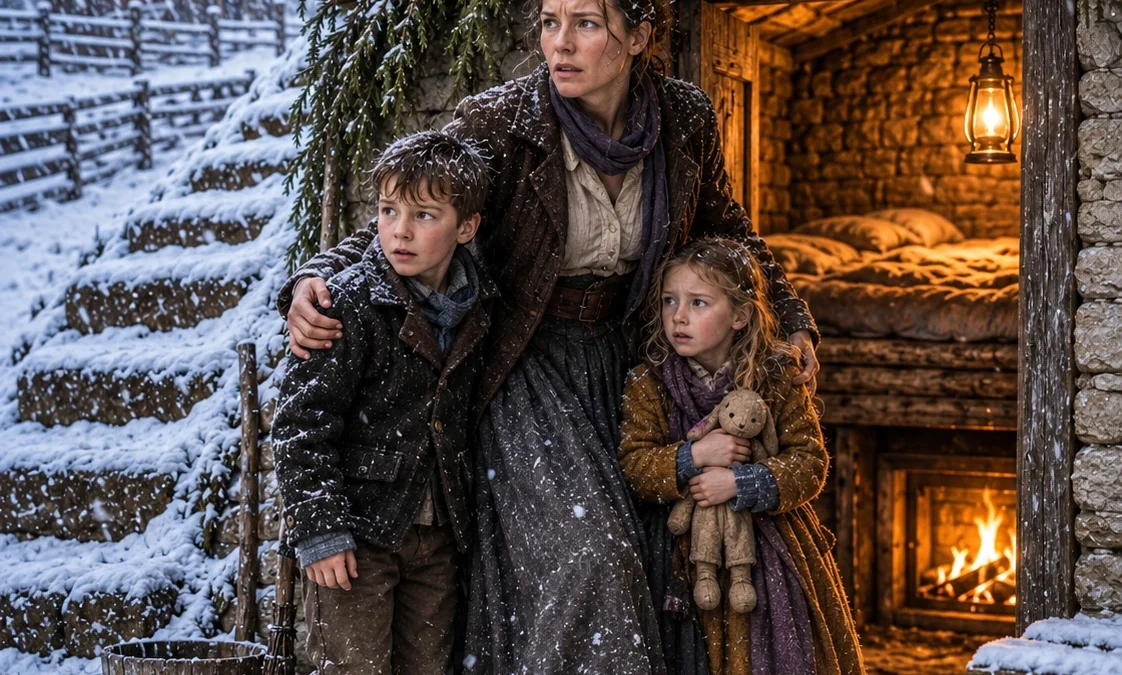
Her Neighbors Mocked Her Secret Cave Project… Until The Deadliest Blizzard In History Buried Them All 😱❄️
Part 1
It was 2:00 a.
m.
in Montana Territory, September 1886, and Maggie Thornton’s bare feet met the cabin floor like touching ice itself.
Her 8-year-old son Billy was trying not to cough.
He’d buried his face deep in a wool blanket, his thin shoulders jerking with every ragged breath, doing everything he could not to wake his little sister Emma, who slept curled around her tattered rag doll Daisy across the room.
The fire in the hearth was still burning bright — and that was the terrifying part.
Maggie lifted the lantern, squinting at the wall thermometer.
Forty-five degrees.
With flames roaring right beside us.
Outside, autumn had barely brushed the mountains.
If the cabin was this cold already, what would December bring?
Her husband Robert had ridden into the hills three months earlier to bring cattle down from summer grazing land.
He’d promised three weeks.
No one had seen him since.
Search parties had combed every trail, every creek, every high meadow — and found nothing.
No horse, no saddle, no Robert.
Only the quiet, sad way men removed their hats when they spoke to her told her they’d stopped expecting him back.
Then she found the loose floorboard beside his chair.
Beneath it lay a small, dust-covered leather notebook.
His handwriting was neat, steady, full of numbers and dates.
Limestone opening on the north slope… temperature recorded: 50°, 52°, 51°… stable regardless of wind… may shelter the family if winter turns cruel.
He’d found a cave.
He’d measured it, tracked its warmth, planned for their safety — and never told her.
Now he was gone, but his plan was still there.
The doctor’s words rang in her ears as she watched Billy sleep: Keep him warm.
As warm as you can.
And she knew the cabin could not save him.
Logs gaped at the joints; heat raced up the chimney and vanished through the roof faster than she could feed it wood.
Her father had taught her engineering once, long ago: Don’t ask if something feels warm.
Ask where the heat goes.
In this drafty cabin, it went everywhere except toward her children.
At dawn, she climbed the hill with the notebook, a lamp, and a hammer.
The cave entrance was almost hidden by brush, so narrow she had to crawl.
But when she stood inside, lamplight glowing over pale limestone walls, her breath caught.
It was dry.
Spacious.
Silent.
And the thermometer she set on a flat rock settled steady near fifty degrees.
Stone didn’t warm quickly — but neither did it lose heat quickly.
That was the secret.
She began to see it: a raised stone bed, a small firebox beneath it, channels to carry heat through the rock rather than waste it heating the air.
She’d warm the platform itself, let the stone hold the warmth, and the children would sleep atop it.
For six days she carried stones alone.
Her palms split open; her shoulders bruised.
She told no one.
But in a valley this small, secrets could not stay buried.
On the seventh afternoon, Marcus Fletcher — the valley’s most respected builder, the man whose cabins always stood firm — saw her coming down the hill.
“Mrs.
Thornton,” he called from his saddle.
“What are you doing up there?”
“Working on my winter,” she said, and kept walking.
Curiosity led him up the slope before sunset.
He found the cave, the half-built curved wall, the marked floor, the stones stacked and waiting.
And by nightfall, whispers raced through the settlement: The widow Thornton’s gone mad.
She’s dragging her children underground to freeze in a hole.
When Marcus came to her, stepping carefully into the cave with lantern in hand, his voice was grave.
“You cannot put those children in here.
This stone will be colder than your cabin.
”
Maggie did not flinch.
“Only if I leave it cold.
I’m not heating the air — I’m heating the bed.
”
She showed him the plan: fire beneath the platform, heat spreading through every pound of rock, smoke vented safely away.
Keep the fire small, let the stone hold the warmth, and the children would stay warm long after the flames died.
Wood would last for months instead of weeks.
Marcus stared at the markings, then at her.
“You’ve never built one.
Never tested it.
”
“Not yet,” she said.
“But I’ve counted the wood we have.
And I’ve felt the gaps in these walls.
My cabin will not last through a hard winter.
Will yours?”
He had no answer for that.
He left shaking his head — but the doubt in his eyes said he was no longer sure she was wrong.
By mid-November, winter roared down from the peaks.
Water froze solid overnight.
Billy’s cough grew deeper, harder, shaking his small frame until he could barely speak.
Maggie worked faster, hauling heavier stones, her hands bandaged and raw.
Then one evening, as she turned to leave the cave, she heard soft footsteps behind her.
She spun around.
It was Billy.
He stood in the narrow passage, cheeks flushed, breath coming fast, his eyes wide and frightened.
“I followed you,” he whispered.
“I saw what you’re building… Mama, are you going to leave us too? Just like Papa?”
Part 2
Maggie sank to her knees and pulled him close.
“Oh, Billy… no.
Never.
Your Papa found this place.
He wrote all about it — look.
” She handed him the worn leather notebook, and he traced his father’s familiar handwriting with trembling fingers.
“He knew we might need it.
He left it to keep us safe.
”
“Did he know he wouldn’t come back?” Billy’s voice was barely a breath.
Her heart ached so fiercely she could barely speak.
“No, my love.
He didn’t know.
But what he did leave… that’s what matters.
”
Helen Morrison, the older widow who lived two miles away, found them there.
She’d seen Maggie’s torn hands and tired eyes, noticed the daily trips up the hill, and came carrying stew and concern.
After seeing the cave — the platform taking shape, the firebox, the clever channels — she simply pulled off her gloves.
“What needs doing?”
From that day on, Maggie wasn’t alone.
Helen watched Emma, brought meals, gathered kindling, and kept their secret.
Together they finished the stone bed, packed clay into every crack, and waited for it all to dry.
The first test came three nights later.
Outside, the temperature dropped to twenty-four degrees.
Maggie wrapped her children in every blanket they owned and led them into the cave.
She lit a small, careful fire beneath the platform, feeding it slowly, watching the smoke drift cleanly through the vent.
For two hours she waited, watching, testing, until the stone grew warm beneath her palm.
Then she let the fire die.
Hour after hour she sat watching.
The warmth stayed.
The thermometer held steady near fifty degrees.
And Billy — her coughing, aching boy — slept through the night without a single rattle in his chest.
Morning dawned pale and wild.
Dark clouds massed over the northern peaks.
Geese fled south in huge, hurried flocks.
An old rancher at the trading post pulled on his gloves and said quietly, “I wouldn’t waste another day.
”
Maggie hurried home.
There was wood to stack, supplies to move, the vent to double-check.
That night, the wind struck like a fist.
The cabin timbers groaned.
Ice rattled against the windows.
By December 22nd, the sky turned a flat, heavy gray.
Deer poured down from the high country.
The world braced.
Marcus rode through driving sleet to their door.
“Come to town,” he urged.
“Stay with the rest of us.
”
Maggie looked toward the hill.
“The cabin won’t hold heat through this.
You know it won’t.
”
“It might not be the cold that gets you,” he warned.
“That cave could be buried.
Sealed shut.
”
Billy stood in the doorway behind her, coughing softly into his sleeve.
Marcus saw it and lowered his voice.
“If you change your mind… come before dark.
”
By midnight, the storm arrived in full fury.
Snow didn’t fall — it blasted sideways.
The cabin roof creaked and snapped.
Inside, the temperature dropped fast.
Billy woke in a fit of harsh, hacking coughs that left him gasping.
Maggie checked the thermometer.
Thirty-nine degrees and falling.
She stood.
“Get dressed.
We’re going to the cave.
”
Emma’s eyes went wide.
“Now? In the dark?”
“Right now.
”
She bundled them tight, tied scarves over their faces, and opened the door — only to find it wedged fast.
Snow had drifted waist-deep against the outside.
She hacked at it with a shovel until the gap was wide enough to squeeze through.
The wind hit her like a physical blow, stealing her breath instantly.
The cave was only seventy yards away.
But in this white blindness, she could not see ten feet.
She tied a rope around her waist, looping the other end securely to Billy’s belt.
“Hold on tight,” she told them.
“If you can’t see… follow the rope.
”
They stepped into the storm.
Ten steps.
Twenty.
Then the rope jerked tight.
Billy had fallen.
He was on his knees in the deep drifts, his woolen glove torn away, his bare hand buried in freezing snow.
When she pulled him up, his fingers were already bright red.
“I can’t… I can’t see the path, Mama!” he cried over the wind.
Maggie lifted Emma higher against her chest, grabbed his cold hand and tucked it inside her coat against her heart.
“Then feel it,” she said, steady as stone itself.
“I won’t let go.
Just keep moving.
”
They struggled on.
The wind shoved them sideways.
The cabin vanished behind them.
The hill seemed to shift and disappear.
Maggie’s eyes streamed so she could barely blink.
She could no longer tell which way was up, which way was home — only that she had two children clinging to her, and the cold was relentless.
Then her knee struck hard rock.
She reached out, brushing snow aside.
Limestone.
The cave mouth.
She guided Billy through first, then Emma, then dragged herself inside — and collapsed on the floor, gasping, shivering, alive.
The storm roared just outside the stone, but in here… it was quiet.
Sheltered.
She lit the lamp.
Checked Billy’s hand — no frostbite, thank goodness.
Stripped away wet layers.
Got the small fire going beneath the platform.
Slowly, slowly, the stone began to warm.
They huddled together on the bed, wrapped in dry blankets, listening to the wind howl over the mountain.
They were safe.
For now.
But hours later, when Maggie checked the ventilation — the draft was gone.
The lamp flame stood perfectly still.
Straight up.
No lean.
No movement of air.
The vent was blocked.
Sealed shut somewhere above by drifting snow.
If she lit another fire now… smoke would fill the cave.
And without fresh air… they wouldn’t survive until morning.
Part 3
Maggie stood frozen, her mind racing.
No draft meant no fire.
No fire meant the stone would slowly cool — and with it, their fragile safety.
If she lit the flame beneath the platform now, thick, choking smoke would fill the cave before she could douse it.
If she didn’t… the warmth soaking into the rock would fade, and the bitter cold outside would creep in to take its place.
She stepped toward the entrance instead.
Most of the opening was buried under drifted snow, but a narrow gap remained near the top — thin, dark, and precious.
She dropped to her knees and began clearing it, carefully, gently, pushing loose snow back with a wooden board rather than digging wildly.
Too much force and the whole heavy drift could collapse inward and seal them completely.
Minutes passed.
Her fingers grew numb.
The wind bit through her coat.
Then — the lamp flame flickered.
Leaned.
Moved.
Air was flowing again.
She let out a long, shaky breath.
Not much, but enough.
She built the tiniest possible fire — a handful of dry twigs, two thin sticks — and watched, holding her breath, as smoke curled into the channel and vanished.
The draft held.
She let the fire burn less than an hour, just enough to refresh the warmth deep in the stone, then let it die out completely.
That night was long and quiet.
Outside, the blizzard raged without pause.
Inside, the temperature held steady around fifty degrees.
Billy slept deeply, his breathing soft and easy.
Emma curled against him, one arm looped through Daisy.
Maggie sat near the entrance, watching the light, listening, counting every breath.
By morning, there was no true sunrise — only a dim, gray glow through the driving snow.
The thermometer read fifty-two degrees inside.
Outside, it was far below zero, but frost forming on the rocks closest to the entrance told her all she needed to know.
Billy woke slowly.
He sat up, stretching, then paused — hand pressed to his chest.
He looked at Maggie, wide-eyed and confused.
“It doesn’t hurt,” he whispered.
“My chest… it doesn’t hurt anymore.
”
Maggie’s throat tightened so she could barely answer.
“That’s because you’re warm, love.
Truly warm.
”
The days that followed fell into a quiet rhythm.
Small fire, let the stone soak up the heat, let it fade, repeat.
They rationed every stick of wood as if it were gold.
Emma turned broken twigs into chickens and rabbits for their amusement.
Billy helped count supplies, keeping careful track of how much they had left.
Once, his laugh rang out — bright and clear — and Maggie turned away so they wouldn’t see her crying.
Late on the second night, a great cracking boom echoed through the mountain.
Something heavy collapsed far below.
The cabin, she knew.
Or a tree crashing under the weight of ice and snow.
If they’d stayed…
On the third morning, the wind weakened.
The endless roaring softened into something quieter.
Maggie wrapped herself tight and crawled out to see.
The world had been erased.
Snow reached her waist in places.
The cabin was gone — buried almost to the roofline, one side collapsed completely, the wood pile vanished.
She stood staring at the ruin, shivering, and realized: They would not have survived in there.
A voice cut through the wind.
Marcus Fletcher was struggling up the slope, tied to a rope with another man behind him, both coated in ice.
He stopped when he saw her, chest heaving.
“We thought… we thought no one made it.
”
“I did,” she said.
“The children too.
”
He followed her into the cave and stopped just past the entrance wall.
Emma sat on the platform braiding yarn into Daisy’s hair.
Billy was eating bread, no coat, no shawl, cheeks pink and healthy.
The lamp glowed warmly.
The air was soft and still.
Marcus reached out and touched the stone bed.
It radiated gentle, steady heat.
“The fire — when did you last tend it?”
“Hours ago,” Maggie said.
He looked at the thermometer, then at her, his face shifting from disbelief to something like reverence.
“I’ve built cabins for thirty years.
I thought I knew heat.
I thought stone stole warmth.
”
“It can,” Maggie said, resting her hand on the platform.
“Or it can keep it.
”
He nodded slowly, accepting it.
Then his expression turned grim.
“It’s not over.
Two barns are gone.
Families are burning furniture to stay warm.
Children are sick.
We came to check… how many can fit in here?”
Maggie looked at the cave — the high dry walls, the space spreading beyond the platform.
“How many need shelter?”
By afternoon, they began arriving.
Helen Morrison leading a girl too weak to walk.
A mother with two shivering children.
An old man whose shoulder had been injured when his roof fell.
They filled the space, spreading blankets on the floor and along the walls.
Maggie shortened the heating cycles.
Marcus helped tend the firebox.
Billy gave up the warmest spot on the platform to the sick girl and slept against the wall instead.
When the wind returned that night, howling over the mountain, ten people sat safe in the cave, warmed by stone and shared kindness.
No one mocked the “foolish underground room” anymore.
On December 27th, the sun broke through.
Pale, golden, and brilliant over the endless white valley.
People crawled out of the cave one by one, blinking in the light, looking down at the settlement — at broken fences, sagging roofs, bare trees.
Marcus stood beside Maggie on the slope.
“I’ve spent my life building walls to keep cold out,” he said quietly.
“I never thought to build something that holds warmth in.
”
In the months that followed, the cave became a lesson.
Neighbors came to learn — not to copy exactly, but to understand the principle.
Some built insulated cellars.
Others lined their hearths with heavy stone.
Marcus redesigned every fireplace he built from that season on.
Years later, Billy would grow up to work with stone himself, always keeping his father’s notebook close.
They never found Robert.
But what he left behind was more than enough.
He’d given them a plan.
Maggie had given it life.
And together, they’d given their family — and their neighbors — a future.
As Maggie took Billy’s hand and turned back toward the cave, warmth still drifting from its entrance even now, she smiled.
The room in the mountain was more than a shelter.
It was proof that love could turn a hidden hole in the rock into the safest place on earth.
This story is entirely fictional and created for entertainment purposes only.
It does not represent any organization or individual, nor does it encourage inappropriate behavior.
The content was generated with AI assistance.








