HER OWN SISTER SHOVED HER INTO THE LAKE IN FRONT OF 80 GUESTS. NOBODY MOVED. THEN THE DUKE SAW HER SINK AND REALIZED THE “ACCIDENT” EVERYONE WAS CALLING IT WAS A LIE THAT HAD BEEN PROTECTED FOR YEARS…
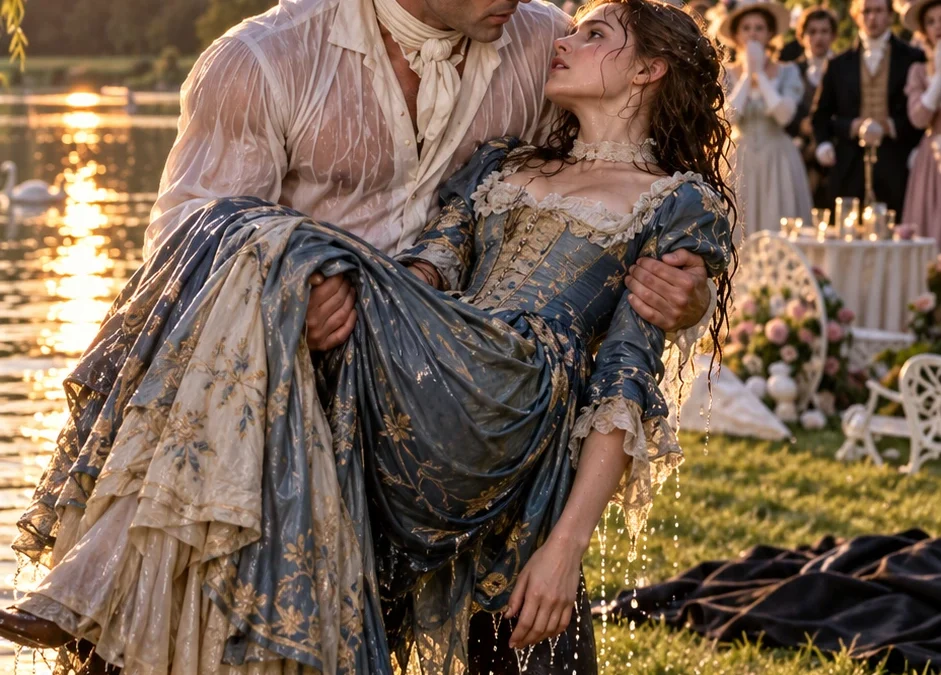
HER OWN SISTER SHOVED HER INTO THE LAKE IN FRONT OF 80 GUESTS. NOBODY MOVED. THEN THE DUKE SAW HER SINK AND REALIZED THE “ACCIDENT” EVERYONE WAS CALLING IT WAS A LIE THAT HAD BEEN PROTECTED FOR YEARS… 😱💔
Part 1
The shove came fast. It came without warning.
And Jasper saw it happen from twenty feet away and could do nothing to stop it. 😨
One moment, the young woman in the pale green gown stood at the edge of the ornamental lake, laughing at something her friend had said, the late sun catching the loose curls at her neck.
The next, her sister’s two hands were flat against her back.
She pitched forward off the low stone rim of the bank, arms flailing at empty air, and the water opened up and swallowed her whole.
Jasper Kendrick, Duke of Briercliffe, had been standing by the refreshment table with a glass of lemonade he had never wanted, half listening to Lord Featherstone complain about his gout. Then the splash cut through every other sound in the garden. A hard, flat crack. A scream somewhere in the crowd.
And then something worse than the scream.
Silence.
He turned toward the lake before he had even decided to turn.
Sir Henry Drummond’s garden party was meant to be the finest of the Kent season. White tents along the south lawn. A string quartet near the roses. Eighty guests in their best silks, sipping wine, admiring the long, curving lake Sir Henry had commissioned at great expense, edged with willows whose branches trailed in the water like fingers combing through their own reflection.
It was the kind of afternoon on which nothing was ever supposed to go wrong.
Jasper had come only out of duty. His aunt had reminded him the whole carriage ride that a duke of nine and twenty who had not danced at a single ball in two seasons was beginning to be talked about. He meant to bow over a few hands, say something pleasant about the roses, and leave before the dancing began.
He had not expected to notice anyone.
Yet twice in an hour, he had noticed the fair-haired young woman by the lake. Once when she laughed, and the sound carried clean across the lawn, bright and unguarded, so that half the garden turned to look. And once when she crouched in her good gown to speak kindly to a stray dog, never thinking of the grass stains.
Miss Emiline Drummond, his aunt had told him. One and twenty. The sweeter-tempered of Sir Henry’s two daughters.
He had not wondered what that comparison implied about the elder.
But he had noticed the elder. Dark where her sister was fair. Dressed in deep blue. Standing a little apart, arms folded, a smile fixed on her face that never reached her eyes. She had watched her sister all afternoon the way a hawk watches a rabbit.
Then the younger one laughed. Three gentlemen turned to look. One smiled.
And the elder sister’s face went white and still with something that was not sisterly affection at all.
And then her hands were on her sister’s back. And the younger woman was in the lake.
The whole garden drew one breath and held it.
Jasper was already running.
His mind worked two ways at once. One part was cold and clear, counting. Fifteen strides to the water. Six feet deep at the bend. And not one soul on that crowded lawn had moved.
The other part was simply afraid, in a way he had not been in years.
She had gone under almost at once. No graceful arc. No control. She had gone in sideways, arms still reaching for something that was not there, and the lake had taken her down like a stone.
Behind him, the party began to understand. A woman’s voice rose into a wail. The quartet stumbled to a ragged stop, one violin note hanging alone in the air. Guests near the water stepped backward, the way people do when they are frightened and cannot imagine what use they could be. One older lady fainted into her husband’s arms.
He passed close by the dark-haired sister as he ran.
She had not moved from the spot where her hands had left her sister’s back. She stood with both arms wrapped around herself, her face the color of old ash, staring at the water with an expression he had no time to read. Not triumph. Not even fright. Something caught halfway between the two, as though she could not quite believe what her own hands had just done.
He did not look at her twice.
Not yet. Not yet. Hold on.
Somewhere behind him, Sir Henry cried out, a raw sound of horror, a father who understood that his daughter might be dying in front of him and that his own body would not carry him there in time.
A young curate took one step and stopped. Two gentlemen by the rose beds began to run, but they were too far.
It would have to be him.
Jasper reached the bank and tore off his coat, because heavy wool and brass buttons would drag a man down like a stone tied to his ankle. For one instant he looked at the water.
It was not calm anymore. A spreading circle of ripples. And at the center of it, nothing. No hand. No hair. No pale green fabric.
She cannot swim, he thought. He did not know how he knew it. Perhaps because she had not come up. Not once.
Behind him, eighty guests stood frozen, like a painting. Parasols dropped in the grass. A plate of strawberries tipped and forgotten. It was not that they did not care. It was that some stubborn part of every one of them was still waiting for the afternoon to go back to being ordinary.
Jasper did not have that part in him. It had been burned away by the sight of two hands flat against a young woman’s back.
He went off the bank in a flat, hard dive.
The cold hit him like a wall. 🌊
It drove the breath from his lungs. Every instinct screamed at him to thrash for the surface. He did not let it. He opened his eyes in the murky green dark and kicked down, sweeping his arms wide. Nothing. His lungs already beginning to ache.
Then, off to his left and a little below, a pale shape.
Her gown. The green muslin had ballooned around her. Her arms were no longer reaching. No longer fighting. Her fair hair drifted loose around her face.
She was sinking slowly, the way a thing sinks when nothing in it fights the water anymore.
Still was worse than thrashing.
He closed the distance in three strokes and got one arm around her middle. She was slack, without resistance, and when he pulled, she did not move. Her petticoats had tangled around her legs, twisted and heavy. For one heart-stopping second he thought he would have to choose between his own air and hers, a choice he would never have known how to live with.
He wrenched harder. The fabric gave way.
It was such a small thing, a length of wet muslin, and it would stay with him longer than almost anything else. How close it had come to keeping her down there.
Black spots crowded his vision. He kicked once. Twice. Then he broke the surface with a gasp that tore his throat.
Air. Blinding sun. Shouting. Real shouting now.
He looked down at the face cradled against his arm.
Her eyes were closed. Her lips had gone faintly blue. Her head lolled against his shoulder as though every string that held it upright had been cut.
She was not breathing.
Hold on, he told her through gritted teeth, though she could not hear. I have you.
The bank was thirty feet away. His arms burned. His boots dragged like weights. He counted strokes in his head, because counting gave his mind something to hold besides the fear that his strength would give out before the bank did.
At last, hands reached for him. Footmen. A groundskeeper with a rope. He felt mud under his boots and staggered the last steps, refusing every hand that tried to take her from him until he could lay her down himself on the trampled grass.
He knelt over her. Water streamed from them both. She did not move. She did not cough.
“She is not breathing,” he said, steadier than he felt. “Someone fetch a doctor. Now.”
A young footman bolted toward the house.
Years ago, off the Yorkshire coast, Jasper had watched an old boatman bring a drowned sailor back while three grown men stood useless. He had never forgotten it. And now the memory rose up whole, as if it had been waiting nine years for exactly this moment.
He turned her onto her side. Dark, weedy water poured from her mouth, more than seemed possible. Still she did not breathe. He laid her back, tilted her chin, pressed the heel of his hand against her breastbone once, twice, a third time.
“Come now,” he said, low and urgent. “Breathe.”
Nothing.
Behind him, a woman sobbed. Sir Henry’s voice, cracked beyond recognition, begged someone, anyone, to do something.
Jasper pressed again, harder. And for one terrible, endless heartbeat he let himself believe he had failed. That the coat, the dive, the burning lungs had not been enough.
And then she coughed.
A racking, violent sound from deep in her chest. Her whole body convulsed as more water came up, and Jasper caught her before she could strike her head, one hand spread between her shoulder blades.
“That’s it,” he said, and his own voice cracked. “Good girl. Breathe.”
She drew a long, tearing, whooping breath. The most beautiful sound he had ever heard. Her eyes fluttered open, dazed, lost, and found his face and held there.
“You are safe,” he told her. “You are out of the water.”
He gathered her against him, soaked as they both were, and around them the crowd that had stood frozen began at last to move.
Sir Henry arrived, weeping, dropping to his knees. “Emiline,” he said, over and over. “My girl. My dear girl.”
So that was her name. Jasper turned it over once in his mind and found he did not want to let it go.
But even then, holding her, he could not forget the two flat hands.
And a moment later, the woman who owned them pushed through the crowd, her face the color of chalk, saying something over and over that Jasper, still holding the shaking girl, did not trouble himself to hear.
👇 Want Part 2? Comment any word and I’ll send it to you privately, or look for it in the comments!
Part 2
The doctor arrived ten minutes later at a dead run, bag half-buttoned. He found little left to do. He listened to her chest, felt her pulse, checked her eyes, and pronounced her remarkably fortunate.
“Another minute,” he said quietly, looking out at the lake, “perhaps less. It is as well someone went in when he did.”
No one asked who. Every eye had seen.
Jasper, kneeling in the wet grass with his ruined shirt clinging cold to his back, found that he did not want the credit. He wanted only to see her sit up on her own.
When she finally spoke, her voice was thin and scraped raw.
“I could not find the bottom.”
“You need not speak of it. You are out. That is all that matters.”
She looked at him then, a long searching look. “Thank you,” she whispered. Only two small words, but they landed in his chest with a weight he had no name for.
Later, wrapped in blankets and surrounded by faces she had known her whole life, Emiline understood exactly how she must look. Not rescued. Ruined. Soaked through, hair loose, gown plastered to her, eighty pairs of eyes measuring which word applied.
It was Jasper who noticed. He took the coat a footman had draped over him and settled it around her shoulders, drawing the collar up beneath her chin. A gentle gesture from hands that had been driving against her chest minutes earlier. He stayed beside her, one hand resting steady on her shoulder, as though daring the ring of staring faces to come any nearer.
By the time they had settled her by the fire in the small morning room, the garden party had not so much ended as curdled.
“I have ruined the party,” she said, in a small, flat voice determined not to shake. “Papa spent a fortune. The whole county was here, and now they will speak of nothing else for a twelvemonth.”
“They will speak of a young woman’s very great misfortune,” Jasper said. “And of nothing to her discredit.”
Her eyes were a clear, pale blue, red-rimmed now. “You are the gentleman who came in after me.”
“Jasper Kendrick. Duke of Briercliffe.”
Dismay flickered across her face, as though the news had somehow made the whole afternoon worse.
“Then you have ruined a very fine coat for a girl you do not know. And I have made a spectacle of myself in front of a duke. I cannot decide which is the greater misfortune.”
“The coat,” Jasper said gravely, “was not a particular favorite.”
The corner of her mouth twitched. She fought it back, as though smiling were disloyal to what had happened. He understood that this composure was costing her.
Then he asked quietly, “What is the true word?”
Her fingers tightened around her teacup. For a moment he thought she would say nothing at all.
“An accident,” she said. “The bank was slippery near the willow roots. I lost my footing.”
Jasper had seen the shove with his own eyes, clear across twenty feet of open lawn. He knew it was not the truth.
But he saw the way she held herself as she said it. The way her eyes would not meet his on the word accident. And he understood that this was not a lie meant to deceive him. It was a lie she had told herself first, and was only learning to say aloud.
“Of course,” he said gently. “The grass was wet. These things happen.”
Something in her shoulders eased. And Jasper found that relief troubling far more than tears. A young woman who was grateful to be allowed her lie was a young woman who had learned that the truth cost more than she could afford to pay. 💔
He did not sleep that night. And he did not leave Kent the next morning, as he had planned.
The next day, he accompanied his aunt, Lady Septton, to the Drummonds’ drawing room. Over tea he finally heard the story properly told, not by Emiline, but by her sister, Harriet, seated stiff and pale by the window, knuckles white in her lap.
“It was entirely my fault,” Harriet said, before anyone had asked. Her voice was steady. Rehearsed. “I stumbled on the uneven ground and caught hold of her, and we both went in. Only I kept my feet.”
It was, Jasper noted, a different story from Emiline’s. A slip of hers. A stumble of Harriet’s. No one else seemed to notice.
When Emiline came down, she took a seat two chairs distant from her sister.
Jasper noticed that distance. He did not think anyone else did.
By the window, in a few quiet minutes, she murmured, “It is kinder, I think, to let it stand as Harriet has told it. It spares Papa. He has enough to think of without believing his own daughter capable of…” She stopped. She did not finish.
“You need not explain it to me.”
As she turned, her loose sleeve slipped from her wrist. A bruise, gone yellow-green with age. Far older than anything the lake could have given her.
She saw him notice. She drew her sleeve down at once, swiftly, practiced, and said nothing.
This was not the first mark she had learned to cover in a hurry.
Then, leaving the house, Jasper glanced back and caught Harriet drawing her sister aside in the hall, her hand closed tight around Emiline’s wrist.
“Embarrassed the family further,” he heard. And then, sharper, in a low flat voice of someone long used to being obeyed:
“Say one word to contradict me, Emiline, and I promise you…”
He did not catch the rest. But he saw Emiline’s face. Not surprise. Not outrage. Only a weary, resigned understanding, the look of someone hearing a threat she had heard many times before.
That night, alone in his study, Jasper understood what he had mistaken for ordinary embarrassment. She had not been afraid of the gossip. She had been afraid of going home to the person who had pushed her into six feet of water, and who would tell her, in a voice too low for anyone else, exactly how she was permitted to speak of it. 😨
Over the next days, he asked no direct questions. He simply listened.
His aunt, over cards, said, “I am not surprised it was Harriet who stumbled into her. That girl has never had an easy temper where her sister is concerned.” She hesitated. “There was a thing years ago with a horse. Emiline’s mare threw her badly. There was talk the girth strap had been tampered with. Nothing was ever proved. I confess I have thought of it more since Saturday.”
A housekeeper’s cousin told of a heavy book flung at Emiline’s head over a ribbon. Sir Henry called it high spirits.
An elderly cousin, delighted to have a duke’s ear, told him with relish that Harriet had once locked her sister in the old ice house for an entire afternoon when they were girls of ten and twelve. Emiline came out shaking and blue, and kept to her bed for a fortnight.
A game that went on too long.
Accident. High spirits. A game gone wrong. Jasper noticed that every story wore the same soft, forgiving shape, as though the whole family had spent years agreeing, without ever saying it aloud, which words were allowed to describe what happened between those two sisters.
When Lady Septton finally put down her needlework and said, “You care for her,” he did not deny it.
“I cannot leave her in that house. I think she needs to be got out of it. Somewhere her sister cannot reach her.”
And he remembered his aunt on his mother’s side, Lady Marchmont, a widow near Bath, who had once said she would not mind a young companion for the season.
It was not a complete plan. But it was a beginning.
He called on Sir Henry the following Thursday, alone. In the pipe-smoke warmth of that study, he set down his untouched glass and said it plainly.
“It was not an accident.”
Sir Henry’s face went through confusion, then wary alarm, then something close to fear.
“I was standing not twenty feet away. Your elder daughter placed both hands flat against your younger daughter’s back and pushed her into the lake.”
“You are mistaken.”
“I am not, sir. I wish I were.” Jasper’s voice was quiet but unyielding. “I have heard of a girth strap that wore through at a convenient moment. A book thrown hard enough to leave a mark. An ice house, and a fortnight’s illness after. Each was called an accident, or high spirits. I do not think you are a cruel man. I think you are a father who has found it easier, again and again, to believe the kinder story.”
Sir Henry’s shoulders sagged, as though some long-held effort had finally given out. When he looked up, his eyes were wet.
“What would you have me do? She is my daughter, too. I will not pretend I have never wondered. Never lain awake turning these very stories over.”
“I am not asking you to turn on her. I am asking you to protect the daughter who is in the greater danger.”
Jasper laid out the plan. Lady Marchmont. A season in Bath. Not in disgrace. Simply a young lady taking a respectable invitation.
“And why,” Sir Henry asked at last, watching him sharply, “should a duke trouble himself so deeply with a baronet’s daughter he has known scarcely three weeks?”
Jasper did not hide.
“Because I have not been able to stop thinking of her since the moment I pulled her out of that lake. I will not pretend my interest is purely disinterested, though it began and remains entirely honorable.”
Sir Henry crossed to the window and stood a long moment with his back to the room.
“I have known in some part of myself for a long time. I told myself it was ordinary sisterly jealousy. I am ashamed to say I chose more than once not to look too closely.”
Emiline was sent for. Her father, haltingly, told her what had been offered.
She turned to Jasper with eyes gone bright and unguarded. “You did this.”
“I told him what I saw. The rest is yours to accept or refuse.”
“I accept,” she said, without a moment’s hesitation. And that quick, unguarded certainty told Jasper exactly how long she had been waiting, without daring to hope, for someone to open a door.
When Sir Henry left them alone, she said quietly, “You did not have to. Most men would have considered the matter closed once I was out of the water.”
“I am not most men. Where you are concerned.”
She went still. Color rose in her cheeks.
“Lady Marchmont used to tell me I had my father’s stubbornness and my mother’s temper, and that the combination would be the ruin of some poor woman someday,” he said.
And Emiline laughed. Soft, surprised, entirely genuine. The first real laugh he had heard from her since the lake.
“I hope I am not the poor woman in question.”
“I hope you might be,” Jasper said.
He had not entirely meant to say it aloud. She did not answer. But she did not look away either.
👇 Want to know what happened to Harriet, and to them? LIKE or COMMENT “REVEAL” and Part 3 will be posted once we reach enough comments!
Part 3
Emiline left for Bath three weeks later, in the first cool week of autumn.
Harriet did not come out to see her go. Jasper noted the absence. And he noted that Emiline did not seem surprised, only quietly, carefully unbothered, like someone who had long since stopped expecting certain kindnesses from certain people.
Before she climbed into the carriage, she found his eyes across the gathered household.
“You will write?”
“Every week,” Jasper said. “Whether you answer or not.”
“I will answer.”
The carriage door closed. She was gone in a cloud of autumn dust. And Jasper stood watching long after it had vanished, counting the days until he might see her again.
He kept his word.
His first letters were careful accounts of weather and Briercliffe, fit to be read aloud to a chaperon. By the winter, neither of them pretended they were anything but what they had become.
Hers changed too. The first were brief and a little stiff, as though she was not certain she was allowed to say what she truly thought to anyone, let alone to a duke. By December they were long and easy, full of Lady Marchmont’s sharp opinions on bonnets and politics, of assemblies she had begun, tentatively and then with growing confidence, to enjoy. A laugh seemed to be finding its way back into her words, even when she was only describing the price of ribbon on Milsom Street. ✉️
He visited when he could. Twice that autumn, and once at Christmas.
On that Christmas visit, they walked together through Sydney Gardens, the air sharp, their breath showing in small white clouds. Her arm tucked through his with an ease that would have been unthinkable months before.
She told him of her childhood. Not the ice house. Small things. A birthday forgotten because Harriet had fallen ill the same week, and could not, their mother said, be overshadowed twice in one month. A new gown put away unworn because Harriet wept at the sight of it until their mother quietly gave it to her. Small unfairnesses worn smooth by repetition until Emiline had stopped expecting anything different.
“I used to think it was my fault,” she admitted, watching her own breath rather than look at him. “That there was something in me that provoked her. It took me a long while, even after Bath, to understand I had done nothing at all to deserve any of it.”
Jasper stopped their walk entirely.
“You did nothing to deserve any of it. Nothing, Emiline. Not the ice house. Not the bruise on your wrist. Not the lake. You were a girl who laughed too easily and drew too many kind glances, and that is the whole of what you ever did wrong. Which is to say, nothing at all.”
She cried then, quietly, in the cold garden, and he simply held her. And it was there, holding her while she wept out a decade of unspoken hurt, that he understood the full weight of what he felt. Not merely admiration. Not merely the protectiveness that had sent him into a lake after a stranger. Something steadier, something that he suspected would last him the whole of his life. ❤️
By spring, Lady Marchmont had stopped pretending not to notice the Duke of Briercliffe’s frequent visits, and had taken to leaving the two of them alone in her drawing room for longer and longer stretches, on the thinnest excuses.
By early summer, when the roses came into bloom again, he knew exactly what he meant to do, and exactly where.
He wrote first to Sir Henry, requesting permission to address his daughter on the subject of marriage, and received so warm and immediate a reply that he suspected Sir Henry had been hoping for the letter for months. Then he wrote to Emiline, saying only that he had a particular wish to walk with her, when she next came home to Kent, along the bank of her father’s lake.
She came home in late June, nearly a full year after the garden party.
He walked with her down through the garden, past the very roses that had bloomed that terrible, ordinary summer day, toward the lake. She had not been back to the water’s edge since the accident. She told him quietly she had wanted to. She had told herself she must face it, rather than let it hold power over her forever.
She stopped a few feet from the bank and looked out across the calm, sunbright surface. There was more courage in her face than fear.
“It looks so ordinary,” she said, almost wondering. “Just water. I had built it into something else entirely in my mind.”
“It was never the water that mattered,” Jasper said. “It was who put you into it, and who was willing to come after.”
She looked at him. He saw that she understood exactly why he had brought her here.
“I think of that day often,” he said, and found that his rehearsed words had entirely deserted him, leaving only the plain truth. “I think of how frightened I was running across that lawn. I have never in my life been so afraid, before that day or since. And I think of everything that has come after. Every letter. Every visit. Every hour I have spent these twelve months finding reasons to be wherever you were. I have never once regretted diving into this lake after you, Emiline. And I regret even less the year that followed.”
A blackbird sang beyond the willows, unhurried. Her hand had found his sleeve, without either of them noticing when, her fingers curled into the fabric as though she meant never to let go.
“I love you,” he said simply. “I think I have loved you since the first time I saw you laugh that afternoon, before any of the rest happened. I do not want to spend my life writing you letters and counting days between visits. I am asking you to marry me. Here, if you will let this place mean something other than fear from this day forward. I would have this lake remember something better of us than what it first witnessed.”
For a long moment she said nothing at all. His heart climbed into his throat, with a fear that had nothing to do with cold water.
Then she smiled. The same unguarded, easy smile he had first noticed across a crowded lawn.
“Yes,” she said. And then, because one word did not seem enough, “Yes, of course. Yes.”
A pair of swans drifted past on the far side of the lake, indifferent to the moment unfolding at the water’s edge. He took her hands in his and pressed a kiss to the back of one.
“I should tell you,” Emiline said at last, with the ghost of a smile, “that I have already written to Lady Marchmont to say I expect to be married by autumn. Whether or not you had actually asked me yet.”
“You were that certain of me?”
“I was certain of myself. I have been for a good while, Jasper. I was only waiting for you to catch up.” 😄
They were married that autumn in the small stone church in the village, with the whole county in attendance. A good deal more of it, Jasper noted with private satisfaction, than had ever bothered to look twice at Emiline Drummond before the day she nearly drowned in her father’s lake. Sir Henry wept through the entire ceremony. Lady Marchmont sat in the second pew looking as though she had personally arranged the match, which she reminded everyone of for the rest of the afternoon.
She very nearly had.
The wedding breakfast was held, at Emiline’s own request, in the garden by the lake, under a sky as bright as the one that had shone on that terrible afternoon. Tables were laid along the bank where Jasper had once torn off his coat and dived without a thought for himself.
And Harriet was there.
She sat at a careful distance near the edge of the gathering, dressed plainly, watching with an expression Jasper could not entirely read. But it held no trace of the cold jealousy that had once darkened her face across that same lawn.
She had spent the year, he had learned from Sir Henry, in a slow, difficult reckoning with herself, helped by a clergyman’s counsel and by the plain, unavoidable sight of her sister flourishing in a life Harriet had so nearly destroyed. In the spring, Sir Henry had written that Harriet had at last begun to speak of that afternoon without reaching first for the word accident. And that she had wept, when she finally did, less like someone afraid of consequences, and more like someone grieving what she had so nearly done.
It was not forgiveness. Not yet. But it was a beginning. And Jasper, reading it by his fireside, had thought that a beginning was very often the best any family torn by such things could honestly hope for.
She did not approach the wedding party, and no one pressed her. But she stayed the whole afternoon. And when Emiline caught her eye once across the crowd, Harriet inclined her head, small and careful, in something that might, with time, grow into an apology.
As the afternoon softened toward evening and guests drifted toward the house for dancing, Emiline turned to him with a teasing light in her eyes.
“No regrets, your grace? Not even for the coat?”
Jasper drew her close against his side, both of them standing at the water’s edge where it had all begun.
“I have told you before, and I will go on telling you for the rest of our lives, Emiline. I have never once regretted ruining a good coat for you. I would ruin a hundred more gladly, and count every one the finest bargain I ever made.”
She laughed, bright and unguarded and entirely her own, and rested her head on his shoulder as the sun went down gold over the lake.
And Jasper stood there a long while, holding her, remembering a terrible afternoon a year gone, when he had believed for one moment that he had lost her before he ever truly had the chance to know her.
He had not lost her.
She was safe. She was warm. She was laughing. She was finally, entirely home.
He had gone to a garden party out of nothing more than duty. And he had found the whole shape of his life waiting for him at the bottom of a lake. ❤️
This story is entirely fictional and created for entertainment purposes only. It does not represent any organization or individual, nor does it encourage inappropriate behavior. The content was generated with AI assistance.








