Her Secret Letter Went to the Wrong House. The Duke Who Opened It Read Every Page, Then Did Something That Changed Both Their Lives Forever
Her Secret Letter Went to the Wrong House. The Duke Who Opened It Read Every Page, Then Did Something That Changed Both Their Lives Forever
PART 1
“Read that. Not from the beginning. From the eighth page, halfway down, where it says And on Tuesday they took away the inkstand. Read it aloud, Crane. I want to hear whether it sounds as bad in another man’s mouth.” ✉️
Mr. Tobias Crane took the sheet with the particular care of a secretary eleven years in the service of the Duke of Dorford, who has learned to tell from the state of the breakfast table roughly how much of the day is going to be destroyed. The coffee had gone cold, untouched. Nine letters from the agent at Dorford lay unopened. The Duke stood at the window with his back to the room, in a dressing gown over yesterday’s shirt, which meant he had not been to bed.
“Your Grace, whose letter is this?”
“Read the page, Crane.”
So Crane read it.
And on Tuesday they took away the inkstand. I do not say this to be pitied. I say it because it is the exact thing that happened, and I find I cannot stop setting down exact things. My aunt came up with Mrs. Suddick behind her and said the doctor had advised against writing. That writing heats the blood and disorders the nerves. She said it in that soft voice she uses, which is worse than shouting, because shouting can be answered. And then she took the inkstand off the table and the pen out of my hand, and she said, “My love, you will thank me in a year.”
I am twenty-three years old. I have been in this house since the fourteenth of March. I am in excellent health. I am writing this with ink I have made out of soot and vinegar and a little gum, in a cup, with a crow’s feather Mrs. Suddick’s boy cut for me on the fell. 🪶
Crane stopped. “Go on,” said the Duke. “There are six more pages.”
They have the guardianship under my father’s will until I am five and twenty. They have let Scarthwaite for two hundred and forty pounds a year, and I am not told where it goes. They have sold the horses and the plate and the pictures, which they may do, and the books, which they may not. The mill at Netherbeck has had no new carding frames in four years. Mr. Heath, my father’s overlooker, has been turned off at fifty-one with no pension, and has written to me twice, and I have not been given the letters. In February my cousin Aubrey sat in my father’s chair with his boots on the fender and told me it would be the simplest thing in the world. That the money would stay in the family. When I said no, he laughed and said I should have a year to think better of it. And on the fourteenth of March a chaise came at seven in the morning.
That is how it is done, cousin. Not with cruelty. With a soft voice and a doctor’s name and the air of Westmorland.
The ninth page said: Do not come. If you came, they would only say you had been imposed upon by a sick girl, and they would say it so kindly you would end by believing it. Keep this letter. Put it in a box and write on the outside the day you received it. If in fifteen months I come to your door and ask for it, give it to me. I have no proof of anything in the world except that I was able to write this down on the day it happened. That is all a person in my situation has. I am, with great affection and a perfectly steady hand, your cousin, Brunhild Quillgrave. Hartsop, in Westmorland, the second of May. 💔
Crane squared the nine sheets, because he was a man who squared things. “Your Grace, who is Miss Quillgrave?”
“I have no idea.”
“Then how?”
“The cover washed out to four letters in the Kendal bag. My housekeeper put it with the Fenimore post, because the four letters were old. For two years I have been forwarding the letters of a woman I have never met. Mrs. Dorcas Fenimore had this house before the fire. She went to Bath in the spring of the year twenty. I open every cover, because the alternative is to send a blank one at the lady’s expense.” He turned at last. “I opened this one at twenty past eight on Thursday. I read two pages before it was clear it was not a woman complaining of her nieces. I read the third knowing perfectly well I had no business with it. And then I read the other six, sitting down with my coffee. There is no version of that which does me the smallest credit. I have been standing at this window since four trying to find one.”
“Your Grace could not have known.”
“I could have stopped at the top of the third page. I did not. Let us have that straight, because we shall be saying it a long time to a number of people, and it had better be the same sentence every time.”
He put one finger on the ninth sheet. “Look at the ink, Crane. It is brown in places. It is soot and vinegar, made in a cup by a woman who was not allowed a pen. In fifteen months it will be the best evidence in the north of England, if she is still alive and in her senses. And if she is not, it will be nine pages in a box.”
“You have no standing, sir. None whatever. You are not her kin, her guardian, or her trustee. You have never been introduced. A great nobleman rides three days into Westmorland for a young woman he does not know. Name me the construction they will put on that.”
The Duke of Dorford stood very still. “That is exactly right. You are a better man than my counsel. Now hear mine. In the year nineteen a tenant of mine named Jasper Creed wrote me eleven pages about an enclosure award. Figures, a pencil plan, and a sentence at the end to the effect that he had nobody else to write to. I was four and thirty, and the Lords were sitting. I gave it to a secretary. It was looked into in the proper manner, and the proper answer went out in nine weeks.” He turned his cup on the cloth. “He was gone in six. Not as you are imagining. He went to Liverpool, and his wife had the parish, and his three children were separated into two houses. There is a very correct minute on a file at Dorford to show that the Duke looked into it. It is in the second drawer of the cabinet behind you. I have not been able to throw it away in eleven years. I have not been able to read it twice.” 🕯️
Crane said nothing at all.
“There are two things to do with a letter you had no right to read. One is to put it in a box with the date on the outside, as the lady asks. The correct, lawful, gentlemanlike course, and extremely comfortable for me. The other is to get on a horse.”
“She asks you not to come.”
“She asks her cousin not to come. Her cousin has been in Bath two years and plainly never knew. That is the whole tragedy of this letter, Crane, and you have not noticed it. There is a woman in a farmhouse who spent three evenings making ink out of soot because there was one person left in the world she believed would keep a thing in a box for her. And the letter did not go to that person. It came to me.” He went to the door. “Have Hardwick bring the gray and the chestnut in half an hour. Tell him Westmorland. Write three letters. One to Nitsdale, to learn who were the trustees of a Mr. Quillgrave of Scarthwaite near Kendal, worsted manufacturer. One to the Vicar of Patterdale, civilly. And one to Mrs. Fenimore at Bath, saying I opened a letter of hers by accident and read it by design, that it is the worst thing I have done in some years, and that she is to write at once to her cousin and tell her she has not been forgotten. Under cover to the vicar. On no account to mention me.”
He was on the Great North Road by eleven, with no standing whatever and nine pages of somebody else’s life in a flat leather case buttoned inside his coat.
“You are either the stupidest man in England or you are my uncle’s, and I warn you I have got very good at telling, and it takes me about a minute.”
It was the evening of the third day. He had come over the pass with the light going, the gray cast a shoe at Troutbeck, and arrived at Slate Farmhouse under Hartsop Dodd on a hired chestnut, unshaven, in a coat wet twice, with four hours’ sleep in sixty and no notion what he intended to say.
She was taller than he had expected, which was absurd. A plain oatmeal gown, sleeves pushed back, forearms wet to the elbow from scalding a churn, hair pinned anyhow, a smear of something white along her jaw. Not pretty as the word is generally used. A long clever mouth and very level eyes, and she looked at him exactly as a man looks at a horse he is thinking of refusing.
“My name is Lodgett. I am the Duke of Dorford.”
“Then you are the stupidest man in England, because the Duke of Dorford is in Berkshire, and a man wishing to get into this house by a lie would choose a name that could not be checked. Mrs. Suddick will come out of the dairy in four minutes, and what I tell her will go to Kendal by Thursday. So you have four minutes.”
“I have read your letter.”
Everything in her face shut at once, like a shop. 😨
“Nine sheets dated the second of May, written in soot and vinegar and gum, with a crow’s feather, beginning My dear cousin and ending a perfectly steady hand.” He did not take out the case. He had worked that much out on the pass. “It was directed to Mrs. Fenimore at the Dower House at Dorford. Your cousin left that house in the spring of twenty. I read two pages in honest ignorance and seven more in none at all. There is nothing to be said for it, and I am not going to attempt it.”
She put one hand flat on the doorpost. “Dorcas has been in Bath since April of twenty. I have written to her seven times in two years.”
“I should think six of those are in a drawer at Scarthwaite, and the seventh went astray because you did not send it through your aunt. It went wrong, the wrong man read it, and here I am.”
She was not crying. He had been braced for tears the whole way over the pass and had assembled three or four sentences for the purpose, and he put them away forever, because what she did was lean her head back against the doorpost and shut her eyes for two seconds and say, in a voice of absolutely flattened calm: “Two years. She never had one of them. And I thought she had grown tired of me.”
Then, to his very great alarm, she began to laugh. A short hard laugh of about three notes, one hand over her mouth. “Do you know what you have done? Standing there with your hat in your hand, being so very honest about it? There is not one person alive who knows the inside of my head except you. Not my father, he is dead. Not Dorcas. Nobody on this earth knows what was done to me in February, and what I think about at four in the morning, and what the ink was made of, except a man whose face I had never seen until four minutes ago, and to whom I have not been introduced.” Her voice did not rise. That was the thing he would remember. “I wrote nine pages because there was one person left who would know me. And you have taken that, sir, entirely by accident, and I cannot have it back.”
“I do not expect to be thanked. I expect to be sent away.”
“Then why have you come?”
“Because of the inkstand. In all nine pages you asked for exactly one thing, and it was not rescue, and not money, and not a man on a horse. You asked that somebody keep the paper in a box and write the date on the outside, because you had worked out, alone in a farmhouse, that the only thing a person in your position possesses is the fact that they wrote it down on the day it happened.” He put his hat on the slate step because his hand had grown tired of holding it. “That is not the letter of a woman whose nerves have been tried. That is the letter of the only person in this business who understands what will happen in fifteen months.”
“Say the rest.”
“On the twenty-second of July after next you come of age, and the guardianship falls in, and they hand you a sheet of paper. You will be a woman of five and twenty who has lived two years in a farmhouse for her health. Your aunt will have said so in a soft voice in nine drawing rooms. The one thing you will not get on the twenty-second, Miss Quillgrave, is your character back. The story will follow you into every room for the rest of your life, and every time you contradict it, you will prove it.”
“And?”
“And it can be broken, but only while it is still being told. With that paper, in Chancery. Which means a petition, an attorney, money you have not got, and a case you have, which nobody in England has read but me.” He stopped. “And the person who does it must be you, not me. I am the single worst thing that could happen to your case.”
“Then why are you in my doorway?”
“Because I did not know that when I got on the horse. I worked it out somewhere about Shap, and came the rest of the way anyhow, because of a possibility I could not put out of my head. That you were ill. Not in your nerves, in your body, in a wet valley, with a kind woman whose wages are paid by somebody else, in the second week of May with no inkstand.” He picked up his hat. “You are not ill. I have seen that you are not, and it has taken four minutes, and that is the whole of what I came for. Where am I to go?”
She considered him. “There is an inn at Patterdale, two miles. The Yew. It is not good.”
“Then I shall be at the Yew.”
“For how long?”
“Until you tell me to go, or the twenty-second of July after next, whichever comes first.”
“That is fifteen months at a bad inn.”
“I have had worse billets. I am told the water is excellent.” 😮💨
And Mrs. Suddick came round the corner of the house wiping her hands and stopped dead, with the plain naked worry of a woman who has been given orders she does not like and keeps them because she has a landlord. Brunhild Quillgrave, holding nine sheets against her apron, said in the calmest voice in Westmorland, “Mrs. Suddick, this gentleman has come up from Berkshire with a letter of my cousin Dorcas’s that was carried wrong, and he is going on to Patterdale tonight. You had better say so in Kendal on Thursday, exactly like that.” She turned. “Go to the Yew, Duke of Dorford. Do not call here. If I have anything to say to you, I shall say it on the fell, which is nobody’s parlor, with Mrs. Suddick’s boy forty yards behind me, and you will not take a step toward me that I have not asked for. And I have still not been introduced to you. I should like that remembered by both of us, because I think it is going to matter.”
PART 2
The Yew at Patterdale had four rooms, a landlord with one subject, and mutton on Tuesdays, and the Duke of Dorford lived in it for seven months and learned the subject. 🐑
He did it at first entirely by letter, because the fell was hers, and he had been a man of his word so long it had stopped being a virtue and become a kind of furniture. Crane came up in June with two boxes and a horror of the mutton, and for the rest of that summer the inn at Patterdale did more post than the whole of Kendal.
Mr. Nitsdale’s report came on the eleventh of June. Hollis Quillgrave’s will appointed Mr. Cosmo Pellick, the testator’s brother-in-law, guardian of his daughter, and appointed Mr. Pellick and old Mr. Rasmus Garrow of Kendal, attorney, trustees. “Mr. Garrow is eighty-one and has been incapable of business since the winter of twenty-one, a fact known in Kendal and not communicated to any court. There is only one trustee who can ride, Your Grace. And he is the father of the young gentleman who sat with his boots on the fender.”
The Duke bought eleven cottages at Netherbeck, a wharf, and a half share in the carding sheds, so that a ratepayer might ask for things a stranger could not. He had Nitsdale find Mr. Heath, the overlooker, and ask him in the ordinary way, before a witness, whether he would come back if the mill were put in order. Heath said yes. He said a great deal else, about a carding contract let every year since twenty-one to a house in Lancaster of which the cousin Aubrey was a partner, at a price one could only call affectionate.
On the fell above Hartsop, with Mrs. Suddick’s boy forty yards off on a wall throwing stones at nothing, Brunhild told him what Dorcas Fenimore’s letter had said. “She thought I had married Aubrey and been too ashamed to tell her. My aunt wrote her so in the autumn of twenty. And now she has written me nine pages, and the first four are an apology, and I cannot bear it.”
“Lend Mr. Heath forty pounds,” she said at last, about the overlooker still on his parish, “at five per cent, on a note of hand in my name, payable by me. I will not have a man of fifty-one on the parish because I am too proud to be helped. But it is a loan, and my debt.”
“To the farthing,” said Lodgett, “and I shall enjoy it very much.” 🤝
In July she began the second record, and it was entirely her own idea. “I have been treating that letter as the proof. It is not. It is one day’s worth. What is wanted is every day. I shall write down everything, in a book, with the date at the top. What is taken away, what my aunt writes, what the doctor says, what I am not given to read. A page a day, dated and dull. I shall not be furious in it, not once, because fury can be called nerves and arithmetic cannot. And I shall want the ink to be soot and vinegar and gum, and the paper the grocer’s sugar comes in, so that every page is its own witness.”
“I would send you a hogshead of ink.”
“That is exactly what you will not. For fourteen months, nothing. No ink, no paper, no pens, not a parcel, not a hamper at Christmas. Can you do that?”
He looked out over Brothers Water. “Miss Quillgrave, that is the best piece of generalship I have heard since the year fifteen, and I would rather be shot than do it.”
He did it. The whole of his part consisted almost entirely of not doing things. He was permitted to walk two miles up the valley with her on a fell, a farm boy forty yards behind. He was aware of what was happening to him. He was thirty-nine, the coldest man in three counties since the year nineteen, and perfectly able to recognize a thing when it had hold of him. He recognized it on the fourth of October, on the path above Deepdale, when she said, “You have it by heart, have you not?”
“All nine pages. I read it eleven times in the first three days, and after that it was simply in me. There is a sentence in the sixth page about what you do at four in the morning. I have never read a sentence I wished so much to have been told instead of having stolen. A man can give back a horse. He cannot give back a page.”
She walked twenty yards without speaking. “No. He cannot. It is an injury, and it is the only one I have ever had that I have not been able to make myself regret. You may do what you like with that, sir. But you may not ask me about it for fourteen months, because I have a book to keep, and it must be dull.” 🥹
They came down in the near dark. In the farmyard stood a chaise with a Kendal post-boy at the horses, and Mrs. Suddick in the doorway with her apron twisted in both hands. “Miss Brunhild, your aunt is in the parlor. She has brought the doctor from Kendal, and says you are to be moved Monday to a house at Wickton beyond Carlisle, where the air is drier.”
“Then he shall examine me,” said Brunhild, “now, in this parlor, with Mrs. Suddick at that window and the Vicar of Patterdale fetched down to stand at that one. And he shall write what he finds, and sign it, and so shall both witnesses.”
Lodgett stood outside the window in the wet with his hat off like a poacher for eleven minutes, and was never afterward ashamed of it. He heard the voice, exactly as written, soft, unhurried, perfectly kind. “My love, you are agitating yourself.”
“Dr. Mullins, you have attended me four times in nineteen months. You have never stayed above ten minutes, nor been in a room with me alone. Will you examine me and sign a paper?”
A silence long enough for him to learn something about Dr. Mullins of Kendal that he used eleven months later to considerable effect. “I think the strictest quiet is everything in a case like this.”
“That is not an answer. You may have anything you ask for, my love, ask me now and see.”
“An inkstand.”
The pause was two seconds long. Lodgett heard it. So did Mrs. Suddick. And so, most importantly, did Dr. Mullins. 😳
“You shall have an inkstand at Wickton,” said her aunt.
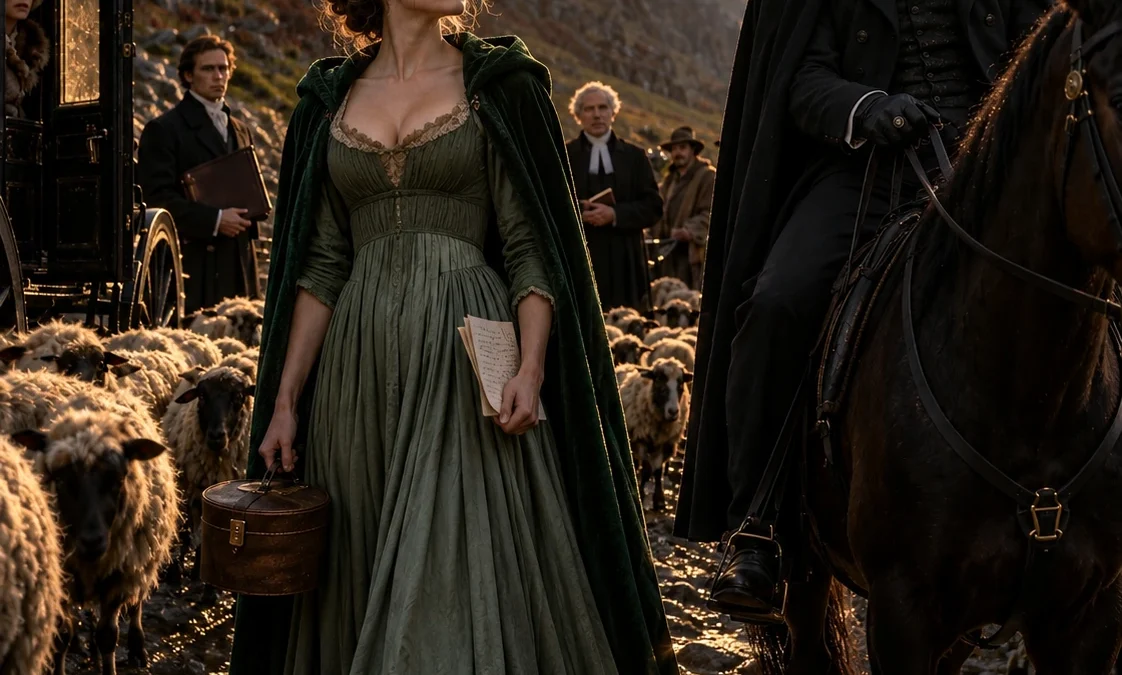
They went Monday the seventh of October, at three minutes past nine, in a hired chaise. The Duke met them at the top of Kirkstone. He had put it together in thirty-six hours, for once in his life with no subtlety whatever, because subtlety was the one weapon the other side had plenty of. A drove of eleven hundred sheep was coming down the pass, with four drovers, the tollkeeper, the Vicar of Patterdale, the Vicar of Ambleside, and Mr. Nitsdale’s Kendal agent with a clerk and a watch. And in the middle of the road, on the chestnut, bareheaded, sat a duke.
The chaise stopped because it could do nothing else. The sheep flowed round it like water round a post.
“Good morning,” said Lodgett loudly to everybody. “I am the Duke of Dorford. I am about to do something improper in front of witnesses on purpose, and I wish there to be no argument afterward about what it was. Madam, I will not stop this carriage. I will not touch the horses. Mr. Bainbridge will record that I did not lay a hand on the door. Miss Quillgrave, can you hear me?”
A second window came down. “I can hear you.”
“Three things, and the whole parish may have them. First, I am the man who read your letter, and I have said so to every soul in this valley since May. Second, you are not required to go to Wickton. You are three and twenty, unmarried, under no order of any court, and a guardian’s authority over the person of a ward of your age is a very much smaller thing than your uncle has let you suppose. If you get out of that carriage in front of two clergymen, four drovers, a tollkeeper, and an attorney’s clerk, no man in this kingdom may lawfully put you back into it. Third, and this is the one I came to say. If you get out, you get out alone. I shall not hand you down. I shall not take you up behind me. I shall not give you a roof, a shilling, a conveyance, or my arm. Mr. Bainbridge has a note of hand for twenty pounds at five per cent in your name, a loan on commercial terms. And the Vicar has offered his sister’s rooms at Grasmere at eleven shillings a week, which you will pay. And I shall not come to Grasmere.”
“Why not?” said Brunhild.
“Because your case is worth more than my company. And because you told me in a doorway in May that you had not been introduced to me, and that it was going to matter.”
The door of the chaise opened from the inside.
A young woman in an oatmeal gown and a gray cloak got out onto the road without assistance. She took out a bandbox, a wooden writing slope, and a brown paper parcel tied with string. She said something into the carriage that the Vicar of Patterdale repeated at a dinner nine months later to eleven people: “Aunt, I am not angry with you, and I do not think you ever meant it as it has turned out. But you took my inkstand off a table with your own hands, and I shall remember it as long as I live.” 🕯️
Then she shut the door and walked round the back of the chaise through the sheep, and stopped eight feet from the chestnut, and came no closer.
“Mr. Bainbridge, the note of hand, if you please, and a pen. I shall sign it here on the slope.”
She signed on the road, on the lid of a writing slope, with eleven hundred sheep going past. “Sir, I observe you have been sitting on that horse this whole while, so that nobody could say you had handed me down. Vicar, I accept your sister’s rooms at eleven shillings. I can keep accounts and copy a hand, and I shall advertise in the Kendal paper on Saturday. And one more note, Mr. Bainbridge, written and signed before I move off this pass. Write that on this day, Miss Brunhild Quillgrave of Scarthwaite, being of sound body and mind and in perfect health, left her aunt’s carriage of her own motion upon the public road at the summit of Kirkstone, and that she did not at any time take the hand, the arm, the horse, the carriage, the roof, or the money of the Duke of Dorford, and that the said Duke remained mounted at a distance of eight feet throughout.”
Eleven people signed it, including two drovers who made their marks and a schoolmaster’s son who wrote a very good hand. “That,” said Mr. Bainbridge, folding it, “is the most extraordinary document I have ever drawn on a mountain.”
“It is the first page of my book,” said Brunhild. “I should like it entered as the seventh of October.”
She walked down to Patterdale with the vicar carrying her parcel, and the Duke of Dorford sat on a horse at the top of Kirkstone Pass and watched her go for a considerable time. Then he rode the other way down into Ambleside, because he had said he would not come to Grasmere, and he had seventeen months of not coming to Grasmere in front of him.
That evening, Crane found him with a letter from Mr. Aubrey Pellick. It threatened an application to Chancery for the protection of the ward’s person, and enclosed a list of dates upon which His Grace was said to have walked with her upon the fells.
There were nineteen.
“Nineteen walks upon a fell, two clergymen, a tollkeeper, and a pass full of sheep,” said Mr. Nitsdale, in chambers in Lincoln’s Inn on the fourth of December. “And I am obliged to say, in this cause, the sheep are the best of it. Everything Miss Quillgrave has done to prove she is in her right mind is also evidence she has been meeting a duke in private for seven months. Her book is magnificent. And in it, in her own hand, under the dates, she has entered every one of the nineteen walks with the hours, because she is scrupulous. She has handed them the scandal herself, out of pure honesty.”
“Then give me the unclever answer.”
“The first is that Your Grace should marry her at once, by license, before the cause is heard. It answers everything.”
“No.” He put both hands flat on the table. “In nineteen months that woman has had one thing taken off her at a time, her house, her horses, her father’s books, her post, her inkstand. All of it lawfully, all of it kindly, by people who told her it was for her good. If I marry her in December to win a suit in May, then every single thing she has done since the second of May becomes something done for her by a duke. She will be grateful. And she will be twenty-four years old and grateful for the rest of her life. I had rather lose the cause.”
“It is not Your Grace’s cause to lose.”
That landed. He let it land. “No. What is the second?”
“The second is that you disappear.”
So he disappeared. It took nine days, and he did it thoroughly, with documents. He sold the cottages, the wharf, and the carding sheds at valuation to a trust of three Kendal men with no connection to him, on terms giving Miss Quillgrave first refusal at the same valuation for three years. The profit, two hundred and eleven pounds, he paid to the Vicar of Patterdale for the poor of that parish, so that no man could say he had made a shilling in her valley. He wrote one letter, four lines long, which took him two days.
Madam, my counsel advises that the strongest evidence in your cause is your own book, and that the weakest thing in England is my presence within forty miles of you. I am therefore going away, and I shall not write again, and I shall not be at the hearing. I beg you will not read this as anything but arithmetic. Dorford.
She answered it in three. Sir, I had worked it out in November and have been waiting a month to see whether you would. I am not going to thank you, and I am not going to argue. Pay the five per cent into your own pocket, where it belongs. B.Q. 💛
The hearing went on in pieces through the spring. Mr. Garrow, eighty-one, was examined at Kendal and did not know what a carding frame was, and did not know Scarthwaite had been let, and asked twice for his dinner. Dr. Mullins, examined on oath on the eleventh of March, declined to say he had ever advised her removal, or advised against her writing, or ever thought her in ill health, and admitted he had been “less particular than he ought.” Then, on the second of April, the other side demanded the letter be produced, proved, and read. They had made their only mistake, wrote Nitsdale, and it was a large one. They were confident because they had never read it. But Miss Quillgrave refused three times, in terms. If the cause is to be won by stripping her in a room full of men, then her uncle may keep the mill. And without the letter, they lose.
Lodgett read that at seven on the evening of the fourth of April, standing, in a room that smelled of new plaster. Then he sat down and did not move for four hours.
At eleven he rang for Crane. “Take this down to Nitsdale by the night mail. Wake the man at the post office. I am the person to whom the letter was in fact delivered, and I am not Miss Quillgrave’s agent, and not bound by her instructions. The original nine sheets go to you by this mail. Produce them. Prove them. Have my affidavit read first, in which I shall say exactly how I came by them, and the court may think what it pleases of me. And add this at the bottom. She has refused three times and I have overruled her, and she will not forgive it. I find I am content to be unforgiven, and not at all content to see her ruined politely.” 🔥
Her answer came on the eleventh of April, and he kept it the rest of his life in the same flat leather case. Sir, you have done to me twice the only thing that was ever done to me without a soft voice, and I cannot tell which of us I am more frightened of. B.
He did not reply. He had been twenty years in public life, and knew the difference between a letter that wants an answer and a letter that wants to be let alone.
The cause of Quillgrave v. Pellick was heard in London on the fourteenth and fifteenth of May, and the Duke of Dorford was sixty-four miles away at Dorford with a spade, planting a hedge he did not need. On the second day, when the letter was produced and the clerk rose to read it, Brunhild Quillgrave stood up in open court and asked whether, since it was her letter, she might read it herself.
There was an argument. It took half an hour. It was permitted.
PART 3
She read nine pages aloud in a public court in London, to perhaps sixty people, with her uncle eleven feet away, her aunt beside him, and her cousin Aubrey behind them. She did not skip a line. She read the sentence about four in the morning along with all the rest. When she came to And on Tuesday they took away the inkstand, there was a noise in the court, and the master did not put it down. She read the ninth page last. Do not come. If you came, they would only say you had been imposed upon by a sick girl, and they would say it so kindly you would end by believing it.
Then she folded the nine sheets. “That is my letter. I never meant any living creature to hear it but one old woman in Bath. I have read it myself, because if it was going to be read, I would not have it done in another person’s voice.”
And she sat down. 🥹
She was in the box two hours and three quarters after that, and they could not move her a foot. The other side’s case rested on the proposition that the letter was the production of an excited girl, and the master had just heard the girl read it. She was cross-examined on the price of carding frames, the rental value of Scarthwaite, the wages of an overlooker of twenty-nine years’ standing, and the proper way to keep a ledger, by a man who knew none of those things, and was reduced in the end to the nineteen walks.
“You admit, then, that you walked with the Duke of Dorford on nineteen occasions.”
“I entered it in my book nineteen times. If I had wished to conceal it, I should have left it out. And if I had left it out, you would be holding up my book this morning and asking the court what else was left out of it.”
“And what was the nature of these walks?”
“We talked about the carding contract, the sheds, Mr. Heath’s pension, my aunt’s letters, and twice about ink. Once he told me he had my letter by heart, and wished to God somebody had told it to him instead of his having stolen it. I told him he might not speak to me of it again for fourteen months, and he did not. And I am told he is at this moment in Berkshire planting a hedge.”
The clerk’s note of that exchange was reprinted in four newspapers. 😂
The master gave judgment on the twenty-seventh. The guardianship of the person of Miss Quillgrave was determined forthwith, with a sentence about the removal of a young lady in good health from her father’s house upon no medical advice whatever, which was read aloud in Kendal for twenty years. Mr. Cosmo Pellick was removed from the trust. Mr. Garrow, having asked twice for his dinner, was discharged with the court’s sympathy. Two new trustees were appointed, neither nominated by anybody connected with the Duke of Dorford, the one point on which Mr. Nitsdale had been given the most rigid instructions. The accounts went to the proper officer, who took eleven months over them and found two thousand nine hundred and forty pounds that had to be made good. The Lancaster contract was referred on, and the letting of Scarthwaite set aside, and the house was empty of tenants by Christmas.
As for the Duke of Dorford, the master observed that his conduct in reading the letter had been grossly improper, and that he had said so himself with a frankness the court was bound to acknowledge, and that his conduct since had been of a singular kind. “The court is not called upon to express any opinion upon a gentleman who has taken care, apparently from the outset, to leave a receipt for everything he has done, including the things that did him no credit.”
There was laughter. And she would not see him.
That was what nobody had allowed for, least of all his sister, who had expected a chaise at the door within a week. Nitsdale wrote that Miss Quillgrave had settled every note of hand to the farthing, with a receipt for each. That she had taken up the first refusal of the cottages, the wharf, and the sheds, paid for out of a mortgage raised in her own name. That Mr. Heath was back at Netherbeck at a hundred and twenty pounds a year and had cried in the office. That she was at Scarthwaite and sleeping in her father’s house. And when Mr. Nitsdale ventured, improperly, to ask whether she had a message for his client, she sat some time, and said:
“Tell him I know exactly why he did it, and that he was right, and that I would do the same for him tomorrow, and that I cannot see him. Tell him there is a man in England who has heard me at four in the morning and has never been in a room with me, and that every time I think of being in a room with him I feel as though I had already been undressed by the post. Tell him I am not angry. Tell him I am twenty-five years old and I have got my father’s house back and the whole north knows the inside of my head, and I find I cannot begin a thing in which I am the only one who is known.” 💔
It took him five weeks, and it came out at nine pages, and he had not set out to make it nine. He counted them afterward, and sat looking at the number for some time. He wrote it at Dorford in the late summer of the year twenty-four, at night, in his own hand, with nobody in the room. Crane was forbidden to see it. His sister asked once, and was refused, and said afterward it was the only time in forty-four years she had seen her brother frightened of a sheet of paper.
He began the way she had begun, because he had it by heart and could not have begun any other way.
My dear madam. I am aware you are not my dear anything, and that I have never been introduced to you, and that this is the fourth impropriety of our acquaintance and the last I intend to commit. My sister tells me you are at present a person standing in a lighted room, being looked at by a man in the dark, and that nothing mends it but the other man putting a light on himself. She is right. This is my attempt. I am going to write down the exact things. It is your method, and I have no other to put against it.
And he wrote the exact things. He wrote about Jasper Creed, with the figures and the pencil plan and the minute on the file, and that Creed’s wife had died at Ormskirk, and that he had found it out secretly from a parish register. He wrote of the daughter at Preston who had refused his money twice, upon whom he had settled an annuity in the teeth of her refusal, which he now believed a piece of cowardice and the second worst thing he had done. He wrote about his father, who had kept him standing in a passage for two hours at nine because he cried at a funeral. About the canal bill, which the newspapers said was what he was, and which he wrote exactly, as nobody ever had. That the two gentlemen who opposed him had been wrong about the levels and right about the compensation, and that he had known it from the second week, and had destroyed them both in a single afternoon, and enjoyed it, and gone home and eaten a plain dinner and slept nine hours. And that one of them had gone to live with a brother at Hull, and he had never once inquired after him.
He wrote about four in the morning. That since the year nineteen he had gone down to the library at Dorford, opened the second drawer of the cabinet, taken nothing out, and shut it again. That he had arranged his whole life, his secretaries, his correspondence, his insistence upon opening every letter that came into any house of his with his own hands, around the single proposition that no man should ever again write to the Duke of Dorford and be answered correctly in nine weeks.
On the ninth page he wrote: Here is the whole of it, and it is a worse nine pages than yours, because yours was an account of what was done to you and mine is an account of what I have done. I enclose a paper, signed by me and witnessed, consenting that you may do with these nine sheets whatever you please, including the printing of them entire in any newspaper in England over my name. I am told you cannot begin a thing in which you are the only one who is known. Madam, you are no longer the only one. I have made it as nearly equal as I know how, and I have given you the pistol as well. I am not asking to call. I am not asking to be answered. I am, with a very great deal more respect than I have shown you in eighteen months, your obedient servant, Lodgett Dorford. 🕯️
The Vicar of Patterdale received the packet on the second of September, wrote the date on the outside, and sent it by a boy to Scarthwaite. Lodgett heard nothing for six weeks. October at Dorford was very long. He planted the hedge he did not need, and a second.
On the nineteenth of October a letter came from Kendal in a hand he had never seen.
Sir, I have read your nine pages forty times, and I am not going to tell you which sentence I have read oftenest, because you told me yours, and look what it cost you. I have done three things with them. The first is that I have put them in a box with the date on the outside, and the box is in my father’s bureau with my own nine pages, and nobody will ever read either unless you and I agree. That includes your consent to print, which I have burned, because I will not hold a pistol on a man I am corresponding with. The second is that I have written to the woman at Preston, not about money, but to ask whether she would come to Netherbeck as housekeeper to the Mill House. She says she will come at Candlemas, and wishes to know whether the Duke of Dorford has anything to do with it, and I have written the truth, which is that he told me her name.
The third is that I have asked your sister to introduce us. Sir, we have done the whole of this backwards. You have had the inside of my head since the ninth of May, and I have had the inside of yours since the second of September, and we have met nineteen times on a mountain with a boy on a wall, and once across eleven hundred sheep, and we have never been in a room, and we have never been introduced. So we shall begin at the beginning, like Christians, and we shall do it in front of other people, and it will be perfectly absurd, and I find that I want it absurdly. Lady Vawdrey will present you to me in her drawing room on Thursday the eleventh at four, as though neither of us had ever heard of the other. You are to say, “How do you do?” and I shall say, “How do you do?” And then we shall be exactly even for the first time since you opened my letter at your breakfast. And after that, Duke of Dorford, we may begin. I am, from the beginning, Brunhild Quillgrave of Scarthwaite near Kendal. 🥹
“Miss Quillgrave,” said Lady Vawdrey, at four o’clock on Thursday the eleventh of November, in a drawing room in town with eleven people in it and the fire lit. “May I present my brother, the Duke of Dorford. Dorford, Miss Brunhild Quillgrave of Scarthwaite in Westmorland. I believe you have nothing whatever in common, and I expect you will find each other very dull.”
That was the maddening thing. She had promised it in writing, and she delivered it with both hands.
Lodgett bowed. “How do you do?”
“How do you do?” said Brunhild Quillgrave.
And then neither said anything for about four seconds, in a room containing two dowagers, a bishop’s chaplain, a man who bred pointers, Mr. Crane in a new coat with his hands behind his back, and Mrs. Dorcas Fenimore of Bath, in a quantity of lace, who made a small noise into her tea. She was in dark green silk. He had never seen her in anything but oatmeal and a gray cloak, and she had never seen him indoors, and he found he had no notion what to do with his hands.
“Are you long in town, Miss Quillgrave?”
“A fortnight. How do you find it?”
“Almost unbearable.”
“Yes,” said Brunhild. “So do I.”
“My dear Miss Quillgrave,” called one of the dowagers from the sofa, with the carrying voice of the profoundly deaf, “you must get Dorford to talk to you about drains. He is the only man in England who knows anything about them, and nobody will let him.”
So the Duke of Dorford talked to Miss Quillgrave about drains for forty minutes in front of eleven people, and it was the happiest forty minutes he had passed since the year eleven. 😄
He called on the Friday, which was permitted, and the Monday, and twice the following week, and Lady Vawdrey did not leave the room once in the whole fortnight, which Brunhild said afterward was the single greatest kindness anybody ever did either of them. Because what they had to do was learn each other the ordinary way, out loud, in a room, by being asked and answering, which is not what reading nine pages does, and not a substitute for it either. He had the inside of her head and did not know whether she liked music. She had the inside of his and did not know he could not eat shellfish, or that he read novels and hid them, or that he had a laugh. She got it out of him on the second Monday over the bishop’s chaplain.
“You laughed.”
“I did.”
“Do it again.”
“It does not work to order.”
“Then I shall have to be very funny for a number of years, which is a great deal of trouble, and I shall want paying for it.”
“Five per cent.”
“To the farthing.”
He did not propose in town. He had worked out, lying awake in a house that smelled of paint, that she had been given exactly one fortnight of being an ordinary young woman in a drawing room in her whole life, and should be allowed to finish it. So he went back to Dorford, and she to Scarthwaite, and they wrote for eight months. He kept every one of her letters, and she kept every one of his, and in the fifth year of their marriage they counted them. Two hundred and ninety-one, of which a hundred and forty-eight were hers, because she wrote often and shorter. They were not love letters, or not for a long time. They were about the carding sheds, and the February flood that took the roofs off eleven cottages in the low country, and the woman from Preston who turned out a better bookkeeper than either of them. And among all of it, by degrees, the other thing came out sideways and in postscripts.
Sir, you asked what I do at four in the morning now. I go and look at my father’s bookshelves, which are three-quarters empty. I have got back eleven out of about four hundred. I have decided I shall not try to get them all. A man is not a shelf.
Madam, I must report that I have had the minute out of the second drawer. I read it twice through, and I put it in the fire. It took eleven years and about four minutes.
Sir, then that is the best thing either of us has done, and you may have the five per cent back. 🔥
He went up to Westmorland in July of the year twenty-five. He gave a fortnight’s notice, and came by Kendal and not over the pass, and put up at the Crown, and called at Scarthwaite at eleven in the morning on the twenty-second of July, which was her twenty-sixth birthday, and the day the guardianship would have fallen in by itself if nobody had ever done anything at all. It was a square gray house with a wet garden and a great many windows and no pictures on the walls. Mrs. Dorcas Fenimore, who had given up Bath in the spring and moved in and was never going to be got out again, received him in the hall and told him her cousin was in the stable yard, and then stood at the window and watched the whole thing, which she admitted freely for the next thirty years.
Brunhild was in the stable yard, in an oatmeal gown, sleeves pushed back, scolding something. “You came by Kendal. I am told it is because you would not arrive on that pass.”
“I have had enough of that pass.”
“So have I.” She put down the ladle. “Say it, then. You have been eight months not saying it, and I have had three letters this spring in which you got to the bottom of the sheet and then wrote about a drain. And I shall be six and twenty at four o’clock this afternoon, and I should like it said before then.”
So the Duke of Dorford stood in a wet stable yard in Westmorland, at a distance of eight feet, which was the distance he had kept on Kirkstone, and said it.
“I came three days into Westmorland for a woman I had never seen, because I had read her letter, and because of a man named Creed. I have been in love with you since some time in the October after, and I think it was the day on the path above Deepdale. I did not tell you then because you had asked me not to. I did not tell you in London because you had had one fortnight of being an ordinary woman in a drawing room, and I was not going to spend it. And I have not told you in eight months of letters because every time I came to the bottom of a sheet I thought, She has her father’s house. She has the mill. She has her own money and her own name back. If I ask her now, she will say yes, and I shall never afterward be entirely certain whether it was me, or simply that I was the only person who ever came up the valley.” He stopped. “And then I decided that was my own vanity and not her difficulty at all, and that a woman who read nine pages aloud in a public court is unlikely to need me to protect her from being asked a question. So I am asking it. Brunhild, will you marry me?”
She stood with one hand on the churn and did not move it. “How long did it take you to decide that last part?”
“Eight months, and about four hundred miles.”
“That is a very slow man.”
“It is.”
“And have you anything to say for yourself at all?”
“Nothing whatever. I read your letter at my breakfast and would do it again. It is the one thing in my life I cannot be sorry for, and I have had to be sorry for it in writing, on oath. And I was lying.”
And Brunhild Quillgrave came the eight feet and took him by both hands, which was the first time in two years and two months that either had touched the other, and stood looking up at him in the wet yard, with her sleeves pushed back and her hair pinned up anyhow. “Then say it.”
“How do you do?” said the Duke of Dorford.
“How do you do?” said Brunhild. “Yes. Of course yes. And I will tell you why, so that you may stop counting the miles. Because when you came up the valley, you did not bring me an inkstand. Because you had the whole of my head in your coat pocket, and you sat on a horse eight feet off, on a mountain, so that no man could say you had handed me down. Because you sold eleven cottages at a loss and gave the profit to the poor of a parish you do not live in, so that I might have the credit of my own suit. Because you wrote me nine pages worse than mine, and sent me leave to print them. I have been given a great many things by people who told me it was for my good. You are the only person who ever gave me the thing I actually asked for, which was to be let alone until I asked.” 💍
They were married at Kendal on the fourth of October in her father’s parish church, and the Duke made exactly three stipulations, and was overruled on one. The first was the settlement, and nobody argued, because Mr. Nitsdale had drawn it with his tongue between his teeth, and was proud of it for the rest of his life. Scarthwaite, the mill at Netherbeck, the cottages, the wharf, and the sheds remained hers absolutely, in her own name, under her own trustees, with no reversion of any kind to the Duke or to any issue of the marriage, and no sum above fifty pounds to be drawn by anybody living but Brunhild. “A perfectly ridiculous settlement,” said Mr. Nitsdale, “and in forty years I have never enjoyed drafting anything half so much.”
The second was the notes of hand. He had kept every one. He had them bound into a little book in red morocco, with the receipts facing, and gave it to her in the vestry before the service. She opened it to the first page, the twenty pounds signed on the writing slope on the top of Kirkstone with eleven hundred sheep going past, and had to be given two minutes and a handkerchief.
“Five per cent. To the farthing.”
“Paid in full,” said Lodgett, “and I have never had such a return on money in my life.”
The third was the one he lost. He had wanted the whole business set out aloud in the church. He had written something and had it in his pocket, and she would not have it. “No. Not in here. We have had it read in a court and printed in four newspapers and talked over in every drawing room from Penrith to Bath, and that was necessary, and I am not sorry for a word of it. But those nine pages were written to one old woman in Bath by a girl with no inkstand. And from today they belong to nobody but us, and they are going in a box in my father’s bureau with yours.” She put her hand on his coat, where the flat leather case had always been. “Leave it alone now, Lodgett. You have carried it two years. Put it down.”
He put it down. 🥹
It was a long marriage and a famously unfashionable one. They lived at Dorford from November to March and at Scarthwaite from April to October, and the Duchess of Dorford went down to the mill at Netherbeck twice a week for thirty-eight years in an oatmeal stuff gown, and the county decided within five years that this was eccentric, and within fifteen that it was admirable, and within thirty that it had always been one of the glories of Westmorland.
There were four children, and a daughter called Dorcas over the loud protests of Mrs. Dorcas Fenimore, who lived to eighty-one in a wing at Scarthwaite and was buried from it. And there was a thing in that household the three younger ones took for granted, and the eldest, who became a very grave and competent man, described at his own table fifty years later as the oddest and best piece of his upbringing. Every one of them, as soon as they could hold a pen, was taught by their mother to keep a book. A page a day, dated at the top, in plain ink out of a shop, and dull. She insisted on it being dull. At the end of each month the pages were given to their father, who wrote on the outside the day he received them and put them away, and never read one without leave, not once in twenty-two years. When the eldest asked why, at nine, his father said it was so they would always have one thing in the world nobody could take off a table. And his mother took him into her room and opened her father’s bureau and showed him a box with two dates written on the outside in two different hands, and did not open it.
They never quite got over the way they had begun. It became the family joke, and then the family liturgy, and it ran forty years. “How do you do?” he would say, coming into a room. “How do you do?” she would say.
He answered every letter that came into his hands with his own pen until the year he died, which was at eighty, and in the last decade of his life it was a public scandal among his secretaries, because the Duke would not have a single cover opened by anybody else, and sat at it from eight until two. There is a well-attested story of a young clerk in the year forty-nine who ventured to say it was not work for a man of his rank, and of the Duke laying down his knife and saying, “I once answered a letter correctly in nine weeks, and I once opened one that was not addressed to me. The first cost a man his life, and the second got me my wife. Sit down and slit the covers.”
She outlived him by four years and ran the mill for three of them. And in the summer before he died, when they were both old and he could not get up the stairs at Scarthwaite without help, and had taken to sitting in a chair in the stable yard because he liked the noise of it, a young man came up from London to write about the great manufacturing families of the north, and found the Duchess of Dorford in an apron at a ledger, and asked how she had come to marry a duke.
She thought about it. “It was entirely an accident of the post. At twenty-three I was shut up in a farmhouse by people who were not wicked, but weak, and I wrote nine pages in ink made of soot to the only person left who would have believed me. The letter went to the wrong house, and was opened by the wrong man at his breakfast, and he read every word knowing he had no right to, and got on a horse within the hour. He has been apologizing for it thirty-nine years, chiefly in writing, and he has never once said he was sorry he read it, because he is not, and neither am I, and we have agreed to be honest about it.” She shut the ledger. “There is a great deal in the world about being rescued, young man, and I have no patience with any of it. Nobody rescued me. I got out of that carriage myself on the top of a pass in front of eleven witnesses, and I made an attorney write it down. What that man did was something else, and it took me a long time to find a name for it. He found out everything about me by accident. And then he spent two years giving me back the chance to tell him. And when I could not bear being the only one who was known, he sat down and wrote out the worst of himself on nine sheets of paper and sent it to me with leave to print it in any newspaper in England.”
She got up and took her stick and went across the yard to where an old man sat in the sun with his hat on his knee and his eyes shut.
“You are asleep.”
“I am not asleep. I am considering.”
“There is a young man here writing a book, and he wants to know how we met, and I have told him, and he does not believe a word of it.”
The Duke of Dorford opened his eyes and looked up at his wife of thirty-nine years. The young man wrote afterward in the notebook he kept all his life that he had never in his career seen one person look at another in quite that way, and had been obliged to turn round and study a wall.
“Tell him to look it up,” said Lodgett. “It is all on a file somewhere. Everything I ever did is on a file somewhere, and it was the only talent I had, and it got me this.” He put out his hand without looking, because he knew to the inch where she was, and she took it.
“How do you do, madam?”
“How do you do?” said Brunhild. 🕯️💛
💭 Isn’t it something, how one letter sent to the wrong house became the only honest conversation two lonely people ever had?
If this story moved you, a LIKE genuinely helps. 👍 Share it with anyone who has ever kept something written down because it was the only proof they had. And tell me in the comments: would you have kept the letter in a box, or got on a horse? 👇
Disclaimer: This story is entirely fictional and created for entertainment purposes only. It does not represent any organization or individual, nor does it encourage inappropriate behavior. The content was generated with AI assistance.








